194: How Being A Long-Term Thinker Will Improve Your Life and Career, with Dorie Clark
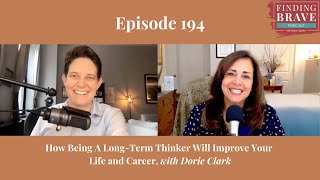
This content was created by Kathy Caprino. This content was uploaded by Kathy Caprino. This is a YouTube video titled "194: How Being A Long-Term Thinker Will Improve Your Life and Career, with Dorie Clark" created on September 23, 2021. It features a conversation between Kathy Caprino and Dorie Clark discussing the importance of long-term thinking in personal and professional development. They explore topics such as building a portfolio career, strategic thinking, and the value of relationships in achieving long-term goals.
Chapters
Hello everyone. Kathy Caprino here and thank you so much for joining me today. I truly hope that you love the show and find it helpful in making the changes you long to. Speaking of that, I'm so excited to open the enrollment of the fall session of my 16 week amazing career Project course today. This session, which starts Oct. 18, teaches mid to high level professional women the 16 most essential steps to building a rewarding, joyful and successful career with the respect and recognition you deserve. Through the four months of the course, you'll get 16 jam packed instructional videos, 16 live group coaching calls with me, 16 tailored homework assignments to move you forward fast, an amazing online support network of members to help you, my hand picked collection of premier resources for additional support, plus great lifetime discounts to my private coaching programs and events, and seven great bonuses including a $500 early bird savings and 75% discount off the foundational level training of my new course, the Most Powerful you Truly, it's a fantastic investment in you and your career and there's nothing to lose and so much to gain. I hope you'll join me this fall. Visit AmazingCareerProject.com for more information. Hello everybody. Welcome to another episode of Finding Brave. I hope you're having a wonderful week. It is September. I hope when this reaches you, I hope it's been a good start of your fall. I sure hope so. And like every episode that I talk about that I have, I am pinching myself to have our guest today, Dori Clark. Dori, I know you're in the middle of a launch of your amazing book and you took time to do this with me. I'm so grateful, so grateful to have you.
Kathy. It's great to be here.
You, you sweet thing. I have so much to say about Dori that I could do all the talking for 30 minutes. But we are. I'm going to try not to do that. As much as I love to talk. But we're talking about Dori's new book which is a total game changer and you have to check it out. And we're going to be focusing on how being a long term thinker, a longer term thinker really improves your life and your career. And we're going to hear all about Dori's new book. But I just, you know, people love to hear how I know of my guests. And I just want to say, did I first meet you, Dori, through Forbes? I know your networking dinner, which I talk about everywhere I go because Dori's a true introvert and a fantastic Networker. So anyone who says I'm an introvert and can't network, you've got to read all of Dorie's work. But where did we first meet? Was it through Forbes when we were both writing for Forbes?
It could have been through Forbes. I honestly don't quite remember. It might have been through Michael Roderick. I feel like I meet half the people I know through him.
He's a real connector. And I sure remember your amazing networking dinner which is just such a special time. So folks, let me read Dori's bio. And you know it's a long one and this is not even half of it, but I. It's important for me to share this because we are also going to talk about having a portfolio career. Dori. Right. Which is something you really believe in and so do I. That we. We shouldn't just look at a job or a series of jobs in this very linear way. Right. And when you look at this bio, which I'm going to read now, you're going to see exactly what. What we mean. Dori Clark is the author of the new book the Long Game how to be a long term thinker in a short term World and is a professor at Duke University. Is it pronounced Fuqua?
Fuqua.
Fuqua School of Business. You've been there a long time I believe. Right?
It's true. I've been teaching there 8ish years.
Oh my gosh. That's incredible. And a Harvard Business Review author. She is ranked number one communication coach in the world by the Marshall Goldsmith coaching lead. This is a long. A long phrase. Leading global coaches awards. Yeah. And named. I'm so excited for you about this. Named one of the top 50 business thinkers in the world by Thinkers50. That was a new award just recently.
Wasn't. Was. Yeah. Thank you.
I'm jealous. You're. I've got a business crush on you. I gotta say. Also it's not over. Dori is also the author of Reinventing you and Standout and another one entrepreneurial you I think three book. This is your fourth book. Which Inc. Stand out. Which Inc. Magazine declared the number one leadership book of 2015. And Forbes named one of the top 10 business books of the year. The New York Times called Dorie an expert at self reinvention and helping others make changes in their lives. But listen to this. Previously Dorie worked as a journalist where she won two New England Press association awards, a presidential campaign spokesperson and a producer of multi of multiple Grammy winning jazz album. You invest in Broadway productions. It just goes on and on. And we have a wonderful entrepreneurial you assessment workbook that you've created. If you want to understand where you stand as an entrepreneur, that's just the tip of the iceberg. So, people, I hope you can see how we can use all of who we really are in our careers. Isn't that right, Doris?
Amen to that, Kathy.
All right, now, let's hop in. You wrote a book on the long game. That's what it's called. What is it? What is it? Why do we need that? Why'd you write the book? Tell us everything about this.
That's all right. We're opening the kimono. We're doing it. So the long game, ultimately, it's a book about our lives and our careers and how we can apply the principles of strategic thinking to hopefully get better outcomes. Because so much in our society is optimized for the short term. I mean, we see it all the time. We see it in news headlines of businesses making horrifying decisions, and we see it looking around on social media and having this pervasive angst that we're not doing it right. And I want us to break out of that because I think we also know, we recognize intellectually that the best things, the most worthwhile things usually do take a while, and they often take longer than we want. But it can be hard to persevere through some of the challenges, the inevitable challenges and rejections and detours. And I wanted to write a book to help people be better equipped to do that so they can actually achieve what they want to achieve.
I don't know why I get choked up when I hear you talk about it, because you know what occurs to me? Tell me what you think. I think even people in our field, there's such a chase going on if we're writing a book, if we're not careful. There's a chase for the best seller status, There's a chase for followers on LinkedIn. There's so much chasing going on. Would you agree? Do you think this time in our lives there's even more. And in society there's even more chasing of things. Do you see that?
There is a lot of chasing. And I think what, what makes it even more ironic, I mean, the metaphor that comes to mind, it's, it's, it's not even chasing that you can necessarily attain. It reminds me of, you know, greyhounds and how they had stuffed rabbits to get the, the greyhounds to run. They are, the greyhounds are totally beautiful. And, you know, course, you don't you don't want to be racing and racing and racing and realize, oh, it's not a real bunny, it's a, it's a stuffed bunny. It's so disappointing. So we want to actually chase after the right things and make sure that we are chasing the right things if, if in fact chasing is the right metaphor. I think a lot of us have just gotten caught up in these hamster wheels that we really have to break out of. And it's my hope that some of the self reflection that we all were forced to go through in Covid hopefully can carry over so we can realize that we actually do have the ability to make different choices. We actually do have the ability to step into something new if we wish to.
I love it. And that leads us to. But before I go there, life portfolio. How do you do it? How do you. Because you're someone who has a large social media following you, you're a prolific writer. How do you do this longer term thinking? Is it, is it a matter of prioritization and fierce honoring of the priorities? What it, what is it and how do you personally do it?
Well, you know, one of the things that, that haunts a lot of us is, you know, fomo and this is, this is the challenge, right? Fear of missing out. I think many F folks would, would like to be committing to a long term vision, but there's, there's often a lot of shiny objects along the way that, you know, oh, oh, but maybe I should be doing that or oh, wait a minute, I haven't tried this thing. Maybe that. And the problem is that we change strategies so often, we often don't even give ourselves a chance for the first strategy to work. So you never actually have real data, you never actually know what would have worked because you haven't played it out. So honestly, what enables me to perform my, my long game agenda is periodically being willing to put on blinders. Because you. One of the themes that I talk about in the long game is the fact that we have to be willing to toggle between heads up mode and heads down mode. And heads up mode is when we're looking for ideas, we're looking for inspiration. Oh, what's the thing? Oh, I got to meet the people. But you can't do that forever. You have to switch at a certain point, just flip the switch and say, you know what? Time for heads down mode. Because that's when you get things done and you have to be willing and able to do both of those things. Otherwise you're either plodding along on a path that stopped being the right path and you don't even know it, or all you are is just swiveling your head around and you're never accomplishing anything.
Oh, my gosh, I love it. And what you remind me of is in my early years in my coaching business, somebody who worked for me said, you know, you're like a hummingbird. You're just everywhere, and you're basically exhausting us. And they were so right. And I think part of that was desperation.
Yeah, maybe this will work.
Maybe this will work. Maybe this will work. And you're right. You know, you have to have patience and you have to have perseverance because, you know, another, I think, problem. Tell me what you think. In this society, this culture, what we tend to see on social media is the final product. You know, your fourth book. You know, we don't see how hard it was to do that, and we want that. But I think that we, most of us, I think, don't understand how long things really take to come into fruition. Would you agree with that?
Yeah, absolutely. And one of my real goals throughout my work has been to try as best I can to peel back the process so that people can understand what things actually look like and what. What it actually takes. Because I think we're all doing ourselves a disservice to have just this kind of shallow societal conversation where everything is either, oh, it's an overnight success, which, of course, you know, on one hand we realize, like, okay, well, it's probably not like that, but. But. But if it's not that, well, we don't know what it is because the story doesn't get talked about or doesn't get told of what it. What it actually looked like. So I really have tried in my books, you know, especially standout and especially the long game, to try to reverse engineer the process so that it's clear. In one sort of example that I have of this is a point that I make in the long game is Jeff Bezos. In his 2018 shareholder letter, he told this crazy story about a friend of his that hired a handstand coach for yoga. And I love this because apparently the handstand coach said that the average person, if you just kind of ask them, what does it take to be able to do a handstand? They will most often guess that it takes about two weeks of practice, and it actually takes six months of daily.
Practice freestanding, not against the wall, to just do a handstand.
Yeah, that's right.
I don't want to try is it is hardcore.
Yeah, no, I'm not even going there. But what I think is so powerful and so interesting is that, you know, people's casual guesses are off not by 10%, not by 20%, but by a factor of 12 by 12x their guess is wrong about what it takes to be successful in that endeavor. If we extrapolate that out to the rest of life. I mean a lot of us are really misinformed and we have to get informed so that we can actually make smart decisions about what, what we want to undertake and what we don't and what sacrifices we're willing to make and which ones we're not.
Oh, I love this. You know what comes to mind? You have a wonderful group and I'm forgetting the name, but several of my course members are in your group about how to be a recognized thought leader. Is that the name of the group?
Yeah, it's the recognized expert community. That's right.
And two things I want to just brag about you about, about. They say, oh my gosh, it is so valuable because we are seeing what is really involved and we're taught, you know what we're. No one else teaches about that. But you know what they also say they're in the group with really illustrious people. But these people are so generous to them, I think to my clients who don't feel that they're illustrious yet in the thought leadership world. Right. But I think what it also shows is even people that are what we consider a hundred steps ahead of us, we're just people. And you know, we've applied these practices, you know. Yes. This is your fourth book. You're multi best selling author in a million other things. But when you meet you, you're a person who's had goals and you've achieved them. You're a lot more than that. You're brilliant, you know, you're an exceptional thinker. But I think when we rub noses with people that have done really amazing things, we realize sometimes we're not that far away. We're just not engaging in life in the same way. Does that make sense?
Yeah, absolutely. I mean one of, one of my big themes, you know, the drum that I, that I like to beat is I, I think that almost anything is possible for almost anyone. I get so irritated around conversations about entrepreneurs born or made, leaders born or made, and it's like, oh my God, so tiresome. Because if you are going to believe that some people are born leaders or not, all that is to me is it's either an excuse or itself aggrandizement. Because if you say, I'm a leader and I was born a leader and you're not, you know, it's. It's like, okay, great. Like, you're. You're the bomb. Congratulations. And if you say, well, people are born leaders and I guess I'm just not a leader, it's like, oh, good, okay, you're justifying your lack of success. Mazel. Now you can just eat bon bons and feel fine about it. Like, that's ridiculous. Of course people can do things. They can do almost whatever they want if they work hard enough for a long enough duration. That's the essence of the long game.
I love the straight talk, people. I love it. Now tell us about life portfolio. How do we build one? Why do we need to. What is it?
Well, I got very into the idea of building a portfolio career around the time I was writing my book Entrepreneurial you. And this was really 2015.
No, what year was that?
It came out in2017. And I really was interested in this mostly as a risk mitigation strategy because sometimes things take a long time to percolate. But in 2001, I was laid off from my job. I was a newspaper reporter. And I was laid off on Monday, September 10, 2001, which is a not great day to lose your job and then be looking for a job. And so, you know, it kind of scars you. You're like, oh, wow, things can change on a dime. And to not have any income, I realized, you know, from. From what I had perceived as a secure job was really terrifying. And so I realized that what we need to do if we really want security, I mean, we know this when we're buying stocks, right? Is you don't just buy one stock. You invest in a portfolio. That's why you buy an index fund or what have you. And similarly, we need to do the same thing in our careers. The way that we're investing the resources we have, we need to do the same thing with how we're bringing in the money in the first place. And so thinking about what are the different pillars that you can create. So I wrote entrepreneurial you as a way of exploring that and just thinking about ways that we can make ourselves more economically resilient. And the good news is, Covid kind of bore it out. I mean, I was not predicting a pandemic, obviously, but I was thinking, all right, if there's a. If there's a recession, if there's a downturn if there's a problem, how can we have different non correlated income streams? And that turned out to be useful.
Now do you, do you deal most. Well, no. You give a lot of talks and a lot of training with corporate organizations, Management consulting, accounting. But you also train entrepreneurs, right? So would you say that exact same statement applies to the corporate professional who's, you know, my, my world is mid to high level professional women. Would you say corporate folks should be doing this too?
100%. Because the more, the, the more you are all in with one thing, the more frankly the more dangerous it becomes. I mean, I hope, I hope it is never a problem. But I mean it's like, it's like living in Florida or Louisiana and being like, oh, I'm sure a hurricane won't bother me, you know, like, I hope it doesn't either. But we have to be aware that these things could happen. And you know, it was bad enough for me being whatever 21, 22 years old and you know, making less than 30 grand a year and losing my job, that was like very traumatic. But tell me how much worse it gets if you're 40, if you're 50, if you're 60 and you're making a six figure income and you have the commitments that go along with that, you know, mortgages and tuition and all the things if, if all your eggs are in that basket, that is a perilous place to be. And so I want for all of your listeners to be able to have, to have other things that they can fall back on. And part of the way we do this of course is, you know, natural things like networking and you know, if you lose your job, you can find another job through people, you know. But I want step further and say that things like creating a side income stream, whether it's through coaching or consulting or speaking or board service or things like that can be extremely important and extremely valuable.
You know, I'm nodding my head, it's falling off, rolling down the, down the floor because that was me at 41, had just moved to a bigger home, two children. My husband at the time, jazz percussionist, you know, I was kind of, I thought of myself as the money bags, not the, I had no creativity, I thought and I get laid off. It was a devastation that I didn't think I could recover from. For exactly all the points you make, what else am I going to do? I hate this, but what am I going to do at 41? My little children, we need the money. It's perilous, it's Absolutely perilous. And, you know, when I think back, so I'd love to hear what you think, but this happened when my kids were little, and I work with a lot of people with young children. And I think if I had heard you say that when I was in this situation, I would say, I can barely function as it is. What kind of side thing can I possibly do? So tell me what you think about that when people are really juggling, especially now with the pandemic and some of the kids are home still. And what would you say to someone who says, I love what you're saying in concept, I don't know how to balance a life that can do that. What would you say to that?
Yeah, well, it's certainly true that the pandemic has overextended almost everybody. And one of the things that I talk about in the long game is the idea of thinking in waves. And what I mean by that is just understanding that there are seasons for different types of activities in our lives and in our professional lives and especially with COVID I mean, I just. I want people to kind of give themselves a little bit of a break. Right. Like, this might not be the time for you to be overextending yourself on discretionary things. I mean, God willing, the kids will eventually go back to school. Right. No one thinks that it is a permanent state of affairs, that everyone in America is becoming a homeschooler. Like, you know, this is. This is going to change. And during this time, even if it has lasted far longer than we wanted or expected, we just have to hold things lightly enough to realize there will be a season when we can overcorrect and when we, you know, that's right. Like right now, maybe it's just over indexed with family or caregiving or different obligations. And, you know, you do what you have to at work, but the extra energy goes there. Eventually, you know, the kids are back in school or they're teenagers and they hate you or whatever, and you'll have plenty of time. And then you can over index on work if you have a long enough timeframe. Again, you're playing the long game. It works out in the end. So we just. We got to stop beating ourselves up, you know, do it, do it as soon as you can, but it doesn't have to be this minute.
Oh, I so love it. You know, it comes to mind, I've had a few women who've just had a baby, literally like two weeks ago, and they're getting coaching because they wanted to start their business at this moment. And I'll say, look, it's up to you, but you just launched something. You just launched a business. It's your child. Give yourself a break. Why. Why don't we reconvene in six months? You know, but. But, you know, women tend to be. We're great multitaskers, but we're tough on ourselves. We feel like it all has to happen and we're falling behind fomo, I think, a little bit. But I think you're right. Timing is everything. There's a good time, and there's a not good time for what you're thinking of. Tell us. You know, I wrote this particular question because you are such a consummate relationship builder and connector. Can you talk about relationships as it pertains to the long game? What do you think about it?
Yeah, well, obviously, relationships are a key part of playing the long game. We all know, we've probably heard some variation of the saying that the only thing that actually changes who you are is the people you've met and the books you've read.
That, oh, that's beautiful.
That's the driving factor. And I. I think it. It's really true in a lot of ways. And so as we're. As we're thinking through that, I think the main theme that I touch upon in the book when it comes to relationships is that in a society that prizes the short term, so often where relationships go wrong, where they kind of die off before they even have a chance to bloom, is when people try to extract something or extract some value from them before it is appropriate. And so one of my cardinal rules that I share in the long game is the idea that you should have no asks for a year. I love that.
Writing that down. I hear people are like, can I do it the next day. Day.
That's right.
Acting with you on LinkedIn. No, literally, yes.
Yeah. We've all gotten so many people. You're exactly right. You meet them at a cocktail party, they send a LinkedIn request, and then literally the next day they're like, oh, hey, Kathy, I see you're connected to so and so. You know, insert super famous person. Can you introduce me? Or like, whatever incredibly uncomfortable thing. And it's. It's terrible because whatever promise that relationship might have held at that point, you're just like, oh, God, this guy. Yeah, love it. Or.
It's so transactional. You know, I, you know, I mentioned you in this LinkedIn Career Network event, networking for job seekers. And I said, listen, people, really, this is the biggest. Do not do, which is when we feel used, you know, that you don't really want to reach out to me. You want to get that connection to Dory. You just use me and it's over. I don't know people, what happened? You know, I say to people, tell me what you think social media behave the way you would in your personal life. But then I'm a little afraid that they're doing that in their personal life too. Do you think?
I mean, I, I think probably like there's, there's just, there's some people giving bad advice. And then additionally, I think there's some people who just, they, they take half the advice and they think they've got the whole picture. Like, you know, one example, of course this is, you know, this is much less bad than people asking for inappropriate favors. But you often see people who I would mark as kind of an amateur networker and they will reach out and they'll be like, can I pick your brain? Or you know, can I buy you a cup of coffee? And it's, I mean it's, it's sweet. It's not like it's a terrible thing, but it's just so obvious that like they read one networking book or they talked to, you know, a college career counselor once and, and then that's been emblazoned in their mind and they have not learned anything new since then. Can I pick your brain is fine. When a 22 year old asks you and you're like, oh, that's sweet, you know, they don't really know any better and they're trying hard and yeah, they've got hustle and it's great. But when you have someone who, you know is, is an adult and they don't understand the kind of political context or the dynamics between things or, you know, you have someone who's asking someone who's, you know, kind of like a celebrity and they literally, if you thought about it for 10 seconds, you'd realize they have a thousand people asking them for coffee every day. This is not something that's going to make you stand out. This is not something that's going to be well received. And they don't ve. They don't know enough to vary their approach based on the context. And, and I find, you know, that to be challenging as well, albeit much, you know, much better in the scheme of things than the person needs, the user.
Something. I don't know. But, you know, I think that in case you're wondering what's wrong with saying, can I pick your Brain. I think it's because. Tell me what you think. But you know, people in your situation and, and let's say people in mine who are hearing from 100 people a week that ask is so much bigger than they think it is that, that literally we, our days are jam packed with so much. So I think that in theory it shouldn't be a negative that someone says, can I pick your brain? But I think sometimes it shows a lack of empathy of the situation the person's in. Do you agree with that?
Yeah, absolutely. And I mean, of course people, people get advice from their friends all the time. That is something we always do for friends. But the issue becomes when it's not really your friend, when it's a stranger, or when it's someone you're approaching cold and you know, again, you might do it if you came to me, Kathy, and you're like, oh my gosh, I really have to ask you a favor, Dory. My niece is graduating from college and she needs blah, blah, blah, blah, blah. Would you be willing to talk with her? And I would be like, of course. I'm glad to do it, Kathy, because. Yeah, that's right.
So sweet.
But you know, it's, it's because it's friends. We're, it's because we're friends. And it's framed in that contextual understanding of, yes, friends do each other favors. But when, when you, you are really only a super casual acquaintance of somebody or you don't really know them at all, it. And oftentimes you're asking them for advice about literally their job that they charge money for. It can begin to be a sort of overstepping.
Oh, you're so right. What a straight shooter you are. I love it. I love it. This is what needs everybody read this book. Tell us one more thing about how we are long term. How we can be a long term thinker that nobody thinks about, that everybody's blowing it. You're seeing everybody that you talk to and you're thinking, oh my gosh, they are such a short term. What else do we need to be aware of?
Oh boy. Well, one area where I think this, this probably goes to the point, Cathy, that you were making earlier about many of your listeners just having these overstuffed days, these overstuffed calendars, and wondering how am I going to fit anything else in the entire first section? The first few chapters of the Long Game is about creating more white space because I, I'm a big believer. It's not that it takes huge amounts of time to be a strategic thinker, right? I mean, it's not like, oh, that's all you can do for months on end. Like, we understand you got other things, but it's also true that you can't do it with no time. You can't be a long term thinker if all you are doing is just getting through the moment. And I want to try to help people clear that out so that they actually have enough space and enough bandwidth to be asking the right questions.
I love it. You know, it's funny, I read all sorts of, you know, how do we save time just because one, I'm going to feature them and also I want to. And one thing I do that I get all defensive about is I feel like sometimes the things that come in, the email, the text, if I fire it off that minute, all right, let me respond to that. I'm fast and I get more done. Bs, really. It's a little bit of that hummingbird thing that. Because here I am writing an article and then I'm off responding to. So I think some of this requires. It's the commitment, the rigor to stay put with what you're focused on. Because if you go away over here, it disrupts in so many ways when you come back. Is that part of the thing that we're flitting around, answering texts, looking at Instagram, we're doing all of that, when in fact it requires a commitment to have white space or focus on the darn thing you're supposed to focus on. Am I making sense?
Certainly a lot of flitting that is not wrong, Kathy. I think it's true, true that it's about focus in the moment. And I think also it's about even perhaps more to the case, it's focus over a duration of time. Because one of the big mantras that I have is a saying that I think bears repeating, which is that we overestimate what we can get done in a day, but we underestimate what we can get done in a year or certainly in 10 years. And small things accrue. They build up, they compound. And recognizing that means that even if you are overwhelmed, even if you can't get very much done about whatever, creating a side project or whatever you're trying to do, literally these small, tiny things that feel very inconsequential if you keep doing them add up. And there's a huge difference. Again, going back to an investing metaphor, you've all seen these preposterous eye pocketing numbers about the difference between starting to invest when you're 20 versus when you're 40 or starting to invest when you're 40 versus when you're 60. And it's because of compounding and similarly, in our actions and in our lives, it's the same principle. It's not that you have to do a ton. We know you don't have a ton of time, but you do need to do something. And if you keep doing something small on a regular basis, you actually can get really dramatic results over time.
Oh, my gosh, I love it. Do you have to scoot off? Can I ask you one more question?
Of course, of course.
This is a personal thing I want to understand, but I think anyone who wants to be a recognized expert wants to know this. Dori, you have a way of breaking down things. You've got sticky language, first of all, you know your framework stick, but you also have this way of thinking and breaking down things that help us process through change. Where do you think that comes from? Were you always like that? How are you so good at it? Give us some tips.
Oh, well, that's. That's very kind, Kathy. Thank you.
Good at it.
I would say, in part, it is just kind of how my mind works. But I would say that what has enabled me to hone that skill actually, was my time as a journalist. Because specifically what my job was, the job of almost any journalist, is you do an interview, you know, you ask all your questions, and then you have this text, you have this huge block of, you know, you know, Microsoft word document. It's 10 pages long, and it's your transcript, and it's all of these undifferentiated ideas going in a million directions. And then your job is to put it in order and to somehow have a thesis and somehow have it make sense. And so doing that over and over again as a journalist and saying, what is the central idea and what is the correct order to frame it so it will make sense to people. Doing that process over and over again helped exacerbate, I guess you could say, my tendency to think in that way.
It's so important and so helpful. And finally, talking about portfolio careers, you and I were laughing. I was an English major. And people are like, what are you going to do with that? What am I going to do with that? It's everything, right? And you got a master's in. Tell me again. Theological.
Theological studies. Yes.
And people are, what are you going to do with that? Can you just tell us? And then I'm going to let you go. How do you Think that's helped you in the work you do today? Today?
Yeah. Well, people, people used to say, you know, what are you going to do with that? And I would say become divine.
And you are.
Yeah, you are.
But is there a little more practical thing?
But yes, besides that, I, you know, it took me a long time to find a kind of connective strand or to sort of figure. Figure it out. But I actually, what I came to realize is that there, I think there is a piece of connective tissue, which is that part of why I was interested in religion is that fundamentally it is about meaning making. It's about the sense that people make of their lives and how they understand their place in the universe. And in contemporary American society, I would say in general, probably contemporary Western society, the same thing is true for work. Our careers are that locus of meaning. And so understanding how you can do that more effectively, how you can be better and more self actualized in your professional life in a lot of ways is actually answering some of the same questions. So I do see a commonality there.
And it's to end this. You know, you were, I think, kidding a little bit about the divine piece. But what is divine? In my mind it's that in some way we're immortal. In some way we're uplifting others. In some way we're making an impact that lasts after this. And everything you're doing is that if you ask me.
Thank you.
Where do people scoop up your book? Where do we learn more? Where, where do we take your group training, your courses? Where do we go? Dory.
Oh my goodness. Thank you so much, Kathy. Well, the new, the new book again is the Long Game how to be a Long Term Thinker in a Short Term World. And it is available at Amazon and Barnes and Noble and all the book.
Places number one bestseller at this point. I have a feeling when they see this.
Fingers crossed. Absolutely. And for anyone who's interested in the ideas behind this and they want to dive a little more deeply into strategic thinking, I have a free long game strategic thinking self assessment that folks can download and they can get it@doryclark.com TheLongAmen.
Is it available now? I'm going to. Let me get.
It is available this minute. Yes.
Oh, Dorie, I always love being with you. You're so insp. Thank you for everything you give us. Honestly, we're so grateful, Kathy.
Thank you. It's a treat to get to talk with you.
Love it. People hop on. Everything hop on reading this book. It's going to change you and it's going to also let you breathe and relax into your life and relish it and not be chasing so much. I know it's going to make a difference. I hope you're inspired, everyone. Thanks again, Dori, and have a wonderful week and we will see you next week.
Time.
Thanks so much for joining us today. And please don't forget to check out finding brave.org for more programs, resources and tips. And tune in next time for your weekly dose of Finding Brave.
More from Kathy


Elevate Yourself, Elevate Others, and Amplify Good | Chris Cooper | Finding Brave Ep. 334

Finding Brave Epis #333: How Leaders Can Harness AI Without Losing Their Humanity, w/Bennett Borden

Finding Brave Epis 332- How to Stay Brave, Valuable and Visible in the Age of AI, with Raman Rai

Finding Brave Epis 331 - The Power of Positive Disruption, with Dr. Patrick Leddin


Finding Brave Epis 330 - Being 40: Letting Go and Embracing Who You Are, with Stacey Lindsay

Disrupt Career Reinvention with Kathy Caprino - via The Disruption Lab Podcast w/Patrick Leddin

Creating Neurodiversity-Friendly Work Cultures: Simple Workplace Adjustments Matter

Finding Brave Epis 329 - How To Create a Neurodiversity-Friendly Workplace, with Kristen Pressner

Finding Brave Epis. 328: Reclaiming the Power to Trust Your Own Voice, with Dr. Cindy McGovern