195: How to Forgive Someone When You Feel You Can't, with Dr. Fred Luskin
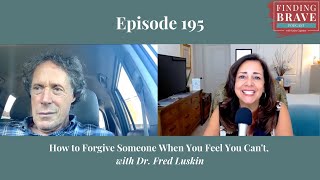
Dr. Fred Luskin talks with Kathy Caprino about forgiving people when it feels impossible. He shares practical strategies for moving past hurt and anger, drawing on personal stories and research about how forgiveness actually changes what happens in your body and mind.
Chapters
Hello everyone. Kathy Caprino here and thank you so much for joining me today. I truly hope that you love the show and find it helpful in making the changes you long to. Speaking of that, I'm so excited to open the enrollment of the fall session of my 16 week amazing career Project course today. This session, which starts October 18, teaches mid to high level professional women the 16 most essential essential steps to building a rewarding, joyful and successful career with the respect and recognition you deserve. Through the four months of the course, you'll get 16 jam packed instructional videos, 16 live group coaching calls with me, 16 tailored homework assignments to move you forward fast, an amazing online support network of members to help you, my hand picked collection of premier resources for additional support, plus great lifetime discounts to my private coaching programs and events, and seven great bonuses including a $500 early bird savings and 75% discount off the foundational level training of my new course, the Most Powerful You Truly, it's a fantastic investment in you and your career and there's nothing to lose and so much to gain. I hope you'll join me this fall. Visit AmazingCareerProject.com for more information. Hello everybody, Kathy Caprino here and welcome to another amazing episode of Finding Brave People. I say this every time. I know you hear this, but I was just telling Our amazing guest Dr. Fred Luskin what I love about this podcast. It's almost like I'm getting a master's degree in everything because I get to talk to people who are making such a difference in people's lives, making such an impact and also loving it. I think what I love most is you can tell how inspired they are by their own work and what they're learning from others. And Fred is no different here. And what we are talking about today to me is one of the most important topics we can cover. And here's the title why that I've come up with. Fred, you'll tell me if it's okay. Why forgiving others transforms your life and leadership and how to do it, how to forgive. And I want to talk about this because, you know, I work with thousands of people and every day I hear people say I've been betrayed, I've been shamed, I've been humiliated. I can say it without crying. I've been humiliated. I've been backstabbed. And I was just telling Fred, in some ways I think women, and men too feel like bloodied, wounded soldiers on the battlefield. There's a lot to forgive. But I don't think we are taught how, frankly. So that's why we're here with Fred. And let me tell you, let me read his bio so you know how amazingly illustrious he is. And he's calling from San Francisco in his car. He's, he's slipping this in amongst some amazing things that he's doing. But here is all about Fred. And I want you to know I met Fred through one of my dearest friends, Carolyn Crinsley McCully. And you know, full disclosure, you are the brother in law of Carolyn and I devoured your book Forgive for Good. And we talked over, I think it was two Christmases ago, Fred and I still remember that conversation. It was altering, I would say. All right, people. Dr. Fred Luskin is the director of the Stanford University Forgiveness Projects, a senior consultant in wellness and health promotion at Stanford University, and a professor at the Institute for Transpersonal Psychology, as well as an affiliate faculty member for the Greater Good SC Science Center. He serves as the department chair of the PsyD program at Sophia University and is the author of the best selling titles Forgive for Good and Forgive for Love. His research interests are in stress management, emotional intelligence, positive psychology, forgiveness and wellness. Thank you for being here, Fred, for making time. Now, I know we're going to have a hard time just not going on for hours because we love to talk, but where I'd love to begin is if you could give us a conceptualization of what forgiveness is and why it benefits us to forgive. So many people say to me, no, I don't want to forgive him or her or, you know, my ex or my boss because that's letting them off the hook. So can you first tell us what is forgiveness?
So when you were saying the way other people hold it, your face was contorted, you had a little bit of a harsh energy towards you, your eyes were narrowed. No, I won't forgive them. And even just mimicking other people, you were showing stress and kind of muscular tension. And so when that gets practiced a lot, that's destructive to our well being. So even if you didn't have anybody to forgive, if you practice sounding like that, you'd hurt yourself.
Oh my goodness.
So what? Forgiveness is letting that go, letting go of that perspective that makes you be tense and hostile and not accepting of your own life. Like imagine, I mean, from a, let's say a more objective perspective, how strange it is for somebody to walk around complaining about their one life.
Okay, questions, questions, questions. I was thinking about this as I was making coffee before our talk, I think, and you know, you've lived this for a lot of years. So you're going to educate me. But when I think about the things that I've had a hard time forgiving and what I hear from clients, it seems to me that what is so hard to forgive is when you're shamed or betrayed or people behave in ways that are so crushing to you, in some way, it attacks your core, or we let it attack our core identity, our core value. So if my face is contorted, I. I think if when we have this response, it's really because what you have done to me, this as I perceive it, I can't even live with because you've reduced my sense of value, my sense of worth, my sense of self, love. Am I right? Is that how people internalize it?
Some people.
Oh, tell us more. I mean, how do other people.
So you could. You could look at that suffering that you're imposing on yourself, or you're imposing on yourself, imagining how somebody else might feel. And you could have compassion for your human predicament about being stuck in a response that isn't helpful to you, that is not nourishing.
But there's something that people. There's some benefit and reward to having that response, isn't there? I mean, not spiritually, but why do we get caught in that loop? Because for a minute we feel good being furious?
No, I mean, when we've been hurt, a deep hurt, our entire. Often our entire worldview has to adapt to a new reality. So let's say, you know, we're keeping it with a client. Let's say some woman comes to you and said she came home and she found hubby with a younger model. And so she's all angry and hurt and scared because she can't compete with a younger model, at least in certain ways.
And also, how dare he do it? And there was trust, and we weren't supposed to hurt each other. And how did you break your vat? You know, it's a lot. Yeah.
And that. That's all to protect her as her nervous system and understanding readjust to a new reality. Like, that's its purpose. That the. The marriage that she thought she had, she found out that her perception was inaccurate. Wow. And it's very destabilizing and scary to find out that perceptions and expectations that we have are wrong. And so it takes time to adjust to that. That you might refer to that as grief. So part of grief is anger. Part of grief is fear. Part of grief is sadness. Part of grief is, you know, it didn't happen those Are all parts of grief. Those are a healthy, short term adaptation to a changed reality, that her brain and nervous system are working so that she can then be in her new reality, which is, oh, wait a second. My husband didn't see marriage the way I did, or my picture of the marriage was wrong. Like I thought we were happy, we weren't. The whole purpose is to come to acceptance of reality like that. That's the purpose. But many of us refuse to do that.
All right, let me ask this, because I'm having a reaction. So if I'm having a reaction, so are listeners. You know what I think of sexual harassment, which I faced for two years. When you talk about that and you are a deeply spiritual person and I'd love to say so am I. But I think I have my moments and I have my other moments where, whoops, what happened?
I think that way. I feel exactly that way.
Like, wow, okay, then we have a little work to do. But if I think back 20 years and there was sexual harassment, I'm following you. That for two years I had it. And, and when I was let go of this organization after 9, 11, and so we're 100 people, a lot of things came out in me because I finally was free of it. But it was rage. Like, I can't swear here, but rage that I went through that. Now, if I follow what you're saying, it's a spiritual approach to say, huh? And I'm not trying to belittle this, Fred. This is just my response. Wow, I have a change in reality here. I'm not safe at work. Isn't that an interesting reality that there are predatory men that do this? But I feel like anger and rage is called for. And if we just distance ourselves to have kind of this neutral response like, oh, wow, interesting. It's not safe. I feel like in some way we're eclipsing our true. Right. Human emotions. You follow what I'm saying here?
Yeah. And I would feel sad if that was really the only response that you had available to that truth.
What, what, what was the only response?
Rage.
You'd be sad about that.
Yeah. Because it shows how limited your repertoire of behaviors is.
So what? Okay. And it, like the stages of grief, you know, there's stages. First of all, you're going to have rage, then you're going to have. You know, I've been through all of these stages, I think. And then I thought, how did I co. Create it or sustain it? Why?
Let me, let me reframe it. Let's say Take this situation that you are, like, sexually harassed at work. Let's just say that. And it's a frightening experience because you're not safe. And there's probably a lot of dishonesty there about what happened. So again, you're not safe. And part of that is simply revealing to you what was already there that you didn't see or that you didn't think would happen to you. There was sexual harassment before it happened to you. Right. So what experience you had is it opened you to a truth that you hadn't prepared yourself to adequately handle. So what. What the rage does is it gives you some time and space to inhabit the injury. But if you stay in rage, then you're extremely ineffective in life, and you burn out your cardiovascular system, and then you become dangerous to other people. So it's not that good a strategy. And. But if you use the rage as a protective shell so that inside of it, you try to create safety that did not exist at that workspace, and then you become a little more safe in you, then you come back out to the new world where you recognize that there is sexual harassment. But I better have much more strength and ingenuity for how to deal with it than just rage, or ain't gonna have much of a happy life.
I get it. So let's go back to giving people a definition of forgiveness so we can take that case. You know, have I forgiven that guy? I don't even think of him. He doesn't occupy a second. Well, I guess he occupies a second of my thought, because I've written about it and I talk about it, but I don't harbor. I'm done with it. I'm so done. And I see how I stayed too long in that job, and I. And I see that I didn't do what I needed to. And I want to talk about how not taking something personally. The tip in your book, which I want to talk about in half a second, that I got out of it. But how would you define forgiveness then in this case? Is it moving beyond. I don't even want to. I don't even want to try to define it. How would you define it?
Well, you forgive the people for being their unattractive selves, and you forgive yourself for not having the best skills to handle it. Then that's when you're forgiving.
You're forgiving them for, you know, whatever it is, inhumane behavior, unfair, unkind, unjust, cruel, but you're forgiving yourself. What about children who don't have any wherewithal to change their situation, whatever it is.
None of this is new, and so it's a no. But it's a constant challenge to deal with life without crippling ourselves by our reactions to it. It's a constant challenge.
Talk about not taking it personally. Fred, honest to goodness, I read your passage and I read it again, and I read it again, and can I just tell you what I got from it and you tell me if I got it right?
Well, you have to understand that it's. You only tell somebody not to take it personally if they're taking it too personally. So it's not that you don't take something personally. You create a balance between personal and impersonal. That's the goal. So if you take something too personally, you get enraged and you become a nasty, like, vengeful person. If you take something too impersonally, then you go like the way you said, it's just my karma, man. I'm not going to do anything about it. Neither of those is effective. They're both ineffective. They're both, like, pretty limited as human responses. What you want to have is both. You want to have your own storyline and your own suffering to learn from and adapt from. And you also want to recognize that you're part of a human experience where suffering and difficulty are common. So you cultivate compassion for more than just your own little drama. That's what not taking it personally is about. It's like if you, if you didn't just see your sexual harassment, but at that time, maybe you empathize with Monica Lewinsky, you know, who was being sexually harassed at work or, you know what I'm saying, Like, there's thousands and thousands of women who are every day being, like, denigrated at work. It's not so much just anger. It's a deep well of sympathy and compassion and. But that keeps your brain open to find solutions, not just punish. And it's a very different experience.
Oh, my gosh, you know, I must have passed over that because you know what, what literally jumped out the page about not taking it personally. Too personally. I believe you. Tell me if I'm not right. You said, ask yourself this question. Would that individual do what he or she did to you, to anyone else? If the answer is yes, why are you taking it so personally? I thought that was. I have taught that a hundred times. And let me just say why I think that's so powerful at work or at home, people are doing things to us that, you know, the full range of emotions, responses we have, we're enraged, we're hurt, we're. But at work, let's say you have been humiliated by a narcissist in the room in front of 20 people. So this is what my clients bring. You know, I had one client in Spain, she was a beautiful communicator. Her boss, she ran a whole big meeting, it was fantastic. The boss called her in, he said, you're a terrible communicator. No, she just didn't communicate like him. And this can happen. This is not just a gender thing. I want you to know it can happen any which way. But when you have that, you take it so personally. And really part of what you're responding from is I'm deeply ashamed and I feel less than and I'm not worthy and this has wracked my confidence. But when I share your point, would your boss do that to someone else? Yeah, does it all the time.
Right.
Then why are you internalizing shame from that? It's. He's an equal opportunity offender, as are.
Most people who are not such nice people.
Right. Did I get that right? Then, then, you know, is that the point of.
That's one of the points. I mean, that's another point about not.
Taking things personally and moving on.
When, when you, when you over personalize something, you create a very powerful adrenalized response that amplifies your fear. And so you either, you know, you're either in fight or flight, but you're not able to think. And the less you're able to think, the more helpless you feel like you want. We all need, you know that we all need to know that there's something inside of us that can still reflect, that can still self soothe, even if the world is not the way we want it to be. Like, so you can have an abusive boss. And I'm not, I'm not defending abusive bosses, but you don't want to give them all the power so that you don't have a capacity to go inside and say, that's an abusive boss. That's his thing. It's not okay by me, but it's not totally about me.
You. You remind me. I just read the book Untangling the mind. Ted George, Dr. Ted George, he's at the National Institute of Health and it's all about brain science and how we react the way we do. And what you're saying reminds me the amygdala, that part of our brain is always looking at the threat and the cerebral cortex is what mitigates that. That's thought and Right. And we can. Most of us can engage that cortex to do what you're thinking. You know, what you're suggesting here, that if we're only from this deep sense of threat, if we're never out of that, in terms of our response, we're gonna. It's a mess. I mean, we're gonna have a limited response. Yeah.
When you're taking it too personally, you tighten your body and you stop breathing, It's a threat.
It's like the tiger's coming out of the cave. Right.
So you don't have to do, like, deeply involved things. Sometimes you just relax and take a breath. But if you practice relaxing and taking a breath, you stop taking it so personally. Really?
Tell us some other. Because that. That really. That's like a shortcut to forgiveness, it seems. What else can we do, Fred? Most people aren't taught how to forgive. Most people, they have to go to a therapist, and maybe therapists, a lot of therapists don't know how to forgive. Teach us that. Teach us some things. What are those ways? So you're saying deep breathe, you know, take a breath. Right. What else?
Relax, relax. Like, don't talk tightened up. But probably the biggest and easiest pathway for healthy folks is to be more grateful. Because if you surround, and none of this means, like, you just give people a pass for being, let's say, abusive or harshly sexist or whatever, but if you surround that with insulation a little bit, like, yeah, they did this to me, and it's awful. And I'm coming home, and I have a home with running water and food in the refrigerator and somebody who cares for me and my kids are safe, and I have public. You know, I have transportation and my brain still works. Then you hold the wound in an appropriate size.
Can I tell you, I'm just giving you a practical thing, people. We just had to put our beloved dog down. Lily. You met Lily. I think Lily might have been at Carolyn's at 16 years. I love. We love this animal more than. Oh, and there was so much grief, like. Oh. And so that was last Monday. And over the weekend, I binge watched movies, and one of them was Dances with Wolves. I know this is absurd, people, but I'm giving you something here. And I have such an affinity for Native Americans. I think I perhaps was Native American in another life. And it's a beautiful story of Watch it, people. But I started weeping over the decimation of the Native American people. I mean, weeping. And obviously, I'm not just weeping about that. I'm weeping about loss and grief. Reef and Lily and. But I have to say, I hope this doesn't sound ridiculous, but it's what you're talking about. It put it in perspective for me that so many people have lost so much.
Exactly.
And we. We. And I felt like at one with the people in the movie who'd lost so much.
That's it.
But there was compassion and there was empathy, but it. I have to say, it reduced my grief over. Over Lily.
Yeah.
Does that make sense?
Of course it makes sense. And that's. That's when you free yourself of some of the prison, of just taking yourself so seriously. And so separately, you. You develop a little more compassion and empathy. And that also can be used to soothe your own hurts. But gratitude does it from the other side, which is, life has given me so much. I can handle the things that life threw me that weren't so nice.
How beautiful. It's a spiritual approach. It's just. It's, you know, and I don't mean religious people, and I know Fred doesn't. I think we are so much more than this human existence. And what you're saying to me is, how I frame it is we're tapping into kind of a higher self that sees things a little differently.
Exactly.
Is that right now you choose.
We choose what self we tap into. It's not. You know, it's not. It's not an accident. It's not random.
But sometimes, like, you know how we said, sometimes we're not that spiritual self. We wanted to be like, there's a lower self. And I call it like a toad will come out of my mouth. Like. And often the toads are hopping around in here. I'm like, wow, you are jealous of this person. Sit down and breathe. What are you jealous of? You know, you can feel the toads. You can feel them. So it's not always a choice. It's. It's sometimes automatic. But the choice can be, ooh, that feels out of alignment.
But what would happen, say you look at the sexual, you know, abusive situation, and you look at it from the place of two years after that, at that moment, you can bring a lot of compassion and a lot of gratitude and a lot of forgiveness. And you may not be able to bring that two weeks after it happened.
And are we having compassion for the perpetrator?
For just compassion? It's not for. It's. It's in us. It's. I have compassion for us humans. I have compassion for what we do to each other. I have compassion for how easily triggered. I Am. I have compassion for how stuck I can get. I mean, there's just so much compassion.
And I have compassion for other people who've been through this, who feel as lost as I did.
So that. That relaxes that body. It helps you breathe differently. And then you don't want to tell a story just about how bad that person was. It doesn't feel right anymore.
You're right. I've had that with family members. I keep telling the same darn story. And every once in a while, a wonderfully wise other family member will say, you've said you've told that story a lot, and I'll listen to it a lot. But I'm sad that you're still there. You're still telling that story.
And I'm going to say two things that. Because I know we're running out of time, two things. One is our simplest definition of forgiveness is making peace with the word no. That what you're making peace with is life didn't give you what you wanted. And that's what. That's what the process of making peace is, forgiveness. Like, it's perfectly okay to be angry. It's perfectly helpful to become bitter and protective and even depressed a bit, because we're overwhelmed. We can't. We can't take in all this information. It's too hard. So that's. That's why we protect ourselves with these emotions and these experiences. Forgiveness is letting go of those protective emotions so we can just be with our life. I mean, we don't have to hide behind bitterness or resentments. It's just my life. But the last piece that I will say is forgiveness is the simplest thing. It's just changing your story. Like, you don't have to talk about yourself as a victim anymore. That's the takeaway. Like, you can say that. You know, I had this difficult experience 20 years ago, and it was really hard on me then, but I learned. And that's it, Fred.
That's all too beautiful. You know, I want to just close that loop and then ask where we can learn about you. But I was saying earlier, honest to goodness, when something bad happens to me, something painful, something horrible, horrible, I honestly now say, holy cow, that wasn't what I expected. And maybe I don't do it that day. Maybe it's two weeks. But I then say, what could this make possible? That in five years, I look back and say, that was the best thing that could have happened to me, even though my human self rejected it. And honestly, whether it's true or not, it helps me because I'm beginning to look at the silver lining. Okay, where's the silver lining here? I mean, I did it with the pandemic. I think there are silver linings. There are, right? What do you think?
Yeah. And that practice helps you get a wider perspective.
That's the thing that it gives me a mindset of growth instead of all of the other. I know you've got to go. You've got a client. You got your teaching somewhere. Where do people learn about you, Fred? Where do we send them? We're going to have the link in our show notes. Read your book Forgive for Good, and you can get that anywhere.
The other thing that I tell people, anybody, you just Google my name and there's probably a hundred YouTube videos on me teaching that. That's usually enough for people.
Great. We'll link to a few of those. Look at Fred. He's like, oh, just find me. You're really. You're an exceptional individual, Fred. We're. The world is so lucky to have you.
Thank you, Kathy. I hope we bump into each other again sometime.
I hope so. And let's get together when you're in Connecticut. Thank you, people. We hope you're inspired. We'd love to hear what do you need to forgive? And is this helping you? And read Fred's book, Forgive for Good. It'll change you for good. All right, everybody. Thanks again, Fred. Thank you, people. See you next time. Thanks so much for joining us today. And please don't forget to check out findingbrave.org for more programs, resources, and tips. And tune in next time for your weekly dose of finding Brave.
More from Kathy


Elevate Yourself, Elevate Others, and Amplify Good | Chris Cooper | Finding Brave Ep. 334

Finding Brave Epis #333: How Leaders Can Harness AI Without Losing Their Humanity, w/Bennett Borden

Finding Brave Epis 332- How to Stay Brave, Valuable and Visible in the Age of AI, with Raman Rai

Finding Brave Epis 331 - The Power of Positive Disruption, with Dr. Patrick Leddin


Finding Brave Epis 330 - Being 40: Letting Go and Embracing Who You Are, with Stacey Lindsay

Disrupt Career Reinvention with Kathy Caprino - via The Disruption Lab Podcast w/Patrick Leddin

Creating Neurodiversity-Friendly Work Cultures: Simple Workplace Adjustments Matter

Finding Brave Epis 329 - How To Create a Neurodiversity-Friendly Workplace, with Kristen Pressner

Finding Brave Epis. 328: Reclaiming the Power to Trust Your Own Voice, with Dr. Cindy McGovern