196: How to Sell With Love (and Love Doing It), with Jason Marc Campbell
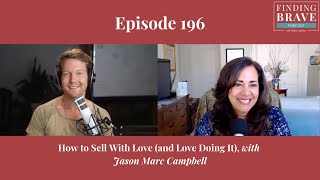
A Finding Brave podcast episode (Oct 2021) in which Kathy Caprino interviews Jason Marc Campbell about his book Selling with Love and a framework he calls the "Five Loves of Selling." They discuss how to reframe sales as ethical, impact-driven work — covering loving the impact, loving the client, loving the product, loving the process, and self-love — plus practical advice on pricing, following up, packaging services, and avoiding misleading tactics. The episode includes host promotions (Kathy's 16-week course starting Oct 18) and calls-to-action for Jason's forthcoming book (release in January) and his contact channels.
Chapters
Hello everyone. Kathy Caprino here and thank you so much for joining me today. I truly hope that you love the show and find it helpful in making the changes you long to. Speaking of that, I'm so excited to open the enrollment of the fall session of my 16 week amazing career Project course today. This session, which starts October 18, teaches mid to high level professional women the 16 most essential essential steps to building a rewarding, joyful and successful career with the respect and recognition you deserve. Through the four months of the course, you'll get 16 jam packed instructional videos, 16 live group coaching calls with me, 16 tailored homework assignments to move you forward fast, an amazing online support network of members to help you, my hand picked collection of premier resources for additional support, plus great lifetime discounts to my private coaching programs and events and seven great bonuses including a $500 early bird savings and 75% discount off the foundational level training of my new course, the Most Powerful youl Truly. It's a fantastic investment in you and your career and there's nothing to lose and so much to gain. I hope you'll join me this fall. Visit AmazingCareerProject.com for more information. Hello everybody. Welcome to another episode of Finding Brave. So happy you're here and I am so excited to talk about today's topic. You know you hear me say this probably every week, but I run this as if I'm in a class with my guest because my guest has so much to teach us. You, the listeners, me, and today is absolutely no exception. And we are so thrilled to have Jason Mark Campbell with us today. Jason, thank you for coming from Bali late at night to join us. I'm so grateful to have you here.
Well, with the beauty of technology I didn't need to leave my house. But yes, I am calling in from Bali and it is later in the evening. But I would want to make sure everybody listening to be assured that that does not mean I'm low on energy and I still have a lot to share. So I'm excited to be here when.
You we know that we're going to everyone's going to see that and hear it. Thank you. So we are talking about how to sell with love and I've added in how to love doing it. So you know, it's two ways. I think it's such a two way street. It's, you know, we're giving with love but we're also loving it. So I know I was just talking to Jason before. I've come a long way with sales in the beginning. It was what mo, I think what you're going to talk about, what most people say struggle with it feels icky. I remember doing webinars and they were free. But in the end I would be pitching something and I would be so uncomfortable doing that pitch now, and it would be long. And now I've changed the whole thing. But what we want to learn here is what are we resisting? Why is this so difficult? I think women too have perhaps even more of a difficulty with it, and Jason is going to teach us all about that. But let me tell you all about Jason first. Jason, Mark Campbell is the author of the upcoming book Selling with Love, comes out in January. Just I think people are hearing this in October, so it's just coming soon. He interviews thought leaders from around the world on topics of leadership, team building, communication, productivity, and so much more. He is a public speaker who shared the stage with the likes of Gary V, Jason Silva, Vishen Lakhiani, Lisa Nichols, and more. Jason is also the host of the fantastic podcast the Superhumans at Work from Mindvalley. But it's actually your content, Jason. Right? And I've had the great pleasure of joining you and it was such a ball and being on your Instagram Live, which was my first being interviewed, that was amazing. And Jason's mission is all about teaching companies to care more. As businesses have so much power in our world, if we can educate businesses to take on more responsibility in how they sell, market, how they treat the employees, and even how they invest their money, we start shifting the planet immediately for the better.
Woo.
No small mission there, but let's dive in. Jason, can you start with why you are so passionate about sales? How did you hone in on that niche? I'd love to hear. We'd all love to hear.
It's funny because you did add that second part, which I think is important, is about how to love the process of selling as well how to be excited about selling. And you know, I had this weird moment when I was in workplaces and I would notice myself always being enthusiastic about selling. And people would just be like, wow, like, we've never seen someone be excited about selling. And it seemed to have come naturally to me. And to be honest, it wasn't natural. Instead, it was maybe some of the benefits of some stories that happened in my childhood that actually reinforced the power of sales as opposed to create a fear or an aversion or a shame or a guilt around sales. So in my personal story, here's how it worked. I was in my early Teens and in my school, we had to do the sale of chocolates. It was like a charity drive to sell these chocolate covered almonds, the world's finest. I don't know if it was the world's finest, but that's how they branded it. And I just remember going through the first door, I knocked at my neighbors, shy, chubby kid at the time, and I'm just like, hi, would you like to buy some chocolate? And we weren't concerned about the sugar content back then. We were just innocently selling some delicious chocolate. So the person opens the door, they're like, oh, wow, this is great. Yeah, I'll give you a toonie, which is what we call in Canada a $2 coin. You're from Canada? I am from Canada.
I always wondered. Okay, thank you. Go ahead.
There you go. So for the fellow Canadian listeners, they'll know what a toonie is for Americans. $2. So some, the chocolate. And then they're so happy and I'm like, wow, that was fun. I went, I was a little afraid, but I knocked at a neighbor's door, they opened the door, they were smiling. I offered them a product. They, they said that's a need that they wanted. They gave me money in exchange. And there I was closer to a goal of being the record setter for the school of selling chocolate. So I repeated this a few times. And you know, the funny part of the story is by the fifth house, I end up knocking at the door. And the lady who opens the door says, well, let me, let me ask my daughter. And her daughter came down, ends up being the same age as me. And how old were you? I was 16 years, 15 years old at the time. And so ended up exchanging numbers. Ended up being one of my first girlfriends. And so you can see that for me, the association around sales was like, sales is a great thing, right? But it's a bit of a cheeky story because, you know, for most of us when we think of sales, there's caricatures that come into mind and there's impressions that we had in our growing up times from the media, from relationship with authority figures, that sales has been considered something that's really yucky, really bad. And you know, the most of people's first interaction with sales might be actually not through the process of selling, but rather through the process of buying. And one of the most emotional purchases we do while growing up might be buying our first car.
Yeah, that's what came to mind.
Could be a ticket to freedom. And if you're buying your first car and ends up being a used car, because obviously we're under a budget. You're not dealing with some of the best sophisticated salespeople. So the used car salesman is such a powerful caricature of a negative sales experience, and a lot of people can relate to it, whether it's themselves or someone they know. And so now already, from the beginning, you think, wow, if I become a salesperson, I'm going to be just like that used car salesman I might have had a bad experience with. And so I see that there's a lot of blocks that starts from there where, you know, forget even loving sales. Most people here despise it, disgust it, find it yucky, and want noise association with it. And I don't know if that's something that relates to you, Kathy.
Well, I got to ask you this because I'm already floored. You know, my kids, excuse me, are 20. What are they, 24 and 27. And they sold things, you know, Girl Scout cookies. And I think they were younger. And I think when a young, young person comes to your door, I'm not sure they even did door to door, but when a little person comes, you're typically kind. But, Jason, these days, I don't think everybody is very kind to the young person that comes to the door selling. So I just have to ask you, you didn't have one snarky response in the beginning. I mean, when you did that, nobody, nobody was like, I don't know. Thanks, dear.
Well, this might be a Canadian thing, Right. I was from a small village in Canada, so maybe again, things that just stacked in reinforcing a positive experience in my early childhood. Right. Because I would think if you're more in an urban area, then they get harassed. Nobody wants any solicitation, even if you're a child. Right. But again, if that was your experience in the Girl Scouts, Boy Scouts, again, you're thinking sales is awful. The person slammed their door in my face. They hated me. I don't want to be hated. But even before that, you know, I've also noticed a pattern. I was talking with Shelly Lefkoe, who's the partner of the late Morty Lefkoe, the Lefkoe Institute. And they, they do a lot of training when it comes to behaviors that we imprint on ourselves when we're children. And then we carry on, you know, you know, these traumatic experiences in our adulthood. And here was one thing we discussed, because I was like, why does people have hesitancy around sales? And think about this, Kathy, if ever you've wanted something when you were a child or if you've seen your children ask for something when they were little and they'd say like, mom, mom, can I please get this? And you said that it was daughters you have or sons?
Both. One of each.
One of each. So I'm going to use the sun because I'm a male and this might relate more to me, but maybe at some point your son was like, can I get this PlayStation or Nintendo?
Oh, yeah, okay. Video game. And I know where you're going. What a salesperson.
Hey. But now they keep asking. They keep asking. They're like, please, please, please, mom. And I don't know in your situation, but for a lot of situation, there's a point that as a parent you got to put your foot down and you'll say, hey, no means no. Stop asking. And that becomes something very interesting to note with the fact that did you know that most professional salesperson, I think it's something like 40% don't follow up more than once. And the amount of people that follow up more than four times, which by the way is what is required, it's four to seven times. Is amounts of follow ups you need to do before a sale is closed. On average, majority of salespeople never get to that number. There's this fear that comes up and I think there's a correlation here about how when you were young and you were told that when you ask too much, you do not receive the love of your parental figure or authority figures and you were told not to ask because when no means no, you have to stop asking.
Oh my gosh. I already have a question here, Jason. So what's really interesting is I come now from a place where I'm hawked constantly and I just did a career Talk event on LinkedIn about how not the do's and don'ts of networking and people. So let me make this quick, but people, many people on LinkedIn are selling and they reach out to a stranger. Hi, I'd love to connect. You think they really want to connect, but they don't really want to connect. They want to sell you their coaching. I can help you make a million dollars in two months. A lot of crap, may I say, but a lot of good stuff too. But when you are a person that's hawked a hundred times a week, I'm not kidding, there becomes a real resistance to it. So it's interesting that you say four to seven times because I will get an email maybe four times selling something. And Jason, that Makes me mad. So I can't respond to everyone because I get over a hundred of those in email and another hundred on LinkedIn. But every once in a while it hits me in the wrong way and I will write back. Not only am I not interested, I'm not the market for you. Like, let's say they're pitching to someone who's never written a book. I've written two books. Do your. Do your darn homework. So it's interesting that you say they have to come back four to seven times. I'm going to ask you to meet me halfway. When you're reaching out to someone like me who's incredibly busy and hawked a million times, what would be a respectful thing? You think still getting four emails to seven emails is respectful?
Yeah. Well, if it's not an email, maybe it's sending you a message on LinkedIn on various platform. And I do think it's respectful. And Kathy, I find it so fascinating because the way that we first got connected was while I was doing an outreach campaign to find journalists that wanted to cover a book that was coming out for my former employee. I was put into a PR team and I had to find some relevant journalists. And what I ended up doing, and you're going to love this, Kathy. I found journalists that had already covered books that were similar to the book that was coming out. And then I set up an automated system that allowed me to reach out to these journalists that would actually refer to the previous article that they had written and would actually add in all these elements that would make it more personalized and more relevant to the person I was reaching out to.
That was all automated.
That was all automated, Kathy.
Well, let me make a differentiation, Jason. What you had was to me a benefit to me because I'm a journalist and not a journalist. I'm a blogger and a columnist. So I am looking for great content. So you weren't hawking someone who was completely out of the pool of individuals who would be interested. So lesson number one, do your homework. Right? And give them great incentive to even open your email and read it. Right. So let's go right to how do we do this? You know, tell us more.
What I want to tell you there is because, yes, you're getting a lot of people following up four to seven times, but they can follow up a hundred times. If it's a bad outreach, it's bad the first time. But what I'm saying is, if I am relevant to you, if I'm reaching out with something that you could potentially truly need, then I actually will see that you respond to me. And it might take more than one email and I'll have to go into my history to see how many emails went out before you actually replied because you, you get a hundred a day. And let's say I did make an email that was focused on your needs, your benefits, spoke to your truth said that I did make some homework and all of that. As much as it was automated, the automation was engineered for massive personalization to show that I've actually had enough care to make sure that whenever I reach out to someone, I'm not just sending a generic email to everybody. And I put the words in a way that spoke to the interest that you would have as a journalist. You were looking for a story and I basically gave you one on a silver platter. And I would be ready to say that I have a feeling would more than likely be the third email you replied to because you get a hundred. They all have the same subject line. But how many of the people actually follow up a second time or a third time? Then you start wondering, what are they trying to say? And is there nothing more frustrating than somebody that follows up two or three times and you realize that it's not even relevant?
Oh, I love this. And I'm guessing, Jason, tell me. I'm pretty sure this is true. If someone just keeps responding, hey, I'm following up on the email below. Here's another time they're hitting me, but they're not giving any additional value added. Like when our children are asking for PlayStation or a video. I remember my son would have a lot of, you know, Fred has it and I played it and I actually learned some math. Mom, you know, he'll come in with four different. When he was little. You don't just keep hitting someone with the same line, you know, you're going to like this. Please read it. Oh, good grief. Tell us more. What? So you're really coming from an energy of giving as well, Jason, I think. Right.
Well, the whole concept of selling with love is about energy. And what I will tell you, we're going to jump a bit ahead, but I'm going to tell you right now that what we're talking about here is what I call the fourth love of selling, which is actually love, the pro process of selling. And we can go deeper into this love. But that's the like, yes, sometimes I will send an email that just says like, hey, I'm just bumping this up because just like your son would ask for a PlayStation. Sometimes he'd be like, mom, is this week a good week for a PlayStation? And you'll be like, no. And you're like, okay. Then they'll come with another angle. And the process of selling is understanding human psychology, understanding that we're emotional creatures, understanding that that's the language that needs to be spoken to get people's attention, which is the hardest currency to access today. Don't waste it, though. So you can put in the energy into copy formatting, paying attention to studying what is it that's going to be relevant to them, making an offer that is scripted in a way that actually brings value to them. All of this is what happens when you start loving the process. But here's the problem, Kathy. People that are in sales often just fall in love with the process, but forget to fall in love with the impact, the client or the product. We are the first loves in selling. And if you skip that, you're just someone using the process to manipulate people and take away their attention, to trick them into offers that they don't even want.
Oh, can you give me those? My head's exploding. That's what I think I'm sensing. For so many people, they have a quota, they don't give a hoot who it's serving, what it's. And obviously you're a terrible salesperson if you don't care what you're selling and you don't care about the benefit. But although I'm sure the truth is there are people that may hit their quota, not caring, but it's not sustainable as a living, as a right. But tell us, what are those three that we need to have?
I'll walk you through them. So people listening, if there was a bit of suspense for what the five loves of selling are, let me lay them out for you. So you know, the first love is love, the impact. And this is the impact of whatever it is that you do in a sales activity. What's going to be the impact for the person you sell to? What's going to be the impact for the community, the world? Like if you're scaling these transactions multiple times, like, for example, I could sell Kathy into some of my business consulting services. But it's not just about the benefits that I would give to you growing your business. I would think bigger and say if I work only with ethical businesses that bring value to the world, the more people I consult, the more I'm going to make the world a better place by making these ethical businesses thrive, survive. And I have to say, for me, One of my passions is or passions. It's more like a contribution. Like in my goal setting, there's one of the contributions I want to make in the world. And one of those is that I've went through a terrible sales experience where I was victim of a scam. It was one of those real estate investing seminars and the gurus brought me along and said their cousin was going to fund all the deals. And. And when I had all the offers on the table and they recorded my testimonial, that cousin disappeared and I was stuck with a ton of properties under contract. The long story of this, or the short story of this long one is I went through some interesting times, but I was able to fix everything in the process. I became very knowledgeable in the field. My health took a toll, my mental health took a toll, and I was able to change the situation to make things better. But I went and realized that one of the contributions I want to make is I don't want. I'm going to use the word douchebag. Sales and marketing people to thrive. I think the ethical businesses need to learn the tools that allow them to stand out and be the ones that thrive. And so I have this in the back of my mind every time I sell. Of course I have enthusiasm when I go to sell. And one thing I want to add to this love the impact is don't forget to love for yourself. Like there are things you want for yourself. You do deserve abundance. And if you're selling in this way while caring about the impact, you should be the one that attracts the most energy. And this energy can be in the form of money or whatever currency is most valuable to you.
I love it. You know, I said to you before, I have gotten to, when I say enjoy sales, I don't view it as sales. I view it as I have something that has come from my heart that I believe very strongly will change people's lives. And what good is it if I sit all quiet under a bushel and I don't tell people about it? And for me, the. The book, the most powerful you I've wanted. My goal is that it touches a million people, will have a million sales. No, probably not. But I think that, you know, I'm. I'm listening to you saying, is that how I approach it? But. And I think it is. But one thing I just want to highlight when we talk about the impact, I love that I'm hearing you say two things. Let two sides of it. Let me make sure if I'm understanding. So if I am selling my upcoming newsletter or a course. I hang tight with what I believe this course can do for you and how I know it can. And I just hang with that story that this is for your benefit. Right, but you said this other part, which I think women really struggle with. How do I put this? Why not allow me to be prosperous in the doing of the work that makes a difference? I wonder if maybe that's the part that so many people struggle with, that maybe they've gotten over the hump that what they're selling is truly valuable. But do you think, have you seen in your work and research that part of it is maybe they don't feel worthy?
Well, Kathy, you're stealing some words from my mouth here because one of the things you will realize is the last love in selling with love is self love.
Oh, tell us about this. I know, tell us about how that gets in the way.
Or doesn't it always gets in the way? Because there seems to be a part of us that when we're so mission driven, we feel like we need to be a martyr to push our message forward. And so you'll be more likely to get on conversations, say, I'm going to offer a discount, I'm going to just take away my portion so that I can push this. It's like imagine being an artist, right? And this is what gets really tough for people. Imagine you're an artist that do these paintings and let's say you want to sell them $5,000 a piece and someone walks up to you and says, oh, I want to buy your painting, but I can only pay 1000. Your incentives are strange now because you're like, I don't want my art to sit on a shelf. I want it to go to a beautiful home. But they only want to pay a thousand. And so you're in a position where you'll compromise on the energy exchange and decide to offer a discount. But what I really want people to understand, especially in a business transaction like if you're an artist, I often suggest people to get agency because your incentives are way too lined up for you to discount yourself. But if you're offering coaching, I know there's a lot of coaches that listen to your show or any kind of consultant or in any business really, you have to remind yourself that if you're mission driven, if you're an impact driven entrepreneur, then every time you discount yourself is you're limiting the potential energy you can reinvest within your business. And that includes within your own self care, your own Development, you're cutting your mission short. Like, let's say one client you discount by 20%. That extra 20% that you could have collected could have went into some more marketing, could have went into some better technology, could have went into improving the service delivery. And so now you've cut your mission. And part of that mission means that you need to be highly functional, highly efficient, and the best person that you can be to be able to bring that mission forward. And so you should not compromise on that. And, you know, I've been in mindvalley for a long time and it is a personal growth education company. And this is something that we are all facing. I mean, I think it's the ultimate journey of our time on Earth is to rediscover this enoughness. Marissa Peer was one of this, our authors, and she always talk about the biggest plague for humanity is everybody feels like they're not enough. But instead when you start realizing that maybe I am enough, I do deserve this. You do set time for your routines and things that bring you in your best shape. And when you go and negotiate. Here's what I love the most about when you go through these five loves of selling is when you get to the table. The cost is not for discussion because the value is so, so overwhelming.
Yeah, I love it.
I mean, I love it if, if I know the amount of value that I'm going to deliver because I've truly taken the time to understand you, which again, I'm leading into the second love here, which is loving the client. And the true way to show love to someone is to understand them. So if taking the time.
Oh, go ahead.
Oh, go ahead, go ahead.
I want to amplify a few things and be practical because a lot of small business owners and coaches and consultants are listening. I want to say this. I absolutely agree 100% with what you're saying. And in order to be truly effective in how you are selling, your pricing has to be right. And a lot of times it isn't. And I know I've been too low and I've been too high, honestly, for the market that I have, I could, I've had consultants say triple the prices, double the prices. Yeah, that's fine if you have a different funnel and if you have a different model, and if you have, you know, if Amazon is paying, you know, because you're working with their senior vice president of marketing, money's no object, right? So pricing has to be right. And that is not easy to figure out. But when you get it right, yes, it's 5,000, you know, for me it's 750 an hour right now, you know, that's how it is. But I do want to say this for people. If I, I know that if I experience this challenge, millions do. I never just wanted to work only with wealthy women. That isn't my goal. So for me, I look at what other things can I give? If someone can only pay $20, I have something for them. If they can only pay 1000, I have something for them. I have courses, I have free training. So another way to work this, you know, sales isn't in a vacuum. It's the whole organic part of how you show up to deliver value. Right? So I would ask you all to think about who do I really want to serve. If it's only wealthy people, fine. But that wasn't what I wanted. I wanted to serve millions of people. Well, then have products and services that fit an enormous array of budgets. Right? Thirdly, really know your audience and you know, one pricing model and approach or sales approach is not going to work for every audience. It isn't. Right. And finally I do want to say this. You know, I've discounted in these situations. I have made it a commitment that quarterly I'll do a talk for free. But it fits certain category. It's going to be a large organization that impacts globally, women, that's what. Or the Diana Award, for instance, which was one of the most rewarding things I've ever done in my whole life. But I. It's pro bono. So I think it's not that you can't ever discount, but it needs to be consciously done, it needs to be part of your mission that once a quarter I will give in this way because that makes me feel good. But if I get three offers to do that in a quarter, I have to say no. What do you think about all this, Jason? Does that make sense?
It all does make sense. And one thing I want to maybe stress on that is when I say don't give a discount, if there is a possibility that you give a discount, it's not just for the sake of a discount. There must be a purpose. And this is what I love that you elaborated for people. Because if you decide to do a talk, it's not that you're doing a free talk, it's that you've understood that the value of that, if it's a personal goal, that's fine. But more often than not is because there's going to be a strategic goal that is non monetary for doing a Certain activity.
That's right.
This could be a brand association. This could be because you're in front of an audience that could generate some future business. And another model that could be more interesting for people that you say serve only the wealthy. And I'll use my consulting firm, for example, like I charge 50,000 for a three month consultation process and I bring all the best people to help with the leadership development, the strategy and the revenue growth. And so for me, 50,000 does not become accessible for the majority of people. But what I've decided in my company is that I want to be able to serve the people that are growing. So I have two distinct customers that I seek to understand. There's one that have the disposable income and want to have problems solved. They can afford it, the value that's provided makes sense and they're ready to take action. And I love doing business with them. But then there's so many people that need the information that I teach. But I've decided that they're not a group that I'm going to monetize on. They're a group that are going to build my brand. And so I give away for free so many things. That's why I'll be doing my own podcast, that's why I'll be writing content, that's why I'll go for shows. And I realize that these people that might not be able to afford my premium service actually become an army of advocate and social proof. So that whenever my target avatar wants to look to hire me, they're like, look at all the people that are following saying great things. These people have became my advocates for my brand and that's how I've decided to position them. So again, what you're saying, what I'm saying, they're all just different business models, but they're all a beautiful way of selling and putting your impact to be maximized to the best of your abilities.
Oh, I love it, I love it. And I've gone through that same thing, putting a course that was a little higher, a lot higher priced on a platform that reaches millions. And I thought, let me just give it that way, may just be of service. But what happened was helped the course be ranked in the top, you know, millions of courses, you know, top, top 2%, whatever. So I couldn't agree more. All right, what else do we have? We talked about all five of the.
Loves, not yet actually getting into the. We were talking about understanding the customer because the loving of the client, this is second love is really about Understanding. And this is where you're getting a ton of people reaching out to you that haven't taken the time to love you. They don't understand you, they don't think about your needs, they don't think about your wants. And so they're communicating to you generically. That falls on deaf ears. And here's the thing. Attention is the most precious commodity right now. This is really what's the most valuable thing. So if you're going to be doing any kind of campaign, honor your client's time by trying to understand them. And so what research do you do on what their needs are? Do you speak their language? Can you communicate with them in a way that'll be empathetic to them? Because once you start really understanding them, then every time you go to execute a process of selling or even when you go to design a product, as Kathy, you were mentioning, you know, you realize that there is a client out there that you understand, might only be able to disperse with $20. And guess what, you've went out and written a book. You, you might even have some other products, et cetera, around the same price point. But you understood that this is the value that you can provide for them. And I Bet that for $20, they're getting more than $200 worth of value. And that just makes sense.
It's interesting that you say that. I always try to say you're going to get a hundred times the value or 10 times the value. Yeah, there you go.
No, that's what it is. And so when you start understanding how valuable it is to them, you can start seeing what can you create that will deliver that and so much more. I mean, you talked about the difficulties around pricing. And I have a whole chapter in my book that I talk about the breakdown in pricing. What I would just leave people with is this formula that you're going to have to let this sink in. But it's very simple. At the basis is there's cost. You're in control with your company about how much the thing costs, and you always want your cost to be lower than the price. The price is what you set. And you have the total freedom to set whatever price you want. But you're probably going to want to make sure that your price is just below the perceived value, and the perceived value you are fully in control of as well. And that is all your marketing material, all your guaranteed and everything that you communicate that demonstrates value for what they're about to purchase. So if I say, if you hire me as a consultant, I'll be making sure to increase your revenue by $200,000 within three months. And. And if not, you'll get $100,000 back even if you just paid 50. I can craft an offer like that. See, now you're like, wait, what?
Okay, sign me up.
Not really. But if I did make that promise, I could make you pay instantly. And if the formula would end there, you'd see a lot of people making promises they can't back up because the last variable is real value. Real value is what they'll actually get once they've made the purchase. And that must be higher than the perceived value that you've made your marketing to be. So as long as you know you're delivering so much real value, you need to get really comfortable in making your perceived value. Be just as close to your real value as you can, so you can set a price that is adequate, where you can have a massively larger margin than what your cost is. And as a salesperson, you're in control of everything.
I love it. I want to ask you this. This is maybe not what you talk about a lot, but you know me. I go. I go deep. I had a situation where a person offered me that approach. You know, join me. It's maybe 150,000, whatever it was, and, you know, I will help you double your revenue in three months and whatever. And as I spoke to this individual, I have a spidey sense of things now after being a therapist, after working with so many people and all the bells were going off. Not good. Don't trust this person. But part of the lack of trust goes back to a point you made, and it reminded me of a therapeutic principle. When you're reaching out to someone, this is not manipulation. This is demonstrating that you're really on the same wavelength as the individual. And part of that is the language you use. Like in therapy we learned, if you come to me and you're swearing like a truck driver and I want to build trust with you, I might start swearing a little more. It's not to manipulate you. It's. It's so that you consciously and unconsciously go, oh, she gets me. She's like me, right? And it's truly not to manipulate. It's to try to develop a bond that, you know, in therapy, if you don't have a bond, if you don't have trust, forget it. But with this individual, everything she was saying was turning me off. You know, all you have to do is raise your prices by double. And she hadn't even Looked at my materials, hadn't even assessed what I was offering. Now, what kind of person is going to tell someone and they haven't even looked at what the work is, that you can just double your prices?
I'll tell you what kind of person it is.
Tell me.
It's someone who loves the process but doesn't love the client.
That's right. I had no language for understanding that, but I felt like I needed to take a shower afterwards. It felt slimy to me. I felt so. I felt used. So that's really helpful for people to vet people who are selling to them. And are there any other cues you can give people? You know what, Jason, you're rare. Let's face it. You come from the heart. You also, in sales, you also do something that I love to amplify. You've turned your mess into a message. You've. You've been raked over the coals by someone who cheated you. And you are turning that mess into a message in that you want to do the opposite in the world. And therefore I trust you because you have empathy for what it is to be rooked, what it is to be gypped and hurt. But are there any other cues people can have to know? Am I dealing with someone who has the five loves of sales or am I not? How do you. What else do we need to know?
Well, already what I think is. Is great, and it's a byproduct of why I do this work, is when you start learning to be a better salesperson by selling with love, you also become a better buyer. Because as I'm walking you through this, like, imagine the next time you go make a purchase, you can start asking the question, how much does this person love the impact they're making? How much do they love me as their client? How much do they understand me? How much do they love the product? Which we haven't talked much about, but how much do you love the product is a key thing within loving your sales. And so as you have now this parameter that you can start judging people that are selling to you based on how much they love the impact, the client, the product. You can look at the processes they use. And for process, I'll give you a litmus test. This is kind of like if you're selling, you can use this, and if the person's selling to you, you can use it as, like, I don't like this and be okay with not liking this. And it's the rabbit out of the hat magician technique. It's cute. But it works. So imagine you go to a magic show, right? Magician gets on stage and he's like, I'm gonna show you how to make this rabbit disappear. And then they use a hat, they take a rabbit, they put it in, they tap it twice, and then they show you the rabbit's gone. And everybody's amazed, right? And then the person goes like, now who wants to know what happened to the rabbit? And everyone's like, tell us. He's like, I'll reveal my secret. I murdered it. People be like, wait, what? What have you done? That's horrible. We don't want to be part of this show. And they're like, what? I killed the rabbit. And then people are like, no, this is disgusting. I don't want this to happen. Think about that. Whenever you're designing any kind of sales process or someone's doing a sales process to you, and you discover the full extent of the techniques that they used, which is, if you know all the techniques being used and you would reveal it to your buyer, would they be disgusted or would they appreciate it? It's a good litmus test because I'll give you an example of one thing that's commonly used in our industry is like, you know, fake live webinars, okay? So if I was signing up and I'm like, oh, look, it's a live webinar that I get to interact live. And you put all your language saying, like, get to personally interact with me live in an intimate session. Sign up right now. All of this language, which we know is being used in this industry. And then when you get there, you're using ever webinar or whatever technology that does automated webinars that look like they're live, but it's all fake generated comments. And you may be the only person there, but it looks like there's a thousand, because the social proof of that makes you convert more. I know how this all works. And if I tell the buyers, by the way, that webinar you just went through, you were the only one. Depending on what you're selling and how you sell to the person, if you think they'd be disgusted by that, you shouldn't be doing it.
Oh, I so love it.
Right?
You know, that's. I do webinars live literally where you're there. But I also will then convert that to one that you can watch. But I am so rabidly careful that I am never misleading for a lot of reasons. One, I don't want to be a person that misleads. Number two, you get into terrible trouble. And number three, it's terribly unfair. And number four, it's lying. And I was just thinking about lying today. I've written about this. People think about this. If you have to lie or mislead, what that says is you don't believe you will be successful if you are telling the truth. And what does that say about you and what your product is?
Amen.
Do you agree?
Amen. 100%. It's so true. And again, like, if you want to do that broadcast, like, call it that you're doing a repeat broadcast, be honest with the words and see if that converts. And if people aren't signing up to it, well, you might need to learn new mechanisms to make them convert. But I also love what you were saying earlier about your therapy. You know, it's, you know, it's not about manipulation. When you're using techniques within the process of selling, which is loving the process. It's not manipulation, it's empathy. Because you learn to speak the language that is necessary for people to understand the true value of what you want to give to them. And you can feel confident using sales techniques, to use closing techniques, to use things like, you know, there's one fun one which is, you know, when you're explaining something. For example, if I'm speaking to the listeners of this podcast, this might trigger you. But I'd say I hope by now you know, all the principles of selling with love are so powerful and by now you'll want to go out and do your sales more confidently. And what I've done twice here is say the words buy now in my language to program people to want to buy towards the end. And so you can use these kinds of techniques, which can be manipulative, but sometimes, you know what? If I know what I'm delivering is of so much value and I'm willing to take a risk to, to use what is necessary for you to empathize, to understand and to make that decision. And I've put in the right mechanisms that if I've missed the mark on the true value, you're going to get that you can get all your risk returned to you and you have no money on the line, and I'm absorbing that risk, then I will do my darnest to sell in the best way possible. I will follow up. Heck, I might even say I'd be a little aggressive. But sometimes when you want to go into the gym to get the body you want, you need to be pushed. And I'm comfortable doing that when I know I have loved the impact, love the client and love the product. Then it's fair game.
I love it. You're really pulling the curtain back here. I want to say. I know. Are we over time a little bit. I want to say this to people. I read recently somebody instructing that when you're writing a sales oriented newsletter, for instance, watch what you're at. The call to action. So they were saying, don't, don't say check it out. Say register now, buy now, whatever. And it made me realize I do say check it out quite a bit. And you know, I have modified that a little. But I also talk about I can't wait to see you. See you on the first call on October Blip. Because that's the truth. Like for me. And maybe we leave it here. Tell me what you think. For me, I want to always tell the truth because, you know, even in therapy and energy healing there was, there's something called a muscle test where if you put out your arm right and someone asks you a question and you tell the truth and, and the exercises keep your arms strong. It's strong. If you even say what's my name? And I give you a false name, Susie. I can't keep the muscles strong. There's. It's crazy. I have more power when I'm telling truth as I see it. So tell the truth, people, but do it in a way that is going to be a call to action that's going to motivate people. Any remainder thing there, Jason?
Well, I think it's a perfect segue to just add a little more to the one love I think we neglected, which was love the product, which there's a big saying in the industry that says fake it till you make it. And I don't think that's correct. I actually think the proper saying is don't fake it. Make it. Oh, make it awesome. You have so many things at your disposal to make it better. And I want to just give a practical tool that people can use and walk away. And I think that'll be great for anybody who struggles with how much value they think they're giving and they feel like they have to discount to feel better about their offer. And as I would, I would tell anybody who's got already something to offer. Let's say it's a five like you mentioned, $750 an hour, right? It's easy. Whatever is your current hourly rate or product price, whatever it is, add a zero to it. Imagine it was $7,500 an hour or whatever. Your product is. And now reverse engineer that. What would it look like if I could charge that much? What could I add? What could I offer? Would it be that I'm flying into their office to do a live workshop? Would it mean that I would prepare a ton of research beforehand so that they would come more prepared? Are they going to receive a report after the consultation that they'll be able to use for three years? Go crazy. Because when you discount, you're coming from a fear mindset, which is not coming from a place of love, but when you add a zero to it, you are forced to be in an energy of creation, and the energy of creation is abundant. And then when you have all these ideas that have come out of this brainstorm, you can start thinking, what could I put together that I feel confident with? And is my price till 750 or did it go up a little?
Oh, I love it.
I love it.
I need to say this because I want to be clear and I think it builds on what you're saying and I'm going to let you go. While I have an hourly rate in mind. I don't quote that I create packages. There's a one session, a three session, you know, six session and a 12amonth session. And the price reflects that. Right. But what I think is finally really important about your 7500 versus 7,750. What a lot of coaches, a lot of small businesses don't do is when I look at their services, I don't see packages and I don't see any difference between the packages that they do have. You know, I'm going to help you build a better career. Really? Show me what you're going to do in three sessions. Walk me through. What is the difference between the 12 session and if you can't do that and you don't know that you have to do more work on the product. You have to understand and dimensionalize. What the heck am I giving here? And why should they go for the 3 versus the 12? Would you agree with that? Does that kind of relate to exactly what you're talking about?
You nailed it.
Oh, my. Well, at least. At least I think I do have the five loves of sales. How do we call it? The five loves of sales. I have them, but I know that I can grow in each of them. Jason, it's fantastic. Now tell us where we get the book when it comes out, tell us where we get your training, where we can hire you for 50,000. Tell us everything. Where do we go?
You know what I Just love hearing from people. Whenever I do these podcasts, I, Jason Mark with a C. Campbell, is what you can find me on Instagram or on LinkedIn. Although when you do connect on LinkedIn, always add a note and tell me where you heard it from me, because I get a lot of requests. If you don't take the time to put a note, I don't respond. And that's, you know, again, being showing that you want to understand. Right. So connect with me. Send me a direct message. Let me know what you loved about this. I want to hear the feedback. And I can offer a cheat sheet which gets you to ask questions about each love. And then with each of these loves, if you answer those questions, you'll be more clear on how outstanding your offer is against the loves of selling. And when you got them all, you'll be powerful, Jason.
Really? I've talked to a lot of people around sales, and I don't think they go deep enough. It's really at the heart, who am I in the world? What is my value and how can I bring that out? And if. If you don't get to those internal blocks, forget it. And you have done that. So everybod, we can't wait to hear from you. And give it. Give us the hard stuff, too. Okay? I try this and it didn't work. You know, let us help you with this because I know as someone who for 16 years has my. Has had my own thing and struggled with this, there's a lot we need to grow in. And first piece is loving ourselves. As you said, Jason. Thank you. All right, people, we want to hear from you. We hope you're. You're inspired now to go and sell. Or maybe there's another word we can use.
No use sell. I want to bring love back to the word sell. Selling. It's a beautiful world. It makes the world go round. We should all use it without any shadow.
There you go. What could be better than that? That's a tweetable. Thank you, my friend. Thank you so much, Jason. Come back soon. And everybody have a wonderful week, and we will see you next time. Hi, everyone. Cathy here, and I'd love to share that we have a really big milestone coming up. November 4th. It's our 200th episode of Finding Brave. It's because of you that we've reached this milestone. And I'm personally so very grateful to each and every one of you who are such loyal fans of the show and for helping us rank in the top 1.5% of over 2.6 million podcasts. Wow. In honor of our 200th episode, we're thrilled to introduce a new feature of the show. Starting now, we're accepting audio submissions of your most popular burning questions around careers, leadership, personal development, or business growth that you'd like me to answer right here on the show. Please submit your Questions@finding brave.org Ask Kathy. We'll be selecting as many as we can to plan the show, and I'll be giving you my personal take on those questions. Going forward, we'll dedicate one show a month to answering the great questions you submit. I hope you find this a helpful feature. Thank you again for tuning in and have a wonderful week.
More from Kathy


Elevate Yourself, Elevate Others, and Amplify Good | Chris Cooper | Finding Brave Ep. 334

Finding Brave Epis #333: How Leaders Can Harness AI Without Losing Their Humanity, w/Bennett Borden

Finding Brave Epis 332- How to Stay Brave, Valuable and Visible in the Age of AI, with Raman Rai

Finding Brave Epis 331 - The Power of Positive Disruption, with Dr. Patrick Leddin


Finding Brave Epis 330 - Being 40: Letting Go and Embracing Who You Are, with Stacey Lindsay

Disrupt Career Reinvention with Kathy Caprino - via The Disruption Lab Podcast w/Patrick Leddin

Creating Neurodiversity-Friendly Work Cultures: Simple Workplace Adjustments Matter

Finding Brave Epis 329 - How To Create a Neurodiversity-Friendly Workplace, with Kristen Pressner

Finding Brave Epis. 328: Reclaiming the Power to Trust Your Own Voice, with Dr. Cindy McGovern