#205: How To Build Financial Wellbeing Into the Heart of Your Life and Work, with Catherine Morgan
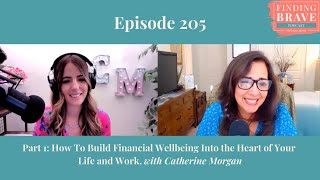
Podcast episode of Finding Brave (host Kathy Caprino) featuring guest Catherine (Kathryn) Morgan discussing financial wellbeing: how personal beliefs and early-life experiences shape money behaviors, separating self-worth from money, healing money-related trauma, practical steps for awareness (financial 'getting naked', desire lists, pricing desires), and reframing money as a tool to expand impact. The conversation also covers small-business owners' challenges, shame around debt, societal pressures, and setting pleasure-rooted financial goals.
Chapters
Hello Kathy here and thank you so much for tuning into today's episode. One quick thing I'd love to share is about my new digital training course, the Most Powerful you, which is the companion to my book the Most Powerful seven Bravery Boosting Paths to Career Bliss. I'm so thrilled that recently a division of the largest intergovernmental agency in the world sponsored several memberships to the Most Powerful U course for members of their staff. And what a powerful move that is in terms of bringing real world effective training to both men and women to help them thrive in the workforce. Coaching so many people, as I do each year, I see that leadership and career growth training programs today are so often not effective because they simply don't go deep enough to address what really holds us back from thriving. Believing in ourselves, understanding our talents and abilities, communicating effectively, asking for what we need and deserve, networking to build a great support community, and making the impact we long to so I'd love to make an ask of you and that is to briefly take a look at what I'm teaching in the Most Powerful you course and you can find that@mostpowerful you.com and if you feel that the content about the seven damaging power gaps and how to close those for good would be helpful for you and people at your organization, I hope you'll ask your supervisors, HR leaders, and diversity and inclusion managers to sponsor memberships of this course for you and other staff so that you can all thrive at the highest level in your roles and organizations. Thank you so much and here's to you becoming the most powerful you.
How much money we have doesn't make us a better or a worse person, but yet the beliefs that we carry and the meaning that we attach to money is then what we attach to our sense of self.
Hello everyone, this is Kathy Caprino and welcome to my podcast, Finding Brave. I've created this show for everyone who longs to create something bold and brave in their life, to rise up, speak up and stand up for who they are and to reach their highest and biggest visions. Each week I'll be speaking with him, aspiring guests from all walks of business, leadership, entertainment, the creative arts and the entrepreneurial world. And they'll be sharing their intimate stories of Finding Brave and offer their best strategies for building your most rewarding, joyful and meaningful life, business and career. Hello everybody. Welcome to another episode of Finding Brave. Kathy Caprio here. I am so excited for this podcast today and I was just mentioning to our delightful, beautiful guest Kathryn Morgan. Often I know my guests in some Personal or, you know, deeply professional way or they're a friend of a friend. And Catherine and I don't know each other, but we got to know each other very well in the last 15 minutes. And more importantly, what you teach Kathryn is so important for so many people and yet we struggle. I think we, we listen to a lot. What am I talking about? We're talking about a number of things. How to put financial well being at the heart of your business and the heart of your life. But also how do we stick to these financial goals that we make? I mean, most, most people have some goals around money and I think a lot of them come and go and we don't understand why. What happened, how did that slip away? So we are going to talk about all of that in perfect timing for the holidays because I think I know a lot of people that when the holidays come, woof, they go a little crazy in terms of shopping and acquisition and I'll say it, materialistic things. So we're going to learn all about that today. So thank you again for coming from the uk. I know you just put your little kids down to bed and you're tired, but thank you for being here.
Thank you so much for having me. It's just such a delight to be able to like. I'm just still flabbergasted sometimes with the power of technology and how it enables us to connect with so many incredible people. So thank you so much for having me. It's a delight to be here.
Oh, thank you. All right, everybody, let me tell you a little about Kathryn. So you know she's done so much. Kathryn Morgan is a multi award winning qualified financial planner, certified financial coach, Trauma of money, method practitioner, Trauma of money, method practitioner. That's how we say it. Wow. I know a lot of people, including me, that could use your help on that. Financial abuse specialist, just to name a few. Winner of the December 2019 Best New Business in National Business Women's Award and featured as one of the top 30 female entrepreneurs to watch and business leader. She's on a mission to disrupt the financial services profession from one of complicated financial products that no one can understand, right. To one that helps focus on people, not products. And Katherine is one of the new financial abuse trauma specialists in the UK and is the host of her own podcast, In Her Financial Shoes, which is ranked as one of the top five 50 podcasts in the UK and in the top 1% globally. Holy cow. Congratulations to you. So thank you again. And let's just dive in here. If we Could. I think I'm going to struggle doing this in 30 minutes, Kathryn, but can we start with kind of the most important thing, which is defining what is financial wellbeing? Because I think just to support this question, so many people get caught up with the shoulds. And I know you talk about that, you know, he's making 200,000, they have two homes. I think we're a mess about it. Can you talk about that? What is it? What should be we be hoping for?
Yeah, it's such a great question. And over in the uk, I was part of one of the many people that helped to found an organization over here called the Initiative for Financial well Being, where we actually tried to define this concept of financial well being. And part of our business is we actually train financial professionals to integrate financial coaching into their businesses, which is all about helping a client to understand their beliefs, their behaviors, their habits around money. And as part of all of this work, I recently won the Financial Wellbeing Champion of the Year. And I was asked to define financial wellbeing. And I think it's a really tricky one because for me, if you take that word, well being, it's about the being as in who we are, our sense of self. And I think one of the biggest challenges that we have with money is that we attach our sense of self, our worthiness, directly to money. Which, when you think about it logically, it's kind of crazy, right? It's like, well, how much money we have doesn't make us a better or a worse person. But yet the beliefs that we carry and the meaning that we attach to money is then what we attach to our sense of self. And we do it by saying things like, I am bad with money. I am terrible at numbers or maths. I am never going to make this amount of money in my business. I am bad at sales. You know, we say these I am statements, and what that does is that is almost like a mirror that reflects back into how we feel about our sense of self. And so whenever I think about financial well being, I always think about, how are you defining your sense of self worth to money? And that's how I would define financial wellbeing. It's about, will you say that again?
How are you doing? Say it again. Those words. Let's all listen, people.
What did I say?
What did I say? Whatever way you want to say it.
Yeah, it's. It's like holding a mirror up to how we feel about ourselves or how we feel about money as a reflection on how we feel about ourselves. So we give a lot of our power away by defining our sense of self worth directly to money. And yet when you think about it, money is just a thing, It's a tool. It's something that the economy can print more of when it needs to. You know, it's quantitative easing. It will print more money when it needs more of it. But yet we seem to give a lot of our power away, a lot of our confidence, a lot of our control. We say things like, I need to be in control of money. Well, we don't really want to be in control of anything, in control of money. Because having control over something is quite masculine, it's quite powerful. It's not actually a good relationship to have with anything or anybody. And the relationship we have with money is probably the longest relationship we have in the entire, in our entire lives. And yet we don't treat it very well. So I think wellbeing is going back to. We've got to separate our sense of self away from money. Oh, I love it.
All right, I'm going to. For everyone listening, there are people that are working for someone else and there are people who are running their own ventures and everything in between. So I'm going to wear the two hats because I'm. I was the corporate and now I run my own business. I have a question for you. And I'm, you know, people, I'm transparent. You, you know what I'm dealing with. Usually I think I'm going to ask questions from what I'm experiencing because I think that really resonates with the people who listen. I have done, I think in my corporate life, I did exactly what you're talking about. And I stayed way too long because I made a lot of money and I had no other means to generate self esteem at that time. So it was the title and it was the money and I wasn't conscious of that. I wasn't a conscious thing. I'm waking up every day going, I'm using money. It's how you feel that without that. And I remember our accountant told my husband, who's now my ex, but we're very amicable, he looked at how much I made and he said, she's a keeper. Imagine that. And I knew, you know, when you hear something that like the universe cracks, I knew something was so terribly wrong with that that I'm. He didn't mean you're only a keeper, but he meant you're a keeper because you made. It was such a mess for me. So then of course I Leave corporate life. And I'm not making a cent because I'm building a therapy practice. I'm building a coaching business. Now that was 16 years ago. But here's my question. Now I can easily separate my worth as a human being from how much the business makes. But that doesn't prevent me from struggling mightily when the business isn't making what I want it to make and what I believe it should be making. And when I say should, I'm smart enough not to compare myself to the people on the Internet who pretend they have 10 million and they don't because it cost 9 million to market their business. You know what I mean? I don't look at that. I look at what I'm selling, what I'm giving and what I believe the value is of that. And there are times where I fall way short of that. So can you push us farther if we are able to separate who I am from that money? What's the second biggest thing that small business owners struggle with? Can you. I'm pushing you. We didn't prepare this, so.
Yeah, no, totally. So what I'm really curious too is in order to separate our sense of self from money, the, the part that we have to work on there is awareness. It's just a bringing awareness to, well, what do I actually believe about my worth and what do I believe about money? So that in order to then separate the two, we've got a really good understanding of who is it to be me? Which is a really big question, right? Like who am I? Is a massive question for us to ask, ask of ourselves. And I think we're all on this big journey as actually uncovering who we really are and what our purpose is in the world. And we also have a bit of a job to do with understanding how do we, how do we behave and what meaning do we give to money. And that again in itself is another journey. But that awareness stage for me is key because once we have that awareness and maybe I can talk through how to get that awareness. The second stage is then what I call get financially naked. Like this is the bit for me where a lot of people, whether they're employed or self employed, just don't like looking at numbers. And that can come from a myriad of reasons why. But most of us don't like looking at our numbers or we, we palm off the responsibility to somebody else. And for those of you listening that maybe do have your own business and have gone from an employed to self employed, that mindset shift is huge to go from suddenly someone just paying you your wages every month to, oh, okay, so I have to generate this income to pay myself first. And it's really. It's a hard transition to make. And even for employed people, we just get into this habitual cycle of receiving a certain amount of money for our jobs. And the only kind of yardstick mark we have is everybody else. We just compare ourselves to everybody else. And that doesn't really tell us anything about our worth, our sense of self. So for me. And I'll share some ways that we can actually bring some awareness to your own relationship with money. But I think once we've done that, getting financially naked and just stripping everything back and understanding, well, what does money mean to you? Why is it so important to you? And when we think about things like financial freedom and creating more money so we can have more freedom, well, what does that look like for you specifically? Not, I just need to make six figures or seven figures or, hey, I'm just going to pluck 100,000 as a target out of the air. Because what does that actually mean? And we put that. Then we put ourselves under so much pressure that we have to generate X amount in our businesses or from our jobs. And actually what would happen if we just took a step back and stepped into trust of not having any expectations on ourselves at all? Can you imagine for a minute.
I can't.
The possibilities that would exist if we didn't set these massive, masculine, hairy goals that, quite frankly, we'll probably never hit anyway. And then if, even if we do hit them, they don't really mean anything. So for me, it's about getting financially naked to just step back into a place of trust and belief that you can do whatever you want to do, like if you're motivated to do it. And every pound that you have has a purpose, and you can align that into what matters really, truly, for you, not for anybody else. No shoulding. No, you should be doing this or you should be earning this. Just stepping back into a place of trust, so much more possibility exists. I love it.
All right, questions, questions, questions. One thing I. So I was corporate, then a therapist, now coach. Right. So everything you say to me makes perfect sense because I feel like money is an energy form. You know, there's a wonderful book, Maria Nemeth, the Energy of Money. Oh. And she says when we struggle with one of the energy forms, we usually struggle with most of them. I'll link to it. It's incredible. Vitality, support, creativity. But so I see it as a flow. You know, and when the pipe is all gunked up, it's not flowing. Right. But I would love to ask you this question while I, I totally see and believe that, you know, your. What happens with money is a mirror also with how you're feeling about yourself. Right. But what I do, when you said what you said, I. I had this. I got a little tear inside and I had this realization that I have had internal conflicts around money since I was young. From I'm picking up apples and I got stung by a bee and my dad's giving me, you know, a five dollar allowance. It should be more or. I made a lot of money as a corporate vp, but literally I felt like a prostitute, meaning not selling my body, but selling my soul. So there was, I think, a long time of I'll make a lot of money, but I'll be selling my soul for it. So then it took me years to slough that off. But here's my question. I'm sure you work with small businesses that are service providers. When you spoke, what occurred to me was, Kathy, do you. Being a therapist, you're. It's not about making the money. It's about giving to people who are desperately in need. And a lot of therapists I know don't make the money they deserve because they, their boundaries aren't. It's hard for them. I'm a coach, not a therapist, but I wonder if I still struggle with. And my rates are high. So if you look at how much I feel it is worth, you wouldn't think I have this struggle. But the struggle is so many people who. Let's just. What am I saying? So many people who are desperately struggling in life need help. And I'm a little conflicted around charging what I charge, even though I have a ton of stuff that's free, ton of stuff that's low cost, even though I say I don't want to just serve wealthy people, there's a conflict there. Am I making sense? Have you heard this a million times before?
No, Absolutely. And I think that that's interesting, isn't it, when we talk about that conflict? Because that conflict comes from the past. It comes from something that we are attaching to money and the meaning that we're attaching to money becomes that conflict. Now, often conflict comes from a number of different places. It can come from societal influences, it can come from religious influences, it can come from friendship groups, social media influences. Consumerism is a big. But I always refer to this as like old pain. And ongoing pain becomes old pain. So in order to heal our relationship with money, we have to heal the relationship with ourself. And this is where I think kind of the concept of trauma comes into this conversation, because, and you'll know this as a therapist, Cathy, is that when. When our purpose is to help people, which is what I sense from what you said there, Kathy, when we want to help so many people, we have these big visions, these big missions on the earth to create change, you know, around injustice or, you know, whatever your. Your thing is that you want to change. That creates a feeling of enabling, that is wanting to give to others, to help others. And that's where a lot of this clash and conflict comes from. It's this kind of conflict between, I really want to help everybody, so therefore, maybe I should keep my charging really low so I can help lots of people who don't. Can't afford to work with me versus oh, but hold on. I want to charge premium prices, but what about everybody else who can't afford to work with me? And if we take that analogy, that analogy kind of infers that money is limited. And if you're taking money from one person, it means you can't give to everybody else. So it comes back to this kind of enabler concept, which is very prevalent in women, particularly very prevalent in creative entrepreneurs, very prevalent in people who are in creative jobs. So therapists, artists, those kind of roles, because they're driven, their core values, they're driven by the need to help others. And I remember when I had this struggle in my business, and I remember I launched my first online membership course and I was charging £10amonth for this membership and it was massively underpriced. And I remember six months later feeling great about it because I was helping loads of people, but then bad because I wasn't making enough money to take profit from it, to make it a profitable business. And I remember my mentor turning around to me and saying, what would happen if you just flipped this whole meaning of money on its head? What would happen if, rather than I have to help lots of people and therefore charge less to help more people? What would happen if you had more income and that extra income would enable you to help more people and create more impact?
I like it.
I was like, hang on. Yeah, hold on. Like that makes sense. But yet still I had this, this conflict that was coming up. And the conflict for me was because when I went right back to my core beliefs around money, which are all formed by the age of six or seven years old, those core beliefs go to form the blueprint by which we operate. And it was actually when I became an EFT practitioner and matrix re imprinting practitioner, which is emotional freedom technique. And I went all the way through my own core beliefs. And when I got to the core beliefs that money in my family was used as a way to control and manipulate other people, it was used only in a kind of given exchange situation. So there had to be, like, there had to be strings attached to it. There had to be a, I'll give you this in exchange for this. And when I really dug down to the core beliefs, then I could understand where the conflict was coming from. And then I just completely reframed. Well, you know, what? If I make more money, I can help more people, not the other way around. Does that make sense?
It's so beautiful. Hello, Kathy here. With the new year coming up, it's the perfect time to start taking steps towards your business's financial future. If you'd like to grow your business as a coach or consultant, but the thought of figuring out how to do that stresses you out, I want to share something that will give you real peace of mind. Brave by Design has created a digital calculator that shows you how you can double your revenue in 2022. I've used it myself, and I love how easy it is to plan out your year and see where the money will come in. It's free and available@bravebydesign.net Brave by Design founder Laura Kahlil has been on Finding Brave twice, most recently discussing the three key questions you need to ask yourself if you want to grow your business now. And I know you'll find the revenue calculator helpful and a great complimentary resource to that episode. If you're ready to make 2022 the best year yet, grab your free download today at brave by design.net calculator and I think that. I'm guessing, I mean, when we look at trauma, there's some major categories. I mean, when you work with people in trauma, you begin to hear so many things, repeat and repeat and repeat. And we can categorize it. But I think what you described, I spent a little time coaching people who were doing financial coaching like you do, but we talked about understanding on a spectrum how your family dealt with money, with love, with fear. It was not spoken about or it was open. It was manipulative or it was, you know, wow. So what I'm saying here is I think everyone should take this exercise of, by age 6, what might I have internalized about money? And it'll probably be the top 10 patterns you've heard over and over. But we all have our individual way we interact with that pattern. Right?
Yeah, we all have these in, in psychology they refer to them as cognitive distortion. So we have these shoulding statements on ourselves. You know, I should be good with money, I should be making more money. We'll tell ourselves that I am bad. You know, I'm bad because I've got into debts. And that whole concept of debt is interesting, isn't it? The relationship we have with debt is a really interesting one compared to the relationship we have with savings.
How would you describe the difference? I mean, debt is shame, isn't it? There is so much shame that people have, right?
There can be a lot of shame, yes. I mean, when I was in my twenties, I lived in recurring debt cycles. I lived in £30,000 worth of debt and I was a financial advisor. So I knew everything there was to know about money. I knew what I should be doing, but yet I wasn't following my own advice. And the reason that was is because I was stuck in this cycle and the cycle I was stuck in was I could make money no problem. Was quite a manifesto actually. But I couldn't keep hold of it. I couldn't keep hold of it because the meaning that I attached to keeping hold of money was greed. It was control, it was manipulation. So of course I didn't want to keep hold of money. Of course everything would break down, my car would break down, then my washing machine would break down and then I would find something to spend the money on because I didn't want to keep hold of it, because my belief was that I would be a bad person. And this is what we call a cognitive dissonance. It's like, it's when we hold a contradictory belief or a value or an idea that typically experienced as stress or anxiety or fear. This is where the whole financial wellbeing concept comes in and it goes against one of our core beliefs. And when those beliefs are challenged or when that behavior is not aligned with those beliefs, it creates a dissonance, it creates a uncomfortable feeling that's caused by stress, anxiety, regret, shame, embarrassment, negative self worth, all of those emotions. And that's why people hold shame with debt. Shame is different to guilt. For those of you that follow Brene Brown's work, you know, shame is, is who I is, your sense of self. I am bad because I am in debt. That's shame. Guilt is more to do with you've done something. It's a behavior You've done and you can kind of get over. Yeah. So that. That's massive. Right? Because if you're holding on to guilt and shame, the first question to ask yourself is, does this guilt or does this shame belong to me? Like, does it even belong to you or has it just been passed down the generations? And that's a really interesting narrative that we choose to use with ourselves sometimes. Because when I was in my 20s, in these debt cycles, I used money and I massively overspent on clothes. Why? Because I had a huge negative relationship with body. I had anorexia, I was bulimic in my teenage years and my 20s, and that was the. The way I kept in that cycle of negative self worth was using money to keep me stuck in that cycle. And the reason I was staying stuck in the cycle was because it was familiar. And the brain loves familiarity. The brain loves to keep you stuck in patterns of familiarity. But a lot of the guilt and shame that I carried around money, a lot of the beliefs that money is greedy and selfish and can be used to manipulate others, wasn't my belief. This was coming from parents beliefs around money. And the day I asked myself that question, whose shame does this belong to? I was like, it's not even mine, it's literally my mum's. I'm carrying my mum's shame and guilt around money. And. And if you follow the work of Dr. Bruce Lipton, he talks about epigenetics and how literally beliefs can be passed through our DNA cellularly, you know, cellular level. Yeah. And so anytime someone says, like, I am bad with debt, or I. Or they feel shame or they feel guilt, I always ask them, like, who does this belong to? You know, is this time to give this back with love and appreciation and gratitude for how it served you, but is it time to give that back because it's no longer serving you?
So powerful. Aren't people lucky to get to work with you? You know, where you've had the trauma, the training, the psychological perspective, because you need that. It isn't just about balancing your checkbook, for goodness sake. All right, I've got a question for you. Often something will come up as a challenge, not in a mean way, that I think a listener is listening and having a question. So here it is. I know in my own life, I. I used to. I raised. We raised our kids in a very affluent area and I remember not wanting to fit in and I moved there when I made a lot of money. And two months later, after buying a big house, I lost my I was laid off after 9, 11. And I, for the first time ever, I knew what it felt like to not be in the same sphere as all my neighbors, all of them. And it was not, not, not easy, not pretty. I remember we had just moved there and my daughter made a little friend and I brought her to a play date. And it was the biggest mansion I'd ever seen. And I had just lost my job and knew I wasn't returning. It was so shame. But here's my question. I think we can grow tremendously by asking the questions you're pointing to and you're going to give us more strategies and tips. But how do we deal with societal's views? In other words, society tells you you shouldn't be in debt, that you screwed it up. Society tells you that if you, you know, you talked about these masculine kind of hairy goals. I remember a few years ago reading something about if you're not making a million dollars a year in your business, it's not a business. That is such a masculine view. That is so masculine. And I don't even want to tell you why, I won't bore you, but that is just not accurate. A fantastic business can be 200,000, 500,000. Why do we need a million? But if society or the community that you're around holds these beliefs, first you have to gain awareness of them, to even know, to separate. But what would you suggest when this is what we're being told every single day?
I think, I think to a certain degree we can control our surroundings. You know, we get to choose what news channels we watch, newspapers we read, which social media accounts we follow. And I'm a massive believer in the law of subtraction, not the law of attraction, the Law of subtraction, which is an incredible book written by Matthew May and what he refers to in that book is about how we can look at the kind of derailers in our lives, what derails us from feeling, feeling like we can be ourselves, feeling happy, seeking true happiness. We get to choose, right? We get to choose who we hang out with, we get to choose our circles. And so on a regular basis I always practice the, the work of law of subtraction, which is very much about what could you get rid of in your life that's causing you distraction? What can you get rid of in your life that's causing you energy, your energy to be sucked away? What's, what can you take away from your life that's wasting your time? You know, how can you leverage your time better Time is the one asset we can't create more of. Yes. The one that we don't pay much attention to. You know, I always, people always talk about wanting to make more money. Actually time freedom is much, a much greater pleasurable goal to have than money because we can create more money because money's unlimited, but we can't create more time. So I think in terms of consumerism, I think pay real attention to get curious to what films are you watching, what news channels are you watching, who are you following on social media? And that's really where I think to a certain degree we can control things and some things we just can't. But if we clear and we're aware of, well, what is important to me in the concept of my well being, what matters to me and, and really embed that into something that is pleasurable rather than moving away from pain. So what I mean by that is when people set financial goals typical for this time of the year, right? Like what do I want to do next year? How much money do I want to earn next year is we often embed those goals into like a derailer, things that are causing us pain that we don't want anymore. So for example, next year I'm going to lose to stone because I've been meaning to do it all year and I've never got around to doing it. Or I've started going to the gym and then I didn't go again or I started on this health kick and then I stopped a month later. They're often embedded in moving away from pain, you know, being overweight, not having enough energy, for example, wanting to, you know, wanting to pay off our debts, for example. And a lot of those goals we embed so much in coming away from pain that they're only short term lived, you know, so if we set, there's.
Not enough juice just to, to sustain them with joy and pleasure. Is that what we mean?
Yeah, it's, it's limiting because what happens is, let's take the example of losing weight. It's a really easy one for most people to resonate with is let's say we wake up on a Monday morning and say, right, the diet's going to start today, I want to lose two stone. You know, I can't get my jeans on, they're too tight. And we kind of make a plan and we think, okay, I'm going to go to the gym three times a week, I'm going to stop drinking caffeine, I'm going to drink these protein shakes or whatever we decide to do. And then the likelihood is we'll probably do it for a week, two weeks, three weeks, maybe even till we hit the goal, we lose the two stone. But then what happens is the brain needs remotivating again. So you'll just basically put the weight back on again so that you can feel the pain again to feel re motivated again.
So true.
And so what the question I would ask yourself whenever you're setting financial goals, if you're sitting here thinking, catherine, it's December. Like, I'm now thinking about what I want to do for next year. Create a desires list. Like, get a blank piece of paper, write 1 to 50 in your left hand column and get to 50 desires. Now this is not an easy exercise for most people. They'll, they'll maybe get one or two down and then they'll go, I don't know what else I desire. And they actually, you know, just the thought of, am I allowed to desire something for myself? Like, is that even, is that even allowed? Is that not selfish? Like, see what comes up for you around this exercise. It can really uncover a lot about your self worth and your wellbeing. And can you give us an example of.
You don't mean desires around money, you mean more time with my children, that kind of thing.
Life desires.
Life desires. Give us a few that you've read on your clients list and went, yep, now you got it.
I'll tell you what, I will give you my desires. So when I, when I did my desires at the start of the year, so I won't share all of them with you, but I'll share a couple of examples. So the first one on my desires list was I wanted a cherry blossom tree in my garden. That was my first one. So beautiful, weird that that came up. Like I was like, where did that come from? And then I've got things like writing my own book, creating a charity, attending a moon dance, visiting Necker island, understanding my astrology chart, saving enough money to pay for my boys to go through private school, living by the sea, having a puppy. Like just a whole bunch of things. Some of them were very like business related, some of them are travel related, some of them are health related. But the interesting thing isn't so much in the actual things that you write down, it's more the process of getting to that 50. You'll, you'll maybe get to like 10, maybe 20. And then you'll struggle. Like, and I really want you to keep digging because when we dig, what happens is we go from surface level desires to deep desires. And I don't want you to set your goals for 2022 based on shallow surface level desires. I want you to go deep. And the reason I want you to go deep is then what I want you to do is think about, okay, so how much money is involved for me to create that desire. And you'll often find that the biggest desires that we have in life don't actually cost us anything. They might cost us time. And it might be that you need to outsource in your business to create that time, or it might be that you need to have a conversation with your boss to drop to four days a week. But there's so many things that we can already do with the money that we already have. You know, often we completely forget about how much money we actually do already have in our lives. And I always encourage people to do a kind of helicopter view of their finances and actually write down everything that they already have, like their house, their TVs, their cars, you know, their possessions, their pensions, their investments, their savings, everything. And often people are like, oh, God, I completely forgot I had this, this other house over here, or this, I've got a house with no mortgage on. Like, what am I worrying about? You know, taking that gratitude reflection on our finances can really help. But that desires going back to this concept of pain and pleasure, once we have that list of desires and deep desires, not surface level desires, then we can start to allocate specific amounts of money. And I mean super specific. I'm not talking like, I want a holiday in Mexico next year. It's going to cost me five grand. I want you to go onto Airbnb or go onto your flight booking systems, and I want you to price it all out and put that figure next to it. So you know, Exactly. This is going to cost me £3,476 to get the flights and get the hotel that I really want. That's your first financial goal. Then you go to your next one, then you go to your next one, and you can start to prioritize those based on a desire or a pleasurable outcome. And from a mindset perspective, it's so empowering to be working towards a goal that is rooted in pleasure, that is going to be much more motivating and much more that you're likely to reach it and stick to it than us writing down goals that we just tend to pluck out of the air based on probably what everybody else is doing, which tend to be rooted in coming away from pain.
Brilliant. You know what I'm thinking? Let me ask you something. I would love to make this a two part series if you have about 10 more minutes. Would you Kathy? Sure. Awesome. Hi Kathy here and I wanted to share some information about my new digital newsletter, your Path to Career Bliss. This monthly newsletter explores one key career, leadership or personal growth topic that is essential for building a happier, more successful career or business. Every issue offers a selection of the most read articles that I've ever written, along with riveting podcast interviews with some of the nation's top experts, as well as career assessments, resource recommendations, a subscriber highlight section and an Ask Kathy column and more. We've made it as affordable as possible with two tiers to choose from and the first month is completely free and you can cancel at any time. I hope you'll join me in this program now. Check it out@kathy caprino.com newsletter and get your free issue today. Thank you. And here's to your path to Career Bliss. Thanks so much for joining us today and please don't forget to check out findingbrave.org for more programs, resources and tips. And tune in next time for your weekly dose of finding.
More from Kathy


Elevate Yourself, Elevate Others, and Amplify Good | Chris Cooper | Finding Brave Ep. 334

Finding Brave Epis #333: How Leaders Can Harness AI Without Losing Their Humanity, w/Bennett Borden

Finding Brave Epis 332- How to Stay Brave, Valuable and Visible in the Age of AI, with Raman Rai

Finding Brave Epis 331 - The Power of Positive Disruption, with Dr. Patrick Leddin


Finding Brave Epis 330 - Being 40: Letting Go and Embracing Who You Are, with Stacey Lindsay

Disrupt Career Reinvention with Kathy Caprino - via The Disruption Lab Podcast w/Patrick Leddin

Creating Neurodiversity-Friendly Work Cultures: Simple Workplace Adjustments Matter

Finding Brave Epis 329 - How To Create a Neurodiversity-Friendly Workplace, with Kristen Pressner

Finding Brave Epis. 328: Reclaiming the Power to Trust Your Own Voice, with Dr. Cindy McGovern