206: How To Build Financial Wellbeing Into the Heart of Your Life and Work, with Catherine Morgan P2
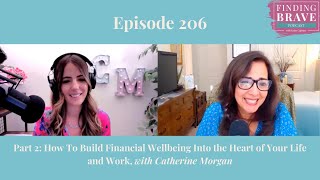
This is a transcript of episode 206 of Kathy Caprino’s Finding Brave podcast (YouTube), a conversation with Catherine Morgan about building financial wellbeing into life and work. The hosts discuss how money beliefs are formed (childhood messages, inherited/borrowed beliefs), the spender-versus-saver dynamic in relationships, the emotional drivers behind money (love/connection vs status/security), practical steps toward balance (self-awareness, separate financial independence, curiosity instead of judgment), and broader wellbeing themes (time, presence, regret). The transcript also includes host promos for courses and tools and mentions Morgan’s book It's Not About the Money (published Dec 9).
Chapters
Hello Kathy here, and thank you so much for tuning into today's episode. One quick thing I'd love to share is about my new digital training course the Most Powerful youl, which is the companion to my book the Most Powerful seven Bravery Boosting Paths to Career Bliss. I'm so thrilled that recently a division of the largest intergovernmental agency in the world sponsored several memberships to the Most Powerful U course for members of their staff. And what a powerful move that is in terms of bringing real world effective training to both men and women to help them thrive in the workforce. Coaching so many people, as I do each year, I see that leadership and career growth training programs today are so often not effective because they simply don't go deep enough to address what really holds us back from thriving. Believing in ourselves, understanding, understanding our talents and abilities, communicating effectively, asking for what we need and deserve, networking to build a great support community, and making the impact we long to so I'd love to make an ask of you, and that is to briefly take a look at what I'm teaching in the Most Powerful you course and you can find that@mostpowerfulyou.com and if you feel that the content about the seven damaging power gaps and how to close those for good would be helpful for you and people at your organization, I hope you'll ask your supervisors, HR leaders, and diversity and inclusion managers to sponsor memberships of this course for you and other staff so that you can all thrive at the highest level in your roles and organizations. Thank you so much. And here's to you becoming the most powerful you.
It's about balance, isn't it? We've got to have balance. We've got to be able to spend money on ourselves without feeling guilty, without feeling shame, without feeling judgment. But also, we do understand that we do also need to be able to save for our future self too. So it's getting that balance between the two.
Hello everyone, this is Kathy Caprino and welcome to my podcast, Finding Brave. I've created this show for everyone who longs to create something bold and brave in their life, to rise up, speak up, and stand up for who they are and to reach their highest and biggest visions. Each week, I'll be speaking with inspiring guests from all walks of business, leadership, entertainment, the creative arts and the entrepreneurial world. And they'll be sharing their intimate stories of Finding Brave and offer their best strategies for building your most rewarding, joyful and meaningful life, business and career. Let me ask you this. I have something called a Career path assessment it's 11 pages of questions I wish someone had asked me, maybe you know, what would have been 40 years ago. And if I had answered them deeply, honestly, I don't think I would have made a lot of the mistakes I made. But one of them is what, what's your list of desires? And, and I have another column, why do you want that? And what's really interesting. And I'm going to really think about how to rephrase this question. But what I, what I see, and I wonder if you see the same kinds of things they will list, you know, let's say they're an HR executive, I'm going to run a bed and breakfast. I want to sail around the world. I want to write a book. And when you look at the why's to be recognized. I want to take my kids to Disney to be a good mother. And it'll be a list of 30 things. I want a new wardrobe to feel more beautiful. Well, I've been doing the same thing you are doing, but not as consciously. You can be recognized without having a best selling book. You can have freedom without sailing around the world for, you know, so when you write them that way, what do I want from that? Or why do I want it? You will also see not just the superficiality of it, but that that very thing you're desperate for is right there. Typically I'm doing the same thing, going, you can do that today. You can do that today. You want to start writing a book. You don't write a book sitting down in one sitting. Start writing. Can't write a book if you don't write a word. Does that sound like exactly what you're talking about?
Yeah, I think what's come up for me there is. I don't like the why question for myself because why automatically insinuates judgment and defensiveness.
Now I got to defend this.
You're a therapist at heart.
Yes. I may not say why. I may say what is the reason behind this? Or what is the impetus or something. I forget how I. Yeah, yeah, like what is it? But how do you phrase it better best?
I always get curious to people's language. So when someone's sharing their desires with me, I always get curious to how they're positioning that. And the question I tend to kind of use here would be what is important to you in the context of your life? What is important to you in the context of your career? What is important to you in the context of money? What is important to you in the context of this trip to Mexico. I really want to hear the story behind it. I really want to hear. Well, why did that come up for you first? Why did this desire come up for you as, like, number 40 out of 50? Because often when we really have to dig deep for desires, they tend to be the more important ones and the ones that automatically come out at the start. But what's really interesting is, like, looking at mine as an example. I remember the first one I wrote out was having this cherry blossom tree, right? And I was writing it downstairs or sitting in my dining room on my dining room table, and I had the sun streaming in my eyes. And I remember just closing my eyes and being like, I can. I can see this cherry blossom. I can see myself walking in Japan in the middle of autumn and with all these cherry blossom trees. And the weird thing was, is I walked upstairs after I got to about. I think I got to about four desires, and I was like, this is. When I did this, like, years and years ago, I was like, I don't know. I don't know what else I desire. Like, you know, my job as a woman is to look after everybody else, isn't it? Like, I have two kids. I have to put their needs first. So how dare I have desires for myself? And I walked upstairs, I looked out of the window, and I kid you not, there was this cherry blossom tree in the next door neighbor's garden. And I was like, have I just never seen this before?
Goodness.
And I said to my husband when he came home, yeah. I was like, has that tree always been there? And he was like, no. Literally, my neighbors had. I literally went and knocked on my neighbor's door. I was like, can you please tell me where has this Trey Boston tree come from? And they were like, we just bought it. Like, what? I was like, no way. No way. But you know what was so magical about the whole exercise itself was that I just paid so much attention to what would make me feel good, what would make me. What would make me become a better person, what would make me, like, bring the whole auditory participation in the whole sensory participation. What makes you feel good with money? What makes you be good with money? What makes you, you know, what make. It's like stepping into that wealthy mindset of, it's not just about how much money we have. It's about, what do we. What do we need that money for? That's going to mean that we can feel aligned, not misaligned with our values and the things that really matter to us as individuals.
Oh, what a story. You Know what that brings up to me? I had a whole thing around when my husband and I divorced. We moved out of this affluent town. This is the craziest thing, but I think it relates to your cherry blossom tree. Your cherry cherry tree. Right. There's some beautiful nature spots, and there's one park that is my heaven happy place. So I move out of it and come to Stanford, which is much more urban, and it doesn't have that spot. Well, for like, two years when I would drive back into Wilton, I would, like, have this sick feeling that this isn't my town anymore. Well, then one day I said, wait a minute here. I pulled into my favorite little park and I took a walk. Well, I enjoy it just as much, if not more, even though I'm not a resident paying taxes in that town. And it occurred to me, wait a minute, I don't have to live here to love this park. It's a park.
And.
And I think that your cherry tree story shows you too, that we don't necessarily have to own the tree. You can sit on your front deck, on your front yard with a cup of coffee and look at that tree. Is that right? I mean, so much. So much is so ingrained in us that we only deserve that joy if we've paid some money for it.
Oh, yeah, that's a really, really interesting, like, money block there, isn't it, that we have to. Well, that block there, like, we have to pay for it ourselves in order to get the value from it. Like, so what would happen if someone bought you a cherry blossom tree and gifted it to you? Like, how would you feel about that as opposed to if you bought it for yourself?
I can't sort it out for the moment, but a completely different emotion. I mean, if I wanted to buy it, if it was something that I wanted to acquire, obviously it's tied into my ego a little bit that I acquired it versus a gift that someone is showing their love for me.
So exactly what you. I'm so glad you said that, Kathy. Because really, the way that we feel about money tends to be one of two things. It's either driven by love, the need for love, the need for safety and security, or the need for security and status. So this is quite interesting if you look at the beliefs of men versus the beliefs of women. And a lot of men place value on money and themselves through status, a status relationship with money. So they will want to get the next pay rise, the next job title. They'll feel quite. This isn't like a generalization for all men. But they can sometimes feel conflict when maybe they're in a relationship and their wife is earning more than they are because it creates that, that fight or flight reaction to, well, if I'm not the main provider based on status, where, where is my place in, in this relationship? Where is my place in the world? Yeah, it goes right back to, you know, DNA of the hunter gatherer. And for women, it's love, right? It's love, it's connections, it's relationships, it's, it's empath, it's the feminine side. Because again, going right back to DNA, it's, we are the caregivers. You know, the, the men go out and they hunt together and we stay at home and we look after, we look after our families. We, we make food. And this is where I think the whole concept of borrowed beliefs and inherited beliefs is a really interesting one. Because if you've grown up with a predominance of seeing and experience that status relationship with money from men and the giving relationship with money from women, which most of us, I say most of us, some of us did, some of us did, then that traditional role becomes the blueprint of how we then perceive money. So going back to that example I just asked you, Kathy, about, well, how would it be if someone gifted you or bought you the cherry blossom tree? You'd probably feel more attached to it because it would provide more love because someone's gifted it to you. Whereas it would be different perhaps, if you're more ego or status driven. So the ego tends to come out when we are driven by status. You know, it is that everyone has this ego part. Everyone thinks that ego is bad. Ego is not bad. Ego is there to give us certain messages. And often when we're in, if we're in business, let's say, for example, we're applying for all these awards all over the place. You know, we do that because we want the validation externally of how well we're doing, because maybe we're not getting that because we're not employed for some, you know, our boss to pat us on the back and say, you're doing a great job. Whereas if we're in an employed role, we're constantly again seeking that validation from other people to tell us that we're doing a good job. Now, what would be possible if we just for a moment thought what would happen if I gave that validation to myself internally? I don't need anyone else to tell me I'm doing a good job. I know if I'm doing a good job or not. But yet the ego seeks that validation. And it seeks the validation because it wants to feel safe. That's the brain's ultimate goal, is to keep you feeling safe and loved and protected. So anytime that you feel misaligned or incongruent or maybe there's a clash in your relationship at home around money, maybe you're arguing with your partner around money. It's not because one of you is right and one of you is wrong. It's because both of you are desperately seeking that fulfilment and need to feel safe and to feel secure. But yet most of the time for men and you know, in a men and a male female relationship, it's because the male is driven by status, the woman is driven by love. And that's why we clash around money. That's why we have arguments about, well, I want to go on a 10k holiday next year, but actually I want to spend 10k on the house. You know, again, it's I want to renovate the house, I want it to look nicer, I want to maybe use money as a way because people might love me more if the house looks nice, you know, if I've got a flash car or, you know, there's no right or wrong with this. It's just about bringing curiosity to what are your beliefs? What are those borrowed beliefs that you've inherited? How did you. What was the perception that you had on money growing up, and how does that now affect how you deal with money today in the here and now?
Hello, Kathy here. With the new year coming up, it's the perfect time to start taking steps towards your business's financial future. If you'd like to grow your business as a coach or consultant, but the thought of figuring out how to do that stresses you out, I want to share something that will give you real peace of mind. Brave by Design has created a digital calculator that shows you how you can double your revenue in 2022. I've used it myself and I love how easy it is to plan out your year and see where the money will come in. It's free and available@bravebydesign.net calculator Brave by Design founder Laura Khalil has been on Finding Brave twice, most recently discussing the three key questions you need to ask yourself if you want to grow your business now. And I know you'll find the revenue calculator helpful and a great complimentary resource to that episode. If you're ready to make 2022 the best year yet, grab Your free download today at brave by design.net calculator Catherine, it's too good. I can't. My head's going to explode. Can I amplify two things? I will let you go soon, but just to help people understand a little more deeply and see what you think. In therapy again, we learned there's a spender saver dynamic with most couples. Meaning it's almost invariable that the partners are not exactly the same. Yeah, one spends for validation, for joy, one saves. So. And boy, is that. Was that true. I. So I want to make another point and then tie it together. My mom was a stay at home mom, Greek, and got so much joy out of it and believed that women's role is to have family. That's it. Dad was a GE guy. They had a wonderful marriage for that time. But I remember mom feeling quite depressed when my sister and I went away to college. And I remember way in the deep recesses of my mind saying, that's never going to be me. I am not going to. She didn't make us feel guilty, but I felt guilty, right. And I said to myself, and I was really more of a, my father's, you know, the son he didn't have. So I wanted a GE job or a big corporate whatever. Yet. The ironic thing that I'm bringing up, and I'd love your thoughts, is just because we say we don't want to be that and we think we've healed a dynamic we don't want it doesn't mean it's true. If you're a reaction to a dynamic, you're still tied to the dynamic. Is this not true?
Yeah, 100%. It's that perception, isn't it, that at that moment in your life you made that decision that I don't want my life to be like this. And so your brain's gone, oh, okay. I'm going to catalog and store that piece of information as a core belief. And that core belief probably goes back way further than that one particular day.
Probably I was six, you know, so.
Probably even further back than that. I mean, it depends on your beliefs. There's some people that believe in past life work. There's a, you know, a lot of the work I do in matrix reimprinting is incredible how far back we can go generationally with these core beliefs. But we made a decision on that day, on that particular day. This is, this is what I've decided. So the brain will go, okay, that's great. Thank you for that factual piece of information because the brain doesn't know how to differentiate between fact and non fact, like what's true and what's not true. It will just catalog it. If you tell it it's true, it will catalog that piece of information and then it will just go about its job in giving you more and more information experiences to reaffirm that belief. So we can't change what's happened, we can't change our surroundings always. We can't change what's going on around us, particularly as children. But we can go back and change the perception. What was the perception on that day that you decided and is that belief now serving you or is it sabotaging you? And there'll be bits of both, right? There'll be bits of both. Like I remember when my, my nan, when I was about six, she used to give me pocket money. I used to go and visit her in a little caravan in the summer and every time she'd get her little purse out and she'd give me like 20p and she'd give it to me and she'd say, don't spend it all at once. And I remember now as an adult thinking, this goes back to the save a spender thing you were just talking about there, Kathy, is that I remember thinking, okay, as an adult, what meaning did I attach to that statement? Don't spend it all at once. Oh, well, I can't spend money, I have to hoard it, I have to protect it, I have to save it.
Grief.
And so you can imagine then the, the cognitive dissonance or the conflict then of but I need to spend some money. Oh, but I can't because I was told don't spend it all at once. I've got to save, I've got to protect it, I've got to hoard it, not take any risks with it. And that's just from one single one.
And we've had 10 million that are making our heads spin.
Yeah, that save a spender. It is about balance, isn't it? We've got to have balance. We've got to be able to spend money on ourselves without feeling guilty, we without feeling shame, without feeling judgment. But also we do understand that. Yeah, we do also need to be able to say for our future self too. So it's getting that balance between the two. But the conflict often comes in, in relationships where we're actually naturally attracted, did you know? To the person with a direct opposite relationship with money. Which is so interesting, isn't.
Is? Well, we look for people to complete us, not to Be the carbon copy of us, I think. Right. Yeah.
And that's a flaw, I think, in itself, because no one can complete us. You know, we're not. We're not two souls, but, like, we are individual people with individual needs. You know, you need to have individual goals, individual needs for yourself, even if you're in a very happy relationship. This is about creating independence for yourself, not codependence, especially for women. You know, we're living longer than men. We need to have our own savings. We need to have our own investments. We need to be managing our own investments, not. Not just passing that on as a job for the men to do. You know, this is a. And equally for the guys. Like, this is about having a balanced relationship so that you are completely and utterly aware of how you can use money in a way that makes you feel aligned, valued internally, motivated by pleasure, not away from pain. So that you can feel, I guess, in control, if you want to use that word, but confident that I'm making the decisions that are right for me as an individual. But in a relationship, sure, we're going to have common goals, we're going to have things we want to do together, but we're different people, and we need to address financial goals separately before we do it in a relationship together. So if that, you know, if that relationship parts, that's okay. We've got our own individual finances sorted out. We're both independent. That's okay. And this is where I think a lot of the challenge comes in, is that, you know, a lot of people don't set up their finances on that basis. And this is also where financial abuse can happen. This is where we know that 90% of domestic abuse is created because of money. And money is then used as a manipulative tool to, you know, to create coercion, coercive control over another person. So if we were to remove that financial abuse, it would reduce domestic abuse, you know, so it's a different subject. I know, but I think it's so important just to step into a place of empowerment, step into a place of complete and utter awareness so that you can have more balanced conversations. You can just feel better about money.
You know, I love it, and I'm going to let you go. But I. I want to say this and have a final thought. I think that you feel the way I do. It seems that life is an internal job. If you skip that part, you won't generate the results you want in life. I mean, I think you listen to every word of Catherine. It's Understanding yourself, loving yourself, forgiving yourself, accepting that, yes, it was age four that I made that decision. And then age six, okay, and it's your husband's the spender and you're the saver. It's not being angry, it's in understanding. Oh my gosh, he needs that because they had no money growing up. And when he spends, he feels secure. You know, it's, it's such an internal job. But people, if you don't do it, the results you get are going to continue to fail to bring you what I think we all want. Unless we're masochists. We want joy, we want happiness, we want pleasure, we want to be loved. I think that we're all kind. Not all. What am I saying? Many of us are running around chasing our tails in the complete wrong direction. Any final words on that?
Yeah, stop running. Like slow down. You know, create more time for yourself. Time is the. As I said before, it's the one asset we can't create more of. It's the one thing that when you look at the, when you read. I've read, I can't think of the name of the book now. It's an amazing book about a nurse, about all these stories about things that she'd learned from her patients.
Ronnie Ware, the regrets of the dying. Oh, I've interviewed Ronnie.
Oh, I'd love to interview her. Like I remember the one. One of them was around. Actually I've mentioned her in my, in my book. It was, you know, we don't ever really regret. We don't ever regret what we did, we regret what we didn't do. And I just think that's so powerful is we, we live such fast paced lives. You know, what would happen if we just created a little bit more space for ourselves to be, just to be. And that for me, going right the way back, full circle to financial well being, the way that we can create more financial well being for ourselves or just general well being, forget the financial right. Is just to be.
To be.
Be curious, be grateful, be empowered. That's how you can create more wellbeing.
For yourself and possibly say it any better. So where do we soak up all your deliciousness here? Where do we learn more? Where do we get your tips and strategies and tell us where to go?
Amazing. Thank you. Well, either on my podcast in her financial shoes, or I'm just about to publish my very first book, which would be cool. It's actually published on my. The 9th of December, which is my birthday this year. I'm turning 40. And I'm forgetting the fact that I'm turning 40.
Oh, my goodness. And that's out. That's incredible. What's the name of the book?
It's called It's not about the Money.
Oh, my gosh. I am going to snap that up and I hope you're doing an audio version and people can listen every possible way. You know, I've interviewed a lot of people and met a lot of people in the financial space and the vast majority don't get it because as you're saying, it's about beliefs, it's about trauma. It's about what we think we're doing right that's making us miserable. I love it. Love it. Can't wait to read your book. Thank you for being here, Katherine. Thank you so much.
Thank you, people.
We want to hear from you. I know Katherine's launching her book Baby, so she's not as available as typically maybe would be. But we want to hear your questions. We want to hear your struggles. We want to hear. Yes, but I don't understand this. Let us be of help. I think from what I'm hearing, we've both had our own. Well, everyone has. But we've had our own struggles and we've overcome them to a degree. But we're human. We're still learning. So there's no shame here. Share your question if you want to, privately or publicly. We would love to hear from you. And I hope, hope, hope this moves you forward in a way that's going to make 2022 much richer in the most beautiful sense. Thanks, everybody, and thanks again, Kathy.
Thank you for having me. It's been a pleasure to be here. Thank you.
So fun. Bye. Thanks so much for joining us today. And please don't forget to check out findingbrave.org for more programs, resources and tips. And tune in next time for your weekly dose of finding Brave.
More from Kathy


Elevate Yourself, Elevate Others, and Amplify Good | Chris Cooper | Finding Brave Ep. 334

Finding Brave Epis #333: How Leaders Can Harness AI Without Losing Their Humanity, w/Bennett Borden

Finding Brave Epis 332- How to Stay Brave, Valuable and Visible in the Age of AI, with Raman Rai

Finding Brave Epis 331 - The Power of Positive Disruption, with Dr. Patrick Leddin


Finding Brave Epis 330 - Being 40: Letting Go and Embracing Who You Are, with Stacey Lindsay

Disrupt Career Reinvention with Kathy Caprino - via The Disruption Lab Podcast w/Patrick Leddin

Creating Neurodiversity-Friendly Work Cultures: Simple Workplace Adjustments Matter

Finding Brave Epis 329 - How To Create a Neurodiversity-Friendly Workplace, with Kristen Pressner

Finding Brave Epis. 328: Reclaiming the Power to Trust Your Own Voice, with Dr. Cindy McGovern