215: Digital Marketing Steps Small Businesses Need to Take To Thrive Today, with Neil Patel
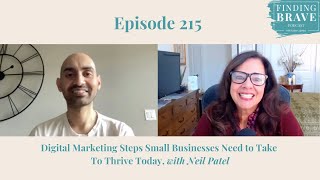
Transcript of a Finding Brave podcast episode (host Kathy Caprino) featuring Neil Patel discussing digital marketing and SEO for small businesses. The conversation covers how marketing has shifted to omnichannel strategies, basics of SEO (links, meta tags, title/description), brand-building (content, product, press), social media best practices, ad campaign vetting, tools (Ubersuggest, Google Analytics, SimilarWeb, Google Search Console), timelines (expect 6–12 months), and common mistakes (giving up too quickly, not promoting content, lack of niching). The episode also includes promos for Kathy’s coaching offerings and an upcoming webinar/course.
Chapters
Hi folks, Kathy here with a quick note for anyone listening who is a coach or is running a coaching practice or business. I'm excited to share that I'm offering a free 90 minute webinar training March 1st at noon Eastern on up level youl coaching Business this key steps to Building More success, Impact and Recognition As a coach, I'll be sharing my top hard earned lessons and strategies from 16 years of running my own coaching business.
On how to make a bigger impact.
With your clients and grow your success this year. Share straight, no nonsense talk about what I've experienced and seen are the seven worst blunders coaches make and how to avoid them, the most damaging myths coaches are taught about how to be successful that are dead wrong, and the critical steps coaches need to take to build more financial and emotional reward in their work today. I hope you'll check it out@kathy caprino.com uplevel2022 I'm confident it'll be eye opening.
And instrumental for you.
Hope to see you there.
Thanks.
People give up too quickly, right? They go and they start a campaign, do SEO or paid ads and it doesn't work out in the first month or two months or even three months and they stop again. You need to do something consistently for at least six months to a year in marketing online and it gets better over time and you can fine tune.
Hello everyone, this is Kathy Caprino and welcome to my podcast, Finding Brave. I've created this show for everyone who longs to create something bold and brave in their life, to rise up, speak up and stand up for who they are and to reach their highest and biggest visions. Each week I'll be speaking with inspiring guests from all walks of business, leadership, entertainment, the creative arts and the entrepreneurial world and they'll be sharing their intimate stories of Finding Brave and offer their best strategies for building your most rewarding, joyful and meaningful life, business and career.
Hello everybody. Welcome to another episode of Finding Brave. Kathy Caprino here, and once again I'm pinching myself out of excitement because what my guest has to teach is something I desperately need to learn. And so I am going to be asking questions of the amazing Neil Patel, a digital marketing guru. I'm going to be asking questions I need to understand and hopefully that'll help you and I believe, Neal, you'll correct me. This is going to be fantastic for small business owners, for larger business businesses, and even for one stop shops like consulting and private practitioners, I would think. Would you agree?
I agree with that. You got it right. So it doesn't matter what kind of business you are, it'll end up working and you'll end up getting more traffic and sales from the web.
Neil, thank you for being here. Neil Patel. I want to tell you, I was just sharing with him. I, I was late to this call because I went down a rabbit hole of watching Neil's short three minute video on, on an amazing tool that you have about SEO and three minutes and I learned so much. So I. Hang on to your seat, people. You're going to learn a lot. But let me tell you about Neil. So illustrious digital marketing executive Neil Patel is the CMO of NP Digital, a marketing agency serving startups, small businesses and publicly traded companies. Gosh. That's everything in between. A New York Times best selling author, Neil was named a top influencer on the web by Wall Street Journal. Forbes has shared that he is one of the top 10 marketers. Wow. And Entrepreneur magazine has shared that he has created one of the top 10100 most brilliant companies only grow. Neil is recognized as the top 100 entrepreneur under the age of 30 by President Obama and a top 100 entrepreneur under the age of 35 by the United Nations. NP Digital is a performance marketing agency that helps companies of all sizes drive more traffic, sales and leads. And you can find everything about neil@npdigital.com all right, so let's dig in. Here's, here's my first question and I want to tell, tell folks the context I'm coming from is, you know, I used to be a corporate VP and my world was direct marketing. That's what we called it, but there was no Internet. You know, I'm, I'm Methuselah over here, long time ago. So there's a lot that I inherently understood, but a vast amount that I never understood. And in fact, SEO and trying to drive traffic has not been something I've had to focus on because I have a big reach from Forbes and other places. So what I want to understand first from you is tell us how digital marketing has changed in the past five years with the lens of what is it that is the most important stuff that small business owners have to understand.
Can you, can you start there, Neil?
Yeah. The big thing digital marketing has changed over the last five years is that years ago used to be able to build a business off of one channel. And here's what I mean by that. Whether it's SEO or paid advertising, you could build a business just off of one channel. Facebook grew by telling people, hey, invite your friends through Email, you know, so and so invited you to join Facebook. Click here to join. Neil invited Kathy to join Facebook. Click here to join. And that model worked out really well. But now people raise venture capital, and they always have been raising venture capital, but they raise obscene amount of money, billions of dollars in many cases. And that money is used for things like that. Venture capital is used for things like sales and marketing. That's where the majority of the money's going. So all good channels eventually end up getting saturated, which means now if you want to build a business and do well, you can't just leverage SEO. You can't just leverage paid advertising. You got to leverage all forms of marketing and go omnichannel. It's the only way to do well in the long run.
Can I go so basic and ask you? Some people don't even really. I don't mean to say it like that. Don't understand what SEO means, what it even stands for, but what it is. Can you just give us the primer here? What is it?
Sure. So SEO stands for Search Engine Optimization. Whenever you do a search on Google, the top results typically have this word in there that says sponsored or advertising. Those are paid. Underneath that are all the free listings. And usually they're differentiated maybe by color or a little label that says ad. And the free listings, the way you get there is through something called SEO. It's making your website friendly for search engines like Google or Bing, so they can read your website, understand what text is on the website. The code has to be friendly so they can crawl your website and dig through all your pages. And based on if they like what they see, you rank higher. If they don't like what they see, you don't rank as high.
So questions here, A million questions. You know, I mentioned to you, I think in the email, I have high domain authority. And if you look at career coach women, that's my world, it looks like to me anyway, I'm ranking in the top, you know, top 10 right there. I've never placed an ad through Google. If you were to look at me and see that, what does that say? Well, you're an expert, but what does that say to the average person? No, I'm interested in what it says to you. Oh. Kathy ranks in the top two pages of Google under career coach women. What do you assume had to happen for that to happen?
It means you either have a good product, good service, good content. There must be something that users like, not just a search engine, but users, because a lot of the things that Impact how well you rank for a keyword, like career coaching woman or any keyword is other people linking to you. Links are like votes for the Internet. When you have a presidential election, someone typically wins based on how many votes they get. Biden won because he got more votes right in the last US Election. I understand in the United States it's state by state, but generally speaking, he just got more votes. More votes means in most cases you're going to win. Now, with the Internet, a vote is like a link. If my website links to yours, that's like a vote.
Wow.
And if you get a vote which would be a link, the higher you're going to end up ranking for keywords. Now, keep in mind, not all votes or links are equal. If I told everyone to run for a candidate or president Barack Obama, the former president said, hey, everyone should vote for this candidate. I'm voting for that candidate. Which vote do you think has more quote, unquote equity? I still get that they each count as one vote, but which one do you think has more poll?
The one who has more poll. Obama.
Barack Obama. Right, exactly. So similar to that on the Internet, if Joe the Plumber links to your website versus New York Times or cnn, even though it's still each is one vote, a link from New York Times is going to be much more impactful than a link from Jill the Plumber.
So would it be like for me because I'm on Forbes, because I have a Forbes blog? That's what's helping. I see.
Wow.
Fascinating. And you know, I want to tell people I just learned this. I mean, I'm ashamed to admit that I just learned this, but I have over a thousand posts that I've written. I never. Thank you. I never once looked down at the SEO there in WordPress at how to maximize, optimize the SEO. Never once did I look at the meta tag. Never once did I do the keyword. So for those of us who are putting out, I'm going to say it. Good content, impactful content. How important is it for us to do that work, to optimize, get the keywords right, get the meta tag right? How important is that?
Yeah, I think it is super important. And the big thing is if you don't get your title right or your meta tags, when someone searches. Okay, just like when you're writing an article, right? If your article has a crappy headline or title, you think people are going to be persuaded to read the rest? No. So same with someone searches on Google, they don't actually see Your website, they don't see your content, they just see that title and they see that description underneath. So you need to get it right so it's compelling. So people want to click.
All right, I'm going to ask one more question. That's self interest, but then I'm going to go bigger. One thing I see, when I took your ubersuggest tool, that's yours. That right, people, we're linked to it. It's incredible. One thing I see over and over is I've written a lot about narcissism, narcissistic personality disorder, what it is to report to a narcissist. And I used to run a Facebook group of 2,000 people who had narcissism in their life. That is the top thing that comes up for me. Narcissist material. What if we are driving traffic about a topic that we're no longer focusing on? What do we do about that? Neil?
So if you have, if you have content, you don't care about that topic, you can leave it no harm, or you can delete it.
It's kind of simple.
Yeah. And if you delete it, just make sure you forward it to the homepage or the most other relevant page.
That's easy. All right. Thank you for getting micro with me. Now, if you had 300,000 people listening to you right this minute, I mean, you teach a lot and you get very micro, what is it that people have to do differently to stand out from the competition? Now, I've read your stuff. You know, we have to build a brand. We have to be storytellers. But a lot of people don't even understand what that means. If you were to say build a brand, they don't know what that entails. Can you break it down for us? If I hired you, for instance, and I said I don't even know if I have a brand, what do you think are the top elements of a powerful brand? And more importantly, what are the three steps to start out of the gate to build that brand?
Sure. So when, anytime you make a purchase, like if you want to make a computer purchase, you think about hp, Apple, Dell, because they've been around forever and you know their brand. If you think about a TV purchase, you may think Sony or Samsung. If you want to make a purchase for shoes, you may think Nike or Reebok or Adidas. It's because these people have brands you don't necessarily Google from. You just know them and you recognize them now. So what are three things you can do to build a Brand one is produce amazing content. You know, if I'm selling toilets, I want to create content. Talking about the 10 best toilets, how to use them, how to install them. You know, I know that may be boring, but if you help people and give them instructions, most people, when they buy a toilet, they don't know how to install it. Give them instructions step by step. Turn off the water to the house, you know, and then do this. And here's how to not get crap all over you when you're changing out your toilet. And when you go very specific, people are like, oh, wow, this is valuable. So the first way to build a brand is give a ton of value and don't ask for anything in exchange.
Can I, Can I amplify that for one minute? I say to people, you have to give more content. You have to reach out and help for free 100 times more than you think you do, perhaps even a thousand times more before you see a penny, before you can expect to see a penny. Would you agree with that?
I agree with that.
Okay. You can challenge me and say no. I mean, people think I built my website. I'm a coach, I'm a consultant. I'm. Here we go. Oh, my goodness. You have a long way to go. Right? We have to demonstrate that we can be helpful, that our unique perspective is. Is something that is better or more helpful or more on point than the 500 competitors.
Yeah.
Yep.
Okay.
So, yeah, a second way you build a brand is you create an amazing product or service. Nike's not Nike for no reason. Their shoes suck and they're uncomfortable, then no one would really care to wear Nike. So if your product or service isn't good or high in quality, your brand's not going to be as good. And last but not least, you need to get tons of press and recognition. So whether it's awards, trying to get in contact with Forbes editors, or whether it's with hiring a PR firm or just going on sites like Help a reporter out Haro. If you go there and you help out reporters who are asking questions related to your space, it's great, Great way to pick up more traffic and links.
What a fantastic reminder. I started with, you know, in the beginning, 10 years ago, before I had a Forbes blog. Haro is. Is it Peter Schenkman who started it? Haro.
I don't know who started it. I think someone eventually ended up buying.
It out, but yeah, that's right. But it's an amazing source, people. You go, and there's hundreds of pages under certain Categories of reporters and journalists writing on a topic or doing research. And they're asking, can you help? And wow, that's a fantastic idea. So for people who say, I really don't know how to get recognized recognition or to be recognition worthy, you know a lot can I. I don't mean to be snarky, but I will say a lot of people write me and say I want to write for Forbes. And I used to answer all of those questions kind of directly. Now I have a. A cheat sheet. Here's what Forbes is looking for. That you have a following, that you have a demonstrated impact in your niche, that your niche is slightly different from the hundreds of people who are already contributors on Forbes. It goes on and on. Right. That you have traction. So do you have any other tips? I think some people don't understand how.
To be recognition worthy.
What else do you have to do?
Do you think the biggest thing to get that recognition out there is leverage social media and create content at least once a day. So whether it's to get that following or whether it's, you know, you want to be more recognizable and I'm not talking about just putting little status updates or images, sometimes go live, sometimes you want to take videos and upload the videos on each of the social platforms. And yet remember, they all take pretty much the same content format. So if you create content for one social network, you can just post the same thing over and over again on all the other social networks. But that's the thing a lot of people forget to do.
I love it. And you have something like 473,000 followers on LinkedIn. Bravo to you. I've got a huge following there too. Would you say of all the platforms, Instagram, Facebook, Twitter, Pinterest, do you have tips for small businesses about. I mean, what I say to people is don't try to be everything to all of them. Choose one or two that are really the ones that you want to build an engaged following with. Do you not agree with that?
No. I would start off that way and then just take your content and then repurpose it to the other networks. You don't have to spend tons of time, but it doesn't take much more effort to click a button and post your content to. Let's say if you only want to focus on Instagram and Facebook, it doesn't take much more time to click on, take the copy and upload it to TikTok. You don't have to respond to anyone. You can literally just take the same messaging and put it on TikTok and see what happens.
Interesting. So what do you think about? I really. I'm an engager, so when people comment, I comment back. I am not a fan of people that post and say nothing to the hundreds of hundred people that have responded to their stuff. That's not my way. And I don't really think that works. What do you think?
I'm with you. I like engaging. And I think if you don't engage, it's called social networks or social networks because you're supposed to engage. So I think if you want to engage, you're only going to get so far.
Good. So what I would say is you think of it. You know, use your spirit, use your heart. It's not all about what you're going to get from this. If that's all you're doing. How do I get recognized? How do I get followers? You're so missing the boat. And it's not only are you missing the boat, you're not going to succeed.
That's right. I don't think you'll succeed unless you engage and really come people first.
Yeah.
All right. Now let's talk about ad campaigns. So this is not something I've had success with. Not needed to do a lot of ads, but I've hired over the past 10 years, four different agencies who all say they're fantastic at Facebook ads or LinkedIn ads. And, you know, because I used to be in marketing, I can, I can tell what works and what doesn't, but I go with it. And they're.
They've always been an abysmal failure, Neil.
So what. How can people who. We're not, you know, ad experts, most of us, we're, we're doing our business. Number one, how do you vet an organist? I mean, everybody should check out Neil's business for sure. And it's so affordable, it's incredible. I gasped. But, you know, so we're not making this totally promotional. How do we vet an agency that says, I can help you with ad campaigns? How do we vet that they're even good and what makes a great ad campaign?
Sure. So the easiest way to do it is ask them for similar case studies in a similar space or your space and have them show you that they've done well. Because then if they've done it for other people in your space, chances are they can do it for you as well.
And a case study would be, I took Kathy's Facebook page from blip to blip, and that also, you know, added to customer revenue et Cetera.
Okay. Exactly. And the biggest thing when you are running an ad campaign is one, check out what other people are doing. So you can see Facebook ad library, and you can look to see what your competitors are doing. So it shows you what's working for them.
What?
What?
What? Slow down. Facebook ad library.
What's that?
You just Google Facebook ad library. It's free. And it shows you you can type in your competitors and it shows you their ads.
Come on.
And it shows you which ones are doing well.
You're kidding.
Yeah. And then. And then once you do that, then just make sure you look at their landing page that they're driving traffic to and make sure your landing page is set up so it also converts because they're. They're driving traffic to specific pages because they know it'll drive them, quote, unquote, results in revenue. So just make sure you check that out.
Good grief.
All right. Other, other tools. Other, other, most important. So you've been in this a long time. What are the things you keep having. And you've written a great book. We'll link to it. What are the things you keep having to say to small business owners that we haven't covered here about marketing? What do you feel like if I say this one more time, my head's going to explode? Give us those.
It takes time. Small businesses want the money now. They want to grow instantly because they're small and they're like, why can't I be bigger? But here's the thing. It just doesn't happen right away. And if you're.
So how much time they. If you were. They. They came to you for consulting and you were on the phone with them and they're hemorrhaging out money. How much time do you think? Let's say they've got the product and they got some decent content.
It depends per industry, but you're looking at at least like a good six months to a year before things start going the way you want. Sadly, it's just reality, though, because it's so competitive.
You know, that is what I've seen. I got big on LinkedIn because when they launched their publishing platform, like 2014, I was one of the first to write. So the thing got 3 million views, you know, six tops.
Now it won't. Right now.
It doesn't.
To get. And, you know, on Forbes, I would get 7 million views. 3 million views. Not unregularly, double negative. Now it's virtually impossible. And in your mind and your experience, it's simply because it's so glutted. Is that right? Nothing is really standing out. And are the biggest brands seeing that as well?
They are, they are. They just spend more dollars on ads.
Darn it. And I know this is hard, and it depends on your niche, but let's say coaching. You probably work with coaches in some ways, right?
Yeah.
When we're talking about an investment to be Omni Channel, you know, present. What. What would you tell a beginning small business owner? This is really what you have to spend pretty much in a year.
Well, let's start off trying to do a lot of the grassroots stuff yourself and save the money and then start looking at an agency and others. Once you can spend like 20 plus thousand a year. Oh, 20 plus.
And the grassroots stuff would be write your content on your blog, do your videos. I mean, the. Very cool. There's some other trends, too. In my day, a long time ago, when I first started out, things were very well produced. You'd have, you know, title cards flowing in.
Yeah.
People are walking down the street with their dog in their ripped sweatshirt. And in fact, we love it because it's real. You can do that, people. You can do that with your. With your cell phone or. And the equipment to even have a podcast is really so accessible. But you're thinking 20,000 a year for. That would be for ads, for SEO help. What else?
Start off with. And it can scale up to 3, 4, 5, 6, 7, 10,000amonth. But because coaching is such a massive category. Right. There's so much traffic. But you should look at it as. As long as it's profitable, keep doing more of it. If it's not profitable, don't do it.
Wonderful.
And finally, what would you say different from what you've just shared here, but what would you say the three biggest errors are, aside from you don't. Okay, we fixed the. We fixed that. We have a story. We fixed that. We have a product. What do you see people doing that? You think, oh, no, that's going to be a disaster for you. You're going to go broke.
The first is they keep creating content without trying to market the content. So if you write content and you don't push it, no one will see it. So make sure you just push it out to all the social platforms and share it. That's an easy win. The second one is people give up too quickly.
Right.
They go and they start a campaign, do SEO or paid ads, and it doesn't work out in the first month or two months or even three months, and they stop again. You need to do something consistently for at least six months to a year in marketing online and it gets better over time and you can fine tune. And the third thing I would say that I see a big, big mistake is people try to have their websites on everything. Search engines, a lot of the platforms, they like sites that specialize. Yeah, right. You want to show that you're expert in a niche. So just conquer one niche first before you expand into too many others.
You know, I love it. You know what, that reminds me, I just had a chat with Raj Seti, who's amazing, and he said, he said this. He went to my website and it was so organized. He started cleaning his, his house afterwards. And I have a lot of websites. What he was talking about was my podcast website, which is so streamlined and it's so, I think it is so organized. When you go to Kathy Caprino.com It's a lot, you know, it's a lot going on. It's 100 pages. And I know that I have to streamline it. And it is all around career and leadership coaching. But there's some personal growth in there. There's a million. So what I notice about your site, we know where to go. Well, I went to your Uber suggest tool, but I do think to your point, if it's like a fire hose coming at people, it's just going to push them away. So I think that streamlining and niching and being organized is also essential. And when we're just starting out often, you know, when I started out, I didn't want to say I was a woman's career coach because I thought, well, that's half the population I'm not going to get business from.
But it doesn't work.
No, that's okay. That's okay to start with. Yeah.
And also the more recognized you are as a coach for women, I hear from men all the time and have a lot of male clients, clients and customers. So you have to be great at something and you can't be great at everything, which is a challenge when you're just starting out. All right, final question here. Tools. It sounds like you have a million tools to offer. But your Uber Suggest, that's the name of it, right? Give us and we'll link to all of them. Neil, but for people just starting out. Oh, before, before you give tools, what would you say to this? And I bet you hear this a million times. What I hear from people in small businesses is, are you kidding me? I've got to do all this plus create product, plus create Content, there's no way. So, you know, for me, I am a small business revenue wise, but I have four contractors, a social media person, a business manager, a podcast editor, and a tech support manager. There's no way I could deliver great stuff and great programs if I didn't have that kind of help. Can you talk about that? Would you agree that that's something you hear like, are you kidding me that I have to do all this?
It's a lot of work and if you aren't willing to do the work or pay people to do the work, you're not going to succeed because other people are. That's the sad reality of it. Nothing worthwhile is easy.
So would you. Do you often suggest that people get a dedicated contractor to do some of this for them?
Or you can, you can outsource. You can use like the sites like Fiverr and Upwork and try to find people that are affordable. But at the beginning, sometimes you may have to do it all yourself. If you can't afford to hire any contractors, and that's okay, just know that once you grow a little bit more, you can start adding contractors to do the stuff that you don't want to do.
I love it. Before I ask you for tools, specifics and links, which we'll link to below, I have to ask you, named by President Obama as top hundred entrepreneurs and by the UN How'd you make that happen?
I'm interested.
I think everyone would be interested in how you got the attention of former President Obama and the United nations, who I adore.
I'd be lying if I said I got the attention. I didn't get the attention.
Make sure you.
There's an organization called IMPACT years ago, I don't know if they're still around, where you just submit your company and your resume and all that kind of stuff and then they submit it and people pick. And that's how it happened. I didn't actually get a me Obama or anything like that.
Oh, you're humble. Yeah. But you stood out. They probably got 10,000 applications.
I don't know how many applications. But there's no way he knows who I am. And I'm not mad about that. And I don't think he needs to know who I am. There's way more important things he needs to do with his life than know about my life. Well, global warming. Go. Go solve something.
Oh, solve something here. We got a lot to solve. But to your point, and I want to drive this home, I see so many of my colleagues being named top you know, 50 thinkers, thinkers, 50 this, that, the other thing. Often it's because you applied. So I bet you can just Google what. So if someone want impact you're talking about, we'll see if that's, we'll check if that's even around. But where would someone go if they wanted to apply for recognition organizations like that?
Google it, search it and start applying. Like my ad agency, NP Digital got Performance marketing agency of the year by media posts. And when we got that, it wasn't by natural, we actually had to apply. If we didn't apply, we wouldn't get it.
See, I am not good at that. I'm not good at it. So we Google search. What would we put in in our search to find where we can apply for various awards and recognition?
It's easier to just search from like top 10 marketers, top 10 coaches, top 10 women. And those are the places that you'll want to reach out to because they're already doing that kind of stuff.
It's so simple. But I think, you know, I work with women and I've just written a book, the Most Powerful you about the seven most damaging power gaps the professional women face. Reluctance to ask for what you deserve. Isolating from influential support. That's gap number four. Influential support is go where it's already there. They're already featuring people who are writing and speaking and doing coaching and whatever it is and you know, running health businesses.
It's there, it's simple.
But we resist. All right, my friend, tell us where to find you and give us your top three tools that you think if people go to. Like this Ubersuggest, which literally it took me five minutes to enter my domain, to enter the search words and to see results like, oh dear, I've got to work on this and change this. And this is good. Tell us what where to go.
Yeah, tell me where to go. Uber suggests. Because we already mentioned this, I'll mention three other tools. One is Google Analytics, just tells you what's happening with your site, your traffic.
It's really interesting.
Another one is similar web. It tells you how popular your competitors are and they do that for free. Just put in your competitor URLs. And the third tool that I have for you is Google Search Console. It's a free tool from Google. It'll tell you what issues you have on your website that you need to fix so you can rank higher on Google.
Good grief. So simple.
I'm going to add and end with this. Knowing your competition is a thread that runs through everything you talk about, so many small businesses I hear about can't name their top competitors. If you can't name your top competitors, you're not really playing the game. You're not even in the arena yet. You've got to look at what you know, get in the field, bring your football. You've got to look at what they're often. That's a great way to start. Look at what they're saying, look at what they're doing. I don't mean copy. I've had my stuff plagiarized once or twice. I don't mean that. I mean, look at. If you're at all ready for this, you're going to look at what they do. You're going to love some of it and you're not going to love other parts. So that use that. What you're pushing up against is your special, your special juice, your special flavor. Go with that. How you're different. No, I don't agree what Kathy says there. I'm going to write a post on. No, don't look for passion in your work, you know, but right now, step one is go find your top 10 competitors. And I don't want to say judge yourself against them, but definitely take a look. How am I doing?
Yeah, you're spot on.
Wonderful.
Neil, I can't thank you enough. I've learned so much. I can't wait to go to each of these things. Google Analytics I'm already doing. And it's incredible that someone in business like me, 16 years, doesn't know all this.
No, this is. Nothing wrong with that. Most people don't, you know, but now you do. And this is going to give you a leg up on your competition.
Thank you so much for being here. And everyone stay tuned. We have a Forbes interview coming out with Neil at about the same time you see this. I am hoping that you will ask questions because we say we like to connect and engage. Neil, maybe where you see this on LinkedIn, where you have so many fine.
Oh, you're busy.
You're crazy busy. You might ask a question or two or go to Neal's site. Really, the tools are. I'm wishing I have product envy from you, honestly, because, you know, I'd love to help create something, for instance, that looks at your resume and offers even suggested trajectory trajectories for your career that you haven't thought of. Wouldn't that be an amazing product? You know, anyone who can help me develop that, let me know. But you have the most fantastic tools. Thank you. Again for being here. People. I hope you're inspired. Don't get overwhelmed. It's wonderful to hear someone tell the real story. It's going to take six months to a year for you to get traction and if you don't understand that, then you're not going to understand how to fund a business. You know you're going to go broke because you didn't understand this. So this is really important information and we hope it's helpful. Thanks again Neal. Come back soon and everybody have a wonderful week and we will see you next time. Foreign.
Here and thank you so much for tuning into today's episode. I hope you loved it. One quick thing I'd love to share.
Before you go is about my new.
Digital training course, the Most Powerful you, which is the companion to my book the Most Powerful you. Seven Bravery Boosting Paths to Career Bliss I'm so thrilled that recently a division of the largest intergovernmental agency in the world, the world, sponsored several memberships to the Most Powerful U course for members of their staff. And what a powerful move that is in terms of bringing real world effective training to both men and women to help them thrive in the workforce. Coaching so many people, as I do each year, I see that leadership and career growth training programs today are so.
Often not effective because they simply don't.
Go deep enough to address what really holds us back from thriving, believing in ourselves, understanding our talents and abilities, communicating effectively, asking for what we need and deserve, networking to build a great support community and making the impact we long to so I'd love to make an ask of you and that is to briefly take a look at what I'm teaching in the Most Powerful you course.
And you can find that.
And if you feel that the content about the seven damaging power gaps and how to close those for good would be helpful for you and people at your organization, I hope you'll ask your supervisors, HR leaders, and diversity and inclusion managers to sponsor memberships of this course for you and other staff so that.
You can all thrive at the highest.
Level in your roles and organizations. Thank you so much. And here's to you becoming the most powerful you. Thanks so much for joining us today. And please don't forget to check out findingbrave.org for more programs, resources and tips. And tune in next time for your weekly dose of finding Brave.
More from Kathy


Elevate Yourself, Elevate Others, and Amplify Good | Chris Cooper | Finding Brave Ep. 334

Finding Brave Epis #333: How Leaders Can Harness AI Without Losing Their Humanity, w/Bennett Borden

Finding Brave Epis 332- How to Stay Brave, Valuable and Visible in the Age of AI, with Raman Rai

Finding Brave Epis 331 - The Power of Positive Disruption, with Dr. Patrick Leddin


Finding Brave Epis 330 - Being 40: Letting Go and Embracing Who You Are, with Stacey Lindsay

Disrupt Career Reinvention with Kathy Caprino - via The Disruption Lab Podcast w/Patrick Leddin

Creating Neurodiversity-Friendly Work Cultures: Simple Workplace Adjustments Matter

Finding Brave Epis 329 - How To Create a Neurodiversity-Friendly Workplace, with Kristen Pressner

Finding Brave Epis. 328: Reclaiming the Power to Trust Your Own Voice, with Dr. Cindy McGovern