216: Female Entrepreneurs: Building More Success and Confidence Through Networking, with Pat Hedley
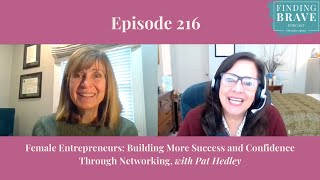
Podcast episode of Finding Brave (late Feb) hosted by Kathy Caprino featuring Pat Headley. They discuss how female entrepreneurs can build success, confidence, and access funding through proactive networking—practical tactics (LinkedIn research, outreach, creating advisory networks), mindset shifts (curiosity, offering value), and how networking aids fundraising and vetting ideas. The episode includes anecdotes, concrete outreach tips, and resources to find Pat (LinkedIn, meet100people.com).
Chapters
Hi folks, Kathy here with a quick note for anyone listening who is a coach or is running a coaching practice or business. I'm excited to share that I'm offering a free 90 minute webinar training March 1st at noon Eastern on up level youl coaching Business. This Key steps to Building More Success, Impact and Recognition As a coach, I'll be sharing my top hard earned lessons and strategies from 16 years of running my own coaching business on how to make a bigger impact with your clients and grow your success. This year I'll share share straight, no nonsense talk about what I've experienced and seen are the seven worst blunders coaches make and how to avoid them, the most damaging myths coaches are taught about how to be successful that are dead wrong, and the critical steps coaches need to take to build more financial and emotional reward in their work today. I hope you'll check it out@kathy caprino.com uplevel2022. I'm confident it'll be eye opening and instrumental for you. Hope to see you there. Thanks.
In the process of networking, you hone your story. You actually get a better idea of what you're trying to convey, how people are reacting to it, and how you need to modify it over time to become even better at telling your story.
Hello everyone, this is Kathy Caprino and welcome to my podcast, Finding Brave. I've created the show for everyone who longs to create something something bold and brave in their life, to rise up, speak up and stand up for who they are and to reach their highest and biggest visions. Each week I'll be speaking with inspiring guests from all walks of business, leadership, entertainment, the creative arts and the entrepreneurial world. And they'll be sharing their intimate stories of Finding Brave and offer their best strategies for building your most rewarding, joyful and meaningful life, business and career. Hello everybody. Welcome to another episode of Finding Brave. This comes to you, I think, end of February. So I hope you've been having a wonderful second month of the year and it's not too, not too challenging in.
A lot of ways.
And I am so excited to talk to our guest today on a topic that we have not really covered in great depth on finding brave. After 200 blip episodes, we have the amazing and inspiring Pat Headley here with us today to talk about let's get the title Right Female entrepreneurs building more Success and confidence and also acquiring more funding through networking. So we were just chatting about we hear a lot about networking for women in the corporate arena. I don't think we hear enough about how essential it is for success in the entrepreneurial arena. Would you agree with that, Pat?
I would definitely agree with that. And I would also say it's incredibly important in the entrepreneurial arena. It sets the foundation for future success. It helps ensure funding. I mean, there are all sorts of benefits that we can talk about.
Good.
We're going to dive in.
But first, folks, let me tell you about Pat. It's so inspiring. Pat Headley is an investor advisor and the Author of Meet 100 People, a How to Guide to the Career and Life Edge Everyone is missing. I love it. Pat spent nearly 30 years at Global growth investment firm General Atlantic and now invests privately. She has a special interest and passion, I would say, in supporting and advising female entrepreneurs. And we did a very interesting Forbes interview recently on the same topic and Pat and I were discussing the feedback we've gotten and I will link to it below. You won't want to miss it, but let us absolutely dive in. First of all, your book is a few years old. Meet 100 people. I love it. What you know, we can with with your experience, you could have written probably 20 different books or 100 different books. What drove you to write a book about this topic? Let's talk. Let's start there.
Look, I was inspired to write about this topic for three main reasons. It is advice I wish I had had when I was first starting out. I was somewhat young and naive as I started my career. My parents were immigrants from Hungary. They were not well networked and by nature I thought of myself as a more reserved, shy person. So if someone had told me how important it was to focus on your network, I think I would have accelerated certain things in my life and in my career. So that was reason number one. It's really to pay it forward and to give other people the benefit of my experience and my advice. The second reason is that I have had experience with a lot of young professionals, with a lot of young entrepreneurs, and with my own three adult children gainfully employed, I'm happy to say, beyond their first jobs. And I've seen the kind of experiences they've had in meeting people and going out and trying to network. And I have found that some of them struggle with it. You know, it's easy to say go network, but a lot of people don't understand what it means. And so I wrote this as a how to guide. It's very tactical. It's something that you can pick up and talk about and it actually spells out exactly what you need to do, which I find to be very useful. And the third reason. Yeah, one more reason. Yeah, third reason is that even after a 30 year career and what one might argue is an incredibly expansive network, in doing what I'm doing now, I had to recreate a network. I'm working with very different kind of people, younger entrepreneurs, smaller companies than I did previously. And so I'm not waiting for the phone to ring. I'm meeting people. I'm being proactive. I am expanding my network. And it's been unbelievably joyful and beneficial. And the story of what's happened with my book has just reinforced that message all the more. How important talking to people about what you're doing and building connections and relationships and helping other people really helps you.
I so love it and I so relate. Can I amplify two things I'm hearing and you tell me a little more about it? First of all, I adore that you have had to go back and build a new kind of network because, you know, I am a coach, you are an advisor, mentor. When we are not doing the work that we are saying others should do, we get stale. And you are doing it and I am doing it in terms of reaching out for help with my course. The most powerful you just as you know, because we talked about it, trying to get it in the hands of organizations that want to advance women. This is not my world typically. So every single day I am doing some form of outreach and it reminds you not only, okay, I can do this, I know how to do it, but also how to hone it. So I love it that you're in the arena doing it. But another thing I want to ask you here. Would you say that you're an introvert?
I would say that I am very happy being on my own. I love to read. I like to do solo activities. However, having said that, what I have found is that I'm very deeply curious and my curiosity overcomes my natural reservedness. And I actually love meeting people. I find joy in the process of learning from others. And if you view meeting people as a learning experience, as one where you're actually seeking treasures, and every single one of us has a treasure, at least one, probably several. The goal is to find that treasure and to learn from it and in the process, share of yourself. And if you think of it that way, it changes everything. It actually makes the process of meeting people and building a network joyful and life affirming, as opposed to intimidating and scary, which is what some people might think of if they haven't really been proactive.
I so love that. And I think let's dive in about what you're seeing, especially younger women struggling with, in terms of networking. And I think you've nailed it. You know, two young people working for the same company I was speaking to, and one is really comfortable speaking to the very senior person and they have a monthly call and he kind of can't wait. And it's not a struggle, although he, although he is an introvert. The other, both young, in their 20s, the other says, I don't know what to say to the senior guy. I don't even know where to begin. And the first person says, I find that interesting that he doesn't know where to begin because it's just about what you're curious about. So if you just hone in on what I mean, I do this on the podcast. What. What do I not understand of everything you just said? What piques my interest? What is a different take from what I understand? I think if you hang on to that, it's going to be able to. What's the word? Intervene. When you get nervous and think, what am I supposed to ask? What am I supposed to say? Is that right? Is that a jumping off point that you teach people?
Yes, it is definitely a jumping off point. And I completely agree that you have to find something that piques your interest. But I actually take it one step, you know, further than that. I think the first step is to actually do some research, because you can't go into a meeting with somebody not knowing anything because of course then you're going to be nervous. But there are so many tools available to us to learn a little bit more about someone before we meet. The very first thing that I do before I meet someone new is I go on LinkedIn and I find that person on LinkedIn. I try to connect with them, but I look at their background. I see which contacts we share in common. That's such an important data point to be able to establish. I see what work they've done, where they went to school, what articles they may have liked or written about. I feel like I'm well armed. I have a little bit of advance information which I think is doing your research. It's very simple. Then I think about what may we have in common, where we could jump off and at least have a conversation. Did we go to the same school, have any of the same experiences, know the similar people? Sometimes it's just, you know, this person, I know this person. Let's talk about that. That's a great jumping off point. And I also think it's important, in addition to doing the research, is to in advance write down a couple of questions that you'd like to ask. And the very first question that I love asking people, especially if I'm at a conference and I'm sitting next to someone, I say, tell me about yourself. How simple is that?
And everyone loves to tell about themselves. Who says that? I don't want to.
They share. They share. And look, if you're a brand new person in a new job, especially a junior person, that is the best opportunity to reach out to practically anyone in the firm and say, I just joined the firm, I'm really interested and I want to learn. Can you tell me about yourself and about your career today? Can you give me some information about how to be successful or what are the things that I should know being brand new in this role? And I will guarantee you, nine times out of 10, the other person will be happy to talk to you because they've been there before. And for them to pay it forward and help you out is something that somebody else did for them. And it's so much easier to do this the first few weeks, the first few months than it is to do it two, three years in, right? So you got to do it right away. You got to jump into the deep end of that pool and start swimming. Call the person that you're working for and say, can I have a 15 minute virtual coffee with you? Call somebody that you're in, or go to somebody that you're in an office with, if you're actually back in the office and say, can we grab lunch together? I'd love to learn from you. Like, who doesn't respond well to an outreach like that? Remember, I always tell young people, and frankly, I tell this to myself, life is all about learning. You're learning until you're breathing. And so if you go approach other people with this spirit of humility and a desire to learn and a desire to share and be helpful. So that's kind of another piece of it that I'll talk about. Everything is different. And you know, this desire to be helpful. When you do your research, you discover a little bit about what that person might be interested in. If you can add value to that, find an article, think of a book you read, think of a conference, think of something that they might be interested in that's valuable too. And it doesn't have to happen at that first meeting. Frankly, if it happens three months later, it helps cement and build the relationship. And I'll give you one quick anecdote on that, which is one of my favorites. I was at a conference talking about my book, and a young woman came up to me and said, would you have coffee with me? Now, this was an alumni organization. She went to the same college I did. And of course I said yes. We met for coffee. We had a great conversation. She asked for advice. She actually asked me to lunch. So we had a follow up, and we went to lunch together. Three months later, she said, pat, I'd like to nominate you to be a TEDx speaker. Oh, she didn't know that that was on my bucket list. And in fact, when she reached out, I said, victoria, that's always been on my bucket list. It's so great that you mentioned that. Yes, please do nominate me. She did. I was accepted. I did a TedX talk. It would never have happened if it weren't for this young woman to whom I was giving advice. So she gave me the greatest gift ever without realizing it at the time. Nor was there any expectation on my side that she would be helpful to me. But I love telling this story. I'm grateful to Victoria to this day because she gave me the beautiful gift of, you know, making me aware of something that I otherwise would not have known about.
I so love it. So let me. Let me pull out two things that I think really deserve to be reiterated or amplified. You know, I had a bit of the opposite happen in a way I've never had it happen. Last week, where I have this rule that if someone I really respect who I'm a colleague of suggests that I talk to someone, I don't care what happens. I'm talking to that person. I don't care if it sounds like we have nothing in common. I'm talking to that person. That's how we. We spoke. The wonderful Judy Robinette. Well, this wonderful fellow recommended a person and said, I think you're in a similar swim lane. So I reached out about what I was doing and even said, would you like to join me on the podcast? So, speaking about trying to be of value, she wrote back and said, I used to be doing that, but now I'm doing this, and I have to decline having a conversation with you to be protective of my time.
Oh, my goodness.
Well, I'm giving you all a cautionary tale about this. This is how I view it, and it's worked well. And I would guess you're aligned with this patient. Sometimes in the immediate moment of a quick email, you're not Seeing where you intersect. But our worlds are so much bigger than that, and our brains are so. And our hearts are so much bigger than that that I, you know, don't get me wrong, I can't speak to everyone who reaches out to speak to. So I'm not saying we have to say yes to everyone, but when a colleague that you respect suggests I think something's going to be there between you, I would be careful saying no for the reason that you don't look like you're in the swim lane that I'm in. Does that make sense to you?
It totally makes sense to me. And I will tell you, I learned this a little bit the hard way when I was in my prior role. Occasionally people would introduce me to someone and sometimes not with the same intention that you had described. Where they knew we would connect. It was almost like just meet this person. And I sometimes might have had lower expectations going in. Every single time. I was wrong. I was wrong because at the end of the conversation, we both. Both of us found something of value. And I would argue it is rare that when you have a conversation with somebody else, there is not some nugget of value in that. If you put real effort into it so you care about it.
If you're looking for it, you will find you're like, prove to me that you're worth me talking to. You're not going to find it.
You're not going to find it. But if you go into it with the right spirit, and I must admit, I. Oh, Even though I had doubts, I went into it with the right spirit of discovery and learning every single time I came out. And I thought, wow, that was so very interesting. And I learned a lot. Which says.
Speaks so much about you, too, Pat. You know?
Well, I mean, it speaks so much about the fact that everyone has a treasure and everyone has something to share and to give. And I amplify that.
Pat, do you mind before. And then I'm going to let you speak. This is a thing I hear from a lot of young people and a lot of people who have confidence issues. They don't think they have anything they can give to this illustrious person they're speaking with. Now, your example, was it Victoria? About the Victoria. But I think that, frankly, you have something to give that is precious and valuable to every person you speak to. Judy, you know, I tell the story, but I'm going to tell it again. You know, I interviewed her on Forbes. She swooped in two months later. Hi, here's what's happening. What can I do for you. And I thought, can't believe she's asking. And then I said to her she was a huge help on a particular thing. And I said, what can I do for you, not having any idea what I could do for Judy. And she said, I have a bio that I have to write and I don't really love writing those, but I need it for a website or whatever, the back of a book. What do you think? I said, of course. And I literally did it in 15 minutes because I'm a writer.
Right. So that's what you do.
What? Yeah. What I want you all to remember is you do have a gift. It may not be immediately apparent, but don't think, think this person is 100 steps ahead of me. I have nothing. Would you agree with that?
I would 100% agree with that. And I really want to reinforce that message to young people because that sometimes holds them back from reaching out to more experienced people. And they think, well, what can I offer? And I will tell you right up front, the most important thing you offer as a young person is a window into the future. A window that sometimes the more senior person might not get to peer through unless they have interactions with somebody younger whose eyes are looking at the world in a different way than the more experienced person's eyes ever can. You do have something to offer. The books you read, the interests you have, the things you see, the people you know, the trends that you foresee, all matter. I love asking young people, what are your favorite apps? Because that gives me exposure to what's current, what's new. And so absolutely do not hold back because you don't think you have something to give because you do 100% fantastically right now.
Can I pivot a little and talk about how networking and connecting with people directly impacts your ability to get funding?
Yes.
Let's hear it.
Sure. I will say so. I invest in and I advise growth companies. Many of these companies are smaller companies. They're not hundred million dollar companies. And one of the things that really matters to me is that when I meet the entrepreneur, do they have a more extensive network? Are they meeting investors before they need investors? Because if you leave it to the last minute, it's going to be much harder. Are they interviewing talent and getting exposure to what good looks like before they need to pull the trigger and hire people? Because if you're waiting to just at the point where you're going to hire you know what, you're not going to be able to identify that it's going to Take you that much longer. Are you the kind of entrepreneur that gathers smart people around you, that finds advisors who have expertise that you don't have that you're going to learn from? In essence, are you looking for teachers along the way? And if you are the kind of entrepreneur who understands that you're not doing this alone because nobody does. And you need to find those counselors, advisors, mentors, whatever you call them, but people who will help guide you, then you're going to be much more successful than somebody who doesn't do that.
I love it. Go ahead.
When I find entrepreneurs who have a good advisory network and they already have an idea of the kind of investors that they might need, and they've had conversations like that, that impresses me. And it makes me think this person does their homework and this person listens to outside advisors. And I think that anytime you make an investment, you are making a bet. But I'm willing to bet on that horse.
All right. Now, sometimes I have a psychic ability to hear what my listeners are thinking when my guests speak. So several questions here. I think if someone's listening who hasn't done anything of what you said, it's overwhelming. And they might have questions like, and I don't know if you can share this, but okay, you're not talking about investing in $10 million businesses. They're small. Can you share a few really brass tax things? Number one, when you say I want to vet the size of your network, what are you actually looking at? If you want to vet who they have as an advisory team, how big is it? Who are you looking at? Who do you think is impressive? Number three, when you have none of these things, where do you suggest these young female entrepreneurs go to? Where am I going to meet an advisor? Where am I going to meet a potential investor? Where am I even going to begin to staff, to consider staffing when I don't have a position to staff? Can we give them really practical things that they're all going to be scribbling like, now I know what to do. Thank you. Thank you.
Sure. Look, I had an incredibly impressive conversation with a young entrepreneur this morning. She told me about a business platform that she was building, and she told me that she had contact with a chief marketing officer of a company in a somewhat related field who she met through her own network. And I don't know if it was a college network or not, but I think that's a very good first, you know, first place to look and told her about her business plan, got her excited enough to have her as an investor. And this other person who she, you know, had this conversation with was someone who seemed very respectable with a very well performing public company. And then she talked about a couple of other advisors that she also brought along the way. That conversation to me was quite impressive because that individual had first of all done some homework and thought about comparable companies, what she aspired to be, tried to identify some individuals who already had that experience, which she did not, and tap into them and made it her own. Now the first step to that is figuring out who are those impressive people. And I very strongly urge people to have a list of aspirational people they'd like to meet. And sometimes the aspiration can be very big and broad. It could be in the if I could only meet this person, I would love it. Or it can be very specific. If I could meet somebody who is the chief marketing officer for a travel related company, that would be really valuable to me. So find travel related companies, identify chief marketing officers, do a LinkedIn reach out, say I'm working on a business. Find something else you might have in common. I love having people who have either work experiences in common or college universities in common. For example, we both worked at Bain & Co. And I'd love to spend 15, 20 minutes with you. Don't ask for a lot of most people will give you 15, 20 minutes to share my idea and get your perspective on it. Would you be willing to have a virtual coffee with me or virtual lunch with me? Or if in fact you could get a real life one, you go for that as well. You start, you start small and you build out. And one of the most make it.
Sound very easy, Pat. It's great.
Well, the hardest part, Kathy, the hardest part is making the outreach is actually yourself. That you should do it is writing the email is, you know, sending the LinkedIn request with a note. You can't just link in cold.
Oh, never, never.
Right, right. Send. If you write the thoughtful note about why people do reach out, people do say yes. And if in fact they, you know, you get crickets, which happens. Or if in fact they decline, like in your situation, honestly, it's much more about them than it is you.
That's right. Don't take it personally.
Don't, don't take it personally. Who knows what the woman was going through that declined. She may have had family issues, she may have had job issues. There's so many things. So if somebody declines, if somebody says nothing, so what if somebody actually says no, so what? That's no. Today it may not be no tomorrow.
And there's no reflection on your worth. Maybe your outreach has to be tweaked a little. Okay. Maybe if you're getting 10 crickets or 10 rejections, maybe one of your advisors will take a look at your outreach. Oh, there was a question that came up. Oh, for people that feel like I'm too embarrassed to even ask this, I'm going to ask it for them. When you said that this individual already had this person as an investor, can you tell me what's the level of financial investment that you think is a, is a real investment? What kind of dollars are, is one talking about here?
Look, I mean, this is so, so broad and it really depends. I saw some statistic that most businesses are, are really quite small, under a million in revenue. And you know, the. It depends on what stage you're at and how much funding you're raising. I mean, some of the companies I talked to are raising anywhere from a million to $10 million in funding. And so, you know, individuals who might invest that could range anywhere from 5,000 to half a million. I mean, there's a helpful range. Wonderful.
I want people listening who, you know, think they can get 10,000 from a great advisor, but think it's way too small to hear your wor.
It varies. It depends on the size of the company, the aspirations that you have, how far along you are, whether you do eventually want to get institutional funding as opposed to angel funding or family and friends funding. I mean, it very much depends on the scale. So, you know, it's hard to give a specific answer because your audience is very broad. And I certainly would want to encourage anyone who has aspirations to start a business to do that. And there are sources for capital for any level. It just depends on how much hustle and work you put into it to be able to access that funding.
So. Great. I'm aware of our time. Can I ask one other question as it relates to people in your circle, in your tribe, in your sphere, in your network, who help you? How do you vet an idea, a great idea? I'm sure there's boxes that you're ticking off that helps you say, yeah, they've got it. And in what way can other people help you vet an idea? Can we?
That's a very good question. Look, there's so much to be said for who refers an idea or who refers a person. So I find that there are people whose judgment I respect, who are knowledgeable, who have had good experience. And when they suggest that, I take a look at an opportunity that already has a higher chance of something happening than if it's a cold call. Cold calls are hard to do. You do have to find people who will refer you, who will recommend you. And that's why the networking piece is so important. And for some people, they have to do a lot more networking. And in the process of networking, you hone your story. You actually get a better idea of what you're trying to convey, how people are reacting to it, and how you need to modify it over time to become even better at telling your story. So much of raising capital is in telling the story and building the vision of what you're hoping to accomplish. And the better you can do that, the more you can gather not just the capital support, but the intellectual support, the expertise that you need to actually take your vision and make it into reality. And so talking to people and finding the right people who can be the most helpful to you is probably one of the biggest challenges and one of the most important challenges any entrepreneur can undertake.
Oh, I love it so much. And I think it also even falls into the realm of, you know, I used to be a qualitative and quantitative researcher for a big book club company, publishing company. I adore research and now I see how research and we can do it in such cost effective ways, whether it's survey monkey or type form or, you know, I did a survey for my book and course when you have actual data that isn't just your five friends as well, but actual data that 98% of women are having at least one of these power gaps and 75% of three or more or whatever it is, there's even more evidence for the appeal or the need and that involves people as well. So it's all about, it's all about your audience, your market, your network and you know, your story. Reminds me for anyone who's ever trying to write a book, there's a lot of fantastic writers out there. Getting published is very difficult, as you know, and getting published from a reputable, by reputable publisher is very hard. And what we often need is a great agent. Well, it's the same thing that you're talking about. The agent is solicited a thousand times a week and they can't respond to everything. But if one of their authors recommends this new author, they will open that email.
It makes a big difference. Recommends.
It's so, so wonderful. Any last words about networking female entrepreneurs? Maybe we can leave them with the one biggest gap you're seeing that they could close.
Look, I very Much believe in personal responsibility and accountability. And I think my parting word is it starts with you. You can make this happen. And in fact, no one else can really make it happen for you unless you embrace them and have them as part of your team. But it really does have to start with you and with you saying, I can do this. I can reach out to others. I'm not going to wait for people to come to me. I am going to make the outreach. I am going to ask for what I need. And that's a real nugget, too. If you need something, other people are willing to help you, but you have to help them help you.
There's no other word I want to add to that.
It's perfect.
Where do we learn about you? Where do we soak up your wonderful, juicy information and tips? Where do we send people?
Pat? Sure. Well, absolutely. Come to LinkedIn and find me there. Pat Headley. I do publish articles I certainly like and share a fair bit. Come to my website, meet 100people.com, and you can find a little bit more about my book. And also come to Medium. I do publish from time to time. And one of my goals for 2022 is to add a little bit more to my, to my writing on Medium.
Beautiful. And of course, those are all going to be linked below. We would so love to hear from you people. Pat, that was just so rich. You know what? I love to. It's tactical. It's it. You and I have heard 2 million times that you need to build a network, but some people really have no idea the first steps to take. And I think you've really given that in, in great depth. All right, people, we would love to hear from you. Wherever you see this social media course, ask a question, say I listen. Pat. And, and I've taken these steps. Demonstrate that, you know, when, when we are building mentorship and advisor relationships, you need to demonstrate your potential. As Pat is saying, demonstrate I did this. I did this. Here's where I'm a little stuck. And I'm pretty sure if Pat has the time, she'll respond, and I certainly will as well. I hope you feel inspired. You can do this. And you know what? The world needs you to do it. The world needs your ideas and your new app and your new business. But you have to meet the universe halfway and really get out there. Thank you, Pat. Thank you so much. Come back again.
Thank you so much. Kathy. What a. What a wonderful opportunity. I really appreciate it.
Thank you. Thank you so much. All right, everybody, have a wonderful week and we will see you next time. Hello, Kathy here and thank you so much for tuning into today's episode. I hope you loved it. One quick thing I'd love to share before you go is about my new digital training course, the Most Powerful you, which is the companion to my book the Most Powerful seven Bravery Boosting Paths to Career Bliss. I'm so thrilled that recently a division of the largest intergovernmental agency in the world sponsored several memberships to the Most Powerful U course for members of their staff. And what a powerful move that is in terms of bringing real world effective training to both men and women to help them thrive in the workforce. Coaching so many people, as I do each year, I see that leadership and career growth training programs today are so often not effective because they simply don't go deep enough to address what really holds us back from thriving. Believing in ourselves, understanding our talents and abilities, communicating effectively, asking for what we need and deserve, networking to build a great support community, and making the impact we long to so I'd love to make an ask of you and that is to briefly take a look at what I'm teaching in the Most Powerful you course and you can find that@mostpowerful you.com and if you feel that the content about the seven damaging power gaps and how to close those for good would be helpful for you and people at your organization, I hope you'll ask your supervisors, HR leaders, and diversity and inclusion managers to sponsor memberships of this course for you and other staff so that you can all thrive at the highest level in your roles and organizations. Thank you so much. And here's to you becoming the most powerful you. Thanks so much for joining us today. And please don't forget to check out findingbrave.org for more programs, resources and tips. And tune in next time for your weekly dose of finding Brave.
More from Kathy


Elevate Yourself, Elevate Others, and Amplify Good | Chris Cooper | Finding Brave Ep. 334

Finding Brave Epis #333: How Leaders Can Harness AI Without Losing Their Humanity, w/Bennett Borden

Finding Brave Epis 332- How to Stay Brave, Valuable and Visible in the Age of AI, with Raman Rai

Finding Brave Epis 331 - The Power of Positive Disruption, with Dr. Patrick Leddin


Finding Brave Epis 330 - Being 40: Letting Go and Embracing Who You Are, with Stacey Lindsay

Disrupt Career Reinvention with Kathy Caprino - via The Disruption Lab Podcast w/Patrick Leddin

Creating Neurodiversity-Friendly Work Cultures: Simple Workplace Adjustments Matter

Finding Brave Epis 329 - How To Create a Neurodiversity-Friendly Workplace, with Kristen Pressner

Finding Brave Epis. 328: Reclaiming the Power to Trust Your Own Voice, with Dr. Cindy McGovern