220: Part 2: Why Happy People Are Annoying, with Josh Peck
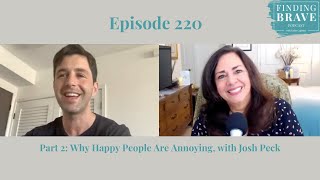
This is Part 2 of a Finding Brave podcast episode (host Kathy Caprino) featuring actor/author Josh Peck discussing his memoir, weight loss, addiction recovery, parenting, public relationships, and personal growth. The conversation touches on writing a memoir, losing 100 pounds, 12-step recovery, fatherhood, and managing public fallout from relationships (e.g., with Drake). The episode includes brief promotional plugs for Kathy's courses and newsletter and for Josh's book/podcast.
Chapters
Hello Kathy here and thank you so much for tuning into today's episode. One quick thing I'd love to share is about my new digital training course the Most Powerful youl, which is the companion to my book the Most Powerful seven Bravery Boosting Paths to Career Bliss. I'm so thrilled that recently a division of the largest intergovernmental agency in the world sponsored several memberships to the Most Powerful U course for members of their staff. And what a powerful move that is in terms of bringing real world effective training to both men and women to help them thrive in the workforce. Coaching so many people as I do each year, I see that leadership and career growth training programs today are so often not effective because they simply don't go deep enough to address what really holds us back from thriving. Believing in ourselves, understanding our talents and abilities, communicating effectively, asking for what we need and deserve, networking to build a great support community and making the impact we long to so I'd love to make an ask of you and that is to briefly take a look at what I'm teaching in the Most Powerful you course and you can find that@mostpowerful you.com and if you feel that the content about the seven damaging power gaps and how to close those for good would be helpful for you and people at your organization, I hope you'll ask your supervisors, HR leaders, and diversity and inclusion managers to sponsor memberships of this course for you and other staff so that you can all thrive at the highest level in your roles and organizations. Thank you so much and here's to you becoming the most powerful you.
I knew that if it was between becoming a movie star but staying that size or just becoming a civilian who had a normal job and being healthy, I would have picked that in a second.
Hello everyone, this is Kathy Caprino and welcome to my podcast, Finding Brave. I've created this show for everyone who longs to create something bold and brave in their life, to rise up, speak up and stand up for who they are and to reach their highest and biggest visions. Each week I'll be speaking with inspiring guests from all walks of business, leadership, entertainment, the creative arts and the entrepreneurial world. And they'll be sharing their intimate stories of Finding Brave and offer their best strategies for building your most rewarding, joyful and meaningful life, business and career. Hello everyone, Kathy here. Just a quick note that this is part two of our two part series with Josh Peck. Don't forget to tune in to last week's show for all of Part one. I know you'll enjoy It. All right, More. So you in the book, you talk about. Well, first of all, you took two years to write this. I've written two books. It's a massive endeavor, isn't it, to write a book.
Yes.
Like, turns you inside and out. Especially a memoir, I would think. Written a memoir, right, you're like having to relive all of what you're trying to share in a helpful way. So bravo to you.
It just feels like homework. You're like having ptsd. You feel like you're back at social studies. You're like, oh, God.
I remember having to. You know, I knew I had to get a chapter done that week, and I. I'd come up with a million excuses not to sit down and write it. Let me wash the floor. And I haven't washed the floor in a year. You know, Exactly. I give you credit. But you talk about all of it, you know, being in TV all this time and. And you talk about the Drake and Josh experience, too, don't you? And they're not. All of it was rosy, even if it all looked rosy to us. Right. So, you know, I'd ask you, there's so much that you share. What would you want? Readers. And first of all, who do you think your biggest target audience is? You know, people your age or etc. But what would you want the biggest three takeaways to be?
Well, I think that the reason why. I think it might be the most millennial thing I've ever done, which is write a memoir. At 35, I wanted to write something from the halfway point, and I knew that my life had gone through. I had had an inflection point in my early 30s between getting married and having a kid, of really looking at how much my identity was wrapped up in what you thought of me and what the world thought of me and validation and this thing. I think even if it's not as extreme as being on television, so much of our identity is wrapped up in the conclusions we made when we were adolescents and we were young and the things that we thought we should have been or the people that we always thought we wanted to be. And that can be in conflict with who we become. And it was facing that that I wanted to share that with anyone who followed me. So I guess, in a weird way, this book is certainly for people my age and younger who grew up with me. But I hope that, you know, I've so benefited from this, the perspective of others, this idea of me, too, that I walked through what you're going through a Couple years ago and I was able to get through it with grace. I love this idea of the rock wall and that I like advice from people that are 20ft above me on the same rock wall. The guy that summited the peak and is looking down from there, hundreds of feet above, pounding the Gatorade and enjoying the sun. I'm like, you don't know what I'm going through. Are going to break. Don't give me, I don't want your advice. But someone who's 20ft above and says, hey, I just use that hold a few minutes ago and it felt really good, I would suggest you try it. That's, that to me has always been powerful and that's what I wanted to do in this book. So I hope that because people have grown up with me, that it's somewhat of a qualifier to know that I'm not BSing them.
How beautiful. You know, you make me think, here I am at 61. Unless, unless you're, you know, really evolved as a human. I, I think even, not even, especially at as you age, you took paths and they inevitably took you way down a direction. And you know, I, I, I'm very happy with my life, but there are times I'll go to this kind of gut punch place where, gosh, I really took this road, you know, So I think people at my age can read your book and remember what we should remember that, you know, we're still evolving. Even my mom's 97 got through Covid. You know, we still evolve, we still learn. So even when you're 60, it's, you haven't, you're not at the summit. I don't think you know what I mean. People look at you, look at us older people and say, well, you did this and you wrote this. And you know, it's not, we're still learning. You know, I just need people to understand that. All right, back to you. You've had, I mean, I call them demons. That's one word. One, you know, addiction. And you lost £100. Can you, for those of us who struggle with, you know, any gradient of, of those things, weight issues or self image issues or addiction. How did you do it? What do you think? I mean, that's a long story in and of itself, and it's all in your book. But how do you think you accomplished that losing £100 and what that did for you and, and dealing with addiction? Can you tell us a little bit about it? Deep. We're going deep here.
I love it. No, I, I think I, I lost 100 pounds. And what, what instigated that was, I was really, I was sick and tired of my way, I tried it my way for so many years. You know, I'd started d Monday and by Tuesday night I'd be like, what happened? And then the pattern would, would repeat itself. And throughout the years, people have sort of looked at me and asked me if I had any, any hack or secret to losing weight because it was so public. And, and I want to share something with them because I know how badly I wanted a secret. I think we're all, whatever size we are, no matter what, everyone in the world is looking for a secret about how to lose weight. And, and what I tell them is, here's my secret, is that if you're sick and tired and you're feeling at a bottom and slightly hopeless and just so frustrated with your way, I'm sorry that you're going through that because I know how painful that is. But the good news is it's a great place to start. And I never learned anything on a good day. Pain has been the great motivator of my life. And I just know that that's where great things can be born. In those moments where you're crying out to the world about what to do next. So I lost the weight. But then of course I was 110lbs lighter in a new body, but with the same head. And so at 18, when I found drugs and alcohol, I was like, oh, this is so much more efficacious, so much less calories. And that led to a four year sort of vision quest where I was just solidly trying to become a cliche more and more every single day until again I was left in that same place. Everything that I've used outside of myself to make me feel okay with the world, be it food or drugs and alcohol or prestige or romance, you know, someone thinks I'm attractive and oh God, that I must be okay. It's finite and it's short lived and it always leaves me in the same place. And So I, at 21, realized that I needed to get my life together. And I was able to do it with the help of 12 Step that because I knew that I was bottomless, I had tried everything and nothing could fill me up. So it had to be an inside job.
Oh, wow. And you mentioned, I'm assuming that losing the weight, it brought different things than you would have imagined. Is that right? Did anybody push back? Did anyone not like it for you? Did anyone? Was it all positive feedback? You Got.
Oh, no way. Of course not so many well meaning people who are like. But you have a niche. Like, you're the funny fat guy. Like, that's, that's historically a win. And you're also in a small pool, right? There's only a couple people like you. If you lose weight, like, you're going to start auditioning against Jake Gyllenhaal. I mean, not really, but you know what I'm saying? You're going to enter the ranks of, like, where there's a giant pool of people fighting for that job. Right? I'm sure this is what you want. And I knew that if it was between becoming a, you know, a movie star, but staying that size or just becoming a civilian who had a normal job and, and being healthy, that's what I, that I would have picked that in a second. And, and then also just dealing with the fact that, yes, so much of the world was, was unbelievably supportive. And I remember I would run around to see people I hadn't seen in years because I loved watching their jaw drop. When you see someone lose over £100, it's a big change. But, but I was certainly navigating, like I mentioned those message boards of people who were sad because they felt like they had lost someone they had grown to love because the person they married themselves to was this big funny guy on Drake and Josh. And I felt like comedically I was still the same guy, but to them they were like, why are you trying so hard? Or you were funnier when you were fat and sad.
And, and is it also that they identified with you? You were safe to them. You weren't someone who physically made them feel inferior. Is that what they were letting go of? Like, damn, you let me down?
It's a great insight, I think, and I've never even thought of it that deeply, but I think you make a great point. Yeah, I think so. Not, not physically intimidating, because I go through that now where I'll see, you know, an action star on the screen, and I'll be like, I got to go to the gym, boy.
Oh, like Chris Hemsworth. I'm like, what? How did that happen over there? You know?
Oh, please. It's not fair. I don't know if I say this in the book, but I'm like, chris is short for Christ. And it makes sense with Chris because he's just godly.
Darn it. All right, well, there we go with that. You're so honest. You're so honest. Tell us. There's so Much about. Tell me what you want to focus on. There's growing up without a dad. There's growing up with financial. Significant financial difficulties and how that's shaped you. There's now. Now your dad. You're a dad of Max and. And what it is to be a parent. What do you want to talk about? The past or the future or where you are now?
Yeah, we might as well go future, right? I mean, keep it in now. Keep it in the press.
Let's do that. What is it like for you to be a parent? And doesn't it. Isn't it crazy how it brings up so much of what you experienced as a child? And that can be good. That can. It's like, oh, there it is. Like, now, with my mom at 97 and dad in heaven, I'm like, oh, my God. I understand so much about my mother and what she went through with us that I never really understood. Does that resonate with you? Well, your kid is young.
Absolutely. And, like, you talk like, my mom was older when she had me. She was 43. And so she's 77 now, and I'm 35. And it's so funny, because we were. My best friend, who's been my best friend since we were 14, and he recently lost his mother, and so he's like, very. You know, he. He's very implicit in conveying to me how important it is to cherish the fact that I have my mom, which I always do. But we've been. You know, it's just been her and I my whole life. So we. We certainly can get into it. And because we're very similar.
Close. Yeah.
And I think I was venting to him one day. He's like, but look at you. He's like. Like, your mom made a good dude. Like, you're a respectable guy. Like, you have a wife and a kid. Like, you're a good person. Like, so despite, like, any misgivings or feelings of, like, oh, because every child. I can't wait till Max. Is telling me all the things I could have done better. Right? And, like, you little jerk, if you only knew, like, what I went through. Right? And that's it. And that's what we do as parents, right? We. We correct generational trauma, Right? You try to give. You try to fix or give your kid what you didn't have. And I have to be reminded of that, like, I am a direct product of my mom, and I'm a good dude today. And that's so much due to her. So of course, she was imperfect because we all are. And she had a lot of challenges that other parents didn't. But overall her work was strong. And so I have to remember that.
How beautiful. And when you're in now your child's little and you're dealing with, you know, the, the real. They. One thing kids do, especially when they. You are in the here and now with them, you can't not be, you know, I mean, you're really present with them. But what are the things that you want to make sure you do as a dad that you see around you? Maybe people aren't doing well.
I think my wife, thank God for her, she's really, you know, I assumed that I would have to, like, man up on my kid at times or like, you know, lay down the law. And she's like, really? You're manning up on a three year old? Like, good stuff, you know? And she helped me to understand that there's no separation between the way you live your life and the way you talk or treat your kid. Right. So you want them to model you. And so my wife doesn't ever allow for us to, like, have conflict between her and I in front of Max. And when she's talking to him, even if he, you know, does something that he shouldn't be doing, she conveys it in a very respectful manner. And, and I mimic that because I'm smart and I listen to whatever she says.
What a wonderful balance you two have. And what a wonderful page is her name. Right?
Wow, she's good people. But she also, like, I can recognize that she doesn't. And I think it's beautiful. Like, she doesn't. She didn't have the childhood I had. She doesn't have sort of the challenges she had her own. But it was very different than me. And so I'm quick to be like, you might have a healthier outlook on life, you know, and so I'll. I will. I'll. I want to mirror that. I want to fall in step with your plan instead of like, thinking I know best.
Oh, God, Josh, Amazing. All right, one more question, but gosh, you know, there's so much in the book. People read it all. What's it like to have, you know, there was a public falling out, a little bit Twitterish Drake and you. And I think it was blown up in ways that, whatever. But what is, what is it like to have relationships that are public or what. What would you say is a. Is a truism that you want people to understand in their own relationships that you've learned in having public relationships. Does that make sense?
Absolutely. You know, basically, and what you're referencing, I sort of talk about it in the book. It has a lot to do with the way that people marry themselves to you when they first fall in love with you as a person. Former.
Wow.
And so when we finished filming When I was 19, I got married at 30 or 31, and I knew sort of like, the secret that Drake and I weren't close, but I also knew how much the show meant to people. And so I would have been happy to die with that secret and just let them believe that we were still sharing a bedroom 12 years later. But unfortunately, when I didn't invite him to my wedding, he was. He was sort of publicly came after me. And I think my biggest frustration, despite the fact that I felt like the public had it wrong, was, you know, I wanted to be protective of my wife, who was a public person and shouldn't have had to deal with sort of that in the afterglow of her wedding. But I realized that I was lucky to have great counsel in that moment because I really wanted to set the record straight and tell people, like, we haven't talked in years, and we've seen each other, you know, a handful of times over the last decade. What do you. What do you expect?
And.
And my friends who are so smart said, oh, so you're the bearer of bad news. Like, you're going to go and tell the world that you guys actually were not what they fell in love with. You can't win here. So instead, I didn't say anything, and I let my life speak for me. And it's the long game, and the long game sucks, because I really want instant gratification. I really want to dunk on someone on Twitter. I really want to get my point across. But throughout my life, you know, I've allowed my. My, you know, your character is your fate, and I've allowed a good life to be the result of good living. So, you know, I have all that same instinct. I love to. I would have loved to jump on Twitter and just gotten into a war, but it behooved me, so, you know, later to have shown some restraint.
That is a beautiful story. And what I take away from that is, first of all, when you have a beef with somebody or you're hurt, don't make it public. Just come to me. Just say, call you up. Wow, I was hurt. What, do we need the world to be involved? Right? And I was just talking to a psychologist who is a CEO coach And I was asking him about something I did that really upset someone, and they came at me in the most hostile way. I said, did I say something? He goes, yeah, kind of maybe would not have said it the way you said it. And I realized I probably had a little unconscious aggression towards that person. So the whole point is, watch yourself, work on yourself. If someone's coming at you, it's something about them, pretty much. But also, it doesn't have to be the world jumping in. In your argument.
Yes.
And so what you did was you tamped it down right there. I'm not going to let the world be a part of this. Right. Am I getting.
I think that's. No, I think you're. You're saying it perfectly. And, like, the greatest remedy to anger is time and taking a pause.
That's so true.
And it's. It's never a good. I don't know if it's ever a good look. I've even seen it. I've seen strange, strategic anger and directors or coaches where they've been like, I pick a moment or two to raise my voice on the set or. Or during the game or something to kind of like to do a big reset. And I guess it's, you know, you can argue both sides, but even though it's a. It seems effective in the moment, I feel like we are also dealing with reptilian brains on a certain level. And the moment you see someone freak out, you go, he's going to get the tribe killed. Or she's going to, you know, she's going to freak out.
Amygdala. We're looking for the tiger in the cave.
Yeah, they're going to spook the lions and they're going to come.
You're too funny. Oh, my God. I could keep you on forever. I know. You have another interview right now. Where do we learn all about you? Where do we get the book? Where do we follow you? Where do we find your new shows? Where do we go?
Oh, thank you. My Instagram issue a pack. I have a new podcast called Male Models and you can find the book at Diesel bookstores or wherever book, books or are sold.
Thank you for coming on. You are such inspiration. Thank you for your. Thank you for being you.
Thank you. I love chatting with you and you have such great insight.
Thank you, my dear. All right, everybody, we want you. We're going to post this everywhere. If you have a question, ask it. Josh is crazy busy, but we would love to hear what you think, what you get out of the book. We I would personally love that. Josh would too. I hope you're inspired, I hope you've learned a lot and I know you'll love the books. So thank you for being here. Thanks again Josh. So loved it. Have a wonderful week everybody and see you next time. Hi Kathy here and I wanted to share some information about my new digital newsletter, your Path to Career Bliss. This monthly newsletter explores one key career, leadership or personal growth topic that is essential for building a happier, more successful career or business. Business. Every issue offers a selection of the most read articles that I've ever written, along with riveting podcast interviews with some of the nation's top experts, as well as career assessments, resource recommendations, a subscriber highlight section and an Ask Kathy column and more. We've made it as affordable as possible and the first month is completely free and you can cancel at any time. I hope you'll join me in this program now. Check it out@kathy caprino.com newsletter and get your free issue today. Thank you. And here's to your path to Career Bliss. Thanks so much for joining us today and please don't forget to check out findingbrave.org for more programs, resources and tips. And tune in next time for your weekly dose of finding brave.
More from Kathy


Elevate Yourself, Elevate Others, and Amplify Good | Chris Cooper | Finding Brave Ep. 334

Finding Brave Epis #333: How Leaders Can Harness AI Without Losing Their Humanity, w/Bennett Borden

Finding Brave Epis 332- How to Stay Brave, Valuable and Visible in the Age of AI, with Raman Rai

Finding Brave Epis 331 - The Power of Positive Disruption, with Dr. Patrick Leddin


Finding Brave Epis 330 - Being 40: Letting Go and Embracing Who You Are, with Stacey Lindsay

Disrupt Career Reinvention with Kathy Caprino - via The Disruption Lab Podcast w/Patrick Leddin

Creating Neurodiversity-Friendly Work Cultures: Simple Workplace Adjustments Matter

Finding Brave Epis 329 - How To Create a Neurodiversity-Friendly Workplace, with Kristen Pressner

Finding Brave Epis. 328: Reclaiming the Power to Trust Your Own Voice, with Dr. Cindy McGovern