221: Strong Company Culture: The Antidote to the “Great Resignation” with Rose Gailey
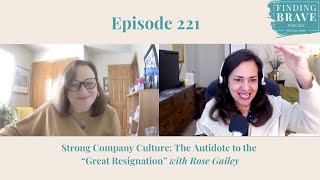
A recorded interview (podcast/YouTube) in which host Kathy Caprino speaks with Rose Gailey (Heidrick & Struggles consultant and co-author) about using strong company culture to address the Great Resignation. They discuss how CEO roles are lonelier and more emotionally demanding today (remote work, speed of change, burnout), the need for vulnerable/authentic leadership, and the difficulty leaders face on diversity/inclusion. Gailey describes how culture is assessed (research-backed surveys, leadership interviews, digital crowdsourcing, desktop review) and presents four principles for shaping culture: purposeful leadership, personal change, broad engagement, and systemic alignment. The conversation closes with action guidance for any employee (own your leadership; speak up with compassion; recognize your contributions) and resources to contact Gailey and find her book.
Chapters
Hi, Kathy here. Before we begin, I wanted to share a bit about my new video training course, the Most Powerful you, which is the companion to my latest book. In my 16 years of leadership and career coaching with thousands of professionals, I've observed what I call the seven most damaging power gaps that keep women from reaching their highest career potential. These gaps negatively impact a staggering 98% of women and 90% of men. If you long for a more successful, meaningful and impactful career and you're ready for help, please visit mostpowerfulyou.com for more information. This training will transform how you see yourself and what you're capable of achieving. And please ask your supervisors and HR leaders to bring this course to your company. It creates not only expanded individual success, but greater success of your organization as a whole. Thank you so much. And here's to becoming the most powerful you.
If culture is the antidote, how do you define it? Where are you headed? Is there a from to that's required both to embrace diversity and drive inclusion and sort of thrive in this environment? And so I think finding ways to keep your fingers on the pulse frequently is really critical.
Hello, everyone, this is Kathy Caprino and welcome to my podcast, Finding Standing Brave. I've created this show for everyone who longs to create something bold and brave in their life, to rise up, speak up, and stand up for who they are and to reach their highest and biggest visions. Each week, I'll be speaking with inspiring guests from all walks of business, leadership, entertainment, the creative arts, and the entrepreneurial world. And they'll be sharing their intimate stories of Finding Brave and offer their best strategies for building your most rewarding, joyful and meaningful life, business and career. Hello everybody, Kathy Caprino. Welcome to another episode of Finding Brave. And this one will not disappoint. I have the amazing Rose Gailey here with us today and what a perspective Rose has. You know, I just. I say this every time, but this podcast blows my mind because it teaches me things that I don't know well enough that I need to keep in mind that also fuel. And I'm saying this because I hope this is what happens to you all. Listening, it fuels my compassion. It fuels my understanding of the struggles people who are different from me have. Why that's really life changing to have that perspective. And Rose, you are it. You're going to give that to us today. So thank you for your time. I know you're crashingly busy.
No, thank you. So gracious. And really, you are so inspiring. And I just heard why this compassion that flows from you is exactly what we need right now. Certainly exactly what I need today.
Aw, right back at you. We need it. We need it. But we're also not going to pussyfoot around here. There are things that have to be said and we all have to hear them. So, people, today we are talking about strong company culture, the antidote to the great resignation. And you know, I want to tell you, I've interviewed Rose twice now for my Forbes blog and we will link to those below. The latest was rebuilding great workplace cultures as CEOs join the great Resignation. And what we were just talking about and then I'm going to tell you all about Rose, is so often when we, I mean, most of Us are not CEOs, right? Some of us run our own businesses, but most of you listening probably aren't CEOs. And I think when we are struggling, what we, as Brene Brown loves to say, we find someone to blame as a way to discharge our anxiety. And I think frankly, CEOs can be that. We go to the blame place. And CEOs are powerful. CEOs shape culture. But there's other things going on that also impact culture. So we're going to talk all about that and also what you can do to shape your work culture. This is not just the top level. It's every word we say, every action. So we're going to learn from Rose about that. But let me tell you about Rose. Rose Gailey is a partner in Global lead for Organization Acceleration and Culture Shaping for Heydrick Consulting at Heidrick and Struggles, and a co author of the book Future Shape youe Culture. Shape youe Future. What a title. All right, let's dive in here, Rose. So let's, let's not mess around. Let's ask the real question that we need to understand first. What is it like for CEOs or to be a CEO today? What do we need to understand?
It's such a great question, Kathy, and not one we ask often, probably in these difficult times where the buck stops with them at the top of their organizations. But the reality is we've always talked about that role of a lonely job, right?
Yeah.
That job has only gotten lonelier and more difficult. And I think, you know, CEOs are in a tough spot right now in the same way that every single one of us is dealing with the uncertainty of the day to day. You know, the headlines, the news headlines, difficult to swallow. And we think about the impact in our lives and our family's lives, the work teams that we have a privilege to work with. But if you think of that key leadership role these individuals are having to carry on their shoulders, the quick decisions, the difficult decisions. Fortunately not alone with, you know, in many cases, fantastic teams, wonderful chros who are counseling them and giving them perspective, as well as other colleagues on their teams. But at the end of the day, what I Keep hearing from CEOs is generally a desire to bring people together during this time. Generally a desire to enable people to be, you know, sort of comforted in this difficult time, to be successful, to be powerful, to be contributing. And I think the answers are just not easy. The clarity just isn't there for the most part.
I have so many questions even within that one statement. Two things here. Why is it lonelier today than it was? Why is that? Is it because there's so much dissension among people?
You know, I think it's more the speed of change and the speed of challenge. You know, thinking back, there was an interesting article back in 2020, really interviewing CEOs on how do you combat loneliness and what's that about? And the feeling I get is one of the ways to combat loneliness is count on your team, connect with your team. Well, they're remote as well. In many cases.
That's what you mean, remote.
Struggling to find that energy and that connection is tough, number one. Number two, we're talking about burnout at every level of the organization. I think that's true certainly for the top job as well. And many of these leaders are just having to address self care, having to address their own need for health, for nutrition, for all the things that all of us are dealing with. But at the speed of light, change is happening rapidly.
I have lots of compassion. The other thing I want to ask you, I know you have family members who are in the helping professions, one, one of your children, a teacher, one therapist, social worker. Yeah. I actually look at my time as a therapist and the training as literally life saving. Like, I literally cannot imagine what my life would be like without that. And Frankly, I think CEOs need therapeutic training. And by that I mean when we're scared, when things are changing, when there's so much flux, when people are angry, what are the best ways to communicate, to present leadership, but not this crushing, authoritarian leadership, but a loving, gentle kind of leadership. Do you see that CEOs are struggling with the emotional, vulnerable side of leading too?
Absolutely. You know, we know that in these difficult times, humanity has risen to the fore. If there is one great thing about, let's call it the great pause, reset There's a lot of great.
Yeah, there's a lot of the great reevaluation, the great. This. Yeah.
Everything that's come from this period of time. And I do think with that humanity comes the need for authenticity, vulnerability. A lot of people are talking about imposter syndrome, all of the human things. And I go back to your book, the Most Powerful you, Kathy, and really just thinking about some of those power gaps and what do you see in.
The ranks of CEOs?
So number two, power gap number two from your book, which is communicating from fear, not strength.
Wow. I don't think the vast majority of people would think CEOs struggle with that. What are they most afraid of? Creating more.
Well, I think right now we're just afraid of how long will this continue. How do we bring people back to connection and still honor the need for flexibility? What if we make the wrong call right now? How do we. What if we lose employees? There's a lot of things to face in this moment. And I think, true to your book, it's really about the reflection that has to go on for all leaders. Right. We have to be asking ourselves, we have to be confronting, as your podcast is labeled. We have to be brave and come from a place of strength and, and clarity. The sixth power gap is another one. Right, really.
Of their thrilling dream.
Dream. Right. What is the connection point between personal purpose, organizational purpose, and our dreams? And if you're bombarded by decision after decision, uncertainty, opportunity even can be overwhelming.
You know, I can relate to that.
You know, our top leader is having a moment to consider their thrilling dream and what that really means personally and true for everybody, obviously. But those are the two power gaps that I think are part and parcel of what CEOs are having to wrestle with at the moment.
You know, what you're bringing up for me, Rose, and let's see if I can say this in, in a way that isn't going to, you know, push anyone away. Often these power gaps hit women more powerfully and more negatively than men. And I'm seeing them in mid to high level professional women. But what's quite interesting is just because you're the top person in the organization doesn't mean you are insulated from not feeling brave enough, not knowing what to do, being afraid that what you do do. And here's a third thing I'd love to hear thoughts on. I'm fascinated. I spoke to Fields Jackson, who's a diversity expert in the South. What? He's an African American. He's what a Perspective. But he said what he sees leaders not doing is talking about the very issues that are on everyone's mind around diversity, around racial bias, around discrimination. They don't know what to say, and so they say nothing. But as we know in communication, saying nothing is collusion. Do you think that also with the pandemic, we also have a shifting tide around equality and equity? And what is discrimination? What is racial bias? Do we have bias? Of course, all of us have some form of biases. Do you think that this issue around diversity confuses CEOs too and keeps them up at night?
Yeah, I have no doubt it keeps them up. You know, we sort of think of, you know, the famous quote, diversity is a fact, inclusion is an act.
And so, oh, I gotta chill.
Confronting the fact of diversity right where there are gaps. What's the aspiration that organizations are all wrestling with at this moment in time? But the real challenge is the inclusive leader behavior that acts upon, creating a sense of belonging, demonstrating empathy, having courage to confront and to really be self aware and have that look in the mirror. So, you know, in a sense, all the curtains are gone and we're all sort of out there vulnerable and we are who we are. And I think communication, to your point, you know, it's interesting, as you were, as you were walking me through those ideas, a lot of it really came back to, are we having conversations? Oxygen today is communication, but telling people the answer is not what's required at the moment. It's dialogue. It's engaging in the conversation and it's.
Listening, it's willingness to change. The telling piece is that you know, everything you don't CEO and top leaders, you don't know nearly what you need to. Nobody does right now.
No. And you know, there are a lot of great vehicles out there for having a sense of what your culture is today. You know, culture is the antidote. How do you define it? Where are you headed? Is there a from to that's required both to embrace diversity and drive inclusion and sort of thrive in this environment? And so, you know, I think finding ways to keep your fingers on the pulse frequently is really critical. And you can do that a lot of ways. You can do that in town halls. You know, I know There are many CEOs who spend their days on zoom with employees at all levels of the organization. There are team leaders who are doing that as well. Critical. However, we can create that human dialogue and that human interaction. It's become absolutely a lifeline for us right now.
I wish I could be a fly on the wall of your office where, you know, you, you're doing the work of shaping culture. And it's interesting, you and I spoke a lot, but I, I think that those of us who want to make a difference, we intervene at different levels. There's the individual, that's my level. There's organizational, societal, institutional, educational, political. I find that for me, I can make a lot of headway quick individually and I love to work with individuals who have a lot of impact. So when they've had a breakthrough, it ripples to potentially thousands. You're at the organizational level, so can I just ask. Your job is to help shape culture. So how do I ask my question. And I didn't think of this before, but I'm dying to know when I'm doing. And I bet it's similar when I'm working with someone who I've never met and it's a career coaching or leadership coaching, they fill out an assessment of mine, which I've seen thousands of times. So it's almost. Not almost, it's a shortcut because I can see the way they're phrasing things, the way they think. And so they. That assessment saves us about six sessions. Honestly, I bet you have the same thing. But I'm interested. I know what I'm looking for. I'm looking for their strengths, their weaknesses in my view, or opportunities, the things they don't see in themselves, the through line, what they've always been, that they don't recognize, what's potentially holding them back. That's what I'm looking at. When you're doing shaping culture, shaping work, what do you do? How do you start?
Yeah, Kathy, I love it. And, and you know, my roots were as a therapist, as a family therapist.
Here we go.
And so there are a lot of analogies to be had there, right. For systems, be they familial or organizational, but actually very similar. And it's a great point because that assessment of culture, especially right now, is absolutely crucial to understand what are the strengths against executing a strategy in these times. What are the opportunity areas?
And do you get that through quantitative information? It's surveys, right? Anonymous surveys or how do you do that?
Well, probably again, not unlike your intake for leadership coaching, we'll come in and we do a few things. Number one, yes, we have a survey that's to going grounded in research and that's actually aligned to the key drivers of thriving cultures, which are, well, they're relationship drivers as well as organizational processes and systems. So we want to understand through the experience of the employee. What are those strengths and gaps? We interview the leadership team, and we oftentimes use a digital conversation vehicle, which is more of a crowdsourcing, where it's a conversation that we have in live chat and employees join and we hear it in their voice as well. So we can draw from that sort of the. The qualitative look. We also look at all the work that organizations do around culture. You know, they're seldom ever just at a starting point. People are very accountable and very diligent about this in today's world. And so we'll do a bit of a desktop review and take a look at what have you been learning and how do we frame that. And then you'll love this, Kathy. And it's not unlike what you do with your clients. We come back and we provide a look in the mirror. So what's all this data telling you? What's the story? Sure, we can tell you what we see, but what do you see? Because what a leadership team really sees in that revealing assessment sets the stage for the case for culture, why it matters, why now, where are we today, and where are we headed?
I get chills. Why? Because it isn't easy changing a large behemoth of an organization. Do they often feel shocked at what they're seeing?
You know, I think maybe the shocking quality is the degree of clarity that comes forward. Oftentimes, you know, they had an idea.
Like, I'm losing people, and they don't feel safe here. I mean, I sense that. But then they see the data. Yeah.
Or things are so complicated, we need more simplicity. Or there isn't enough foresight in the organization, or there's not enough coaching and feedback going on. And here's a big one, Kathy. Here's one we see. Unfortunately, a lot people don't feel valued and appreciated, and that hits hard. We observe leadership teams to really take a pause on that one. Sometimes they are surprised by that because generally people want to do the right thing and have people operate at their best. But to know what value and appreciation look like for you might be different than what it looks like for me. And so we've got to embed in an organization a sense of recognition and appreciation on a personal level.
You know, I'm thinking here, there's a few people in my life, family, friends, clients, when they share what their senior leaders do with them, I, at age 61, never once had a senior leader do it. Beautiful things. Transparent. When they can't be transparent, they say, I can't be transparent. Right now, you know, I don't really, honestly. And the other thing, I just need to say this. I realized in doing this work, I don't know, two months ago, never once did I sit down in my 18 years of corporate life and say to the people reporting me, what do you want for your career? Not this job, your career. I never asked that. So here's what I want to ask you. You know what occurred to me? For me to feel validated, respected, valued, it might be different behavior than what you need. And that reminded me, the book, the Five Love Languages. We need a five Love Languages for organizations. Is there one like for me, I want words.
Yeah.
I want to hear it. Kathy, we did that. But I also want action. It better show up in my paycheck somehow. There needs to be a bonus somehow if I've gone above and beyond. Is there like the five love Languages for corporations? Organizations?
Well, here's what I think. They're being translated as. If an organization commits to a set of values, those values become the love language of the organization. That's where people want to connect. And usually those values include a value around respect, a value around access, excellence or quality, or delivering. People get up in the morning generally wanting to do a good job and wanting to contribute in great ways. A value around accountability. You know, if you think about an organization's values, there are some of the love languages and the biggest, I love you is connected to mission and purpose. And what. Why does an organization exist beyond profit? And why should I get up every morning and give my all that really matters? And I think that's becoming our equivalent. That's what's universal, is particularly we've all taken the pause and thought about what really matters in our lives. This is one of the things that I think is a huge opportunity for organizations to focus on culture, to focus on purpose, to come back to their values.
Oh, I so love it. I would let me ask this because I'm just fascinated. I think that poison toxicity can be such a powerful thing, even if it's one person out of 50 leaders. So when tell me what you think. But I've had a lot of toxicity in my corporate life. I didn't know what hit me over and over. The thing is, if these people are bringing in money or generating new clients, they don't get reprimanded, they don't get trained, and they don't get moved out, period. And I'm still seeing it because I work with so many people. So one thing I would want leaders to understand that I don't think they understand well enough. They may be great and kind and compassionate and they value respect. If you have a person leading someone five layers below you who's toxic or a narcissist, you haven't done it, you haven't lived up to your value. Would you agree with that?
Yeah, wholeheartedly. I mean, look, we talk about four principles of shaping culture and that really is the focus of the book, are great exemplars, CEOs we've worked with who really do demonstrate or CEOs we admire, who you would associate the talk. So I'll go through them really fast because come back to your question. The first one is purposeful leadership. So that's both purpose driven, but it's also intentional and committed. Right. Hopefully this is a ray of hope to your listeners today. We're talking about some of the great stories that are out there of leaders who are really leaning into this purposeful leadership. We know there are others who are not right and this will become a make or break during these times for sure. The second is personal change. So it goes back to a point you just made. Individual, team, organizational. It all starts with me. Regardless of where I sit in an organization, am I going to live through to these values? The third is, is really around broad engagement. And that's, that's really important right now.
What does that mean? What, how does that come into play.
That we've put into practice and we have communicated, brought to life, connected to an organization's purpose and values throughout. That means the employee value proposition and the employee experience is real. It's not just beautiful words. We're living it, we're experiencing it. And that becomes. To build a bridge between the employee's experience and just what you were saying, Kathy, the behavior of leaders. Right. Against the fourth principle, which is systemic alignment.
So all of the systemic alignment.
Oh, all the systems have to be in place. Right. The performance management system has to be integrated with the values. So now let's come back to your question.
Yeah.
If I'm a leader that is leading my team or leading my division or leading a company, and I'm very clear on the purpose and values of that organization and in the annual performance review or the conversations I have quarterly, I'm coming back to how are you delivering on that performance, then I'll probably be very, very clear and very, very consistent about ensuring that the rewards aren't coming to those who perform, but who don't live the values. The rewards are coming to people who do both. It's the what and the how. What I'm delivering and how I'm delivering it. And sometimes that's easier said than done, right? Somebody's really delivering. We've seen it. We've seen the courage, the bravery, the conviction of an organization and its leaders who say, yeah, no, we can't, we can't tolerate that. And you said something else I want to point out, which is, are we developing leaders? Is someone coachable? Can that person have the mirror shown to them and have an aha, have an insight, engage in that personal change? But you know, everything comes together in a very clear focus. When that commitment is there from the.
Start, it's so beautiful. Utopia. There is one thing, though, and then I'm going to ask you two concluding questions. I could keep you for an hour. There's one thing that I think is missing regularly that is needed that you didn't address. I mean, you probably did in the pillars. But in order for a leader to understand who is falling down, they have to have a system of listening and getting feedback. And that often starts with hr. And sadly, I mean, I wonder what you say about this. This is not probably a very popular idea, but HR is not your friend. Typically, they have a role to play. If one goes in and says, I'm being mistreated, abused, disrespected, if you think what you're having is a conversation with your friend, you're going to be sorely disappointed. That has a lot of implications. But I'm loving to hear what you think. But I have seen certain HR organizations, teams listen. They know how to elicit information that's helpful and useful, and they do something with that information. I've been in other organizations where that the opposite happens. You're pushed out, you're penalized, you're not a team player. So in the whole realm of in order for leaders to know when particular players are misbehaving or are not a fit with the values, what has to be in place? Rose?
Yeah, you definitely need the performance management system to be very clearly aligned. The HR leaders can't do everything in the sense that there has to be a commitment at the top. There has to be that purposeful leadership in place. And HR leaders are part of that. Right? They're an important part of holding that mirror up at the right times and sharing that. But that's got to be shared with leaders at all levels. If one of the themes of our conversation today is compassion and listen, there are great leaders in every function, in every division, and there are not so great Leaders. So some of those stories come from.
Not some terrible ones. All right, I'm going to say it.
But I'll tell you, our HR leaders are holding the line these days for so many things. Retention, you know, attraction of talent, policies that are being made yesterday. Notice, you know, dealing with the misinformation and not enough information and not getting, you know, so that is. That is a tough job right now as well, where I've seen fantastic HR departments sort of inspiring the village that it takes to shape a culture. It's when they're operating in that trusted advisor role and sort of empowering and enabling other leaders to step it up and really demonstrate those values. And you're right. I mean, the systems have to be in place for that to happen. And the spirit and the commitment of the organization has to be to make that real.
Aren't organizations lucky to have you? My gosh. All right, one final question would be this again. Not everybody listening is a CEO or even in senior leadership. Can we bring it down to the level of every person? Absolutely. Like what? I wish I'd known what I should have known 18 years ago. What does everyone who is managing anything, a group, a team, a person, a project, what are say? I'm putting you on the spot. We didn't plan this. Three things that anyone listening who intersects with anyone in a system can do to help build this resilient, loving. I'm going to say it. Loving, respectful culture that helps everyone thrive. What can we do? Three things.
Yeah, I think it's great. Number one, own your leadership. Everyone has the gift of leadership, truly. And what I mean by that is you may lead by being a shining example of the organization's purpose. You may lead by being brave and being a shining example of speaking your truth and speaking up when things need to be pointed out. So number one, own your leadership. Number two, speak up. Give feedback. Be absolutely brave enough to say what needs to be said. And, you know, even when that voice may not be listened to, look around to see where is the opportunity to.
To make an impact and you're changed in the process. You know, maybe this organization can't hear you, but I would just add you do need to speak up in a way that there's love and compassion in your heart. I mean, if you come in, this isn't about screaming and haranguing or. Yeah, because then no one can hear you. We're just fighting, we're defending. I love it. What's the third one?
And the third one is, is I think, really recognize your Contributions, you know, recognize how important you are and kind of goes back to your book again. Kathy, read your book, okay?
You heard it from Rose.
And own that bravery and certainly own your purpose. Make sure you have clarity on your purpose so that your contribution really feels like it matters for you first and foremost, because then it will for the organization. And I think if we have organizations filled with people who recognize their leadership, who communicate, who both speak up and listen right on both ends, and who own their purpose, it'd be a pretty cool world more of the time.
It's a transformative experience. Look at me choked up over here. I think I'm choked up because there's a longing, you know, I never. I don't recall ever really feeling that I had eight years in an organization that was kind and good for the most part. But generally, overall, I don't think my experience matches that beautiful vision that you're talking about. But thank goodness there are folks like you that can help shape culture. Where do people learn about you? Where do they get your beautiful book? Where do they hire you? Where do we send people?
Well, please, by all means. I'm on LinkedIn. Rose Gailey, reach out InMail or however you'd like. Happy to connect with you. Take a look at our website if you want to learn more. I've got some amazing colleagues who have just written some very powerful pieces, particularly at this time, that I certainly have taken to heart. So Heidrich and struggles. And you'll find Heidrick consulting on that site as well. And you can ask for a copy of the book on our website. Download it. It's, I'm sure on Amazon and all of those normal places as well.
And we will link to all of those below.
Yeah. But most importantly, I think, you know, our organization has a purpose statement which is to change the world one leadership team at a time. We have some amazing executive search colleagues who really exemplify that on the consulting side, our contribution is our purpose statement, which is to enable a world better led. And it's what wakes us up in the morning. And please reach out. It would be an honor to connect with your listeners.
So great to have you. And I can feel from your heart, this is your purpose. This is your passion. It's not just a job. It's beautiful. Thank you for spending time here and sharing your insights. Oh, all right, folks. You know, I say this every time. Broken record. We're not just sitting here talking here. We want to hear from you. We want to hear, you know, you may say, yeah, really that's not what's going on in my organization. Okay, let us hear from you, but let's do it constructively in a way that uplifts all of us. Right? We'd love it. We'd love to hear what you got, what you from this, what you're still struggling with, where you can turn wherever you see this. We'd love to hear from you. All right. I hope. What, what was your last, what was that your last purpose statement, Rose?
To enable a world better lead.
I would love to add. For me it's to enable a life better led.
Even better.
Look at that. We can go hand in hand to marching down the purpose driven path, enabling a life and organization better led. Oh my goodness. All right, everyone, hope you're inspired. Love to hear from you. Have a wonderful week and thanks again, Rose, for your time.
Thank you, Kathy.
Bye, everyone.
Bye.
Hi, Kathy here. And I wanted to share some information about my new digital newsletter, your Path to Career Bliss. This monthly newsletter explores one key career, leadership or personal growth topic that is essential for building a happier morning, successful career or business. Every issue offers a selection of the most read articles that I've ever written, along with riveting podcast interviews with some of the nation's top experts, as well as career assessments, resource recommendations, a subscriber highlight section and an Ask Kathy column and more. We've made it as affordable as possible and the first month is completely free and you can cancel at any time. I hope you'll join me in this program. Now check it out@kathy caprino.com newsletter and get your free issue today. Thank you. And here's to your path to career bliss. Thanks so much for joining us today. And please don't forget to check out findingbrave.org for more programs, resources and tips. And tune in next time for your weekly dose of finding brave.
More from Kathy


Elevate Yourself, Elevate Others, and Amplify Good | Chris Cooper | Finding Brave Ep. 334

Finding Brave Epis #333: How Leaders Can Harness AI Without Losing Their Humanity, w/Bennett Borden

Finding Brave Epis 332- How to Stay Brave, Valuable and Visible in the Age of AI, with Raman Rai

Finding Brave Epis 331 - The Power of Positive Disruption, with Dr. Patrick Leddin


Finding Brave Epis 330 - Being 40: Letting Go and Embracing Who You Are, with Stacey Lindsay

Disrupt Career Reinvention with Kathy Caprino - via The Disruption Lab Podcast w/Patrick Leddin

Creating Neurodiversity-Friendly Work Cultures: Simple Workplace Adjustments Matter

Finding Brave Epis 329 - How To Create a Neurodiversity-Friendly Workplace, with Kristen Pressner

Finding Brave Epis. 328: Reclaiming the Power to Trust Your Own Voice, with Dr. Cindy McGovern