222: How To Scale Your Business with Product-led Growth, with Mahesh M. Thakur
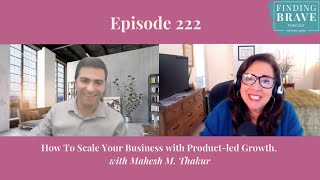
This content was created by Kathy Caprino. This content was uploaded by Kathy Caprino. This is a YouTube video titled "222: How To Scale Your Business with Product-led Growth, with Mahesh M. Thakur" created on April 7, 2022. It features a conversation between Kathy Caprino and Mahesh M. Thakur discussing product-led growth strategies, innovation, and leadership in business. Kathy Caprino hosts the podcast "Finding Brave," where she interviews Mahesh about his insights on product-led growth, customer engagement, and innovation in organizations.
Chapters
Hi, Kathy here. Before we begin, I wanted to share a bit about my new video training course, the Most Powerful you, which is the companion to my latest book. In my 16 years of leadership and career coaching with thousands of professionals, I've observed what I call the seven most damaging power gaps that keep women from reaching their highest career potential. These gaps negatively impact a staggering 98% of women and 90% of men. If you long for a more successful, meaningful and impactful career and you're ready for help, please visit mostpowerfulyou.com for more information. This training will transform how you see yourself and what you're capable of achieving. And please ask your supervisors and HR leaders to bring this course to your company. It creates not only expanded individual success, but greater success of your organization as a whole. Thank you so much. And here's to becoming the most powerful you.
Sometimes it's just best to let the product and the customer be together. Don't get in the way, don't misinterpret the signal. Let the customer tell us exactly how it is they want this experience to lay itself out and then let that further dictate how should we shape the product vision and the vision for the company. So you're really putting all that control in in the hands of the customer.
Hello everyone, this is Kathy Caprino and welcome to my podcast, Finding Brave. I've created this show for everyone who longs to create something bold and brave in their life. To rise up, speak up and stand up for who they are and to reach their highest and biggest visions. Each week I'll be speaking with inspiring guests from all walks of business, leadership, entertainment, the creative arts and the entrepreneurial world. And they'll be sharing their intimate stories of Finding Brave and offer their best strategies for building your most rewarding, joyful and meaningful life, business and career. Here we go. Hello everybody. Welcome to another episode of Finding Brave. I'm so excited today. So, so excited. I've. I've recorded a number of podcasts and every one of them is just so, I think, fantastic. The interviews, because we're getting such rich, deep, focused information that you just don't hear in a lot of places or reading leadership books, etc. And today is no exception. Today we have Mahesh M. Thakur with us, who is so illustrious and I was introduced from a mutual friend and your work is so inspiring and we are going to be talking about product led growth and how that's so essential and what leaders and managers need to understand to experience that kind of acceleration in Product led growth. So thank you for joining. Thank you. All right, let me tell everybody about Mahesh's. Your bio is so amazing I couldn't even fit it on one page. So I'm giving giving just an excerpt, but here's. Here it is. Mahesh M. Thakur is an award winning B2B SaaS chief of product and a former CEO with experience delivering over 600 million in revenue by building high performing organizations that drive product led growth. A strong track record of delivering new products in fast paced environments including at Amazon, Microsoft, Intuit and GoDaddy. A data driven operator who drives commercialization, user acquisition, usage, retention and scale, and an experienced former engineer. How many careers can one have with strong business acumen? Mahesh is skilled with driving high stakes initiatives collaboratively. There's the keyword. And you're a certified board director of the Stanford Graduate School of Business. And I just realized you are one of the MG Marshall Goldsmith 100 top coaches. Bravo to you. Bravo. Thank you for being here.
Thank you, thank you for the beautiful introduction. It is such an honor and such a privilege to be here, Cathy. I've had the chance to listen to some of your podcasts and have read some of your work on Forbes and more and I'm just delighted to be here with you today.
Thank you so much for your time. All right, let's dig in. I'm dying to know and as we've talked about, I ask questions as a small business owner that I want to understand personally, but also I kind of have in my ear what the listeners are dying to understand. So can you explain what is product led growth? What is it?
Sure thing. So in very simple terms, product led growth is an alternative approach to growing just through sales. So traditionally all companies looked at growing their business by employing more salespeople, sales organizations, and they always thought about taking a customer in their sales cycle from A to B and making a sale happen. Product led approach is it is an all new way to look at your customers, their problems and figuring out how do you actually add value even before you get a penny out of them through a sale. That's an all new way of thinking. The best example I think I'll take is a call you and I are on right now which is hosted by Zoom. So if you and I can vote a member, we probably didn't pay for it before we tried it out for the first time. And that's an example where Zoom gave out these 40 or 45 minute free trialers to anybody who wanted to get On a confidence call. I bet there are people even today outside who are having Zoom for free. So that's an example of where a company can understand that customers are willing to connect with each other. So the problem is people are at two different locations and you can offer them something for free that they can try. If it's truly solving their problem, guess what? They'll figure out a way to either pay it themselves or get their employer to pay it, or get their university to fund it. They'll figure it out. But then the first and foremost step is to figure out, is this something that I can do or give to our customers to add value? So there are innumerable examples, like Dropbox is another example that offers storage for free until you hit a certain quota. GoDaddy launched a range of services which we call our freemium or things that small businesses can try for free. And until they really see the need to go live with a website, unless and until it's published as a. As a www URL, they can still try and build on and do so much more for free. So that's the world we live in where you don't just need sales to close the deals. You have an organization that understands the customers problems, builds the products, lets the customers try, and then once the value is added, magic happens from there and businesses start to flourish and grow.
I have questions. Let me ask this. I've been coaching 16 years. I train coaches, have an upcoming certification. And what I talk about over and over and over is something that many coach training organizations don't tell people who want to start coaching businesses. But I wonder if you would say yes, this is product led growth. What I've been telling people is you have to give free content 100 times more than you think you do at a regular interval, a hundred times more than you think you do before you will earn a penny. And why is that? And I'd love you. And you don't have to say yes if you don't agree. Challenge me. But why that is is in a very competitive environment. People need, as we've heard a million times, people buy from people they know, like and trust. You have to understand their needs and give them something that moves them forward without them spending a penny. When you do that, there's trust built. There's an understanding that wow, Mahesh. Kathy understands me. I know that what I'm going to get is a value. Is this what you would call product led growth?
Totally. Absolutely. Yes. I've been doing it. But I would agree with you would agree. I would agree. And there are a few reasons why I would say that's in fact the best thing to do. Number one, as a coach, you're doing yourself a good service by actually attracting the kind of people you want to attract because they've already seen your work, they've seen what you're writing. There's a chance that you will attract the people to whom you can deliver the best value. And guess what? That's when you would feel fulfilled. I bet it would be okay for you to earn ten grand less. But if you felt satisfied and if you got a very good experience out of that coaching, now you want to do 10x more of that. So that's absolutely the right step. And the other thing, which, Kathy, I think you already answered it, is that if you're going to put out so much content on your website, technology also benefits you because Google now thinks about you and your website as a credible source. And they rank you higher. So that further boosts the traffic. Even if some of that is free, the freemium. It's okay until they achieve something, which is called wtp, Willingness to pay. And it's okay. Not everybody has that willingness, but they at least have an. I have an idea. Who's Kathy? What's their work? So you're absolutely leading the way in doing product led. Growth, Growth, Kathy.
I love it. I didn't even know I was doing that. Thank you. All right. You know, I'm sitting here knowing what objections are going to come to people's minds. And we're talking any business we can imagine, right? Well, wait a minute here. I've got to make some money. So how long am I offering these free things? Where's the cutoff? When do I realize I'm barking up the wrong tree? And you do so much work with Senior, senior people, CEOs, directors. I'm really interested in the pushback. You get the fears. Why we don't do this? What is the deepest fear from people? I'm going to lose. We're going to lose everything.
So let's talk about fear. Fear is different for employees. Fear is different for founders and CEOs. Fear could be different for the board members. Which one would you like to address?
Let's start with the people running the business, the startup founders, the people who have an idea. Those people first.
Sure. So some of the common fears that startup founders have, number one fear that they always have is, is my product something that the customers would like? It's also called product market fit. Is this something that will truly solve the customer's problem. And then from there, can I scale this so that I have 10,000, 100,000, a million customers almost in parallel? They have this whole issue or fear of attracting and then retaining the best talent. And even if they do end up having the right co founder, that chemistry between the cto, CEO, chief officer has to be very tight, very good. So there's that fear that they live with that can they attract and retain the top people as their co founders, as their employees, early employees. And the third fear or insecurity that they have is about the funding. Like one of the common questions investors ask or even board members ask is, how much Runway does this company have? Said another way, how much cash do you have to keep going until you burn everything, until you burn through everything? And those are some fears that startup founders, entrepreneurs, CEOs have to constantly address. And quite honestly, you can only be proactive there. You can be thinking ahead. You can use all your network, all your insights, all your creativity that you have. And at the same time, you need to be very calm and composed with everybody that you work with. Because let's just say if there's an employee, all hands, and you as a founder are being asked a question. And this happened to one of the founders I was working with right in the middle of COVID when there is this whole survival, there's this question about the survival when they're going through the crises. Yes, they had questions about the race. The employees had a question like, am I gonna get a raise? And this person, unfortunately, did not have the best answer. So the learning, because it's yes, we'll make mistakes, but the learning there was. Did you provide enough context to the employee before saying giving out a binary yes or a no answer? So I think that's where the founders have to be really providing everybody that they work with, whether it's their investors, their co founders, the employees, enough context before they provide the content. And that's the environment we live in today.
I love it. Now, let's tie that bit back into product led growth. I have questions and I'm not an expert in this, so really treat me like, you know, it's your beginning graduate school, you know, business school course. I'm guessing, tell me if this is not right, the traditional way of leading growth through sales versus product that you're talking about. I'm guessing there's been a shift in the past 10 years, right? Five years. I'm making this up. So tell me if I'm wrong. I'm Guessing if there was a shift, it's because consumers have changed, our demands have changed, our needs have changed and our willingness to trust through our dollars has changed. Am I right?
Yes. Yes. There's, there's that change. There is that huge change that is happening, a shift that is happening. And also for the companies, they can't wait forever for these enterprise sales to close. They are getting creative that how can we get the sale, how can we get the product, how can we get the expansion out there without putting together a 10,000 people workforce? And so that is that hunger that the founders, that the entrepreneurs, that the startups have to become that unicorn to go get that market share without having to put a sales guy on every call or a salesperson on every call. And so that led to a lot of the creativity, that led to a lot of innovation. And also sometimes it's just best to let the product and the customer be together. Don't get in the way, don't misinterpret the signal, let the customer tell us exactly how it is they want this experience to lay itself out and then let that further dictate how should we shape the product vision and the vision for the company. So you're really putting all that control in the hands of the customer.
I love it. So what are the. When people try to do this, you're working with boards, CEOs, you know, product people. When people try to do this, what are the biggest failures you've seen? So for me, I'm thinking, and I have a tiny business, right? But I'm thinking I've put out a lot of content, a lot of products, some have failed miserably, some haven't even gotten off the ground, some have really taken off. If I were to look at some of the mistakes I've made, I think the biggest one would be flitting around, trying to do too much instead of focusing on one or two. That would be one of my errors. I'm so ready to put out stuff that wearing myself out and my team trying to do five things when two would have been best. What are the errors you're seeing in people pursuing product led growth that we should learn from? Am I making sense?
Sure. So some of the errors that we see in people approaching product led growth are that they get way ahead in their journey. Assuming that if I give this out for free, the customers are just going to line up outside my website or outside my store and they're just going to use it non stop and I'm going to get the world's best engagement and the world's best retention and almost everybody's going to convert to a paid customer.
Why am I blushing? Why am I blushing over here? Because it really resonates.
Yeah, we all have those. We all sometimes feel like if I just do this, then that should automatically happen as the next step.
I build it and they will come. Yeah, yeah, we are all true. Is it?
Yes. We all grew up watching that movie, didn't we? So what happened? I mean, there are big examples as small. You can take an example of Amazon, which tried to come out with its own cell phone, mobile phone, and it was a disaster. But when you look at these large corporations including Amazon, Amazon Prime, Amazon Marketplace, Echo, Alexa, behind each of these huge successes, there are probably hundreds if not more failures. They have the appetite to fail. But then the good news is startups and startup founders can become smart not through their own mistakes alone. They can learn from others mistakes, including Amazon's Facebook's or meta's mistakes as well. And the opportunity is to truly step back and tying this back to your question again, we've seen this play out enough times to understand you don't need to go and build an entire product based on an assumption or an insight. You can start your testing and your customer validation even with just a screenshot or a wireframe or a concept paper and take it to the customer early on or show it to 100 customers. What do they need, 100 Starbucks coupons or gift cards or something like that. But they'll tell you that, okay, this is, this is solving my problem. Or they'll tell you this is, I don't understand why you're trying to build this. I'm not never going to use it. You can detect that whole failure point way before you Invest. Like in 10 engineers trying to build a product, you don't need that. So that's the biggest learning, research, research, enough use. There is a platform user testing dot com. How many people know that? So startups go there, they can get customer insights probably for a few hundred dollars and not spend.
I need to go there right now. What the heck? Oh, you're so. It's so. Of course you're right. Of course. You've had 20 plus years experience. But I've made that mistake too, where I think I'm in the world of my customer and so I think I understand what they need. Yeah, well, that's not the same as asking. It's not the same as saying, here's what I have developed a rough version. What do you Think, oh, it's so important. Oh, I love it.
You know, way back when I was at Microsoft, we had a lab. We had a lab where we would have customers visit us and it had glass windows where we could see the customers, but the customers didn't know we were watching them, observing them from a distance, of course. And we could see them interact with every single pixel on the screen. And we could tell, are they discovering what they put out there? Are they using it this way? How did they get to the end goal? How did they get to the last step in the workflow? Did they struggle? How many seconds, many seconds did they spend? In that whole workflow, every single detail was being monitored so that then we could bring that learning back to our teams would then start to build the world's second most powerful search engine, AKA Bing. And that's the kind of customer focus that you sometimes need to have much before a product is built and shared with the customers.
Look how much I'm learning here. Darn it. Why didn't I talk to you 10 years ago? Okay. And we didn't prep these questions, so thank you that I'm throwing them at you because they're what I want to know if that's okay.
I'm amazed with your quality of questions and how much you are curious.
Thank you. Thank you so much. So here's another question. Innovation. When you think of Amazon and Microsoft Intuit odaddy, there is so much innovation being expressed there. If we're a leader or running a team, wherever you are in the organization, how do we boost our ability to be innovative, to even have an idea to get so far as it would be tested, Are there ways that either innovation is crushed? I'm sure. I mean work workforces, their systems, I think either promote innovation or crush it or anywhere in between. But based on what you've seen, what do we need to do to be more innovative? How do we do it?
Yeah. So I think the way I would put it is that innovation starts at every part, from top to bottom. Innovation is not the responsibility of an R and D lab or a bunch of researchers wearing a white coat. Monday to Friday. Research and innovation should be part of the culture, part of the DNA of a company. And they should not just talk about it, but they should invest in it. And one of the best ways to invest is to invest in your employees. So the number one question I would ask the founder, the CEO, no matter what size of the company, it could be a 20 people organization. 202,000. 20,000, number one question is, how well are you investing in training your employees to think outside the box? So Google Intuit, all these companies have a, have an initiative called 20% project. We did something similar at GoDaddy as well. So you're carving out time for employees where they can spend dedicated hours or even days to come up with ideas and then brainstorm and then validate, have a way to validate with their own real customers. And the short answer is you teach them how to write down experiments. So I coached hundreds of people at GoDaddy to actually templatize how do you write down experiments and how do you run them? So that it becomes more of a question of science. Take the guesswork out, make this a systematic scientific process for every business unit across a 10,000 people company to run systematically and have a cadence around it. And then as you get deeper, you can get all the engineers excited by having this, such as hackathon, which you may have heard. So companies have hackathons where all the engineers come out, there's two days of you don't need to work, you just write creative code or creative, you work out voodoo logic and then come out and tell us what your product does for our customers. And the best idea will get funded by the chief technology officer or by the chief executive officer. And those teams go out and do the best work because they themselves have come up with the ideas. So that's where companies are investing in coaching their employees, training their employees, and also showing to the rest of the company that we are serious about innovation. This is not just PR talk, but we actually are taking that and applying that into our culture. And those are some things that even startups and small companies can learn from and establish those days during a month or even during a quarter where employees can come together and brainstorm.
I'm learning so much. I mean in my team of four, we're going to, I'm going to do these things.
If it's a team of four, I'll just say have a day in the month called a customer day and everybody just sit down and talk about what you learn, what you're observing, what are the trends and maybe one small change that you could do to make the customers lives better.
How beautiful. I love it. All right, now what did I want to ask? I had a question about what shuts down innovation. Darn it. What was it? Let me ask this. We were talking before we pressed record. You know, organizations are made of humans. We're only as good as human, human behavior, human communication, right? And we're only as. Oh, that's what it was. We're only as, you know, effective as how we can collaborate. And collaboration is a big thing for you. Can you tell me about, tell us about failure. I'm forgetting where this was in a podcast, but some people have dimensionalized that organizations that learn from their failures, that don't punish people for failures, but actually celebrate them as a way to dissect what did we do well and what did we not do well? So it's not punitive, it's let's learn. Do you see failure as a key in this whole product led piece and great leadership, how we deal with so called failure? Do you talk about that in the work that you do as a coach, et cetera?
All the time. All the time. Actually, factually speaking, failures teach us more than successes. That's a given. So failure is not a point to feel bad about. Failure is a point to pivot. Failure is a point to reflect and internalize that. This is a chance to learn and quickly shift gears to do something differently. And even as I talk to you about experimentation or the culture of innovation, we go in there knowing that a third or a less would be successful. As you try to experiment, a third or a less third or less may be successful. The remainder third will fail and the other third, we won't even know which way it went because it was poorly defined. All right, so the expectation is already lowered. Now get this. If people are new and coming into this culture of innovation and they already know you're not expected to hit a home run, you're not, you're not expected to just knock it out of the park. With every experiment, the pressure is already off and they are focusing on the science. Like, how do I get better at writing the hypothesis statement? How do I get better at collecting the data before the experiment so that I'm good with that number? How do I get better at using the platform for running that experiment so that I can then get the right Results in the 2, 3 or 4 week period duration? How do I get better with learning about those customers who actually go through these tests and then what is their life before and after you start to think about those things versus emphasizing I must succeed. This is a test about me, not about work. And that's where you know you have to manage as leaders. You have to really set the tone and the culture so that the emphasis is on learning how incredible.
And what I'm also feeling is there's the idea, but there's the implementation. This, the strategizing the communication of an idea. There's. It's not just does one idea win or lose, it's you have made it a scientific process to not only, I mean the generation of the idea is the first second of this whole thing. There's so much more in it. And what it sounds like you've done is why do I want to say democratize the process? But you've made, is that right? You've made, you've made the process accessible to anyone. So we don't have to be Einstein necessarily to oh, it's so good, it's so wonderful. So I'm aware of our time. Can I ask you what is the one thing you want to leave listeners and me with about mindset or leadership or communication? The thing that you find yourself teaching and training more than anything else that we need to understand that we don't?
Sure. I'll give you an example of Zio Tag Z I O T A G. This is a company where I'm on the advisory board and I'm helping the founder CEO with the business strategy and with the product led growth there. And the one thing which I'll call, I'll basically mention with regards to mindset is that as a founder, Jeff applied technology at the right time. It was only two or three years ago when he and his original partner started the business as people who would tag videos for commercial reasons was a very manual, human driven process. At the right time we applied AI and machine learning to the whole work that they were doing and now it has become an enterprise, a software as a service solution that's actually really helping knowledge seekers. So imagine if you went to YouTube and there was a topic which was on a subject you were researching on. Could you tell me anything that you're recently trying to study or analyze?
How about let's say career growth? Would that be all right?
Yeah, sure thing. So let's say you went career growth and you went and saw that there was a video from Reid hoffman, the founder CEO of LinkedIn and you find out that that video is an hour 42 minutes. You definitely want to watch it. But then what if you only had half hour before your next meeting? So what Zio Tag does is that if you run Zio Tag on that video, it'll show you a very, an amazing table of contents and it'll structure that the entire video and they'll show you this is the index and these are the topics and subtopics. It has the capability, it has the AI to be able to review every single Word and every single topic which is being discussed and come back to you in a way where you can look at it, you can point to that specific section and just learn about that section in that punchline. So that's the level of insight that product is now able to do. To bring it back to your question, Jeff then demonstrated that mindset of a being very curious about his customer base and B, applying technology meaningfully where applicable. And over a period of two years, the company has a good starting point in the enterprise segments and it's truly making the whole solution scalable, at least across more than one vertical as we speak. So that's the mindset that a lot of founders and startup owners have to have where they remain curious, basically be customer obsessed, and then continue to meaningfully apply technology. Because where we are today is at a very different place. A lot of these technologies, whether it is through freemium or not, they're available for startups and small businesses to try. So it's for you to try.
Can I try it? So in other words, I would license this or apply this software to my own webinars or my own products where I know people don't want to watch an hour, give me the thing in three minutes. So this would be applied and it would be offered on my own programs. Is that it? Is that what we're talking about?
Absolutely. And the best part is because you have an entire high quality transcript available, because that software generates a very high quality transcript, much more reliable than any other transcription. You can absolutely go out and put that on your blog pages. So your entire interview, such as this one, can be then searchable by Google. And it'll start to bring more and more people who are trying to find Kathy to you.
So brilliant. Did they? All right, I got to ask a question. Did they arrive at that idea through lots of research about what people are searching for, or how did that person come up with that idea? Can you share that?
So it was a lot of research with a variety of customer needs, primarily the ones who are watching a lot of videos. And now when we look at it, the problem is actually something which is not just with people who are researching, but also people who are on sales calls. They need to learn something quickly. PhD students who need to come up to speed on a certain topic within two days. And it's like everybody's starting to have that need to be more advanced in terms of their skill sets, their knowledge, remote workers whom we hire, and we expect contractors like Apple would not give you a month to ramp up As a contractor, they would want their contractor to deliver the goods. Week 2 so how do you get these people up to speed? So there are numerous use cases that are solvable. But obviously as a startup, you want to make sure you address one or two segments at a time. Do a really good job with that vertical, go super deep and then pick up the next vertical, go super deep.
Oh, it's so fantastic. As someone who interviews a lot of people every week, I wish I had this where I go to your, you know, your page with all your information and it goes, gives me, you know, a summary in two minutes and I know everything you've done. I don't need, you know, two hours. Oh, it's, it's brilliant. I can't wait to see what happens as, as they accelerate and expand. Thank you so much for joining. There is so much more I would do you teach a master class, Mahesh? I would want to go to, you know, your classes. My goodness.
But you're on for that question. You can Visit my website, Mahesham Thakur.com and you can learn more. And it is such an honor to be on your show and be with you here today. Thank you, Kathy, for the amazing opportunity. I truly enjoyed your very thoughtful and engaging questions.
Thank you so much for your time. Come back again soon. Oh, wow. All right, everybody, you know where to go, you know where to follow Mahesh's work and you know, as, as I've said every, every show, we don't just want this to be talking heads at you. Interact with us, let us know the question you had, let us know what you're struggling with. And I know you're incredibly, crashingly busy, but we'll do our best to answer or send you a resource that will be helpful. I think what we're all getting here is it's time to be product led. It's time to be. Time to be listening to our customers in a way that will really serve them, not serve us necessarily first. Right? We need to be putting their needs first if we're going to have a successful business. Thank you so much. Have a wonderful week. I hope you're inspired everyone and we will see you next time. Hi, Kathy here and I wanted to share some information about my new digital newsletter, your Path to Career Bliss. This monthly newsletter explores one key career, leadership or personal growth topic that is essential for building a happier, more successful career or business. Every issue offers a selection of the most read articles that I've ever written, along with riveting podcast interviews with some of the nation's top experts, as well as career assessments, resource recommendations, a subscriber highlight section and an Ask Kathy column and more. We've made it as affordable as possible, and the first month is completely free and you can cancel at any time. I hope you'll join me in this program now. Check it out@kathy caprino.com newsletter and get your free issue today. Thank you. And here's to your path to career bliss. Thanks so much for joining us today. And please don't forget to check out Finding Brave documents for more programs, resources and tips. And tune in next time for your weekly dose of Finding Brave.
More from Kathy


Elevate Yourself, Elevate Others, and Amplify Good | Chris Cooper | Finding Brave Ep. 334

Finding Brave Epis #333: How Leaders Can Harness AI Without Losing Their Humanity, w/Bennett Borden

Finding Brave Epis 332- How to Stay Brave, Valuable and Visible in the Age of AI, with Raman Rai

Finding Brave Epis 331 - The Power of Positive Disruption, with Dr. Patrick Leddin


Finding Brave Epis 330 - Being 40: Letting Go and Embracing Who You Are, with Stacey Lindsay

Disrupt Career Reinvention with Kathy Caprino - via The Disruption Lab Podcast w/Patrick Leddin

Creating Neurodiversity-Friendly Work Cultures: Simple Workplace Adjustments Matter

Finding Brave Epis 329 - How To Create a Neurodiversity-Friendly Workplace, with Kristen Pressner

Finding Brave Epis. 328: Reclaiming the Power to Trust Your Own Voice, with Dr. Cindy McGovern