229: How Writing Your Story Transforms Your Life Part 1with Bruce Gelfand
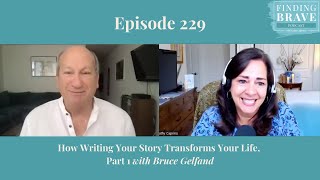
This is a transcript of Finding Brave episode 229 (May 26, 2022) in which Kathy Caprino interviews writing teacher and coach Bruce Gelfand about how writing personal stories transforms lives. Gelfand describes his Writer's Hour — small, frequent group sessions (15-minute timed writing, shared reading, in-class coaching) created during the pandemic — and explains why writing in present tense, writing in community, and accessing one’s full "genius" (Emerson: "to believe your own thought…") help people access deeper material. The conversation also covers practical devices (a "disclaimer bowl" to reduce shame), the therapeutic-like but distinct nature of writing versus therapy, and how perspective/agenda shape narratives in public culture.
Chapters
It's a miracle what happens when people are invited into a safe space and invited to speak their heart, speak their mind, and there's no wrong way to do it. You just drop onto the page and you go.
Hello, everyone. This is Kathy Caprino, and welcome to my podcast, Finding Brave. I've created this show for everyone who longs to create something bold and brave in their life, to rise up, speak up, and stand up for who they are and to reach their highest and biggest visions. Each week, I'll be speaking with inspiring guests from all walks of business, leadership, entertainment, the creative arts, and the entrepreneurial world. And they'll be sharing their intimate stories of Finding Brave and offer their best strategies for building your most rewarding, joyful, and meaningful life, business and career.
Yep.
Hello, everybody. Welcome to another episode of Finding Brave. You know me, and you know that I say this regularly and I mean it regularly. And today I mean it times 10. Because we have such an amazing guest who's been so instrumental in my life in so many ways that we are going to be talking about. But we have the illustrious Bruce Gelfand with us today all the way from California. Bruce, thank you for taking the time and being here. So, so exciting. So exciting. All right, everyone, we are going to be talking about how writing your story transforms your life. And I want to just give you a little brief introduction of how I know that it does. And then I'm going to read Bruce's bio because it's so illustrious. You're going to be excited to work with him immediately. But Bruce. And I was trying to remember what year. I can't remember maybe five years ago. I had a. A story I so wanted to tell as a screenplay. And it was about a past life of a woman named Mary, who I believe I was in another life. I know you're going to think, oh, there she goes. She's being woo woo again. But this past life memory emerged such a strong way that I could actually feel what it was like to be her. And it was so different from my experience of being me. And what unfolded I wanted to write about because I thought it had a lot of messages that would be helpful for people and it would be helpful for me to write it. So I asked a Dear colleague, Laverne McKinnon, who is a producer in Hollywood, and she said, yeah, the best writing coach I know is Bruce. So we hopped on a call. Oh, my gosh. And in that process of writing that, and I have not written it actually, but the process was. It was truly life changing. And what I realized and what Bruce helped me understand is it's so much about what we're going through individually, internally, how we see ourselves, the messages we're trying to give ourselves. You know, it's so such. It's a transformative experience. And I still am benefiting from that work, Bruce, and can't wait to. I want to write it as a story first, not a screenplay. But huge thanks to you for that transformational experience. But we want to talk about how writing your story is going to transform you. So let me tell you about Bruce based in Santa Monica, California. How lucky. Bruce Gelfand has over 30 years experience in theater, film and television publishing in both New York and Hollywood. His plays have won. I know. Look how uncomfortable he is even hearing these accolades. His plays have won national Playwriting awards and been produced off Broadway in theaters around the country. He's written numerous feature films and movies for television as well as writing and directing feature length documentary the Family Safe. He's also a writer of fiction, nonfiction, songs and award winning poetry. His book Brighter the Light, Deeper the Shadow. What a Title. Was published in 2004. His many screenplays include Rainbow Man, Bashirte, Is that how I pronounce it? Touched the House at oh no, what is it? Otowee, Ottawi, Ottawi Bridge and most recently Refugee and adaptation of the award winning Holocaust memoir Choices. Bruce is also a renowned writing teacher and coach. He's taught at Emerson College in Boston and in the MFA program at the California Institute of Integral Studies in San Francisco and taught hundreds of writing workshops and seminars and venues around the world. From gang members in LA to patients in the Mind Body Institute at Brigham and Williams, Brigham and Women's Hospital at Harvard. He's worked with tens of thousands of writing students, me included, from masters in the field to be absolute beginners. His online course, A Writer's Hour is being used by writers all over the world. It goes on and on and it's so illustrious I can't even believe it. And we will have that link to below, but we want to hear from Bruce here. And again, thank you for taking the time. I want to share with everyone the three bullet points that you shared about what?
Excuse me, I'm still looking for the blushing thing on Zoom.
There must be a the blushing emoji.
The button you can press for the couch that you want to hide under. You know that's Bruce. There's somebody hiding under a couch.
And the funny story is I had to cajole force, make you give Me? A bio. Your bio that you gave me was one sense. I'm like, oh, no, that's not gonna do. So, you know, I had to dig this out of you and. Which is. It's so endearing. But I do want you to just.
Thank you. As someone who has a long, intimate relationship with shame and guilt, it's shocking how bad I am at shameless self promotion.
Yes, you're bad. We're going to help you fix that. But here are three bullets that Bruce really wanted to make sure everyone understands. Everyone has a story to tell. Everyone has a voice as unique and distinct as their fingerprint. I say that, too. I probably learned that from you. I thought that was my brilliant thing. Number three, permission to have a voice and permission to use it to contribute. It can be learned. All right, let's start there. I have so many questions, but let's start with. You were telling me about your Writer's Hour and how transformative it is for people. Tell me why. Tell us why. Why is the process of writing our story? What are we getting out of that? What's happening?
Well, I think, you know, I've been accused over the years of being a therapist or trying to Play 1 on TV, and no interest in that at all, though I appreciate great therapists. Writing is a very different kind of process because you start off. I mean, I just believe that anybody who steps into the ring with a blank piece of paper, a blank computer screen, I can't kind of not love and not root for. And because. Because challenging, that is, I know, frightening. Your podcast is called Finding Brave. Well, that's. That's where Brave is located. As far as I'm concerned. That part of oneself. And so you're sort of plopping yourself like a matzo ball into a bowl of hot soup the minute you step into that place. And the Writer's Hour came out of the. I mean, when the pandemic hit and everything kind of shut down, I wanted to contribute something. And about the only thing I thought that might be useful to people was to do this thing on what to take my workshops online. So the first month or two, I offered them as a gift to anybody who wanted to participate. And it just took off. People all over the world signed on and jumped on, and they wanted to write.
They have an idea. They have a poem. They have.
What did they want, had an idea. Some of it was about writers having an idea, needing a place. Some of it was about just people wanting to connect with other people in a way that was safe in A way in which they could be seen and heard and tell their story and held in community. Because the writer's hours. Never more than eight people in a class, just an hour.
And every week, an hour weekly.
Well, three times a week I have a class. Tuesday, Thursday and Friday and Saturday rather. Now one to two in the afternoon, California time.
And people are coming three times a week.
Oh, yeah, people are coming. Sometimes people are coming to every class. I have people writing novels in the class an hour at a time, 15 minutes at a time. And what happens in the class is actually quite magical because I read something from which I curate a writing assignment or prompt. People take 15 minutes to write in present time all together into this thing. When they're done, they come back and we read the work. And then I work with people. I coach people individually, but in this.
Group context right there on the spot. So it's like group coaching. All right, Kathy, let me talk about blah, blah, blah.
But it's very specific to them and it's very safe. And everybody's in the same boat, whether they're an Academy Award winning writer or they're a complete novice. And it's a miracle what happens when people are invited into a safe space and invited to speak their heart, speak their mind and whatever. There's no wrong way to do it. You just drop onto the page and you go. And what happens in those hours? I mean, it's very interesting because I'm a. I'm a. I'm always bugging my people I work with about writing in present tense because I believe in present tense. I believe that the more we write in present tense, the more we live in present tense, the more present and the less tense we are. So there's something about writing in present tense in the moment, in a group that creates a kind of timeless zone around the work. And writing present tense to me is the way of getting to the zone, waiting to getting to timeless. And as any writer knows, it's when you disappear onto the page or onto the computer screen and you look up and it's five hours later and you don't know how it happened that all that time went away. But Here you have 20 pages worth of manuscript, whatever. That's what I mean. That's what we're all looking for. We're looking for that zone and we're the right where one disappears and this other thing comes through that's sort of bigger and smarter and wiser than you are, you know, and one becomes a kind of an instrument for this is why Talking about past lives. I mean, when we started working with you and your story and you wanted to sort of go back into these other lives or go. Go forward into these other lives. It's. It's. Excuse me. It's very useful because there is something timeless about the act of writing. It's also something that's completely original. You're not like in therapy, often in bad therapy, I would say you. You're always recycling the same story, and you're just. You're like rearranging the chairs on the Titanic. You know, it's all the same box you're living in. The great thing about a blank page and a blank computer screen is it compels something brand new, completely original from you. It never existed before, and it may not exist again. So it can't not be you. It's coming from someplace in you, even if you're not aware of it and where it's coming from. And the. The. My. One of my favorite parts about the. About the Writer's hour is when people write their thing and they're about. And sometimes. And of course, the hardest thing is to. It's one thing to write something in the privacy of your own journal.
No one will see it.
Exactly right. Some people go into their closets and hide in the back of their closets and work on their journals. It's another thing to actually step out and embody it, read it, stand with it in front of a room, even a zoom room full of people. Even if people are all over the world and have no idea who you are. And because you can't not be confronted by what it is you've written. And I have all kinds of games and things we play with as a way to make space safe and easy. But very often before someone reads, they will roll their eyes 15 times and say, I have no idea what I'm about to say or what I wrote. And then they will start to disclaim what they're about to write and lower the bar so that every excuse you can imagine, every disclaimer, why, what they're about to read is awful, terrible. And please don't kill me for what I'm about to read. And I just have a rule for the room that for every disclaimer, you have to put a buck. There's a thing called a disclaimer bowl. Used to be in my office.
I love it.
For every disclaimer, you have to put a buck in the bowl. And so sometimes people would take a $20bill and throw it into the bowl. And then just have their way telling us how awful what they're about to read is going to be. And they get their $20 worth. They finish, and then they start reading. And invariably, the more the disclaimer, the greater the disclaimer, the juicier. What they're about to read is because that's the level of writing.
Notes. All right, I have questions. I have questions.
That's the skin they have in the game. So anyway, so the Writer's Hour gives people an experience of that, and it gives it to them together in community in a way in which they get seen and heard. And I would even say appreciated.
All right, may I ask some questions here? Boy, I wish I had you for five hours. And I can't wait to sign up for the Writers Hour. I remember when you gave me the first exercise, all that, and we weren't meeting together, you know, in. In the Writer's Hour, you gave me an exercise. I came back the next week. All I could do for the first 10 minutes was critique, criticize. I could barely get a gosh darn word out on the paper. And then I would do it. But I was afraid it was wrong, Stupid. I didn't understand the exercise. You know, here I am, rather a confident human being. I fell apart. And I think we had six sessions, something like that. And I would say 10 minutes of every session would be walking me off the edge, that you did it right. And there is no right. But what it showed me was how terrified I was to be in that realm. But here's what I want to ask you. You know, I write a thousand words every three days. I am a writer. But I realized through working with you that I'm good at prescribing. I'm good at giving advice. I'm good at highlighting what's wrong. But when we're talking about this kind of writing, it's a completely different thing. It's. How would you put it? Is it giving voice to your unique perspective? And that is what is so terrifying.
Yeah.
Because I feel like I do that every day. What's the difference between the person you know? Why is that so scary? Okay, I'm telling a story. Why am I so nervous?
Well, because I think you're using more of you. I think. And this is not to diminish what you do every day and what you do and you do very well.
What's more of me? What is that?
Well, the invitation is to use more of you if you remember the first exercise. And I do this often when I first Start working with people. I do what I call the genius exercise.
Oh yeah.
And. And it's from a quote from Ralph Waldo Emerson. And because I believe, you know, and people. The reason I do it is because everybody's got a thing about people think geniuses. You know, you look up in the dictionary, there's a picture of Albert Einstein, right?
There's seven of them alive at one time. That's it.
You know, you know, Elon Musk and Mark Zuckerberg and blah, blah, blah. And they're all kind of the same guy. Actually. It's pretty. It's pretty twisted. I, you know, I love doing this exercise because. Triggers a lot of people in a lot of different ways. And from seeing how they're triggered shows me. Gives me an entire readout on where the best way to. How to. How to best work with them. Because I mean, the word genius comes originally from the word spirit, doesn't. It's not an intellectual thing. Yes. And so. And I believe that everybody's a genius. I've always believed this. I believe everybody is divinely charged and pulsed. And I think we have genius as something that lives from the neck up. And I think we. The neck up is part of it, but also the neck down, also the heart, also the gut, also the body. I mean, the chakras, if, you know.
The chakras certainly do.
And so the invitation when I work with someone is to see how much of oneself one can use, because there's like an infinite amount to be drawn from and we only use a fraction of it.
What are other parts? What. What, like if you're looking at my genius exercise, what is it? What's the.
What's the Emerson quote is to believe your own. To believe that what is true for you in your private heart is true for all human beings. That is genius. So that's emerson's quote from 200 years ago.
Say it again, Bruce. Say it again.
To believe your own thought, to believe that what is true for you in your private heart is true for all human beings. That is genius.
Okay, how do I cry every time I hear you talk?
A lot of. There's a lot of levels to that. But the key. The key level to me, especially someone like Emerson who was very much an intellectual and transcendentalist. All this is your private heart. And imagine if you had. If it was safe enough and it was encouraged from day one for you to be able to speak from your private heart what it wanted to say. People talk about God is love. And, you know, love being the Currency and all. People talk about love like that's the thing. Well, it kind of is the thing. It's just so we get. It gets so buried in all these other autoimmune sort of safety mechanisms that we create around ourselves in order to get through an hour or a day, you know, in order to kind of get the shit show that's out in the world these days. Forgive my language.
Love it.
And it's so. And people are, you know, the default setting. I mean, why it took. It may have taken you 10 minutes. Why it might take someone 10 hours or 10 years to get to a place where they feel like they can actually write from their heart and write what it is they want to say tell their story is because for so long we've been encouraged not to do that. And the default settings are just really thick and complicated and twisted and we're all twisted up inside of them. So part of what's exciting is watching someone begin to unravel and untangle some of those knots that are living inside. They don't even know very often. They're living inside of them. Look, I have clients who are eight figure CEOs who have no idea how to do this exercise and are paralyzed by it because they're so wounded in ways that they don't even know they're wounded that they've been spending a lifetime, a very successful lifetime running from and making sure no one ever gets to see.
What you're also bringing up. Bruce, I don't mean to interrupt. I realize, and now I can't wait to work with you on, on this. But that story that I wanted to tell, I mean, I remember the past life memory like a video that hasn't changed. But the story I would write about it now is so different.
Sure.
Like I realized, you know, just if you're interested people, it's about a woman who didn't really have a strong intellect. It was, you know, I think the 1800s. I think it was in England or Ireland. But I could feel what she felt about her husband John. And I saw him die. And I saw. I felt what she felt. And it was so unlike anything I've. It was kind of what you're talking about, pure, raw emotion without the intellect, education nonsense getting in the way of raw emotion. And I remember wanting that. But what I would write about now is so different from when I was working with you, when I was going through big shifts in my life that were hard.
Well, your point of view is different.
My point of view of my own past Life memory is different because our.
Stories are constantly being rewritten as we live, as we learn. I mean, one of the exciting things about the fact that the world has shrunk to a click on your computer and the World Wide Web is we get that everything is a story. We get that everything is narrative. And it has everything to do with who is telling the story and why they're telling it and what their agenda is. I mean, this whole thing about the news and false news and all of that. The people in the United States and most of the rest of the world are watching what's happening in Ukraine and are horrified by the slaughter that's going.
On.
By the incursion, by the violation. The people inside Russia are watching it like Vladimir Putin saving the world from Nazis and from bad people. So, and those are just two different stories and two different versions of an event. Right. So how one tells the story and why one tells it, what the agenda is, what the big picture is, what the end game is, has everything to do with it. And it has everything to do with how much you can trust the story. Right.
You know what you're making me think. My sister told me she read that the Johnny Depp Amber heard it is the most shared social media event in the world.
Does not surprise me. Right, right.
But I was saying, from a therapist perspective, when do we all get a voyeuristic look at people that are celebrities and wealthy, and yet we're looking at some of the hardest things in human experience. It's culmination of horror playing out. Would you agree? Tell us what you think about that story.
It's so fascinating because I think it's a. We think we're getting a free pass into a private screening of. And we are in some ways of our own kind of private chit show. I mean, this is. And the fact that they're both actors and they're playing these roles in a courtroom that, you know, it's, you know, this may. These may be the best roles on the two roles that they'll be remembered for the most. Whatever they've done before might do after, because it's so completely. It's such drama. It's such.
You bring up a really good point. Don't forget, people, these are scripted behaviors. You know, they're not just marching in, saying what they want to say. They have been counseled very. Whether they're following that council, you know.
Well, they're also, they're, they've also, they've got their own version of it.
Right.
You know, if I, if I had a, if I had a session with Johnny and a session with Amber, you know, a private session, their stories might come out very differently, but as they're filtered through their own, their own terror of being so public, they're. All the coaching, all the fanfare, all the, it's, it's like watching, it's like watching a, it's a, you know, it's just, it's, it's horrifying on one level, it's absurd and ridiculous on another. And, and the crazy thing about the Internet is it sort of weighs the same or weighs more than the 10 people who are slaughtered in a supermarket buffalo, you know, and again it throws it back on us. What do we value? Where, what do we care about? Why do we care about? Where are our measures? It forces us to have nuance and measure in our own lives that we're not predisposed to having necessarily. You know, we're being fed this stuff and so you know what, the doom scrollers, you know, it's impossible not to doom scroll on your little phone.
Scroll. See, that's what we're doing.
Scrolling for a reason. You know, these are not, these are not the sacred souls from the middle from, from the Dead Sea. These are, this is this tape that is running 247 all over the world. That is just storytelling. That somebody's version of something, of something, of something. The exciting thing about the writing and the coaching work that I do and the writers hour and things like that is, is that we're doing original storytelling. Like people are storytelling from their own lives, from their own hearts, from their own bodies and their own souls even. And it's exciting.
Hello everyone. Kathy here. I hope you enjoyed part one of my two part series with Bruce Gelfand. How I found it so inspiring I wanted to share the entire discussion. So stay tuned for part two next week. Thanks so much. Hello, Kathy here and thanks so much for tuning into today's episode. One quick thing I'd love to share before you go is about my new digital training program for organizations and professionals called the Most Powerful you, which is the companion to my book the Most Powerful seven Bravery Boosting Paths to Career Bliss. I'm so thrilled that recently an international division of the United nations brought in the Most Powerful you program as a training tool for members of their staff. And I'm speaking with other global organizations right now to do the same. This program brings to organizations real world transformative training for leaders, teams and professionals to help them thrive at the highest level in their work. And projects. So here's my Please take a look at what I'm training in the most Powerful you, and you can find that@mostpowerful you.com and if you feel the content would be instrumental for you and your team, I hope you'll ask your leaders and DEI managers to bring in this training program to your company. It's truly transformational for work cultures everywhere, and it generates amazing results. Thanks so much. And here's to you becoming the most powerful you. Thanks so much for joining us today. And please don't forget to check out finding brave.org for more programs, resources and tips. And tune in next time for your weekly dose of Finding Brave.
More from Kathy


Elevate Yourself, Elevate Others, and Amplify Good | Chris Cooper | Finding Brave Ep. 334

Finding Brave Epis #333: How Leaders Can Harness AI Without Losing Their Humanity, w/Bennett Borden

Finding Brave Epis 332- How to Stay Brave, Valuable and Visible in the Age of AI, with Raman Rai

Finding Brave Epis 331 - The Power of Positive Disruption, with Dr. Patrick Leddin


Finding Brave Epis 330 - Being 40: Letting Go and Embracing Who You Are, with Stacey Lindsay

Disrupt Career Reinvention with Kathy Caprino - via The Disruption Lab Podcast w/Patrick Leddin

Creating Neurodiversity-Friendly Work Cultures: Simple Workplace Adjustments Matter

Finding Brave Epis 329 - How To Create a Neurodiversity-Friendly Workplace, with Kristen Pressner

Finding Brave Epis. 328: Reclaiming the Power to Trust Your Own Voice, with Dr. Cindy McGovern