230: How Writing Your Story Transforms Your Life Part 2 with Bruce Gelfand
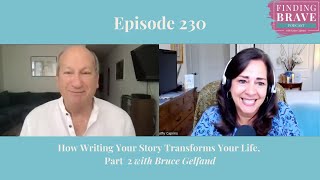
Bruce Gelfand on writing as a practice that builds vulnerability and self-love. He shares an MFA exercise asking "Who the hell do you think you are?" and describes his film project about the atomic bomb from Native American and women's perspectives.
Questions this video answers
"brucekelphan.com" (as stated in the transcript).
"I have" (in reply to "You've interviewed 600 people for this, haven't you?" — transcript indicates he answered: "I have.")
"The House at Ottaway Bridge" (as stated in the transcript).
"Eventbrite" (transcript: "You can register on Eventbrite. It's on Eventbrite.")}],
Chapters
You know, writing is just somebody's holding up a mirror and you're getting to look into the mirror and seeing yourself. And when someone's vulnerable, they're holding up that mirror and the light is bright. And I think you're putting skin in the game in a way that is courageous.
Hello everyone, this is Kathy Caprino and welcome to my podcast, Finding Brave. I've created the show for everyone who longs to create something bold and brave in their life, to rise up, speak up and stand up for who they are and to reach their highest and biggest visions. Each week I'll be speaking with inspiring guests from all walks of business, leadership, entertainment, the creative arts and the entrepreneurial world. And they'll be sharing their intimate stories of Finding Brave and offer their best strategies for building your most rewarding, joyful and meaningful life, business and career. Hello, everyone. Kathy here. I hope you enjoyed part one of our two part interview with writer and writing coach and teacher Bruce Gelfand. It was inspiring. This is part two and I hope you enjoy it. So I just got off the phone with a person who's considering hiring me as a coach and at the end she said, and I get this question a lot and I want to ask you, what am I, what am I going to end up with at the end of six sessions or six months with you? And, and this is what I say, and I mean it with all my heart. You're, it's breakthrough. You won't be the same person. You won't. Now, you know, some people say I'm just coming to you to get a job and I need that by six sessions. I can't guarantee that happens because there's a lot that you know is involved, but I can guarantee you're not going to be the same person. And what does that mean? Confidence, clarity, you're going to speak up, you're going to. Whatever. I would love you to tell me what. How are these people changed from the Academy Award winning writer to the beginner? What are the changes when they come after your writer's hour? What do you, what happens to people?
Well, I mean, that's not necessarily the best. I'm not the best one to answer that. They are. But they've told you. Oh, they have. And I see it, and I see it in the moment too, to, you know, I, I get to participate in watching someone fall in love with their own lives and fall in love, in some cases with the parts of themselves that they feel are the most unlovable.
And they fall in love with it, even though it says shit, shows we said it. So I can say it again.
They fall in love with themselves, with their own lives and with their own. Like we're all, we're all.
Gonna say.
You know, there's, there's.
Oh, man. And they fall in love with their own version of being a human.
Exactly. And there's, there's a relationship. I just think writing is a kind of a marriage. It's a kind of a sacred vow, which is what marriage at least used to be, that you make with yourself, that you make with a part of yourself that you don't always trot out into the world. And I'm just a great believer in making sacred vows and keeping them. And in the way that you make a vow to a partner, you make a vow to your child. And so when someone shows up on a regular basis and steps into this part of themselves and gives it a voice, gives it language and tells their story in some way, whether they know they're telling their story or not, whatever their story is, it gives, it oxygenates them. It. I can't. I mean, it's very physical. It's very. I mean, I work with people who've had catastrophic illnesses and it's thrilling to watch people get energy and feel, you know, start, start at the beginning of a class or beginning of a session and be really depressed and contracted and really beaten by the pain in their system, whether it's emotional, physical or whatever. And then by the end of the class, lit up and look exhilarated because they've been given an infusion of oxygen, of actually refined oxygen. Really good stuff that honestly comes from them. You know, it really just comes from them. So there's the, the infusion of it, and there's also the recognition that there, it comes from them, that they're the author of it and that they can always be the author of it. They don't need to hire me or go do a workshop or do this, read this self help book or read that. You know, I mean, that can trigger it, that can catalyze the process. But we've all got the way, a way of doing this in the privacy of our own little room if we want. And I mean, there's lots of ways to do this. Writing is, is one of them. And I'm very clear that if I didn't have writing and if I hadn't discovered writing when I was literally 3 years old, I, I would have long since departed this planet. And I don't mean that dramatically.
I hear you.
I Believe you, I, I. And so that's part of what gives me the, the nerve, like, to.
Hold.
The space that I hold and stand where I stand with the people I work with and see the genius in everyone and then see the shadow that that genius casts, because that's part of the genius, you know. The first, I taught years ago at a school in Northern California called the California Institute of Integral Studies. I actually created their first MFA course. And they wanted, they wanted somebody to create a course called the Artist in the World, because colleges never teach that. They never teach. They'll teach you the art, the craft.
Not the human development required.
What happens when you walk, when you go out into the world, you know, and, and so they wanted something like that. So I, and I don't have a college degree. I'm a college dropout. But one of the things that made me attractive to them was that I had been more or less an artist in the world for a long time. So the first weekend of this. So there were a series of weekends in San Francisco. I was also teaching screenwriting at the time in Emerson. I'd go back and forth. The first weekend was the genius exercise. And I had 17 students, ages 27 to 77. People from all over the. They would fly in for these weekend workshops and choreographers, actors, writers, poets, the whole gamut of artists who were there to get their mfa. I was their last stop. They had to get through my class to get through mfa. So the first weekend was a genius exercise. And oh, I was, it was Kumbaya everywhere. And I. Everybody loved me because everybody felt so good about themselves after the weekend. It was so inspiring and thrilling. Second weekend was, was about the shadow.
Let's hear that exercise.
Well, I, in the, in the course of the running up to it, I screened. There's an old, an old movie called Dead Poets Society with Robin, Rest in Peace. And I screened a section of this old movie, the Dead Poets Society. If you haven't seen it, wonderful movie where there's a kid in there who wants to be an actor and his father is forbid him for doing this. And the kid defies his father, acts in a play, is the star of the play. It's a glorious moment for the kid. And his father just shuts him down. And the kid then blows his brains out. And it's just this bummer, really. It's really sick. And so I screen this little section of the, of the film in the class. And then I stop. Lights come up and I look around. The room is just. Oh, they Want to kill me?
They're like, yeah, I wanted to feel good here. There. Bruce, what are you doing?
What happened? Kumbaya flew out the window. And. And I said, okay, get out your computer, laptops and your notebooks. We're doing a little writing exercise. And I looked at them and I said, I want you to answer this question and forgive my language. Who the fuck do you think you are? You want to be an artist in the world? Who the hell do you think you are? And they looked at me, just stone face, an oil painting, right? Not even crickets, just grim faces. And this novelist, wonderful writer, woman from Sacramento stands up and she's sort of the leader of the pact. And she stands up and she looks at me and she says, who the fuck do you think you are to give us an exercise like this? Like. And I. I walked right up to her, looked her right in the eye, and I said, I'm somebody who loves you and my feet. And I said, look, you want to be an artist in the world, that's great, but. And you don't have to have an answer for this question, but you better know it's coming, and you better be able to sit with it and reckon with it. Okay? Who the hell do you think you are?
Let me ask something here. When I hear that, my interpretation is, I know who you are, but you fucking better know who you are. I mean, I wouldn't be mad at that. I would. I would take that as the gauntlet. You just slap me if I can't answer that. It's not you saying that. It's the world saying that. Of course I'm just. But, no, but I mean, the way she took that is so telling.
Of course.
Of course it's saying that. What you said is right.
Well, yes, right.
To be defensive about that.
I'm not, but I can't.
But is that right?
No, no, of course, but I. But. But it's a completely legitimate response. And God bless her for standing up and pushing back.
What the group do. Like.
Yeah, well, she was. She was absolutely. She was the leader of the group. And she was doing this because she had the nerve, she knew herself well enough to. To push back.
But was she perturbed, feeling like you were putting her down, or. No, of course.
And it was in every way like, I was a man. I was a white man. Well, every. She missed every single card in the book. And. And appropriately so, like, yes, yes, yes.
And get ready.
Do the class. I mean, you're in the class. You're paying for this. You might as well, you know, they hired me. I'm the guy in front of you.
I got something good.
Well, maybe not, but here's but. Or don't do it. Don't do the exercise. I said earlier, said to her, and if you don't want to do the exercise, don't.
Because I'm sure the exercise was transformative for everybody. Right?
But that's also doing the exercise. So everybody's private reaction to what I. What I offered is the beginning of the exercise. Okay? Needless to say, they all did the exercise, and it was completely transformational, and it opened up the class in a way that. That was transformational for the rest of the semester.
And I dare say, had you said it nicely and sweetly. All right, people, I'd like you to think there will be pushback in the world. It wouldn't have gotten to the. Well, I, you know, fight response we need.
Well, I mean, I. Look, I. It wasn't personal to any of them. And I'm. I feel like I'm the sweetest guy in the world. And if I've. If I've learned anything.
It.
It's that I've learned that I have to. I have to deal with that question. I mean, I'm meeting later today with financiers on a movie project of mine, and I'm. I have to deal with that. That question later today. Otherwise I'll have no voice with these people. Right? And. And it's, you know, so the great thing about a college classroom is that there's this safe space so that they're going to get. I mean, I'm, you know, they have the freedom to do anything that they want. The people who are the. And I've got letters and notes over the years since then thanking me for that. That. That still resonates and rings in people's ears. And these are the people that have gone on to actually write the novel, do the graphic, you know, choreograph the show, you know, who have gotten successful in their artistic careers. It's. It's not a. It's. It's a good thing because we all have these. We. You walk. That's why. Brighter the light, deeper the shadow. You walk in the sun, you cast the shadow. I mean, really.
So, you know, I hope everyone will answer that because, you know, I'm realizing the first time an editor at Forbes wrote to me and said, do you want your own blog? That's what she said, one sentence. Because I'd written something for someone else's Forbes blog. And it went a little viral. What do you think I said when I got that email to myself? No, no, don't want my own blog. What do you mean? I'm not ready. It's going to be terrible. You're going to hate it. Thank goodness I answered the call.
You know, and the truth, the truth is that we're all in the same boat. I don't care how accomplished you are the minute. And there's community, there's, there's, you're actually just welcome to the monkey house. You know, you're, you know, and.
All right, let me ask something there on that. Can I. Yeah, you know what, first of all, I want, I want you to hear me when I say this. You're so self deprecating. I don't think that the outcomes that you create by creating the space are possible with many other people. It's who you are. I just want you to say, take that in.
Well, and I do take that in because part of what I've had to sift through is a lot of really bad teachers in my life who I've been killed by. And so I felt I had permission to pose that assignment to this class all those years ago because I, because I could stand in front of this woman and say, I love you. And this is why I mean it and feel it and, and have them mean it. I mean, have them get that like I'm not just, I'm not trying to get over on you in some way. I'm not, you know, and yes, I'm white and I'm a man. I'm all these things and I love you. And this is where it's coming from. And this is the best I've got to offer.
And that reminds me, I just wrote to my friend Lorna Byrne, who sees angels. She's written five international bestselling books. She's dyslexic and illiterate and yet she's written five best selling books because they come through her. And she, but she says when you're with her and when you read I love you and you don't doubt it, you don't doubt it, you just feel it to the bottom of your toes. And that's what I think you help us feel. And that's spiritual, that spirit.
Yeah, and I, and I honestly, it's, There's a lot of, there's a lot of sham out there. There's a lot of.
Yeah, a lot of manipulation, a lot of bs, A lot of.
It's hard to trust people. It's hard to believe anything, anybody, especially if somebody is saying I love you in some way, it's hard to believe any of that. And, and nor should you. I mean, that's.
I think you should feel. Feel.
And I feel. I think people. People are who they are, and people are tested the way they're tested. And there's a lot of stuff that. I mean, look, I think the greatest thing that ever happened was the Me Too movement, was all these. Was Black Lives Matter, all these things that are. That are dragging us kicking and screaming into a. Kind of. Into a better world. I also think it's terrifying for a lot of us because it's brand new and it feels like we're. I mean, this kid who did this thing in Buffalo, clearly this, like, wounded kid who's terrified, terribly troubled, who's getting. Who's been infused with all these really ugly narratives from the Internet. And, you know, it's so. It's a challenging time to know what. To know what the right thing to do is, who to believe. And so part of the thing about the writing is it gets you back to square one. And, and if you're not starting from that place and you're not coming from that place, and you can't own that, then you actually shouldn't be trusted. Look, I have a movie project that has. Telling the story of the bomb, of the atomic bomb through the eyes of a woman and the Native Americans who lived there. It's a true story. It's never been told through this lens. It's always been told through the same white, male, colonial, European, you know, Robert Oppenheimer, God bless, you know, extraordinary man, but through the same. But you can draw a straight line from Vladimir Putin's nuclear saber rattling from the same box to the story that, that I'm telling back, way back when, where there was. Through another person's point of view. Now I get a lot of. I've gotten a lot of pushback over the years from women, from people in the Native American community. Who is this white guy from New York trying to. Presuming to tell our story because it's.
It's a woman's perspective. This amazing woman, of course, how dare. Native.
Yeah, and, and, and, and it's a fair question. How dare I? And the only way. Because of course it's. How dare I is. It is. And I believe this as a writer, that you have to do your due diligence.
You've interviewed 600 people for this, haven't you?
I have. But at the end of the day, it has to do with how much I care about telling the story with an element. I want all the women watching this movie, I want all the Native Americans watching this movie to feel like their story is being told by them.
This Right. But you can't. I'm sorry to say we can't do that just because of the goodness of our heart. You better damn well be talking to people who have lived it or you don't have any right to pretend. Right.
And as a writer, you have to find that place in you that is human. That. Where we're all connected maybe. And you can call it that. God, space, whatever you want to call it. And you have to. You better be coming from there because if you're not coming from there, you're. Then all the blinds, all the blind spots, all the presumptions, all the entitlements, all the prejudices, all those things are going to start showing up because they can't. Not all you can do is do the best you can, but you better. You better work your butt off to get to that place. And do you. Because I believe a great writer can. Can write from that place of imagination. That's the black box where, where if it's. If the writing is good enough and the writer does his or her due diligence, their due diligence, people will feel seen and heard and will cheer that right. Whether. Whatever that so. But it's not. But, but it's not for the faint of heart. And it takes much more work.
It takes work.
Yeah.
I love your new. Your new project. I can't wait for it to be birthed. Bruce, can I ask you two more questions? Then I have to let you go. Please. One is think about. I'd love you to leave us with an exercise for us to go do that you haven't mentioned yet. But before that, I am curious about one thing and when something pops into my mind to ask someone else who's listening has this question. You mentioned that every walk of life comes to your. Your classes, your writers hour. So you've got the Academy Award winner and you've got the brand new person. I'm not going to believe you if you answer this. Let's put it this way. You gotta have had a narcissist or two in your group. Someone who you gotta. Because they're 10%. Really. So my question to you is, and this is the skeptic in me that other people are going to have the same skepticism. You can't tell me that every group is a Kumbaya. Experience. There's someone who thinks they know better. I bet there's someone every once in a while who tries to teach the course because they just won an Emmy or whatever the hell. Am I right?
Sure, sure.
And how do you neutralize. Just because I run groups and I'm working with teams now, what do you, what's the single most potent thing you do to neutralize the negative effect of the person who is putting that stuff in out. I know, I didn't ask Prep.
One thing is to, is to create a space where it's almost self correcting it. Almost how? It's part of my intention part.
Like someone will step in and say, oh Fred, really?
No, no, someone will self correct themselves.
That they will self correct.
There's a, there's a, there's a way in which people are vulnerable and open in the, in the room. Now I've had a couple of, over the years I've had, I mean years ago I, I've actually had to kick one person out of a workshop I did years ago in Palo Alto. And because he was in the, in the morning, we were doing some work and he, he, and it seemed like he was there to get laid basically.
Oh, great. And because match.com for writers.
Exactly. And he was making comments to some of the things, it was mostly women in this group and he was making comments that were just off and inappropriate or just, he wasn't getting it and he wasn't getting how his comments were landing and how at a certain point they just became inappropriate, became offensive. And I was watching the room and reading the room and so during our first break, I took him outside and said, look, this is what's going on. It was really funny because we're standing on, we're in this beautiful home and in Palo Alto and we're standing on the front lawn of this woman's beautiful home. And we're having this fight, this argument. He's denying everything, calling me, whatever he's calling me. And I look over and there's in the window, there's like 12 women, their.
Faces plastered against the window.
And I finally said, I need you to, because I got that. I couldn't trust that he would, he would get it and that he wouldn't just completely keep killing the room because why would anyone feel safe to have this guy in the space? I said, look, I, I, it's clear that you're not getting this and you're not up to this. Yep. You can't go back. I'm, I'm kicking You out. You're leaving.
Oh, Bruce.
And my hero threatened to, you know. Yeah, he threatened to. You sue me, kill me, beat the shit out of me, blah, blah, blah, blah, blah. And. And. And. And he left finally. And then. And then, of course, I went back into the room, into the class, and we had a little period of cleanup of what just happened. Because, of course, you just have to address what's in the room. So when something like that happens, I just address it head on and I ask the person and call the person out if they're. If it feels like. But. But there's a very fine line between. Look, so part of the invitation here is this is not like some Kumbaya thing where you have to love everything everybody's written. Very often people won't respond to something someone's put in the space. If somebody responds in a way that feels like it's detrimental to the space or to the person who has put something in the space, then I stop it and I call it out.
That's what I wanted to hear, and I knew you would answer that. But I want everyone to understand when you're working with groups to create that space is work, and it requires you being strong and you having to say, I'm sorry, Susie, Sam, you know, this isn't going to work the way we're doing this year. So I just want to applaud you. And it doesn't just happen. We have to be the hero that people need us to be and say what needs to be said. Would you agree?
Because the privilege of people, that people feel safe enough to step into your space and open up that parts of them, that part of themselves that they wouldn't open in any other.
You have to defend that.
You absolutely have to defend.
You have to.
Because you have to be awake at the wheel because not everybody can be. Can hold that space.
Yeah, I love it. All right. I want to say one thing, then ask you the exercise and then ask, where can everyone learn? You know, I want to just say one thing about vulnerability. People say to me every other day, you're so vulnerable. A woman wrote today, I wrote a. I did a Facebook video on how not being true to yourself crushes your life. She wrote, thank you so for being vulnerable. I get that every other day. I do want to say that. And I'm about to write some comments about what vulnerable leadership is and why vulnerability is essential for leadership. I just want to, you know, one sentence comment from you about what you think vulnerability is and why. I'm guessing you feel it's so important in our writing.
Well, it's. It's the place. It's. You know, writing is just somebody's holding up a mirror and you're getting to look into, you know, the mirror and seeing yourself. And when someone's vulnerable, they're holding up that mirror and the light is bright and it's. I mean, I think. I think you're putting. You're putting skin in the game in a way that is courageous because you.
Can be hurt, you can be attacked, you can be ridiculed, you can rejected, you can be alienated, and you're becoming who you are.
Right?
There it is. There it is.
You're modeling a kind of. A kind of courage, a kind of bravery.
That's it. And.
Modeling that vulnerability actually is a strength. It's a superpower.
And it's necessary if you want to lead. I'll tell you that. Your own life or an enterprise. Can you leave us with. Thank you for that. Can you leave us with a third exercise? And you can just state it. And what we're going to do is ask you all who are listening to do the exercise. Can you.
Well, off the top of my head, because I didn't know this question was.
Coming, of course.
The first thing I'm thinking of, and this is just a different way of framing it, is I would, because I. Because I do think vulnerability is a superpower. I think emotional. I think the world is moving from valuing intellectual iq, IQ that lives above the neck into emotional iq, IQ that lives below the neck. And. And I think emotional IQ is. Is hugely important and powerful. And I think it's been dismissed, neglected. I think people associate it with being with. I mean, what. I mean, weak. Well, and it goes with the. With the. The evolution of women.
Femininity.
Powerful. Absolutely. Like, it's. And for man, it's also. It's. It's just. To me, it's. It's very, very powerful. But I would say that. I would say everybody has a whole bunch of superpowers. There's a reason all these Marvel movies are so popular. All these comic strip heroes are so popular. People want to be reminded that they have superpowers and that we are all these characters. These. You know, and I don't see any of these movies because I actually am not totally interested in them as movies, the violence of them and all that. But. But there is something at the core of it that I feel like people are really hungry for, and that is to really have an experience of their own superpower. So I would invite people if they just, you know, what's your superpower? Tell us about your superpower.
I can't wait to do it. I'm gonna hang up and write it and send it to you.
You know, for some people, it could. Could be very much. Could be empathy. It could be sensitive. You know, a lot of us are accused of being hypersensitive. And kids. I have, I mean, kids nowadays, imagine being a teenager in this world and a sensitive teenager. Someone who's a alive and feeling and feels things and, and being then treated like you're some sort of a freak or gaslit or you're. You're, you know, you have to take drugs or whatever. When in fact, one sensitivity, one's hypersensitivity is a superpower. Can be a superpower. Of course it needs to be parented. It needs to be loved. And there are distinctions and trap and rules and all that. But I mean, I see a sensitive kid. I just. You just want to love them to forever because God blessed that they can still feel things.
Oh, Bruce, I love it. All right, people, you're gonna write. What is. What are your superpowers? Yes, Let it rip. And then. Can I add a thing to that, please? I always love. You know, there's the content of what we're doing and then there's the process, how we feel. How I would ask you to do what I was doing when I did Bruce's exercises. I. I could barely do it. Like, let me go wash the floor. Like, I can't do this because the vulnerability and the mirror was so bright. I'd ask you to watch yourself in the process of answering this question and write about that.
What do you say that maybe washing the floor is your superpower?
What does that mean?
Well, I would say if washing your floor is a superpower, right into that, because you might be the best floor washer who ever lived. And that reveals a deeper superpower. But you have to have permission to actually wash, be able to wash the floor. Like, that's a. That's a great example of like you follow. Follow the. Where the. Follow the go. Follow the thread. It may not take you where you think you should go, it may not take you where you want to go, but it will take you where you need to go and it will astonish you. And if nothing else, the great thing, one of the great things about writing is it can be endlessly astonishing. And that's a really fun place to be. To be astonished.
You know, we're ending it, Bruce. Oh, my God. Let's be astonished. I love talking to you. I can't wait to write this damn thing or something else and work with you. Where do we learn about the writers are. Where. Where do we go to learn?
Well, you go to my website, just my name, brucekelphan.com. got that below a writer. You can probably Google a writer's hour. It'll come up it. You can register on Eventbrite. It's on Eventbrite.
Link to it, people.
Link there.
About your film project. When are we going to see that in?
Well, how can we help? We're going to get some financing and we're going to. We've got. I mean, the movie's called the House at Ottaway Bridge, this particular movie, and it's a New Mexico movie and there's a lot of people now in New Mexico are very excited about it and we're engaging the native community and they're excited about it, which is a huge honor. It's honestly telling the story of one of the darkest, most amazing moments in the 20th century. The creation and the dropping of the first atomic bomb. And it's telling it through a woman's eyes, and it's telling it through Native American eyes. And it's looking at it from a completely different point of view. Point of view that has.
Anyone wants to send some funding, let us know.
We're raising money and it's an exciting project that is. It only gets more relevant with time. And I mean, I've got a lot of other things going, a lot of other projects, but that's the one that's.
And if you have a link where people can read about that or, you.
Know, help you find, you can go to my website.
Wonderful.
My email's there. You can always reach out to me.
Wonderful. Having just come back from New Mexico, what a special, beautiful, magical place.
There's a reason if people bring their spiritual truth there. It's thousands of years of Native American presence.
Look at my ring. I got it. You know, Native American artisan. I love it. It has an energy.
It's honestly, it's. It's us getting back to us. Which is. Which may seem really weird to a lot of us where, you know, my. My grandparents were Russian immigrants. Right. So. But it's the American spirit and there's. The depth of the American spirit is really present in that. In that land, in that place. And it's not a coincidence that Robert Oppenheimer brought the bomb there. It's not a coincidence. So anybody's interested.
Can I just clarify Please. What I'm guessing that means is it. And maybe it alone could hold that.
Incredible container, a spiritual container. Oppenheimer had a house in the canyon for decades. Loved that part of the world. And I believe that.
Did he do it there then?
Well, I believe that part of it was. Los Alamos was a very remote area. It was a top secret thing. Part of it was he needed a container that was big enough and old enough and I would even say wise enough to be able to. These guys didn't know what they were doing.
Do you think he knew that at some level?
I think at some level he knew that. I believe that because I think Oppenheimer was an extraordinary guy. I also think he was.
Chills.
Tortured for the rest of his life by what.
What he held, he did, what he unleashed.
Yes. And I also think that it's. It doesn't have to be the end of the world. And I think we can look at. We can. We can just. It really doesn't have to. It doesn't have to be the end of the world. A lot of these scientists that were there, and their characters in my movie, too, these are extraordinary men. Extraordinary. They came to beat Hitler to the bomb. They came to save the world. And for a lot of them, they were very, very conflicted and haunted by what they put into the world. Because we're still the first country to drop a bomb on other human beings. And we did it twice.
How horrible.
And we've been living in that shadow, inside that shadow, I think, ever since. And we also, you know, there was. These are not devils. These are not. These are human beings who thought they were doing something for good reason.
And they're not the first that have done something for seemingly positive hope. That turns.
One of the things about Mexico is in this area, and I would say a lot of Native American that I've experienced, culture is. It's so graceful. It's so full of honor for the planet, for the Earth, for living in harmony, respect. Yeah. And I feel like. I feel like we have to find a way to marry that with all the brilliant technology that we've created that we don't. The genie's not going back in the bottle. The genie has to learn how to play with all the other genies. Right. That are popped out of the bottle.
Oh, Bruce.
And I just think that's. That's the challenge moving forward.
So may. May the universe allow this. This beautiful project to move forward beautifully. Bruce, thank you for being here. I. So I need to take a nap because that's what your energy does. It heals. And when I heal, it's not just because you're not that I'm bored.
Okay?
It's a healing experience, dear.
Thanks for having me and thanks for the work.
I so appreciate your work in the world. All right, people. Okay. I hope you're inspired. Do this exercise. Share the exercise. You may email Bruce. He may not be able to respond in a minute. Email me with it. Let's help you birth who you are really inside. Thanks everybody. We'll see you next time.
See ya. Bye.
Hello, Kathy here, and thanks so much for tuning into today's episode. One quick thing I'd love to share before you go is about my new digital training program for organizations and professionals called the Most Powerful youl, which is the companion to my book the Most Powerful Powerful seven Bravery Boosting Paths to Career Bliss. I'm so thrilled that recently an international division of the United nations brought in the Most Powerful you program as a training tool for members of their staff, and I'm speaking with other global organizations right now to do the same. This program brings to organizations real world transformative training for leaders, teams and professionals to help them thrive at the highest level in their work and projects. So here's my Please take a look at what I'm training in the most powerful you, and you can find that@mostpowerful you.com and if you feel the content would be instrumental for you and your team, I hope you'll ask your leaders and DEI managers to bring in this training program to your company. It's truly transformational for work cultures everywhere and it generates amazing results. Thanks so much. And here's to you becoming a the Most Powerful you. Thanks so much for joining us today. And please don't forget to check out finding brave.org for more programs, resources and tips. And tune in next time for your weekly dose of Finding Brave.
More from Kathy


Elevate Yourself, Elevate Others, and Amplify Good | Chris Cooper | Finding Brave Ep. 334

Finding Brave Epis #333: How Leaders Can Harness AI Without Losing Their Humanity, w/Bennett Borden

Finding Brave Epis 332- How to Stay Brave, Valuable and Visible in the Age of AI, with Raman Rai

Finding Brave Epis 331 - The Power of Positive Disruption, with Dr. Patrick Leddin


Finding Brave Epis 330 - Being 40: Letting Go and Embracing Who You Are, with Stacey Lindsay

Disrupt Career Reinvention with Kathy Caprino - via The Disruption Lab Podcast w/Patrick Leddin

Creating Neurodiversity-Friendly Work Cultures: Simple Workplace Adjustments Matter

Finding Brave Epis 329 - How To Create a Neurodiversity-Friendly Workplace, with Kristen Pressner

Finding Brave Epis. 328: Reclaiming the Power to Trust Your Own Voice, with Dr. Cindy McGovern