231: Building a Fearless Brand for Your Small Business, Part 1 with Robert Friedman
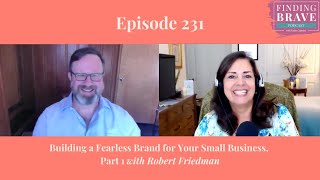
Robert Friedman, founder of Fearless Branding, talks about how expert service firms can stand out through clear differentiation and emotional positioning. He walks through laddering benefits to find your brand promise, using examples like a personal injury lawyer positioned as David vs. Goliath, and does a live branding session with host Kathy Caprino.
Chapters
When I will screen a prospect, I'll ask, if your best clients couldn't hire you, they had to hire one of your competitors, what would be the value that they would lose, that they would be missing?
Hello, everyone.
This is Kathy Caprino, and welcome to my podcast, Finding Brave. I've created this show for everyone who longs to create something bold and brave in their life, to rise up, speak up, and stand up for who they are and to reach their highest and biggest visions. Each week, I'll be speaking with inspiring guests from all walks of business, leadership, entertainment, the creative arts, and the entrepreneurial world. And they'll be sharing their intimate stories of Finding Brave and offer their best strategies for building your most rewarding, joyful, and meaningful life, business, and career.
Hello, everybody. Welcome to another episode of Finding Brave. My goodness, am I having a week. I'm talking to people who have been so instrumental to me, who have so much to offer. And today, Robert Friedman is no exception. Robert, thank you for taking time. I'm so excited to dig in all about essential steps to our branding of our small businesses so that we can have the impact that we dream to. That's your sweet spot, right?
It is, it is. It's so nice to be here. We've known each other for well over a decade.
Isn't that crazy? And I have a story about. I tell this story constantly. I think the world has heard it, and I'm going to about to tell about. To tell it about how instrumental you were for me early on when my first book came out. So thank you for being here. All right, everybody, let me tell you about Robert and I. What I want you to do is be tell us you just did this for me, Robert, but let's say it again, so everyone knows who this is for. Your. Your ideal person that you support, your avatar, your. Your ideal client. Who is it?
Right. So I should say first, the name of my business is Fearless Branding.
Yes. And I'm going to definitely going to tell everyone your bio. That's so illustrious.
All right, so I work with owners of service firms who are experts. These are people who have defined their expertise in their own field. They've written books, they've published. They have a unique way of doing their work that their ideal prospects need to have. And so when I will screen a prospect, I'll ask, if your best clients couldn't hire you, they had to hire one of your competitors, what would be the value that they would lose, that they would be missing? Right. And so I really feel like there's Two types of really established professionals. There can be somebody who might say, you know, I'm an accountant. We do great work. We make sure that our clients are absolutely maximizing all of the legal strategies to optimize their taxes. But really, really, we're not doing it differently than the other cream of the crop accountants in town. Right. It's not bad. And if you are in a business and accounting is one where there is so much demand, differentiation is not that important. Right. You will still. You will have a thriving accounting practice. You will do fine. Right.
Okay.
My clients, totally. Yeah. My clients, however, are in businesses where that's not necessarily the case. They will often say, we're looking for better clients, which could mean bigger engagements, where the clients will let them do their absolute best work, where maybe the engagement has a longer duration so that they can make a bigger impact. It may be just about the money that they want to charge more. And you have to work with bigger clients who can afford the bigger budgets. Right. So when that is the case, where my clients say, we want to uplevel. And so what I'm looking for are the owners of firms that want to grow by at least a million dollars a year in incremental revenue. And the thing that's standing in their way is they're not getting traction with their market. They're not getting the attention of their absolute best prospects because they're not telling their story in a powerful enough way. They're not presenting who they are and what they do in a way that the prospect can say, wow, you're talking to me. That's exactly what we need. And I'm not hearing that from. I'm not hearing that from anyone else. I'm not hearing that from every other management consulting firm. You're telling me something different that's really related to our business, and I'm intrigued. And now let's start the conversation. And that's where I want to meet people. Because one of the things that I see is that when professionals sell, if they just enter that conversation with a blank slate, then they're not really doing their job, because then they have to explain to that prospect who they are, what their value is, how they're positioned, et cetera, et cetera. And then they have to turn it around and focus on the prospect to understand who that prospect is and what they really need. So my job as a branding consultant is to set all of that up in advance so that the prospect can look at the website, maybe see a podcast. They see exactly how that firm is Positioned exactly what their value is, that they can come in and say, I'm already at least half sold, if not 90% sold. Now that expert can focus on solving my problem and telling me how they would solve it.
Anyway, I definitely want, I want to work with you once again, you know, after a decade, because I have a million questions. And you also said something. Hold, hold your response. But you said, kathy, I see your brand as finding brave. And, and you were about to give me some advice about that. And I can't wait to use me as an example. I'll get some free consulting. But people, let me tell you about Robert first, if that's okay. Owner and founder of Fearless Branding. My gosh, just saying it. I go back to 2008 working with you. Robert is a branding consultant who focuses on creating powerful brands for experts and the firms they own. He works with consultants, law firms, executive coaches, and other professionals who are paid for their ideas and expertise.
Robert's mission is to eradicate generic.
If you want to attract and work with your ideal clients, you have to make sure they understand the value you get, they get from you. And prior to starting, I never knew this Fearless Branding. Robert was a brand manager for craft. He sure learned a lot. I'm sure there. Ran a joint venture between the US Postal Service and Golden Books and worked for several large New York City ad agencies. Okay, that's Robert. Now let me, let me just ask questions from the perspective of the person who would be your client. Could I do that?
Of course.
So let's even start. Well, let me ask you this. Oh, this is a story I want to tell and I've told a million people. When we first started to work together, I was struggling with who am I? What kind of coach am I? Who am I serving? And I did not want to say.
I was a woman's coach.
Which is quite ironic because 16 years later. No, it wasn't 16. How many years is it? 10 years. I was saying to you that it looks like I'm number one on Google under the ads for women's career coach. So thank goodness you slapped sense into me. But I said to you, you said.
Why don't you want to call yourself a woman's coach? Career coach.
And I said, number one, it's half the population.
I'm not going to serve, and that scares me.
And you said, number one. Didn't you tell me you just researched women's issues for more than a year? Yep. Didn't you just publish a book, breakdown breakthrough on the 12 hidden crises working Women, Faith. Yep. Didn't you tell me that when women come on your calendar, you're overjoyed and you're doing a happy dance? Yep.
And you said, why wouldn't you want to brand yourself like this?
And that was the most impactful branding advice I ever got. It's women. Yes. I have male clients who I adore, but they're a certain kind of male client, to be honest. They're going to go vulnerable, they're going to get deep, they're going to look at how they do. They're not overly defended. There aren't typically CEOs, to be honest. I'm just coming out and telling you because CEOs are incredibly well defended about how far they've gotten and what they don't want to let go of. In fact, I'm writing a piece now on vulnerability and leadership. And, you know, I'm loving working with people who are strong enough to find, brave and be vulnerable. Right. So I'm thanking you for that. But here's a question I want to ask for people listening. When you say you work with some accounting, it's, it's okay for them to say, you know, we're really not that different from other competitors, but we'll do a fantastic job. When people ask me, how are you different, Kathy, I say four things and I want to make sure you'd say, yeah, that's, you're on the right track.
One.
I had an 18 year corporate career, so I have lived what it is to be a vice president, a woman in high level corporate life. I'm not just making it up, I have lived it. Number two, I'm a trained therapist. You are going to go deep with me, and deep is what makes change, superficial does not. That's my view. Number three, I've researched women's issues for 16 years. I think I know women's challenges better than most people on the planet, and I've written two books about them. And number four, I'm a business owner. So I'm in the arena. As Brene Brown has said, I'm not sitting out here, you know, in my jammies, not knowing what it's like to compete on a business level. If those things attract you, I'm the right person. And usually people are like, sign me up now. And they usually find me through Forbes or the podcast. Or would you say that those are articulating differentials that you're kind of referring to when people know what the difference is in why someone should hire you over someone else? I'm Going to get critiqued. I can tell it.
Pardon me?
I said I'm going to get critiqued. I love it. Yes. And yes.
And so, you know, if you want this to be a real life branding session.
I do.
Don't you people? I do.
I think that there are important supporting points.
Bring it on.
So what I do with clients, and I think you've already done this work, but maybe it's not completely expressed, is to wrap those functional definitions. Right. You know, those functional proof points that you are a VP level in a corporation, that you're a business owner. Right.
The credibility points, I would call them.
Right.
But what is the underlying meaning that inspires all of it? Right.
You're gonna have a breakthrough with me. You will break through and be a different person after that. That's it.
And I think that it goes back to what you said a minute ago, which is finding brave. Right. That it's the having lived, finding your own brave. Right. Having lived the deep dissatisfaction of what.
You went through and pain and hurt.
And harassment, connecting all of those dots to create an end benefit. Right. Where finding brave is the fulcrum, Right. That if somebody is stuck, AKA they need a breakthrough, that's why they're talking to you. Right. And your job is to get them to that breakthrough. How? By finding their brave. To get to what their definition of success is. So, you know, I think so you're.
Are you saying, like you started before we pressed record, a lot of people talk about the functional things they do differently and you're saying to do something else. How would you articulate?
I'm saying that it's about knowing the meaning you create. It's what you put in that post a couple of weeks ago about the experience. Right. That what I really see makes you unique is your ability to help the client to find their own bracelet. Right.
And why do. And don't people go, who cares? Who cares if I find brave? What am I going to get out of that? Doesn't the brand need to talk about? And so what? Yep. You're going to be brave.
Absolutely.
Okay.
Absolutely. So, okay, branding is. Oh, yeah, tell us an exercise in laddering. Laddering is a market research and marketing term where the benefit goes from very basic to very exalted. So, for example, I'm a market researcher and you're a mom and you're going to the store to buy your kids some milk. And I say, well, why? And you may say, well, my kid is thirsty. And then I said, like milk. Well, okay, so we're starting at thirsty. But you could, you could drink water, you could drink soda, like all those things. You wouldn't be thirsty. Yeah, but he's going to first grade. I really want him to be healthy. I want him to do really well in school, to be strong and play sports and have good grades. Then what's going to happen is he's going to be really smart and then he's going to be class valedictorian of his high school class, then he's going to go to Harvard, then he's going to be president, and then we're going to have world peace.
Agreed.
So we have just laddered from thirsty to world peace. And the reason it's appropriate in branding is because thirsty is too low. But it's not always to go to the highest. It's not always where you want to go. If you go to world peace, it's too high. So what you. So the, the objective in branding is to figure out the point at which your brand can make. Like, what rung on that ladder will enable you to make the strongest connection to your ideal prospect, to your people, your audience. How do you make a benefit that is going to be relevant? So, for example, so I intuitively feel, and you know, if we were working together, I'd want to explore this further, but I intuitively feel yours is about finding brave, just like mine is about being fearless. Right, Right.
Like you're saying, didn't you just say these 20 things? And that would point to you being a woman's coach and of course men too.
But yeah, so I think that's it. I mean, there's, there's rungs above that. You'll have your breakthrough so you can get your ideal career. So you're going to make the money you want and have the work life balance you want and all of those things. Right. It's not that those things aren't important, but when you are telling your story, it's really important that you know your central theme. Right. So if I may, I'll give you a couple examples. Right. I have a client who is a personal injury lawyer. And when she came to me, looked at her stuff and so, you know, kind of one of the main problems that I help my clients solve is marketing. I'm spending money on marketing, but it's not producing a result. I'm not getting a good return on investment. Right. So she was spending money. So her name is Marjorie Heinrich. Her business is heinrich law, heinrich law.net and she was working with, she's okay.
With us talking about this.
Thank you.
She's working with an SEO firm and they were doing work, and she was paying them on a monthly retainer, but it wasn't producing business results. She wasn't getting the right types of potential clients and then closing them, and they weren't. She wasn't getting cases out of it. Right. All this effort, all this money, no work. She showed me how they were positioning her, and it was very generic. Right. You need a personal injury attorney in Oakland, California. Right. Where the ones for you? So Marjorie then told me what her story is. She had spent 20 years as a defense attorney for big insurance companies, and she was great at it. She was, you know, San Francisco Bar association trial lawyer of the year, and she was rocked.
She rocked, but she was feeling sick about it.
Yeah. So what an insurance defense attorney will do is their job is if somebody has been in a bad accident, her job is to make sure that the insurance company's profits are maintained. Right. They'll pay a settlement. But how do we make this as, you know, as low as possible? Right. So she had a crisis of meaning. Right. And then she switched sides. So her switching sides had happened long before I met her, and she had built a thriving practice. And she told me what she does. And it's always about, you're in a terrible accident, you're injured, you're trying to heal, then you realize you've got this big battle. It's you against a giant insurance company or a city or a corporation. And the last thing you want to do at that moment is to fight a battle. You've just been fighting a battle, getting exactly right.
So she's advocating, like, for, you know, for your human strength and self respect and not having. Allowing you not to have to go through another battle.
Yes. So in her telling story, we saw something. David and Goliath. Right. It's a perfect metaphor where she is fighting just like David against the giant, the lumbering behemoth giant. Malcolm Gladwell wrote a great book on David and Goliath that really, like, helped me with this brand that. That David was not only brave, was not only strong, but super strategic. He didn't fight the battle the way Goliath wanted to fight the battle. He knew where to go, how to get the high ground, how to take, you know, even though he's much smaller, how to take that strategic shot from the right place. So the reason I tell you this story, so we, we developed a brand and the expression of it is, we will be your warriors. Marjorie's on the warrior archetype. It's a modern day retelling of David and Goliath and that story is the focus. Right. It's not everything she does. She knows courtroom strategy and how to hire the right expert witness and how to do cross examination. I mean her skill set is so broad to be able to master what it takes to win a high stakes personal injury lawsuit. But from a branding perspective, from, from a connecting to someone perspective, she has a theme, she has a simple, emotional, single minded message that people get emotionally because they're, she's telling a story that people really, they already know that story. Right. But she's a new incarnation of it. Right. So it's so important to have that and that's what I feel like. So I'm always looking for that kind of emotional hook that can be turned into a story. And so, you know, to wrap it back to what you were saying, you already have it. Now here's a question that finding Brave, right?
So exciting. I love your work. Hello everyone.
Kathy here. I hope you thoroughly enjoyed my discussion with Robert Friedman today on fearless branding and what it means and why we have to engage in it. Please do stay tuned for part two of our conversation next week for more hands on information about how we can.
Articulate how we are different from the.
Competition and why that matters. Thank you. I'll see you then. Hello, Kathy here and thanks so much for tuning into today's episode. One quick thing I'd love to share before you go is that about my new digital training program for organizations and professionals called the Most Powerful you, which is the companion to my book the Most Powerful seven Bravery Boosting Paths to Career Bliss. I'm so thrilled that recently an international division of the United nations brought in the Most Powerful you program as a training tool for members of their staff. And I'm speaking with other global organizations right now to do the same. This program brings to organizations real world transformative training for leaders, teams and professionals to help them thrive at the highest level in their work and projects. So here's my Please take a look at what I'm training in the Most Powerful you. And you can find that@mostpowerfulyou.com and if you feel the content would be instrumental for you and your team, I hope you'll ask your leaders and DEI managers to bring in this training program to your company. It's truly transformational for work cultures everywhere and it generates amazing results. Thanks so much. And here's to you becoming the most powerful you. Thanks so much for joining us today. And please don't forget to check out findingbrave.org for more programs, resources and tips. And tune in next time for your weekly dose of finding Brave.
More from Kathy


Elevate Yourself, Elevate Others, and Amplify Good | Chris Cooper | Finding Brave Ep. 334

Finding Brave Epis #333: How Leaders Can Harness AI Without Losing Their Humanity, w/Bennett Borden

Finding Brave Epis 332- How to Stay Brave, Valuable and Visible in the Age of AI, with Raman Rai

Finding Brave Epis 331 - The Power of Positive Disruption, with Dr. Patrick Leddin


Finding Brave Epis 330 - Being 40: Letting Go and Embracing Who You Are, with Stacey Lindsay

Disrupt Career Reinvention with Kathy Caprino - via The Disruption Lab Podcast w/Patrick Leddin

Creating Neurodiversity-Friendly Work Cultures: Simple Workplace Adjustments Matter

Finding Brave Epis 329 - How To Create a Neurodiversity-Friendly Workplace, with Kristen Pressner

Finding Brave Epis. 328: Reclaiming the Power to Trust Your Own Voice, with Dr. Cindy McGovern