232: Building a Fearless Brand for Your Small Business, Part 2 with Robert Friedman
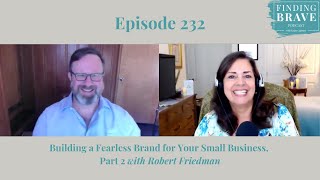
A Finding Brave podcast episode (Part 2) where Robert Friedman and Kathy Caprino discuss building a fearless brand. Friedman presents a five-question framework to clarify brand identity and audience (Who are you? What do you do? Who do you do it for? What do they need? What do they get?), emphasizes making brave choices (narrowing focus, closing doors to open the right ones), differentiation, narrative and competitive analysis. He also mentions a Brand Strength Assessment on his site (fearlessbranding.com).
Chapters
Being in this type of life, in this career trajectory, we are faced with decisions, right? And whether it's for branding, other aspects of your career, or your professional life, it's all about the choices that you make. And are you in fact, making the brave choices?
Hello everyone.
This is Kathy Caprino, and welcome to my podcast, Finding Brave. I've created this show for everyone who longs to create something bold and brave in their life, to rise up, speak up, and stand up for who they are and to reach their highest and biggest visions. Each week, I'll be speaking with inspiring guests from all walks of business, leadership, entertainment, the creative arts, and the entrepreneurial world. And they'll be sharing their intimate stories of Finding Brave and offer their best strategies for building your most rewarding, joyful, and meaningful life, business and career.
Hello, everybody.
Kathy here.
I hope you so loved part one of my interview with Robert Friedman on building a fearless brand for your business. This is part two with even more strategies, solutions and tips for building a brand that connects with your ideal clients. I hope you find it so helpful. Thanks so much.
Let me ask this. We'll touch on it a little bit. Hopefully it's helpful for people like me in the B2C world where you are pitching to consumers, not businesses, what if you know very clearly, let's say you're the warrior. In some ways, I feel that's what I'm helping women do, frankly. Become the author of your own life. Finally do it. But you want to pivot that to B2B, where that message that you are known for, like this client of yours, is the warrior. She's not going to be pitching that for companies to pay to hire her. But you want to pivot because B2B is a great avenue for revenue and recurring income and licensing. What do you do when that key trajectory that you're known for isn't going to fly in B2B? Do you chuck B2B or do you tweak it? What do you do? Have you had this with clients where they don't want to let go of what they're great at? She's the warrior spirit for the underdog. But let's say she wants to pivot a little. What?
What do you suggest?
Does that make sense or is it too narrow a question?
It absolutely makes sense. And so this is what I was thinking about when I was thinking about our commonalities between fearless branding and Finding Brave, that being in this type of life, in this career trajectory, we are faced with decisions, right? And whether it's for Branding, other aspects of your career, your professional life. It's all about the choices that you make. And are you, in fact, making the brave choices? So the way that I would. So the way I would answer your question, Kathy.
Yes.
I'll tell you a little bit about how I work. It's actually quite simple. There's five questions that I use.
I'm dying to ask those. Go ahead.
What are those questions that you're asking your clients to answer as honestly as they can?
Yeah. So the first one is, who are you? And it's the beginning of the conversation, but it's the end of the conversation, because if I just ask you that and you haven't already done the work, you may not have a precise answer and a powerful answer right away.
And do you mean who are you simply as a human being, or who are you as you show up to your work?
I mean, what do you believe? What do you stand for? Where will you be willing to make a decision because you know it's the right thing, even if it may not be the most expedient thing or the most profitable thing because you know it's right?
Oh, it's me in the gut.
Oh, boy.
Wait a minute. Repeat that. Repeat it. The decision one, Sadie, the first question, who are you?
And what I mean by who are you? Is what do you stand for?
What do you stand for?
What do you believe? Like, so where are you willing to put your stake in the ground and say, this is what I believe. I will not sell out on my beliefs.
My goodness.
Right. So listen, I work with a lot of professional services firms. Most of them are not interested in working this way. Most of them. It doesn't matter what I'm talking about with you right now that you're resonating with like, they don't care.
What do they care about? Give me the money. Yeah, well, what do they care about? What's more important than that question?
Well, that's because that's how you are wired. That's how you are built. Right. So.
Because for 18 years, I sacrificed answering that question. I lived the pain of it, like your friend.
So you. So you found. You found your brave in that way? I would say. Look, I'm. I do not want to diss any of these people. It's not like they're saying they're going to sell out or be mercenary.
They're not.
They're good people. Right. But the way that I'm talking about finding that deep meaning is not something that your typical owner of a law firm or A managing partner of a law firm or, you know.
Yes.
I mean, many, you know, many kinds of consulting firms, they just don't care. But there are some that will resonate deeply. Right. So you have to know, right.
Are you are. That's question one.
Right, Right. So that's question one. Question two is more expected, which is, what do you do?
Okay.
I can't tell you how often when I say, tell me who you are, people will just jump to, what do you do? Right. So what do you do? Ideally does have differentiation. Do you have some kind of method, some kind of approach that is not doing the work in the same way that your competitor is doing?
Right, got it, got it.
So those are the two questions that are about you.
Can I. Can I dimensionalize that for people? So what do you do? Would this be a way that you're looking for? Yes, I'm a coach, speaker, trainer, writer. But what runs through it are frameworks that, for instance, close your power gaps. The seven damaging power gaps that help me identify where I want to intervene with you for breakthrough. Would that be what you're talking about?
Yes, exactly.
Okay, got it.
What's number three?
So now we're switching sides. We were focused on on the brand. Now we're going to focus on the audience. There's two questions there. Who. Who are you? Right. Who do you do it for?
And you want the answer to be, who do you love doing it for? Or who do anyone who slops in the door, who do you love doing it for?
Right. So when you say, I don't want to eliminate men because it's half the population. Right. That's making, you know, that's making a decision. But it's not necessarily the brave or fearless decision, Right. Of saying, I can do it for anybody who might possibly need anything. Kind of sort of like what I do and has some money to pay me. Right? Like, so just, you know, we can joke about that, but we want to start to get precise, Right?
Love it. Love it.
And it's based on demographics. So is it somebody who is a VP level who wants to become CEO or somebody who's a VP level who wants to start their own business, etc. Etc. Right. Then that's demographic, because you can see you're either the owner of a law firm or you are not. Right? Like, that's easy. But then the next is psychographics. What do they believe? How are they wired? Right? So one of the things that I know about my clients that actually took me a while to recognize is they believe in themselves and being so expert. But not having the powerful brand to express that is kind of an affront to themselves. Like, like, I think it just kind of hurts them a little bit where they feel like, you know what, like I am so good at what I do and I really believe in myself. And so I need to have that powerful presence. It's part of like who I am. Like, I deserve this. Right. So I'm going to invest in it.
Yes. You know what? It strikes. This is why you and I get along so well. Marie Nemet Maria Nemeth's book, the Energy of Money. She says people are happiest when they're dem three things. Demonstrating in physical reality what they know to be true about themselves while they're given for giving form to their life intentions in ways that contribute to others.
So powerful. Wow, what a domino.
I mean, what else do you need? There's your guidebook, I think for life. But I have never heard someone describe in kind of layperson's terms, like you just did what it feels like when you're not demonstrating in physical reality what you know to be true. Like when I started my coaching practice.
And I wasn't making any money, I thought, I'm a smart person.
I was a vp, a corporate vp. I know how to market, I'm a good coach, what the heck. And it causes pain and confusion. That's exactly what you're talking about, isn't it? The person who knows. No, I don't understand what's in the way here, but something's in the way of me self actualizing. Is that what you mean?
Yeah, partly. I don't even know if they would say that they needed to be self actualized because I think that my clients, for the most part, they're already self.
Actualized if they're not having the business success or they're not having the impact they wanted. There was something there that you were explaining.
Yeah, there is definitely an opportunity to create a bigger business and to attract more of the right clients for sure, by having the right story. So they see the opportunity. I think it's more of a personal thing though, that, that they, that I help them to see. Like you're amazing and you can have an expression of your business and yourself and your brand that is congruent with who you already are. Right. Like my clients are really, they're the people I'm thinking in particular, like they're coming from a position of power. They're already powerful. They don't have to kind of figure out what makes them powerful? They already are. But there's. There's gaps in the story.
Yes. And I think those gaps. I mean, I think I work with people not on branding, but in ways where they're gapped and they can be incredibly powerful and millionaires and managing $50 million budgets. But that gap, whatever they identify, is the power gap. It sucks. It sucks something away. So I'm not casting aspersion on any of your clients or mine, but even. Even me, when I'm trying to figure out, do I want to pivot over here, over there, it's not a comfortable place to be. We, you know, it. I think sometimes it reflects indecision, which reflects fear.
Sometimes.
Oh, that's another story. All right, Then there's number five. Look ahead. You wanted to.
Yeah, I think we didn't even really get to number four. So who do you do it for? Right. Then what do they need? Right. So it's really. So those are the two things that you focus on outside. Right.
Well, let me ask you something about what they need. Do you ever find that what they think they need is not really what they need?
Oh, yeah.
And which one do you go with? Do you tell them what they think they need?
You have to meet them where they are. Right. The conversation. So this is. This is kind of a lesson about. About selling. Right.
Okay.
Come on. If you tell somebody what you know they need, but they don't think they.
Need it, you don't got nothing.
Right.
They're not buying the milk.
You're just kind of spewing your opinion.
Okay. You just lost the sale.
Got it.
Right.
That's quite easy.
Where. Where they are. And honestly, I don't. I don't know that in the. In the process of doing the work they experience, you know, what it. What it's like, what it's like to step up, they're not necessarily going to understand everything that will result from the work. When they begin the work, they may look back after it's all done and know, like, wow, I thought you were just going to help me get a better return on my marketing budget. Right. But then look at this. Look at everything we did.
You know, when you're making me think so, my book, the Most Powerful you and my training course. I know that 98% of professional women and 90% of men have at least one of these gaps. I know it, but I think that language. I just did a poll on LinkedIn. What did it get? 50,000 views. Women shun power. So if I tell them you're going to become more powerful with this. If they don't want power. Power the way they're perceiving it, there's a. There's a branding problem. In other words, I'm, I'm supporting your statement that I think that we need to meet them where they are and not be educating them before they're ready to even make the sale.
Yeah, it's very. Right, yes. I mean, look, I don't know how you created this. I mean, so I'll go out on a limb and ask some questions. You know, is it power the thing that they want or that they'll resonate with? Is it influence?
It's the word influence. But I'm trying to tell them, you can't have that without power. Get good with it already. But we need a branding discussion. My point is I see what exactly what you mean. I think once I explain it to them, they get it. But they have been conditioned as I have. That power is not what we want.
Yeah.
Anyway, enough about me. Did we get to your number five?
Five is what did I get. So. So we've got the two sides. There's the you, there's your audience. Who are you? What do you do? Who do you do it for? What do they need? What do they get? Bridges, the two. That is your brand promise. Right. And it goes back to the beginning of our conversation. What will you get if you work with me, you will be and feel more fearless. Which is another way of saying stepping into your own power. Right. There's a confidence that happens by going through this process in which you make the decisions. That can feel scary if you're just confronted with the decision, am I ready to eliminate 50% of the people on the planet from my target market? And it could go right. Like, that's just a simple, easily relatable example. Right. So the whole thing that I want to emphasize in this conversation is when you look at those five questions.
Always.
There are ways that you can answer them more precisely. And the whole exercise is to figure out how focused you can be in your answers to those questions. Right. Like, people don't like to close doors. It's scary to close doors, because closing doors means it feels like you are shutting off opportunity. But we don't want to shut off opportunity. We want to open up to opportunity. Right. But if you're open up to too many different types of opportunities, then people don't know where to place you. They don't know how to think about you. They don't know why are you right for Them, Why are you the one for them? And the broader you are, the less likely you are to resonate with anyone. Right? So you want to get as precise as you possibly can to say, those are my people. I really understand you. I know what you need and what you're trying to do, and I can help you, and I can. I am uniquely positioned to help you. And they see it, and they're like, nodding their head and say, I'm not hearing the same thing from anybody else. That's why this is already feeling like a good fit. But the broader your answers to those five questions are, the less likely you are to get that result. But finding brave, fearless branding, it's scary because you're closing doors. You're closing doors so that you can leave the right one open, and the right people know, like, whoa, that's my place.
Love it.
Do you see this a lot? I tell this to people too, because I train coaches on a lot of this stuff. Not as deep as you do, of course, about branding, but you know what I find? Even though I say it's a women's career coach, men will come. And it's as if they didn't even hear that. They're like, I need to work with you.
So this is a really question fairly, and this is what I tell people. Making the decisions is how you position yourself. It's how you put your message out into the world. Right. And are you brave enough to make those difficult strategic choices to create your focus? Other people may resonate, Right. If you have a man with a power gap and he's looking, it's like, wow. Like, I know you're talking to women, but, man, I really experienced that too. These are my power gaps. Right? Could I benefit? Could I work with you? You always have the opportunity to say yes, Right? But the broader you go, the less.
Likely you are to even have that reaction.
Yes, exactly. So you really. So there is an irony there. And you can always say yes on the back end, but if you don't say no on the front end, you're perceived generically. Just using example, like coach. Like, what do you do? I'm an executive coach. I work with business owners. I work with C suite executives. I work with, you know, rising up and, you know, up and coming leaders who want to go from manager to directors. Work in big businesses, small businesses. Right. Like, I can't refer that person to anybody. Right. But people are doing some version of that all the time.
Help us with this. And I'm. I have eight more minutes with you. I'm going to pick that brain, if that's okay with you.
Sure.
When I work with a lot of coaches, hear from a lot of coaches, and they will do just what you said. I'm just starting out. I've been doing this three years. I am a career coach for mid life women. And I'll say, tell me more. How do you do it? How are you different? And they don't have any idea. And again, not casting aspersion when we're just starting out. It's all new. But part of what leads them to have no idea is they don't have a framework. They don't even have a way of doing their work. There's no model for change. There's nothing. My question to you is.
How do.
You help people who truly have no idea how they're different?
And maybe they're not.
Yeah, they may not be yet. They're at a fork in the trail where they have to decide, do I need to figure out some way that I am different? Maybe I'm not right now, but I need to make some choices about who I do it for, what I do, what I believe. These five questions are all the framework, the method for thinking through how might you be different? Right, Right. There's a brand needs to be two things. It needs to be relevant and it needs to be differentiated. So you don't necessarily need to be different. Right. So if you're so differentiated that you're just weird, then. Right.
She's out there. Yeah.
And you've probably gone too far.
Right.
You don't necessarily need to be differentiated in every single way from your competitors. Right. But you need to have critical points of differentiation. And you know, the proof is in the pudding. If you can be undifferentiated like that accounting story I told you, but you still have a thriving business, a thriving practice, and you don't need to be differentiated. You don't need to be any more differentiated than you already are. But if somebody is coming to you and saying, you know, I wish my practice were a lot bigger, I wish I had more clients, I wish I could charge more, then choosing how you want to be differentiated, which is really claiming your expertise in specific areas is a way to do it. So anyway, what I was saying is you're at a fork in the road. You have to figure out, do you want to be differentiated or do you not? If you do, then you have to figure out how. Right. There's a couple of things that I want to add to the five questions because that's very much. There's three parts of creating a brand. So that's the deep dive internally, right? But then the other parts are you need to understand your market, your audience, right? So there's questions that you really need to understand. How might you want to define your target market? More specifically, how might you get a deeper understanding into what's the problem that you really solve, right? So that's the second step, and the third and final step is competitive analysis. And so, like, that analysis just means you got to look at your competition and you got to look at your competition in the way that your target market would look at a competition. So if you say, like just career coach, right? So let's say I'm going to look at two or three or six career coaches and just try and figure out who's going to be the best one for me. So one of the traps that I see professionals who have brands fall into is they think that something is differentiated when it's really not, right? Like, so, like, you ask, you know, professional service firms what, you know, what makes you so great, what makes you. That's our people, right? Or, you know, our combined hundred years of experience, or, you know, like, they're just talking about things that it has to be relevant to the audience and it truly needs to be saying something that the competitors are not saying. So you've got to look at that, right? You really have to look at kind of what's the standard in your market, right? You look at coactive coaches, right? Like, I'm not going to tell you what, I'm not going to tell you what to do. The answers are within you. Like, that's fine. But that story that, that point is articulated a lot, right? And so you always have to ask, does it work? Right? And does it work? Meaning, are you finding the right clients? Are they getting results? Are you building your business in the way you want it to? If it's working, don't change it, right? If you like it, don't change it. But if it's not working, then there's ways to be more fearless, more brave, more rigorous, and look at those questions that you may need to answer.
I love it. Would you agree with this? When I'm talking to coaches, I'll say, look, compare yourself to the top 50 coaches in the world. Look at their website. And I remember when I began to be a writer, I would start looking at coaches and I would sometimes not agree with what they're saying. For instance, I'll be really honest, the coaching training community says, you should not be directive. The answers lie within. Well, I had coaching and I didn't have the answers, like how to build a million dollar business. I don't agree with that. So in my coaching, I'm also a consultant, a mentor and advisor. But. And what's interesting is I interviewed Karen Kimsey House, the co founder of CoActive CTI and I go, what do you think Karen write on the podcast? Is it okay? And she goes, yes, you got to give them everything you got. But you have to make it clear when you're being directive that you don't need to be the expert. You as the coach do not need to be. Right. You are offering this as something to push back on.
Brilliant.
So brilliant. But that is a point of differentiation for me, that I will come out and say, I am not like other coaches. I am going to tell you what I think. I am going to tell you the three careers I think you should perhaps consider. So would you agree that part of this is looking at your top competitors and seeing where there's a gap in what they're doing that you don't agree with that that's absolutely a great sign of where you might be different?
Thousand percent. I mean, one of the things that I see for my clients that have started their own firms is one of the main motivators is they have that senior position somewhere else. And then they say, that's not the way I believe we should be doing this. There's another way. There's a better way. I'm starting my own firm. So I can go do that. Right?
Perfect. I could keep you on forever. Is there one more thing? Besides don't be too generic. You know, really muster that fearlessness because that's what it's going to take. You got to make decisions. Is there anything else that you see us screwing up in our branding?
It's something that I already articulated. But you didn't just say it now, which is find the meaning and find the story. Right? What's that? What is that point of connection? Right. So for my clients, may or may not be true for everyone, I really believe their best clients are hiring them just as much for who they are as for what they do. And so it's incumbent upon you, if you are starting or growing a business, to define that. It goes back to the first question. So this conversation is mirroring the process, right? You start with who are you? But you can't get all the way there. But then you have to keep circle back to it. How do you want to frame the Narrative of who you are. And it's your job to know your narrative, to articulate your narrative, to not stray from your narrative, right? To always find the ways that any particular point that you're trying to explain is connected to that bigger narrative. If you're the warrior, if you're the finding brave, right? I have another client who is the truth teller. Like the little boy in the Emperor has no clothes, right? So it's always about coming back, right? Like her brand is the straight truth, right? So it's always about bringing it back to what that narrative is in a way. So it's. You're telling it because it's true for you, but you know, it's also true for, for your people too, not for everyone, but your people. And that you have that, that essence to share, right?
So good. I think, you know, every time I speak, every time I tell a five minute story that you, I am standing here because everything I'm going to teach.
You, I didn't know for 18 years.
And I had every crisis you can imagine. And then I state them and I see people in the audience, their eyes are getting huge because these are common crises and that's the meaning there. Let me help you bypass the pain.
That I had and find your own brave.
And find brave. Robert. Where do people hire you? Where do we suck up all your deliciousness? Where do we go? And we're going to link to it all below. Tell us, tell us, where do we learn more? Where do we hire you?
Send me a note. Robertearlessbranding.com Fearlessbranding.com is the website. Find me on LinkedIn. It's easy if you have those. My name and the company name and yeah, thank you.
Thank you so much.
It's so rich what you share. You make it clear, you make it simple, but it's deep. And to really do this work, you need a helper. And you're the helper.
Thank you, my friend. I really appreciate it.
People connect with you.
So fun.
I could talk to you for another 10 hours. I hope everyone that this is inspiring to you. Yes, it's work. Yes. It requires us to understand ourselves and understand yet again and peel the onion and peel the layers. But it's so exhilarating when you get to something that really does feel like who you are in the world. I hope you find this inspiring. We want to hear your questions. Robert just gave you his email. That's amazing, right? Write to him. Okay, I got a question. What did you mean by this? And you know, I know you'll have resources, Robert, to share and ask me a question. Wherever you see this LinkedIn, Instagram, Twitter.
I do actually have one resource. So on my website, Brand Strength Assessment, it's very simple. 12 statements. You rank yourself on a scale of one to ten. Take you five minutes, take it. If you want to send it to me, send it to me and we can talk about and really what I'm looking for are are you committed to what you're doing? Are you committed to growth? But are there gaps? Have you defined your competitive advantage? Is your marketing really resonating with your prospects? Do people tell you I love, I love that thing that I read or I love your brand? If you're committed but your people aren't loving it, then you've got some opportunity.
Oh Robert, thank you so much. It's brilliant. And what's the link to that?
It's just right on the homepage of my website.
Just right on the homepage.
Perfect. All right, photo ideas, Brand Strength Assessment.
Thank God.
Thank you. Thank you so much for the beautiful work you do. So appreciate it. All right everyone, hope you we're going to have a two part series here because it's too great to condense. Have a wonderful week. I hope this inspires you and see you next time. Bye. Hello, Kathy here and thanks so much.
For tuning into today's episode. One quick thing I'd love to share before you go is about my new digital training program for organizations and professionals called the Most Powerful you, which is the companion to my book the Most Powerful seven Bravery Boosting Paths to Career Bliss. I'm so thrilled that recently an international division of the United nations brought in the Most Powerful you program as a training tool for members of their staff and I'm speaking with other global organizations right now to do the same. This program brings to organizations real world transformative training for leaders, teams and professionals to help them thrive at the highest level in their work and projects. So here's my Please take a look at what I'm training in the most powerful you. And you can find that@mostpowerful you.com and if you feel the content would be instrumental for you and your team, I hope you'll ask your leaders and DEI managers to bring in this training program to your company. It's truly transformational for work cultures everywhere and it generates amazing results. Thanks so much. And here's to you becoming the Most Powerful you. Thanks so much for joining us today. And please don't forget to check out the finding brave.org for more programs, resources and tips, and tune in next time for your weekly dose of finding brave.
More from Kathy


Elevate Yourself, Elevate Others, and Amplify Good | Chris Cooper | Finding Brave Ep. 334

Finding Brave Epis #333: How Leaders Can Harness AI Without Losing Their Humanity, w/Bennett Borden

Finding Brave Epis 332- How to Stay Brave, Valuable and Visible in the Age of AI, with Raman Rai

Finding Brave Epis 331 - The Power of Positive Disruption, with Dr. Patrick Leddin


Finding Brave Epis 330 - Being 40: Letting Go and Embracing Who You Are, with Stacey Lindsay

Disrupt Career Reinvention with Kathy Caprino - via The Disruption Lab Podcast w/Patrick Leddin

Creating Neurodiversity-Friendly Work Cultures: Simple Workplace Adjustments Matter

Finding Brave Epis 329 - How To Create a Neurodiversity-Friendly Workplace, with Kristen Pressner

Finding Brave Epis. 328: Reclaiming the Power to Trust Your Own Voice, with Dr. Cindy McGovern