234: Summer Pick #2 How Confidence is Key How to Get It Build It and Keep It
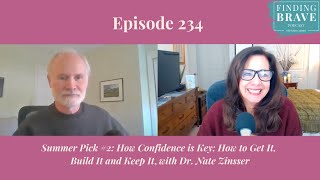
Dr. Nate Zinsser, a performance psychologist, explains confidence as a skill you build by replacing seven self-limiting beliefs with what he calls "first victory" beliefs: remember what you want, be your own best friend, use logic and creative fantasy, play to win. He shares how to reframe failures and practice consistently.
Chapters
Hello, everyone. Kathy here. I'm very excited to bring you this year's Summer Pick series, a selection of the most downloaded shows we've published in the past that we think you'll not only love to listen to again, but they'll also help you in a big way to find Brave and build even more success, reward and fulfillment in your life and work. I also wanted to share that we have now moved to a bi weekly schedule, continuing to bring you great episodes that I hope you find instrumental, but also giving you a bit more time to check out and to digest each episode and take action on the powerful strategies and tips that are shared. Thank you so much and wishing you a great summer. Enjoy the show.
Whether you're on an athletic team or you're in a salesforce or you're in a symphony orchestra, boy, you better be honest about what you think about yourself. Because what you think about yourself and what you think about all the things that happen day by day by day, that's what constitutes your confidence.
Hello everyone. This is Kathy Caprino and welcome to my podcast, Finding Brave. I've created the show for everyone who longs to create something bold and brave in their life, to rise up, speak up and stand up for who they are and to reach their highest and biggest visions. Each week I'll be speaking with inspiring guests from all walks of business, leadership, entertainment, the creative arts and the entrepreneurial world. And they'll be sharing their intimate stories of finding grave and and offer their best strategies for building your most rewarding, joyful and meaningful life, business and career.
Here we go.
Hello, everybody. Welcome to another episode of Finding Brave. Kathy Caprino here. And once again I am beyond excited to learn from a master in a topic that I tend to teach a lot. And so I cannot wait to learn and grow and stretch in my own understanding of confidence. And we are talking about how confidence is key and how you can get it, build it and keep it. You know, the keep it part I think I am most interested in because I get it and then every once in a while I lose it. So thank you, Nate Zinserber, for taking the time in the middle of your book launch. I'm so grateful, so grateful to you. Thank you for being here, Kathy.
It's a pleasure. Delighted to have you be aboard. Delighted to connect with your listeners.
Thank you. Thank you so much. All right, people, I am going to read this some of Nate's bio because it is so inspiring. It goes on longer than this and you can read it on the show notes, but I want to tell you who we're listening to today. Dr. Nate Zinsser is an expert in the psychology of human performance who consults for individuals and organizations. Excuse me. Seeking a competitive edge. Nate's latest book, the Confident A Battle Tested Guide for Unshakable performance hits shelves January 2022 and has been endorsed by many people, but also by two time super bowl champion and MVP Eli Manning. And best selling authors Jon Krakauer and Steve Steven Pressfield. And U.S. olympic bobsled head coach Mike Cohn. Holy crow. Nate was a regular consultant to the Philadelphia Flyers and the New York Giants for 12 seasons and has been a keynote speaker for so many companies that you've heard of. General Electric, Facebook, McDonald's, Staples, Major League Baseball, NBA and so many more. And a consultant for the FBI Academy, the US Army World Class Athlete Program, including mentoring four Olympic medalists, the US Army Recruiting Command, and the US Army Marksmanship Unit. Wow, there is so much more here, including personally conducting over 17,000 individual training sessions for cadets all around athletic, academic and military performance. And you know, this was an interesting fact. I had no idea of that. You helped launch the highly successful magazine Sports Illustrated for Kids and was presented in American Library association award for his 1991 children's book Dear Doctor A Kid's Guide to Handling Sports Problems. Wow. I guess you're pretty busy every single day of your life. It seems there's a lot going on here, isn't there?
Yes, indeed, Kathy. I will try to live up to my hype. Thanks for the intro.
All right, confidence. You know folks, when I'm about to interview someone, I have a prep form and I ask, what are the top three bullets you really want folks to take away? The key takeaways. And I don't always read them, but I have to read this. Number one, confidence has relatively little to do what happens to you. It's a function of how you think. Number two, it's very situation specific, but you can develop it for any situation you care for. And confident performers think differently from the average person. So I'm dying to know, first of all, Nate, how did you get into this?
Oh, we have to jump into the wayback machine for that one, Kathy. I had the curious experience of attending a small boys private country day School, grade six through grade 12. And at this school there was always constant talk and constant enthusiasm about a particular sports team. Our soccer team.
Your school soccer team.
The school soccer team.
Okay.
And this, this school soccer team is very, very good. Year after year after year after year. But it was the only team in the school that was good year after year after year. And even though you could put half the members of the soccer team onto the basketball court or onto the tennis court, or onto the lacrosse field, those teams were never as good as the soccer team. So there was something happening. Obviously didn't have anything to do with athletic talent. It had something to do. I later studied this. But it had something to do with a shared expectation, a shared belief that this master coach of this school's soccer program, a fellow by the name of Miller Bellari, there was something in the way that he communicated with players, something in the way that he got players to believe that even if they were just, you know, marginally athletic, if they devoted the time to work their skills, if they took a soccer camp or so in the summer. Oh, and this, by the way, was back in the days when boys typically played three sports. A fall sport, a winter sport and a spring sport, much different from the degree of specialization that we have today. But Coach Bollari was really good at communicating a vision and expectation of success. And the whole school bought into it and the whole state bought into it. And I later learned that this is something called a self fulfilling prophecy, a expectancy effect. It was this belief that, hey, we're good, we do the right things, we are good. And no other team in the school had that expectation. And I'd never played soccer at this particular school, so I wasn't the direct beneficiary of it, but I was an indirect beneficiary of it. And I'll never forget when I was in the ninth grade, sitting at lunch one day telling a bunch of my classmates how we really had a great opportunity to build a much better wrestling team over the next few years. Once a few guys in my class who seemed to have some ability, got a little experience, got a little seasoning, and I was explaining this to some other people at the table, and a guy looked at me from across the table and said, nate, shut up. You'll never be any good guys at this school don't wrestle. Well, we're good in soccer, sometimes we're good in swimming, sometimes we're good in tennis, but we've never been good at wrestling and we never will. And I just sort of sat back in my chair and said, wow, I don't see any crystal ball in front of this dude. Where does he. Where is he getting this intelligence? And he was just a victim of a certain self fulfilling prophecy that he had bought into. Now, the fact of the matter Is that the wrestling program at the time, we were pretty much a doormat. But I'm delighted to say that two years later, at the conclusion of my junior year, our wrestling team had its first winning season in a long, long time. And in my senior year it had another winning season. And I don't think it was so much because we were all that physically gifted. It was just as much a function of the fact that we did not buy into that negative self fulfilling prophecy.
Well, this is amazing. Now wait, you were, you said, I'll be the coach. You decided you would coach the wrestling team or how did you instill that in the coach of the wrestling team?
I. Well, I don't know if I influenced the coach of the wrestling team so much. I just refused to buy into that self limiting belief myself. And I guess I talked enough to Kevin Brady and Tommy Kendall and a few other guys in my class and they kind of got the idea, hey, we could be good too. So we made this break from a shared belief system that was operating throughout this particular organization. And that's always been a metaphor for me. That's always been a moment that I try to share with people. Whether you're on an athletic team or you're in a salesforce or you're in a, a symphony orchestra, boy, you better be honest about what you think about yourself. Because what you think about yourself and what you think about all the things that happen day by day by day, that's what constitutes your confidence.
I want you here for 10 hours. Can I dig in with you?
Dig away.
I have a million questions. First of all, I couldn't agree with you more in terms of what I see in coaching executives and professional women. And I'm going to give you all a secret. One of the things that creates breakthrough for these people is because I say to them that they are amazing. I am not BSing. I'm looking at what they've said, they've done. Everyone is amazing. Everyone has something. And some people have many things that make them fantastically different. And because I can see that with my clients and I say it and they believe me because I've worked with over 20,000 people in six continents. Instantly something shifts in them. I can see that. So I know that what you're saying works. But here's my question. So I was a former therapist, so of course some of these questions are therapeutically, they're deep.
That's okay.
I know you're ready for it with everything you've ever done. I believe that there's A lot that goes into confidence, that if we are not aware of it, we can't shape it. I believe if I'm understanding you, anyone can change their level of confidence. Yes, But I believe we must be aware of some things, like our pessimistic mind, like our negativity that we were given. Many of our ideas and beliefs were given to us by the culture of the family. So I have a question for you. The fact that you looked at this coach in grade six and made an observation already sets you apart from millions of people. But do you think. Go with me here, that you had an innate sense of confidence that maybe was instilled by your family, that you would even say, I watched this guy. I think there's something different here. I think we can have an amazing wrestling team. Was there something that is inside of you that made that an easier leap than for the guy sitting in front of you going, what are you talking about?
I'm not sure there was. You know, I was not a precociously athletic kid in any sense of the word. You know.
Yeah, I don't mean about sports. I mean that you just thought, why not? Why can't I be successful? Why can't the team be successful? That one leap is a big leap for millions of people. So what do you think may helped you make that leap?
I may have had a little encouragement, you know, from mom and dad, but I don't recall moments in my earlier childhood where I received, you know, a series of messages that really encouraged me to believe in myself. I had to. I had to work at that. I had to work at that. I mean, I'll tell you this, and some of. Some of your listeners might be able to relate. Once upon a time. I don't know if it's still the case, but once upon a time, if you were to buy a box of Wheaties at the grocery store, on the back of the Wheaties box would be a short biography of an American success story, typically an athlete. And I remember reading a couple of those, and I'm saying, yeah, okay, maybe that's what it takes. And so I started working a little bit harder.
You wanted to be. You wanted that level?
Oh, I wanted that level, for sure. You are absolutely spot on in that messages. And from authority figures, cultural forces really have an impact in formulating our system of beliefs and our whole approach to growth and success and progress. I devote a whole chapter in the book to an articulation of, you know, I refer to them as the seven deadly sins. Seven messages, seven commonly Held beliefs. And then the seven saving graces. Some alternatives for those that seem to be the kinds of things that confident, successful people choose to endorse rather than any one of the seven deadly sins.
Can we hear those?
Oh, sure we can. We can go into all kinds of detail for that.
And everyone, you've got to check out this book. You know, already when we're recording here, it's already, you know, in top three lists. Sports, psychology, success. It's incredible. But, yeah, you know what? What? I. When you talk, half of my mind goes flying off and thinking of things. But I remember my mother used to say, you can do whatever you want to do. It was a mantra, and I believed it. I believed it. But what are these?
I'm glad you. I'm glad you chose to buy into that because there was probably an opportunity for you to say, nah, mom doesn't know what she's talking about. No, Mom's not really all that, you.
Know, mom doesn't know about the business world or mom doesn't know.
Mom doesn't know what it's like to be me.
Oh, wow. All right.
I think just as important to the message that you received, it was, again, as you point out, something about you, a little bit of willingness to endorse that message, to take that message in.
Yeah.
So, you know, those kinds of things are super important. I'll dial up some of my seven deadly sins.
I would love that.
I want to get them in order for you. So. So I'm dialing them up here.
Wonderful. And I want anyone who's a parent, you know, I spent time as a marriage and family therapist. And I want to say not, I don't mean to be a downer or doom and gloom, but how we relate to our children every single day. The words that come out of our mouth, how we respond when they have failure, will make or break your child.
Really, really, really true.
Okay, okay, let me hear.
Limiting belief number one, Remember your failures and mistakes because those memories motivate you to improve. A lot of people think that's the case.
Oh, this is not the case. What you're about to read. These are deadly sins.
Yeah. These are the seven. Yeah. These are the seven deadly sins. Remember your failures and mistakes because those memories motivate you to improve. Deadly sin number two, always be your own harshest critic who wasn't encouraged to take oneself seriously in the pursuit of their personal success. You know, deadly sin number three goes right along with it. Always be logical and think carefully about what you're doing. Okay. Now, a certain degree of self awareness is, is, is crucial. But to be locked into logic, if this, then that. If this, then that, that can be tremendously self limiting. Here's deadly sin number four. Always be on the lookout for more knowledge and more information and more practice opportunities. The idea that you can never have enough. If there's one thing that's important for confidence at the moment of truth, it's your willingness to look at what you have in your tank, in your reservoir, in your, as I put it, mental bank account and say, okay, I'm enough. I may not be complete, I'm still a work in progress, but right now I'm enough. As opposed to constantly thinking, oh, I wish I had more. Oh, I wish I had more. I wish I had studied this, et cetera, et cetera.
Oh my gosh, that one brings tears to my eyes. So obviously I needed to hear that one.
Okay, well, we got a solution for that one.
Okay, good, keep going here. 1, 2, 3, 4.
Here's, here's deadly sin number five. You better be really good at something before you become confident about it.
Oh, boy.
Number six. Worship the gods. The experts know what's best and the winners have earned your respect, you know, and that always puts you in a place of, you know, second best, you know.
Wow.
I've always gotten the kick out of the phrase, if you have a hero, the best you can ever be is second place. And a lot of people put themselves.
What a downer of a statement. Yeah, but why try if I'm always just going to be looking at, up at, you know, from the feet of the hero.
That's right. Okay, but you think, you think about how powerful a message that often is. And here's number seven, A ball above all else. Thou shalt not screw up. Also known as the team or the individual that makes the fewest mistakes wins.
Oh, wow.
Don't screw up. Don't mess up.
Okay, so first of all, let me just state that these are proliferated 10 billion times around our universe every day.
Absolutely.
Wouldn't you agree? Like in the subtlest. And I'm thinking of my kids on their sports team. I played tennis competitively, went to the states. I think I heard all of these.
Of course you have. I will never forget when I began my doctoral studies at the University of Virginia in sports psychology, and I first had the opportunity to listen to Dr. Bob Rotella, the man that I had chosen to study under. The first time I heard him, the first lecture he gave, he came right out and said, sports Psychology, the psychology of elite performance. Very much about resisting socialization. And I sat back and I said, wait a minute, I thought it was all about visualization. I thought it was about all this neat stuff and you're telling me that it's about resisting socialization. And the man was right.
And how would you define knowing what you know now? How would you define socialization? I couldn't agree more, but I want to hear your definition.
Socialization is the process of fitting into a group or a culture and becoming normalized within that. Now, to a certain degree, we are all social beings, us humans, we do live in groups, we do need one another. But I think it was Bertrand Russell who pointed out after a very certain small degree of shared experiences, being socialized is just a formula for mediocrity. So Barbara Tella was right. You do have to resist some socialization. Those seven deadly sins that I just read off are points in our acculturation, points in our socialization that tend to retard, inhibit, limit our sense of certainty about ourselves as we pursue what matters to us. So we got to be honest about which one of those are hanging us up. And we got to be willing to let it go and cultivate an alternative belief about that that feeds our energy and motivates us to make better decisions with how we manage our memories and how we think about ourselves and how we construct those, those still photos and those short videos in the wonderful video production studio that is our imagination.
Oh, why there's so much in that one statement and, and you know, as someone who I, I was always different in a lot of ways that I think freaked out my, my parents, I rejected, you know, the religion. I was raised in Greek Orthodox. I'm a, you know, 10 year old thinking, none of this makes sense to me. And you know, people saying, I mean, I thought people were saying on who the heck do you think you are at age 10 or 12 that you would question, you know, it takes confidence to be different. So much confidence that, that socialization process is so it's osmosis, it's the water we swim in that if for you to be different and be okay with it takes confidence. So let's, let's talk about.
Yeah, let's go to the other side of the equation, please. Let's look at the saving graces. I refer to these as the, you know, the first victory alternatives. First victory meaning that victory that you have to have in your mind before you can succeed at anything else.
What is it?
The first phrase in the book is a Quote from the Chinese military strategist Sun Tzu. And it reads, victorious warriors win first and then go into battle, while losing warriors go into battle and then hope to win first victory. The first victory is your own victory against fear, doubt, worry, etc. So here. Here's the first of my first victory alternative beliefs. Remember what you want more of. That alters your brain and your body, so you'll get more of it. What you know, I ask people to be very honest. What creates more eagerness and more motivation to move ahead? Mentally replaying that narrow loss you suffered and feeling it sting, or mentally replaying one of your most successful moments? What creates more energy? What gets you moving more again? We were socialized to remember your failures and mistakes. That's what motivates you to get better. I quite thoroughly disagree. Remember what you want more of. That creates a great deal more energy.
That's a spiritual concept of what you focus on expands, isn't it?
You said it couldn't. Yeah, exactly.
Okay, here's what's next.
Here's saving grace. Belief number two. Always be your own best and most honest friend. I mean, people stick up for their best friend. You accept his or her imperfections. You still bring the love. You encourage them, you support them. When things go bad, you're likely to take your best friend aside and say, look, I know you didn't make it. I know you didn't mean to, but you messed that up and you're going to have to fix it. That could be tough, but I know you can do it. And let me know how I can help.
Well, that's beautiful.
And usually after a talk like that, your best friend heaves a little sigh and gets to work knowing that you're still in his or her corner.
That's beautiful.
She's pretty glad to have a friend like you. But the question is, do you treat yourself that way?
No. Never.
Yeah, exactly, because we. Because we have socialized to be our own harshest critic exclusively.
Okay.
Be your own best friend. You can be honest with yourself. You can say, yeah, you missed the ballist.
The ball there, dear.
Yeah.
All right, what's next?
What's next? Saving grace Belief number three. Use both logic and creative fantasy to create your own reality. Oh, I want to hear about logic and. Careful, careful thought.
Crazy fantasy. What was it? Don't just use logic, use creative. I thought you said use logic and. All right, can I hear about that? Okay, and here you are working with the military and you know Eli Manning. Tell me about creative fantasy.
Well, you know There is a time and a place for being logical and being careful and breaking things down. You know, if you're. I urge my climates, my clients, to limit their careful, logical thinking, to practice activities and daily drills which involve just one thing. You know, like simple passing and catching in basketball, or simple pads low, come off the ball fast, and football, you know, but the rest of the practice, when they're performing complex drills involving many skills simultaneously, I want them to turn off that careful, analytic mind and simply look and do, sense and react. The mental process of conscious, deliberate analysis interferes with the smooth execution of any skilled movement. Whether we're talking sports, whether we're talking performing arts, whether we're talking surgery. It interferes with the smooth execution. It interferes with the automatic retrieval of remembered information in testing, taking questions from an audience, making a counter argument. The human mind's analytic conscious capacity is wonderful, but just as wonderful is the mind's unconscious competence. And a lot of people only develop their logic. They miss out on all of these possibilities. They don't attempt anything unless it is quote, unquote, realistic. Do I have a 50, 50 chance of doing it?
You know, and even scripted? I think, you know, oh, yes. I don't want to try this thing I had. It's new. And I mean, I. In my little tennis clinic, I, you know, I've been playing tennis 50 years. I don't want to learn this new stroke because it's so foreign to my cells. Stop resisting. You learned a lot of things in life. You can figure it out. Oh, wow. All right.
Love it.
What else?
Let me share a little story about logic and creative fantasy. You know, one of my proteges that I'm really proud of is a lady named Donna McAleer, West Point class of 87. She is not one of the most people, and she does not think like the most people. She left a very good corporate job and spent two years training full time to make the Olympic bobsled team. Even though she had never been a power athlete, she twice ran for Congress as a Democrat in Utah, a state which ranks 43rd in the number of women in elected office. She knew that none of these goals were realistic, but she pursued them with complete conviction and energy, firmly believing that if she worked hard, worked smart, she'd come out on top. Now, she didn't make the Olympic team. She didn't win those two elections, and skeptics will say, well, you know, she was just wasting her time. But Donna never saw it that way. In her mind, being a Catholic Democratic congresswoman, from an overwhelmingly Mormon state made perfect sense. And that's exactly what the world needed. That was the reality she chose to create and believe in. The alternative reality, the logical reality was that the incumbent male Republican candidate was a lock in. That's just justification for negativity. She wrote a beautiful book entitled Porcelain on women of West Point's long gray line. And she describes all these women who went on to become general officers, Olympic team members, business leaders, and they're all about people who refused to accept the status quo and. And be a little bit creative.
What a story.
So I really encourage that good mix of logic when you're doing simple things, but fantasy when you're looking long term and trying to combine into a preparation for performance.
Can I insert something here? And I think it might be our next question. Part of embedded in what you said is how we look at failure. And tell me if I'm on, on the right track here, but when something happens that anyone would consider a failure, you know, I had a very bad month in my business or whatever. I don't tend to thrive by beating myself up and seeing it as a failure. I tend to thrive by saying, wow, I didn't expect that. Yikes, got my ass handed to me. But what can I get from it? I don't punctuate it by it failed and that's the end. And I never want to have that again. I punctuated as wow, that's part of the learning journey. I didn't expect. What. How can I be better, richer, smarter, whatever, more happy? Looking at this differently, is that part of this how we.
That is definitely part of this. I devote a whole chapter in the book, in the book about protecting confidence from mistakes, failures, human imperfection, things that happen, and also protecting confidence from your own internally generated thoughts about yourself. And you just mentioned something really, really important. You know, you get your butt handed to you, the first thing that you got to do is decide that, okay, this disappointment, this poor performance is not the definitive statement about who I am, what I can do. I treat it as non representative. So. And that lets me leave it where it is and move forward. And the second thing you mentioned was a certain degree of curiosity. Oh, what's. There's a message in here. What's this trying to tell me what's something that I can learn from as opposed to just regretting it and pushing it away and hoping that it never happens again.
Thank you for clarifying that. You have three more here, don't you?
I got three more here. Here's number four. The key is just enough knowledge consistently applied. Okay, what do you know? What are you good at? What can you apply consistently time after time after time? I did a research project while I was at Virginia back in the old days of mainframe computers. And I had to input data from the professional Golf association tour about every player on the tour. And what we wanted to do was ask the computer if there was a particular stat that separated the high money earners, the guys making bazillions from the guys who were playing every week on the tour, but basically having to live out of their car because they couldn't afford. They weren't making enough money to stay in nice hotels after having, you know, spent the money for the tournament entrance fee. And what the computer told us was that really, the only thing that separates top performers from the bottom performers is the fact that the top performers make 1 to 2 fewer putts per round. Play every round. They're just consistently better at one little tiny thing. There's not a million things that separate the top from the bottom. Just one little thing that is done on a consistent basis. So let's find out what you can be good at, and let's make sure that you're applying that time after time, day after day, moment after moment.
Oh, I want to, if you don't mind, amplify that, too. I think in business, I run a small business. When things don't go well over a period of time, I'm asking everybody, you know, I'm listening, and I'm often listening to the wrong people, Nate. And just the other day, I had a conversation that I left going, oh, that was wrong in every possible way. But the way it was wrong is, why am I trying to reinvent the wheel? I've done things well for 16 years. Certain things. Why am I ready to flush that down the toilet? Exactly.
Exactly.
You just have to do that maybe a little differently in this Covid environment or maybe a little tweak, but I think so many small businesses forget this principle. We're desperate for the. The easy silver bullet.
Yeah, we all like bright, shiny. The next bright, shiny object.
Wait, let me just chuck this whole thing. No. All right. Wow. Give me two more.
Two more. Alternative belief number five. Beliefs produce behavior. So confidence comes first. Okay. Confidence comes first.
What beliefs do what beliefs? What behavior?
Beliefs produce behavior as opposed to. Well, you can't be confident about anything. You can't have a sense of certainty about anything until you've done it well, time and time again. Not necessarily. Remember back in those moments when you were struggling to ride a bicycle without training wheels. You had no experience of success with that. As a matter of fact, you probably had some memories to the contrary. Steering out of control, bashing into the curb, maybe scraping your knee or two. But somehow you had the idea that you could do it. Something inside you told you that you could develop the very desirable competence despite the frustrating falls and scraped knees that could be interpreted as evidence that you couldn't do it. But you maintained enough certainty and in your eventual success, and that motivated you to try it again. Until you got it, the confidence was there. You just had to feed it with a few improvements, a little more distance, successfully ridden each time, and that modified your bicycle riding internal software to the point where you got it. You had to have a little sense that it could be done before you did it.
All right, I have questions.
The number of perfectly competent individuals equipped with all the required skills. They just paralyze themselves with mediocrity and inaction because they refuse to allow themselves to actually be confident.
All right. Can I ask you this? Yeah. When I teach confidence in, I want you to challenge me if this is wrong in your mind. I say this as a former therapist. Insight's great, but insight doesn't change your life. It's action that changes your life. And what I say for people, for instance, my world, they're very scared to network. They're very scared to interview. They're very scared to change careers. They're scared to even take the first step to consider changing careers. Because you know, and I say to them, I know that you're scared. I want you to operate in action regardless of the fear, and it is the action that gives you the confidence. But sitting at your computer waiting till you're confident is never going to get you there. You have to take action. So in a way, I flip what you said. I think behavior shapes our belief. Would you agree with part of what I'm saying here?
I agree with part of what you're saying. Don't think of it as an either or think of it as two sides of a coin. Or think of it as the black and white segments of the Asian Yin Yang symbol. Each feeds the other. Your work feeds your confidence. Your confidence feeds your practice. Those two things go together. What we seem to de. Emphasize in our world is the conclusion that you draw from the practice, from the work, from the study that you just put in the conclusion that you draw from your action.
So in other words, if. If I'm telling someone, go and do it, and they go to network on LinkedIn and it's a disaster. They conclude, unfortunately. See, I'm terrible at this. I don't know or that person didn't respond. So I'm not worthy of a response.
No, wrong conclusion.
Wrong conclusion, Right action, wrong assumption. Yeah, I got it.
So we have to learn to be very selective in what we choose to remember. We have to be very selective in what we choose to tell ourselves about ourselves. We got to be careful about the kinds of conclusions that we are drawing from our experience. If those conclusions don't give us a little bit of energy, a little bit of optimism, kick us down, you know, the enthusiasm road, then we're drawing the wrong things from it. We're drawing the wrong conclusions.
That's right. Did you give me your seven?
Okay, I got a couple more here.
Okay.
All right.
Keeping you longer here because I love it. I'm learning.
Number six, Know yourself. Trust yourself. Every competitor, every opponent is human and beatable. You don't put people up on a pedestal. You don't wait until you've achieved something before you allow yourself to feel powerful. Forget the experts. Don't buy into the images and the stories of some godlike performer. I mean, if I have to go play tennis against Serena Williams, I am going to think about Serena Williams in her most human, vulnerable and beatable context. I might actually discipline myself to think about what Serena Williams looks like at 6 o' clock in the morning when she drags herself out of bed, shuffles into the bathroom, starts to brush her teeth, and all the toothpaste stuff is dribbling down her chin. Come on. Nobody's impressive when they do that. And some other things that go on in the bathroom. You've got to look at your opponents as human and beatable. You can't put people up on the pedestal.
I love it. I love it.
Okay. And my last one, my alternative belief to above all, thou shalt not make mistakes. My response is, above all else, play to win. Play to win.
Play to win. What's that mean?
It means you think about what you want and you go for a desired outcome, even though you are aware of some imperfections around you. Okay, I'll share with your listeners an Eli Manning story. This is a true story.
Okay.
Okay. February 5, 2012. Eli Manning takes the snap from his own 11 yard line with 3 minutes and 46 seconds remaining in Super Bowl 46. The favored New England Patriots are ahead 15 to 17. And if the Giants don't score on this drive, that's probably going to be the way the Game ends up, Manning looks first to his right, instantly recognizes his receivers are covered, looks back to his left, steps up, throws this beautiful high arcing pass that covers 43 yards, drops perfectly into the hands of his receiver, even though his receiver was really tightly covered. And this ball was either going to be caught by Mario Manningham of the Giants or it was going to fall harmlessly out of bounds. That completion was the play of the game that set up the Giants winning touchdown, helped eli earn his second Super Bowl. Now, two days later, February 7th, Eli took the following question from ESPN radio host Michael K. On a nationally syndicated radio broadcast, Michael K. Said, do you ever consider the ramifications of failure at a time like that? Referring to Manning's decision to throw at that, make that particular throw at that moment?
Oh, I'm fascinated.
And Manning's response was simple and to the point. He said, that's exactly what you don't do.
Why am I going to think about how I could fail at this? That's absurd.
You recall all the times in those moments where you succeeded in similar moments. You recall the game early in the season where you played the Patriots and you had a fourth quarter drive to win the game against Dallas. You did the same. The game, the win against Miami, the win against Buffalo. You recall the successes. And in those moments you forget about the games where you didn't have the game winning drives where you fell short. You have to misremember those ones and just recall your positive experience. That's the feeling having make you think about those things you have. It brings you to a particular feeling that allows you to go for it.
Can I push that even farther? Please ask you something. I doubt any person in that situation is having an analytical discussion with themselves.
Would you agree?
Well, I mean, they're going to fire off what their creative mechanism of their human species knows how to do. I don't think they're sitting there going, all right, well wait a minute, you know, four days ago, right? You don't have luxury sells. He knows what to do, no.
Yes. Well, he knows what to do and he trusts what he knows. And he's got one, 1,000, two, maybe two seconds to read the movement of five of his teammates, six of the opponents, all the while moving his feet in this tight pocket of human activity with thousands of pounds of angry guy coming to knock the snot out of him. Okay? He has to be quick. He has to trust himself. And that is an ability that the good quarterbacks decide to develop. They work at it all the time, all Your listeners in their own respective worlds face the same challenge. Am I going to trust what I know? Am I going to have a sense of certainty about my skill level that lets me bring it up and repeat it and deliver it more or less unconsciously? That's the challenge we all face.
Every time I do this podcast, I'm learning something that I so need. I. I know I've kept you over. I have two very quick but I'm curious questions. Do you have it? Do you have five minutes?
Let's do this. This is too much fun.
Kathy, want to come over and have my veggie lasagna soon? That's a private joke, people. All right, question number two. Question number one of the two, what I'm getting from you. Would you say that this is accurate? Confidence is an internal job, first and foremost?
Yes, absolutely. Confidence is an internal process. It's all those decisions, all those conclusions you make. It has relatively little to do with what actually goes on in the world. It has relatively everything to do with what goes on internally in that space between your ears.
And when you're working with athletes and the military, so, you know, you consulted for so many teams. You're not, as I'm guessing you're not. Are you sitting with them looking at plays? No. You're working with their mental construct, is that right?
A little bit of each, actually. We will actually look at a videotape of a wrestling match or a videotape of a piece of a game and say, okay, what do you. What's going through your head right here?
And they do.
They remember it A lot of times. They do. A lot of times they do what an exercise?
And like, if you had. You used AI or the computer to assess that, is it more times than not that what they were thinking about directly led to the error or the misperformance or the. And they can remember that, and they.
Can say, oh, oh, yeah, I was thinking this. And I can see how that led me to this behavior. Oh, I was feeling this at this moment. I can see how that led me to that behavior. And just sort of connecting all those dots helps them toughen their mind.
I mean, I see it in my mediocre tennis playing. I often know when I double fall, I have a thought that leads directly to it, like, I'm gonna double fall. It's crazy. I love it. All right, my final question for you. I don't know if anyone's ever asked you this, or maybe they have a hundred times, a million times, but I am personally curious. I Believe I have a strong understanding of confidence. Yet in reading your bio, looking at your book, I had an idea of the kind of individual who I was going to be speaking with. And your demeanor is not that.
It's what were you expecting? Right?
I'm sure. Let's put it the other way. You. You have a soft way about you, you have a gentle way about you, you have a measured way. And yet you're standing in front of cadets and the military and, you know, top athletes. So even don't you hate it when you have unconscious bias that you know is wrong? Meaning, what did I think confidence embodied should look like? Or a teacher of confidence? Are you following me at all?
I'm following you just fine.
So when you are walking in, I'd love to ask you two things. When you're walking into something that a group, an organization that you really want to make sure you have the most impact. Do you ever feel insecure or lacking in confidence anymore or have you mastered it to the guru level where you don't?
If I don't believe that I'm the right person with the right knowledge at the right time to step up in front of a company of new cadets, a annual meeting of the General Electric Aviation Division or whatever, if I don't think I'm the right person at the right time for that moment, then I got no business being there.
You don't take the job.
So, yeah, I wouldn't do it. You know, that doesn't mean I will not feel an accelerated heart rate, some butterflies in my stomach, a little tingle of arousal. Of course, we're all wired to be.
That way, human being.
But to answer the question is no, I'm going to step up on that stage and I'm going to look at that audience and I'm going to say, okay, you all need to listen to this because this is going to help you out. It's not about me.
It's not ego. You.
So let's all get together and get clear on a few things.
I love it. So back to the other question. Have. Has anyone ever said to you, wow, you don't look or act the way I thought a master in confidence would?
No. No one has ever phrased it quite like that.
And I hope that's not insulting to you. I'm thrilled that there's.
Oh, oh, that's not an insult at all, Kathy. I'm very secure with myself.
Good. I mean, I'm thrilled that a person who. I don't even know how to say it because there's so much bias about what a teacher of confidence might look like. And frankly, you know, I've had a lot of. There's been a lot of narcissists who reach a very high level in. In business, in the military, in academia, in government, and people mistake narcissism for confidence, and they're not the same.
You said it.
So I am overjoyed to see an individual like you who's modest, who's unassuming, but yet understands what they have to give fully, without question. Would that. Would that make sense?
I'd say you pretty much nailed it.
Wow. Any last word? Thank you, my dear. Anything else you want to share? You know, one question we talked about is, what did you learn from writing this book? Because sometimes we think we know pretty much what we need to know, and then we learn something else from writing. Did you learn something special from writing the book?
Yeah, I learned how vast the. The need for this really is. The feedback that I received as I was doing it, the feedback that I received once the manuscript was completed, the feedback I'm receiving from people such as yourself, and I'm doing dozens and dozens and dozens of such interviews is that this is really necessary. We now understand this better than we ever have. And now we can make the choice to embrace these methods, follow these principles, and see where they take us.
On that note. Oh, my goodness. Thank you for letting me keep you longer. I learned so much, and I'm going to make changes. I mean, in honor to you and your time, I'm not going to sit around and do the same thing I've been doing. I'm going to make changes. And I know, and I'll let you know how it goes. People, we want to hear from you.
This.
You know where this is posted everywhere, where you get your podcasts on LinkedIn, social media. I'd love to hear your questions. And I know Nate's in the middle of his book launch, but we'll try to answer any question that you have. We'd love to hear from you about how this impacts you. And I'm so grateful to you, Nate. Thank you so much.
Thank you for the opportunity to be here. If your listeners are curious about the book, Nate Sincere.com will take you to a link where you can order. And if you got questions for me, I'll take them, too.
Wonderful. And we will post all of the links that we've talked about here. We'll books and people in the show notes, including your amazing book. Don't miss it. In fact, it's available. Well, you all are seeing it in January, but you know, I think it's a fantastic holiday gift. But you're going to see this after the holidays. I'm going to snap it up right this minute and read every word again. Thank you again, Nate. All the best.
Thank you people and your listeners. Thank you, Kathy.
All right, people, have a wonderful week and we will see you next time. Hello, Kathy here, and thanks so much for tuning into today's episode. One quick thing I'd love to share before you go is about my new digital training program for organizations and professionals called the Most Powerful you, which is the companion to my book the Most Powerful seven Bravery Boosting Paths to Career Bliss. I'm so thrilled that recently an international division of the United nations brought in the Most Powerful you program as a training tool for members of their staff, and I'm speaking with other global organizations right now to do the same. This program brings to organizations real world transformative training for leaders, teams and professionals to help them thrive at the highest level in their work and projects. So here's my Please take a look at what I'm training in the most powerful you, and you can find that@mostpowerful you.com and if you feel the content would be instrumental for you and your team, I I hope you'll ask your leaders and DEI managers to bring in this training program to your company. It's truly transformational for work cultures everywhere and it generates amazing results. Thanks so much. And here's to you becoming the Most Powerful you. Thanks so much for joining us today. And please don't forget to check out findingbrave.org for more programs, resources and tips. And tune in next time for your weekly dose of finding brave.
More from Kathy


Elevate Yourself, Elevate Others, and Amplify Good | Chris Cooper | Finding Brave Ep. 334

Finding Brave Epis #333: How Leaders Can Harness AI Without Losing Their Humanity, w/Bennett Borden

Finding Brave Epis 332- How to Stay Brave, Valuable and Visible in the Age of AI, with Raman Rai

Finding Brave Epis 331 - The Power of Positive Disruption, with Dr. Patrick Leddin


Finding Brave Epis 330 - Being 40: Letting Go and Embracing Who You Are, with Stacey Lindsay

Disrupt Career Reinvention with Kathy Caprino - via The Disruption Lab Podcast w/Patrick Leddin

Creating Neurodiversity-Friendly Work Cultures: Simple Workplace Adjustments Matter

Finding Brave Epis 329 - How To Create a Neurodiversity-Friendly Workplace, with Kristen Pressner

Finding Brave Epis. 328: Reclaiming the Power to Trust Your Own Voice, with Dr. Cindy McGovern