238: Anti Time Management: The Power of Time Tipping To Achieve Your Goals, with Richie Norton
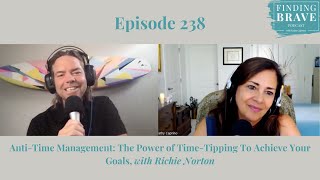
A Finding Brave podcast interview (host Kathy Caprino) with Richie Norton about his book Anti Time Management and the idea of "time tipping": flipping priorities so purpose and lived values precede traditional work schedules. Norton contrasts corporate-era "time management" (Taylorism/control) with an attention- and purpose-first approach, offers the Prolific–Purpose–Payments (project stacking) framework, and gives coaching examples showing how aligning payment with purpose and prioritizing attention can create more time, freedom, and resilience in life and work.
Chapters
So if you were to say, instead of, I'm working and then I give my life and my family the breadcrumbs of time, why don't I turn it over? My family, my time, my whatever it is that's important to you, it could be work. But whatever you actually love, if you do that, this is what happens. You think you won't have time to do the things that actually have to get done to work and get paid. Not true. You actually create and get smarter because you get more creative in getting those things done in less time.
Hello, everyone. This is Kathy Caprino, and welcome to my podcast, Finding Brave. I've created this show for everyone who longs to create something bold and brave in their life, to rise up, speak up, and stand up for who they are and to reach their highest and biggest visions. Each week, I'll be speaking with inspiring guests from all walks of business, leadership, entertainment, the creative arts, and the entrepreneurial world. And they'll be sharing their intimate stories of Finding Grave and. And offer their best strategies for building your most rewarding, joyful, and meaningful life, business, and career. Hello, everybody. Welcome to another episode of Finding Great. I say this probably, I don't know, every other time, but I am literally. I can't even sit in my seat today, all day before this interview. I am just. My head's exploding with joy to have our guest, Richie Norton, here. Richie from Hawaii. Hawaii.
You are so good. I know I'm interrupting you, but you're so amazing. I'm so excited to be here. We're going to have so much fun, you sweet thing.
And I want to tell you, I'm going to read Richie's bio. You're going to. And talk about his book. But before I do that, you know, I love to tell people how I learn of my guests sometimes. I've never met them in person. I don't think I've actually ever met you in person. We haven't, but we go back nine years. I found out. I looked it up when we did our first interview on my Forbes blog, the Power of Starting Something Stupid, which people flipped over and so did I. And I have been following your meteoric rise. And then we did another piece on Stephen Covey, his impact on you, you know, how he really changed things for you, right?
Yeah. And those articles were instrumental because, you know, the way you write just crystallizes it and people are able to relate to it, and it's brought a lot of good people to me. So I honestly, I appreciate it.
So happy to hear it. Well, here we go. This is no difference. Here we are learning about your next book, which I read, I devoured in one sitting. And I was telling Richie, you know, there's a lot of amazing ideas out there. And sometimes they, you know, they're inspiring. Sometimes they land in a way that's like, that's useful. Yours landed in a way that I heard the thing that I needed to hear that nobody else got through to me, no matter how they were trying to tell it or how I was trying to hear it. Your book did that for me. And I feel, you know, when you read something or your mentor says something, you're almost buzzing. Like something physiological happens when you know you've heard a lesson that you're ready to act on. That's what your book did for me. Do you know what I'm talking about?
Yes. And I love that you're saying that. Oh my gosh, that's so powerful. We need to hang out more.
Please get your ass over here to Connecticut from Hawaii. I don't know why you're wasting your time. Totally kidding. All right, everybody, let me tell you about Richie and let me tell you about his new book. Let me give you a little bio, which is absolutely amazing. Richie Norton is an award winning author and serial entrepreneur. An executive coach to CEOs. He's featured in forums, Bloomberg Businessweek, Inc. Entrepreneur, Huffington Post, Pacific Business News to recognize Richie as one of the top 40 under 40 best and brightest young businessmen in Hawaii. What a beautiful recognition. And Richie is one of the world's leading thinkers and top 100 coaches as honored by MG100. That's Marshall Goldsmith, right? What a. What a luminary Marshall is. Wow.
Yes.
He is the CEO and co founder of Prouduct. Why do I have a hard time saying that but.
Because it's weird.
But I understand what it means. We're proud of our product. That's proud of who we are and delivering our product.
That's right.
An Inc 5000 company, which I just learned. A global entrepreneurship solution. Helping businesses go from idea to market with full service sourcing product strategy and end to end supply chain. Holy gap. The author of several books including the new one just coming out end of August. Anti time management and the power of starting something Stupid and resumes are dead and what to do about it. When did that come out? That's a lot. Long time ago I'm thinking.
Yeah, that was 2011 and I self published it and then it got picked up by a publisher like later, so. And that thing's Been traveling around different universities. Professors even today reach out and go look. And it's weird because that long ago resumes are dead was way ahead of its time. Like that was like. And today it's like. Yeah. And it's like, well, you know, it's this weird conversation and how the future is now the present. And it's, it's pretty cool. It's pretty cool.
But look how ahead of your time you were. 10 years cheaper. 11 years. And I'm going to add this. I don't often talk about personal stuff. Well, my guest. But this is in your bio, which I adore. Richie is happily married to the amazing Natalie, who is just so beautiful. They have four boys, one son already made his way to heaven. Can't say that without crying. And they have cared for three beloved foster children. And I know you have an intense story about that as well. And you live on the north shore of Oahu in Hawaii with their little dog. Is it Velzy?
Yeah, it's Valzi.
What kind of dog is Valzi?
He's a Maltese Shih Tzu. And he's like this little like, looks like a doll, you know, like just a little fluffy little bunny running around the beaches.
I love it. Didn't I see Velzi on your Insta?
Oh, for sure.
Recently something happened.
He's there every day. I don't know.
He features prominently in your media share. All right, my friend, I gotta start with this and I, you know I mentioned your book kind of knocked me for a loop in an amazing way. But what I want to start with here, you know, you, you gave me a description of what you really want to talk about. I can't even. Here it is. I can't even begin to synopsize it because there's so much. Find your motivation, prioritize your ideals and create a flexible worth work life lifestyle no matter how busy or successful you are with anti time management. So with everything you are seeing with all these people that you work with, you know, writing a book ain't easy because we know a lot and there's a lot of ways we intervene with people. So I'm fascinated to know why this book and why now.
You know. And what's interesting is I added that part like no matter how busy you are or how successful you are, because when you're in the struggle and you're trying to make things happen, there's all kinds of thoughts you have. But what's interesting is when people are successful a lot of times they have the same thoughts because they worked for this thing so long and then they got there and they still don't have it. And so it's like, wait, wait a second.
They still don't have it.
They still don't have it. So they've been working for something and they don't get it. And it wasn't that anything was necessarily wrong, but maybe the way they work wasn't in alignment. So they cemented systems that they thought they would exit from. But these systems are so ingrained now, they still do them. Even when they do have possibly more time and more options available to them, they choose not to do them even though they want to.
And you know, I'm you, it's like I'm having you over for dinner because I need you. So, so everyone knows I'm asking questions that are desperately important to me. So here's another. And you're not prepped for these. I'm laying them on you. And we're going to talk about time tipping, which is what your book is all about and your, your framework. One thing you're amazing about, Richie, is you have frameworks and so do I. Instead of these are the things we have to do. You put it in 52 different ways and we're going to talk about prolific practices, purposes and payments. But I want to ask you this, the flip side of what you just said is me, you know, people, I'm very transparent here at age 62, having had a ton of success, I want to ask you this. What happens when the success you've had and the way you had it, and just so you all understand, you know, 18 year corporate career for me that was, was successful on the outside but miserable on the inside. Right Then becoming a therapist, which was the most life changing thing ever. But that wasn't the ultimate destination. It was career coaching and leadership coaching. But here's what I want to ask you. Do you work with people who at one point it was all working beautifully, but because the world has changed or commerce has changed or demand has changed, the way they were scooping up money and having joy and time tipping no longer works and they don't know what hit them. Do you have that?
Well, of course, you know, I mean, absolutely. Like the social landscape has changed, the technological landscape has changed and these aren't things that are any fault of our own. It's just, just happened. And in some ways for the worst, in some ways for the best. I really do believe these are the best times, you know, and, and, and we, and the worst of times as as, as, as they say in A Tale of Two Cities. But, like, this is a time where we know so much, there's so many opportunities. This is one of the first times in history, I believe, where people actually recognize they actually have choice, many choices. Like in the past, Even in the 20th century, it was like, to switch careers, there was a high switching cost, and it was like, I can't. Plus that whole embedded incentive system to stay with one company, you know, that our parents, grandparents, great grandparents, had to retire at a certain time. Now that's kind of, I don't know, eroded or whatever. Whatever's happened, this is the first time in history where at large people are like, I have choices. And this is, this is, this is weird because employers are like, oh, it's a generational thing. It's this, you know, it's.
It's you young. You young millennials who don't want to stay put and don't want to commit. Right? Is that what you mean?
Yeah, yeah, yeah. It's Gen Z. It's, it's whatever. You know what? Forget generations that way. Think of it as like, generation now, meaning everyone that's alive right now, everyone that's on the planet right now. And it's like, if you take away the ageism and you take away all the prejudice that's there and you go, this is the opportunity. This is what's happening. And you look at the world differently. What employers are dealing with are people who are in the back of their head going, I could be making money doing something else, and they know it, and it could happen tomorrow. This is different. And yes, they're willing to work for meaning more than money. And yes, they'd rather work in a bad job with a good boss than a good job with a bad boss. You know, there's all these things at play. But it's an awesome opportunity for employers, too, because they can attract talent that wants autonomy and availability and ability from all over the planet.
So there's a lot of opportunity reframe here. I love it. And you know. Oh, go ahead, go ahead.
No, I'm just going to say, when I wrote the Power of Starting Something Stupid, which we have talked about so many times, well, this was what was interesting. People would come to me with their stupid idea. I became the stupid guy, you know, Google stupid, Richie. I'm everywhere. And that's why I started product and other things, to help people make stuff and do their thing. But it wasn't hard. I'm oversimplifying. But it wasn't Hard to say, okay, here's a market. They want to buy it, they can afford it. You know, you present it to them, they want it, they buy it, you scale it, great. But what was interesting to me is that when they were successful or as it was becoming successful, it wasn't what they wanted. What do you mean it's not what you wanted? Well, I wanted to be able to travel with my family. I wanted to have more time. I wanted to have more availability. And what happened is they lost all the freedom and time they thought they would have to the business. So I thought, what if we just started with what you actually want? Why are we two stepping? If you actually want to live with your family in Europe for several months out of the year, why don't we say, go do that and then build a business that supports it instead of endlessly toward it? And we're smart enough to get what we measure for. So when you measure for time flow and cash flow, you get it. When you measure only for cash flow and say, then eventually I'm going to have time, you get it, but likely you don't.
I love it. And you know what's running through my mind? I've interviewed a few people about exiting businesses. So, you know, I'm an older generation, let's face it, I don't want to work till like this, in this way forever.
Yep.
And you know, we're talking about, how do you sell a business, how you exit. And consultants of mine have said, you know, three things. Look at the intrinsic value of working, look at the income you're making, and look at exiting.
Sure.
But one person I had on this podcast said, who helps business owners sell their business, you can't imagine the percentage who sabotage the sale of their business because they don't know what the heck they would do after running this business.
Sure.
What I love about your work is if we begin to approach and we're going to get into specific practices and steps, how we show up in the world, deliver products, services, work in a way we want it, that also creates life the way we want it. I don't think we're going to have this terrible realization at 65 that what the. I don't even know what to do if I'm not working. Which is a sad. I mean, don't get me wrong, if we love our work, like sometimes I say, my work is as fun as, you know, playing tennis, going to see a movie. My work is fun. Not every minute, but I also want to make room for other things that are Fun.
Yeah, I agree.
I see your brain going 5,000 miles.
Everything you're saying, it's too real. You know, like. Like, my mom just turned 65, and I'm like, all right, mom, now you can finally start your life.
You know what?
Come on. You know, that's what they told us we were gonna do. And it's like, she lived a great life. What are we talking about? You know what I mean? She still has a great life ahead of her. What are we talking about? So this is the idea I think, actually we may have talked about before, but the idea is to bake it in from the start. If you. If you have a cake and you don't put sugar in it, you can't expect it to have sugar in the end. Oh, it's not gonna be sweet if you. Sure, you can put in other things. Right? But. But we trick ourselves. We say we're going to do these things, and then it's going to turn out this way. Let me say it this way. Let me make it real, like in real life. Value your time. Don't time your values.
Isn't that fantastic? Tell us more about that. How do we do that?
Even the person in their 60s who's been waiting till they're 65. And this is the way it's been done for a long time. But if you say, I'm going to. When I'm 65, what am I going to do? How am I going to do it? That's fine. Whatever, whatever, whatever. And I'm not judging. I'm not even in that situation. You know what I mean? But based on what people tell me and based my research and based on ideas and taking out ageism, whatever that thing is you might want to do, why don't you try doing it right now? Right now, at 60, at 61, at 62. Because in practice, you'll be able to get better at it and you'll function differently. You create. You literally create forcing functions that make you do the work differently. So right now, people will, oh, you like functions.
Look at your frameworks. You know, I'm even thinking, I'm divorced now, happily, amicably, very friendly with my. My ex. But what do I have to make time for? Dating, you know, and if you don't do that, you don't make time for it. And when is there going to be a time where suddenly, okay, I'm ready. You have to be ready.
That's right. And a couple things happen. So we already know what it looks like to do what one is Doing it looks like how we are today. You know, however you, I get up, I do this.
It takes three hours. I do. Yeah.
So it's actually, it's a learnable skill. It's not that hard to tip it. Right. Time tipping. So if you were to say, instead of I'm working and then I give my life and my family the breadcrumbs of time, why don't I turn it over and put my family, my time, whatever it is that's important to you, it could be work too. But whatever you actually love, if you do that, this is what happens. You think you won't have time to do the things that actually have to get done to work and get paid. Not true. You actually create and get smarter because you get more creative in getting those things done in less time or outsourcing them or delegating. Because, you know, let's be honest, like not every situation, but if you're working 9 to 5 a lot of times it's because you think you need to work nine to five, you could have gotten the same work done in one hour. You could have. So when you switch it around, it actually just try it as an experiment. Just try it. Like next week you'll be like, oh my gosh, I can't believe I got so much done. I feel like I'm so lazy because I have so much time. This happens over and over and over again to people.
I'm really in that boat. I have so much time, I'm like, woo hoo. And I remember I laughed because when I was killing myself in my 20s and I was working at a publishing company, a reputable one, till seven every eight every night. The president was in the bathroom with me at 8 and she goes, what are you doing here? Not pleased. I said, well, I have so much work. She goes, if you're staying here till 8, you're doing something wrong. And I was thinking I was getting all these kudos. I couldn't agree with you more. I have a question for you though.
Yeah, yeah, Yeah.
I have a guess about the single biggest fear that people have to adopt. What you're talking about the. I'm guessing the way everyone is raised that they think there's no way I can make enough money to support my family, live the way I want, travel and do what you're saying, is that what they say to you? Is that the fear or what other fears?
Yeah. Yes, yes. And. Or they know they could because they see other people doing it. They don't think it applies to them.
Why not?
And. And they wonder.
They're not smart enough.
They wonder. They wonder how it could be anything. But you know what's interesting is, let's start with the person who's already successful. They are afraid of falling because the fall is. There's more distance between where they are now.
And is that money when you say successful? Or they'll be humiliated or they'll lose their staff, It'll be embarrassing.
Yeah, it's pride. Like they knew what got them there. But they're unwilling to do that again. And it doesn't mean you have to start over, but it can mean you're starting on the top of a mountain, working towards a new mountain, and people are unwilling to do that. And then on the other side of that, there's people who are just starting out. And because they're told they have to do a certain way, they will. And they're unwilling to try it another way. Now, look, you have to pay your bills, you have to do your thing. Money, to a certain extent is completely necessary. I'm just saying it's not how much you're paid to a point that's important, but it's not how much you're paid, it's how you work. Change how you're paid, change your life. Two people making the same money, one person can be in the grind, have no time. The other person, same money, same scenario, all the time in the world. Why? Because they work differently. But same results. Same results at work, different results at home. It's a matter of thinking how you're going to operate, not necessarily how much money you're making.
So you think it's the same. Wait, let me really articulate this.
Yeah.
One of the messages you've always driven home is you don't call it work life balance, which has become a very cliched term people don't like. Like what? A crock? A hooey? Work life balance. Some people call it work life integrations. Sway, you've always said, from the minute I've known you prioritize and value what your life, what you want your life to be about now. But are you saying that even someone who is working 9 to 5 and just doesn't feel they can risk it and go out on their own or become a consultant or be paid for their. Their mind or their. Do you think. How do I want to put this? Do you feel that much of what you are suggesting here will have to require you chuck your 9 to 5 job?
No, no, no. Stop managing time. Start prioritizing. Attention if you prioritize your attention at your work at 9 to 5, you will find hours and hours and hours of things you love doing at work or at home.
You will prioritize your attention.
So let's make this super real. Like we use this word because I have this new book, anti time management. People use this word, time management as if it's this wonderful thing, it's going to get your time back. Time management, I don't know, I actually don't know how it entered the self help vernacular, although I do because I think once companies realized they could get people to manage their own time, they could actually stop one of their own jobs of managing people's time. This is real stuff. But it was invented by a guy named Frederick Taylor. It was called Taylorism back in the day, also known as scientific management. And, and you know, they did these time motion studies and you will find that it was for wage rate setting. In other words, time management was specifically designed to measure every drop of blood, sweat and tears. It was designed for output had nothing to do with you having time. So time management means control. It's not control time, you can't do that. It's who controls your time. And time management means they control your time always. Period. Time management means they control your time always. Hard. Stop. Anti time management is you control your time. Time management, they tell you what to do. Anti time management, you decide what you want to do. Time management, they take up space. Anti time management, you create space. Sure, there's a blending and yes to the person that chose a job where they will be managed, you chose that. Accept that. Are there other ways to do things? Can you get a new job? Sure. But remember, like Covey would say, when you pick up one end of the stick, you pick up the other. And Covey said begin with the end in mind. He did not say begin with means in mind. And I believe that means are what we think are ends. We've made them. Means have become ends unto themselves. So goals, we're obsessed with goals. They're a means to something else. Habits, obsessed with habits that we forget. The purpose of a habit is to move beyond them to something else. Like strengths. I'm glad you're good at that. But most people at some point in time, they don't like doing what they're good at anymore. That's why they transition careers, et cetera, et cetera, et cetera. So do we have to keep doing this? So habits, strengths, goals have become means. They are means that have become ends unto themselves. So I Like to say, goals from experience are tasks. Goals outside experience are growth. Wow.
I have questions, Richie. So would you say that anti time management equals attention management?
You could say. You could say that.
Is that it?
You could say that, but I'd say it is. It is that. You could say that. But the reason it's more than that is because your attention has to be aligned with. With. With your purpose and purpose. I know it can be a weird word, but, like, if you think about purpose, this way you go, I have a goal. Cool. Like. Like my clients who would start businesses, they'd say, my goal is to start a business. They start a business. They were lying. Their goal is to have freedom. What's the job of the goal? Now we're talking about alignment. Because once you realize the job of the goal is to do this thing well, the job.
You're so brilliant. I got. I'm hanging on by a thread. The job of the goal. You mean, what is it that you want this goal to bring, give, provide? Yeah, don't leave it at I want to start a business.
Because once you realize that I don't have to start a business at all. Or I could, and it could be a pencil business, or it could be yoga pants business. It doesn't really matter at that point. It doesn't matter. Those are means.
All right. Can you. Can you give me coaching right here on the spot for people?
Yeah.
If I came to you and said, which I will in two minutes, I absolutely. Here's the goal. I want to help a million women in this world live better, work better. I call it thrive, rise and make their mark, be happier in the work that they're doing. That's the goal. Would you say that's a means goal or would you say I'm getting on the right track for goal setting there?
So there's a principle in the book that I teach. I learned from a mentor. And again, these are no right or wrong answers. This is just a way of thinking different.
Sure.
So I would. The principle is, ask a better question, get a better answer. So, like, if you were measuring, did I reach a million people? Then when you reach 900,000 people, you're still not successful. That's not cool.
That's not cool. And Frankly, I have 34 million views on my Forbes post.
Well, there you go.
I've blown that million 34 times out of the water. So maybe get rid of that number.
No, I would keep the number, but I would say things like this, like, life is multipurposed. So there's Your professional goal, which is that one. Then you have your personal goal, which is maybe another. Then you have your payments goal, which is a different one. You have your people goals, which are a different one. So I start, I call it project stacking. How do I bring all these together? So, like, you go, yeah, I want to reach a million women who are going to do these things, and the job of that is to have them lead great lives, et cetera, et cetera, et cetera. Very fulfilling. But if you do that at the sacrifice of your own person, which nonprofits do all the time. So nonprofits will go, I'm going to help all these people, but we don't care about money. Then they. Then they experience mission creep, mission drift, and they end up spending more of their time raising money than helping people. This is going to creep.
Yeah, it's creeping off exactly the ledge.
So that in our personal lives, that happens, too. So the idea would be money and meaning. So I think what you're doing there, regardless of how you call it, what you do is meaningful. But if you were also to say, and my goal is to make a million dollars, I know this isn't what you're doing. I was making it up.
I love it.
Think of the different. Yeah, think of the lifestyle you would have if a million dollars was made by getting a dollar from each of those million people.
I like that idea.
Well, yes, but if you had to find and talk to a million people, your life would be all about every day doing all these things, and you would have no free time.
Don't like that.
But what if you were to say, gosh, why can't I? I'm just making this up on the fly.
Yeah, I love it.
Isn't there an organization out there? Maybe Grameen Bank, I don't know, someone out there that is already working with women that can sponsor this thing and give my organization a million dollars, because they're probably already giving away millions of dollars anyways. But I can do it better. Now all of a sudden you have one client giving you a million dollars or impacting a million people. You have all the time in the world to spend with your family and your relationships. And by the way, now it turns from 1 million people to 10 million people and 100 million people. So again, it's not like what you're doing. What you do can be anything. How you do it changes how you operate, changes how much time and freedom, autonomy, flexibility.
So let's take that example, because I think people can relate. How is it that we have the idea I want to impact a million people. And in the beginning, I'm open to how that is going to happen. It could be one company that helps me reach 10,000 times. It can be the United nations, which did just take my course, you know, for a number of members. Well, how do we get solidified in one path? Like let's say I were trying to literally reach a million people, where you're saying Grameen bank could just give you the million. How do we get so solidified in the wrong ways or limited ways? Is this part of your book too? I think it is.
Well, yeah. I mean, the quick answer, based on what we've already been talking about is that we start focusing our attention on the means and not the purpose, right? So I'm like, hey, I'm going to make a million dollars, so I'm going to sell this thing. So now all my time becomes about selling this thing. Or you say, you know, a hole has to be dug, so you can either use a shovel or you can use a bulldozer, or maybe you wise up and realize there doesn't need to be a hole there at all.
Quality. I have a question.
Yeah? Yeah.
Have you always been an out of the box thinker? I'm dying to know. You know, the former therapist and me and I. And if anyone reads Richie's story, it's. It's really, truly full of, you know, kind of devastating experiences that you've overcome and in such a beautiful way. But even as a child, did you, did you look at stuff in a different way?
Well, let me, Let me. I'll be honest with you because I'm. Because you're. I think you're getting into. You're getting into my psyche here. I gotta. But, no but. And I gotta be careful too, because we all have our own unique individual talents and stuff, and this is a learnable skill. But when you said that, I actually remember being like camping. And I remember like as a child, as a. As. Yeah. I was probably a teenager, but I remember I was like, honest, maybe 12 or 13. I don't know. I remember floating down this river and it was just light, like just very calm, just kind of just floating. And I remember. I don't know why I remember this right now, but I remember like thinking and making all these analogies, like just comparing the water and the river and floating to, you know, life and living. You know, I remember thinking about that. So I don't know if I've always thought this way. I guess I have. But what I. What I have done is I've always tried to like, see things and then relate it to how it could apply to life. And for some reason I've always wanted to like, share with other people so that they can, I don't know, be happy or something.
You're right in the right place. You're so in the right place. Yes, you see things very differently. Thank you for explaining that. Now, I think one thing that would be really helpful is the Prolific Practices Purposes and Payments framework. Do you want to touch on that or is there something even more important that you want listeners to get take away here?
Let's say this. I'm going to go, I'm going to say exactly what I'm thinking and then we'll go back. But prolifics, Prolifics are important because you'll, you'll be. A lot of people say they're perfectionists. The problem with perfectionists is you want to make things perfect. It's hard to make things perfect. So instead of doing the like high priority things that will take a long time to make perfect, you'll do low priority tasks perfectly. So you end up doing, yeah, these nice little things. We never end up getting the thing done you wanted to get done. So, so there's this metaphor. I don't know if it was real or not, but it was something like a guy is teaching his students to make pots and pottery stuff, right? So clay. And one class, they say you need to make the perfect pot by the end of the semester. And the other class, they say, make as many pots as you can. It turns out that the ones who try to make perfect pots did not. And the ones that made as many pots as they can got better. So being prolific is better than being perfect. Wow. So the idea is, if you start with purpose, Aristotle called it final cause an acorn becomes an oak tree. So you think of what seeds am I planting? Because a lot of times we're planting seeds that will never turn to the tree we want. So pick the right seed. So when you realize the purpose and you can align it all. So you go purpose. Then you, then you create your priorities. Because a lot of times we put our priorities last. Ironically, priority means to be prior, to precede.
And you don't mean priorities just for that goal. You mean our life priorities.
Life and business. Because people will say, this is my priority today, but it's not on mission. So purpose priorities. Then you create a project. In this project, you can operate all kinds of different ways to get it done. And then, yes, you align how you get paid for it. So payments. And then you can be prolific in that thing. The reverse is to decide, I'm going to get paid by living in city. You know what I'm saying? Excuse me. So you go to that city and you get a job doing all these things. Whether you like it or not, your entire lifestyle revolves around living in that city. Whereas today you could live in Montana by a lake if you want to, and get paid the same amount of money, maybe even doing the same work. But you chose where you wanted to go because you knew that your lifestyle revolves around where you live, same money. So that's the idea. That's the framework.
I have a question. Another 5,000 questions. You remind me of me in that if someone comes and speaks for five minutes about their career, I can see pretty quickly exactly what isn't working. Some of it is the frameworks. I've already written about seven damaging power gaps, but I can pretty much hone in on. Okay, I think this is the issue. So you are an entrepreneurial coach as well. When people come to you. Like, if I came to you and say, richie, here's the problem. It used to be so easy writing on Forbes and making money and everything's changed and I don't know what to do. Would you probably within five minutes, see what is in the way of this? Would be entrepreneur or any kind of worker with an idea. Would you. Do you. Are you able to laser in like that?
Yeah, I ask questions to help them discover that, you know, on their own, because it's more meaningful that way. But yeah, so someone will jump in and say they want to do all these things. And it would be really easy for a coach to say, cool, let's make that happen. It's the wrong answer. The better answer is to keep asking questions and then to say, let me give you a real one. A venture capitalist who's giving all this money, you know, investing all this money in their. In their startups. I asked these guys this question and it's so funny. It's terrible. I go, when their business is successful, why don't you ask them what they want to do when their business finally is successful and there's an exit? And I know, you know, they're not doing this to change the world, even though they say they are. They're doing this to make money. And so are you. It's only half the story. And they laugh because they know it's so true. But what's cool is you ask someone what would happen when they were successful with you. Know, exiting now you can integrate all these meaningful ideas and thoughts and processes from the goal of the goal. This makes companies grow in a way that allows the bottleneck, which is us, to be removed.
So then you is that, does it make it grow? Because once a person is connected to the real goal, all of a sudden everything is unleashed.
Yes, definitely. And when you are attached, the person working for something is already attached to that thing and they will quit for that thing. So if you as the partner are able to understand that, you guys don't have to be on the same page, but by understanding what you're doing, you are and you can support them in that.
Do you have a wonderful real life example of that where the venture capitalist had no idea, but then after you're working with them, he go, he or she goes and says, all right, Fred or Sally, you want to launch this fund to support women owned businesses?
Yeah. I'll give you. I used to have little. We called it a mentor venture capital board and we would help people in developing countries start businesses. So it was like that middle ground between like twenty, fifty, a hundred thousand, maybe a little more. The less here and there, the area that no one's investing in because the really small ones are really small ones, like cool microfinance, the bigger ones, you know, you get, you get angel and you get venture and you get all that private equity. But that middle one, no one wants to help them. But they're the ones that are going to create jobs. They're the small businesses. They are the ones that will be.
The leaders that will help a whole community, a whole region, a whole.
Yeah. And these people are so good. They're so good. But this is what would happen. They always say, don't pay me, I don't want to get paid. I'm just doing this to help other people. You know what, you know what happens when someone decides not to get paid?
They won't get paid.
They won't get paid. But what happens is they actually have to pay their bills. They have to pay their bills. So they start working on side projects to pay their bills and let their main project fall apart. So we're like, no, you are going to get paid, you know, and, and we're going to make this work. And it's more likely to than not, you know, under, under those kind of circumstances versus not being paid. So aligning payment with purpose changes the way you work and helps you become more successful.
This is so rich with life changing experience. I know I'm running over any final everyone's going to race to read the book. We're going to tell you where that is. I'm telling you, I read a lot of books and you know, interview a million people not really close to seems like. And this really something really hit that made perfect actionable sense. Is there anything else you want to leave people with that you think we just don't understand well enough?
Well, I'd say this, this is, this might be a harsh truth, but it's not always true. But in some cases, a full calendar is an empty life. You're not calendaring things that you care about. You're calendaring.
What's that? Me? What's that mean? You mean you don't write down in your calendar? Tell me what that means.
Anyone who's listening, like, look at your calendar right now. Like, where is it? Where you're playing with your children. Oh, it's on. It's on Friday night. You know, when I go on a date with my husband, we get babies that are on. No, no, no, no, no, man. Where is the living? Put the castle first, then create strategic and economic moats around it to support it. So like, I think this way because as you know, you know, I son passed away. A brother in law that passed away. You know, we have those three foster kids that came and went after two years, which is so hard because we don't know where they are, you know, and so we like to wonder like, are they okay?
The system swooped in and yeah, I.
Mean, they went back to Biomomic, which was a wonderful thing. And you know, for reason, other reasons, it's, you know, a hard thing for us to think about and we hope they're okay. And then, you know, my wife had a stroke and she lost her memory for a time and she got it back. My kid got hit by a car crossing the street. Like he should be dead. He was in the hospital, he had surgery and all these things. What you don't have in your calendar is what to do. You don't create room. There's no space for how to make better decisions under times of tragedy, hardship, difficult circumstance, and no one's going to put that in their calendar. But when you practice anti time management and time tipping, you create space so that when things happen, even things that are unexpected good opportunities and then the ones you need to like, you know, figure out, you actually have room to do something about it without just reacting and making it worse. So I think it's really important that people focus on the goal of the goal and when they do that they will see a million opportunities ahead of them instead of just a few. Means that they think will get there, but get them there, but never will.
That is so damn beautiful. And I know that everything you're talking about, and I'm admitting this, even though I'm a career and leadership coach, I have fallen prey to victim to whatever the. No, I don't like that word. You know, and I think part of the problem is we're very logical thinkers, and we're trained to be logical thinkers. We're trained to be linear thinkers. I'm blaming something here, but. And maybe our brains just work this way, but we're trying to figure things out and be reasonable and rational. And what you're really saying is, I mean, I'm going to go spiritual. Tell me what you think. I think you are one of the most spiritual people I've ever met. But I think we're on this planet for a hell of a lot more than doing a good job. I think we came here for big reasons. And if you don't allow yourself to even think, what. What the hell is this? And at the end of it, what do I want to have done and felt and given and stood for? If you don't think about that, the end will come anyway.
Yeah, it's true.
Is that true? Do you agree?
No. You said it so, so well, and it's so true. And what I just keep thinking about is like, look, what is rational? Because it seems pretty irrational to wait 40 years to do something. And in fact, it seems way more rational to me if I want to spend time with my family, to spend time with my family than to fool myself and pretend like I'm sacrificing every for them, everything for them at the sacrifice of them. That seems irrational, but that's what we do. And we call it. We call it rationality.
And I think you're so clear on that because you've had so much loss that has made you. Or potential loss.
Yeah.
That has made you understand what's truly important.
Yeah, it does definitely narrow things in the focus. And also anyone who's going through grief or pain, you know, I truly believe it's a tunnel, not a cave. And, you know, keep walking on that.
No, Richie, thank you. What a. Thank you for being not only on this podcast, but on this planet. Thank you for everything you're doing. And where do people scoop up your amazing, amazing insights and help? Where do we send them?
First of all, you're so nice. I love you so much. Thank you for being so cool.
Thank you.
Yeah. You know, you can go to my website, rich enorton.com richard.com time you just go there, you're gonna find all kinds of wonderful resources that you can download that are free to help you tip time. And of course, the books available on Amazon and everywhere books are sold. And I'm just grateful for anyone who takes the time to grab it and read it.
All right, everybody, first of all, thank you, Richie. You're so damn busy. Thank you for coming, people. We want to hear from you. This comes out, I believe. What did I say? September 8th. I believe. We want to hear from you. Questions. You know, it's. It's wonderful if you love every word of it. It's also great if you don't understand, I don't understand how to use this. I don't understand how to change. This is what we want to hear. And Richie's crashingly busy, but wherever you see this on Instagram, wherever LinkedIn ask us a question and we will do our best to answer.
Thank you. August. August 30th. It comes out a little bit earlier now. August 30th.
Your book comes out August 30th. Yes. This podcast comes out September 8th.
Oh, so this will art. Oh, this is perfect.
Is that good?
It's available now. Everybody go grab it. I love it.
All right, everybody, I. We'd love to hear from you. I hope you're inspired and have a wonderful few weeks and we'll see you next time. And thank you again, Richie.
Thank you.
Hello, Kathy here, and thanks so much for tuning into today's episode. One quick thing I'd love to share before you go is about my new digital training program for organizations and professionals called the Most Powerful you, which is the companion to my book, the Most Powerful seven Bravery Boosting Paths to Career Bliss. I'm so thrilled that recently an international division of the United nations brought in the Most Powerful you program as a training tool for members of their staff. And I'm speaking with other global organizations right now to do the same. This program brings to organizations real world transformative training for leaders, teams and professionals to help them thrive at the highest level in their work and projects. So here's my Please take a look at what I'm training in the most powerful you. And you can find that@mostpowerful you.com and if you feel the content would be instrumental for you and your team, I hope you'll ask your leaders and DEI managers to bring in this training program to your company. It's truly transformational for work cultures everywhere, and it generates amazing results. Thanks so much. And here's to you becoming the most powerful you. Thanks so much for joining us today. And please don't forget to check out findingbrave.org for more programs, resources and tips. And tune in next time for your weekly dose of finding Brave.
More from Kathy


Elevate Yourself, Elevate Others, and Amplify Good | Chris Cooper | Finding Brave Ep. 334

Finding Brave Epis #333: How Leaders Can Harness AI Without Losing Their Humanity, w/Bennett Borden

Finding Brave Epis 332- How to Stay Brave, Valuable and Visible in the Age of AI, with Raman Rai

Finding Brave Epis 331 - The Power of Positive Disruption, with Dr. Patrick Leddin


Finding Brave Epis 330 - Being 40: Letting Go and Embracing Who You Are, with Stacey Lindsay

Disrupt Career Reinvention with Kathy Caprino - via The Disruption Lab Podcast w/Patrick Leddin

Creating Neurodiversity-Friendly Work Cultures: Simple Workplace Adjustments Matter

Finding Brave Epis 329 - How To Create a Neurodiversity-Friendly Workplace, with Kristen Pressner

Finding Brave Epis. 328: Reclaiming the Power to Trust Your Own Voice, with Dr. Cindy McGovern