239: Creating Your Legacy Through Your Personal Brand with Cindy McGovern
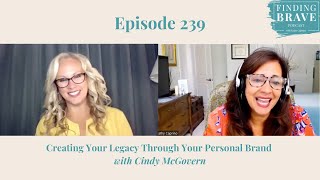
Dr. Cindy McGovern argues that everyone has a personal brand, whether they build it intentionally or not. She says selling yourself is a life skill: craft stories of your impact, ask for candid feedback to find blind spots, and use your network to amplify your legacy.
Chapters
You're selling yourself every day. You just don't call it that. And so if we're not actively and more importantly, proactively selling people on the idea and impact that we want to be making on people, the idea that we want them to think of when they think of our name, the impact that we want to be leaving behind is kind of like a boat that leaves a wake. What is the wake that you're leaving? Because you have to sell people on that.
Hello, everyone. This is Kathy Caprino, and welcome to my podcast, Finding Brave. I've created this show for everyone who longs to create something bold and brave in their life, to rise up, speak up, and stand up for who they are and to reach their highest and biggest visions. Each week, I'll be speaking with inspiring guests from all walks of business, leadership, entertainment, the creative arts, and the entrepreneurial world. And they'll be sharing their intimate stories of Finding Brave and offer their best strategies for building your most rewarding, joyful, and meaningful life, business, and career. Hello, everybody. Welcome to another episode of Finding Brave. I'm so happy to be here with you, and I do need to make a little preamble about a few things. First of all, I'm so excited for my guest, Dr. Cindy McGovern, who is, you know, you are crashing around every possible place imaginable. You're in a hotel room, ready to go give a talk. I can't thank you enough for being here and being flexible, for what I'm about to share with everyone, which is quickly. So I'm just coming over Covid, getting over Covid, and, you know, I really want to hug everyone who's been through it. It ain't easy, and it's. It's no small, simple thing for many of us. I mean, some people have no symptoms, but. But I have to say, it's been a rough week, and I feel like coming back and being myself is difficult. So forgive me if. If I'm sounding a little grally and in some ways don't seem like myself. It's just me getting over that darn virus. And thank you again, Cindy, for moving around your schedule. I also wanted to just share this with you because when I go through something big, I love to be transparent about it. I. Right before COVID I was on a cruise, a hol America cruise in Alaska. And I want to say, Cindy, you probably know exactly what I mean when you have a number of firsts happening in your life, but when they come together, it's not only so exhilarating but it can be a lot. And so this was my first time on a cruise, first time in Alaska and first time delivering content about my book the most powerful you on a cruise in Alaska to 50amazing travel professionals who we lived, ate, danced, you know, had cocktails with together and it was so astoundingly powerful that I'm still, I'm still coming off that high. But I want to say that first of all, I have such a love for travel professionals. Wow, what a. What an interesting life. Number two, deep thanks to Michelle Sutter, who is the chief of staff and VP of sales of Holland America, who, who had the idea to have me on as part of her mastermind. This is an Ms. Michelle Sutter mastermind group summit at sea. Huh? So I got a chance to take excursions with her and, you know, have a ball. But I do want to say seeing firsthand how the most powerful you content has changed people's lives. Like one of the Holland America professionals went, what am I saying? Was employed by Holland America because of what she read in the book and what she did. So I just hope this is what I'm about. What I'm saying inspires you to go check out most powerful you again. And I hope you love it.
All right, that's it.
Now, Cindy, we are talking here about creating your legacy through your personal brand. And I want to tell you all about Cindy. Cindy, how long have we known each other now?
Oh, it's got to be at least, at least four years, I think, because.
Your prior book we talked about as well. And Cindy never failed, fails to inspire. You are a mentor to me and, and such a bright light and you're helping so many people. So let me tell you all about Cindy and then we're going to dig in here about. Well, what do you mean, what do you mean creating your legacy? What is a personal brand? And you're going to tell us about the heart of your book, which is amazing. All right, people, here's all about Cindy. Dr. Cindy McGovern is the author of the upcoming book which is coming out 27th September on personal branding called Sell Yourself, how to create, Live and sell a Powerful Personal Brand. Often we don't hear sell yourself in the same way you mean it. We're going to dig right in on that. Dr. Cindy is the founder of Orange Leaf Consulting, a sales and management consulting firm, the author of the Wall Street Journal bestseller Every Job is a Sales Job, how to Use the Art of Selling to Win at Work. Work. And you are known as the first lady of sales. I love it. And Cindy speaks about personal branding, sales and leadership topics all over the world as we're seeing here. Again, thank you for making time here, you know, in your crashingly busy book launch period. All right, let us. You know, I. You know, this people. I send out a prep sheet to my guests, and they often write really compelling bullets that are the takeaways that they want people to get. And I just want to start with this. Having an idea of what your personal brand is will not make that brand powerful or effective. Ouch. You must thoroughly create an authentic brand and then live it day in and day out. And if you do that, your personal brand would. Will be the most powerful tool in your sales toolkit when it's time to sell yourself. I mean, that in and of itself is a book, and of course it is a book, but we could have 10. 10 episodes on this. But can you. Can you tell us what you mean by. Just because you kind of identify your brand doesn't mean it's going to work. Doesn't mean it's alive. Can you tell us more?
Yeah, absolutely. So, first of all, I'm so excited to be here with you and thank you again for having me back because I'm such a big fan of most powerful you. And so this dovetails into that, where you've got to be able to sell yourself your most powerful. You're bringing your whole self to the table. And what I mean in that bullet point that I shared is everybody has a personal brand, whether they realize it or not. So that's the first thing I would say is you've got one. Is it on purpose? But it's more than just having a brand and saying, I want to be known as these words. It's how you exemplify those words through your actions, through your life, how you create and craft your legacy, and more importantly, how it impacts those around you. Because without the impact, you don't have a legacy. Oh, wow.
All right, let me tease out some things for people. Let's just, you know me, I love to talk Frank. Right. Let's just get down to it. If we took the flip side of that, what you're seeing every day, what are people doing wrong with their brands? And maybe they're not even recognizing that they have a brand. What are they doing wrong?
So the first one is the ones that are not recognizing that they have a brand. So they're in a separate population of their own. So you got to recognize you have one, then you got to fix it. And make sure it's on purpose and that you're living it and then you're actively selling it. But let's say that we'll take the population that knows they have a brand, but why isn't it getting them where they want to go? It's because they're not selling it. Right?
Selling it. Tell us more.
And, well, people freak out about that word. And I used to be one of them. I mean, that's part of why I wrote the first book, is because sales is a life skill, not a business skill. You're selling yourself every day. You just don't call it that. And so if we're not actively and more importantly proactively selling people on the idea and impact that we want to be making on people, the idea that we want them to think of when they think of our name, the impact that we want to be leaving behind is kind of like a boat that leaves a wake. What is the wake that you're leaving? You have to sell people on that because people too much credit for connecting the dots, right? We think, oh, well, I'm a good worker at work, so everybody knows that I want a promotion. I think it's a little narcissistic to think that everybody is looking at you, making you think, you know, but what's funny is we don't want to sell because we think it's narcissistic.
Wow.
So if you flip that around a little bit and you think about it, it's actually less narcissistic to promote. It's actually better. Because how can you truly create an impact on the people around you if they have no idea what your superpowers are that you could offer? Why wouldn't we want to tell people that?
I so love it. So let me, let me ask questions that I want to understand. You know, I, as a person who has her own business but also had had a corporate life, I have a question for you. I so get it and live it that if you. If I'm asking you to read my book, you to take my most powerful you course or the amazing career project course which we're promoting now, I've got to make it so compelling to you that you understand what is missing if you don't, what you're going to get and why that matters. Right. I understand that that is selling. And I even understand that when someone calls me and says, you know, I found John Forbes, I'm thinking of, I need a career coach. Can you talk to me? I understand that that's a selling Conversation. So I have question number one here. So many people, particularly women, think that this is gross. Ew. They're calling you to see if they should work with you. And you're selling. Can I tell you what I think that means? And you correct me?
Yeah.
I'm not selling as if I'm manipulating you to do something you don't want. I'm selling by sharing with you a very intimate, powerful understanding of what working with me will do. And I can do that because I've been doing it 16 years and I have stats and statistics. So it's not selling in terms of making you buy something that's not good for you. Am I getting it?
You are 100% getting it. And I have a very different definition of selling that is very much in line with what you do. Because it's the way that I sell. I don't actually sell someone on something. I invite them to buy.
Oh, I love it.
Because that puts them in the power position. If I'm selling you, I'm the one pushing. I'm the one in power. I'm the one probably manipulating, probably, you know, giving you all these horrible scenarios if you don't do what I'm telling you to do. But if I sit back and I ask questions about what you're looking for and then I present options for you that I can offer, you are 100% in control of that decision and you are 100 in control of your destiny, of what happens in that moment. You get to choose to buy. And show me one person on the planet that doesn't like to buy. Right?
Oh, I love that. But I love that you call it an invitation to buy. You know, I just had a quick example. So what I want to do is dimensionalize this for you people, right? So you understand what actions to take. I heard from a woman who read an article from Forbes 2013 and actually changed her career from it. So I said, you want to hop on a call? We just had it. And I asked her, what. What did you get from that specifically? And what did you do from it? You know, it's one thing to read something, but you special person took action, right? But in the end I followed up. What can I help you with? You know, is there any? And in the end I sent her a follow up email and it had five resources. Two of them I'm giving to her for free because she took the time to talk to me. But I think it's what you're talking about that, you know, she also is responsible for, for Career growth at this very large company. So, of course I'm wanting her to love my course. But it was an invitation. Let me give it to you for free. And of course, I'm hoping you love it. I mean, we're all doing these things because we hope it makes a difference. But I. I think that that's exactly what it was. It's an invitation to check out some other things that I hope are useful.
Yeah, but you did something in that moment in your conversation with her that I think people skip. You asked the right questions to uncover what specific things you could offer. And I think people think their personal brand is. Well, this is who I am. I, you know, this is what I offer to the world. We are multifaceted people. We're like a diamond. Every human being is multifaceted. You knew which facets of your shiny awesomeness to elevate in that moment that would make the greatest impact on her.
Interesting, Cindy. And I think you're right, because I have 10. I have a thousand resources. That's it. What am I going to give her? A thousand articles? And I even deleted a few. Like, no, let's not overwhelm too much. And I think these are going to be most helpful to her, not what I want to sell. Okay, I get it. Now. Can I go back to another piece that you said? As an entrepreneur, I think we all know we're selling. If I were talking to you when I was a vice president in a corporate, I think I would say, I don't know what the hell you're talking about. What impact? And you know, this was before I had an enlightened moment that you know at all. But do you question one? I think that corporate professionals struggle with this. Like, I do a job. I'm a marketing vp. What the impact? What's the impact? I think I sell marketing products. Do you find that. And you're working with sales professionals as well as a million other professionals. Do you find that the vast majority of corporate professionals don't have any idea what they. What their brand is?
I think that they. I think that they have. Know they have a brand to a degree, but I think it's very much tied to the label. I think that that person that you're talking about would say, but I am the VP of marketing. That is the brand. No, your brand is that you're the lady that doesn't trust your team to delegate to. And yeah, you might also be the VP of marketing. Right. So you have to recognize you're making an impact. You're maybe the diminishing manager. That's not who you want as, but that's who you are because that's what you're selling people on. And I think that's where you know an entrepreneur, they very much are selling themselves. They are the product, they are the brand, at least in the beginning as they team. When you're part of a larger organization. It's funny, I just wrote a blog on this too.
I can't wait. We should link to that. Yeah, definitely.
But. But it's. There's a confusion between the company brand and your personal brand.
You're right.
In a world they would, you know, align with missions and values and sort of the core pieces of it, but you are not the company brand. You are not what is on your email signature line. You are whatever it is the impact that you're making on those around you because that's the legacy you're leaving. And I, and I'm going to use a term and I find some leaders are tone deaf and this because they are so busy in their swim lane going straight for the end of their career and what they think is important, they are forgetting what is being left in their weight. How to watch the back to see what's happening. What are you really selling to these people around you? Because you're selling something. Is it what you mean to be.
Oh God, it's so important. You know what's awesome coming up for me? You need to read this book. How do I want to say it? What ran through my mind is anybody who's unhappy in their company, their brand is at odds with the company's brand. I mean I, I think invariably it's.
Either that or they're selling the wrong thing. And, and it's funny, I have an example in the book of someone who keeps getting passed over for promotions and they don't understand why. And these are true stories in the book. All of them are true.
Oh, wow.
Obviously in companies and everything, but, but the problem is this person is selling the wrong thing. They're doing all the right stuff on paper, but they are selling this. The world owes me a living impact versus I want to help because I want to help and I am aligned with the mission of this department and I want to make a stronger impact and I want to be a team player. They are, they are playing the victim card.
Are they doing that just in their effort to get promoted or just it oozes out of their body every minute?
I think it's that they've been passed over for promotion so many times that it's starting to ooze. But what they're not recognizing is that's the story they're selling, and that's what people are buying into.
And that's what's unconsciously being. Yes, unconsciously being transmitted and received. I mean, I think if, if somehow we were observing 2,000 organizations and 2,000 interactions, I think the transmitter and the, the receiver aren't even aware there's just a yuck factor or that person's not. Not promotable.
Right.
And sometimes it's hard to articulate why. All right, now let me ask this. The way you're talking about personal branding, then sounds to me like the question is, who are you, not only at your best, but every day? So, like, if I thought of myself, tell me if I'm wrong. If I think of myself now, it's, I am a good listener. But what that means is I'm able to pull out threads that allow us to make quick breakthrough. So good listener. Empathic. I can feel what you're feeling. Can, can translate thoughts and emotions into what action should be taken next. But if I think back of me as a vp, Huh. I was that. Okay, I was gonna say I, I, I don't think those things were as well defined and well honed, but that, that's who I was even back then.
So I think that's your DNA, though. I really did like just knowing you. And, you know, we have history. Like, I think that's in your DNA. But what I think changed for you is, like, I believe you have to create the brand, you have to live the brand, and you have to sell the brand. When you came into this entrepreneurial space, and here's, like, the coaching piece.
Yeah, I love it. I'm sure that's helpful for people.
You started selling those facets of your brand differently. And that's the part that people forget is you have to sell yourself. It's not speaking for yourself. And you were very articulate there in saying the impact that it made. It's not that you're a good listener. Listener. It's that you're a good listener and can pull out the blind spots for somebody so they can get out of their own way to what they want in their career.
There's a brand.
I love it. That is your brand.
That's it. Absolutely.
In my opinion, one of your facets of your brand. So that's a very different story to tell than I'm a good listener.
So true. All right, now can we go back? Thank you for That I was powerful. Can we go back to. You know, I love to look at. I mean, we. A lot of us have strengths, but it's the weaknesses, the blind spots. That's what holds us back. Right. We gotta close those gaps. What else are people doing wrong? I mean, part of this is. How do I want to say it? Their brand might be who they really are, which is not really helping them. I.
And you have to be honest about that. And so one of the things I think that people are doing wrong is they're not actually testing their brand.
Tell us more about this.
So we need to solicit feedback on our brand, which is actually why I wrote this book, so.
Oh, wow.
The story is in the book. But I'll tell you the moment when I realized I wasn't selling what I thought I was.
Oh, wow.
I was about to graduate with my doctorate degree, and a very trusted professor pulled me aside and said, girls who look like you aren't supposed to be smart. And I was shattered. Why did he say that?
I mean, was he trying to be helpful?
Well, that's. And this was someone I trusted. I knew it wasn't a slight. I knew it wasn't a dig. He was trying to wake me up to my own blind spot, that despite the fact that I had gotten good grades, I was a student teacher. I was about to defend a dissertation that I did the research on, that I did all the things right, all the boxes were checked that I had to sell against perhaps preconceived notions.
Oh, I see.
And I never thought of that. And so I thought about, okay, well, how do I do that then? Because I sat there thinking my work was telling that story, my work telling who I was, and it wasn't. And that came to light. And so I was like, wait a second. You're like, why did anybody teach me this before now?
Oh, my.
That's part of what brought me to write this book is as I've been coaching our clients and speaking, you know, and doing the same things that you do, really trying to help people to live their best lives. I'm recognizing. Selling the wrong thing because they're not soliciting feedback. They're not looking for someone to point out a spot. And I think part of the reason is we're afraid of what they're going to say. But here's the advice I would give the listener. They're seeing it already. Wouldn't you like to know?
Like, you don't want to be the last one to know what everyone is seeing. But wait. Oh, my God, I have so many questions on this. So can I say it another way?
Yeah.
You're beautiful. And is. Is. Was he saying you're beautiful and that's what people are going to see. And you're blonde, and we all know the cliche. Well, what do you do about that?
Well, if you notice, I didn't dye my hair.
Right. So. Right, right. So, I mean, do you just call a spade a spade? Do you bring it out?
What do you do? I recognize that I needed to elevate different facets of my brand to compensate for some of those other things. So, you know, if you're playing for something, you're like, hey, I'm gonna, you know, wear this over my shoulders, but I'm gonna wear some sparkly shoes instead. You know, that' easy one is attire. And that's where people go with branding. You always go to attire. It's so much more than that. It's so much more than what you're wearing. So if you take that and you say, okay, with my brand, I'm going to walk into this room and they're going to underestimate me. So how am I going to use that to my advantage? How am I going to elevate the facets of my brand to show them and sell them on the fact that I can do this? I can do this job, I can be their coach, trainer, I can. How am I going to create that? But if you weren't looking for those blind spots, if you weren't looking for that feedback, if you weren't thinking a couple car lengths ahead of how you might be impacting them, you're never going to be able to sell them.
This is so powerful, Cindy. So I want to ask you, am I getting it? First of all, I think every woman on this planet can relate to. Not to the beauty part, but dare I say, almost every woman I've ever met is underestimated. I don't mean to paint every woman with the same brush or every man, but I know I've been underestimated. And then, unfortunately, when I was perceived as strong, it was, she's the buzzsaw. Yep, she's the bitch. Excuse me. Now, this is going to be an explicit podcast, so. But what. What you've made me realize is when I get up to stand, when I stand up to speak in front of, you know, men, women, and people who, you know, identify in every possible way, I'm pretty sure that, come to think of it, power is what comes out pretty quickly. And that is not unintentional. Like I even say, one of the power gaps is, you know, acquiescing instead of saying, stop to mistreatment. And one of the things I say, don't f with me. I mean, that's my MO. Don't mess with me. But then I use that to say, that doesn't mean I'm not gentle or spiritual or kind. It means, don't mess with me. It's not going to go well for you. I think that I've been unconsciously doing what you're talking about. Am I getting it right?
You are. You are 100% getting it. And I think that what's amazing, this is like the most amazing moment, because I think this is really fun because I think women, nothing against men. I coach a ton of men. Women haven't ever given themselves a moment to think about this. They haven't ever paused long enough to go, wait a minute. I want to sell my most powerful self. And these are the things that I'm going to do. I think we do it for some things, right? You're going to comb your hair. You're going to, you know, do your research before you go in. You're going to practice your speech. You're going to do those things. But if you paused even for 30 seconds, and you went, I'm about to walk into a boardroom of senior executives who don't think I'm ready for this role, and here's what I'm going to convince them of. You just created what I would call a sales plan.
I'm also thinking. And your work, and mine, of course, dovetails so well, I think one question is, are you buying into the brand they have of the brand expectation, the brand limitation they have of you?
So I talk about this in the book as well, and I talk about, don't sell yourself short, because we end up creating a box, and then we live in that box. We're like a plant. We'll stay there. And so my. My invitation to all your listeners is, who chose that pot for you? Who. Who decided that? And if you don't want to be there, the only person that can get you out is you. But you're gonna have to sell your way out.
So you're gonna say that again. Say it again. Oh, I love it.
You're gonna have to sell. Sell your way out.
And that's if. If you. Okay, you're in a box. We know you're in a box. You know you're in a box. You're not going to Hop out of it without selling your way out of it. Meaning demonstrating very clearly, you know, through everything that you do. And that's body language, what you say, all of it. All right, now I got to ask this question. And, you know, we're also doing a Forbes interview, and I'm aware of our time, so I'm going to make this fast. Even when I said what my parts of my brand are, I'm empathic, I'm a good listener, and I truly know how to tease out, probably better than most, what's in your way and what we're going to do about it. But what I hear in my career path assessment when I ask, what are your special talents? How do you stand out? It is the most platitudinous, vague, common words. I am kind, I am nice. I listen, and I'm like, darn it, no. And the example I'm giving all the time is I have an anesthesiologist who's a client. And I said, what are your special talents? And she said, I don't have any. I go, really? Let me ask you this. Could I do your job? Well, probably not. She didn't even want to say. I said, would I probably kill someone within a week in the emergency room? Yes, I think you have some special talents. And I don't just mean what you learned in med school. I mean, you do this job differently from how he does this job. What am I rambling on about? Can you leave us with, I don't know, besides asking people, how do I come across? What do you think my brand, and you probably have to say it, how do I come across? I think people don't understand brand, right. The term. But how do you make sure that it isn't those vague things I've heard 10 billion times? I'm nice, I'm kind. I'm a good daughter. What do we do? What do we give them? What steps?
What they're missing is the impact. So they have to do the exercise of taking whatever the word is. First of all, why are you choosing that word? Like, where did you hear it? Was that something that you think you should be, or, you know, nice and kind? Or two. And I just have to pause on this because I'm kind. I'm actually not nice. I beg to differ. But, you know, I'm nice in terms of politeness, but as a business coach, I'm kind, which is, if your baby is ugly, I'm going to tell you, like, that's why you hired me. So I will be kind and I will give you a hug and tell you how to fix it. But I mean, if this is not going to work, I'm going to tell you it's not going to work. So. So I think we have to think about it one step further so that there's is you take the word and then you go, okay. Where did that word come from? Is it really mine or is it what I think I'm supposed to be assigned? I'm from the south originally. I'm supposed to be nice. Okay, I am. But I'm also breaking that exact same rule by being kind conflict with one another if they weren't both part of my brand. So where they both intersect and why they can both live harmoniously is because I can be nice. I can hold the door open for you. I can say please and thank you. I can send a nice handwritten note. I can do those things. But my kindness comes out when I'm making that impact, when I am creating a new life and a new path with a client that's saying, this is where your comfort zone is. You are going to have to not only jump over that line, but leap with a somersault to get where go in your life. And here's how you're going to do it. So I would invite about the word and then what is the impact it actually makes? Because that's your legacy. If I don't have a story to tell about you, you don't actually have a legacy.
Wow.
Think about that like we think we do. Because it's like, oh, I can say nice things about Kathy. She's a good listener, she's a good. That. That's not what you want them to say. You want me to tell people things that you've done for me, which is Kathy smacked me across the face and said to do this, and this changed my life. That's a legacy. And so it's taking those moments and thinking about those stories and those defining moments where you made an impact and making that your storyline. And then that's the most powerful unit you have to sell to the people around you. So that's the story they're telling about about you. Because the other problem is everybody telling the same narrative of, oh, she's nice, she's this, she's that. No, no, this grew my business because I did these things she told me to do. That's a legacy.
I understand. It's so much better now, even though I read your book and gave you a beautiful blurb. So I'm going to recap and then I want you to think about what is the one thing where can we soak up all your deliciousness, but the one thing you want people to hang up from listening to this and go, oh, my gosh. But I think what I'm getting here is, you know, even when I look at. When I was a vice president, I was a good listener, but I was a mediator. And I could say this, this faction is mad at this. And if we don't do something different that we can live with as the marketing team, the bank client's walking. What are we going to do? So it was listening, it was strategizing, it was dimensionalizing, and it was getting agreement. And that's part of. So you're talking about not only who you are, but how who you are makes a difference in how you do the work that makes a difference in the impact. Is that it?
That's exactly right. Gosh darn.
Everyone's got to read this book. What's a thing you want to leave us all with that maybe we still don't understand anything?
Yeah. So I firmly believe, and I talk about this in the book, that nobody does this life alone. And we help each other, but we have to work our network to be able to create a lasting legacy. Because you cannot be a legacy amongst.
Yourself in your own mind. Right. And.
And that's.
And.
But the only way to create a legacy is to sell it to others, and then they continue to carry the torch. So you got to recognize it's the way you show up, the way you consistently keep the message going. You're truly being your authentic self, but you are activating your network to want to help you sell. That's how you actually create a list. That's beautiful, Cindy.
And you've really made the word sell so, so palatable and so understandable. Thank. And so much better, frankly. We all can engage in what you're talking about. Thank you. Where do we learn? Where do we. So everything. Your course is your book. Where do we go?
So Dr. Cindy.com and DC Indy.com and then Orangeleaf Academy and then sell yourselfbook.com. we're all over wherever books are sold.
Thank you for coming on. I truly feel like I understand this much better. And I've worked with a lot of branding people. I'm getting ready to sell. Off I go. Thank you, my dear. All right, people. Now, Cindy's in the middle of a massive book launch, but I have a feeling wherever you see this posted, please leave us. A question, please. The fun is in where you don't understand how to do this or where there's. I think I get it, but I'm still stuck here. I think we'd love to hear that. And I know the book will address the vast majority of your questions, but please let us know. And please share this with it wherever you can. And thank you again, my friend. I wish you a Wall Street Journal bestseller, a New York Times bestseller. Why not? We all need to know how to do this and embrace it and feel good about it. And I think your book is the pathway to that. Thank you.
It's a lot. Thank you for having me.
Thank you, dear. All right, everybody, have a wonderful week and we will see you in two weeks. Have a great time. Bye. Hello everyone. Kathy here. Thank you so much for joining me today. I am thrilled to share that the enrollment window for the fall session of my 16 week amazing career Project course is open now. This session, which starts Oct. 6, teaches professional women how to take the 16 most essential steps to building a rewarding, joyful and successful career in the fastest way possible. Through the four months of the course, you'll get 16 jam packed instructional videos, 16 weekly live group coaching calls with me, 16 tailored homework assignments that move you forward fast, and so much more. Check out AmazingCareerProject.com today for some fantastic bonuses and savings for early birds. And the enrollment window closes October 1st. Truly, this is a powerful investment in you and your career and there is nothing to lose and so much to gain. I'd love to work with you. See you soon. Thanks so much for joining us today. And please don't forget to check out findingbrave.org for more programs, resources and tips. And tune in next time for your weekly dose of finding brave.
More from Kathy


Elevate Yourself, Elevate Others, and Amplify Good | Chris Cooper | Finding Brave Ep. 334

Finding Brave Epis #333: How Leaders Can Harness AI Without Losing Their Humanity, w/Bennett Borden

Finding Brave Epis 332- How to Stay Brave, Valuable and Visible in the Age of AI, with Raman Rai

Finding Brave Epis 331 - The Power of Positive Disruption, with Dr. Patrick Leddin


Finding Brave Epis 330 - Being 40: Letting Go and Embracing Who You Are, with Stacey Lindsay

Disrupt Career Reinvention with Kathy Caprino - via The Disruption Lab Podcast w/Patrick Leddin

Creating Neurodiversity-Friendly Work Cultures: Simple Workplace Adjustments Matter

Finding Brave Epis 329 - How To Create a Neurodiversity-Friendly Workplace, with Kristen Pressner

Finding Brave Epis. 328: Reclaiming the Power to Trust Your Own Voice, with Dr. Cindy McGovern