241: Escape Your 9-5 Job With More Meaningful Work, with Steve Oehley
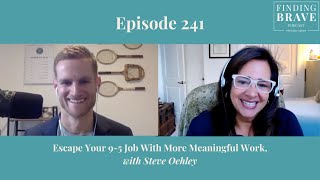
This is a podcast-style YouTube episode (Finding Brave) in which host Kathy Caprino interviews Steve Oehley about escaping the traditional 9-to-5 through greater self-awareness and career redesign. Steve describes his path from qualifying as a veterinarian (2013) to feeling emotionally drained by client interactions and euthanasia work, how life coaching and an emotional-journal practice revealed what energized versus drained him, and how he launched the Escape the 9 to 5 podcast and coaching work. He presents a five-step framework: (1) self-awareness, (2) career learning (strengths/values/purpose), (3) trial and error (side projects/networking), (4) transition/jump (with a safety net), and (5) thriving (build curiosity, feedback, grit). The episode focuses on practical pivots for medical professionals (esp. vets), niching, managing lifestyle trade-offs, and gradual transitions while maintaining income.
Questions this video answers
2013
Over 100 people
1) Self-awareness; 2) Career learning (strengths/values/purpose); 3) Trial and error; 4) Transition/jump; 5) Thriving (curiosity, feedback, grit)
Chapters
But then after a few weeks, I started to notice common themes. And one of the common themes I got because I was becoming more emotionally aware by identifying these things, is I'd be in a consult doing a vaccination, which is about as low stress as a consult should be, but yet at the end of that consult, being absolutely drained. What I noticed is it wasn't the work I was doing, it was the people I was interacting with. So if someone was really demanding and high strung, they would take all the energy from me and I would just leave or finish that consult being exhausted.
Hello, everyone, this is Kathy Caprino, and welcome to my podcast, Finding Brave. I've created this show for everyone who longs to create something bold and brave in their life, to rise up, speak up, and stand up for who they are and to reach their highest and biggest visions. Each week, I'll be speaking with inspiration, inspiring guests from all walks of business, leadership, entertainment, the creative arts, and the entrepreneurial world. And they'll be sharing their intimate stories of Finding Brave and offer their best strategies for building your most rewarding, joyful, and meaningful life, business and career. Hello, everybody. Kathy Cabrino here. Welcome to another episode of Finding Brave. I'm finally feeling over my Covid, and you're seeing this and hearing this a little later than we're recording it, but that was a little rough in many ways. But here, here we are, healthy. And I am so excited to have my guest, Steve Wheelie from New Zealand. It's eight in the morning. God bless you, Steve. And you know, I, I forget how we first met, Steve, but I certainly was on your wonderful podcast, Escape the nine to five. But before we get into it, I love people to know how my guests and I connect, but we are talking about escape the 9 to 5, how to do that, pursuing more meaningful work. And Steve has an amazing personal and professional story all about that and a business all around that. And I'm going to read your bio. But, Steve, how did we first meet? Can you tell. Tell everyone that I forget.
Before I. Before I tell you, Kathy, I just want to let your audience know that Kathy was really stressing about getting my last name right, and she's got it right on the money.
Yay. Oh, my God. There's nothing more disrespectful than getting someone's name wrong. So thank you. Thank you for guiding me through it.
So, yes. So how did we meet? So Kathy is obviously, as our listeners will know, quite influential in the LinkedIn space. And I think I'd seen a number of her posts and reached out to her because her message aligned so well with my audience on the podcast. So yeah, we connected there. And then Kathy came on my podcast and we had a really good chat. We got talking about tennis as well as stuff that's actually relevant to the podcast.
My mother, your. Your baby, the whole thing.
We talked bringing up childhood issues with your 97 year old mother.
That's it. You remember. Well, I had a wonderful chat and we're going to link to that. I hope you'll listen to that and let me tell you about Steve. And then I'm going to dive in here to some questions I really want to know and I know everyone listen does. So Steve followed the traditional path, getting good grades at school and college, graduated as a. Well respect. No, with a well respected job as a veterinarian. I love what vets do. It's so inspiring to me. But finding himself unhappy, he noticed so many friends and colleagues who were successful on paper but not enjoying their jobs and looking to change. But they often do not know what to change and how to do it. And also they have financial commitments which mean they need a well paying job. So Steve founded Escape the nine to five, a podcast and coaching program that provides a framework for college educated professionals looking to design a career that works for them. And you're also talking a little bit about a potential pivot, Steve. Right. Want to see say a word about that?
Yeah. So we just talked before the interview got started. Just in terms of the reality is with any business, be it a coaching program or any business, is that you really do need to niche down and find your target audience. And While the escape the 9 to 5 journey does apply to any working professionals, my niche really now is focusing on medical professionals, in particular veterinarians, because that's my journey. And you're going to relate better to your people if you're talking directly to them as opposed to trying to really talk to what would be probably 500 million people who are college educated working professionals.
I couldn't agree more. And that's lesson number one for everyone listening. I think a lot of us starting out, we're scared to niche down. I don't know if I forget what I mentioned on your show, but starting out, I loved working with professional women, but that didn't mean I wanted to block interest from men. But wonderful branding experts have said, look, didn't you say you understand women? There's a shortcut you have with women. You went through all these challenges that you help women with and you know I finally got over my fear of saying I'm a woman's career and leadership coach. But the wonderful thing is the more niched you are, the more successful you are. And the word gets around you. And I think you're more successful generally, frankly, even though you have a tighter niche. Does that make sense?
Yeah, 100%. And the sort of the framework to escaping the 9 to 5 would work for an accountant and a lawyer, but there's individual problems that an accountant and a lawyer would have that I can't really understand. Whereas within the medical professional space, I can really understand what it means to be on call, how to balance the, the mental demand of the job with trying to potentially find something to do on the side where. I know, because I've been in that situation where you've worked your 40 hour week and you're mentally exhausted, but you're trying to find that little bit of energy to, to actually figure out something else to do with your life. And I guess people might be wondering, you know, Steve's a veterinarian, he's, he's found the dream job. How possibly can he be unhappy? And here's the funny part.
Yeah.
So veterinarians have one of the highest rates of depression and suicide as a profession. So it's what? So it's one of those, you know, people talk about architects and veterinarians, those sort of dream jobs, but we're essentially being sold a little bit of a lie. And it's not to say that there aren't aspects of being a vet that have been amazing. It's just that we get convinced to do these jobs at a very young age when we don't even understand ourselves. Most of us make our career decisions when we're teenagers, when our brains aren't even yet fully formed. And then we go to college and we rack up a huge amount of student debt to qualify in what is a very stressful job. And I guess understanding that what looks successful on paper isn't necessarily what actually is going on in reality.
Wait, I have so many questions. Can I ask what makes being a vet so stressful?
So I think from my own personal perspective, it is the having the demands. These days, pets are almost as high up in the family as children.
Absolutely.
And so people's expectations on what a veterinarian should be able to do are just, quite frankly, unrealistic. So if you, if you've got an injury, you go to your physio, if you've got a simple medical sickness, you go to your gp. If you need An X ray, you go to a radiologist. If you, you know, anything, you need your bloods taken, you go and get your bloods taken. If you need your results analyzed, that's a pathologist who does that. There's so many different areas within human medicine, but then a veterinarian is expected to do, or not only do all that, but the expectation is that they do all that to the same level as what their gp, their radiologist, their physio, their surgeon. That's the other thing. We're doing surgery.
Wow, Steve, I never for. And I've had pets all my life. I've never thought of this. On top of that, I'm crying when you talk because I lost my, my beagle a year ago. Look at me. I can't even talk about it. They are our children. I don't care that they have four legs, but they also have short lifespans, many of them.
Yeah.
So you might be seeing someone with three different animals over a course of 20 years who, who are. Are losing their precious babies. Right. Is that another part of.
I mean, that's definitely a huge part of it too, is just, you know, just to address the elephant in the room as we perform euthanasia. And, and I think that's where, I guess, I mean, I really don't want to go too far down this track because I don't want it to become a really depressing interview. But. But, you know, it is a quite a dark part of the job and I think it is a necessary part because the alternative is for animals to suffer.
But Steve, thank you. I mean, you just reached probably every single person who's listening. Not every person has a pet, but so many of us do. I literally have never thought of that. I will look at veterinarians very differently with a lot more compassion now. Thank you for that. Oh, thanks, Kevin. All right, now let's. Let's go to. You have an amazing story that led you to even think about careers. Can you talk about that from the beginning? What happened after. After realizing, heh, I don't think this is it for me. Tell us.
So I think I want to go right back to. My parents immigrated from South Africa to New Zealand. You probably would have noticed by now that I have an accent. Not as an Australian accent, a Kiwi accent.
I love it.
So they, they immigrated to New Zealand when I was quite small and probably a young age. We were taught to work hard. And there was very much this idea that you got good grades at school and you were going to go to university. And from a young age, my parents kind of instilled in me this idea that I was probably going to become a veterinarian.
Really? They were too. You're.
Yeah, absolutely. Yeah. So. So they weren't by any means forcing it down my throat, but they definitely were, you know, oh, you, you like animals, Steve, and you're, you're good at science, why don't you become a vet? So I had this message throughout my childhood. So I reached 17 or 18. And let's be honest, when you're 17 or 18, you're not really seriously thinking about your career. You're more worried about, you know, the next party you're going to go to and whether you fit in with your friends. And so it came to the stage where I had to choose what I was going to do. I got a little bit of career advice, but it was pretty useless, to be completely honest. And I did what most people do. I listened to my parents, I got good grades at school, and so I got into veterinary school and enjoyed veterinary school. I enjoy learning, made good friends. And then I qualified as a veterinarian in 2013 and very quickly realized that this career was not the dream job it was made out to be. So fast forward a few years and I'm in a highly stressful job with demanding clients doing sort of 20 to 30 consults a day, consult after consult. Very demanding people. Very unrewarding too, because you just don't have enough time to develop a relationship with an individual person. You know, you've got sort of 10 to 15 minutes per consult. So what was happening? I was coming home from work grumpy. And my partner at the time, my now wife, somehow I was coming home from work and one day she said to me, I don't look forward to you coming home from work. And I don't even know if it was those exact words. It might have actually been, I don't look, I dread you coming back from work. And for me, that was a huge wake up call. You know, jeepers. Is this. Actually, I kind of knew that I was grumpy because I'll be snapping at her for minor things, but to actually hear those words was a real wake up call. And that forced me to really start looking inward for the first time in my life. I got life coaching from a guy called Chris Turner, who really changed my life in that he helped me better understand myself emotionally. And that's the first thing I would say for anyone looking to change career is before you go and look at what other jobs are out there, what things you might be best suited to. You really need to emotionally understand yourself. You need to get a better self awareness. I mean, I think I read somewhere that majority of people believe that they're self aware, but research shows only about 20% of people are actually self. Aware. So it's not to say that you have no self awareness, it's to say that you can improve your self awareness. So that was a big starting point for me, getting better self awareness of what drive me, what made me tick. And then I started to get some career help myself and in the process realized that I really like talking to people. I started a couple of podcasts and.
At the same time, Brave. While you were a vet, you did that?
Yes.
You were working a lot. Okay, that's amazing.
So it was more like a hobby thing on the side for starters. But initially the podcast was called not the nine to five. It was very much a hobby thing. And then it sort of evolved into Escape the nine to five. And the reason I started it was alongside the fact that I like talking to people is at the time I noticed so many friends who had gone to college got these very successful jobs on paper, but yet finding themselves unhappy. The number of people I looked at on LinkedIn, you'd look at them and you'd think, gee, this person's really smashing at her life. They're a commercial banker or financial analyst or chartered accountant or you know, veterinarian on paper, looking very successful, but then reaching their late 20s or early 30s and saying, Am I really going to be doing this for another 20 to 30 years? And so that's really what inspired the, I guess to get into the coaching space and help other people. Because I've had this journey myself and it's a learning process and I'm still learning as I go, but really helping other people to escape the 9 to 5. And what does escaping the 9 to 5 mean? So initially when I first was going through this, there was probably a little bit of resentment. Resentment towards my parents, resentment towards the university system, resentment towards the way our society structured in terms of capitalism. But really escaping the nine to five isn't to say chuck in the towel and go and live on an island and smoke weed and go surfing and do as little work.
That's not bad for a week or two.
But it's to say that it's finding work that works for you. So designing work to work for you and figuring out what that means to you. So some people might enjoy working 50 hours a week if they're doing what they enjoy doing to someone else. They might be looking for more balance, they might want more time with family. And really maybe they only need 25 to 30 hours of work a week. So not only figuring out the amount of time that you're spending, but obviously, ideally doing something closer to what energizes you as opposed to what drains you and causes you to come home and snap at your wife.
That's an amazing story. I got questions. I got questions.
You always do.
I always do. So what your story is, it's got this fascinating twist that I think a lot of people think. In the US for instance, being a vet is one of the most difficult, most competitive fields there are. So I think a lot of people think, well, you got through it, you're in it, you must love it. And I think everybody needs to understand just what you said. None of that guarantees feeling fulfilled, feeling you're in the right place. None of that. You know that I worked my tail off and I was number one in class. You have to know that, right? Number two, another thing I want to amplify. You are so right about self awareness. I find that we might be aware of certain things, but we're not aware of the right things. We're not aware of how I feel inside, how I feel every day, how my mind feels, my soul, my spirit, my body, what I love, what I'm worth in the world. We're not aware of the things we need to be aware of. So I just couldn't agree more. Now here's a question I have. I'm dying to know the answer. If you came to me as a career coach and you were in the throes of that point in time where your wife to be said, I dread you coming home, you're horrible. The first thing I would say, I would want you to tease out, and I want to be clear about this and see what you think. I call it the pendulum effect, where we get so broken down in how we're doing our work that we want to run to the farthest ends of the earth. Like, I can't stand that I have 20 consults a day. I'm working for this ass who I don't even like. I don't know if that was the case. So I want to be a surfer, you know, or whatever it is. For me, it was, I'm done with corporate life. I'm going to be a therapist. And that was a great journey in terms of the training. But the identity, the professional identity wasn't right. What I want to ask you is if I had said to you, first of all, let's get a lot more self awareness about what isn't working. But let me ask you this, could it be that how you're being a vet is the problem, that you actually don't want to do 20 consults, you want to do 10, 5. You want to run your own, your own practice, you want to get rid of all this staff that's making you nuts. What would, what would the answer have been?
Well, it's funny. Excuse me, Kathy. It's funny you say that and that very soon after I got the life coaching, we went into lockdown with COVID and I was still working as a vet at the very same practice. But our hours were reduced. And because we were doing things by distance, the nurses would go out into the parking lot, they would get the animals, bring them in. I'd have a nurse and a colleague who I liked essentially doing the consults with them. My hours were reduced. And did you love it more? It was a far more enjoyable. It's definitely not what I want to be doing long term, but it was far more enjoyable in that frame than it was getting absolutely slammed. Where I think what I found as I did the emotional work myself, so one of the things I found really useful was doing an emotional journal. So that is each and every day at the end of the day writing down three feelings that come up during the day. Now it sounds really sort of woo woo and wishy washy and stuff, but when at first I started doing it and I didn't, I kind of felt like it was a waste of time, to be completely honest. But then after a few years, that.
Was an exercise that was given to you to do by your life coach?
Yeah, by my life coach, yes. And I sort of thought, you know, what's this achieving? But then after a few weeks I started to notice common themes. And one of the common themes I got was because I was becoming more emotionally aware by identifying these things is I'd be in a consult doing a vaccination, which is about as low stress as a consult should be. But yet at the end of that consult being absolutely drained. What I noticed is it wasn't the work I was doing, it was the people I was interacting with. So if someone was really demanding and high strung, they would take all the energy from me and I would just leave or finish that consult being exhausted. Now I've sort of kind of lost my train of thought. I'm trying to remember what you noticed.
That that Was the problem that, well.
That was a big part of the problem. And just by doing the emotions journal and becoming more self aware, it even helped me to realize parts of work that I was really enjoying. So I was doing surgery, you know, routine surgery that's not very stressful because it's sort of like routine stuff you do all the time. And I was working with nurses that I got along well with and having a bit of banter and having a few jokes and thinking, actually I'm, I quite enjoy this and I enjoy the days more where I'm not spending the entire day consulting.
So you are illustrating exactly the process. And I love the journal exercise. Here's what I want to hit home on. You know, if you had come to me and said, I think I don't want to chuck being a vet entirely, you know, what I always love to do is try to make you more powerful, more boundaried, more self aware, more confident right this minute before you make any career changes. Because those boundaries or how drained narcissistic people make us, that's going to follow us. If you become a life coach or not or you know, a poet, you got troublesome people wherever we go. So what I love is Covid made you realize, wait a minute, I kind of like this and this is better and I don't have to deal with the high strung person it gave you the opportunity to sort out, wait, these are the things I do like, these are things I'd like to do more of. Am I making sense?
Yeah. And what I'd say on top of that is for any working professional, in particular with medical professionals who I can, I guess, sort of relate to their story a bit more, is that when you start doing that self work and understanding what drives you, you're not necessarily going to find the perfect next career for you tomorrow. But you might find that an example that comes to mind is someone who really likes the technical details. They really like, you know, the details of the medicine and going into the, the depth of the medicine, they might find, oh, I really enjoy like reading the textbook and understanding this disease really thoroughly. And from that, identifying that means that they could get a job, say as a technical advisor where they're, you know, working for the government or working for an animal health company doing a technical role, reading lots of, you know, lots of technical information that might not be their dream job, but it's a step in the right direction because they've identified what makes them work. But if they just say, I'm hating my job, I hate this, I'm going to quit. I'm going to, just as you say, the pendulum effect, I'm going to quit and I'm going to go and do the complete opposite. Whatever I'm doing now, that's actually not going to help you find where you need to go.
Right. It eclipses the learning. The learning is not there, you know. Right.
And just to add to that from a, purely from a career perspective, because let's be honest, we've got to pay the bills. If you. And this isn't always the case, and it sounds like you made it work for yourself, Kathy, but with the pendulum effect that sort of like quit, I'm going to throw the towel and do something completely different. You're potentially just diving straight to the bottom of the pecking order. Whereas if you identify your strengths within your own industry, you can then get potentially quite a respectable job that pays relatively well and is hitting you in the right direction towards what might ideally be your dream job in five or 10 years time.
I love it. I love every word. I'm coming to you as a coach. All right, now there's another piece to this. I'd love to hear what you think. When people do this work, sometimes they discover, okay, wait a minute. I do like being a vet, but to be honest, there's more to me, there's more that I want in my life. So for me, for instance, I wanted children deeply. I wanted to be a mother and I wanted to be a professional at the same time. I wanted that. But I think we've mentioned. But I have other things on the side. I'm a singer on the side and my ex, we were married for many, many years. He wanted to make his living as a jazz percussionist. He's a well known jazz percussionist. I, on the other hand, have made a little money as a singer, been on record since, sung at Carnegie Hall. I don't want to have a living singing it. It doesn't bring me joy. But if I don't sing every week or regularly in a group, I'm not as happy. I'm depressed.
Yes.
So can you talk about how you've seen and how you help people? All right. They figure out how to better the career they're in and they're making good money. But they realize that this is not the be all and end all of a full life. Are you finding that with some of your clients and the people you work with?
Yeah, a hundred percent. So some of the people that I work with, the. What they find is that there is that niche within the profession that they're currently doing that they're quite happy in. But when they really do the self work, they realize it is really important to me that I have a day, a week to myself. And that might mean, you know, going and playing tennis or going and singing, going and doing, you know, it might even be going and just taking it easy and just having that complete shift in the hours that you're doing might be the biggest part to changing you from being in a job that you dislike to one you actually enjoy.
That's the truth. It's amazing how even like I, at my age, I've said I can't work this hard for another, I don't want to work this hard for another 10 years. I don't. But I don't want to stop working and I love what I do. So part of this, what we're talking about is if you fiercely prioritize, if for instance, I only want to work three days a week, what would I give up? And it's an incredible exercise. Like as much as I adore this podcast, it's a full time job to run it weekly. For me it is. So I've decided to go bi weekly and I said, let me give it a try and maybe I'm going to miss it. And one thing, it is hard. If I book you now, you may not be published, the interview, it's months, but I'm getting used to that. So the point is, one question is if I were to back off and give myself one or two days where nothing is in the calendar, first of all, what would I let go of and then what would I fill in with? Does that make sense to you?
I would argue that you already know the answer to that question.
Most of us do. You mean?
Yeah. And because if you honestly had to right here and now say what is the one thing that you're going to cut from your, your life in order to, to go down to a four day week, you, I, I think deep down we know what that is. Another thing I'll say, and this is not to become your financial advisor, is that we as working professionals get to a certain level of income and there's what we call lifestyle creep, which is you used to be happy with the, you know, I would name the beer brand that I used to buy at university, but no one would know.
What is it? I want to know.
It's called, it's called Tui that I used to buy at university. And then, and then you, then you leave university and you Go into the working world and suddenly you're spending another $5 a box on Heinekens. And then you get to your 30s and suddenly you like wine and you're spending, you know, $25 on a bottle of wine. And with everything that you're doing, when you look at where you're spending your money, that's often the first starting point to be able to reduce your hours is if you're honest with yourself. Do you need to go on that overseas holiday twice a year? I mean, I know people that are so unhappy in their jobs and yet they'll go and spend a month overseas every year spending 20, $30,000 on an overseas holiday that makes them happy for a few weeks only to have to go back to that same job to pay for their next overseas holiday. So really reducing the amount that you're spending might enable you to go from your 40 hour, five day a week job to maybe a four day a week job where you can do those things on the side.
These are incredible insights. All right, one more question then. I know I have to let you go, but here's a question. Often I can hear what our listeners are saying, like, okay, now wait a minute here and, or wow, here's a question that comes up. I have my own business so I can construct it any way I want. Most people I work with don't have that. And you know, it's taken me a long time and I did what you're talking about, went to the bottom, went through all my savings just so I could get a master's in marriage and family therapy, start a business, you know. Ah, but what, what do you work, how do you work with people who they're not going to be able to actually leave a five day a week job that's not going to be in their future for a while. So in other words, you know, many of the people I work with, they can't just do it four days a week.
So there is a way I would always encourage, at least in the starting point, even if it's for a period of time, to say to your work, look, I'm feeling burnt out at the moment. I can't afford to go down to a four day a week job long term. But for, you know, as a starting point, you've got your, your, your annual leave and instead of going on an overseas holiday, use that time to better understand yourself. Get some coaching, life coaching, career coaching, to better understand what makes you tick and then to go back to that five day a week job. If you really can't reduce your hours if you've done the self work. You can actually change jobs either within a workplace or to a new workplace. But there are ways within that very workplace to transition into something that better resembles what's good work for you. So I know one of the guys that I interviewed on my podcast, he started auditioning for roles within his own industry. He was working in an advertising industry, and his role was, I want to say something in sales. But he was far more interested in the strategy. So what he would do is every Monday morning he. He would present his case to his colleagues, and then a few months down the line when a role came up, he'd essentially been auditioning for the role for months.
You mean he would present strategy? He would be that role? He would. He would say, I'd love to have a strategy meeting. And he would demonstrate that. Is that what he would do?
I don't know the exact details, but he would. Outside of his role in the sales department, he would present strategic. A few hours a week doing strategic stuff within the advertising role to show showcase to his colleagues that he was the person. Because the only person that cares, the only person that really cares about your career is yourself. And it can be so easy to think that behind the scenes, your manager or your boss knows that Kathy really wants to go into this area, but really they're too busy worrying about their own problems and they don't realize necessarily that you're unhappy in your current role.
It's so good. I remember when I became a coach, so I was a marketing vp, marketing director, and I found no meaning in it, you know, pretty early on, but I didn't think I could, especially at 41, when it was my last job in corporate. I didn't think I could transfer to an HR or whatever. Never occurred to me. When I became a career coach, I had a client who did that who said, you know what? Darn it, let's say it's Pepsi. I'm in marketing, and I want to be in hr. I went in and talked to them, and wouldn't you know it, they. They thought so well of me. They said they would fund my transition, they would fund the training. I was like, I can't even believe it. Like, I. I didn't even think I could do that. Yeah, so my clients are always. That was, you know, 16 years ago when I was just starting out as a career coach. But you're exactly right. And, you know, find a way to do something that is meaningful to you. Volunteer, take on that Charitable cause at your organization. Sometimes that's going to make you work a little more, but find where the meaning is. I love it. I love it. You know, one thing that, that's fascinating to me, you all probably take four weeks off in the summer, right?
Yeah, I remember we in the US.
Don'T even take our vacation.
Don't you guys only get two weeks?
What's that?
I thought you guys only get two weeks.
We only get two weeks, but the research shows that Americans don't even tend to take their full time off. So at least you're a little ahead of the game. I finally want to. Oh, go ahead.
One thing I want to say, Kathy, because you sort of mentioned Pepsi and it just got me thinking about the, you know, this sort of corporate world that we live in, which when you really think about it, it's only the last sort of what, 200 odd years that we've lived in a world where the most important thing is the profit at the end of the year. And really, do you want to live your life with the idea that you're making money for someone else? And the thing people regret the most in their life is not the things that they do do, it's the things that they don't do. You don't want to wait until you're lying on your deathbed to say, oh, I wish I'd lived my life differently. If you're unhappy in your job, you need to make changes now. And I know that you've had Bronnie.
We on your podcast, the Top Regrets of the Dying People. Read her book.
Yeah. And just don't.
Nobody regrets that they didn't work hard enough. Nobody at the end of their life regrets that that was.
The number one regret actually was that I wish I hadn't worked so hard.
That's it. That's so beautiful, Stephen.
I wish I hadn't been more true to yourself.
That's it. That's exactly what we're talking about. I think you have such a unique perspective and I think vets and medical professionals and, and everyone else, we can learn so much from you. So, Steve, where do we scoop up all this incredible wisdom? Where do we send people?
So just before we do that, Kathy, I just wanted to summarize my framework for escaping the nine to five. And there is no way that we'll have time today to go through it. So I just want to really very briefly summarize.
Beautiful.
What it looks like. So the first step is gaining self awareness, understanding yourself better. Because if you don't Understand yourself. How are you possibly going to know what is the ideal career for you? The second step is career learning. So that's understanding your career strengths, understanding your values, understanding your purpose, and pointing your work and life view compass in the same direction so you know you're heading in the right path. There is no ideal job for anyone. There's just a compass which should point you in the right direction. And what you want right now is going to be different from what you want in 10 years time. The third step is trial and error. So that's actually doing something. You can have all the information in the world until you actually go out there, network with people, try things, do a side project, try something within your workplace, maybe even consider changing jobs. But you've got to do trial and error in some shape or form. So that's step number three. Step number four is transition or jump. Most people would be more comfortable with the transition. And if you do it properly, you shouldn't ever really be jumping. You should be jumping with a safety net. So there is, at some point you're going to have to change to something else. So there's gotta be that transition. And then the final step is, once you've moved into the new role, is to not magically think that everything's fixed and you're in this perfect job. I guarantee you your next job will not be your perfect one. It'll be a step in the right direction. So the final step is thriving. And in order to thrive, there are three skills that everyone needs in the modern workplace. One is to have curiosity. Two is to give and receive feedback. And three is to grow your grit. So have more. You know, things aren't always going to go well in your career and you just need to be able to develop resilience and understand that there's going to be good days and bad days in any job.
What a framework. I adore it.
That's just a little summary of, of what we do at Escape the nine to five. And so then to answer your question, Kathy, where can you find out more about me? You can find me on LinkedIn, steve dashoely and hopefully Kathy will provide a link so that you don't have to spell my last name. You can also go to Twitter or Instagram @Steve O' Ealy and you can, if you want to contact me personally, you can email Steve oely at, @escapethe9to5.net or if you want to get really personal and you send me a nice message, you can even reach me at steve omail.com and then you can show.
Up at your door and have lunch.
I won't give you my address.
Yeah, I love it. I, I, I, I think I just agree with everything you're saying. Not that that means it's perfect, but I think if people follow this framework there is no way they will not progress towards more meaningful, more joyful work and more meaningful and joyful life. So everyone, I hope you were inspired. I'm so inspired. Steve.
Here's the last comment I want to make Kathy is, you know, I've got this framework and people might think what does a 32 year old vet really know about careers? On I'm no career expert at all and I'm glad that people would be asking that question is it's the result of a combination of interviewing over 100 people on the topic plus reading all the top books on making a career change. So by no means I'm the expert. I'm still learning on this journey myself but I've learned from the best minds in the world on this and there are some genuinely proven methods for changing career including stuff used by Stanford University to change change career in a productive and meaningful way.
I adore it. Couldn't agree more. And I'm going to add one more thing and then let everyone go. When you're working with someone like a coach, it's the relationship that moves you forward. It's, I mean when I listen to you I feel that there's so much learning but there's so much more than that. I mean there's so much more than a framework. You know, I have a five step framework too which is similar to yours but when you're working with someone, it's also that you trust them, that you feel safe, that you feel inspired, that you feel listened to, that you feel understood. And I think a lot of helping professionals don't give you that feeling. So I think it's also people if you feel, gosh, I think Steve could really understand me and really I feel would feel safe working with him or this framework speaks to me. That's why we're helpful that people feel uniquely drawn to what you have to say versus what I have to say. There's a little more going on even than the intellectual part. There's a spiritual part. Do you agree?
I think that's the biggest part of it all really is to yeah, I don't know how religious particular people are, but just spiritual in the sense that when you start to really understand yourself better, you grow in ways that you can. I can't even describe ways that I've grown in the last few years. And, you know, if you told me two or three years ago I'd be sitting opposite you doing a podcast interview, I wouldn't have sort of believed it. But the from those low points in your life where you come home from work and your wife says she doesn't look forward to you coming home, those can be some of the most important moments in your life. So if you're personally right now in the pit of despair in your own career and you're feeling like things aren't going away, that can potentially be, you know, the Phoenix rising from the ashes.
I love it. I call it the breakdown moment before the breakthrough. Sometimes it's got to be the roughest thing you've ever gone through. Rising from the ashes. That's it. That's what you're helping people do. Thank you so much, Steve. I loved it. Come back again. Such a joy to talk to you. All right, people, we want questions. I say this every time. Please, wherever Steve is so open, find him on LinkedIn. Ask, say I listen to this. And you know what I gotta ask you. I don't understand this. I don't understand that. Both of us will answer your questions as best we can. And I do hope you'll check out everything Steve offers and his podcast, and we'd love to hear from you. Hope you're inspired. Thank you again and have a wonderful Finding Brave two weeks. We'll see you next time. Thank you again, Steve.
Thanks, Kevi. It's been.
Thanks so much for joining us today. And please don't forget to check out findinggrave.org for more programs, resources, and tips. And tune in next time for your weekly dose of Finding Brave.
More from Kathy


Elevate Yourself, Elevate Others, and Amplify Good | Chris Cooper | Finding Brave Ep. 334

Finding Brave Epis #333: How Leaders Can Harness AI Without Losing Their Humanity, w/Bennett Borden

Finding Brave Epis 332- How to Stay Brave, Valuable and Visible in the Age of AI, with Raman Rai

Finding Brave Epis 331 - The Power of Positive Disruption, with Dr. Patrick Leddin


Finding Brave Epis 330 - Being 40: Letting Go and Embracing Who You Are, with Stacey Lindsay

Disrupt Career Reinvention with Kathy Caprino - via The Disruption Lab Podcast w/Patrick Leddin

Creating Neurodiversity-Friendly Work Cultures: Simple Workplace Adjustments Matter

Finding Brave Epis 329 - How To Create a Neurodiversity-Friendly Workplace, with Kristen Pressner

Finding Brave Epis. 328: Reclaiming the Power to Trust Your Own Voice, with Dr. Cindy McGovern