246: Recovering from Grief, Loss and Major Life Changes with Kristine Carlson
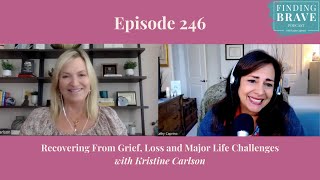
Podcast episode (Finding Brave, ep. 246) in which host Kathy Caprino interviews Christine Carlson (New York Times bestselling co‑author of the Don't Sweat the Small Stuff series) about recovering from sudden grief, loss, and major life change. Christine recounts her sudden widowhood after Richard Carlson's death, describes how grief "broke her open" and ultimately led to deeper presence and purpose, and offers practical approaches (not numbing, a daily mantra: "surrender, trust and accept", sitting with feelings, supporting others) plus spiritual perspectives (meaning‑making, signs/synchronicity, soul continuity). She emphasizes choice (victim vs. victor), no fixed timeline for grief, and that grief can reveal and expand who you are.
Chapters
There's some really powerful moments that many people who go through this kind of deep grief realize. And that grief isn't all darkness. It isn't. There's so much beauty and light because there's so much grace. And the word grace carries so much power.
Hello everyone. This is Kathy Caprino and welcome to my podcast, Finding Brave. I've created this show for everyone who longs to create something bold and brave in their life, to rise up, speak up, and stand up for who they are and to reach their highest and biggest visions. Each week I'll be speaking with inspiring guests from all walks of business, leadership, entertainment, the creative arts, and the entrepreneurial world. And they'll be sharing their intimate stories of Finding Brave and offer their best strategies for building your most rewarding, joyful and meaningful life, business and career.
Hello everybody.
Welcome to another episode of Finding Brave. Once again, I'm sitting here pinching myself for the for the opportunity to do this work and connect with people who are so inspiring, have so much to teach us, and have, in some ways, I love to say, turned our mess into a message. Not that your life, Christine was a mess, but so many of the people I speak to have transformed what could be situations that could break them for good. And they've transformed them and are of help now to thousands, millions of other people. And I think you fit into that category, Christine. We have Christine Carlson here today. Thank you so much for joining me.
Oh, thank you, Kathy, for having me on.
Okay, folks, let me tell you about Christine and I want you to definitely pour over Christine's materials and videos. They're so moving. But a little bit about Christine. She is a New York Times best selling author and renowned speaker recognized worldwide for the global success of the Don't Sweat the Small Stuff book series, which is fantastic that she co authored with her late husband, Dr. Richard Carlson in October 2021. Her life changing memoir Heartbroken Open what a powerful title was adapted into a Lifetime television biopic starting Heather Locklear titled Don't Sweat the Small Stuff. The Christine Carlson Story. I can't wait to hear all about that. That must have been an experience. With over 30 million books in print, Christine has emerged as a leading mindfulness expert and transformational guidelines and has been featured on national radio and television broadcasts and and in your bi in her bio you can read all about those. I I love to mention this too. Through her beloved women's retreats, including her signature what now? Program, Christine serves as a guide for women navigating transition and change of all Kinds. Thank you again. What an inspiring bio.
Oh, my gosh. And you have the most beautiful voice. Thank you. Thank you.
I am a singer on the side, which helps, but I. Oh, my gosh.
Yeah. Just beautiful. So it's wonderful to listen to you. It's. You're very melodic in the way that you speak, and I'm sure your listeners love that.
Thank you. That means the world to me. Have. Knowing that You've had about 2 billion interviews with a lot of people. Thank you for that.
Yeah, no, it's delightful. Thank you.
Thank you. All right, so. So what we're going to focus on, although Christine can talk about an awful lot, is recovering from grief, loss, and major life changes. And there's so much I want to start with. But can I. Can I say this? In looking at your YouTube channel and watching your introductory video where you talk about the loss of your husband, your beloved soulmate partner, and it was, of course, a sudden loss, and he was very young. You talk about what it is not to be able to say goodbye and how you had to live with that. But you also said, I can't say it without crying that the grief transformed your life. And the way I experienced you saying that was as horrifically hard as it was to process through that, you came out the other side, another person. Is that correct?
Truly? Yeah. That's a beautiful way to say it. Yeah. You know, I mean, I think the surprising thing for all of us when we go through a real cataclysmic change in our lives and one that I say destroys, really annihilates your identity, whatever that is, whether it be the loss of a spouse or a child or the loss of a career. We sit in a place of, you know, what you said earlier, we sit. We sit in a real mess. And all of us do. We all find the same. You know, we find ourselves in the same place for those same identity crisises that we get in. It's a low place. And I never anticipated that I would actually become more of who I really am going through the loss that I went through. But it was very clear to me very early on that I had somehow woken up to a deeper meaning in life very quickly and very suddenly. And it was like. It felt like a pressure, a pressurized water hose just hitting me in the face. And I was really surprised. And that's where heartbroken open came from. I was journaling one morning not too long after Richard died, and I just remember journaling the words, oh, my God, I can't believe this experience. I Have been heartbroken, open, and I feel everything. And I think, you know, we take for granted when life is going and humming along. We have success in life. You know, we're building lives and such ages as your 30s and 40s and 50s. And then you go through a sudden loss like I did. It's sort of like you. You're. You're catapulted into a totally different trajectory in life. And you sit there and you say, wow, what happened? Like, how did this happen? But in that I started to really. I started to really realize how much I had been holding life and holding it, holding it, like, holding it. Well, now I think in terms of really being deeply engaged in my life in a very present sort of way. And at the time, I realized that I was living within my role as a wife and a mother, and I wasn't really acknowledging what I felt passionate about, and I wasn't really acknowledging maybe what my own personal needs might have been because I was serving my family, serving my husband. And it was as if not. It's. It's as if. As hearing the news and just going through that first few months of loss, I realized how much I had been holding this very perfect life and holding meaning, not really living it, but holding the space for it and holding everyone else in it. And when Richard died, I just. It all came crashing down, and I felt shattered and my heart was broken. But in that brokenness, I also became open and open in the sense of, when I say feeling, I just felt everything. I felt tremendous grief and sorrow, and I also felt tremendous bliss. And it all happened within a huge range every single day. And I felt tremendous anger. But see, all of these things, I started to equate with, well, this is life. Like, this is what being alive is like. It's feeling everything. And I realized I hadn't been feeling deeply a lot of things for a long time and had wondered about that. So it really awakened me. I awakened at a very deep heart level. And I think that's what can happen for many people. I often say, you know, you can become better for having gone through loss, or you can become bitter. But there's not a lot of gray area for a lot of people. It's. It comes down to really a very profound choice that we have to make, and that is that we are going to walk the walk of grief. We are going to embrace change, and we are going to let go of. Of a dream that was our future on some level. And it's hard work. It's very, very hard Internal work. And as apropos to your podcast, it takes a lot of courage and bravery to do so.
It sure does. I mean, you. You speak such truth, so I know every word is true. That's how I experience you. Yet you've come to the other side with kind of a miraculous experience of living full out. The finding brave path. I wonder how many people you work with get there.
That's a good question. I mean, I was. I'll give you an example. There's this woman, Mary, and she's a really dear friend to this day, but I met her about two years into my grief, and right after I had written the first rendition of Heartbroken Open. And it was just coming out, and some friends called me and said, we. We have this widow and she's a recovering alcoholic, and, you know, we're worried about her and would you meet with her? And so I met with Mary and she was just, you know, distraught and in the very early stages of grief, and she'd lost her husb pretty recently, and. And I just. I remember I was only two years ahead of her, but it's to her that she thought I was just way far ahead and in. In my grief, you know, and we laugh about that now. But I remember I looked in her eyes and I said, mary, I said, I know this isn't a club that you ever wanted to belong to. I didn't either, but, you know, here we are. And I said, you're going to be okay. You are going to be okay. And I said, look in my eyes. Look in my eyes. Look in my eyes. And she looked at me and I put my hands across the table and I said, what do you see there? And she said, well, I see hope. And I see strength. And I said, you're going to be okay, because I'm okay. And you've got a ways to go, but. But I'm here for you, and I'll hold your hand, and you're going to. You're going to make it through this. And I was so proud of her because, you know, she never went. She never went to alcohol. And for, you know, if she was ever going to again, it would have been during this time, because it was so hard. But I watched her just not only survive her loss, but change and thrive. And one of the funniest things she ever said was she called me up and she goes, oh, my God, Chris, everyone thinks I'm crazy. Everyone thinks I'm just so nuts. And I go, well, Mary, you're not crazy, but you are in a transformation. So it feels crazy. And I said, you know, hang on, it's going to be okay. And then she called me up and she'd say, hey, you know what? It was a whole lot easier being Catholic. And it's not as if she gave up her Catholic upbringing, but she had expanded so much. And to this day, I mean, Mary is just, she is just such a strong, amazing example of how when you do surrender into your grief and you allow it to transform you and you don't resist it, how you come out the other side and you're just that much better for having gone through your experience of it.
You know what's crazy to me, that is so beautiful. But I, I'm reading two books now and it, interestingly, I did so on a long Amtrak train to visit my 98 year old mother this weekend. And there's so much, so much emotion to it, you know, which we won't get into here. But one book is Viktor Frankl's Man's Search for Meaning, which we were just talking about and I haven't read it. It is my favorite book ever and I hadn't read it maybe in, I don't know, six years. It's different when you read it again. But I want to ask you something that I feel is a tie in. But the other book, Forgetting Reflections, is a Buddhist book and one of the things I got out of it was that instead of us trying to, when we're in a suffering place, to fix it, to change it, to run away from it, to numb it, how can we be in it in a more present way and watch ourselves not trying to race to fix. Which you know, though. So back to Man Search for Meaning. I have to ask you this. Of course it's. And if you haven't read it, people, I think it's a life changing book. I, I recommend it. We'll, we'll link to it below. But what I'm getting out of it once again is that when there is meaning in intense suffering, even through the brutality and torture of the concentration camps, when we can find a sense of meaning for that suffering or meaning through that life that can be strong enough to buoy us through it and to even thrive in it, which I think is, is really incomprehensible to, to a lot of people, would you agree with that? That in. You know, I think the answer is glaringly obvious when we look at your materials. But have you found a different meaning than you had before? Is, is your meaning supporting people who have been through this is that I'd love to hear your thoughts on meaning and being present.
Yeah, well, gosh, you know, I'm. First of all that that book Man's Search for Meaning by Viktor Frankl is, is really was one of Richard's all time favorite books and one of mine. So I mean he serves as such an incredible. I mean the premier example of resilience of somebody who put into practice everything that, that any person would hope to prescribe to in mental health and wellness. You know, that that was just an amazing story and his outlook was amazing and that he could find that inner peace and that inner place of how to see the meaning and what was going on, you know, was just incredible. And I think that those kinds of examples are. They're almost archetypal in a sense that they're within us. They're. We almost have sort of a tide of DNA to it, you know, like that, that I honestly don't believe that everything happens for a reason. And I don't really believe in coincidence.
Interesting.
I think that we have to find the reason for what happens in our lives and that in that space of making meaning, then everything appears to have its reason.
Oh, that's brilliant. Interesting. Yeah.
So I feel like, I feel like our spiritual philosophy, Richardson mine was understanding that nothing was accidental in life. And that really helped me a lot when Richard died suddenly because, you know, he died on a flight to New York from a pulmonary embolism. And he was only 45 years old and I was 43 and we had two daughters in high school. So it was incredibly traumatic and unexpected. And yet there was some part of me because I could track like the day he died, it happened to be St. Lucia Day. And that was. She was the inspiration to authors and she was about love and kindness and the last timestamp on his computer he had written a blog right before he closed his eyes on the descent of the flight. And it was about love and kindness and there were all these things that showed me that there was some sort of divine plan at work here. And while it certainly didn't fit my plan, and it didn't, I don't believe fit Richards either. It was what it was. And I think that, that really, that really helped me to understand that it wasn't an accident that he died, that this might have just really been his time. And, and it wasn't like an immediate sense of acceptance of his death. It took me a very, very long time to accept that he would never be walking through the door again. But these kinds of Things that I thought about and parts of my philosophy really helped me to. Like you say buoy. You know, buoy to the top every day. And, I mean, there's some practical things that I did that I'd love to share too.
Yes, please.
And that was that immediately, I. I just intuitively knew not to numb out to the pain that I knew. I'd never experienced any kind of suffering like this before, but I also. I knew that I needed to go through it. And I knew some. I just. Based on all my personal development work and many of my friends that were in. Are in the personal development space, I was wise enough to know that I had to go into it. I couldn't avoid grief. It was gonna find me. And, you know, Richard was way too important in my life and was my person that I. You know, I couldn't even know how I was gonna breathe without him, much less live a day without him. But every day I just. I had. I stepped in and I surrendered, and I followed a mantra, and it was literally, surrender, trust and accept. And I said that to myself thousands of times a day. Just surrender to this. Trust and accept. And it started to become a real pathway for me and a pathway to just wake up to and just be in the day in that way of surrender and allow myself to. Just. After I got my kids off to school, I would just sit in the silence of my house, or a friend would come over and we cry, and we'd walk, and we'd just talk. And I just let myself be in that space. And I knew I started to feel this sense of peace come over me and the sense of inner joy starting to rise, and it. It would be like terrible sorrow and enjoy the next moment. And I kind of did this real roller coaster for a long time. But I also noticed that that was my body's way of rewarding me for going into the grief, was I felt this sense of peace and bliss afterwards. And. Yeah, so. So there's just. There's some really powerful, you know, moments that many people who go through this kind of deep grief realize. And that grief isn't all darkness. It isn't. There's so much beauty and light because there's so much grace. And the word grace carries so much power. You know, that grace.
What. How did you see grace? And before you answer that, Christine, can I need to ask a question. I'd love to hear your thoughts. I feel being a spiritual person, me, not religious.
Yeah, me too.
I feel that in order to accept, that's where most people Are. Are going to get hung up from my time as a therapist, you know, rape, incest, pedophilia, suicidality, drug addiction. Yikes. I need to ask this question because I'm curious. You know, friends have. I'll make this quick. Friends have said to me, you know, Kathy, sometimes a butterfly is just a butterfly, because I see meaning in everything, you know?
Yeah.
But this is my belief, and I'm sharing it with listeners. Take it or leave it. I really believe. And I'm sure people are going to go, oh, she's lost it. You know, here's a woman who writes for Forbes, but I'm. I believe we've had many lives, and we will have many lives. And I believe there's an overarching soul, and I believe we have an idea of what is going to be happening in the life we choose. So in that way. And I don't believe it's faded and set in stone, but I believe that the. The soul experience is very different from the human experience. And therefore, when, like, someone might say, well, who would sign up to lose their husband? Or who would sign up to die in a tsunami? The thing is, I think the soul is looking for learning and evolution.
Absolutely. I have the same exact philosophy, so. Oh, yeah, yeah, absolutely. I don't really see why having many lives is that far of a big concept for most people. But I think that you have to go deeper than that and realize that the soul is eternal and the soul that when we're in this human life, this is a very temporary experience. And we tend to think as human life as the permanent experience, but it.
Really is not the end, and this is it. So you better get it right in 80 years. Here's my question.
We'll see.
You know, if God forbid, you know, I'm gonna face stuff that we all face, but I believe that acceptance, when you believe that the soul signed up for it in some way, acceptance is a little closer than. This is my 80 years, 90 years, 98 years from the hundred years on the planet. This is better be good. I better not blow it. What do you say to people who, I'm guessing you've heard 10 billion times, no, I don't want to accept this. Do you hear that? Is that one of the biggest things you're hearing? No. Why should I accept this?
Well, yes. And really, honestly, what somebody truly doesn't want to accept is it's. It's not so much the death, it's about the death of the dream.
They cannot be any longer without this right in Their mind.
Yes. And that's what they don't want to accept, is that they have to step into life and create a new life. And that's, that's the hard part. You know, it is. It's. It's the hard part. But once you get there, once you start really living again and you. You find out who you are, you know, I mean, that's, that's. The other piece is that we're really different after we go through loss. And we're very different after we've been with a person that we love and spent so much time with them. You know, when we become like our spouses and they become like us, it's just natural for human beings to take on each other's characteristics and, and all sorts of things in life. And. And so, you know, suddenly you're this, you know, woman, or you're this man and you're without your spouse, or you're this mother of this father and you're without your child. And. And you have to. You got to find out who you are now outside of that role and outside of that relationship. And that's different. I remember just feeling like I was this young girl again. Here I was in my 40s, and I remember being dropped back to a lot of the insecurities I felt when, you know, when Richard wasn't there, when I. Before I met him. And I thought, this is so weird. Like, I'm like, this is so weird. And, and, and yet I. I made the leap much faster than it didn't take me 30 years to catch up to myself, thank God. But. But I. I realized, wow, I'm really insecure. Kind before I met him. And I thought, well, that's because the relationship, the marriage became this blanket. The insecurity always was there. It's just that I just hadn't. Didn't have to acknowledge it for, you know, 30 years. And so suddenly I'm like, oh, wow, there it is again. I need to. I need to deal with this, you know, so it. It's very. A very rich learning, very fertile learning experience and ground. And I remember John Walsh ons, who wrote a really wonderful book called Awakening from Grief. I remember he was Richard's one of Richard's very closest friends. In fact, he was the one I chose to go and identify Richard in the morgue or at the. Yeah, in the morgue at New York because he lived in New York. And it was so crazy because John went to go. To go identify Richard for me. And a couple things happened when he went There or when he went to schedule his appointment, he opened his appointment book and the, the coroner said, well, she was a woman and she said, well, come at Friday at 2 o' clock if you can. And he looks down in his appointment book and there it said, Richard Carlson at 2 o' clock on Friday, that Richard had been flying to New York and was gonna. And they had an appointment time at 2 o' clock on Friday. And then John couldn't help but laugh because he knew Richard would never miss an appointment. But you know, and then it turns out the coroner was a huge fan of Richard's, you know, and she was so impacted by his work and, and you know, there were just all these very auspicious moments like that. But I remember he said to me, John said to me pretty early on, you know, Chris, you're standing on some of the most fertile ground of your life right now and the growth that you are going to go through is going to be so exponential to your life. And I remember thinking, God, I hope so, because if I have to go through this, it better count for something big.
Be good.
Better be good.
Yeah, you know, I have, I'd love to punctuate something you said. I, I lost a friend of mine who was, I believe, 80, 84 and I'm 62 and we had an amazing 10 year relationship while we were working together. But her daughter called me to say that she had passed and I was just so upset, of course. And about two months later, I was sitting at the beach here recently and we, my friend Ann and I would spend a lot of time on the beach. That's what we did. She lived in Naples, you know, and it was my respite there to go visit her. And there was a seagull, and there were lots of seagulls that would come down. They wanted our food, our sandwiches, whatever. I'm alone on the beach, down it comes. And it sat next to my towel and it looked at me and I went, buddy, what do you want here? And it did not leave Christine for 30 minutes.
Oh my gosh.
There was an, there was an. I'm like, are you an. So the second thing I, I'd like to punctuate is there are signs.
Oh, there are.
And do you believe kind of the veil that we think is so non traversable is much thinner than.
Oh, it's so thin. It's paper thin.
Wow.
It's so paper thin. I believe like it's all right here, you know, and it's up to us to access it. It's up to us to open ourselves to, you know, higher dimensions really. I mean, greater dimensions, stronger energies. You know, we have to be open to transcending the human body and having a truly rich spiritual experience. But that's not easy. I mean, the mind is a powerful thing and keep us safe.
So that's another question I have for you, if I can. I'm probing deep here. It's a therapy session. I'm back to the accept part. You know, tell me what you think. But in my time as a therapist, I would see that given what someone had experienced, it would appear that the bandwidth for change, the bandwidth for growth for some could be infinite. For others it was this. For others it was this. Like one of my clients watched his stepfather shoot his mother to death when he was a child. And I do think when you're a child you don't have the coping mechanisms, you internalize and you know, the trauma is probably different within yourselves, et cetera. But I'm interested in your thoughts about when you have seen someone fail at stepping into the, the new dream, the new story. They just can't, they won't accept. Is there a, is there a recurring through line about, I don't want to say what's missing, that that sounds pejorative, what maybe those individuals aren't doing or aren't having that get them to acceptance?
Yeah, I mean, I think so. I mean I have my own like kind of idea about that. And that is that I feel like there's a real pivot turn that a person has to make when they face undesirable circumstances of any kind. And the, the true pivot is really to answer one question for yourself and that is, you know, are you going to be the victim in the circumstances you're going to sit in victimhood or are you going to be heroic and be the hero or the victor of your circumstances? You know, when you look, go back to man's search for meaning. Viktor Frankl he was definitely not a victim within the most horrific circumstances. And you can see that the mindset, the way that the path of the mind goes in victimhood is to wallow in self pity and go down that rabbit hole, you know, and get stuck, you know, get very stuck in, in feeling that real sense of victimhood. And it's not as if the hero in making that choice doesn't mean that you don't feel sorry for yourself sometimes, but you don't get stuck there. You tend to step into life and say, okay, well I don't like that. This happened. But this is what I get, you know, this is what I've gotten. This is here and I need to deal with this. And it's just much more empowered attitude.
Isn't so is it? Reminds me of my 98 year old mom who lost dad 10 years ago and they'd been married 56 years. She kind of fell apart but then bounced back. And I always call her my warrior spirit because she wasn't going to let it vanquish her. And you know, I think what's encouraging about that is she wasn't an educated woman. You don't need to have a psychological degree, you don't need to be a thera therapist. She just, she's a tough cookie and, and said what am I gonna do? Bemoan every day of my life without your father? And I think it's exactly what you're talking about. It's, it's a choice.
It is a choice and it's a choice you have to make sometimes, many, many, many hundreds of times before you start really living into it. And, but I think if you don't know that that's a choice and you don't know that you're making that choice, it's harder.
It is harder.
It's much harder.
What a story. Is there anything you want to leave us with? Anything you think we don't understand well enough about? And before I ask that question, I do want to say, and you mentioned it, I feel like I went through a terrible grief loss period when I was laid off after 9 11, in a way, after sexual harassment, after Hell on Wheels, in a way that broke me. And so what I want to share from the perspective of a former therapist is we can feel desperate grief over something that someone thinks, why don't you, what's your problem? You got laid off. You hated that job anyway. So I encourage, I'd love to hear your thoughts, but I encourage people when they hear friends or family members who seem broken by an event that one would judge is what is this big deal here? Now of course that's nothing like loss of a husband. But I think everyone, it's, it's the loss of the story, the loss of the identity.
Yeah.
And often that identity isn't your real identity anyway.
No.
And the loss of it paid for me. I think it did paves the way to who you really want to be in the world. But I would ask everyone to be not judgmental about it. If someone's going through something terrible and you think what is the big deal here? Why is It. And how about timelines to grief? You know, you should be over this by now. No, do you agree with what I'm saying that it could be something that other people think? What is the big deal here?
Oh, yeah, yeah. I mean, I. I'm seeing people go through really messy times in their life and really. And it could be even just by thinking that they might have a health issue or then they don't, or they, they're under tremendous stress or they think they should be further along on their career path than they are. I mean, people go through all kinds of messy times. But one of the things that. When you asked me, it was so interesting because that was right on the tip of my tongue when you asked me what would I love to tell your listeners that maybe hasn't. Yes. Been gone over. And then. And then you said it because.
Come on.
Because I was like thinking there something that Richard used to say and I. This came back to me so much in my own healing journey. And that was that the circumstances of life don't make or break you, but they reveal who you are. And I love that so much.
So beautiful.
Yeah. Because. Because if you. How you show up amidst those circumstances is who you really are. And you can make different choices and changes at any time in life, and that is the path of growth and that is the trajectory that we are on in the human life is. You talked so much earlier about the soul, and I feel that way that the soul comes into the body for the human expression of what it means to be in human life. But then when we die, the soul leaves the body and returns to source and eternity and, and returns to, you know, this ever present experience of life. But it's not human. But it's still, it's still present. You know, it's a presence. And so I just, I really think for people to understand that this, when you go through something cataclysmic, it's, it's. Yes, you can, you can acknowledge it's horrible, but you can also be open to the idea that, that this really did. Might have happened for you in your life to open you to a greater experience of what it means to be alive. And when we can get to that place, then we can also get to the greater experience of what it means to be in love with our life. And that if we really love life and really love the expression of what this human life has to offer us, then we can have that love affair to its greatest degree. And that sometimes being broken open means you get to be open to Having that greater joy, that one of the last things I want to say is that the quote that resonated so deeply with me when I was in deep grief was from Kahil Gibran, from the Prophet. And he says that our joy is our greatest sorrow unmasked. And when you take off the mask of sorrow, meaning you go through the path of grief and you express that grief and you let that grief out, then you're carving out this place in your heart and in your body and your whole being to be enjoyed. And that eventually. And there is no timeline to grief, your timeline is purely your own. But eventually you will return to such joy you never even knew. And I'm the living testament of that. I am living just such an incredible life of joy today. And I never would have thought, like I said, I could have ever lived one day without Richard. But he's with me. Just as your mother is with you.
I know.
And Anna's, too, and my friend Melanie, too.
I love it. And I. I want to stop talking and let everyone just. Just soak in what you said. But I have to add, I was looking for books to take on this trip. The Prophet. I found it. I opened it. There was Anne's inscription. Can you believe it?
Wow.
Dear Kathy, fellow journeyman on this road of life. What. What a number of coincidences here. Christine. It's kind of crazy.
Yeah. Or maybe not. Maybe no coincidence.
I don't believe in. I don't. I don't. Serendipity, synchronicity. But what you have to say and share is so beautiful and the world is so fortunate to have you. Christine.
Thank you.
Thank you for being here. Please come back again and we can talk about. Look, we took one sentence and dove into every word. It's seems, you know, I'd love to come back.
Thank you.
Please do. I wish you all the best and thank you for your bravery and your courage and. And lighting the light for other people. It's so inspirational.
It's been amazing journey, and. And it fills my heart with joy to do so.
I can see that. And where do people soak up everything you have? And where do they watch the Lifetime show? Where do we get everything that you have to offer?
Yeah. Well, to find the Lifetime movie, you just really need to do a search. If you have a cable or I think you can even find it on YouTube. I mean, you just have to do a search. You'll find it. And it's called the. It's called. Don't sweat the small stuff, The Christine Carlson story starring Heather Locklear.
So great.
And and then you can just go to my website, Christine Carlson.com and that's with a K Christine and Carlson is.
With a C and we will link to it below. I can't wait to just pour over everything you have even more a tenth time. Thank you again. All right everyone, I hope you're inspired. I hope you're moved. I hope if, you know, the hair on the back of your neck stood up or you felt a little rush of something, you know, maybe think of it as there's a sign that there's something I could do that would help me on this journey. I hope wherever you see this and if you have a question or you're going through a challenge that you'll leave a comment and we will both do our best to support you in any way we can. Thank you for being here. I love this Finding Brave community in this experience. What a gift it is. Thank you and we will see you in two weeks. Bye everyone.
Hi folks.
Kathy here. I'm so excited to share that story. Starting in February, I'm offering a new eight week live coaching and training course all around the content of my book, the Most Powerful youl. The course teaches both men and women how to recognize and close. What I've seen are the seven most damaging power and confidence gaps that keep us from having a happy and successful career. When you have these gaps, you simply cannot thrive in your work and there's a lot of pain, conflict and challenge. The course offers eight weekly zoom coaching calls with me, eight video training modules, a step by step process for boosting your career confidence and impact. Fantastic additional resources from over 30 of the nation's top experts, a private online support community, four members and more. To learn more and claim your spot, sign up for my newsletter@kathycaprino.com Signup and watch for the updates. People who have taken this training have called it transformational and life changing and I'm confident it will help you too. See you there. Thanks so much for joining us today. And please don't forget to check out findingbrave.org for more programs, resources and tips. And tune in next time for your weekly dose of Finding Brave.
More from Kathy


Elevate Yourself, Elevate Others, and Amplify Good | Chris Cooper | Finding Brave Ep. 334

Finding Brave Epis #333: How Leaders Can Harness AI Without Losing Their Humanity, w/Bennett Borden

Finding Brave Epis 332- How to Stay Brave, Valuable and Visible in the Age of AI, with Raman Rai

Finding Brave Epis 331 - The Power of Positive Disruption, with Dr. Patrick Leddin


Finding Brave Epis 330 - Being 40: Letting Go and Embracing Who You Are, with Stacey Lindsay

Disrupt Career Reinvention with Kathy Caprino - via The Disruption Lab Podcast w/Patrick Leddin

Creating Neurodiversity-Friendly Work Cultures: Simple Workplace Adjustments Matter

Finding Brave Epis 329 - How To Create a Neurodiversity-Friendly Workplace, with Kristen Pressner

Finding Brave Epis. 328: Reclaiming the Power to Trust Your Own Voice, with Dr. Cindy McGovern