247: What Fearless Leadership Really Looks Like, with Adrian Koehler
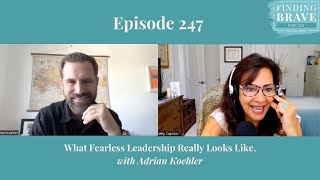
This episode of Finding Brave (Dec 29, 2022) features Kathy Caprino interviewing leadership coach Adrian Koehler about fearless leadership. Key themes: distinguishing feelings from action ("my feelings aren't my friends"; feelings are "indicator lights"), choosing courage over aiming for emotional states, testing intuition then acting, redefining power as generative agency and impact (not coercion), embracing vulnerabilities and personal limitations ("hug the cactus"), and practical leadership training referenced (Revenant Process, Naked Leadership podcast). The episode blends personal stories, coaching metaphors, and invitations to training/resources.
Chapters
The prison cell I've put myself in, you know, there's no music inside that prison cell. It's really quiet. And we say, like, no one with a vision can be held captive by circumstance. Like, I can let myself out if I choose to get a vision that's worth being powerful for.
Hello, everyone, this is Kathy Caprino and welcome to my podcast, Finding Brave. I've created this show for everyone who longs to create something bold and brave in their life, to rise up, speak up, and stand up for who they are and to reach their highest and biggest. Each week I'll be speaking with inspiring guests from all walks of business, leadership, entertainment, the creative arts, and the entrepreneurial world. And they'll be sharing their intimate stories of Finding Brave and offer their best strategies for building your most rewarding, joyful, and meaningful life, business and career.
Hello, everybody. Welcome to another episode of Finding Brave. Kathy here. So thrilled you're here. This is coming to you, I believe, end of December, so in the middle of crazy holiday fun for many people. And I hope this is really going to be impactful for you. We are talking about what fearless leadership really looks like and I'm thrilled to have my guest, Adrienne Kaler got it right. Adrian, it is perfect.
So good to be here.
I'm so thrilled. I can't wait. I have, I poured over so much of your stuff. And you know what I love most about doing this podcast? It's a chance for me to learn, for me to ask questions of people who are rocking it in ways that I can grow in. And you are absolutely one of those. Thank you for taking the time. So happy to have you.
Awesome. It's great to be here. You know, that's one of the biggest benefits of my work as well. Working with top world class leaders is I just get to hang out with brilliant, ambitious, driven, caring, committed folks. It's like, wow. Just I get to be in their orbit. So I feel it.
Oh, so wonderful.
Thank you. All right, everybody, Fearless leadership. We're going to talk about everything you can imagine. We're also hopefully going to talk about how we show up in terms of are we always just crashingly busy and you have a term, Adrian. Sourcing your. Yes, I love it. And because busy, as we all know, especially now, coming off the pandemic is not something we should be incredibly proud of unless it comes with other things. So we're going to dive right in. But let me tell you about Adrienne. Adrian Kaler is a leadership engagement expert and senior partner at the Executive coaching firm Take New Ground.
Love it.
He coaches executives and entrepreneurs in the art and science of leadership for themselves, their teams and clients to create new, unprecedented results and experience fulfillment in their work. He's the founder and senior partner at Take New Ground, which we talked about, based in Los Angeles. And your background, you have the most varied, amazing bio I've. I think I've ever read, and I've. I've read a lot. Drawing on your background in philanthropy, ministry, activism, and medicine, Adrian thrives in extreme environments and finds comfort in difficult conversations. That's special, truly. In fact, his passion for human performance has taken him all around the globe, serving people in times of crisis, transformation, and stalemates. Over the last decade, Adrian has trained and developed leaders at Nike, Virgin, Hyperloop One, Jenny's Ice Cream, Herschel Supply Company, Oprah Winfrey Network, and more. Ucla. And you're the host of two engaging podcasts as well, Raising the Bar with Dry. Dry Bar founder Ali Webb, who you happen to be married to, who I had on the show last year and was fantastic.
Isn't she awesome?
She is awesome. And it was about what we wish entrepreneurs would talk about, honestly.
And they don't.
And she did.
She did.
I love.
She didn't mess around. She makes my mother very uncomfortable. I'm great with it. My mom's always calling me, saying, can you. Are you okay? I'm like, yeah, mom, it's good. It's Ally. This is. This is. This is her jam. It's great.
Too funny.
Oh, mama. I love it. And you also have the Naked Leadership podcast with your partner, Dan Tochini. My goodness, you're doing a lot. So can we dive in here first on what you feel fearless leadership is and why so many of us aren't doing it? Can you.
Yeah. Well, once again, thanks for having me and hello, Finding Brave listeners.
Thank you.
Even just the title of that, the aim of that, is just so invigorating to me. I, you know, when I got the opportunity to come beyond this podcast, I'm like, yes, that's what I'm up to. I want to find Brave.
I love it. That's the idea.
That's amazing. It's amazing. Well, I mean, it's probably. Let me connect. Let me connect the title and the theme of your podcast to what I'm talking about.
Love it.
So, you know, people. Everybody wants to be more confident, you know, and that's a conversation people are always having with themselves especially. And then sometimes externally, it's like, you know, they want to be More confident. And they, you know, what's really that is, is they'd like to be less, less self conscious, they like to be less insecure, they like to, you know, be less fragile. They'd like to be less. Whatever, fill in the blank, right? And we all want to do that. That's just human 101 stuff. That's survivalist type brain I call it, you know, our core survival needs of what I call looking good, feeling good, being right, being in control. These are just, we don't on this, this is human gravity, right? Is that the machine between our ears is going to look for those four things. And wanting to be more confident is usually wanting to look more confident to others. So it's a. At least there's the didactic there that I want to feel more this way and I want to definitely want to look a certain amount of way, like a certain way. And, and I just think anytime we aim at an emotional state, we're in trouble. Because for me, my. I have a personal mantra that my feelings aren't my friends. Meaning that they're just not. They're not the kind of friends I want to lean on only because my feelings are pretty unreliable. I don't know, it's almost like the wind. I don't know when my insecurity is going to pop up. I don't know when my defensiveness is going to happen. I don't know when my, you know, my own, like, am I a fraud question. When I like, should I step back? Should I not say something or you know, my controlling side. I don't know when all those things are going to come. They just come like the wind. I don't get to. So anytime we aim at some kind of state, I think we're in trouble because we can't really get like handles on our feelings. They're really like jello. So, so then what, then what are we to do? So we get like, I want to feel more confident or I could decide to be courageous. Now that's a whole different ball game because I can be courageous despite how I feel like. And, and actually how do I know I'm being courageous? It's usually because I'm at some kind of deficit. Or like, you know, it's like I'm courageous when I don't want to talk and I do. I'm courageous when I don't want to ask for help. And I do. I'm courageous when I, you know, don't want to admit I've messed it up. And I do. I You know, that's, that's when I'm. I am courageous. When there's something counterintuitive to, to that happening for me, number one. Or I've just. I am courageous when I've decided to go beyond what I think, what my history says is possible for me. You know, I'm choosing to be a fraud. Like, meaning that, you know, anytime we're striving for something beyond our history, we're going to feel like a fraud. That's just natural because I am like, I'm actually signing up for something. I don't know how it's going to work. I want it to work and I'm committed to it working. And I'm going to throw my whole self at it. I don't know if it's going to work, though. And I'm going to be in it in such a way that new things are going to pop up and I'm going to discover my foolishness, I'm going to discover my naivete, I'm going to discover my, you know, ignorance. And I'm committed to something. All that is just going to be happening. Now I can say that's a problem and then pull myself back off the ledge and go back in the cave, or I can just say this is the lifestyle I want and so I'm going to throw myself at the future. And with that type of venturing comes fear. It does because your brain wants to protect you at the end of the day, that's its job. Survival. Number one, save energy. Number two, so you can survive later. That's the space suits job. Survive and save energy. So if I'm going to lead, if I'm going to lead, fear is going to be with me.
Yeah.
Period. Or if I'm gonna, if I'm gonna venture into something that's actual leadership, if I'm just doing what I know how to do, we could call that leadership. If you want. You can look like a leader. You can have the title and have the look good and be in the meetings and, and you know, keep climbing the ladder. But that's probably not real leadership. That's probably just I'm following my history instead of leading my future.
Oh, God, stop a minute. Can I. Can I tease out a number of things and ask questions?
Yes, please do.
All right, so first of all, I'm a former therapy. I'm a former corporate vp, then a therapist and a coach. So when I'm listening to you, I'm splitting my mind four different ways. You know how I feel as A person, how I feel. So I want to ask you because I had a reaction, interestingly, to forget about feelings. They're not your friends. Can I say this, however, and see what you think?
Of course.
Those feelings that are from the, you know, the reptilian brain, they're really instinct. You know, I'm not safe. I'm not. I'm standing here sweating, giving a talk, therefore I suck.
Right.
That's exactly what you're talking about. I think it's that. And we're not evolved beyond that yet, sadly. Right, Right. Where I want to ask you something, though, is there have been times I have followed my feelings intensely and they have been the right things to do.
Right on.
So can I just, for people listening, differentiate something to see if it's helpful?
Yeah.
There's into intuition, instinct, I call it even a higher self that's above your ego, above your personality.
Yeah.
Where you might say, holy, he's a narcissist, she's an art. I don't. I'm not going to partner with that person or I don't even want that person on my podcast. I don't know why.
Yeah.
I think that is leadership. Yeah. When you have differentiated and distinguished your true intuition from all that other gunk, would you agree with that?
I think we're pretty aligned. So I'd slice it this way. Is like having their intuition. I don't think that's leadership. I think. I think having the intuition, testing the intuition, and then I think taking appropriate action based on the future that I'm committed to, that's where the leadership happens. Like, leadership is a phenomenon that happens in action. Right. So.
Yes. Yes.
So, I mean, I. I'm with you on. And I don't. I don't demonize feelings. I just don't depend on them.
Right.
So I want to list. There's an old. I used to. When I was. Six years ago, when I was going through a divorce and I was getting sober and raising kids on. On my own and. And lost a business partner. Went through so. And lost most of my. Anyway, there's a whole bunch of stories there. We don't have time for today. Anyway, when I was going through. When I was. You remember in Bugs Bunny and some of his. Of his cartoons, when he's like, underwater and like breathing through a straw.
Yeah.
Like that. That's. That's what my life was during that season of time. Right. So underwater, just making. Just take enough breaths to keep going, do the essential stuff. There came to me a thought one day and I would just write it up. I'd write up any of these kind of thoughts that hit me that I needed for myself. And they became stuff I'd work with, with clients because they ended up being universal. But there was this old sign, which is a nice way of putting it. It's a landscape piece of paper with me and a Sharpie, and I taped it on my wall, but it said this, that my feelings aren't my friend. My feelings aren't my friends. They're indicator lights. They're indicator lights. And they're not. No, let me get this right. My feelings are indicator lights. They're not signposts or mile markers. And here's what I needed to know, is that they're just indicator lights. They're telling me something. To your point, if I've got an intuition about somebody, hey, I think this person's screwy. I think they've got a hidden agenda here. That's an intuition. And I want people to listen to themselves because we know more than we want to know. We do. We know more than we want to know. We have hunches. Most people, when they get betrayed, they've. They've been betraying themselves for a while, right? Because they knew something was off three months ago, and they didn't say something, and they knew it was off two months ago, and they didn't say something. And they knew something was off a month ago, they didn't say something. All of a sudden it happened. And then they say, I'm. I look at this person, I can't believe they did this. I feel so betrayed. But they knew it three months ago, and so they've been betraying themselves for three months and not being real with themselves. And. And. And I think you ought to trust your intuition, but I think you also ought to test it, go see, have a conversation. Hey, it seems like there's a couple messages coming from you. I see you saying this. I see your behavior saying this. I don't know which one to believe, and I really want to believe you. So which one is you?
I like it. I would say, having worked with a lot of narcissists and working with adult children of narcissists, you can't have that conversation. You can vet it by other people that you trust who've worked with this person. If I come at a narcissist, say, listen, something's not. Oh, God. I mean, I have been on the receiving end of toxic, you know, leaders who were narcissists. So I love it. I love it. Can I ask you another question?
Of course.
It's my podcast. Why not? Come on.
You're.
You know, I wrote my second book is called the Most Powerful you. Yeah. And it's about closing what my research has shown are the seven damaging power gaps that negatively impact 98% of professional women and 90% of men. But women have it harder. All right, here's my question. Yeah, I'd love to know what you think. We named the book Harper Collins Leadership. And I. I thought it was right. Exactly what I was teaching and what I come to find out is a lot of women shun the word power. And so I just did a poll. A lot of people comments. I don't want power. Women say, not all women. You know, I'm not painting all women or men with a skin brush. And I say, why? What do you want? And instead, I want influence. I want impact. And I said, I hate to break it to you, that is power.
Right on.
But why I think women shun it is. We've. Many of us have been on the receiving end of abusive power. But I'd love to hear what you think about power vis a vis fearless leadership.
Can you talk?
I didn't prep you on this, so I'm making sure you're Riff. Can I hear what you think about power? Power.
Yeah. Yeah. So, all right, I. I think my guess is what people were thinking when they answered the survey is they don't want force. Yeah, they want, but they do want. I think you're. You're correct. Because all of us, I. I would say that's universal. Like, because for me, power and vitality are. Are inseparably linked.
Oh, that's beautiful.
What is. What is power? Power is. I've got myself, first off, I know who I am. I'm generating who I am based on the future that I'm committed to. That's who we are. I mean, Freud didn't say that. Freud said, I am my past. Adler, though, said, I am my future. I am my commitment, right? I am my purpose. I am the meaning that I'm generating in life. That's who generates the self. So first off, if I'm willing to. For that to be true, that I can create who I am based on the future that I want, then all of a sudden, I am right. I am substantiated in the moment because I have decided so, like I am that I am. So that's number one. That's first a first sense of power. And then if anything worth having has an impact in the world, Anything worth having, it has an impact on other people, has an impact on society, has an impact on your own legacy. And you can't do that playing a very small, internally focused, I don't want to get in the way kind of game.
That's right.
So beautifully so people want power.
They don't want to be a forceful dick.
They don't want this. They don't want to do this.
Yeah. They don't want to play the transactional game. Like, if I am, that means you're not, which a lot of narcissistic, arrogant people are. Like, I can only be if you're not. And so they spend their time making less of people. But that's not leadership. That's coercion. That's authoritativeness. That's, you know, being forceful. Powerful people say, oh, hey, my power isn't threatened by yours. Actually, if I make you more powerful, ironically, it is a rep. It is a representation, a reflection of how powerful I am. So I want you to be great. Your greatness doesn't threaten me at all. Your greatness actually is a great reflection of how I am with you.
God. And so that's crying here. I'm getting choked up. It's for me. So beautiful. I wish. I wish everyone will hear this. And my God, I'm going to do everything I can. If everyone could embrace that and stop. And I think power, the kind of power you're talking about, is even more frightening than the other kind of power.
It is.
Why is that? So you deal with Nike leaders. You deal with why. Why is everyone so afraid of that beautiful power that makes a difference? Why do we think we're going to screw it up? Do we think we're not worthy? I have an answer, but I'd love yours.
Yeah, I've got chills over here, too. Why don't people do it and let me connect to. Because I didn't answer your question, which was, how does that connect to the fearless leadership? And I think. I think it's connected to this answer. Why don't we. Well, that's fun to think about. It takes risk to own your own capacity. It's vulnerable. It's vulnerable to decide that I'm worth it. This is like. There's a hidden payoff to feeling depressed, to feeling oppressed. There's a hidden payoff.
And we.
If we. Well, I don't have to do anything like. Like other people are creating my experience. And then I'll just settle for. It's like what kindergarten said. People find a level of despair. That's tolerable and call it happiness. So because I can't. Look what they're doing to me. Look what the system's doing to me. Look what da da does doing to me. And I'll just make the best of my little bit that. That the universe gave me. And that's a. That's not true. That's not true. That's just real for people. That's an experience they have. And those are all the labels they have on it. They usually don't say it that way. They'll just spend their time complaining about what's not possible and that's just safer. It's a way to control things. Like someone that's really committed to being stuck is in control because you can't. You've probably had this experience. You try to like point out what's possible to somebody that's really stuck and they're like going to fight you every time.
How dare you tell me I'm sustaining this hard.
It is for me. Let me tell you five stories from my past about why it's so. And I mean, we've got it. We've got a saying in our trainings. We do a lot of personal development trainings, what is called the revenant process, to come back. And we always warn people in the opening saying, hey, at some point in the training, we being, me and my business partner, we say, at some point in the training, I'm going to be fighting for what's possible for you and you're going to be fighting for your limitations. Which one do you want to win? And because that will show up. Because people really want to defend what's. What's impossible for them. So they don't have to look and see. So they don't have to see, you know, they don't have to like take a venture and take a risk. And that's why people don't. On the other hand, it's just. That's just a small game. I mean, that's playing not to lose is what I call that. Playing to win is. And getting back to your point. And when we really become dangerous, and I don't think dangerous is a bad term, Dangerous meaning like I am full of vitality. No matter what happens in circumstances, I'm not going anywhere. I'm really committed to fill in the blank. And it's easy. You could think about that in business context. You could think about that and it really shows up in relationship context. If you've got a spouse or if you've got some Kids or you've got some, whatever, whoever's close to you, you can stand with them in such a way that, hey, no matter what, this is who I am and where I am. My relationship with you really has little to. My commitment to you, has little to do with you. Like, it's really coming from where I am. So no matter where you are, I'm not going anywhere. And most people would rather live a transactional type of relationship and because it's safer. Because, oh, if they, then I. If they, then I. If they, then I. And then we complain about what doesn't happen in the relationship because we're all waiting to see when it's safe to come out of the cave instead of saying, oh, I'm coming out of the cave and here I am. And that's. This fearless leadership is like living in a commitment. And fear is going to be a part of the conversation. It's there because we're human. We're insecure. I'm insecure. I come off really confident, but I'm as insecure as the next guy. And I'm. I've got tons of stuff from my past I'd rather, you know, that I'm embarrassed about. Mistakes I've made, times I've missed it. You know, lots of things that are just. That are there and they're just hauntings. They come and they go and they come and they go. And those mistakes of mine become my great mentors. Like, there's something in there to listen to and to learn from. And those are actually the place to connect with other people. So if you're thinking about it and back to your back to your point is, is if we can. We call it hugging the cactus. If we can listen to our fears and listen to our. What other would call life lies. Listen to that. That one thing we believe about, like, you know, I'll sit for myself. I have this kind of life lie. Adler calls these. Like, we have a thing we believe about ourselves, that we keep up the belief and we live in that kind of belief. We hang it around. One of mine is that I'm dumb. I'm not that smart. Now that's interesting because I'm. I am smart. But. But that. I don't know why, but for whatever reason. And I could tell you when it happened and when it was crafted and blah, blah, blah, but you know, it's like I step in on stage and all of a sudden I'm a fraud. I don't know what I'm talking about. Blah, blah, blah. And that's, that's, that's not going anywhere. It's there, it's doing its job. It wants to protect me. I can say, hey, why don't you sit down, have a cup of tea, Little idea, I'm not listening to you. Today I'm going to go do what I'm committed to for the future. Now, if I can bring that with me and carry it with me, not like an enemy. Most people think that I have to change that belief in order to move forward. I say no. Life is short. Why don't you move forward and say the belief? Hey, if you want to come with me, fuck, fine. No big deal. I'm just not honoring you. But, but whatever. You can pipe up when you want to. So that's when I. If we, if we embrace our insecurities, embrace our failures, and are willing to do that in an interpersonal context, you can't do with everyone, but you can create a culture around yourself where being real is what's championed. Being real is what's, you know, valued. So this, like honoring the, what I call, like the mixed bag of life. Because I'm going to kill it some days, I'm not going to kill it. Some days I'm going to be really charismatic. I'm going to be a dud. It's just going to happen. And I want to be with people and generate a culture around myself that a true human experience is available and it's possible. And where we champion asking for help. And so that's dangerous because most people create a life that fits their illusion they're creating for themselves instead of creating a life that generates, invites them to be their best self on a moment by moment basis.
I love it.
Can I amplify a few things, please? So you know, we're always listening for what I am, what I agree with, what I don't agree with, what I don't understand. And I agreed with every word you said. And I see it this way. I want to see what you think. You know, when I was a therapist, I came up with, or maybe I was taught it, a strategy where you have a lot of voices inside you, one that's the warrior and the champion, one that says, you dumbass, what the hell do you think you're doing?
Right?
And I, as a therapist, we learned you can't shut that voice off. And you shouldn't because that's suppression. And suppression never helps you heal or grow. But I do think like the way I see it is all these voices around are around your executive Board table.
Yeah.
And you look at what that voice is trying to do for you like you already knew.
Right.
You're trying to protect me. But I think I would love to share this exercise. You say to that voice, Give it a name, you know.
Yeah.
Whatever you ask it. Listen, you've been really in the forefront of how I've been operating. I get it, and I'm grateful. Can you sit back in the corner now?
Right.
And let this voice come out? So it's exactly what you're doing. You're not fighting it. You're not dominating it, because you're going to fail. Right. Yeah. Another thing that. What you say. Tell me what you think.
Can I add. Can I add just a punch to that, too? Because here's why I think that's important, because that might be a nice psychological exercise and it might make us feel better. But I think why. Which I dig it for that reason is enough. Fine. But I think the reason why we ought to take that brilliant exercise seriously is that if I see my own. My own conversation that I'm resisting internally, if I see that in another person, I'm going to resist them and think that I'm resisting them. I'm just resisting the part of them that reminds me of the part of me that I'd rather not deal with.
Absolutely.
We call that projection. Right.
Right on. Right on. And so therefore, I get all defensive and get all limited and then get, you know, all stuck in one spot. And I'm not versatile. I can't move around and be agile and partner with, like, my own insecurities. I want to partner with them, and I want to partner with people that sound like my cynic or sound like my judgment or sound like my shame. I can, you know, I become really powerful if I don't resist that person and I can get on their side. So anyway, I just, you know, that's that for me. That's what. What's. What matters.
We go ahead, point to the other thing that strike. I love it. That strikes me with what you're saying is I really believe that greater awareness equals greater choice.
Yes.
And everything you're talking about is becoming a friend with.
Right on.
Everything you're thinking and even makes want you through it makes you want to throw up in your mouth. You go, wow, I'm having such a reaction to this person. What is it? Yeah. And you get curious because you can't have choice if you're not aware.
Right on.
One final thing I want to say and then ask. And then I know you have to scoot off. I don't want to diminish or put down people that I don't even want to say, make excuses. They don't know they're making excuses. I stayed in an 18 year corporate career that in the end was freaking miserable. I didn't know I was making excuses. What I want to say though is yes, it might make you feel safer somehow that you feel the world has done that to you. But what I'd ask people to think about is wouldn't you prefer that you have more choice in the matter?
Yeah.
Wouldn't you prefer that you have more power than you think you do? Now, obviously the answer is no, that scares me. But that would be my. How I implore you to think about it, that you actually have much more choice, control, power than you want to think. Because that probably scares you. Yeah.
Oh, yeah. I mean, I. For, for the person listening or. We definitely don't want to like, you know, bash anybody, that's for sure. I mean, all this comes from advocacy. Right? So.
Right.
And I. Anytime I feel stuck and I think it's something outside of myself, I really want to get myself to a conversation with myself about how am I setting this up for me. Because if I can take personal responsibility, which is what, you know, we're hinting towards here, if I can take, if I can own. I was just saying to a client yesterday, I'm 100% responsible for 50% of every relationship.
Oh, I love it. You're like a marriage and family therapist.
I do a lot of that work. So if I'm willing to own that, then I gotta be willing. What's required is for me to be willing to look at. Here's a question I ask clients all the time. If you were lying to yourself, would you want to know? And that's a setup question because, you know, there's not like a. People never say no. They always say yes. But I delude myself all the time. Like I get caught up in narratives about why it has to be so and which is any like have to or any kind of stuck is usually a victim stance. And if we get real with ourselves, it's like, you know, there's a future that comes if, if I'm living as a victim, if I'm living as I'm at effect or if I'm living as, you know, I. I can't get everything I want here. And there's a future that comes and that if we play that out, that really sucks. And if I. And you know, and If I'm. Yeah, well, and if, and if I get real, it's like, okay, hold on. What do I really want? Which is what you're asking. Would you prefer more power? Well, maybe, or maybe not. But do I want a future that the power can make happen for me? That answer is usually yes. Then, great, okay, good. So if I want that, then what's going to be required of me? Well, usually a lot more courage. Usually a lot more honesty. Usually a lot more feedback for myself. Usually a lot more forgiving people and getting off of my resentment and getting, you know, and signifying. Signifying my insecurities and finding meaning and purpose. Like, we're going to need to be in some fresh conversations that the, you know, that the prison cell I've put myself in, there's, you know, there's no music inside that prison cell. It's really quiet. And, you know, and we say, like, no one with a vision can be held captive by circumstance. So it's like, I've got it. Like, I can let myself out if I choose to get a vision that's worth being powerful for.
Oh, Adrian, it's gorgeous.
It's. I love it. And I can tell you're amazing in these trainings.
I mean, oh, we have a class. We have a blast. We have a blast. By the time this airs in December, we'll have just done our.
Our.
We're doing one in November called the Revenant Process. First weekend in November. But we do three or four these kind of public trainings. We've put out this recent YouTube channel just to serve folks and get more of these conversations out there to hopefully help serve and provoke. And the episode and the Naked Leadership podcast that we're talking about earlier, we did a whole episode on this. I think it was 121 or something. So if people are interested in that, they can listen to 45 minute conversation with me and my business partner. He's twice as smart as I am, and us talking about the dynamics and we just, we want to, we want to have a conversation that's naked. Let's get real, let's get vulnerable. Let's talk about what's really going on.
So you so much. I want you. I know you have to scoot off. Come back again soon and we'll follow. Great. I'm so grateful. Everything you say, like, my head is buzzing. That's what happens after a podcast where I gotta, I gotta listen again and take notes. And that's what you did for us today. So again, where does everyone scoop up all of it from you. Where do we send them?
Yeah, well, go listen to the Naked Leadership Podcast if you like this. I think episode 121, Chad was just telling me, so go listen to that. I mean, this is. This is like a little thumbnail version. Go start listening to that right now. There's so many. We have. We have founders on there, we have leaders on there, and then we really talk about the dynamics that all of our clients are going through. So we get out of coaching calls and we're like, we need to do a podcast about that. And so we cover, really the. All the, all the teaming, hiring, firing, leveraging, negotiating, all like the dynamics of what's necessary to lead. Well, we talk about those dynamics meaning, like, how do you presence that. How do you have tough conversations? How do you. Anyway, how do you do things honorably and with integrity so you feel great about yourself at the end of the day and you make a big impact to those people. So that's the Naked Leadership Podcast. This we've alluded to the YouTube channel, the fearless Leadership. I'd love to talk with anybody on Instagram. Adrian K. Good.
Oh, great.
You know, if they want to over.
There right now, I just want to say I'm grateful that you're in the world.
Yeah, thank you. Love your spirit. Love what you're committed to. I'd love to come back.
Oh, come back. Thank you. Thank you so much. I learned a lot. All right, people, you know where to go. Please follow Adrienne on Instagram. Ask your question. If this didn't spur a question, we're not doing our job. We want questions.
Right on. Let's be provoked.
That's it. Thank you again for being here. And everyone have a wonderful. If it's the holiday season, I hope this rocks for you and it sets you off on a new path. Thank you so much. And see you in two weeks.
Thank you.
Hi, everyone.
Kathy here. So excited to tell you that I'll be offering a free 90 minute webinar on January 13th on how to close your confidence gaps now and build your best and happiest career. You'll learn powerful confidence boosting actions based on years of research that I've done and from my latest book, the Most Powerful you. This is information you won't hear elsewhere because it's based on everything I've personally learned over 40 years of working, including as a director and VP in my corporate life, to serving as a marriage and family therapist, and 17 years of coaching and training over 20,000 professionals across six continents. What you'll learn can truly change how you're operating, so that your professional endeavors will uplift you while also paving the way for a much happier and more balanced personal life.
Bring your questions to the webinar.
I'm happy to address them. Sign up today@kathy caprino.com BuildYourConfidence2023 let's make this a different kind of year where you finally shift and heal beyond where you are today to a happier and more satisfying career and life.
See you there.
Thanks so much for joining us today. And please don't forget to check out findingbrave.org for more programs, resources and tips. And tune in next time for your weekly dose of finding brave.
More from Kathy


Elevate Yourself, Elevate Others, and Amplify Good | Chris Cooper | Finding Brave Ep. 334

Finding Brave Epis #333: How Leaders Can Harness AI Without Losing Their Humanity, w/Bennett Borden

Finding Brave Epis 332- How to Stay Brave, Valuable and Visible in the Age of AI, with Raman Rai

Finding Brave Epis 331 - The Power of Positive Disruption, with Dr. Patrick Leddin


Finding Brave Epis 330 - Being 40: Letting Go and Embracing Who You Are, with Stacey Lindsay

Disrupt Career Reinvention with Kathy Caprino - via The Disruption Lab Podcast w/Patrick Leddin

Creating Neurodiversity-Friendly Work Cultures: Simple Workplace Adjustments Matter

Finding Brave Epis 329 - How To Create a Neurodiversity-Friendly Workplace, with Kristen Pressner

Finding Brave Epis. 328: Reclaiming the Power to Trust Your Own Voice, with Dr. Cindy McGovern