249: Legacy Leadership What It Really Takes to Run a Successful, Impactful Business with Gina Gomez
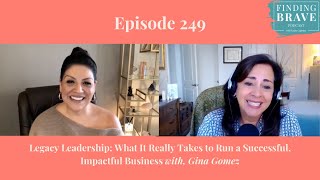
This episode (podcast interview) features Gina Gomez and Kathy Caprino discussing what effective, legacy-oriented leadership really requires. Key themes: leadership grounded in integrity (leader defined as integrity), the dangers of seeking external validation/significance, healthy ego versus narcissism, the necessity of honest communication and change management, and practical guidance for leaders navigating growth, layoffs, and business reinvention. The guest also shares her personal origin story and a call-to-action for listeners to visit her site.
Chapters
You have to have it all together, and that's why people hire people like us. And I also think that if we could be more authentic and have more community, like I run a mastermind, and we talk about these things. We talk about the things that no one talks about because we're taught. Let's talk about it. What I say is you have to be able to talk about these things, because if you can't, you're not going to be able to show up as an effective leader.
Hello, everyone. This is Kathy Caprino, and welcome to my podcast, Finding Brave. I've created the show for everyone who longs to create something bold and brave in their life, to rise up, speak up, and stand up for who they are and to reach their highest and biggest visions. Each week, I'll be speaking with inspiring guests from all walks of business, leadership, entertainment, the creative arts, and the entrepreneurial world. And they'll be sharing their intimate stories of Finding Brave and offer their best strategies for building your most rewarding, joyful, and meaningful life, business and career. Foreign. Welcome to another episode of Finding Brave. And here we are today. First of all, this is coming to you in January, I believe. So we're not quite there yet. Recording. We're in a little bit of the fall. Beautiful, little chilly, but hope you're having a wonderful start of the new year. And I am so grateful and excited to have our guest today, Gina Gomez. Gina, thank you for coming on the show.
Thank you so much. I am so excited to be here in the fall, in January, anytime in.
Between, whenever we can do it. Oh, thank you for taking the time. All right, people, we are talking about, you know, I hope you know this by now. I love to just go deeper and really talk about the real stuff. And what is that? That's the stuff that you don't see or the stuff that you're not allowed to see or the stuff we try to hide about success, about, oh, how easy it is to run a business or, you know, even in financially difficult times. We're doing great. A lot of stuff that you hear that is. Is probably not always exactly the truth or authentic, but we're going to dive deep here and talk about legacy leadership, what it really takes to run a successful and impactful business. And Gina knows all about this. And let me tell you about Gina. And, you know, I love to tell listeners how my guests and I have connected. So I believe this is how it went. My wonderful business manager, Haley, recommended a incredible woman, Lycia, who works with you as. As part of Your team. I know and I want to tell you, don't you understand this when I say this? There's so many people that say they know about marketing and you work with them and you know more than they do. I don't mean to sound not, not humble, but finally, when I met Lisa, wow, is she bringing to me research and data, what's working, what isn't, why courses aren't selling as much. It, it's just been an incredible experience. And then of course we got talking about you and your amazing work. So that's how, how we connected and we feel like we know each other. I think in another life. So here we are. Gina Gomez is a business advisor and strategist with over 20 years working with leaders of multimillion dollar companies and unions including cbs, Viacom, Los Angeles, Department of Water and Power, International Brotherhood of Teamsters. How fascinating. The United Food and Commercial Workers and. And more. She is also the founder of Gina Gomez and Associates, a female led and minority run company that hires and trains teams to perform at their best in an ever changing business environment. Well, we got that, don't we? Right now, Gina has helped industry leaders develop the skill sets they need to lead, working with companies like Red Table Talk, Marie Forleo, Amy Porterfield, Kate Northrup, Colette Baron Reed and more. With a proven track record ranging from Fortune 500 companies, the entertainment industry and the online business world, Gina teaches clients how to create a profitable and sustainable business where everyone feels welcome, respected and included. What a beautiful bio.
Thank you.
All right, can we dig into something I'm really dying to know here? Please. Your three takeaways for this really caught me. Leadership starts with identifying and adhering to your values. Number two, what actually makes a good leader versus what we think makes a good leader and why ethical leadership benefits everyone, including your bottom line. Can we start with what you think leadership, good leadership really is? And can we start with the misconceptions that people have? I would love to hear from your perspective. You know, what are you, you seeing that you think, oh no, that's not, that's not it. That ain't it.
Well, I think this is such an interesting place to start because there is a perception of a general perception, perception of what we think. A good leader is someone who is fun to be around, someone who's dynamic, someone who has a lot of reach or visibility. And those things are helpful. But what you really want is somebody who knows how to show up when things are hard, someone who can admit that they don't have the Answers and commit that they're going to figure them out or figure them out with the team. Somebody who's not afraid to say, I don't know what the next step is. What are your suggestions? So someone who can also see the long term vision and understand that this is more than vanity and vanity numbers. What I see is a lot of people look at leadership as an end result to, I want to make as much money as I can, to be the best leader as I can so that I can, I can retire and make money in my sleep. And I got to be honest with you, I don't know. Like, I've worked with really successful leaders who are multimillionaires and, and have led great lives, but that's not how they did it.
Thinking, let me just do this to make money so that I can have the life that I want later. My goodness, who's doing that?
Well, I think what happens is we misunderstand what our motive is and our intention for when we choose to become leaders. So for me, I knew I wanted to become a leader at a very young age because I wanted to have some kind of impact for that that impacted people who don't always get opportunities. So people who come from underserved demographics. That's been something that's been important to me for a long, long time. But I also know or, and I also know from coaching different people. And this is throughout the years, one of the things that I would see with early leaders or people who are early on in leadership is I would say, tell me what your goal is. Like, what's your ultimate goal? Because that would tell me everything right there. And it was always some form of, I want to be on Oprah Super Soul Sunday, when she had Super Soul Sunday. I want to be on the Today show. I, I want to be giving my TED Talk, I want to be making, I want to be on the Forbes list and you know, in the top 10. And all of those things are great. But then when I ask, well, what are you willing to do to work towards it? There would be this kind of blank stare where it was like, well, I can't, I can't do the work. I have to be the face. So I need help hiring people. And I don't necessarily, I don't have a budget to hire people. And I'm like, well, then you can't hire if you don't have the budget. And let's take a step back and look at what you're really looking for. And what I learned was that not Everyone, but a lot of people are looking for significance. And we think that when we have significance, it's going to solve all of our problems.
And it's not, oh gosh, everybody hear that again. We're looking for significance. We're looking for relevance. We're looking. You know, I was for validation, right? And I was going to say I'm a former therapist and a former corporate vp. I think we're looking for love. And, and the way we think we're gonna get it is by having 10 million followers or a best selling book. We're look, it is validation, but even deeper, I think it's please love me, right?
And here's the truth, and you know this as well as I do, no job or career is ever going to love you the way a human being loves you, including yourself. So if you are looking for a job, and I can tell you, because I've done it more than once, you, if you are looking for a career to fulfill you, you are going in the wrong direction. Fulfillment comes from within. So we're looking at externally for validation. We're never going to get what we want and we're constantly trying to fill a bottomless bucket.
Wow, that's powerful. You know, I wrote a post once, or image. I've written a lot about this. If you're searching for purpose, if you're searching for it, you'll never find it that way. Purpose grabs you by the collar. You don't go, I'm looking for some purpose here. It's, it's something so compelling, you wrap your whole identity around it and you can't help yourself, often to the detriment of a lot of things. Well, I have a million questions, Gina, Can I punctuate a few things and understand your thoughts about this first? Sure. You know, I'm in the leadership coaching space, but I don't. We were talking before we recorded that. We, I think we both do things differently and see things differently. I'm so sick of the way we talk about leadership because it's, it just feels to me like a patriarchal paradigm and it's so vague. So here's what I'd like to ask you. And I didn't prep you on this, you know, so I know you know, you might have to think about.
You're going to do a magic trick. We've never met people.
There comes the bunny flying in from the. What, what is your one sentence definition then of a leader? So if it's not the person who's just the face of it, if it's, you know, what is a leader, then?
Well, for me, because I think it's different for everyone how they decide to show up for a leader, as a leader. But for me, it's a single word and it's integrity. So for me, everything rolls back to integrity. So for a long time, I used to even think about what's more important to me, integrity or respect. And it was like, well, if I always maintain integrity, respect is part of that. But sometimes respect does not include integrity. Right.
So in other words, standing in your integrity, you may not be respected. I mean, someone may not respect you.
Correct.
For your view. Is that right? Is that what you mean?
Well, I'm looking at it more from the other point of view, where if I only want respect, I can get respect through fear. Right. Which is not necessarily integrity. So if I'm leading from integrity, from a place of integrity, and I want respect, fear's not going to be the way that I get that because that is not in alignment with my integrity. So instead it's going to be like, how do I get respect? Well, it might be something like communication, showing up, following through. Right. Being consistent in my behavior, setting clear expectations, being willing and able to have the hard conversations, not necessarily have the answers. Because I think that's a big misconception, is that people feel that leadership have to know everything. And I think if we're really honest, which I know we don't always do, but if we're really honest, we're always learning. Like, yes, we bring a lot to the table, and the more experience we have, the more we have to offer. But that doesn't mean you get to a certain place and you're like, well, I'm good for now. I'm just going to be a leader. Oh, gosh.
I'm just. I'm swimming in agreement here. You know, I. I've started to coach some younger managers who've never managed people, and. And now they're managing 100 because they're in a startup that went wild. And. And they'll say to me, I don't want to admit what I don't know.
Yeah.
And I say to them, you can't hide it. So, you know, what would you rather have? That they. They're guessing behind your back or that you admit it? Not that I don't even know. I've never managed. You don't need to be that forthcoming. But I think so many managers and leaders, to your point, think they have to have all the answers. That's not leadership.
No, that's also.
I'm dying to know. I happen to have written a lot about narcissism and I. Gina, what do you think? I see so many narcissists at the head of multinational companies, and I think it's because narcissist and I. I don't mean it in the pop culture way. I mean narcissistic personality disorder. You can't be challenged. You don't take accountability. You have no empathy. You will drum someone out with a murderous rage if they challenge you. I think we all know we've seen some of that in our lives. The problem is narcissism can look like charisma. It can. It's often, you know, people who are attractive and good with people because they know how to get over. Do you see a lot of narcissism.
In yes and no. I think it depends on one. I think it all. It can depend on industry. Not to say that some industries have it and others don't, but I do see it more prevalent in some industries than others. Yeah, I have a little bit of a probably different take on it.
Oh, I'd love to hear.
I think in some ways, not always and not most ways, but in some ways there is a healthy part of narcissism in leadership. Because one, you have to believe that you're confident enough to. To lead a company. You have to have a little bit of that. That, like the ego gets a bad rap. And I'm not comparing ego with narcissism, but. But it does tie in.
I understand.
And in some ways, ego can be a detriment. Right. When we're. When. Especially when it slips or shifts into narcissism. But ego can also protect us. When the ego says, no, you can't walk into oncoming traffic and survive that.
Right, Right.
No. No. If you jump off of this building, something will happen to you. You are not a superhero. Yeah. Even though you show up as a superhero at work, you might break some bones or worse. So. So I do look at it from that perspective of is this. Is this healthy ego or somebody who's, you know, doing the fake it to make it, or is this someone who is using this type of. This role and character trait or personality disorder to influence in a negative way, to manipulate. And there. I do think there is a very big difference. And I've. I've experienced both working with leaders.
I see. Yeah, I. I would call that confidence. And, you know, the good parts of it is self belief, even in the face of terror. And I don't have the answers. But I believe that I can persevere. I believe that, that I can overcome this with the help of other people. I mean that's self preservation. That's that we need that to survive. I love it. I love that differentiation. So let's talk about. I do have to ask you this other question and I don't get to ask it to many people, so I want to throw it out. Can I? Yes. You've worked with a lot of multi, multi million dollar businesses, probably billion dollar businesses. I also see in maybe I'm wrong. You'll tell me this kind of patriarchal view that you're not a business unless you are netting a million in revenue every year. Do you believe that?
I don't believe that. I believe. I believe that if what your outcomes show. And when I think of return on investment, I always say return on investment is more than a financial return on investment. You only look at the numbers, then the numbers are going to tell you a story and that's not a bad thing. But if you only look at the numbers, you're only getting part of the story. You have to look at everything like how does your team perform? What are the measurable outcomes for everything and how does that translate into your goals and the return on investment? So that's where I always start is looking at from that perspective.
I love it. That's beautiful. Now let's talk about the legacy word, the legacy piece. Can you talk about your vision of legacy and what is legacy leadership?
Yeah. To me legacy is. It's what we leave behind. It's the imprint that we leave when we're long gone. It's the people that we affect through the work that we do that we never ever know about. That to me is so much fun to know that there are people who are watching on YouTube or listening to the podcast episode that will take something from this conversation. I hope that they take some action on or it helps them unlock something or see something differently. Whether or not you and I ever know that is not as important as the impact that it has in a positive way to somebody else's life and how they impact others and their leadership. So to me, that's what leadership is. Legacy leadership is the consistency around that and the practices about how you show up as a leader. And you know, we were talking earlier about leaders having to have all the answers and the perception around that statistically that is not what people want. What people want is a leader who says, we're going to get through this together. I don't know the answers, but we're going to figure it out and we're going to be fine. That's what they want. Not someone who says, it's fine, it's fine, it's fine, it's fine. And then suddenly they're having a conversation saying, I'm so sorry, but we have to close the doors.
Oh, so hard.
And it's happened. I mean, I've seen that happen more than once, unfortunately.
Oh, I couldn't agree with you more. What drove me out of corporate life was that kind of leadership where it was right after 911 and our business had a travel piece and we were decimated and we. It was rumored things would change, but then, you know, and rumored. And closed doors. It's horrific. And then all of a sudden, the announcement. 100 people laid off, and I was one of them. And I had been promised really the moon. So it didn't end well for any of us. But I couldn't agree more. I mean, there's nothing more sickening and scary to know that something's happening, but you're not being told right. And you're treated like a pawn.
And that ties into integrity. While they may not have been able to share with you, here's what's going on. Because you. I'm sure you've been in these meetings, especially being at a VP level as much as I've been in these meetings. We know what the conversations are, and we do talk about how many people are going to be laid off, who some of those people are going to be, who some of those people may be, but may not be. So when we go out and we say everything's going to be fine, and we know that's not true, that is not an integrity. And while we can't necessarily share things that are confidential, what I'm always honest about is I may not be able to tell you the details, but if I can't tell you, I will just tell you we're working on it. I can't tell you any details.
Oh, gosh, I wish you were my boss.
Isn't a heck of a lot better than someone saying, everything's going to be fine. I'm going to promise you all these things, and then suddenly you're like, I have to start a whole new career all over again.
It's horrible. And it's especially horrible if you've been lied to, you know?
And how do you trust other people when you take that hurt right from. Because it is an experience and it's a relationship. It's a Business relationship, but there's still relationship. So then we take that into the next thing. And if we haven't had time to process all of that and discharge it and let it go, we bring that anxiousness, that fear, that mistrust all of those feelings into the next thing. How can we set ourselves up for success or set somebody else up for success in a relationship with us when we haven't been able to heal yet? So I think as leaders, we have an obligation to tell people the truth.
I love it. I. It's like you. It's like you read my book Most Powerful.
You.
Not that you needed to, but you're speaking my language, you know, and I. I often talk about when. This is how I see it. When we lie, we rob people of the opportunity of doing what is right for them because they don't have the information they need. And it also, when you lie, is telling yourself that you don't have what it takes to deal with reality. It's bad for you and it's bad for them. And, and really, anyone listening? And I'm not saying that liars are all, you know, have mal intent. I think a lot of lying at the top is we need people. We don't want to upset them. We don't want to freak them out. We don't really know what's happening, so let's keep them in the dark. The thing is, we're all like energy magnets. We know when things are bad. So.
Right.
Tell the truth where you can.
And sometimes people don't have the answers yet. So it's kind of like, I think with 911, I think there were companies that thought they would be able to turn it around.
Right. We'd never had.
Exactly, exactly. And then we start. So I'm not saying that's every company, though. I think that there are still some companies that are not honest. And then. And then I think there are people like us who are probably more honest and maybe sometimes to a fault.
One of my bosses called me pathologically authentic when I was 25. Pathologically. I don't even know what that is, but probably I am. All right now.
Can you.
How are we doing with time? Good, we have more time.
Can you.
Since you've worked with so many fascinatingly diverse organizations and a lot of women's organizations, you know, Marie Forleo, Amy Porterfield. Can you tell us maybe the top two. No tales out of school here. You've worked with tons of organizations, but the top two additional mistakes, you see heads of businesses Leaders make that you can kind of now spot pretty quickly.
Yeah. I think one of them, and this goes across the board in all industries is people go into leadership and they. They have the best of intentions in their mind, and they know what the goals are and what they want. And then they get into it and they find out that it's so much harder than it is. And I think that can be really hard if you don't have support. So what happens is it turns, it feel. It starts to feel like a very lonely road because we're also taught that we're not supposed to talk about our weaknesses as leaders. So it's like I can't reach out to Kathy and say, I. I'm really struggling and I don't know what to do. And I feel like I'm, you know, the bottom is going to fall out because then she's going to think I'm a weak leader and then she's going to tell our colleagues. And so I think that becomes very hard in leadership when you feel like you have to have it all together. And that's why people hire people like us. And I also think that if we could be more authentic and have more community, like I run a mastermind. And we talk about these things. We talk about the things that no one talks about.
Wow.
Because we're taught. Let's talk about it. Because what I say is you have to be able to talk about these things because if you can't, you're not going to be able to show up as an effective leader and you're not.
Going to get the help you need. You're not going to get out of the hole.
Right, Right.
It's just not going to vanish. It isn't.
Right.
Wow.
That can be really hard, especially when you want to do a good job, but you feel like you can't tell the truth where you're struggling because it means that you're not good enough. And. And I think that's why a lot of us chase significance, because it's that validation of tell me I'm good enough so that when I'm not feeling good enough, I can rely on that.
That's so true.
Right.
Would you say this, this is relevant to what you're saying? So I train coaches and work with coaches. What every person who is new to coaching thinks coaching is, is not. Is not running a coaching business. They think it's, I'm sitting on zoom and I'm helping Gina. That's 10 to 20%. Yeah. And so what I'm starting To have to have some hard conversations. You know, I'd love you to take my coach certification, but if you're going to fail at running a coaching practice, I want to help you either head that off at the pass or get the. The training you need or have the realization, the understanding. Do you see that with leaders of, you know, okay, we're talking about people starting their own coaching practice, but do you see that with leaders in even much larger purviews, that they thought it was going to be something very different and they had the penchant for that thing, but that's not running a business.
Yeah. I think this is such an interesting. An interesting comment and question because when I work with new coaches who are very new to coaching, it's exactly what you said. And so one of the questions I like to ask because it helps me know where to meet somebody, where they are is I'll say, so tell me, tell me how you got into coaching. What made you decide to become a coach? And I don't hear this anymore because I work with a very different demographic. But in the beginning, nine times out of ten, I'd hear, well, I've always been really good at giving advice. Like, my friends always ask me for advice, and I'm like, okay, so that makes you a great friend. Tell me what makes you a great coach? And I would get a very blank stare. And it wasn't to make somebody feel bad or less than I needed to understand where their head was. So I knew what they understood as coaching so that I could help them understand what coaching actually is. So in leadership, I think it's the same in a lot of ways where we go into leadership and we think. And I was one of these people where I was like, this is going to be amazing. I'm going to get to develop raw talent and I'm going to show them how great they are and that they can do everything. And then. And then the sleepless night started happening and the processing of, oh, my gosh, I don't think this person is happy. What do I need to do to make sure that they feel challenged and they feel rewarded and they know that I really care and that they're valuable and right. They start to become like, we take on that responsibility. But I don't think we talk about these things. We also don't talk about things like leadership and women not getting paid, what we should be getting paid and how there's an equity issue and then there's an equity issue with women within race and all the disparities there. These are the things that we need to be talking about in order to come together. We cannot heal as leaders if we constantly talk about these inside conversations or we don't talk about them at all and pretend like it's not going on.
I think you're so right in every way. You know what it reminds me of? In the time I was a therapist, I was a marriage and family therapist. What's interesting is it's, it's a metaphor here what I'm about to say. I'm divorced now and I think some people would say, well, we don't need to go to a divorce person who's a marriage and family therapist. You failed. First of all, I don't think divorce is failure. But the point is, I think a lot of people are afraid to say they don't have what it takes because they feel that their very lifeblood is to generate money from people who are looking to them for the answers. Do you understand what I'm getting at?
Such an interesting point because I so much like most people, I had a very hard time admitting when I didn't know things because I don't like it. I thought if I said, yeah, if I said I didn't know something, it meant that I wasn't as valuable as someone else. And then I felt like my job was at risk. That's, that was my stuff. But what I found was the first time I admitted that I didn't know something, it was like how that was empowering because the person who does know that can actually come in and do it. So that's how I look at it. Like I will tell you, you ask me things about like the back end of my website and I'm going to, I'm going to start acting like a 2 year old without a nap within 30 seconds because it's not my favorite thing to do. It makes me very frustrated when I can't figure things out quickly figure that out. So rather than making everybody else miserable, including myself, it's like I don't care how much it costs. I will find the money and pay somebody if that's what I have to do. Right.
Well, that's also a way to deal with what I see is perfectionistic over functioning of every high level woman, high achieving woman I've ever met and I'm a recovering one. We want to do more than is healthy, appropriate and necessary and get an A plus in all of it.
So let me fix that banner.
Why can't I get into the HTML cold coded movement? Because that's not what you're doing here, Kathy. Oh, all right. Now, what else, what else do we not understand about. Let's talk about success. Let's put ethical leadership, which we want to talk about aside for a minute and integrity. Can you tell us one thing? If we really want to generate more income or a higher ROI, or really have more success in the market, are you seeing any overarching principles that some people are missing? Particularly in times like this where. Yikes. Anything you can tell us?
There's a very significant piece. It's the. I think it's one of the most significant pieces of leadership that gets taught the least and most people do not know how to do it. And when you're in a situation like this or a pandemic or anything else, if you don't know change management, you are in serious trouble. You have to know what change management is. So that's identifying it like we've been talking about recession, the economy. If you are doing business as usual, then you are not, you're not even thinking about what's going on and how your business may be affected. So you have to identify what's going on, what's the change you're going to make if there's going to be a change, right. Then you start to analyze that. What, what's the impact if we make this change? What's the impact if we don't? So you got to look at the benefits and risks of either option, then putting together the solid team to make sure that whatever the strategy is to one, help build the strategy and two, implement it. And then you've got to have ongoing communication. Are we on track? Are we off track? Is everything working the way we wanted it to work? If it's not working, what do we have to change? And then making sure that's communicated and moving forward. What I find people tend to do, and I don't think it's because people don't care, but it can come across that way, is that they react in the moment. And so what happens is you put yourself in crisis mode. So you're making very different decisions because you're making crisis based decisions. Not thoughtful.
Wow.
Sometimes they can be effective, but not always, especially if it's a rushed decision. So understanding change management and being proactive in that and is one of the most critical pieces of leadership that people don't, they just don't know. Because here's the truth. You know this as well as I do. When people make you a leader, they don't go, hey, you're a leader. So we're going to put you through six months of training and then we're going to send you to the next one. And in three years, you're going to have this nailed. They go, congratulations, you're a leader. Here's your new business card and here's your new responsibilities. And what I always tell people is when they go into leadership, they go, I thought this was going to be a whole lot of fun. I'm like, yeah, they told you your new title and what you were going to be making that was the most fun. Now it's work. It's all down here.
Oh, my God.
And not that you don't have fun. Like when you were reading my bio, I was just, you know, like, reminiscing on the clients that I worked with. And I think that's a big part of, of leadership, too, is being able to, to build strong bonds and relationships that are based on integrity, respect, and all the other things that go, you know, ethics that go into that. I'm still friends with a lot of the clients that I worked with early on in my corporate career because of that.
Beautiful.
And unions taught me that. How, how important relationships are, solidarity.
How absolutely beautiful. What, what, what did I want to say to you? Oh, I'm just going to be really authentic here. You know, in my small business right now, change management is essential. Right. And what I find myself sometimes saying at, at my age, no, I just wanted to coast for a few years, for goodness sake. What do you mean? But I'm perpetually, perennially positive. I don't mean Pollyanna. I mean, I really believe I signed up for these challenges. I do, I believe it. And so I say, look, even if you didn't sign up for them in the past life, you're in them. You're either going to break yourself and bloody yourself against them, or you're going to find something enjoyable about learning why your course isn't selling like it was five years ago.
Right.
And, you know, all of a sudden I had a day and I'm sharing this to. I hope this is exciting for people. All of a sudden, I had the most creative day, like, you know, as a writer, but also creator. I, I was up till midnight with I. And I'm not bipolar, you know, that doesn't tend to happen to me. So many new ideas, like, let me reinvigorate my mentorship program. Let me do this now I'm on the uptime app for a hack of my book. I think that there is a silver lining to this I agree, can be fun, it can be creative. And no, sometimes we just want to coast.
Wait a minute.
I don't want to learn anything else.
And, and I don't think there's anything wrong with that. I mean, there are definitely times when I am like, oh, there's nothing happening. And then I go, oh, my gosh, what's wrong? And then I go, oh, nothing's wrong. Like, like enjoy it. Because eventually something's going to happen and you're not. And then it's a go time again. And then when it's go time, yes, I feel stressed just like everyone else. I can have sleepless nights just like everyone else. And there are times when I don't know what the answer is, and I get super stressed just like everyone else. But I also try to remind myself that I'm resourceful, I have good people around me, I have a lot of experience. And I like you, I signed up for this. I love leadership. I love working with good people. And I also love being able to help them figure things out that might seem impossible or tricky or even in my own business. When we're watching what's happening with the economy or world events or the pandemic or whatever it is also being able to revisit and go, well, the landscape has changed. What can we do? What, what problem can we solve for people? That's fun.
It's fun. It's fun. That's why we're here. Oh, Gina, I want to let you go, but I, I would love everyone to hear, if you don't mind, I'm fascinated about your trajectory. What, from a young girl, what you do mind telling me, telling us what you were interested in, what you went to school for, how you found yourself in this incredible arena. Would you tell us?
Sure. Well, it was an accident. Well, I mean, I don't think it was an accident, but it was definitely not my plan. So let me say that. So I was really lucky to have parents who just gave me the really the, the coolest experiences that they could. So my father was a court administrator for one of the courts in Los Angeles when I was a little girl and my mom was a stay at home mom. So I was maybe 7 years old and I was fascinated with what my dad did. I didn't know what he did.
I don't know what a court administrator is.
They run the court. The only person they report to are the judges and. But they run everything else in the court. So I didn't know what he did. I just knew he Sat behind a big desk and told people what to do. And I was like, I can get on board with that. So I would always ask after school, can I go? Can. Will you take me to dad's work? Can we. Can I just go sit with my dad? And my mom would call and say, you know, do you have meetings? And he said, just, just bring her. It's fine. So she would drop me off and my. Because we called them secretaries at the time. My dad's secretary, Eileen would get me and she gave me a yellow pad of paper and a pen and she'd take me by the hand and she walked me over to one of the courtrooms and she'd sit me down and she'd say, okay, are you ready? And I go, yep.
And it would be a filled courtroom.
Yeah, there were. I would sit and listen to all the cases, small claims cases. Like I'm seven years old. @ the end of the day, the bailiff would take me back to my dad's office. And my dad would sit at this big desk and he had that big glass blotter thing on his desk. And then he'd take a piece of paper out and he'd go, okay, Gina, the people versus so and so. Tell me what the case was about or whatever it was.
Oh my.
And I would have to tell him what the case was in my 7 year old knowledge and voice.
He doesn't like her.
He'd say, do you. Did. What was the. What was the verdict? I would tell him and he'd say, do you agree with the judge? And then he'd make me argue the case. So I had a very early on experience in critical thinking. But for me, not having any experience and not knowing what critical thinking was, it was my first experience with live theater. So I got very interested in the aspect of performing. My parents were very interested in the aspect of me performing in a business capacity. Business, not on stage. Yeah, so. So my dream was to go into music and to be an artist. My parents dream said, we're paying for this dream, so you got to make a different decision. What was so great about that, even though it was heartbreaking at the time, was I understood what it was to have a dream and how important that is to feel supported through all of that. And I don't regret that I didn't move into theater and music because it taught me so much and because I get to have an impact in a much greater way than I think I would have had. I pursued the other.
Wow.
But I also get to work with people I work. I have clients who are theater directors, performers, musicians, music managers who manage, you know, big artists. I work with a lot of people in the entertainment industry. And I think that was the real gift was that I got to understand why it's so important to them to create and be artists the way that they are. So it all worked out in the end.
And do you sing and do something on the side?
I do it inside. Inside my house, but that's pretty much it. I mean, that's. That's enough for me.
That's enough because I. People know I'm a singer on the side and have done singing all my life, and my ex is a famous jazz percussionist, and I never really wanted to make my living doing it, but if I don't have it in my life, I'm not happy. So. Wow. You know, it. It's all. We use all of it, don't we? We use all of it.
So true. It's so true. And I think that if we always stay curious and look at things like, huh, I don't know where that interest comes from, but I'd be curious to know what it is that drives me towards that interest. I think we can start to notice all these different clues that are leading us to the next thing and the next thing and the next thing. And that's part of reinvention, too, right? And as leaders, we are constantly looking to reinvent ourselves.
I'm so inspired by Eugenia. Let me join your mastermind.
So where can everybody.
I gotta let you go. But where can everyone learn about you? Tell us. Where do they go?
Give a. I'm gonna make it super easy for you. Go to gina gomez and associates.com. and all the good information is there. Yeah, sign up for the list. That's where we advertise whatever we're working on. And we do special things specifically for the list that we don't publish on social media. And if you do sign up, be sure to say hi, because I read and respond to all my messages.
Well, what a light you are in the world. Our world is lucky to have you, Gina. So thank you for. For sharing. Please come back again. Chapter two, three, and four about, you know, legacy leadership.
I would. I'm gonna be. I'm gonna be here every week. Now.
I may not, but I'll. I'll see you there. Thank you, my dear. Oh, people, can you tell us what you got out of this? What idea did it spark? What challenge? What authentic, Authentic thing. Did you hear that? You're not hearing or what do you need help with? Can you let us know? Wherever you see this, just ask your question. We'd love to do anything we can to support you. Thank you. Thanks again Gina. Can't wait to see you again soon. Thank you.
Likewise. Bye everybody.
Hope you have a wonderful Brave week and we will see you soon. Bye. Hi folks, Kathy here. I'm so happy to share that I'm offering a new eight week live coaching and training course starting February 1st. All about the content of my book, the Most Powerful youl. This course teaches professionals how to recognize and address what my research has found are the seven most damaging power and confidence gaps that block us from achieving our most exciting goals and our highest potential and success. When you have these gaps, and certainly if you have more than one, I can tell you that you simply cannot thrive in your professional life and there's a lot of pain, conflict and challenge that these gaps create. The course offers eight weekly zoom coaching calls with me, eight video training modules, step by step process for boosting your career confidence and impact. Fantastic additional resources from over 30 of the nation's top experts, a private online support group for members and more Spots are limited, so hop on and Register now@mostpowerfulyou.com I've delivered aspects of this training at over 50 organizations, conferences and communities worldwide, and people who've taken it have called it transformative and life changing and I'm confident it will move you forward fast. I hope to see you there. Thanks so much for joining us today. And please don't forget to check out finding brave.org for more programs, resources and tips. And tune in next time for your weekly dose of Finding Brave.
More from Kathy


Elevate Yourself, Elevate Others, and Amplify Good | Chris Cooper | Finding Brave Ep. 334

Finding Brave Epis #333: How Leaders Can Harness AI Without Losing Their Humanity, w/Bennett Borden

Finding Brave Epis 332- How to Stay Brave, Valuable and Visible in the Age of AI, with Raman Rai

Finding Brave Epis 331 - The Power of Positive Disruption, with Dr. Patrick Leddin


Finding Brave Epis 330 - Being 40: Letting Go and Embracing Who You Are, with Stacey Lindsay

Disrupt Career Reinvention with Kathy Caprino - via The Disruption Lab Podcast w/Patrick Leddin

Creating Neurodiversity-Friendly Work Cultures: Simple Workplace Adjustments Matter

Finding Brave Epis 329 - How To Create a Neurodiversity-Friendly Workplace, with Kristen Pressner

Finding Brave Epis. 328: Reclaiming the Power to Trust Your Own Voice, with Dr. Cindy McGovern