250: When Masculine Norms Shape Leadership Norms and How That's Damaging with Ludo Gabriele
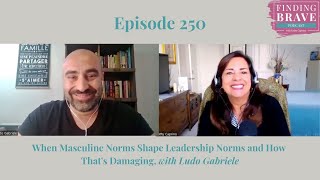
Podcast episode (Finding Brave, host Kathy Caprino) interviewing Ludo Gabriele (senior director of MARC at Catalyst, founder of Woke Daddy). They discuss how traditional masculine norms (narrow, competitive, “alpha” behaviors) shape leadership and organizational culture, produce masculine anxiety among men, and impede gender equity. The conversation covers research findings (e.g., high rates of masculine anxiety, desire among men to interrupt sexism but low confidence), barriers to men’s engagement, the MARC learning approach (conversation-based, majority-men audiences with gender partnership), and practical guidance (look inward, build empathy, role-modeling and advocacy).
Chapters
The reason why it has to be represent all type of gender is because our approach is really on gender partnership, which is we believe it's men, women, and people of all gender identities working together in partnership to create collective culture change. Because we cannot achieve progress with one set of people.
Hello, everyone. This is Kathy Caprino, and welcome to my podcast, Finding Brave. I've created this show for everyone who longs to create something bold and brave in their life, to rise up, speak up, and stand up for who they are and to reach their highest and biggest visions. Each week, I'll be speaking with inspiring guests from all walks of business, leadership, entertainment, the creative arts, and the entrepreneurial world. And they'll be sharing their intimate stories of Finding Brave and offer their best strategies for building your most rewarding, joyful, and meaningful life, business, and career. Hello, everybody. Welcome to another episode of Finding Brave. You're in for an amazing one today, folks. I hope you feel it is amazing every. Every time you hear it. But we are so blessed to be speaking with Ludo Gabriel today. Ludo, I have been following your work for years, and even I featured you once back in 21 in my Forbes blog. Did I even have this podcast? Yes. I should have had you on a lot sooner, but. And. And we have a Forbes interview coming out. This is reaching you all in February, and we're doing this in November. But I just want to tell you, I so appreciate the work that you do, the brave work that you do, and it is so needed. And just thank you for taking the time to come here and talk with us. Thank you.
No, thank you. Thank you so much. And thank you for the kind. The kind words. Those are really appreciated because this is not easy work, for sure.
Oh, it isn't. And what work are we talking about, people? We're talking about how masculine norms shape leadership norms and why that can and often lead to inequity. So, Lulu, let me tell. Let me tell you all about the work that Ludo does. But we were talking about how the work I do, I'm immersed in women's issues. And because I was a former therapist and a former corporate person, I do believe I can glimpse at one what men experience. But my world is what women experience, and you are a little bit of the opposite. Although you shared with me that in your amazing work, you're also surrounded by women, too. So what a. What a. What a lens you have. But without further ado, let me tell you about Ludo. Ludo is the senior director of Mark Branding. Mark represents men advocating Real change at Catalyst, one of my most favorite, most powerful organizations. A global nonprofit that works to accelerate progress for women through workplace inclusion. The Mark Initiative is designed to inspire and equipment men to leverage their unique opportunity and responsibility to be advocates for equity. Ludo is also the founder of Woke Daddy, an amazing platform where he shares his thoughts about fatherhood, masculinity, and society at large. Check that out, people. Before joining Catalyst, he worked for over 10 years in international marketing and branding in an advertising agency and as an entrepreneur, and holds a master's degree in management from the esm, a management school in Paris. I don't know what that school is.
It's. It's. It's a. It's a school in the suburbs of Paris. It's not an amazing school, but it did pay for my. It was free. Because the French system is built just differently. So in Paris, for this, I'm grateful. Yes.
So amazing. So international. All right, Ludo, let us dig in here, but I do want to share. You all fill out a guest prep sheet and. And my guests let me know what are the takeaways. They want to make sure we hit home. And I just want to read these because I think they're amazing. Number one, no meaningful progress can be achieved on anything without involving the majority. I mean, look at what we're seeing in our world, even today. Today is election day for the midterms. I. I voted. It was amazing, President. But that statement is so true. Number two, barriers preventing men to engage in dei. We're going to talk about what those are, because I think we often don't know. We know that things aren't moving, but we. We. And again, my world happens to be women. In terms of who I support, I think we don't have the empathy for what men go through that we don't.
Know what we don't know for sure.
We don't know what we don't know. And number three is Steps to prevent sexism and create more inclusive cultures. So let us start with the title of this. Masculine norms. Ludo, what are those? And spell it out for us. And also, why does that go against creating equity and inclusion and, you know, diversity in our organizations? Tell us everything.
Well, well, first of all, thank you so much for the opportunity to. To. To discuss today, for the opportun, this issue, which is, as you said, solely needed, timely, and never green. As we were, as we were talking before, when we talk about masculine norms, it's really what we think about traditional masculine norms. Right? You know what? We collectively agree on what it means to be a man. And what we know, and I think we are kind of desensitized to this fact is that it's very narrow, you know, it's very dominant being, being aggressive, being a winner. Take all kind of approach to what he means to be a man. It is also has, you know, he holds a lot of imbalance in terms of relationship across genders. You know, because historically we know that women have been also socialize themselves to see themselves as inferior as, as men. Right. We were talking about patriarchy a little bit before Katzi. So this idea of this over glorification of traditional masculine norms will lead to the word that we have today, which is hyper competitive, which is driven on competition over aggression. Those are attributes that we have valued a long time within organizations and in the way also organization compete with one another. Right. When we talk about the market, we are not approaching the market as a collaborative place. We are approaching the market as we're gonna be the best so that we can beat everyone else. You know, so those are the translate, right. Those masculinity norms shape the way a lot of organization are still run. A lot of countries are still run a lot of institution Austrian. And this is, this is the result of socialization. And that's where the root of that issue needs to be addressed. And unfortunately, when we are in places such as myself, when we address those issues from workplace perspective, we get caught in or we get asked many times to provide a checklist and we are not looking at the root causes of those issues, which is socialization, which is how we are all socialized to value each other and how organizations and countries and are run as a result. So that's.
Well, what you just said is, you know, volumes of books and this would be, you know, a hundred year course. But I do want to say something and dig into this a little bit if I could. I want to punctuate two things. We will link to it below. But I interviewed your dear friend and collaborator and colleague Mark Green on Man Box Culture. And I told you Ludo, I literally cried on. You'll see it it go to YouTube because I am so, you know, tuned into the ways in which women are told don't be a braggart. Don't act like you think you're great. Don't ever put yourself in front of other people. Don't act too assertive. Don't. It's, it's. It's the flip and we are so damaged by it. You know, just, just an example is honest to Goodness, Ludo, every single day I'm talking to a high level woman who says, I mean, I'm talking founders of pharmaceutical companies and, you know, high level. And they say, one woman yesterday said, I don't know how to ask for what I want without looking disagreeable. There it is. So I know my world. But when Mark was talking about what men deal with, and I'm just going to say it here, based on a lot of research of like pre K, you know, five year olds, you ask a boy what it is to be a boy. Don't be a. Excuse me for using that word. Don't be weak. Don't be friends with girls. Don't ever cry. Don't be vulnerable. They know at age five. Am I right?
Yes. That start, that starts. Yeah. In pre K. And that socialization process is something that is built and reinforced and passed down, but not only at school. Right. It's, you know, as we were saying, it's, you know, Mark always give that list of people that we interact with depending on our culture, you know, our, our pastors, our preachers, our coaches, you know, you know, the, and the TV that you watch. And it's, everything is reinforcing that. And that's. And, and it, it is true that, you know, what you were mentioning about girls having the other side of the coin, which is you're being police by, by being assertive. I would, I would, I would tell you, Katie, though I would say that masculine norms are arguably even stricter. And here what I mean by that. So we know that we have a long way to go as it comes to gender equity for sure. But we know we can see how the path for women is aspirational. Right. And that's, and, and the messaging that is, you know, communicated as such for girls, you know, you can do anything, you're strong, you see it everywhere. Right. And that's clear. When you're a boy, though, the message is not that simple anymore. You know, when. Well, that's what I'm saying. It. We don't know what it is. We don't know what it is because we, we are coming from a place where we were kind of blindly reciting a script of masculinity. And for the first time we are, we are questioning it. So it's a generational questioning that will take generational change, time for change. Right. But when we are at that juncture, I mean, look around, you can still see that alpha male attributes, also largely glorified by myself included, what are glorified? Alpha, Alpha male Alpha male attribute, of course, you know, like.
Yeah, take a look. I mean everywhere.
What I'm saying is it's, it's uncharted territories is really not easy. Men also receive a lot of mixed messages. You know, when we are taught to. In one, in one way we are taught, we know that we cannot that emotional choices and hurt us. I mean on mental health, you know, it's been proven. There's a lot of data around that. At the same time, we know that men are perceived as more collaborative and power sharing, especially in the workplace operatives, less competent by both men and women. You know what I mean? So this is not, this is not a. This is not a.
Is that true still? The research shows. So in our Forbes interview, you talk about men who advocate for women and, and point out the inequity are seen as less competent. But not just by men, by women as well.
The ones that are more collaborative and more power strike. Meaning a man that has not. That would not act like a. What you would think as a individualistic career person would like that doesn't feed that norm will be perceived as less competent just because he doesn't embrace that. And that's also part of the story which needs to be told on the men's side, which is men, as you know, experience masculine anxiety in the workplace. I don't know if you want to touch on that now, but that's a huge.
So masculine anxiety.
Yes. 94% of men, based on Catalyst research, experience masculine anxiety in the workplace. So we define this as kind of the distress that men feel when they have the feeling that they do not fulfill society expectation of what it means to be a man. And the consequences on this, aside from the anxiety itself, which has, which is a mental health symptom, is also they are less likely to interact sexism in the workplace. So if you are. If your environment is likely to be hypercombative or kind of, you know, in, in that, in that sense of the spectrum because not all cultures are the same. You are much less likely to interest. To interrupt the sexist, sexist, you know, interaction or sexist occurrence in workplace.
Let me rephrase because I need to understand you and you're going fast. Men who have this anxiety.
Yes.
And there's confusion within that causing anxiety and fear. I'm guessing that's the former therapist in me. What do I know? But they. If they're going through that which is an angst, it's an existential angst. Who am I right? Are going to be less likely to interrupt Sexism when they see it, where they see it. And is that because they're already struggling with identity, and if they put themselves out there in that way, they're probably afraid they're going to be perceived, pushed into a corner of a negative judgment. Is that it?
Yes, and that's what I'm saying. Masculine norms are much more narrow because if we are all experiencing it at some level, it also shows that the workplace, the way it's set up, doesn't necessarily work for men either.
You know, can I ask you this, Ludo? Because this is what I don't understand. Well, there's so much I don't understand. You said how we perceive women. And. And it all comes. Wait, I have to say this. One of the challenges with anything regarding workplace workforce work is that it's about us as people. So if we're trying to shift something up here, but we haven't done the deep work.
Yes.
Forget it.
Yes.
And this is. You know, I'm not a therapist anymore, but my career coaching is often career therapy without. You know, when. When I know someone's functioning is. Is deeply impacted, I immediately refer them to a therapist. I don't do therapy anymore. But it's all with a therapeutic lens.
Yes.
So one problem, people, is you can't just fix it niggling around up here. It's deep. Right. But here's. Here's something I'd love you to tell me based on your work in the research it's taken us since the seventies for.
And.
And front runners like Gloria Steinem. And boy, there's a whole controversy over feminism that term. And boy, I've been called some things I can't and even ever say out loud. Shut up, you dumb C word. For what. What I said, I believe feminism is. But the point is, since the 70s, we've been fighting for getting out of our female box.
Yes.
Now it's. It's more recent for men. But why do you think it's so much more intr. Intractable for men? Why? I mean, because we live in a patriarchal world. It's been, you know, under 10% of Forbes. What am I saying? Fortune 500 organizations are run by women. So, yes, the patriarchal world is heavily cemented. But why in particular. Particular do you think this is so hard to stretch out of? Well, as I've been doing it.
Well, it's a. It's a good question. I mean, I think it's also because when you're in a place of privilege, why would you. Why move. You see the difference. So that's where also where I, I believe it stems from.
However, wait, let me understand. Privilege in, in like we know what privilege means, but the average life of a man who is, you know, in his mid to high level position in, in an organization, how do they see privilege? How, how do they conceive of it?
Well, first of all, they need to have, as you were saying before, this is an individual experience. So they need to question, I mean.
How are they benefiting in their minds? Are they outwardly thinking I'm going to get this job and she isn't?
That's, that's, that, that's, that's the thing though. It is privilege is very often unconscious. I mean it's, it's, it's invisible for, to those who have it. For certainly if they have, if they have not questioned it because you know, equity is going to feel like oppression for, for someone that has been privileged his whole life. Right. So I think that lens is, is, is very important and it, but it's, it's not easy to acknowledge privilege because privilege, everybody has it at, in some level, but it's, it is not framed as such. And unfortunately not everyone has it.
You mean, you mean a certain group have it?
I said everyone has some level of privilege. What I'm. And what I mean by that is you catchy or me. I, I'm a straight, white, able body man. So I have a lot of privilege. Right. I struggle with mental health and things like that. You don't see that. But in the Prince, I have a lot of privileges. Other people are going to have different advantages. I come from a very, very humble, economical background, so I didn't have. So that's very, very different. And that's where also this conversation becomes complicated because sometimes you have a lot of men that becomes defensive because when they hear the word privilege, they hear I am privileged, meaning you are not seeing. You don't know what I've been through, think everything has been easy, you know, and the fact that we are not also socialize to share about those things. It reinforced that resentment that you can, that you can find with, with men, which is.
I'm sorry, go ahead.
No, please.
Do you think it's what came to my mind is when black lives matter came out to the forefront. What you heard is no. Well, white lives matter too. Of course white lives matter, but they have mattered more than black lives matter for centuries. But is it exactly what you're talking about that when you feel unappreciated, underserved, whether you're white, black. You know, when you feel you're not part of privilege, then you, I'm guessing, people, you'll let me know if I'm way off. It's not going to come as a happy message to you that another group that perceived itself to be underprivileged is going to get attention, Am I?
No, I mean, it's. I think you're putting the thing. Yeah. You're putting the finger on something that is critical, which is people tend to think, especially when they are suffering. What, what about. What about me? Right. And. And unfortunately, especially as it comes to men, you have the narrative which is a true narrative, which is men, Men are challenged like never before in history. I think it's fair to say that. I think it's a good thing. You can say that men are under a unprecedented, unprecedented amount of scrutiny and accountability. And at the same time, and at the same time, they are still being asked to remain in a very narrow set of norms in a lot of areas of their lives. And when they step out of it, they are getting. And they are also being questioned and punished by doing things that they've been told to do for generation. And when they step out of it, they get policed by men for stepping out of it and they get police by others because anything too little too late. You're performative, you are. Whatever it is, you shouldn't.
I will say this, and I mentioned it with Mark, just a brief illustrious story. I'm a feminist and I have been for years, but. And, and I had. Was married to a wonderful guy. We're amicably divorced now. And he was a feminist in that you can do what I can do here. And I remember when gas you, you had to pump it yourself. It turned from full service. And I don't know what was I 35? And I said to Arthur, my ex, my husband at the time, I don't know how to do that. Will you come with me to the pump? He said, kathy, yes. So I must have been 40. He said, you have a master's degree. I'm not coming to the pump. You read the directions and you pick it up and you do it. And I was like, jeepers. But what I want to say is my father, who died at 9310 years ago, did everything for my mother. So the, the additional challenges. So I'm thinking my father would have helped me.
Yes.
So then there's what you consciously think you believe, and then this stuff comes up. Do you understand what I'm getting?
Of course, of Course.
So I think men are policed by men and women.
Yes.
Who either outwardly accept equality or inwardly, but inwardly do not.
Of course.
Does that make sense?
Of course. And it's, it's exactly what I mean, what you describe with the memory of your dad and the way it shaped you and how it shaped the interaction you had and the expectation you had. I mean, it's, it's generous and stereotype one on one. Right. I think it's, it's also because historically, right now we are in a critical time where we are questioning it. Not from only what you were saying before. The first wave feminism was about women being able to do anything. So that's one thing. But it was never really questioned within the, the lens of true inclusion. Right. What does that mean? Because from. Men were not even part. Remotely part of that conversation for, for a long, long, long time. And I think that's, that's really a me too movement in my, in my view, that kind of put a catalyst on it and kind of, you know, put a critical mass of, of visibility so people could more openly talk about it.
So when you say men weren't in the discussion, weren't discussions happening at the dinner table 10,000, 10 million times a day, like, listen, a woman saying to her husband or, you know, I'm sick of this. I'm sick of any number of things you can imagine. Right. Weren't. Weren't they being discussed openly with the men in our lives?
I mean, I would argue that a lot of it could not be discussed that way because the world was different. You know, like I would, you know.
Yeah.
If you think about just how in terms of legislation, women get the right to vote very late also, the, the fact that they've been able to also have full control of their own body gave them really access to the workplace. So just that, you know, biology just biological control. Right. So. So I think those were not questioned also maybe in that fashion, because there was those biological barriers plus the legislation that was just so much. That was just, you know, completely. The system was clearly, you know, against women when the, the, when the workplace started to open up, essentially, which is how Kelly's was created, which is really with the.
Catalyst was created.
Yeah. 1962 was created really by the. And that's the mission of Catalyst, which is really building inclusive workplaces that work for women with the argument that workplaces that work for women work for anyone. And at that time, it was really giving opportunities for women to work to not have to choose between being a caregiver and a breadwinner to have some level of independence. That's 1962, Cassie. We're not talking about a long time ago. Right. So right before it was not about a glass ceiling. It was about a locked door or a door that didn't even exist. So I think that's why when those things started to be possible, then yes, women were challenging men more on a day to day basis, I would say because those opportunities went, were open.
I understand. It was somehow a little, I don't even want to say safer. For many it wasn't, but I understand. Oh, thank you for explaining all this. So we know what these masculine norms are, unfortunately. We understand that human beings don't change too quickly. And this is a societal paradigm that many people do not want to change. I mean, you know the people calling me terrible things. And it's interesting that feminism article and video, we'll link to it. People is still the most, one of the most popular things. And I have 35 million views on Forbes, one of the most viewed things today because I think people don't understand, but given the barriers we have that for men, and I get it internally, they're going to think, wait a minute, how is this working for me? And socially, societally, culturally, we're not really 100 on board. What do we do, Ludo, how do you go in and how do you go in and train? You know, it's pretty clear. I mean, if I'm sexist, tell me. But men are going to listen to you more than they're going to listen to me about it. Because I, I'm not living that reality, that gender reality. And I think for women, often when we're talking about the struggles women have, there's a shortcut when I come in to talk about it versus someone else. So you're training men. What goes on in these trainings and these conversations?
Yeah, thank you for. It's actually not necessarily a training, you say. It's really. We call them learning programs and they are usually conversation based as you just pointed out. So actually a lot of us, a lot of people are asking us if we are, if our programs are for men exclusively. So you know, the Mark initiative, do.
They want them to be?
Well, we do not do 100 program 100 towards men. And the reason is that we believe that it is important, but it is in majority for men. So 70% of our audiences are men and 30% remaining is all gender identities. And the reason is that we want to invite people in conversation. It's also very Important that people hear each other's experiences to hear voices are not necessarily heard in the room especially when those session. So we have different types of sessions. So we have sessions that are like just company based on. So the employees will be just for. It will be for one organization only or we have also sessions that are like cross organizations. So you would have people from different organization joining in. And what we found is that the hearing there is just a powerful element of hearing your woman colleague talking about six instances in the workplace about something that happened yesterday or something that happened across the hall from them. Right, right. It's. It's just, it just. It's differently. We have a few, you know and that is just. I believe this is why our program are also very successful. It's because we are not necessarily. We are trying to equip men with the skills to be more effective than a partner. So we are not trained. Training them. We are not training them to. We are not giving them a set of solutions. We are trying to help them ask themselves the right questions which is not necessarily the easiest thing. But it's a different mindset, it's a different way of seeing situation. And the reason why it has to be represent all type of gender is because our approach is really on gender partnership which is we believe it's men, women and people of all gender identities working together in partnership to create collective culture change. Because we cannot achieve progress with one group set of people.
Everyone is can I ask you this? And again I'm asking you what I want to know. Hope this is interesting people. I feel like I'm just alone with you here. What's interesting to me is a lot of my programs are for women only. And the reason is this is the God's honest truth. You invite one man in, the energy is different. Women aren't as safe to share. They I see it over and over now. A lot of my free stuff, a lot of my private coaching is so inviting and inclusive for men and men have said write a book for me and the most powerful you My latest book, it's the seven damaging power gaps. They impact 98% of women but they impact 90% of men based on my survey. So it is written for you people but it's got a lens for women. So here's my question to you. And my work is different in that I'm helping a certain demographic, mid to high level professional women or women of any level claim their power, claim their confidence, overcome what they know or don't even know is holding them back. From what they really want. So your, your stuff is different. But do you find that when you happen to be in a group of all men, there's a safer feeling of sharing?
Not necessarily. I would, I would tell you this. I found that men tend to.
Be.
Vulnerable more easily with women than they are women different because it's very difficult to say to another man, I need help. I don't know, I am unsure. And that's actually very. It's actually very sad. You know, that's what creates the epidemic of loneliness that men go through. That's why men kill themselves so much more. So I think that's, that's. And that's what we need to actually do more with men. You know, there is a. This analogy, I don't know, it's not from me, so don't quote me on this, but this, there's this great analogy that I've heard right around Covid because a lot of people were isolated and things like that. And they were saying that men in general, when the world is open and whatever, they have side by side activities. So you know, we watch a game, we watch something we play, you know, but we don't have a face to face. We never have face to face interactions. Right. We have a be. So we have, you know, we, we bond. But it's very selfless level and straight shoulder to shoulder. Right. And that's. That goes to show that we need more of that. But I think there is also power. Power of seeing the vulnerability of men. Having women seeing that is also very.
Important because having women be.
Yeah. See also how the experiences of men can be complicated and difficult. One of the main issue I see in that conversation is that we tend to compare people experiences instead of honoring. Honoring each of them individually. You know what we were. What I was saying before the. What about me, right. And for men, it's, it's even greater, I would say is that because we know that there is this privileged position, right? So, okay, you know, how can you express, how can you express distress when the world is basically telling you you have everything, right?
It's like, you know, you hear a celebrity with millions in the bank and they're complaining. It's. They have mental health issues. It's hard. And I hear people going, oh yeah, it's so hard for you, brother. You know, you've got a mansion.
I'm like, Anthony Bourdain. But this person took his own life. He had the best job in the world, in my view. Anthony Bourdain. Can you imagine Anthony Bourdain, if you may. If a man like this, I mean he had demon. Everybody does, I guess. But if a man like this, with that level of, you know, does something like that, it speaks volume. Right?
So true. So I need to say one more thing and then I have a few more questions, if you can hang on with me. After I spoke with Mark, something huge occurred to me. And maybe it's incredibly obvious to everyone, but here it is. Tell me what you think.
Yes.
So I'm a. I was. My father's. My. My parents had two girls and I think I was the boy that my father wanted. Although he never said it and he never let it on. But I was a little more boyish. I was number one on the tennis team. I was competitive, I was outspoken and I would watch sports with dad, my sister would a little bit, but I was that. And I love watching sports. And I have a boy and a girl, 25 and 28. My son Elliot, I love sports and he was a sports kid and we saw a lot of games together. But it occurred to me that, you know, the, the cliche is there's the guys sitting around watching football and the woman's making the nachos in the. You know, whatever. I mean it's such a cliche and I know women love sports like I do, but it occurred to me that sports give men a way to be connected.
It is so true.
Is this true? How did I not know this before?
In so many levels. So it's actually one of the reasons I had this realization. A few powerful one around that as well. And it was actually through talking to Mark. So that was. That's funny that you just mentioned. Well, yeah. I mean think about it. Sports is the one place where we let our emotions. You can cry when you're exactly each other. And. And my son, so I have an 11 year old boy and I have a 5 year old daughter. So we have Sock. We are a soccer family because we are European, you know, so we go to the stadium. Soccer is the number one thing that I bond over with my son. I curse a lot. I curse like when I watch games and when we. So I take him to the stadium when we are in France, in Marseille, right. So when we go to the stadium, it tells me, tells me what goes on the stadium, stay in the stadium. So let me. So I need curses. He's like with the ultra. Like it's crazy, but yes. And that's how he lets it out, you know, it's a very big plays as well. It's a big outlet for the emotional display that a lot of it is actually kind of remove for a lot of us at a young age. Right.
There's such a hugging, the, the joy when your teammate gets the goal.
Yeah, the, the camaraderie, the, the, the non sexual touch. Right. You know what I mean? That's not the, that's not something that you experience a lot in Western, you know, cultures, at least outside of sports. And unfortunately, you also have the dark side of gym sports, which is, you know, when testosterone is growing and then we have, you know, locker room culture and which is also very much also more in the US Side, I would say. I mean, exists everywhere. But. But yeah, that's when also you have that, that manifestation of it. But, but it's true that it. Sports, as you were saying, is. It's also usually tied to identity because you usually, you know, root for your town team.
You immediately have a community. Yes, I love the.
Exactly.
The Rangers and you don't. And I hate you for that. And it's fun. Oh my gosh, it's so fascinating. But, but you're right that the, there's a flip side to it that's very dark. And for instance, in the school system my kids grew up in, if boys, if you had a boy and he wasn't a sports person, he could be bullied, of course. I mean, that is, That's a whole other thing. All right, let's rain. Gosh, I could talk to you for hours. Ten more minutes, please, if you don't mind. Tell us, given the challenges and everyone you're hearing it, it's layer upon layer upon layer. It's conscious, it's unconscious, it's by design, it's, you know, what's the word? Organic culture, institutional, societal, individual. Holy crow. So where do we begin? And who do I want this audience to be? I want it to be both women and men. Like when I had these revelations, like that's what sports is about for so many. I mean, there's much more compassion. And we were talking about empathy. And I think compassion and empathy are different. Compassion is. Wow. I feel what I can, I can see what you're going through. I'm talking about empathy, that somehow it's in my cells, what you're experiencing. And I think when we have that, like the quick story that I wanted to share with you about a girl who was working for me and we found out she was living in her car, I didn't know it, and her car got impounded and she called Me. I will never forget this, Luna. This was one of the most pivotal moments for 20 years ago. She called me and said, I didn't admit to you. I was living in my car and it's impounded and they won't let me in to the car. And it's everything I own. I can't say it without crying. I go, I show up. And she happened to be a white person. But something about her made people look down on her. And I watched the owner of the auto shop talking to her. And he didn't see me talking to her. And he was talking to her like she was garbage. I walk up. I don't know how to describe it. He was completely different with me. And I was kind. But I said, we need to get into the car. May I have the keys? He freaking handed the keys over. And all I can tell you was I was so my whole world unraveled. I called my mother. I cried because for the. Literally the first time. I mean, this is privileged. I felt what she felt to be her and how people look at her and talk to her. Does this make sense? Does this. Is this relevant in any way?
Empathy is absolutely a critical skill to. To develop. It's. It's a skill. You know, it's not. We have some degrees of it. I believe in it. But it's a. It's. It's very much a muscle. I would say that you need to exercise.
Do we need this? Is this part of this journey?
It is a critical part of the journey. If you do not. That's just. We have to see the humanity in each other. And that's what the man box culture as, for example, prevented men to do historically with women, which is do not take an active interest in the experiences of women, of girls, because they are essentially the property of. Of men already.
So is that where it comes from?
I believe it was. I think there is some. Some version of that. I mean there is a reason why women and. And men were. Were treated differently and still are. There's a.
There's a reason why my property. You're less than. I think.
I think. I think. I think we were. I think men were socialized to think like that. Absolutely. I think.
I think it's true. Why am I acting so shocked? I'm watching this show about Vikings outlier.
It's. It's saying it outline out loud is. Is crazy to say. But think about the fact that vestige.
Of that is still there.
I mean, in the United States we are going backward. I'm not going to get into the details of it, but we are going backwards. It's harder for women to have control over their body in certain. Do. Do you watch? And the. An. An. Tail King.
Oh, my gosh. I have.
Okay. Okay. So that is, to me, a fair warning if you are.
Oh, no. Handmaid's Tale, people.
Yes. If. If, If. If you look at it on with cold critical aisle and you see the world the way it's. It's going, it's fair to assume that we need to be very vigilant in taking things for. You know, taking things for granted as it comes to democracy and equity and. And women having agency over their. Their own reproductive organs. That's what we're talking about.
And not only. I mean, it's going in the wrong direction for every group that isn't white male. I'm sorry.
Yeah. And it's consequent. It's consequential. And you know how. Especially when you see the. All the Supreme Courts worked in the United States. And, you know, this is not. This is not changing in every election cycle. So. So this is why this is important to keep that front and center. You know, a lot of people tend to think, oh, but our children know. You know, they are aware. They are. They don't see. They don't see color or whatever that means. You know, but we have to be. It's something that we need to work on. You know, something that we need to be very vigilant.
That's a. That's a chilling statement, but ever so true. All right. In the remaining time, I don't want to have overwhelmed you all people, but this is the depth of the issue. It doesn't help us to. Sometimes I read about leadership, and I just want to spit because it's so superficial.
Yes.
We're not talking anything superficial here. So tell us some things both men and women can do. It takes. And. And. And all gender identities. What can we do here?
I. I would say first look inward. And what I mean by that is it's. It's very important to take an introspective journey and an intentional one if anyone wants to make any type of progress as it comes to being a better partner from a gender lens or. Or anything.
And they're human.
Exactly. And we have to. We have to examine our most ingrained beliefs, which is not easy. You know, what you were describing with your dad and, you know, and it's very difficult because it's. Yeah. Because we are attached to those things, you know, so that's critical. And And I would.
Can I say something about that? To help people. Ludo, see what you think. I was with a friend, Aideen Byrne, I mentioned this before, who is supporting the rights of indigenous people and in atrocity prevention. Suffice it to say, our dinner was so eye opening to me about things I'm thinking and doing that are just wrong. This is what I want to say to people. Try to do it in a way that you don't further heap shame on yourself. We humans carry so much shame and humiliation. You're going to have to love yourself if you want to do this. And sometimes we need therapy, sometimes we need a support group. But don't sabotage yourself by being so ashamed that you can't. You can't push through it. That's all I would say. Would you agree to that?
I would 100% agree to that. And it's also because it's. This journey is so long and ongoing with no destination. You better be a good friend to yourself because you're gonna. You're gonna have a very good hard time with it. And, and one of the aspect of looking inward is it is also to take an active interest in the experiences of others that look different than us. If you do not do some version of that, if you do not take an active interest of the experiences of women. Non, Non. Not only the woman in your life, because other women are also human beings. And if you only question. If your empathy sphere goes that far, question why it goes that far are, you know, so those are also very important elements because we tend to stay in echo chambers a lot.
Especially with echo chambers.
Yes.
Is that because the people one degree from us are probably pretty similar to us and they feel safe, they're not challenging. Is that it?
Not necessarily that. I think it's. I mean, part of it is algorithm on social media. And then also, also you. The idea of having discussion with the opposite point of view is unfortunately not conducive of encourage and also conducive in incivility. Because this, this, this does not trend. You know, nuanced conversations do not trend, unfortunately.
Nuanced conversations, yes. Yeah. They're boring. They don't. They're not enraged.
Well, they are not.
I don't mean they're boring. I mean the algorithm.
Yes, exactly.
In media we used to say what bleeds reads.
Exactly.
Why do you think the news is all about murder and hurricanes and the elections?
And also because polarized conversation helps the status quo. You know, if you push confirming, you know, and that's also tweetable no, not a tweetable.
Put it on LinkedIn somewhere else, but say that again. Polar. Say it again. Polarized conversation.
I say polarized conversations serve the status quo. Yeah. Damn it.
So much you have to say. There's one other thing you say in our Forbes piece. Can we leave with that?
Yes.
You also said, and I think this goes to the heart of good people and we're talking about good people here. We're not talking about. It's a very small percentage of demons that are, you know, I think. But we're flawed. You mentioned that people are of men, women. We're afraid to say the wrong thing. And I know, I'll raise my hand. I don't want to use the wrong terminology. I don't, I don't want to offend. But I push myself and boy, am I corrected when I got it wrong.
Yeah.
Can you talk just a little bit about that to help good, meaning people get over that fear or what to do? Tell us what to do.
Well, the fear component is a barrier that exists across genders, but it's for men specifically. And the fear of saying the wrong things or doing or doing it the wrong way, a lot of, A lot of the things is a lot of the time it's rooted in this cancel culture environment that we live in, which is, oh my goodness, I'm gonna be.
Out of a job if I.
Exactly. I mean, and it's also. You want to be encouraged to, to take risk and be in conversation. But the inclusion conversation is very dragonic. There's a lot of, you know, and I think we need to dumb it. Not to dumb it down, but to keep it simple. As I was, as I was telling you before, you know, when we say, for example, without involving the majority, we cannot make progress, that's easy to understand. This is not a, this is not a polarized.
I don't need a Ph.D. exactly.
This is not a polarized statement. But that fear component, we as the practitioner, we have to also mitigate that by being inviting in our conversation by making sure that what you were saying before, Katie, how we inclusive of men when we engage them in those spaces, all those are those question frame in a way that they are not, you know, identified as the courses or the issue. Because, for example, I would give you one piece of stat, which I think you would, your audience would appreciate, especially because a lot of men have had a bad rap for the past five years especially. But 86% of men, 86 of men, this is Catalyst research said that they feel committed to Interrupting sexism in the workplace. So there is really. They really want to do it. When we measure the confidence, it dropped.
To 31% that they can do it or they will do it.
The confidence that they. That they can do it. And the difference between the two is when you have organizational culture that are the silent side. Exactly. So what I'm trying to say here is this individual agency alone is not different. Men want to be part of the solution, as you said. The vast majority of men do, but the culture is not. Is often not the way it should be to help them feel confident in doing so. And this is where. This is where leaders, especially men, have to role model the inclusive behavior that they want to see in workplaces, that they take their pattern to leave when it's available, that they publicly. You know, that role modeling aspect is critical from a men perspective because as you were saying before, the messenger matters as much as the message. Right.
And we believe what we see.
Yes, exactly.
We're not going to believe it and put ourselves in, you know, scary, un. Uncharted waters if no one else is doing it. I've always said you can't turn the Titanic around yourself. Yeah, you can't.
That's true.
But if you're seeing leaders doing their best, and I would say, too, yes, we're all afraid of saying the wrong thing, but I think if you're coming from a place of your heart, help me understand where I'm getting this wrong.
Yes.
I don't think you're going to be canceled as instantly.
It's very true. It's very true what you just say. It's critical. It's also. So there is intention and there is also. How can I say that? It's not supposed to be comfortable. I think a lot of people, you know, a lot of people think, oh, I'm gonna wear this Elisheet badge on me. And now here we go. Yeah, I'm part of. I'm part of the good guys. Right. And it's not like that. And, and that's why we also, in Mark, we talk about advocacy because allyship is really about. When you're an ally, you're always an ally to something, which is also. It's. It's. It's necessary, you know, so you're allied to women as a man, you're an ally to LGBTQ plus as a straight, you know, as a. And advocacy is different. Advocacy is really proactively looking for opportunities, you know, to create greater equity, which is another set of. Of creating, you know, those, Those Dialogues, those chances to. To. To change the culture. So that's also, I think, an important part of. Of creating change.
I've just thought of something. My seven power gaps. The flip side are seven brave pathways to whatever you want. Career bliss. But brave sight seeing yourself bravely brave speak brave ask brave connection, brave challenge, brave critical braving. He brave healing. That could be your framework that you can use to be an advocate.
Yes.
It's lovely that you have nice.
Courage is absolutely. It's wow. It cannot be done without courage, especially as a man. Because as you was. As I was saying before, society is set up in a way that it's every. Everything is telling us not to do this. So with courage and be brave is absolutely critical.
On that note, Ludo, oh my gosh. I could talk to you for hours. I'm gonna go visit you in New York. Where can we learn all about your work? Where do we soak it up? Where do we read it? Tell us where to go.
So I would encourage people to go to catalyst.org/ where they can learn about the MARC program, the way we are structured, the programs that we have, and the movement part of it. You can also follow us on Mark by catalyst on LinkedIn and. And you can also find me on. On LinkedIn on Lido Gabriel, if you want to connect with me.
What about your platform?
I have workdaddy.com as well. So this is a platform that I keep open. But I am not your writer. So you understand right now I'm in a phase where I am taking the time to be quiet a little bit because it's a. Yes, but I have. But I have. I'm more. I've been writing on. On the. On the Catalyst website, on a few pieces. But I. I do feel that there's been a lot of movements in the past five years. I also feel that my thinking of nuance. I mean, I've matured in many ways, especially the past four years gave me so much. You know, I talk to so many people right. In my work. I. I've seen the flip side of so many situation that people would think about that.
And also being a dad.
Yeah.
I mean, a parent changes everything.
That and being. And being a parent of a boy and a girl. I would. I. That's what I tell my. I told my. I tell everyone I started this journey for my daughter and I am continuing for my son. Because I will tell you this, I am much more certain of how I'm going to take a step for my daughter. But when my son it's, it's, it's.
Going to, it's going to take even you who are.
Yes.
Deep, absolutely researcher in this. Ludo, thank you so much.
Thank you so much, Katie. I appreciate the time. It was a pleasure talking to you.
So fun, everybody. I hope you listen to this. I hope you listen to it again. I hope you look at it on YouTube. I hope you share, share it with everybody. You know, I hope you pour over Catalyst. Mark. Mark.
Work.
Marc. And we would love to hear from you. You know, if, and I say this every time, but if we're not spurring questions or challenges, what are we doing here? We want to hear from you. Please ask us. You know, if you have a question for Ludo on LinkedIn would be a great place to post this. Repost it and say, listen, I got a question. We would just so appreciate hearing from you because it's in conversation that moves us forward. Thank you everybody. Appreciate it. Hope you have a wonderful, wonderful few weeks and we'll see you next time. Bye. Thank you again, Ludo. Hi everyone. Kathy here. Do you run a coaching business that focuses on supporting women? If so, I've got some news. Right now we're opening the enrollment of my coach training program called the Amazing Career Coach Certification, which is a 17 week hands on training program that certifies female coaches in my proprietary 16 step career growth model, which is perfect for coaches who want a deeper dive into powerful proven coaching frameworks, concepts and skills that will help you become far more effective in working with women. And through the program, you'll get access to a powerful small business acceleration program called the Rapid Growth Academy, delivered by my friend and colleague, award winning business growth expert, Matthew Pollard. Through Matthew's program, you'll be taught essential business and sales growth information that will help you grow your business success in the quickest way possible. In my view, there's nothing on the market like this for coaches because it targets the two critical aspects of success. How you support your clients to thrive, and just as importantly, how to grow your own business to the next level. For more information, visit certification.amazingcareerproject.com and check out the details. Thanks so much for joining us today and please don't forget to check out findinggrave.org for more programs, resources and tips and tune in next time for your weekly dose of finding brave.
More from Kathy


Elevate Yourself, Elevate Others, and Amplify Good | Chris Cooper | Finding Brave Ep. 334

Finding Brave Epis #333: How Leaders Can Harness AI Without Losing Their Humanity, w/Bennett Borden

Finding Brave Epis 332- How to Stay Brave, Valuable and Visible in the Age of AI, with Raman Rai

Finding Brave Epis 331 - The Power of Positive Disruption, with Dr. Patrick Leddin


Finding Brave Epis 330 - Being 40: Letting Go and Embracing Who You Are, with Stacey Lindsay

Disrupt Career Reinvention with Kathy Caprino - via The Disruption Lab Podcast w/Patrick Leddin

Creating Neurodiversity-Friendly Work Cultures: Simple Workplace Adjustments Matter

Finding Brave Epis 329 - How To Create a Neurodiversity-Friendly Workplace, with Kristen Pressner

Finding Brave Epis. 328: Reclaiming the Power to Trust Your Own Voice, with Dr. Cindy McGovern