251: The Good Life What An 80 Year Study of Happiness Now Tells Us with Marc Schulz
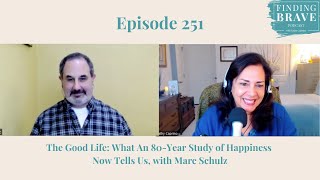
Transcript of a Finding Brave podcast episode (host Kathy Caprino) interviewing Dr. Mark Schulz about findings from the Harvard Study of Adult Development and the authors’ book The Good Life. The conversation highlights that long-term, high-quality relationships (social connection, community, close partners) strongly predict emotional, physical and brain health across the lifespan; loneliness is a major public-health risk with effects comparable to smoking/obesity; and meaningful connections can be protective and even affect longevity. The interview also discusses implications for work, introversion, parenthood, and community engagement.
Questions this video answers
724 individuals.
In the 1930s.
About 1,300 children.
The Good Life.
About 43.9 million views and described as the 9th most-watched TED Talk.
Chapters
We see this in the lives of the participants of our study. I also want to say that it's never too late, that there are folks that have experienced challenges and have been unhappy for large parts of their life. And in their late life, they find ways to lean into connections that lead to new meaning and a kind of new experience of joy. So that's important.
Hello everyone. This is Kathy Caprino and welcome to my podcast, Finding Brave. I've created this show for everyone who longs to create something bold and brave in their lives life, to rise up, speak up, and stand up for who they are and to reach their highest and biggest visions. Each week I'll be speaking with inspiring guests from all walks of business, leadership, entertainment, the creative arts, and the entrepreneurial world. And they'll be sharing their intimate stories of Finding Brave and offer their best strategies for building your most rewarding, joyful and meaningful life, business and career. Hello everybody. Welcome to another episode of Finding Brave. Kathy Caprino here. I know it gets old that I say this every time, but honestly, this is one of the most favorite things I do in the world. This podcast and today is no exception. Having the amazing Dr. Mark Schultz with us today. Mark, thank you for your time.
Oh, my pleasure to be here. Thank you for having me.
Oh, so thrilled. We are talking about, you know, you hear us in the show talk about leadership and personal growth and communication strength. Today we're really talking about the good life. We're talking about happiness, which I think we're going to learn from you is not what we think it is or the pursuit of it. And what we are attending to probably isn't doing it. And we're going to learn all about that. So this show is about the good Life, what an 80 year study of happiness tells us. Now, I, I know you're going to be kind of as stunned as I am, but let me tell you about our guest, Dr. Schulz before we begin and then we're going to dive in all about this study and what we're learning and what we're getting wrong about happiness. So Dr. Schultz is an is the associate director of the Harvard Study of Adult Development and The Sue Cardis, Ph.D. 1971 Chair in Psychology at Bryn Mawr College. He also directs the Data Science Science program. My gosh, so busy. And previously chaired the Psychology department and Clinical Development PhD program at Bryn Mawr. He is a practicing therapist with postdoctoral training in health and clinical psychology at Harvard Medical School. And Mark is the co author with Dr. Robert Waldinger of the New Book, the Good Life Lessons from the World's Longest Scientific Study on Happiness, which has published in January. And this is coming to you all in February. So thank you again for being here and let us just dive right in. Can you tell us, Mark, tell us about this study. Why is it different from anything else? Let's start there. What is it?
Yeah, it's a pretty incredible study that began in the 1930s and it started by tracking the lives of 724 individuals. And we've actually tracked them across their entire lifespan. So it started when they were originally adolescents, two very different groups from very different walks of life. About two thirds of the sample were young boys who came from the poorest neighborhoods of Boston, often living in tenement buildings without running water. And then not far from where these boys grew up, the study also included about a third of the sample, included students from Harvard University that had obviously a better future on the horizon for them, or at least more prospects for a better future. And the study has tracked these 724 individuals very carefully throughout their lifetime with interviews and questionnaires and home visits, and more recently, videotapes of interactions with partners and brain scans and all sorts of modern technology. And we're actually working now with the children, the 1300 children of the original participants, so we're able to look across generations as well. So what makes this study unique is its longevity. It's incredible to follow people across their entire lifespan. Most of the original participants have passed away at this point. It's also a study that really looks at people from two very different walks of life and looks at the opportunity opportunities that that might, you know, precipitate later in life and also the kinds of outcomes of well being. And the study has focused from its very beginning on what makes people thrive as another important, unique feature of this study. So I was really interested in trying to understand the factors that led to happiness and well being and positive adaptation throughout the lifespan.
How brilliant. And it's not just, as you're saying, not just surveys, not just quantitative information. You're in the lives of these people.
Exactly, exactly. So one of the amazing things about the study, obviously I wasn't there at the beginning. I've been working with the study for 20 years. I'm lucky to work with these data. But one of the remarkable things about it is that when you go in and look at the files and we literally have a file drawer full of information about each participant, there are in depth interviews with the participant, letters from the participant, very careful measurements of their bodies, and descriptions of what their homes are like. It really was a study that was interested in trying to capture the daily experience and the. The life as it was lived by 724 people, which is remarkable.
Now, I just have to ask this because, you know, my focus is often women. Women at work. It's all men, correct?
Well, the original study was all men. That's a really important question. And one of the challenges of doing a longitudinal study like this. If we could do it again, we go back and obviously extend participation to women. At the start of the study, they focused on men. There are other studies that we take advantage of and talk about. In our book, the Good included women that were inspired by the Harvard Study of Adult Development. But this study initially was all men.
Sure.
We, as quickly as we could, included the spouses or significant others of participants. And now, of course, we're studying the second generation. And the second generation is about half female and half male, of course.
Wonderful, wonderful. And the TED Talk, Bob Waldinger's TED Talk, I understand, has 43.9 million views and is the 9th most watched of TED talks. Right. I. I loved it. I poured over it and I laughed out loud when he said, we at some point asked the spouses and the partners to contribute. And they kind of unilaterally said, well, finally. Because as we know, you know, I was a marriage and family therapist. It's a system, right? I mean, this is everything you're talking about. We're not just in a vacuum. So to have members of that system, sharing is so important too, right?
Absolutely. And Bob and I. Bob has been the director for the study for the last 15 or 20 years, and I've been the associate director. We're both very interested in this sort of system and the family that people grow up in. So one of the perspectives we brought when we joined the study was a kind of renewed focus on the context of individual lives, including the relationships that we kind of are immersed in. Study was always interested in the families that folks came from. So it did a good job of capturing that family experience. The other thing that's important is in preparation for the book and in the book itself, we really talk a lot about other studies because no single study, no matter how interesting or how long, is a definitive study. So science is built by replication of findings, finding the same thing across many studies. So the kinds of things that we'll talk about, the kinds of things we talk about in the book, are really things that we find across many different samples and groups of people from around the world, not just in our study.
I know that's so important because I used to do market research in the corporate world and I used to select the participants of focus groups. And that will make or break. That'll shape it, you know.
Absolutely.
So I love to hear. All right, let's. Let's go to. I'm dying to ask this one question. It was about well being. Were you, you weren't there at the beginning. Was the idea, what is happiness? Or is it well being in all the parameters we understand it to be?
Initially, it was really well being in all of its parameters, as you described, in all of its kind of form. So they had this idea, which was kind of crazy. This was during the 1930s, that maybe instead of studying folks that are struggling in some way, that they could start with a sample of people that seem to be thriving. And both these very diverse samples were thriving in certain ways. So the Harvard students had made it to Harvard. They had gotten through an incredible gate. They had real opportunities in their lives. And these were students that were expected to graduate. So they're already thriving in some ways at Harvard. And then the inner city sample was thriving in a different way. They grew up in very difficult neighborhoods, but they were doing okay. They were avoiding some of the pitfalls that their peers were experiencing. Getting into trouble with the law, failing out of school. But these were kids that were doing okay early in adolescence. So the study really remarkably was interested in trying to understand the factors that led to thriving in life. And we've of course, enlarged that to think about the modern ways that we think about physical thriving. But. But we're also very interested in happiness and well being as well.
All right, let's get to it. And there's a million bits of data I'm sure you're swirling around here, but if you could tell us the one most important thing that we in modern society are getting wrong about happiness or well being, what would you say that is from this study?
Yeah, I would say we can boil it down to a really simple idea that it's relationships that keep us healthy and happy through the lifespan. It's not the things that we're often led to believe. It's not about money, it's not about success, it's not about achievement, that those are all things that can bring us certain kinds of pleasures. But when we look across the findings from our study and a number of other studies, what we find is the real driver of happiness and success in life as we define it, meaning a happy and fulfilled life. Is the quality of your relationships, your.
Connections to others and how does that emerge? What is a quality relationship? Tell me more, I'm dying to know.
So there are all kinds of relationships that are important to our well being. And I'm going to kind of elaborate on it a little bit by giving you some examples of how we look at this in the study. So one question we ask is if you are in trouble, that you need help and it's the middle of the night, do you have someone that you can call? So this is a question about support. Do we have folks in our life that when the tough times happen, that we can find support from them, that we can depend on them? And for some people, that's one person. For some people, they don't have anyone. But that distinction of having some support is really an important predictor of how people are doing. We're also interested in more general connections. So it's very clear from our own work and from the work of many, many others that being alone, a sense of feeling lonely, is corrosive to one's health and well being. So having a sense that you're connected to other people, that there are other people that care about you, just that feeling, not even the connections themselves, but a feeling that you're connected to others, really important for your health and your emotional well being as well. And then of course, close relationships, close friends, partners that we have in life, all of those things are important. And we have a number of findings about the ways in which those close connections help predict well being through the lifespan. And some of those connections have been surprising for us. It wasn't surprising that close connections, quality, close connections are associated with more happiness. What was surprising was the number of times it predicts things about our physical health or even our brain health late in life.
So will you talk more about that? Because I think that anyone listening would say, yeah, I know this, I need to have friends. You know, they'll diminish it. But the, the data is incredible. Can you talk more about.
Yeah, yeah. So I like to start with thinking about the absence of friendships. And that's this idea about loneliness that, that folks who are lonely don't live as long as folks that are feeling connected to others. They also have more physical problems. So loneliness is such a significant risk factor for physical health problems that in a number of countries it's seen now as a, as a huge public health challenge. And the reason for that is that loneliness has a similar amount of risk if you think about how it contributes to health or to Mortality, the risk is on the same level as things like obesity and smoking. So this is a serious public health concern, the quality of our relationships.
Can I stop you there, Mark, and ask you, in what way does loneliness impact our health? Is it that we're overeating? Are we, is it substances? Is it failure to care? And so we don't get what is it exactly?
I love the question, I love your answers. And the answer to your answers is yes, those are all true. And then there probably are 30, 40 other reasons why loneliness is corrosive. So the presence of people in our life that we feel connected to is so important to us in so many ways that I think we really don't fully recognize or understand it. So I want to talk about it a little bit. So maybe the most obvious is when we are feeling a challenge in life or we're stressed out having someone that we can talk to, that we trust, when we're at our most vulnerable, really important. It helps us settle our emotions and helps us think more clearly, consider alternatives and helps us plot a path forward as a way to get out of that challenge.
So it's a stress reducer, is that so?
It's a stress reducer. It definitely helps us during, during difficult times. Close connections help buoy us our mood and help us feel joy. And that's good for the body as well. There's lots of evidence with studies of people and studies of animals that even touch. The experience of touch with another person is protective. So for example, we experience less pain when we're in physical contact with people that we care about. In our own research, we found that as people aged so in their 80s, when they're experiencing some of the challenges associated with aging, the physical challenges and having mobility challenges or the daily experience of pain, that being with others, particularly a close other like a partner, helps diminish the experience of pain and increased mobility. So relationships are one of these kind of magic pills if you think about it. They're all out there and available to us if we can be brave enough to engage with them and we're successful enough to do that well. And it helps us thrive in so many different ways.
I'm tearing up because I. Every word you're saying, I'm reliving it or thinking about it. I have a 98 year old mother who you know, is going through challenges. It's so very difficult. But I know that when she sees my sister regularly, how, how that impacts her positively. I just came off of singing in, you know, holiday concerts and the love that we have and the joy. I literally feel like it's keeping me young. But, oh, there was a question there. Not just me. Waxing poet, the loneliness piece. You know what. What really struck me this morning. I work with a lot of people who report as introverts, and I'm dying to understand, you know, there's so much written about it. Susan Cain, the Quiet Revolution. But a lot of the introverts I work with say that, for instance, the networking, the social connection strategies I'm suggesting for them are harder they feel than for extroverts. Is there any piece that you looked at about when someone's an introvert? And don't get me wrong, people, I'm not saying introverts are lonely, but is there anything you found about introversion as it relates to social connection here?
Yeah, really important connection, because I think, you know, Susan Cain's work has been really important and influential, and a lot of people identify as introverts. So we're not talking about a small group of people. We're talking about almost half of the population might identify as being introverted. And one of the things that we found, and a number of other studies have found, is that relationships are good for all kinds of people, even though we come in different flavors, that we all need those connections. And the positive functions that relationships provide, we may need them at different doses or in different ways. So if I'm introverted, it may mean that just being surrounded by one or two people is the kind of connection that's important to me, as opposed to always being at parties and being in places where there's lots of noise and activity, and I may not thrive in that same way. So I think it's important to recognize that this is a kind of universal need. We understand where it comes from. We're a social animal. It was important to our survival thousands and thousands of years ago. So we're social, and even folks that are introverted are social. I want to say one other thing, which is, is that if we look at what people say about connections to others, there are a number of reasons, even though we know it deep in our kind of bodies, that connections are good for us. Relationships are challenging. They can be messy and unpredictable. We can get hurt in them. So there are a number of ways that it would make sense that people would worry or shy away from relationships, even extroverted people. And I think we're also not so good at predicting the things that actually make us happy. So there's a really remarkable study that I'd like To talk about, which was done by professors at the University of Chicago. And they caught people on their morning commute. So these are busy people going into work, about to get on the train or the bus. And they said, what's your normal routine? And almost everyone said, I listen to music. I put on my earphones and I listen to a podcast, or I just sleep or read. And very few people said they talked to strangers on the train. And then because they were psychologists, they did a cruel thing. They randomly asked half of the people to talk to strangers and the other half to either do what they normally do or to sit in solitude.
So the people who were asked to talk to strangers didn't normally do it. They were asked to go out of your way and do this.
Exactly. And they said, oh, it's going to be horrible. I'm going to hate it. And then they caught them at the end of their commute and they asked them what it was like. And it was very clear that the people that were forced to talk to strangers said that they were happier at the end of that ride.
Happier.
Happier. They were happier. They got a kind of jolt of joy and connection with other people. And this is one of many studies that suggests we're just not good at predicting what makes us happy. We call it affective forecasting, casting. So even extroverted people might say, I don't want to talk to strangers. You know, I want some alone time that's important for me to get ready for work. And it turns out that these little jolts of connection are also things that I think buoy us. They make us feel human. I love it. You know, it's that. That wave to the postman when the postman comes by, or the person where you get your coffee that you see every day that you might not know well, but you pay some attention to them. And on some days you have a lovely interaction. You learn something new about that person, which is great.
Love that. My kids always say, if they're with me, they're 25 and 28. Ma. Do I have to talk to everybody? Do we need a 20 minute conversation with the AT&T guy? Yeah, I like it. It makes me feel. Yes, I. I so understand. Speaking of children, Mark, did anything. You know, I just read it wasn't a scientific study at all, but it was women weighing in who had decided not to have children. And they were giving their reasons. And it was. Was fascinating. And, you know, several people over the years have talked to me about. I'm. I'm wondering, do I Want children or do I not? And, you know, it's a very personal decision. But one challenge, I think, is a little bit what you're talking about forecasting. I think it's very difficult to forecast how we're going to feel if we have or do not have children, because you don't know how you, you, you would feel if you had them, if you don't. But it did you. Am I making sense?
No, I think it's a great kind of thought experiment. Right. We want, you want to be able to lease those children for a while to see what it's like. But of course that doesn't work. Right. Right. So.
So, so tell me what the study showed about. Did it, did it look at those who had children versus not?
We did. And, and the one thing I want to say from the beginning is that there's no one way to find happiness and fulfillment in life. So there are folks that are not married, that are happy, happy. There are folks without children that are happy, divorced, divorced, and all sorts of ways of living. That's important. And we see this in the lives of the participants of our study. I also want to say that it's never too late, that there are folks that have experienced challenges and have been unhappy for large parts of their life. And in their late life, they find ways to lean into connections that lead to new meaning and a kind of new experience of joy. So that's important when it comes to having children. This is a, you know, I'm the parent of two boys, very proud parent of two. They're not boys anymore. They're young men. And greatest experience of my life, I would describe it, but it's also really challenging. And when you study the transition to parenthood, which we have, one of the things you find is that people experience levels of stress that they haven't experienced before. It challenges their sense of identity. It challenges the sense of satisfaction that people have in their marriage. So having children is not an experience that's filled only with joy. It's filled with challenges as well, and sometimes filled with sorrow. So one of the messages that we write about a lot in our book is that the good life isn't about only happiness. It's about leaning in and experiencing the, you know, the joys and the sorrows of life, the ups and downs, that you can't have one without the other. So that we all have this idea that if we pursue happiness, that we'll be happier. Well, in the pursuit of happiness, you risk things and sometimes you find yourself, you know, feeling Sad or experiencing loss, or being discouraged by the route that your child is taking or the challenges you're having in communicating with your child if it's around parenthood. But it's hard to experience the joys that we can experience, and they're incredible joys in life without also leaning in and experiencing some of those sorrows. So that's an important lesson. And our participants teach us all the time.
That's a beautiful way to put it. Beautiful, beautiful way. Love it. I kind of see it as. Is this an accurate way to look at it? We're looking at the expansiveness of the human experience. And what it sounds to me like is the more you can have an expansive experience, which may include mood, stress, sadness, loss, devastation. There are benefits of that. Maybe more resilience, maybe more hope. Am I getting it right? Is any of that?
I think that's right. And there's. This is kind of the basic ingredient of life. It's. It's what life is about, that without experiencing those things, without pushing us to make those connections and to have those experiences, we're not really living life, life fully. And there are all sorts of, you know, wisdom traditions that talk about this. There's popular culture. So Zorba the Greek, the great catastrophe is living life fully, right? Yeah. Children, wife. The whole catastrophe is what he talks about. So, so, so the idea there is that you can't really live unless you take some chances in life. When I. I lived for a while in California, there was a bumper sticker I always loved it said, now that I've given up hope, I feel much better. Of course. Of course. What I love about that is the irony that this idea that if we don't hope for joy, that we're safe, we're going to protect ourselves from disappointment. But boy, what a sad way to live. That if we don't venture forward, if we don't make ourselves vulnerable, if we don't try new things in life, then we're not going to experience the kind of joys and moments of happiness and connection. That's another important part. So when you talk about expansiveness to me, I begin to translate that into, I'm at my happiest. Our participants are often at their happiest when they feel connected to other human beings.
It's a basic, basic instinctive need, isn't it? I do want to say, people, we are not saying you should have children. That is not the message here. The message is you must choose your life as you see fit, based on your values and your Needs, so. But expansion in other ways is important, you know, that keeps us stretching. So I want to talk about too. You talk about loneliness at work and I remember in my worst two year period when that ended my corporate life, I felt so lonely, so unseen, so misunderstood. I, I used to say not one person asks a question about me and they don't know that I sing and they don't know that I just want to went. And I didn't realize how detrimental that was in. I mean I was chronically ill. Infections of the trachea of all things. You know, the seed of our personal expression. Can you talk about what loneliness does at work and what it means?
Yeah, I mean I think it's, it's an important topic and one we don't talk a lot about. So many of us spend most of our waking hours at work, at least during that work week. And that's where we need to start with thinking about this question. So if we're thinking about the importance of connection, of course work is important. And by connection at work, I think the words you used were quite beautiful and really quite important. Right. So what do we mean by connections at work? You don't have to have a best friend, although that's great if you have a good friend at work. But it means feeling seen, feeling heard, being recognized, not being dismissed, not being overlooked. Those are the kinds of things that we're looking for at work. It could be someone at work that you find out you have a kind of common interest, or maybe that person is interested in something that you've always been curious about and that person can teach you about that interest. It may also be someone that you can commiserate with when you're finding challenges with a boss that's difficult or with a particular job that isn't going the way it should be going. So connections that work are important. There's some survey data that people like to talk about. It's a Gallup survey that suggests that when people have friends at work, they're more productive. And that's great for the employer, but the idea that we want to be connected and seen by co workers, really important idea. If we think about these massive sort of warehouses where people are walking alone, the lights go out when they're not in that particular part of the warehouse. They don't see people or get to interact with people for hours. That kind of experience can be quite aversive for people. So I think we need to think about workplaces that allow us to interact with other people in meaningful ways and Sometimes it's really simple. It's bringing back a coffee machine and having people collect around that, you know, kind of, kind of opportunity just to get some refreshment, to get some coffee and to just chat about what's going on. Gee, did you see the World cup games that are going on? You know, so interesting. Such an experience the whole world is talking about. And now we're sharing an experience together. So I think we tend to neglect work as a venue for connections. And there are a bunch of reasons for that, but it's an important source of connection.
I have so many questions. How can I do this in 20 minutes, 10 more minutes? What you're also pointing to is community, I think, which is, I'm. I'm guessing, like when I think about my 50 singer friends and coming off a concert, a shared experience like that I think is. Even feels differently to me. You tell me if I'm not getting it. As with a one on one experience or even the World cup cop, I can walk down the street and go, yeah, hey, go whatever, USA before, before they were out. And just having that. What does that do? Having that kind of community, even with people you don't know?
Yeah. So now we're talking about as the, the kind of layer of connections moves away from the closest personal connections we have to families to beyond that, to communities. Those community connections are also important. So they give us a sense of identity. Your singer friends, you. You feel a shared pur. I also want to say doing activities together in unison, a very special thing. So people who sing or play in bands or orchestras, some of what they talk about as being special is this idea of doing something collectively. Their actions are kind of literally harmonizing in a way that makes them feel a connection to other people. And it's that connection to other people that I think is both a rare feeling and such an important feeling for us. So part of that sense of community is what you're describing. A sense of community also allows us to feel connected outside of ourselves and to see the world as a bigger place, which I think is important. And for most of us, particularly the last few years with COVID our world has shrunk in many ways. So those opportunities for connecting with people outside of our immediate family or immediate social circle, even more important, and it may be important on a societal level that when we connect outside of our neighborhood, outside of our immediate family, that we tend to. To get exposed to people that are different than us, have ideas that are different than us, really important in a time when we talk A lot about division and difference. So, yeah, being part of a community, doing things collectively, but also sharing experiences in which you may differ, that you may have a unique interest or talent, really important. It tends to expand us in important ways.
I mean, I'm relating so much right now. In the past four months, I've had a lot of stress and things are breaking. I have a broken toe, I have, have inflammation in my sternum. All of it's coming and I have no doubt it's, it's a culmination of all of these factors you're talking about. More isolation, more worry about. It definitely is. You know, what we think is, is as a therapist, we learn, you know, your body says what your lips cannot. And I, I do believe that. So here's another question mark, if I can ask you, you, you know, I've interviewed some clinical psychologists, some psychiatrists, and some brain science folks, and everyone has their own view. But a few of these brain science experts seem to me to say this is not to be pejorative, but you know that it's all about what's going on in the brain. It's all, we're an organism and it's really that simple. Do, are all of these things that you have found in this study, are they really about that? We are, how do I put it? Just not just we're an organism defined by instinct, defined by hard wiring. Is it mostly that? Is, that is what we're seeing here. In other words, community. We needed it a million years ago. Stress reduction, we need it. Whatever is it, Is it really, is it mostly that? Am I making sense? Articulating?
So I, I, I think it's definitely a part of the puzzle. So we're social because for a long time our, our survival depended on being social. So evolutionary forces meant that we needed to come together to provide protection and shelter and food for, for our survival. And we've inherited those kinds of social instincts. So when we're not social, when we're lonely, it's not surprising that it has a kind of corrosive effect on our body. I think what's become clearer, and this is to me, one of the exciting frontiers of science is that we're really starting to unpack the ways in which our experience literally gets under our skin and affects our body. So we're finding that connections to others affects your brain health, it affects your immune function, it affects your inflammatory processes. And there are a bunch of really exciting frontiers here. One of them is epigenetics, the ways that experience changes the expression of our genes. So it's clear that people who experience adversity, particularly early in life, have a different set of epigenetic effects than people who didn't experience adversity. And what I mean by that is certain genes get turned on or off, and those genes, there's a kind of pattern. The genes that get turned off are genes that protect us from invaders in our body, from microbes and disease, from viruses and bacteria. And the genes that get turned up are inflammatory genes so that we experience more inflammation in our body. So these kinds of, this is, you know, frontier work, really exciting. Of course the exact sort of mechanisms are going to shift, but we're starting to understand the subtle ways in which our experiences and our experiences, even in our mind, affect our body. And what I'd like to say is if we, if we just think for a moment about how our bodies react to certain kinds of relationship experiences. So maybe think back to that first moment of love or first kiss that you had when you were very young. There's a kind of excitement in our body that's not, it's very powerful. We all experience it. We know what it's like when we experience loss, when someone we care about is hurting or we've lost them. We experience in our body a kind of pain that's a psychological pain, but it almost feels like physical pain. It's really not surprising that we're now learning how that works because we all know it, right, that there's a way in which our experiences have a physical impact on our body. Emotions are often the kind of conveyance, the root of transmission for that kind of influence.
I love it. But you know, I think a lot of people that I speak to resist this. I mean, very well educated people say no, you know, there isn't a correlation between stress and my physical body. Yes, there is, friends. I mean, I hope that's one thing you get out of this. Absolutely. That it's inextricably linked, you know, what's going on inside and how we feel and what is emerging in our body. Anything else you would love to leave us with? Another big surprise that you think people who haven't studied this would be pretty shocked about. Anything else, Mark?
Well, I think I'll give you one example of a specific finding that just shows you how remarkable the impact of connections can be. So because we follow people through their lifetime, folks who have been in marriages across their lifetime, we've tracked their reports of how satisfied they are. And what we find is, is the kind of, maybe the stereotype of what you might expect. That satisfaction tends to go down after people have children and then it seems to recover about the time that those children become old enough to leave the nest. But the particular finding that's interesting to us is that if we try and characterize that change across the lifespan, there's a little bump that people get around the time that their youngest child turns 18. We call that the empty nest. But boost. And both the depth of the u, how low you go during that childhood period and the boost that you get when the child leaves the home, they predict when our participants died. So that's a remarkable factor.
What I don't get it. What do you mean? It predicts.
So if we look, if we look at those personal trajectories. Right. Of all the participants in our study, the depth of that you. That low moment and their satisfaction curve and also the little boost that they can get when they're.
The low moment is usually when the kids are younger and they're focused around that time, not connected. I'm interested that the connection isn't to the kids, that they didn't get a boost from that. But you were looking at to the marriage, how you were looking how the.
Marriage was doing across time.
So there's a dip at, you know, when it's a mess. When the kids are young.
Exactly.
And then there's a boost when the. The child goes to college. College.
Exactly.
Tell that what that predicted.
Yep. So both the depth of the dip and the size of that boost, they predict when our participants die. So they predict how long our participants lived. And what I want to say, because I think it's a particularly kind of inviting finding to think about sort of why that may be. And one idea may be that when parents experience that empty nest, this is an opportunity to think about what's important to them. Are they going to lean into their connections with us others or are they going to continue to worry about the kids so much that they neglect their relationships? And it looks to us when we look at these data and we look at the participants lives, that the folks that are able to lean in in a new way when the youngest kid turns 18 leaves the nest, that proverbial leaving the nest, that those are relationships that tend to blossom later in life. And there are huge benefits to that, including it looks like how long you live.
Holy cow. What about when you divorced like I did as the kids grew older? Well, hopefully what I'm surmising is don't lean out of connection. And thankfully my ex and I are Incredibly amicable. We're dear friends, so that's great. And, you know, there's, there's new relationships that we can lean into. Is that.
Absolutely. And I think that that's absolutely the key that, you know, none of us have lived a life in which we haven't experienced, you know, a kind of moment in relationships in which we've been hurt, we felt too vulnerable, and those are painful moments. And I think the key is being able to sit with those feelings, being brave enough to be vulnerable again. So this is true for people that have divorced, people who have had a string of difficult relationships and never found the right person. And it's even true of people who are in relationships that have lasted for a long time. Time, but maybe aren't fulfilling in the way that they need them to be. Fulfilling. It means taking a chance. It means being vulnerable. It means talking about what you're missing in life. So the message is absolutely to lean in, not to pull back and protect.
What fantastically important information here. So where do we scoop it all up, Mark? Where do we learn from you? And boy, would I love to be your. One of your clients, your patients, because you're a clinical psychologist as well, with a practice.
Yeah, I am a clinical psychologist.
Flooded now.
Well, I also want to say that, you know, it's one thing knowing this stuff, and it's another thing practicing it and living it. So, of course, I've had my challenges in life and these lessons, I, I, I love being able to learn them through my research and trying to apply them, you know, in my life, but it doesn't always work. I have my own challenges, of course, but, but if folks are interested in learning more, a good place to look is our new book that I wrote with Bob Warren Waldinger called the Good Life. We also have a website, thegoodlifebook.com that'll tell you more about the book and about Bob and I and about the study itself. So those are good places to start.
What beautiful, important work you're doing. Thank you for joining us. Wow. My head's exploding with, with things I gotta do differently.
Well, thank, thank you for having me. It's been a pleasure.
Thank you so much. All right, everybody, you hear this every time. If you don't have questions about this, I don't know what you could have questions about because, you know, it's not, it's not, what's the word? Unilateral. I mean, there's, there's nuances to everything that you've said. So dive into the book. Ask wherever you see this, ask your questions and or share how you feel you're doing in the Wellness Happiness spectrum. We'd all love to hear. Hope you enjoyed it folks. Have a wonderful few weeks and we will see you next time. Thanks again. Mark hi everyone. Kathy here. Do you run a coaching business that focuses on supporting women? If so, I've got some news. Right now we're opening the enrollment of my coach training program called the Amazing Career Coach Certification which is a 17 week hands on training program that certifies female coaches in my proprietary 16 step career growth Plan model which is perfect for coaches who want a deeper dive into powerful, proven coaching frameworks, concepts and skills that will help you become far more effective in working with women. And through the program you'll get access to a powerful small business acceleration program called the Rapid Growth Academy delivered by my friend and colleague, award winning business growth expert Matthew Pollard. Through Matthew's program, you'll be taught essential business and sales growth information that will help you grow your business success in the quickest way possible. Possible. In my view, there's nothing on the market like this for coaches because it targets the two critical aspects of success, how you support your clients to thrive and just as importantly, how to grow your own business to the next level. For more information, visit certification.amazingcareerproject.com and check out the details. Thanks so much for joining us today and please don't forget to check. Check out findingbrave.org for more programs, resources and tips and tune in next time for your weekly dose of finding brave.
More from Kathy


Elevate Yourself, Elevate Others, and Amplify Good | Chris Cooper | Finding Brave Ep. 334

Finding Brave Epis #333: How Leaders Can Harness AI Without Losing Their Humanity, w/Bennett Borden

Finding Brave Epis 332- How to Stay Brave, Valuable and Visible in the Age of AI, with Raman Rai

Finding Brave Epis 331 - The Power of Positive Disruption, with Dr. Patrick Leddin


Finding Brave Epis 330 - Being 40: Letting Go and Embracing Who You Are, with Stacey Lindsay

Disrupt Career Reinvention with Kathy Caprino - via The Disruption Lab Podcast w/Patrick Leddin

Creating Neurodiversity-Friendly Work Cultures: Simple Workplace Adjustments Matter

Finding Brave Epis 329 - How To Create a Neurodiversity-Friendly Workplace, with Kristen Pressner

Finding Brave Epis. 328: Reclaiming the Power to Trust Your Own Voice, with Dr. Cindy McGovern