255: Expanding Emotional Intelligence To Become a Great Leader with Luis Moreno
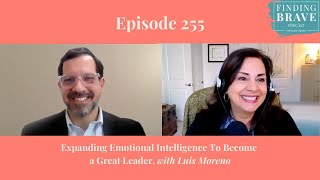
Luis Moreno, who has worked at seven Fortune 500 companies, explains how leaders build empathy through both feeling and understanding. He warns that diversity efforts often stay performative, and walks through concrete practices like pausing judgment and listening to create psychologically safe teams.
Chapters
I'm not going to teach you how to make other people think that you're more empathetic. I can teach you how to be more empathetic. And I'm not going to teach you how to make more money. Because what I'm going to teach you is how to be a better person, how to be a better leader, how to understand your emotions, how to use them to be more successful and help others.
Hello, everyone. This is Kathy Caprino, and welcome to my podcast, Finding Brave. I've created this show for everyone who longs to create something bold and brave in their life, to rise up, speak up, and stand up for who they are and to reach their highest and biggest visions. Each week, I'll be speaking with inspiring guests from all walks of business, leadership, entertainment, the creative arts, and the entrepreneurial world. And they'll be sharing their intimate stories of Finding Brave and offer their best strategies for building your most rewarding, joyful, and meaningful life, business, and career. Hello, everybody. Welcome to another episode of Finding Brave. It's sunny here. That's a very good start. My goodness, it's been gray. And this is coming to you in May. We are actually still in January. Right. But so happy to have you and so thrilled to have our amazing guest today, Luis Moreno, who I have known for. It feels like decades, Luis, but I. I looked it up. I think it was 2018 we met. But thank you for taking the time to be here on Finding Brave. So happy to have you.
Thank you. Thanks for the opportunity. Great to see you.
Oh, so happy. All right, folks, we are talking about so many things. It's hard to title these, you know, when you know you're going to be hitting on 52 important topics. But this is once a great leader, not always a great leader. The need for expense, expanding emotional intelligence, and a few other things which you're going to talk about. And let me tell you, let me read Luis's bio. But I. I do want you to know how we first met, which. Which really was inspiring. And then you went on to help my son Elliot, who at the time was coming out of college. And, you know, he was new to LinkedIn. And truly, I will never forget that we were not even dear friends. You know, we had just met professionally and you said, oh, happy to help. Help Elliot. And you know, when. When you're starting out and you're young and it's all new, that kind of mentorship is so impactful. He sends his best, Luis. Thank you for that. All right, let me tell you about Luis. Luis has over 18 years of experience in seven Fortune 500 companies. I wasn't quite aware of that. He leverages his expertise in human centered leadership and emotional intelligence and collaborates with other experts around the world to help foster workplace cultures and communities that are healthier and happier. And I wanted to add for all because, you know, you have such an important, keen focus on diversity and equity and inclusion and you're going to tell us a little bit about why you have that focus now. But there you go. Let us start there. Luis, can we. Oh, I do want to say, here's how we met. I was writing about leadership and diversity, I think back then 2018, and tell us, tell everyone what happened there.
Then you reach out, you know, through LinkedIn. I saw articles of yours and I read and I was just fascinated. I really like what you were talking about. And, you know, I reached out, I. There was one particular article that I wrote to you about and I was actually impressed that you responded. And then, you know, as we connected, we got to see each other in person, which was.
That's right, that's right, that's right. And then you shared with me about the CEO then of Synchrony Financial, where you worked, and you were in a senior marketing role then, weren't you?
Yes, yes. Yep, I was working in marketing there. And so, yeah, that's it.
And we connected and then I interviewed the then CEO for Forbes. So that's how we got to know each other. Now, can you tell us a little bit about the trajectory of, you know, a lot of people will ask me too, how, how did you go from kind of corporate market, what you do now, what was. Can you just maybe even start before a little bit earlier, what you thought you wanted to do in your career, how it went and then what was the catalyst for the work you do now in your own business?
Yeah, no, thank you for the question. Actually, I. So, you know, when I, before working at a company, I was always fascinated to see kind of those, you know, global corporation major businesses, right. That were, you know, fast growing Fortune 500. I always thought, wow, how interesting it would be to get to, you know, b. To become an employee in those companies. So when I went to business school, I had the opportunity to, you know, interview with multiple of those companies. And then I started, you know, I received one offer to work in one, and then while I was working on that one, another one made me another offer. And then I went and I ended up working at seven Fortune 500 companies. So it was, you know, kind of dream Come true in the sense of being able to be exposed to great, you know, very talented high achievers, you know, very, you know, just folks that are really smart because they have the ambition, they go to top schools, and they end up working in these companies that are really competitive to stay. So you really have to be on the top of your game to be in it. I wanted to see that in person, that fast growth. But what I learned was that I was seeing a lot of great leadership, but I also saw great leadership that was not so great, or I saw leadership that was not so great. And I was fascinated to see what were those great leaders that I saw. Two kinds of leaders. They were great leaders or leaders that were admired from the top and liked, you know, from the top and also liked from the bottom. So, you know, the employees that work for them were, you know, always happy to work for them, would do anything for them, were very highly motivated and all that. And then there was another kind of leaders that were very liked at the top, right? And they kept moving up and getting promoted and getting all kinds of opportunities. They were not very liked at the bottom. So those people that were working for them were continuously looking for opportunities to work somewhere else, to move outside of their team. They would take another assignment, even if it was in another division that was not as popular or anything like that, but so that they could be outside of a leadership of that person. And so I thought that was an interesting disconnect. The top really like those folks, but the bottom didn't. And then that's where my interest started to investigate. Why is that the case? And then I learned a lot that I'll be sharing with you through our podcast today.
I just sigh and there's so much I want to even ask you with that, but can I make something clear? Because I think you and I are very much on the same page about how we view what truly inspiring leadership is. But you and I are not the same human beings. So you have a different perspective. But I want to make one thing clear. When you say there are some people that were liked from the top down, but were not liked with people underneath them. I want to make something clear and I want your thoughts. I think like is an interesting word. I think what I see in being a career and leadership coaches, people will work for someone they respect, someone they trust, but not necessarily like all the time. In other words, people we want to emulate or we feel are empowering are sometimes not the most likable in a moment or in a meeting. Would you Agree, like, is it like we're talking about or is it respect, inspiration? You want to learn from that?
That's a complex topic and a complex question. So I agree with you that, you know, you won't, you will not always like a great there in every moment. But there is some new dynamics in that context. So, you know, not disagreeing, but one of the changes that we're seeing is that it was very common in the past for some leaders to say, I don't care about being liked, I'm about being respected. As long as I get respected and I get people to do what they have to do, I can care less whether I'm liked or not. And people would clap and wow, that's an amazing leader. But what we're seeing now in your research is that there is more connection, especially with the new generations coming into the workplace, between liking and respecting. And there, there are two, there are multiple layers, generational layer and also a cultural layer. So in some countries, in some regions of the world, like Latin America, is very hard for someone to respect you if they don't like you. Because there is a connection where liking means I see in you something that, you know, I aspire to be. I connect with your values. You know, I feel comfortable, I feel psychologically safe around you. I feel that you look out for me. And so that's kind of more what, like, rather than. Because sometimes I'll speak with senior leaders kind of more from the past that they'll tell me, well, I'm not going to let people do whatever they want so they can like me. And then when I interview employees, especially younger employees, when they tell me about liking, what they describe is like a leader that is looking out for me, that gives me a vision that, you know, gives me the resources that I need mentoring. So they're not talking about let me do whatever I want. They are talking about give me the guidance, give me the resources, give me the structure so that I can succeed. And I like you if you do that. So it's kind of a, this is.
A whole thing we could talk five hours about. But I don't want to belabor it. But I do want to say this. You know, my world is professional women.
Yes.
Typically, I'm not painting all women with the same brush or all men. Typically women, even incredibly high level women who we think are successful, struggle with the fear they won't be liked.
Yeah.
And that does make them have boundaries that are not sufficient. Makes them have a hard time saying hard things, makes them apologize more. They're about to say something difficult in a meeting, and they apologize for it or weaken the message because they want to be liked. And I do think that men don't tend to experience. They don't even understand what that feels like.
Yeah.
So I. That's why I'm careful with. Because women often live the world. I've had two young managers say to me, I just want to be. I want to be liked.
Yeah.
And they're new to managing and they haven't gotten over that yet, that we can't always be liked. That's just important for me to say.
Of course. No, and absolutely. I mean, if you. If your goal is to be liked, you're going to make, you know, decisions that will, you know, won't be the right decisions in some cases. Actually, that connects your analogy that I'm making in my head there is that one of the questions that I get a lot is, you know, whether being empathetic is good or bad. Right. And I always say, hey, it's like everything in life, you know, everything in moderation. So, you know, being, being, wanting to be liked is not necessarily a bad thing. It's just more, what is the, you know, how much do you need to be liked or do you want to be like the being like this, your main objective, that's probably not going to be good for you as a leader. Right. So then it's the same with empathy. It's like, you know, if you're not empathetic at all, if you have zero empathy, you're not going to be a great leader because you simply don't care about the needs of others. And as you start being more empathetic, you're going to be a better leader up to the point of the optimal level of, you know, empathy. And then there is such thing as being too empathetic where, you know, if you're going to have a hard time making decision, if you're spending too much time thinking about the needs of others, if you have a need to always, like, feel other people, you know, then you're going to be. You're going to be slow because it's going to take you forever to make a decision. Right.
You're gonna agonize and you're gonna. Yeah. Oh, I love it. I see it as a spectrum, like anything. You know, as a therapist, we see personality disorders in a spectrum. Narcissism, you can have it on a 1 or a 10 or anywhere in between. I love it. Balance is what we're looking for. Beautiful. All right, now there's one other thing I would love you to share with listeners then. I want to talk about emotional intelligence. What, what your, what you live and breathe and human centered leadership. You once said to me, and I don't want to put words in your mouth, that what you were looking at in terms of what companies said were the optimal leaders and they paraded them in front of you at a leadership meeting. What did you say to me? I don't want to put words in your mouth.
Yeah, I know that there is a disconnect. A lot of times when I do research with employees and I ask them about source of who studies dissatisfaction is that they see that there is a mismatch between what they hear their company saying. So like an employee works at a company, they're reading their website or you know, kind of any, any promotional material that they, that they're seeing the company projecting out there and they feel that what the company is saying doesn't match what they are experiencing.
Like we believe in diversity.
Exactly. Like we believe in diversity, for example.
And we support diversity. Yeah, go ahead, tell us, tell us. Because this is part of great leadership today. Absolutely.
Because, you know, companies say, you know, companies have a need right now, you know, almost like an obligation to say that they are inclusive and that they support diversity and they will do some, I mean there are some tricks that companies will do, you know, you will hire, you know, maybe you have somebody that is from a diverse community and you put it in a leadership role and then you go, and then you promote that, you know, via social media. Look at this. You know, or chief diversity officer is, you know, a person of color or a woman. Right. And then, but then, you know, if you look in the past, that worked because people are like, okay, great, they have a person that is a woman of color and chief diversity officer. That company is amazing. Right, Check. But now the new generation is scrutinizing those things. So for example, okay, the person has achieved role, then does the person report directly to the CEO? Does the person have other senior leaders reporting to them? Is the person's compensation comparable to others? Is the person being invited to the same types of meaning, what is the budget that a person have? Did the person move up through the organization was higher as an outside, you know, higher. Higher. Right. How long does the person stay? Can the person pass the 3 to 5 year mark? What are the changes that are happening in the organization as a result of that participation? And so you're right. When you start looking at those things, you see that it's not really that, you know, in some cases, not always, but in some cases it was more like, we have to do this move here. But it's really. You don't see the impact. Right. And what we're seeing is that the tenure of chief diversity officer, for example, in companies is kind of between, you know, three to five years is the maximum you'll see.
You mean they'll put a person in at. To check off a box and then that person leaves because they're not getting the impact the. The influence, the authority, the budget that they need to make a difference.
Right.
Can I, can I amplify that? I'm hearing, doing a lot of speaking, hearing from companies we all know, media companies we know. And they have. May have ergs, employee resource groups for women. And then they say they have no budget.
Yes.
And, and it's run by volunteers, no money, nobody dedicated to it. So I want to say to you, people listening, if that's what you have, you're just checking a box and you're failing.
There was.
What do you think of that?
There was a story that a good friend of mine told me the other day that kind of connects what you were saying. She was working at this large company and they invited the women to go to these leadership conferences. And they were there, you know, maybe, I don't know, for a few days. And they were all super fired up and pumped and excited and super encouraged. And they were talking about, you know, their future as, you know, leaders, how far they were, you know, how the company was basically doing all these things for them to succeed. And so they come back from this thing and they're like, you know, in the clouds, right? Like, all super excited about their future. I was like, yell, you know, conor Pancin, where have you been? He's like, yeah, I was like, at the conference. And he's like, what, what conference? Where is that? Like, what were you. So it's like the story here is like, okay, yeah, you told us all those things and we believe it and we got excited. But you, you know how we're going to be successful if you are not telling the rest of the company what the strategy is, what we're trying to do here. So then what you are telling me, you're only telling me you're not right? You have to go now to the, to the male leaders and tell them, hey, our plan is for female leaders to come in and also succeed. So, you know, she realized, well, this is not a message for everyone. This was only message for us. Right?
Oh, there's so much to unpack there. All right, thank you for sharing that. Now let's talk about emotional intelligence. If, if you could, what is it? What do people not understand about it? Give us the primer that you teach when, let's say I'm the leader sitting in your workshop or I'm working one on one with you. And how do we know we have a problem with emotional or lack of emotional intelligence? Start from the beginning. What do we need to know?
Yeah, yeah. So from the very basic, you know, what is emotional intelligence and is that capacity that we have to really be aware of our emotions and you know, understanding ourselves from a self awareness standpoint and then be able to manage our emotions and understand the emotions of others, you know, to have the ability to motivate ourselves and then to leverage empathy to have more successful interpersonal relationships. So this is important. I'm very excited because, you know, over the past, you know, 20, 30 years, obviously there are, you know, the parents of emotional intelligence that came up with these many decades ago, had a hard time convincing people that the emotions were that important. But I think now more and more people are realizing that, you know, the power of emotions and how emotions can help you and how they can actually, you know, work against you if you don't know, if you don't understand your emotions and how to manage them. So the good thing is that even when I started, I started with this work, you know, a number of years ago and I had to, you know, email people, knock on doors, call, and I wasn't getting a lot of traction. I actually got, I started writing, you know, inspired by other authors like yourself and started writing and people would comment on my and say, oh yeah, whatever, that's easy to say to your students in a classroom, but wait until you come to work for a company. It's like, no, I, at that time I wasn't teaching, but I said like, I'm not a professor at a university. I'm actually, I'm an actual employee at a company. But the thinking was that was something like esoteric, that was something like a lot of theory, but they couldn't work in practice. One of kind of I got the feedback and the other feedback that I got was a lot about, you know, people would go read my articles and go to a training and then come in, you know, more senior leaders, right, and say, luis, I have an idea, great idea for you. You, I like your training. That was very good, but you need to modify it and making about how to make more money, how to Bring more roi. And people would say, like, for example, you, you know, teach me how to make others think that I am more empathetic. And it's like, I'm not going to teach you how to make other people think that you're more empathetic. I can teach you how to be more empathetic. And I'm not going to teach you how to make more money because what I'm going to teach you is how to be, you know, a better person, how to be a better leader, how to, you know, understand your emotions, how to use them to be more successful and help others. But what I'm going to teach you is going to help you make better decisions. And some of those better decisions that you're going to be making could actually end up generating less money because some of the decisions that you're going to make that are the best decisions, you know, from an ethics standpoint and from a community standpoint and from a holistic standpoint, may result in less money in the short time, which, you know, it's going to mean more money in the long term because some of the short term decisions that make a lot of money now will cost you a lot in the future. So it's having that balance. Remember you, you brought it up, balance.
Let me ask why. It's reminding me of a dear colleague, Sean Acor, who's a top happiness expert. And people were like, happiness, good, great. But how does it impact my business? Well, his company did studies and proved that when employees took the steps that he's a positive psychologist, Harvard, when they took those steps, it improved the bottom line. We always hear, what is the business case? That's what business people want. What's the business case for this? But let me just ask this. If someone said to you, how do you teach it? How, how can I make people think I'm emotionally intelligent? Are they making the leap that they can't be that they don't want to learn how or they can't learn how?
Is that? Yeah.
Is that where they're coming from?
Yeah. So one of the, what I'm hearing a lot is like leaders that are leading younger, you know, just the new generation of folks, you know, coming into, into the workplace, they want something different from their. One of the things they want is connection, more of a personal connection. And part of that dimension in personal connection is sharing because they are, they were born, you know, with the Internet and people's social media. So folks are more, the younger folks are more open to sharing and they tend to share Things that were very personal that in the past, nobody would ever consider sharing because there makes them more. More vulnerable. For example, mental health. I have employees that I have shared with me, you know, about their own mental health journey. And I'd never had an employee before, you know, in the past 20 years, that we share something like that with me. Right. It would be considered, you know, you're. You're kind of derailing your career by letting your manager know that you have, you know, mental health issues. But because they want to connect in that way. They want to, you know, they want to be real.
They don't want to have a fake Persona.
Exactly. They. So they also want. They're expecting their leaders to also open up, to have a window into who they are. What do they think? Where do they stand in. In terms of things? So, for example, example, when we have issues of social justice like, you know, we've had in the past, you know, two, three years and forever. Right. In the past, the, you know, more senior leaders were coaching the junior leaders to say, hey, you know, John, you want to be a great leader? Hey, when there is something going on in the news, in the media, there's something, you know, just kind of stay away from that, you know, step back, wait for the storm to pass and then you will reemerge. And that's how. And that worked because that's how many leaders stayed on the top, was to stay back, away from all of these issues because it allowed for them to not to have to disclose how, you know, what their opinions were and their positions were about certain things. Right. So then, now that. That doesn't work with the new employees because the new employees now say, hey, if I'm going to be under your leadership, I need to know who you are. Where do you stand in terms of, you know, if there is issues of social justice right out there, if there is disparities, racial and social dispar, is what do you think? You know, so if I'm an African American and there is something going on that is affecting the African American, and I'm being led by a leader, maybe, you know, a white leader. Well, I want to understand what does that white leader think about my community, about me, you know, something unfair happened to a fellow member of my community, what does that leader think? I need to know. Because if I don't know, I don't want to be under that leadership because that's part of my psychological safety and that's part of wanting to feel more motivated to work in these companies. I need to know what kind of support I have from the leader that I am under, that is manifest by how they think about the community that I come from. Right? So then, because that's happening, those leaders are asking me, Luis, how can, you know, I have people in my team, they, they want to connect with me. They want to what is something that I may be able to do, you know, because I don't want to. So it's just like they're protecting themselves. And what I. My advice to them is it's not business as usual. It's a new day, so you have to really change. And there are some tough decisions that you're going to make because to be able to connect with those employees so they feel motivated, you're going to need to make a decision to things in your life that you never wanted to disclose. Then. Now you have to, you know, think about what would be something that I want to. Maybe you had a, you know, you were telling before that you were always successful, never had a failure, but think about a failure of that and then, you know, share it with them because that's how they're going to connect with you. Right? It has to be authentic, like you were saying before.
All right, I got a question here. Here's the deal. You know, one, one issue for me is having been a therapist, Luis.
How.
Do I want to put this? So much that we hear, so much that we're trained in or the there's supposed training does not go deep enough? And I'll explain what. I mean, let me, let me just say this. I was looking at 10 years ago, I. I taught one and New York University graduate course on managing inclusion and cultural diversity. And I swear to you, I had to get a master's in my own mind to even think I could teach a eight week course in that. But anyway, I was looking at a slide the other day and what I saw was I had made this assumption that everybody wants to bring their whole self to work. And I said it, and there were 10 grad students. Two were men or two or three. The rest were women. All the women went, oh yeah. All the men went, what? No, I don't want to bring my whole self to work. I was so floored. And this is why you need to really vet your teaching ideas. You know, I was like, what? You don't. What do you mean? He goes, that's the last thing I want to do. And, you know, we know why. Listen to my podcast with Mark Green. In a patriarchal world, men are in a man box culture. They it's don't be vulnerable, don't be weak, don't be emotional. Things are changing, but not fast enough, if you ask me. But. So he went and he asked all of his buddies, all the men he knew, and came back the next week and said, I asked 15 buddies and they all said, I do not want to bring my whole self to work. Never. So I do think we have to understand gender in relation to this. But that's not what I. My biggest point. My biggest point is this. Look at what is happening in our country. People cannot. That the vast majority of people absolutely don't know how to articulate what they feel in a way that doesn't cut people down and damage relationships and destroy. So the challenge here is bring in a therapist to help you people. But no, I'm being somewhat facetious. I think the idea that we want our leaders to come forth, let's say Black Lives matter or, you know, a key issue. Let's say Roe v. Wade. You know, let's say a woman isn't going to feel safe with male boss who, you know, thinks xyz. Exactly. What people generally don't have any idea how to do is process their own thoughts and emotions, but also pave the way to build a bridge in communicating those beliefs when they are gonna fly in the face of what these communities who are suffering and struggling feel. So I want to ask you and get really authentic for us. People are learning here. Here, let's say. I mean, I've actually talked to strangers who say, I was saying I'm liberal. And this person was saying, well, I'm moderate. And I said, interesting. Tell me what that means. And he said, what does liberal mean? I said, it means what you probably think it means. I believe there's social injustice. I believe in, you know, Black Lives Matter. I believe in this.
And.
And I. When I said there's racial injustice everywhere, he said, what?
Where?
I don't see it. Now, when you face someone who is diametrically opposed, so you're you. Let's say your leader says, you know, maybe he or she says, I respect your beliefs. I don't see racial injustice or social injustice or gender discrimination. How do you train people that even though they don't agree.
Yeah.
For emotional intelligence to. To exist, we have to understand that the impact of our views and. And we have to learn how to build a bridge to people who do not view life the way we do. Would you agree with that statement?
Absolutely. You bring up a fantastic point. In fact, you know, one of the Motivations that I had to come into this work was that I learned many years ago ago that people had a limited understanding of empathy, right. So because there's a. There's a big opportunity with emotional intelligence in multiple components, self awareness and empathy. But one of the things I learned was that people think. Many people think of empathy only about one of its components. That has to do, you know, with the emotions, with, you know, kind of accompanying someone in feeling something that someone else is feeling, even when that, you know, may not reflect your own situation. That is, in fact, empathy. When somebody says, you know, it's like, hey, you had a loved one that you lost, lost a loved one, and you know, the person is sad. And then you can say, hey, you know, I offer you my condolences that they think of that as empathy. Which is correct. That is one component of empathy. What people don't always realize that that is not all that empathy is. And a very important component of empathy, it has to do with the cognitive. Right. Which is about. More about the thinking. So empathy gives us the opportunity to actually spend the time, you know, commit to spend the time to think through somebody else's thinking and logic and try to understand why somebody thinks, you know, try to understand the way somebody else thinks, even when it doesn't match yours, and try to understand why they think in the way that they think so that you can connect with them. And actually, this is very fascinating because when I'm training, these people tell me, well, but, you know, that would be agree. And I say, no, no, no, that's not agreeing. There is a difference between understanding and agreeing. And when you, you know, when you understand something, you don't ne. Agree with it. And people say, no, that's, that's not true. How can you, you know, they not.
Agree with it means. Can I just say this? In therapy training, we learned every behavior makes sense when you understand the context in which it developed. So you understand that, you know, I'm a woman, you're a man, you're a Latino man, I'm Greek and Italian. I can understand that, that your journey has led you in a very different direction.
Yes. And the, the reason why that is super powerful is because, going back again to my point on connection, Right. So, you know, when, when people tell me, I don't understand how you can understand something without agreeing, I say, well, one of the examples is I've had the opportunity to work with law enforcement, multiple, you know, law enforcement agencies. And so those that work, you know, when somebody's keeping kidnapped, right and they're. They're talking to the, you know, the bad guy, because he's usually a guy that's these kind of things, right? And they need to establish a connection with the person to negotiate usually what they do there. There are two important components there. One is they work in teams. So let's say, you know, somebody's held, you know, is being kidnapped. I establish a communication with the person, and I have a whole team that is working for me, and they are live the moment that I'm talking to a person, they're investigating, who is that person? Person. Where did that person, where was the person born? Where did the person grow up? Who were their parents, who are their siblings, who, you know, any relatives working with them, where do they live, where do they go to school, what kind of religion do they have? They're trying to understand everything that they can about the person as quickly as possible to try to form that profile of who is a person and what might they have in their head. And the reason why they do that is to try to understand the logic of why the person could be thinking in the way that they're thinking that may have led to them to do these terrible things that they're doing. And so by doing that, they can incorporate that into the language and say, hey, you know, it can match.
We learned in therapy, if I match language or, you know, he swears, I'm going to swear. Ah, there's an unconscious belief that you're similar, that you get me.
Absolutely. So you mirror, you connect with the person. But that doesn't mean that the law enforcement agent, you know, would do something like that. They would never do it. But they use language and say, I understand, you know, that you're doing this. I can see why. Right. And that's like very strategic language. And say, I am following you in how you're thinking. But I don't, you know, I wouldn't do that myself. Right. And that's very important to understand. So, for example, when, you know, our country is going through such a terrible political crisis where people are, you know, families are, you know, obviously breaking apart because they can agree, you know, on political terms. So then it's like if you meet somebody that is diametrically, like in the complete opposite, you know, thinking of you is emotional intelligence will give you the ability, you have to train for this, where you can genuinely, you know, put your thoughts on pause for a second and, you know, you kind of open a drawer, put your thoughts there, close the drawer, and then you actively listen to the person. And as you hear the person, without any judgment, you try to use your own intelligence to actually follow the logic of what the person is saying, to try to understand the thinking process that is making that person think. That. And by, interestingly enough, in many cases, I mean one is. Is going to help your understanding of the world because, you know, you're going to get a perspective that is different than yours. So now you're smarter and wiser because you have a new perspective you didn't have before. But there are instances where it can actually change your mind. It has happened to me that somebody has said something. I was like, wow, that's totally the opposite of what I've. And then I say, okay, let's use my emotional intelligence here. And then I, you know, listen attentively and I test, you know, what the person is saying. And I, you know, I check it with other things, testing a lot. And then I say, I'm gonna need to change my mind here, because what I was thinking is no longer true. In fact, my last point, because I know I've extended a little bit, I just wanted to add, there is a colleague that I work with. She is French and lives in Scotland. And part of her work is, is she works with authors that need to rewrite the book because in the new edition, they need to change about something that they said in a previous edition of a book that was true for them at the moment that they wrote it that is no longer true. So in a new edition, they change basically a notion or something. That is fascinating, right?
I love it. Again, talking about therapeutic training, I think this relates. And I want to offer it as a tip. When I was an intern at 41, I. I had clients that were difficult for me. A. A client who beat his daughter. And I. My first session with this guy, I'm like. And he was mandated to come. I'm like, I don't. I'm not trained to do this. What do I do? And he's beating his daughter. And I went. I got through the first session, went to my supervisor, and she said, let me give you a. A tip here. If you sit in judgment of this person, you will not help them. You must find something to love, which is not exactly what you're saying. And I'm like, what? I got to find something to love? She said, yes, because otherwise, here is this individual. Yes, he's mandated, but he's sitting there with you trying to get some help or understanding. And if you are judging, challenging in your heart, you have lost it. And I'M like, oh my God, I gotta find something to love. So the next week, I committed to find something to love. And I did. And because of that, I'm not saying I was the best therapist in the world, but I said to him, what not why? Because that puts people on defensive. What leads you to hit her? And he said, she doesn't, doesn't respect me and it's the only way I can have her respect me. And so because he trusted me, we got to the point of hitting her is not building trust, respect. It's hurting her, it's damaging her, it's making her afraid. You're pushing away the very thing. But none of that could have happened unless I could say, I've got. This is a human being sitting in front me of, of me doing horrible things, but I have to find something to love. Does that fit any kind of any paradigm you have, or you.
Yeah, yeah, yeah, no, absolutely. Thank you for the story. Because one of the things also with emotional intelligence is that the concept of timing is that there are. We by default are ready to jump in and do some things. And one of those is judgment, right? So we by default, when somebody says something to us, like I always say in my training, we need to open our minds to the notion that, that the way we see things may not be the way things actually are. So then you include a component of timing is when something, when you have a stimuli, when you see something and your brain goes to like decode and decides so wrong. And you know, you immediately stop and say, okay, let me see what other information I can get, you know, so that I can then finally make the judgment. So I want to share a story with you. So in, in one, one university professor, so a group of students have to do a group assignment. And they go to the professor and say, hey, you know, here we did the group assignment, but there is this one student that didn't contribute to the, to the group. So, you know, we don't want, you know, obviously that person shouldn't get the grade because that person didn't work right. When you get that information, what's the first thing that you're going to think? You know, it's like, yeah, that person.
That person is a deadbeat person. Reloader.
Yeah, freeloader. He's going to, it's not going to get the great. And let's see how we can penalize this person and all that. But if you use emotional intelligence, you use that information and say, okay, thank you. That's an input that I Have what's next. I need to talk with the person, right, and see kind of what is their, their view of this. And then when you meet with the person, the person says, hey, for the past three months I've been trying to connect with this group. I've been reaching out to them. I've sent them email here, look, I'm going to forward to you all the emails that I have sent to them. When I met with them, I gave them these ideas. They didn't take any of my ideas. And it's like, look at all of the things that I did to try to be part of a group. And none of them were welcome. And I was basically shut down. So then if you take all of that information and it's real, it's sincere and you have enough evidence, then here you are in a situation where it's not that this person was a freeloader, lazy person, didn't want to, to help. What you have is a team that was not open to that person being part of the team. And as a result, you know, the person couldn't contribute. Now if you take it so that they actually, this is a real story. And the university gave the grade to that student that didn't contribute because he had all, you know, he did everything that he could to contribute. And if you apply that to the workplace, it's like if you, as a leader, if you have a member of your team, if you have somebody in the company that is not having good performance, that's one input. The person is having low performance, but the, the, the poor performance. But the, the second part is, okay, what other information can I gather? Okay, how is that, you know, if we hire that person, something good, we must have seen in that person. That person has to have a talent. But why is the performance being poor or low? Well, how is that person, you know, welcoming the team? How is that person incorporated? Are their ideas being, you know, follow or you know, how is the person.
Are they an introvert and they contribute and speak differently or think differently?
So then in some cases, though, in many cases is women and people of color that end up, you know, they don't, they don't feel welcome, they don't have the right support and then they don't perform well, then they are of the company. And then, you know, the other day somebody was signing a like, statistic with me to saying, hey, you know, people of color have the fastest rate in terms of like starting new companies. So it's like, yeah, celebration on one end. Fantastic. People of color, we've been starting new companies. But think about why are they starting new companies? One of the reasons is they go into corporate, they're trying to, you know, use their talents to advance and contribute. And when they run into these walls, they say, I can't make it here. I'm going to have to do my own thing. And when they go and do their own thing, they are very successful. Well, what is that telling you? Somebody that was able to be. Have their own business and be very successful was not able to be successful within the context of a corporation. We need to study the environment. What is happening in the system, in the structure that is not allowing a successful, the person that will otherwise be successful to be successful in this environment. Environment.
Oh, Louise, I love it. I want to amplify one thing, then I've got to ask, where can we learn all about you and get your trainings? But if you need a, a way to remember what LIS is saying. When I was a marriage and family therapist, it's exactly what you said. The wife or the husband would come in and they would say, here's what's happening. And I, I'd go as an intern, go right down the rabbit hole. Oh, wow, that's bad. They're doing, blah, blah. Then you bring the other one in.
It.
It's a completely different story. And, and that's why family therapists do family work, because the picture is skewed if you're only listening to. And so if you ever wonder is that true, think about your own relationships. If, if you went and told someone what was happening, is it really the whole picture?
No.
So that is just such a powerful story. I love it. All right, Luis, we could talk forever, but where do we, where do we read all your work? Where do we get your trainings? Where do we send people to learn more?
Of course, I mean, you know, multiple social media platforms, but I think, you know, LinkedIn, LinkedIn, Instagram and YouTube. So on LinkedIn, Luis Moreno in Minnesota, emotional intelligence. On YouTube, also, Luis Moreno. I use the initial initials T, C, B, P, N. So T as in Tom, C as in Charlie, B as in boy, P as in Peter, and as in Nancy.
We'll have those links below, people. What does that stand for?
Twin Cities Business Fear Network is an organization that I, I'm part of and I helped to fund. So. And on YouTube, I have put clips of multiple sessions so people can go in and listen. I want to, I want to share just one quick, uh, uh, that, you know, how, like, connected to your story on Family therapy is that empathy actually has a great. You know, empathy can help us in many ways, obviously, in the workplace, because you can help us understand how other people think, feel and their experiences. In one of the things that I hear the most, I'm not a therapist and I don't work with couples. But these sessions, these training sessions end up being like therapies as people open their hearts and tell me stories. But what I find is, you know, I'm at that age that many, most of my friends have unfortunately divorced. And a lot of time the story is that they kind of grew apart, right? They had like, different interest. And one of the things that I say with emotional intelligence is that it helps you to understand that there are things intrinsically that you're going to be naturally interested in, because those things are, you know, just kind of like you. You maybe you watch sports and that's something that you just like naturally. But one of the things is that when you are with someone, you know, significant other. I want, I'm going to talk about the personal component, but we can apply to the workplace is that if I am with someone and I love that person, if a person is important to me, one of the things that empathy can help me with is to say, okay, because I am with this person and this person is important in my life, and I would like to continue to have the company of that person for many years in my life. If we only pay attention to our own interest in the things that we're naturally attracted to, then naturally we're going to, to have end up going in different directions. So I can use emotional intelligence to basically direct myself to put the time and the attention with willingness to say, okay, so Kathy, let's say, you know, if you, if you are. I wear a couple, say, okay, Kathy likes to, you know, she likes opera, for example, making this up. But she likes.
I do love opera.
Don't. But because I, you know, Kathy is important to me. I need to actually. And some people will think, well, that's disingenuous because you're forcing yourself. But it's not. It's just to say, okay, let me talk to Kathy. So she tells me more. But what is it about Oprah that, you know, that she liked? What is that she enjoy and all that. And in fact, I can start, you know, to learn more about it, to start to like it progressively, you know, by little. But ultimately what I have to think is, okay, the more that I get, you know, if I get closer to that thing that, you know, my partner Likes and enjoys and loves and I, and I'm more interested in. I, you know, express a sincere, you know, interested engagement in and I learn more about it. You're going to appreciate that. You're going to see it as a, you know, as an expression of love, as a gift to you. It'll help us connect better. But like I was saying earlier, it could happen that I end up realizing that there is something that I never thought would like that starts to, that I start to like. Especially because the most, if I love someone, the most important thing for me has to be to see that person happy. And if me coming closer into that topic area or you know, whatever they like makes them happier, that in itself has to be a motivation for me to want to, to be closer to that.
That's beautiful. That's beautiful. And how would you relate that to the workplace?
Yes, because sometimes we have in. So let's say that I have an employee in my team that comes to me and says, wow, you know, I need to leave on Friday a little earlier because it's the World cup, you know, the soccer World cup, you know, Argentina is going to play, you know, France. And I'm like, it's like, sorry, but like, you know, I like food, I like, you know, NFL, American football. I don't like soccer, so I don't, I can't relate. And it's like, why? No, I'm sorry, you can, you know, on Friday we have this assignment and this and that. We have a client, you know, you have to stay, you cannot go. Because in this case, you know, I'm not being able. I'm. I'm just kind of focusing on the things that are important to me in this case, you know, like American football. And I am not being able to put my world aside for a moment to connect with this person. Understand, okay. Something that means nothing to me means the world to somebody else. And for that employee, key to make the. To give the most of themselves, to give the most productive and the best work. They have to love the work they do and to love the work they do, they have to feel good, you know, with themselves. They have to do the things that they enjoy. So then I will, you know, again, I'm using force myself, but it's probably the, the wrong word. But I am going to take them myself. Self motivation to direct myself to get interested in something that means something to somebody else else and say, wow. And I could, and I could actually in, in that journey, in that vector, I could say, what time is the game? Do you want to watch it here in the office? Let's call the. The rest of it.
Holy cow. That would be some boss together. I love it, my son. They. They were watching it. They had the screens on. And I would say, you know, I always hear. And then we'll end, people, because I know you have other things going on. I always hear objections in my mind of what my listeners are thinking. So I'm going to throw this out to you, Luis, and then we'll end. I think that sometimes going over that bridge into I end up loving what that person loved. Let's say soccer, which is, of course, an international sport, and here in America, we're way behind about it. I think what you could do is find something to love one thread of it or love that that person loves, loves it. We're not asking you to now adopt everybody's interests. And you're not. You're. You. You know, you're a different person. We are asking you to find something to love. And I am going to say love. You know, I. I often say you can say anything if you say it with love in your heart. And people will say love. My. My corporate environment doesn't have any love. Well, it's time that we have love. And I don't mean it, you know, romantically. I mean love in your heart. Heart, which is respect, care, appreciation, empathy, compassion. Try to make a bridge to the people that you're living and working with and spending more time at work than mostly anybody in your life. Would. Would that summarize it?
Well, yeah, yeah. No, absolutely. Definitely makes sense. And I would say that just like in, you know, if we talk about, like, a personal. In the personal sense of things, if someone. That. If someone supposedly loves you, but the person cannot find it in themselves to appreciate something, that is the most important thing for me. If I am an actor and I am into theater, and that's the most important thing for me. And you cannot even find it in your heart to take a day, an entrance, see me, or anything like that. I could think that maybe you may not really love me as much as you're thinking. In the same way I would say if I have a leak leader, if I am being led by a leader that I talk to and I tell them about something that is really important to me, that I have a passion for that is, you know, so important in my life, and that leader cannot even ask me questions about it and cannot find it in themselves to develop a little bit of interest in that. I could make the connection to Say that great leader may not be that great leader for me. That may not be the great leader I need to be under. Because if they are not interested in the idea that I be happy and successful, then they may not put the time and the effort to provide the opportunities and the development and the resources for me so that I can succeed in my journey. Thank you for the invitation, Kathy. It's always, always a pleasure to be.
And talk with you, Louise. I loved it. I learned so much. All right, people, I hope you're inspired. I hope that we've given specific tips. We're not asking you to turn yourself inside out. And Luis and I are doing this work right along with you. There's amazing millions of opportunities to grow in this work way. But you're probably going to have questions like the questions you brought up that people have, like, do I really have to do this? So wherever you see this, I'm LinkedIn. I know, Luis, you're very active there. So am I. Will you ask us a question? I feel like we're not doing our jobs. If, if this hasn't spurred some kind of question or challenge, we would love to hear from you. We would love to support you in any way in being a great leader and continuing to grow in that way, because that's what today's times require. So we hope you loved it. We'd love to hear from you and have a wonderful week. And Louise, come back, will you, for part three, four and five.
Would love to. Looking forward to it. Thanks, everybody.
Thank you everyone. Have a great few weeks. Bye. Hi, folks. Kathy here. I'm thrilled to share that I'm offering a new session of my eight week coaching and training course, the Most powerful you. Starting May 10th. In eight powerhouse weeks together, I'll train all about the content of my book, the Most Powerful Helping professional women Address. What I've seen are the seven most damaging power and confidence gaps that block women from achieving their most exciting goals and their happiest and highest potential and success. This includes imposter syndrome that impacts 75% of executive women today. The course offers eight weekly Zoom coaching calls with me, eight video training modules, a step by step process for boosting your career and confidence. Fantastic Additional resources from over 30 of the nation's top experts, a private online support community for members and more. Spots are very limited, so sign up now@mostpowerfulyou.com and when you register as an early bird, you'll save $300 and get eight amazing bonuses. I've delivered aspects of this training to over 50 organizations worldwide and participants have called it transformative and life changing. I'm confident this course will move you forward fast. I hope to see you there. Thanks so much for joining us today. And please don't forget to check out finding brave.org for more programs, resources and tips. And tune in next time for your weekly dose of Finding Brave.
Sam.
More from Kathy


Elevate Yourself, Elevate Others, and Amplify Good | Chris Cooper | Finding Brave Ep. 334

Finding Brave Epis #333: How Leaders Can Harness AI Without Losing Their Humanity, w/Bennett Borden

Finding Brave Epis 332- How to Stay Brave, Valuable and Visible in the Age of AI, with Raman Rai

Finding Brave Epis 331 - The Power of Positive Disruption, with Dr. Patrick Leddin


Finding Brave Epis 330 - Being 40: Letting Go and Embracing Who You Are, with Stacey Lindsay

Disrupt Career Reinvention with Kathy Caprino - via The Disruption Lab Podcast w/Patrick Leddin

Creating Neurodiversity-Friendly Work Cultures: Simple Workplace Adjustments Matter

Finding Brave Epis 329 - How To Create a Neurodiversity-Friendly Workplace, with Kristen Pressner

Finding Brave Epis. 328: Reclaiming the Power to Trust Your Own Voice, with Dr. Cindy McGovern