259: Overcome Perfectionism & Self doubt by Embracing Your Flawesome Self | Kristina Mänd-Lakhiani
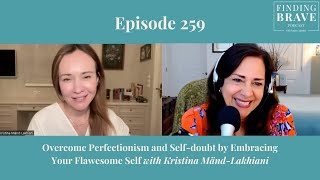
Kristina Mänd-Lakhiani talks about ditching perfectionism and embracing what she calls your "flawesome" self. She describes how we numb difficult emotions, which also kills joy, and offers a concrete first step: replace self-judgment with curiosity about why you feel the way you do.
Questions this video answers
Since June 13 (mid-June release).
Hay House.
June 15, 2023.
Chapters
What happens is that we are growing the thick skin and we idealize the idea of not feeling things, at least not feeling the things which are unpleasant. And as a psychologist, you know that you can't numb feelings selectively. You numb bad feelings, good feelings get numbed as well. You numb pain, pleasure is numbed. You numb fear. Love is numbed.
Hello, everyone, this is Kathy Caprino and welcome to my podcast, finding Brave. I've created this show for everyone who longs to create something bold and brave in their life. To rise up, speak up and stand up for who they are and to reach their highest and biggest visions. Each week I'll be speaking with inspiring guests from all walks of business, leadership, entertainment, the creative arts and the entrepreneurial world. And they'll be sharing their intimate stories of Finding Brave and offer their best strategies for building your most rewarding, joyful and meaningful life, business and career. Hello, everybody. Welcome to another episode of Finding Brave. How have you been? Been? This is coming to you in mid June, my favorite month, my birthday month. I hope you're loving it, it's treating you well. And I am so, once again, so thrilled and honored to have a guest here who has such an interesting and important perspective on what it is to lead to live authentically. But we're going to give it new words flossomly. I think we're giving it. And I want you to welcome my wonderful guest, Christina Mand Lakhiani. Thank you for being here. From Estonia. Christ, Christina, thank you.
Thank you so much for giving me this opportunity. It's, it's a privilege to be able to talk, you know, big audience.
Thank you, my dear. All right, I want to tell you what we're talking about today, which is one of my favorite topics. But Christina has a wonderfully different perspective, I think. How to overcome perfectionism and self doubt by embracing your flawsome self. I cannot wait to learn more. And of course we are talking about this in honor of your book that's come out this month. So let me tell you all about Christina. Christina is the co founder of Mindvalley, which is so incredible. The world's most powerful life transformation platform with an ever growing 20 million strong following. Bravo to you. She's an entrepreneur, writer, international speaker, artist and philanthropist based in Estonia and the author of live by your own rules and seven days to happiness online programs as well as the new book becoming flossome. The key to living an imperfectly authentic life. There's so much that can be said about this and you're going to tell us More. Christina's content has touched the lives of tens of thousands of students by providing wisdom life hacks and healthy habit building formulas. Curated. Inspired by 20 years in the personal growth industry, Christina hosts her own podcast, Honest Conversations, and has interviewed over 200 specialists in the field of psychology and development. So there we go. Let us welcome again and let us dig in. And there's one thing I want to start with, Christina. You know, you all know my guests fill out a prep form in advance, and often what they're sharing is so. It's so eye opening. But this is what you said I want to start with. It's odd to think that we can simultaneously be living as ourselves, without ourselves. As life happens, we fall in love with the idea of who we could be instead of with who we actually are, leaving parts of ourselves behind and losing sight of what and who is truly important within ourselves. Can we start there? I have a feeling that is just at the core of your book about being floss. Awesomely you. But tell us more about what you mean about that exactly, would you?
So there's a personal story which is, which ties to this, this quote, and then there is also a little bit of theory. So my book actually starts with that story. I remember coming into the office one day and a friend of mine saying, hey, Christine, I missed you. And I replied without him thinking, I missed me too. And when I said that phrase, it, it stopped me in my tracks. I was literally, you know, like the Matrix had a glitch. I was thinking, did I just say I missed me too? And for the context, I had a perfectly Instagrammable life at that time. Married, business, traveling the world, two children, costume parties, whatever. Everything I had, I had it all. So a lot of people actually thought that I was an inspiration to them. And somehow in on that height, I realized that I was missing. And I. I just was so puzzled. How can I be missing? I mean, the main character is missing from my story. And that started the whole journey of going back to myself. Of course, I had been a teacher before that, and I've done, I've done that work, but that, that was the. The beginning of my current most important message. Now, the piece of the theory is this. In relationships, there is this phase when we fall in love with someone, and a lot of us have the idea of what makes someone a perfect partner for us. And very often for a lot of people, it's a subconscious idea. And when we see a person who starts ticking all the boxes, we start falling in love. And of course, nature Steps in and helps us along. Because according to nature, our primary goal is to create more humans. So nature, kind of drugs, usually. And we start falling in love with the person, ignoring the red flags, ignoring all the signs of whatever may be wrong, and just focusing on the things that we like. And of course, what happens in the end is that we fall in love with an idea, not a real person. Almost any relationship starts with that. Falling in love with an idea, not a real person. But we can't be drugged the whole time. So at some point, somewhere, two months to two years down the road, we start seeing the person for what they are. We start seeing the real person. And in relationship, in relationship between two people, you have a choice. Are you going to love the person the way they are, the real person, rather than the idea, or you're going to get disillusioned, turn around and leave. Now, in our relationship, the most important relationship, relationship with ourselves, a very similar mechanism works. We have a picture of what it means to be a perfect version of me, the best version of me, and that's the version that I'm willing to love. And whenever we see that the real person doesn't correspond that ideal, we don't have a choice of walking away. We are stuck, of course, but many, many of us get disillusioned or scared or don't know what to do with that. So that's how we lose the main character, because we don't like it. So we have something else.
There's so much to unpack there. Can I add a few things and see what you think? You know, I was a marriage and family therapist, so I know a little bit about couples and personality formation. But one thing that research talks about is that when we meet someone that we like and think we want to, you know, pursue a relationship with, we actually, the highest self of us is what comes. We're able to bring that forward in a bigger way and sustain it, but only for a short time. That veneered, you know, wonderful me. And I think in some ways we know what that highest self is. So it's not all an act. It's not all manipulation. It's, oh, I'm going to be more compassionate, I'm going to be more fun, I'm going to be more loving, right? And we bring it forward, but we can't sustain that typically. So what happens is we're giving the other person a different look at who we are as well, where it's a little bit of a dupe, right? So that all comes together. But Tell me, tell me what you mean. You know, I am curious. When you walked in and spit out the words I missed me too. What do you think you missed the most? Can I ask? Did you know what you missed.
At that point? Probably not, because I was shocked by what I said and it was something which came probably from subconscious, you know, this suppressed cry for help. But because I'm inquisitive person, I, I kept asking questions and trying to figure out what's going on. And I think the thing that I missed the most was just being okay with being me. I have been perfectionist all my life. Very, you know, very driven. And I'm the only child of my parents, so I, I have no other siblings to rely on. I have to make it. I was born in Soviet Union, varied idealistic society. So if there is a way to be a perfectionist on steroids, that was me. And I guess it was. I was about 40 when I suddenly felt like I'm so exhausted and tired of feeling shame for the true self.
So hard. Let us start there too. You talk about perfectionism. You know, I, I coined a term, perfectionistic over functioning, which is a double whammy. Doing more than is healthy, appropriate and necessary and trying to get an A plus in all of it. I, I have found that women have this in spades and people don't come out of the gate with this. They don't. It's culturally trained, it's societally trained, it's familially trained. But you have. I really would love to hear your take on perfectionism. What, what do you see it as? How does it show up and how do we address it from your perspective?
So perfectionism is one of my dragons and the dragon that I know very well. And I probably have to explain what I mean by dragons. I think we all have the dark side and it's can constitute of a lot of things, mostly personality traits, but also maybe some traumatic experiences, something which makes you what you are and that makes you feel less than. For example, English is my third language. I make mistakes and my pronunciation is funny and I've been criticized for the way I, I speak a lot. So it's probably also a dragon, but an easy dragon because it's not very shameful thing to admit. But those dragons are in, in traditional theory they're more known as the shadow work or the, you know, the dark side. Whatever you like. If you go into Star Wars. So we all have them. And perfectionism is my dragon because I have been struggling with that. It has Been a curse to me for a long time. And I remember about 10 years ago I heard this wonderful phrase, I'm a recovering perfectionist. And I was so enamored with that idea, I started calling myself recovering perfectionist. And I felt so good. Something that a lot of people who come to personal growth do. You make a step in that direction of I can see the light in the end of the tunnel. And I felt so good until I realized, and that was probably that moment when I started missing me, that I can't recover from being myself. And there is a difference. There is a difference between certain bad habits and certain behaviors that you can unlearn and untrain versus your personality, which you cannot just eradicate, no matter how much you would like to be something else. And we all have those dragons. I like to call them dragons because it's a very vivid picture, but also because it starts another conversation because people tell me, so how do you slay your dragons? And that's the point. You don't. You don't slay your dragons. You look them in the eye and you say, okay, you're here, you're part of my life. What do we do together now? So you tame them and if you're brave, you, you ride them.
So interesting. So let me ask this, I don't mean this as a challenge, but tell me what you think I am a recovering perfectionistic over functioner and why I'm comfortable saying that is that in my view is not who I am. That is a trait I adopted. An addiction that I adopted. And while I will never be completely free of it, the dragon will not die. I have seen that taking really proactive measures. And that's self awareness, that's empowered action. Unlike action I've ever taken before. It mitigates and reduces the impulse to be a perfectionist and the self hatred or self rejection when I am not. Is that making sense?
Yeah, you know, I would say that it's, it's, it's literally, you know, you're looking your, your dragon, which is perfectionist in the eyes and you just, you just choose for it to stop being your curse.
Yes, exactly.
How can I, how can I work with you? We don't always get to choose what we're given in life. And maybe I'd to have blonde hair and blue eyes, but I don't. So my question is, how do I live? And I use, I deliberately use very light physical features because we don't. We get what we get.
Yeah, yeah.
And things you can't change and by recognizing that, yes, I have perfectionism as part of my personality. It's intrinsic part of my personality. And I think it's one of a lot of people actually relate to because we all have that need to be good. And that is a trained thing. But behaviors are trained, patterns are trained. Your personality trait is still there. So what I say by I will forever be perfectionist is because, because I'm perfectionist, I have a high bar, I'm competitive, I shoot for the stars. These are the things which are good about it. But also because I'm perfectionist, I'm afraid of competition. And when I'm aware of that, when I'm aware of my dragon, I know you do that. I just figure out how to go around that, how to not let it stop me. So the question is not really how you slay your dragon, but the question is, are you willing for it to become your blessing rather than your curse?
I love it. And even when you said that, I love to talk about all these parts of us. I like to think of them kind of at a boardroom table. And sometimes we need the warrior, but sometimes we need the. The seeker. And sometimes we need to say to the warrior, could you sit in the corner? Now, we've heard you a lot. Thank you so much. But we need to hear. But when you said the dragon, I had this vision of looking into the eyes of the dragon and instead of making it the enemy, saying, I know what you want, it makes me cry. I know what you want of me. I get that. But let's be friends and let's understand that what you want of me, I do not want to give in this moment. Like if we're fighting with every aspect of who we are, it's not a happy life.
Yeah.
But if we can make friends of it. And understandably, I love it. I love just that simple. That simple image and think how much.
How much focus and energy we put into trying to be something which we are not.
It's incredibly exhausting. You know, I do a lot of speaking and with mid to high level professional women and 75% of women one research study showed have imposter syndrome. And I believe I know why. But part of it is we're not. And the way that was defined is they don't believe that they got to where they are from their own talents. They think it's luck or being in the right place at the right time. Christina. So part of my job is saying that isn't sure. Luck is great. And we have that serendipity good fortune. That isn't why you're here. But I think, you know, we could talk forever on what society teaches women to think about themselves. But let me ask you this, because this terminology really struck me. Emotional analgesia, my. From your book. Can you talk about what's going on here from your perspective?
I love it. I'm so glad you picked up on that because I invented this term.
I'd never heard it before. That's why I gotta know more. Tell me.
So, yeah, there is. There is a medical condition called, called God, I forgot the name of it, but it's analgesia. Congenital analgesia, that's what it's called. So congenital analgesia in essence means that people don't feel pain, physical pain. So people who are born with that condition, they die before they reach adulthood just because their bodies don't sen signals that something is hurting. So their bodies deteriorate and break. Like if you, for example, if you feel that your finger is burning, it's because you're touching a hot surface. So obviously the moment you feel it, you know how to remedy. You remove the finger. Or if you're sick with something, you feel it because you. It hurts, it's. It's uncomfortable. So people who can't feel physical pain, they don't survive to adulthood because their bodies just break, right? It's as simple as that. Now live in the world where we taught from the very early age how not to feel. Don't be angry, don't scream, don't be sad, don't be upset. So many things we are not supposed to feel. And when we grow up, it's actually continuous. Like, why are you so upset? Oh, first world problems. You, you don't even have the right to be, you know, good vibes only, no negativity, you're being toxic. All those messages, how you're not supposed to feel. So what happens is that we are growing the thick skin and we idealize the idea of not feeling things, at least not feeling the things which are unpleasant. And as a psychologist, you know that you can't numb feeling selectively. You know, bad feelings, good feelings get numbed as well. You know, I'm. Pain, pleasure is numbed, you numb fear, love is numbed. It's as simple as that. So that this fascination with not feeling has brought us to the point where we as society suffer from emotional analgesia. And what that means is that we don't notice our emotions, we don't understand them. Emotions, just like physical pain are signals Pay attention. Something is going on. So because we are taught not to pay attention, our lives, just like bodies, deteriorate and break from undetected trauma.
This is so true. I. It's so true. I can't help but think, you know, my world is supporting women. And why? Because women are not men in skirts. We're different and we have different challenges. This is my belief till the day I die. Not, you know, we're not different completely. There. There's so much shared experience and shared traits and, and physical material and emotional material. But when you talk about this, you know, I interviewed a wonderfully fascinating guy, Mark Green, on this podcast about man box culture. And I literally cried. I've said this 10 times. And he got teary eyed. You know, my world is often how women have been trained not to be confident, not to be assertive, not to talk about themselves, not to put them forward. Themselves forward. Right. To be accommodating, pleasing. Whereas boys, even at age 4, are taught, don't be emotional, don't be connective, don't be vulnerable. Right. Don't be friends with a girl, never cry. So I think that what you're discussing, emotional analgesia, hits women and men equally powerfully and in a damaging way. And in different ways. You know, for instance, I know some people in my life, if I'm getting worked up about something, they'll say, relax, boy, that makes me mad. Why do I need to relax? I'm angry. Relax. And it's men that say that, you know, Whereas, you know, per what Mark's work is getting men not to be trained in a man box. We want our men to feel those things that are typically considered feminine in our society. Vulnerability, fear, connection. Which brings up, as we know, Brene Brown has taught, which brings up fear.
I think that men and women should feel the whole spectrum of emotions without even saying is it, you know, positive or negative. That's, that's the first thing we do. I don't want to feel this. I want to feel that. Men are not allowed to feel fear, right? This is a very unpleasant emotion which they should be allowed to acknowledge. We actually don't, don't support men feeling literally anything except passion for their goal.
You're right.
How about anger or rage?
It seems like it's okay in our society. It's okay that men feel anger. I feel it's not okay that women show anger. Would you agree with that? There's a little bit of a, I don't mean to make everything gender.
There's a lot of Gender bias. There's a lot of gender bias and there's this theory of social roles and there is stereotype. You know, there are stereotypical ethical qualities which people think that women should, should possess. So for example, according to that theory, there's an interesting conflict and sorry, I'm switching to the topic of women because I'm a feminist as well. So I, I get the pain. So if a woman, for example, is. Also has another social role which is stereotypically male, for example entrepreneur, right? Or politician, or a leader. So society deems as good qualities for a leader, unnaturally contradicting what society deems as good qualities for a woman. So if a woman has both social roles, society is going to judge her as a bad woman. Yet we, as human beings, we tend to prioritize roles which are socially more valuable. So we want to be considered good leaders. So we'll sacrifice the fact that people will think us bad women and assume the qualities which society thinks are good leadership qualities. Although I would argue with what is good leadership quality. Quality as well. But that aside, let's just look at stereotype. So we, we have that contradiction. Men have a contradiction in a different side. They have to be strong, they have to be successful. So whatever is deemed as not strong or not successful, that's their struggle. But the struggle in essence is the same. Just the decorations are different. The struggle in essence is the same. And the idea is we have to allow people to feel emotions because the problem is not what emotion you feel. The problem is are you acting out of your emotion or you're acting out of your value? Emotion just carries the message. That's all it does.
Oh, tell us more about this. Tell us more. And before you do, I think this might lead into it. Tell me if it does. I don't want to take you off track. You talk about in the book can positive what is positivity and can it be detrimental? And it occurs to me, you know there's a term toxic positivity, right? I just want to say this and see if this leads into what you're thinking about here. You know, I just several months ago now when people hear this, lost my 98 year old mother. And from what people shared with me, I had to write a post 7 things never to say and do. Yes, when someone is sharing, they're going through a terrible time. And if I look at them, what those things are mostly is a hijacking. I get emotional. I guess I'm not over this. A hijacking of me feeling sad. It's oh, she was 98. She lived a good life. What does that have to do with how I. How I feel? In fact, the longer you have a beloved, the harder it is to let go. Or, well, at least she didn't suffer. So there are these terms, you know, that you never want to say when someone has just shared with you. I'm having a really hard time. But I think to your point, so many of us are trained not to feel, and therefore it's very hard for us to feel, to put ourselves in your shoes, because we can't even feel what it feels like to be in our shoes. So that makes sense.
Yeah.
People are. People don't know what to say. So, for instance, I said, by the way, here's a tip. Just say, how are you holding up? Then do not hijack the conversation. And do not go talk about your own situation.
Yes, especially, oh, and by the way, I did, right.
Oh, I just lost my father. And there goes the conversation. But I think people mean well. They just can't sit with the difficult emotion. What do you think? Is that part of being overly positive that we have to spin it?
I think, I think it's. No, I think it's just discomfort. We are not comfortable with other people's pain because we are so removed from grief on a daily basis. We live longer. Our medical services are so much better. We don't see, we don't live in huge communities. We don't see death very often. So not, not to hijack the conversation. My mom lost her sister two years ago to Covid. And I realized how hard it is, and I live with my mom right now. I realized how hard it is to be next to a person who is grieving to that degree, how hard it is to be there and be okay with their discomfort because you want to, you want to feel better. But when you say, oh, but don't be so sad, oh, but look at the bright side. It's not because you care about that other person's experience. You care about your own discomfort. You're trying to make yourself comfortable.
You're right, Christina, you're right.
And, and it's, it's. It's because we don't know how to feel. And the, the sad thing for me, because, you see, I've been in person growth for 20 years and I know a lot of the things that we teach are not science, they're value based. And I understand why they're not in schools. But psychology, the basic behavioral psychology, understanding of emotions, it is science. It is not Value based. We should teach our kids like we teach ABC mathematics. Let's teach them how to deal with emotions, how to feel emotions properly. It the most valuable skill for life. And it's not, it's not fringe.
You know what's crazy? You're in Estonia, I'm in the us I'm going to say this. Given what my country is going through trying to teach a curriculum about emotion will be shut down in half a second. It makes me very angry because in other words, part of that would be if you're a boy, you should be able to feel every range of emotion and here's what they are. And if you're a girl, you should the exact same thing. You know that I, I don't want to get political or whatever I am getting, but I think that it's so right now tangled up in what society says we should be.
Yeah.
That it's not a pure conversation any longer. What do you think?
Yes. For, for something to become curriculum in school, you, you require societal agreement. Society has to say, okay, that's fine. And that's why a lot of things that we teach which, which we all understand are good. For example, meditation and mindfulness. Right.
No one's going to say that's bad, that's toxic.
But, but it's not in the curriculum. And you know, I lived for 16 years in Malaysia and we, I remember there was a moment where there was a discussion about yoga classes and Muslims were not allowed. And Malaysia is, has one of the, the strictest societies were not allowed in yoga classes. And then they made a concession, they said, okay, you can go to yoga classes, you're not allowed to meditate. And I remember, I remember I was in Africa once in Kenya and if, you know, Kenyans are very religious and Christian by the way. And this woman came to me and she said, could you please teach me to meditate? But I'm so scared because according to my religion, I'm opening up my soul to the devil. So you see, there is, there is this question whenever we talk about faith or values.
Yes.
It's very hard for society to agree and that's why a lot of things are not in the curriculum, because curriculum does require that agreement in the society. But that's exactly my point. Psychology is not religion. It's not value based. It's science. There's research, there's science. So it shouldn't be like this. It shouldn't. But I understand some people might say that what you prioritize is that even a priority. So I get where you're coming from. And I agree with you. And I think it's going to happen because we need that skill.
And that's why you and I and a million other people we admire are putting out content that we are training in our own courses that we believe through our own work. And you doing this for 20 years is research, you know, and you're bringing this forward for people that gravitate to it and feel the need for it. So this is why we're putting out our own material, to be of help. Let us talk about. Tell me, tell me the key thing you want anyone who reads your book to come away with. This is not easy.
It's not. It's a big question, you know, it's a huge question. And my book is very. It covers a lot of different topics. It's a journey. I like to call it the Journey. And I remember when I had my first meeting with the editor, she said, can you give it a proper introduction? I was like, no, I can't. I can't give you a spoiler. Imagine, imagine if Gandalf told Frodo not Fraud or probably Billboard had some slightly lighter journey. What's going to happen ahead? It would be a spoiler. So I don't like giving spoilers. But what, why I wrote the book and what's my main message is I want people to come to peace with themselves. We are hurting so much by not being okay with who we are. A lot of the things that we do which are horrible, which are painful, which are bad to the world are because we. We don't find ourselves worthy or lovable. We need to prove that we are worthy and lovable. And the proof has to come from the outside and all those distortions and horrible things happen from there. Or like my very dear friend Veena says, it's very simply, she says, hurt people, hurt people. And I think by not loving yourself, you hurt. It's a relationship. You have a relationship with yourself. If your relationship is not, if you don't take care of your relationship, if you don't invest into it, it's going to stink like any relationship.
I think it's so true. And, you know, I think of Brene Brown saying we discharge our anxiety through blame. I think also what's happening is there's so much hurt, but we can't. We don't look to ourselves to deal with the hurt. So the impetus is, who can I hurt? Because they've hurt me in, in, in these people's minds, you know, 100% so can I ask you, not a spoiler alert spoiler, but you know, I think you and I are in the world of. It is absolutely one thing to say these things for me, I'm talking about becoming the most powerful and confident you. But people will say how it's a journey. It doesn't happen this second. But, but there's a step you can take this second. And so I break it down with a lot of steps. If you could give us one step towards being on the flossome journey. Am I pronouncing it right? Could you give us one?
You know, it is a journey and as, as you very well know, if a problem takes you five years to create, you probably need some time undo it. But, but having been in personal growth for a long time, I understand how transformation works. And a lot of the times we slightly misunderstand it. In fact, transformation is when you just shift the way you interact with the world. So it's a slightly misapplied term, but it's a paradigm shift in essence. Right? And that requires knowledge and experience. That's why knowledge doesn't work. Knowledge alone doesn't work.
Oh, I so agree. I always say insight is great, but insight doesn't change your life.
Typically you have to, you have to couple knowledge with experience. Only then it's going to give you the paradigm shift. And very often it is a matter of decision.
But what, it's a what?
A matter of decision. Decision, you decide. And that's, and that's the tricky thing because you see, we live in a paradigm that idealizes hard work, struggle working, you know, putting 120 into everything that you do. So we naturally, we become what? I don't remember the term you used, but I will butcher it and say high functioning perfectionist. You got it.
Perfectionistic over functioners. Every high achieving person I've ever met is one. Because it gets rewarded in the outside world.
In a way we understand how it works. We understand how to put more hours, how to put more effort, how to work harder, how to, you know, grease your fingers to blood. We get that. What we don't get is how to let go and trust. Because it's the exact opposite. And that's what transformation is about. It's about actually suddenly seeing things in a different light. And then you don't need to put any effort. So it doesn't need time, but it requires you to be ready. So another crucial point to that is that you can't teach a person climb a tree until, until they've learned to Walk. When a baby learns to walk, they first turn to their tummy, they hold their head, they sit down, they get up, and then they walk. And very often, we want a transformation. I want to climb that tree. But maybe you're just not there yet. You know, I've been in this industry for such a long time, and I know there is no one size fits all. What works for you now might not work for you five years from now. What works for you in this part of your life might be completely the opposite from what you need in another part of your life. But I will give you one tip.
Thank you.
Because it also comes from the same idea. What, what fuels transformation. If you can replace judgment with curiosity, it will open up so many doors, especially towards yourself. So, for example, what's wrong with me? Rather than that, replace it with curiosity? Oh, I did that. I wonder why. What does it say about me, about my values? Do I like it? Do I not like it? Would I like something different? So if you replace judgment with curiosity, it's going to be a much better fuel for transformation.
And it's so beautiful. So beautiful. I am going to stop right there. Although I could talk to you for another four hours. Thank you. Now, tell everyone, where do we get the book? Where do we learn all about you? Where do we soak up all your wonderful teachings and trainings? And where do we go?
Thank you so much. So, first of all, because I'm a co founder of mindvalley, of course you'll find me in mindvalley a lot of wonderful teachers. But my book is. Is since June, it's available in all. Since 13th of June, it's available in all the bookshops in us, all the major bookshops. And it's in July. It's going to be even available in the airports, which.
Oh, great. And it's a Hay House book.
Yes, the Hay House book.
Love Hay House. Louise Hay. She was remarkable. Bravo to you. All right, my friend, come back again, will you? I. I could just listen to you all day. You're very soothing to listen to, which is. It's easier to listen to someone's beautiful messages when the sound of it is like a beautiful wave. Thank you for the great work you do. Thank you so much.
Thank you for your kind words and for this opportunity.
You. Oh, my pleasure. All right, everybody, you are going to see this, as you know, on all the social media platforms and we would love your questions. You hear this from me every week, every other week, but I feel like we're not doing our job here. If you don't have a question about what we're saying, you know, please, please curiosity rather than judgment. Curiosity. Hey, what did you mean by blah blah blah? And I know you're crashingly busy, but either of us would would love to answer and support you any way we can on your journey to the Flossome. You thank you everyone and have a wonderful few weeks and we'll see you next time. Hey folks, Kathy here. Are you ready for a big positive shift in how you're working and what you're capable of achieving in your career? Let's make that happen for you. While you might know me best as a podcast host and writer, a key focus in my work is helping women achieve greater success in their work. In my career and Leadership Breakthrough one on one coaching program, I help women get what they want most, which includes more confidence, impact, advancement, financial reward and fulfillment. And I also help them achieve their most exciting visions for the future. In the past 16 years, I've worked with over 20,000 women across six continents and before that I served as a therapist and before that I was a Corporate VP managing multi million dollar budgets and global initiatives. I leverage all of that experience to help women build a new chapter where they can reach their highest and happiest potential doing work they love. Check out kathycaprino.com careerbreakthrough and I hope you'll register now. I'd love to support you. Thanks so much for joining us today. And please don't forget to check out findinggrave.org for more programs, resources and tips. And tune in next time for your weekly dose of finding brave.
More from Kathy


Elevate Yourself, Elevate Others, and Amplify Good | Chris Cooper | Finding Brave Ep. 334

Finding Brave Epis #333: How Leaders Can Harness AI Without Losing Their Humanity, w/Bennett Borden

Finding Brave Epis 332- How to Stay Brave, Valuable and Visible in the Age of AI, with Raman Rai

Finding Brave Epis 331 - The Power of Positive Disruption, with Dr. Patrick Leddin


Finding Brave Epis 330 - Being 40: Letting Go and Embracing Who You Are, with Stacey Lindsay

Disrupt Career Reinvention with Kathy Caprino - via The Disruption Lab Podcast w/Patrick Leddin

Creating Neurodiversity-Friendly Work Cultures: Simple Workplace Adjustments Matter

Finding Brave Epis 329 - How To Create a Neurodiversity-Friendly Workplace, with Kristen Pressner

Finding Brave Epis. 328: Reclaiming the Power to Trust Your Own Voice, with Dr. Cindy McGovern