261: How to Work with (Almost) Anyone with Michael Bungay Stanier
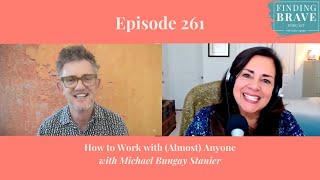
Michael Bungay Stanier talks about building effective working relationships through direct conversation. He argues that most workplace friction comes from never actually discussing how you and a colleague prefer to work together, and that a simple talk can transform almost any partnership.
Questions this video answers
bestpossiblerelationship.com
June 27 (pre-release bonuses available before this date)
More than a million copies (collectively)
Chapters
People who matter most to you. Your most important working relationships. Not about what are we going to work on, but how will we work together. You have a better chance of building a relationship that is safe and vital and repairable.
Hello, everyone. This is Kathy Caprino and welcome to my podcast, Finding Brave. I've created this show for everyone who longs to create something bold and brave in their life, to rise up, speak up, and stand up for who they are and to reach their highest and biggest visions. Each week, I'll be speaking with inspiring guests from all walks of business, leadership, entertainment, the creative arts, and the entrepreneurial world. And they'll be sharing their intimate stories of Finding Brave and offer their best strategies for building your most rewarding, joyful, and meaningful life, business and career. Hello, everyone. Kathy here. I just wanted to share a deep note of thanks for helping our podcasts reach the milestone of over 500,000 downloads and ranking in the top 1.5% of over 3 million podcasts globally. In addition, the show consistently ranks in the top 100 Apple career podcasts in countries all around the world, and we have you to thank for that. I hear from so many amazing listeners who share truly inspiring insights about what they're learning from our amazing guests on the show. And I can tell you sincerely that hearing how the show is making a difference in people, people's lives is why we love to produce Finding Brave for these past five years and are thrilled to continue to bring it to you. Thank you again for all your support and encouragement. And I and my awesome team are sending our deep thanks and wishes for a beautiful Finding Brave week. Thank you again. Hello, everybody. Welcome to another episode of Finding Brave. Balloons. Confetti. I am so excited. I know I say this every time, and we're on 200 and whatever, 60.
Episodes, but you're really, really, really excited about this one.
Like, I truly am. I truly am. Because we have Michael Bungay Stanier today. Australian. But you're calling from Toronto right now.
Yeah, I am. I. I have. I actually have three passports. I have a British passport because my dad's English. I have an Australian passport because I was born there and grew up there. And I have a Canadian passport because I've married to a Canadian and lived in Canada for 20 years. So you can think of me, like, out of shape, Jason Bourne out of shape. I also don't know how to shoot guns or run or beat up bad guys. But apart from that, there's so many similarities, it's almost the same.
I probably shouldn't go Here. But are people in your family excited about the coronation? Now, this is. We're recording in May. You're seeing this in July, people. So this is months later. But.
Well, my mom was pro royalist kind of 30 years ago, back in the heyday of Charles and Diana and all of that sort of stuff. I think she has swung to being a strong Republican. Now. She's not a great fan of Charles, as far as I can tell.
I see.
I am very Republican. I'm really not a keen, keen person of having a King of Australia or Queen of Australia. So much so that when I lived in England, as an act of rebellion, anytime I sent a postcard or a letter, I would stick the stamp upside down. So the queen's head was upside down, which is technically an act of treason. But I'm like, you know, I like to live dangerously. This is all about being brave. This podcast. So that was me.
That was me.
That was brave, kind of fomenting rebellion.
And just so folks know the term Republican for you does not mean what it means for us in the US that.
That is a helpful distinction.
Right? It's about the opposite, I'm guessing.
Well, you know, Australia was a colony of England and then in 1901, became an independent country, but remained part of the Commonwealth. And we still have the Queen of England. King of England now is the queen, slash king of Australia. So they're part of our. Our government. And as. And that's true in Canada as well, where I now live. And a Republican is somebody who goes, we don't need to have Queen of England or the King of England.
We have our own. Why can't we govern our own?
Yeah, it's not the whole turmoil of Republican Democrat that you guys in the States have going on, which is a whole nother drama.
It's another. That's another podcast. All right, my dear, let me tell you folks now again, I want you to check out in the show notes. You'll see it. Michael has already been here. Here talking about how to begin doing something that matters, which was so incredible and so useful. But let me tell you all about Michael. Michael is the author of six books. Is it six or now it's seven with your new.
Well, it depends what you count as a book, but it's possibly closer to eight or nine.
But, you know, that's so inspiring to me. I have two, and it's not easy. All right. Which between them has sold more than a million copies. And I think this is old. One thing I just want to say before I Read this. I connect with a lot of people you can't even imagine. And when someone like Michael comes along who has done so much, but you're so humble, like if I even look at you on LinkedIn, I don't see all the millions of things you've done. There's such a humility about you that I really admire. I just want to say that because this bio, you know, is just touches the tip of the iceberg. But here we go. Let me read it anyway.
Sure.
More than a million copies sold. You are best known for the Coaching Habit, the bestselling coaching book of the century. Okay, there we go.
Doesn't sound that humble, does it?
Scratch humble.
Sounds like a bold claim there. But.
But it's in fact, I'm sure recognized as a classic. He is considered the number one thought leader in coaching and a top rated keynote speaker. And his new book, how to Work with Almost Anyone. And I'm so glad you put in almost because we got some people you can't. Right. Shares the way to make every relationship the best possible relationship. A working relationship that's safe, vital and repairable. Michael was a Rhodes scholar and plays the ukulele badly. Are you getting better yet? I read that two years ago.
Yeah. You know, I feel like I've reached a plateau of mediocrity with ukulele and it's unlikely I'm going to get much further than that. But I'm content, you know, that's. It brings me happiness and mostly it drowns out my singing because my singing is shockingly bad. But if I'm playing ukulele, you can almost not hear my singing. So it all.
So it serves a very important purpose. Love it. I want to share that Michael also has a fantastic podcast called Two Pages with mbs where brilliant people read the best two pages, what they think are the best two pages of a favorite book and how that shaped them. Check that out. And of course, there are links below. And check out his TEDx talk. What did we say it was called? The Advice how to Tame the Advice Monster. I just want to say, you know, you're in the presence of someone who has so much to teach. When I watched it and I the whole audience groaned at a particular question. And I'm a coach and a trainer and an educator and I groaned because the Advice Monster, it's really something. So there we go. Check everything out. But let's start with.
I'm going to say one thing about the TEDx talk, please. My favorite comment in the. In the comments Was this. I tried to watch this, but his trousers were too tight. I'm like, you know what? That totally makes that I'm. I'm claiming victory right there.
Was that a friend? Was that a friend?
Oh, no, there's some random person. I don't know who they were, but I'm like. So if you may not be interested in taming your advice monsters, but just how tight were Michael's trousers? You two can find that out by typing in TedX tame youe advice Monster.
Oh, dying over here. All right, I. I watched it. I did not think that. So there you go. A sample of two.
Exactly.
All right, let's start with the overall important question. Out of all these books you've written, why this one? Why this one?
Well, I am trying to become a writer. The last book I wrote is called how to Begin, and it's about what's a worthy goal for you? What's something that will crack you open and help the next best version of you appear? When I think about what my worthy goal is right now, it is to be a writer. And I know, because we've talked about it, you're like, but you've already written seven or eight or nine books. Aren't you already a writer? Well, I think I'm an author, meaning I've got books written, but I haven't yet structured my life so that writing is the central engine behind what I do. And I think of all the stuff that I do, whether it's wearing tight trousers on a TEDx talk or coaching or facilitating or whatever else, writing books is perhaps my most distinctive skill, where my voice is most clear, and when what I try to do is make simplicity on the other side of complexity appear. And book writing is where I think I can shine around that. So what that means is not necessarily about putting books out, but it does mean having a commitment to writing and writing books. So I came to a point when I had finished how to Begin, and I'm like, what's my best guess at the next most useful book that I could write? And I've got a bunch of ideas. I had a number floating around. I actually had an idea around another book, which is what I thought I was going to start writing next. But this was the book that just kind of grabbed me and said, start writing this one. So it became the next book.
I have to ask you because I'm jealous. So I'm going to go back to another question. You're not prepped with these. I sent you. You sent me questions? Of course. I'm not even asking those, but when I, when I read that your coaching habit book just took off in, you know, millions. How do I want to ask this? There's so much written about how to be a great coach. And you know, I, I think I mentioned in our previous talk, I throw everything I've got into coaching, consulting, advising, but I wear a hat, I tell them to push back, blah, blah, blah. But it's mentoring, cheerleading, everything I got.
Yeah.
What do you think is, and you're, this is going to force you to be non humble? I just want you to tell us the truth. What is the stickiness about your work that makes it sell a million copies? What is it?
Well, you have to say that it's a very big part of it is actually good luck because I have written nine books, one of which has taken off and sold a million copies, two of which have taken off and sold maybe three of which now have taken off and sold more than 100,000 copies. But five of which have not and have not taken off. So you've just got to say that sometimes it's the right book at the right time that lands in a certain way. There are a few things that I think tip the odds more in my favor. They're still long odds. I mean, I would love to have another million selling book. I'm not sure I ever will.
I mean, I see it's already on Amazon before it's even come out as you're doing fantastic.
It's already taking off. But, but here's how I try and make the odds better. First of all, I try and write the shortest book I can that's still useful. So, you know, if you look at people like Tom Peters and Seth Godin and even Edward de Bono from way back when, the originator of lateral thinking, they wrote really short books. It was like an idea in a book. And what so often happens when people, particularly for their first book, they're like, here's everything I've ever learned that I think is useful. And they're trying to add value. But one of the great insights around coaching or facilitation or teaching or writing is how much space can you create so people can engage with the most important idea. So I'm always going, how do I write this book? Tighter and shorter and cleaner and less filling to it. What that then demands is the book has an arc and a shape to it. Like I'm trying to take people, I'm trying to keep people reading. I'm trying to get them to the Next paragraph and then to the next chapter. Because most books get abandoned pretty quickly into the read. So that is partly how I write, but also the design of the books are deliberately designed with a lot of white space so they become less scary to pick up and read. They feel less daunting. And then there's something about knowing what problem you're trying to solve, because I think that's in, in the world of self help or business books, the book has to know who it's seeking to serve. And when I wrote the Coaching Habit in particular, I had such a clear idea of who this was. She was a team leader, a manager. She's got some years of experience. She likes her job, she likes her team. She's exhausted, she's frustrated. She knows there's a better way to be leading. She's not quite sure how. She's got a bit of a tendency to be a rescuer, to try and do it all. And she walks into the airport bookstore. She sees a book, she picks it up, it fits in her purse. When she opens it up, she's like, I could probably read a good chunk of this on my flight. And that's who I wrote this book for. I'm like, I'm going to unweird coaching for you. Because in organizations we've all heard of the power of coaching, but mostly most people go, that's for weird, touchy feely HR people. I'm an engineer or a marketer or a salesperson. I'm just a regular person trying to get stuff done. And I'm thinking to myself, being more coach, like, can help you with that. Let me unwield it so that when you read this book, you go, oh, if that's coaching, I could probably give that a go.
So I see what you're doing differently from what I've done, which is I fall into that trap having written the most powerful you7 damaging power gaps that keep professionals from thriving.
Right.
You know, it's therapeutic. It's spiritual. It's, it's 50 dimensions. It's, it's, it's a master's class in growth.
Yeah.
And, and you know, people love it. I love it. I still turn to it, I still use it. But it isn't what you're doing. It's such a, it's an important tip. I'm going to try it.
Michael, what would be the book that would be the introduction to your current book? How would you write something where people go, this is great. How do I get what's next? And then they Move to this bigger, more complex, more inclusive, conclusive book.
What a great idea.
Yeah, write that. Write the sequel. Write the. Open the. The opening act. Because what you've got is part two of a three part series and you just need to write the first part and then maybe think about a third part and suddenly you've got intro masters and then doctorate level books for people to jump into.
I love it, Michael. I'm doing it. What a coach. Thank you. All right, now let's talk.
We'll call the podcast off you get writing.
See, you're so amazing. All right, now tell us, you talked about the connection between. Did you. This book and all the others. Do you see a connection? You know how to work with almost anyone. Do you see that's a connection with all these other books? Or you see that there's such a pressing need right now because of the divisiveness in our world? Tell, tell me.
There's. There's a connection between. I, I tend to write one of two different types of books. One is a book that is about bringing out your best, unlocking your greatness, and do more great work. Which is my first kind of formally published books. A bit like that. How to begin is definitely that. It's like, how do you find the thing that cracks you open? And then the other type of book is how do you bring out the other person's greatness? How do you bring out their best?
Yeah.
And all of this is often in the context, well, of life, but sometimes in work. And there are so many forces pushing against us to be human, being at our best, to be fully expressed, to be all of that. And I think that's the soil from which all of my books grow, which is this sense of how do we all be fully human, the best humans we can, and how do we bring that about with the people we interact with.
How beautiful. All right, so again, these aren't questions I sent you, but I've got to understand, because you're so good at this, dissecting it down to diluting it down to one thought. How to work with almost anyone. Can you summarize it in a sentence? What we have to do. Cool.
There may be some semicolons in the sentence, but I can do it in a breath.
Might be three minutes long, but you'll do it.
No, no less than 60 seconds. Our working relationships are key determinants of our happiness and our success. Most of the time, we cross our fingers and hope for the best. If you have a conversation with the people who matter most to you, your most important working relationships. Not about what are we going to work on, but how will we work together. You have a better chance of building a relationship that is safe and vital and repairable.
All right, so I was a former therapist. I gotta, I gotta ask you questions.
Yes, of course.
I mean, there are certain people, and, you know, I hate to have to emphasize this, but so many people I know have been hurt by certain types of people, like those with narcissistic personality disorder. We know who they are. And that can really mask as charisma, as confidence, as strength. So part of my world is, it's amazing how people who are struggling with other people, such a high percentage had narcissism in their childhood and they, so they don't recognize it and they're beating their, their head against the wall when it's not going to work. So that's probably a little bit why you said with almost anyone.
That's right.
But let me just ask this. In the pursuit of. Let's say you and I have decided to work together. You're going to be my advisor on my next book. Talk to me about how you begin it, how you start it, the middle of it, how you end it in terms of committing to how we're going to work together. How do you do that?
Yeah. So I'm your advisor on your new book. I'm like, kathy, look, I'm super excited to help you with this. I love helping people write great books. I think your idea for this book is amazing. I'm excited about it. But look, I want to be the best advisor and support and coach you can. And also, I want this to be a great thing for me as well. I want you to be the best advisee or coachee that you can be. So let's not talk about the book for a moment. Let's just talk about you and me. How are we going to make this work in a way that would work best for both of us? So that's the setup, which is like, let's just talk about you and me and how we work best together before. Because the temptation is for me to go. Tell me about the book and what are you thinking and what have you written before and what are the chapters and how might you work and what do you want to do and when you want to get it published and who you manage, sell to, and it's all about the work. And we're all just hoping that you and I are going to somehow click and get along. And we will, because you and I are particularly charismatic and brilliant and open hearted and all of that. But not everybody has that same good luck. So it is a conversation now about you and me. And I've already won because we're having a conversation about the relationship. Doesn't even matter if this doesn't go particularly well. What I'm doing is giving us both permission to keep talking about how well we're working together. And then in the book I talk about this idea of a keystone conversation, this metaphor of a keystone being either the thing in an arch that gives it strength and stability and robustness, or if you want to use a ecology metaphor, the keystone species, which is what keeps an ecology and an environment healthy and robust and changing and vital. And I think there are five possible questions you can have in a keystone conversation. One of them is simply about, let me give you questions three and four because they pair really well together, which is like the good date and the bad date questions. The good date question is when you've worked with somebody like me in a relationship like this and it's gone really well in the past. What happened? What did you do? What did I do? So you could go, look, I've worked with coaches and you know, Joanna was this amazing coach for me. I'm like, great.
What?
What happened? Well, how did Joanna make this amazing? How did you make it amazing for Joanna? And then I'll go, so when I've coached people before and it's worked really well, this is what happened. This is how I did it, this is what they did. And already we're just sharing stories of this is the type of interaction and the type of experience where I flourish. And so that's going to be super helpful. And then the flip side of that, the bad day question. What can we learn from frustrating past relationships? Because I don't know about you, but I've been coached a few times where I'm like, this sucks. This is not a good. It's not even terrible. It's just thoroughly mediocre. So I'd be going, okay. And honestly, I have times where I have coached people and I'm like, I'm not being a good coach. I'm plunging new depths of joylessness and the experience of coaching myself. I mean, it's just, it's just not great. So I'll go, look, this is what. When I'm working with somebody and it's not going well, this is typically what's happening. This is what I'm doing, this is what they're doing. You're like, okay, when I'm being coached and it's been bad. This is what happened. And we've already had this exchange of conversation where we're like, let's avoid some of that, let's lean into some of that. And we give ourselves this opportunity to start defining the best possible working relationship between you and me. Safe and vital and repairable.
All right, questions here. I'm dying to know what comes to my mind. Oh, there's so much to say. I think that you naturally are able to focus on people's strengths and their internal resourcefulness, etc. Yeah, because I've had a lot of struggles. Of course you have too. But I tend to help people by making sure they know what their strengths are, but looking at where the gaps are and close, helping them close those gaps. That's my happy place. But what comes to mind when you say what you just did is that my guess is. But you tell me you've had a million of these conversations that people just like, what happened with me in your TEDx talk. You said the question to ask is what is the challenge? But don't stop there. I don't want to give it away, but what else? What, what other? And I was walking around all day going, what else? Because I know what my challenges are. And I'm like, I don't know. My mind goes completely blank when I, when I'm really in a confused place. What, what I'm saying is how often what I want to do is give people actual language. Like if, if you and I, you were to tell me what a great coaching relationship has been like for you and what you need from me, and I want you to give that language to people because I, I see that the vast majority of people don't have the self awareness. I don't mean that as a judgment. They haven't had a relationship with themselves enough to even answer your question. Am I wrong?
I. So my guess is that everybody has a first round of answers to all five of the questions and everybody have, can uncover answers that maybe go a little deeper and have a little more nuance and a little more subtlety and a little more truth, perhaps. And in the book itself, each one of the five questions comes with three exercises kind of connected to it to help you actually build language and build stuff around that. So as an example, the very first question, which is the amplify question is what's your best? Like, tell me what your best is when you're, Whatever the context is, if it's you and me and you writing a book, I'M like when you're at your best, when you're flourishing, when it's really flowing, what's going on? How are you showing up? What does that look like? And you'll have an answer for that. But the first exercise that I suggest around that is just teasing apart the difference between good at and fulfill. Filled by. And this is particularly helpful in working context where it's so often easy to easy look at somebody and go, well, they're pretty good at this, so I should just give it to them because they're highly competent. And so often there are things we become highly competent at that we just don't love doing anymore.
Or never did. Yeah.
Or never done. We're just a competent person. So in a conversation if, if, you know, if I, if you were being my manager and I was in a conversation with you and if I said to you, kathy, look, I am, I'm really good at photocopying, but it no longer brings me joy. I mean there's a time when I love being a reproduction technician, which is what I used to call myself when my job was mainly photocopying. But these days the thrill is gone. There's only so much time I can get excited about getting four sheets, double back, double sided or whatever. That's a helpful distinction. So there is a truth that part of committing to a keystone conversation opens up the possibility that people do self work to become more articulate about who they are and what brings out their best. So that when they're in conversation they can have a more nuanced discussion and exchange of information.
I get it. So let me ask this. You have this conversation.
Yes.
And I'm thinking about, you know, I have several contractors who I adore. One's in Pakistan, one's in the U.S. i think that we are all trying to be our best selves always. And we haven't had that conversation. Exactly. But we've said how can I show up for you, that I'm not making you crazy, that I'm supporting you and blah, blah, blah.
That's a great question. Yeah.
But here's my question. Say you have that and you're in a corporate environment or not and three months into it there's conflict. Right. They're not meeting deadlines, they're backstabbing other. Whatever it is.
Yeah, yeah.
You've, you've agreed to be your best self.
Yeah.
Or this is what fulfills me. But let's say the other person or even you are falling down on what you said. What do you do Then what happens?
It's not even a maybe like every working relationship is going to come off the rails at some stage. Sometimes it's going to be a minor thing, sometimes it's going to be a deeper sense of betrayal or frustration or confusion or anger. But it is impossible to sustain a happy go lucky, perfect. We love each other all the time. Working relationship. So the bet is there is going to be this moment where you feel let down by somebody. What are you going to do about that? Well, using a sample of one me, I've got plenty of examples of how I normally manage that is going if I don't mention it, maybe it'll just go away and miraculously resolve itself. And you know what? It doesn't.
Yeah.
Sometimes it gets back to a kind of we can make this work. But it's something. There's tarnish, something's been dented. We've lost a little something here. There's a leak. And part of the power of having a keystone conversation and I think this is actually the big win in this. It's actually not the answers you get in that moment. It is permission for you to talk about the relationship. And the fifth question, the fifth and final question in the keystone conversation is how will we repair it when things go wrong? How will we fix this thing? You actually get a conversation to go, how might it go wrong? How might we choose to try and repair it and fix it? And again, you may not actually use those tactics, but you've now got permission to go, hey, Kathy, you know, we talked about how will we fix it when things go wrong? I'm feeling things are going a little wrong. What do we want to do about this? And you give yourself a chance to reset rather than see the gradual diminishment of a working relationship.
I want to believe that this works. Always what I find and tell us how to address it. Because I always feel that what I'm objecting to my listeners are saying, wait, wait a minute, hang on. That sounds like Utopia to me. Yeah, I know you make this work. I feel it.
I do. Yeah.
When I'm having what feels to me irreparable problems. It's. And I've never thought of this really. I don't think it's typically that how I want to be treated is not really going to be possible for them given who they are. Like, I don't want to be humiliated in a meeting.
Yeah.
I don't want to be spoken down to. I so what happens in your. Maybe they fall into the. Anyone not almost Anyone. But what happens when what you are articulating that you need.
Yeah.
They either argue against or can't do it.
Right.
What do you do then?
Well, the idea is you're trying to build the best possible relationship with the person across the table from you. That doesn't mean you're building the best of all relationships and you're getting married across the table. Okay. If you look at all your relationships, past and present, present, they will map out on a bell curve. You are going to have some. Where you're like, this is so delightful. I love working with this person. We somehow we dance well together. We make each other think and laugh. When we. When we stumble. We figure that out quickly and easily. We bring out the best in each other. The sum of us is more than the parts of us. All of that great stuff and we've. There are some people at one end of your bell curve who are that. There are some people at the other end of your bell curve where you're like, it's not even that they're terrible or you're terrible, but you're like. We just feel deeply incompatible. And even though we're both kind of trying to make this work, for some reason, it feels very stuck. And there's always sand in the gears. But you've got to keep working with them. So you're going to kind of got that. And then most of the people, of course, are in the middle, which are like perfectly fine. Sometimes it's great, sometimes it's a little less than great, but we get along just okay. Every relationship on that bell curve has a certain amount of potential to it. The question is, how do you fulfill as much of that potential as possible? So how do you make the bad ones less bad? How do you make the average ones more than average? How do you keep the great ones shining? And there is a way that some relationships will not work. And you're like, how do we terminate this relationship? Wow. I find that I have a history of terminating some relationships that I reckon probably could have been rebooted if I'd had a better articulation of this process. I give up. Too soon. I'm like, see, this just proves it. I knew they were terrible. And it's like, it's too hard and I can't deal with it. And it's better if it just all ends. And there's no doubt about it. Sometimes that is actually right. Sometimes I'm like, you know what this. But if you had a conversation to say and a keystone conversation to say, let Me tell you, when I tell you it's been a bad relationship and this is why this is a red line that if it happens, that won't be repairable. If you talk down to me and make me lose face in a meeting that is actually just. There's no way back from that. Then when that happens, you're like, we had that conversation. I said, there's no way back from that. So now we're figuring out how we end this relationship because you knew that to be true.
I get choked up. Look at me. Why? Why am I getting choked up?
Yeah. What's landing with you?
Yeah. I wish that we could always operate the way you're talking about. You know, when I was in the corporate world 20 years ago and I, you know, teach and train and coach people in the corporate world as well as entrepreneurial, I would be sitting in meetings saying, this is absurd. You know, like a president would be saying, well, duh to the senior vice president. And I'd be like, how do I suffer this fool? How do I do this? And I just felt so overwhelmed with what I didn't respect, what I didn't value. Now I have to own my accountability for being in those. Why didn't I not see that coming? Why didn't I leave sooner? But what you, what you describe is such a beautiful, heart opening way. And I know enough of you to know that you try it, you do it, you live it, but you know where it falls down. You know where you fall down. It's. It can't always be a walk in the park, or we'd be in some other dimension.
It's not a walk in the park. But working with people is a walk in the park. It's like working with people is messy and hard and confusing because most people are messy and confusing and inconsistent and have contradictory values, all sorts of stuff. And, you know, that's true about me as well. And this doesn't miraculously, you know, sprinkle fairy dust and unicorn farts over the working environment so that suddenly everybody's joyfully dancing in three glades of bluebells. You know, I'd be cool if I could do that, but I'm just not that good. But I think the, the call to action, Kathy, is to say to people who might listen to this podcast and beyond, what if you were one of the people who took responsibility to say, how do I build, you know, kind of the best possible relationships with the people with whom I work, not just for their sake, but for your sake and what comes with that is having your heart broken. But I think your heart gets broken anyway when you work with people. But at least here you're like, let's give us both the best chance of not having our hearts get broken when we get worked. There's just no doubt about it that if you do this work, there will be times where you feel let down and betrayed. And I think brokenhearted is a good way of naming it. I've certainly felt all of that. But those moments are outweighed by the amplification of the good in other working relationships that you have. I think. I hope you.
You. That's so beautiful. And you just answered a question that I've written down that I know people will say. They will say, I wish I could do this, but I can't with the people I work with. And I mean, I just can't. I've tried. Da, da, da. And my guess is you would say, let's look at that. Where is the can't? Number two, you might say, what we always tend to do is the black and white. I never could. I always can. When you ever hear that, you know all, wait a minute now. And you might work with people on, you know, this narrow pathway of making it better.
When people ask me when they've read the coaching habit and they're like, so what do I do now? I'm like, don't try and be more coach, like, with everybody all the time and use all the questions and all the tools because it's impossible. All that does is lead to disappointment and misery. Like, pick our question, pick our person, pick our conversation. And practice staying curious just a little bit longer with that person in that conversation. Build a habit based on that. I think something true is about this, which is like, if you think there's a maybe here, if you think to yourself, actually, I wouldn't mind giving this a shot. I don't mind. I'm going to be that brave person who reaches out and takes the lead. Pick a person with whom you think, actually, I wouldn't mind building a stronger, better, more safer, more vital, more repairable working relationship with that person. And it might be somebody for whom it's actually already humming. You know, like, this is already great. It might be somebody where you're like, this is so badly broken that I've got nothing left to learn.
What the heck, let's give it a whirl.
I mean, the only way is up. If any of this works. The only way is up. Or maybe somebody in the middle where you're like, you Know what? There's not that much at stake. But let me give it a shot. And ask a question about how you want to work better together based on the five questions with a person, and give it a crack, because this is a little daunting. This can be a little awkward. This doesn't get done very often. This is asking for somebody to be brave enough to say, I'm going to be the person who chooses to try and improve the way we work together.
And it requires us to have some mastery over our own ego.
Yeah.
Because if I'm asking you. Yeah, Michael, I better darn well be ready to hear it.
That's right.
And not just fly away. Love it. Well, I know you have other things to do. Can I ask you two more questions?
Of course. Yeah.
When I talk to a lot of people, some who are new to the working world and some who've been Methuselahs, you know, doing it for 20 years, what I see continually is teams go so awry because managers are not saying what needs to be said. They're not saying, you're not doing the job.
Yeah, it's.
It's. Can someone pick up the slack here? What? What do you mean, someone? How about this person?
Someone watch the slack? Yeah.
Do. In the book, I'm guessing, you talk a lot about or you touch on it. The need for direct communication, not vagueness, not waxing poetic when it's not a poetic situation. Am I making myself clear here?
Yeah, you are. Ironically, you're waxing poetic as you talk about the problems of waxing poetic, but we'll let that irony slide. Look, there's nothing specific about that because that's not actually true for every working relationship. The point of building a best possible working relationship is that between the two of you, you figure out how best to have that conversation. You know, one of the questions is, how do you like feedback? And I'm like. For me, I'm like, please be blunt. Please don't beat around the bush. You know, often, for instance, when I'm working, like this morning just before alcohol, in fact, I was talking with a new vendor, and I was like, let me tell you the way I'm going to screw this up, because I've done it before with other vendors. And let me tell you how I want you to tell me that you're screwing it up. So I need you to be blunt about it. I'm not good at hearing, you know, whispered subtext. And then I'm like, and how about you? How do you like feedback? Because you'll be doing this for me. I'll need to give you feedback. How's the best way for me to do that? And they said, oh well, maybe not quite as blunt as you're wanting, but maybe like this. I'm like, great, that's self aware. Exactly. So it's a conversation to try and figure that stuff out. There is a. It is one of the great muscles for a manager and a leader to go, I know how to give clear feedback. I often think, Kathy, we tend to put it down to people's fear of conflict. You know, I'm not going to do this. I'm going to.
Or they'll leave if I tell them what's what I really think, actually.
But I often think, I mean, I use a simple model around this which I'll teach in just a nanosecond. It's based on nonviolent communication and it says, look, everything in a communication has one of four elements. It's data, the facts, it's feelings, how I responding to the facts. It's my judgments. Feelings and judgments are really connected and it's what I want or what I need. And I often think the greatest barrier to giving feedback is a lack of clarity on what you want to ask for. As soon as you get clear on what the request is, what you need to tell them becomes more crystalline rather than going, here's a whole bunch of stuff now guess what I want. It's like, here's what I want, then here's a little bit of context that will make that make sense. And the feedback conversation becomes a little more easily done if you can get grounded in what you want.
Honest to goodness, I talk to you and I think, what the heck am I doing over here? Meaning you know so much about what goes into how we are not delivering on our highest self.
It's hard. I mean, it's hard and messy. I just want everybody to keep hearing this, which is like, this is, you know, this is not soft skills. I don't even. Power skills. It's just hard being human with other human skills. And it. It takes practice.
Bravo to you. All right, my dear, I gotta let you go. Come back a hundredth time, will you? But where do people get the book? Where do they. Where do they soak up everything you have? Where.
Where you know the best place to go is bestpossible relationship.com. because if you go before the book comes out on June 27, there are free bonuses you can get. If you come after the books come out, there are other bonuses and downloads and stuff that will be available there. And if you want to skip all of that and you just want to go straight to places you buy books, you'll find places you buy books.
Wonderful. Oh, I'm so grateful for your, for who you are in the world. I feel uplifted at the same time. Yikes. I got a lot of work to do, which I think is inspiring and motivating all at once. Thank you.
I'll take that.
Thank you so much.
Thanks for having me back. You're a great host. I appreciate it.
Thank you so much. All right, people, if you do not have questions on this, which I say after every single episode, you know, what are we doing here? So I hope wherever you see this, Michael, you're very active on social media where you just connected on LinkedIn for, you know, said things on LinkedIn, please, wherever you see this, will you offer a question. It, you know, you make it sound incredibly easy, Michael, but it's requiring us to grow in ways that we're scared to grow often. So please ask us a question or leave us a comment. Share this wherever. We'd love to hear from you. All right, my friends, thank you again, Michael, and have a wonderful Finding Brave two weeks and we will see you next time. Bye. Hey, folks, Kathy here. Are you ready for a big positive shift in how you're working and what you're capable of achieving in your career? Let's make that happen for you. While you might know me best as a podcast host and writer, a key focus in my work is helping women achieve greater success in their work. In my career and leadership breakthrough one on one coaching program, I help women get what they want most, which includes more confidence, impact, advancement, financial reward and fulfillment. And I also help them achieve their most exciting visions for the future. In the past 16 years, I've worked with over 20,000 women across six continents. And before that I served as a therapist. And before that I was a corporate VP managing multimillion dollar budgets and global initiatives. I leverage all of that experience to help women build a new chapter where they can reach their highest and happiest potential doing work they love. Check out kathycaprino.com and I hope you'll register now. I'd love to support you. Thanks so much for joining us today. And please don't forget to check out findingbrave.org for more programs, resources and tips. And tune in next time for your weekly dose of Finding Brave.
More from Kathy


Elevate Yourself, Elevate Others, and Amplify Good | Chris Cooper | Finding Brave Ep. 334

Finding Brave Epis #333: How Leaders Can Harness AI Without Losing Their Humanity, w/Bennett Borden

Finding Brave Epis 332- How to Stay Brave, Valuable and Visible in the Age of AI, with Raman Rai

Finding Brave Epis 331 - The Power of Positive Disruption, with Dr. Patrick Leddin


Finding Brave Epis 330 - Being 40: Letting Go and Embracing Who You Are, with Stacey Lindsay

Disrupt Career Reinvention with Kathy Caprino - via The Disruption Lab Podcast w/Patrick Leddin

Creating Neurodiversity-Friendly Work Cultures: Simple Workplace Adjustments Matter

Finding Brave Epis 329 - How To Create a Neurodiversity-Friendly Workplace, with Kristen Pressner

Finding Brave Epis. 328: Reclaiming the Power to Trust Your Own Voice, with Dr. Cindy McGovern