262: Employees Need Empathy From Leaders and Half Aren't Getting It with Raj Sharma
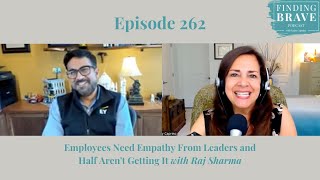
Podcast episode (Finding Brave) featuring Raj Sharma (EY Americas Consulting Vice Chair) discussing empathic leadership and an EY survey on empathy. The survey (≈1,000 respondents across the Americas) began during COVID and was expanded during the 'great resignation' to examine how empathy affects retention and transformation. Key quantitative findings reported: large majorities link empathic leadership to better creativity (88%), job satisfaction (87%), idea sharing (86%), and innovation (85%); roughly half of employees report leaders talk about empathy but fail to follow through (≈47% previously, now ~50%). Raj describes empathy as actionable (not sympathy), ties it to purpose and safe culture for experimentation, and offers leader practices (vulnerability, communication, customization, courage/curiosity/care). Episode date/metadata: uploaded by Kathy Caprino (July 27, 2023).
Chapters
We're getting good results from showing empathy and actually really working on empathy, truly caring about what our employees are going through, putting ourselves in the shoes, and then figuring out what's the right set of back to work types of things that we could potentially do.
Hello everyone, this is Kathy Caprino and welcome to my podcast, Finding Brave. I've created this show for everyone who longs to create something bold and brave in their life, to rise up, speak up, and stand up for who they are and to reach their highest and biggest, biggest visions. Each week I'll be speaking with inspiring guests from all walks of business, leadership, entertainment, the creative arts, and the entrepreneurial world. And they'll be sharing their intimate stories of Finding Grave and offer their best strategies for building your most rewarding, joyful and meaningful life, business and career.
Hello everyone.
Kathy here. I just wanted to share a deep note of thanks her helping our podcasts reach the milestone of over 500,000 downloads and ranking in the top 1.5% of over 3 million podcasts globally. In addition, the show consistently ranks in the top 100 Apple career podcasts in countries all around the world, and we have you to thank for that. I hear from so many amazing listeners who share truly inspiring insights about what they're learning from our amazing guests on the show. And I can tell you sincerely that hearing how the show is making a difference in people's lives is why we love to produce Finding Brave for these past five years and are thrilled to continue to bring it to you. Thank you again for all your support and encouragement. And I and my awesome team are sending our deep thanks and wishes for a beautiful Finding Brave week.
Thank you again. Hello everybody. Welcome to another episode of Finding Brave. I am beyond thrilled to have our guest today talking about something that is so essential, but I think it's still misunderstood, I think, and you'll hear in a minute what I mean, but I think in some ways it's still considered a soft skill, not something that's essential for business. I think in some ways it can feel like a dirty word for a lot of leaders and we are going to dig into. Here's the title. Employees need empathy from leaders, but half aren't getting it. And our guest today is Raj Sharma, an expert on this. Raj, thank you for taking time out of your crazy busy schedule. So appreciate it.
Kelly, great to be here. And as you said, this is a great topic and the timing of it couldn't be more opportune to figure out and delve a little bit deeper into this.
I love It. You're so right. All right, everyone, let me tell you about Raj. So such an impressive background and I'd love to even hear what happened before this position if you don't mind telling us all. But here it is. Raj is the EY Ernst and Young.
America's consulting vice chair.
He is the global business executive and transformative technology leader with over 25 years of experience in commercial and financial services, building businesses and executing strategic growth initiatives in Israel. Raj leads 25,000 consultants. That just makes my head explode. Across the Americas service line.
Wow.
So of course your phone's going to be ringing off the hook. It already happened and we understand and we're here. You know, we had a fascinating Forbes interview as well, and that's going to be linked to below. But we're here specifically to talk about a survey that EY did on this topic of empathic leadership. So I would love to dig in. I mean, the findings, the data, the hard data is fascinating. And before I ask you all about the survey, aren't there some other data points that employees feel? Empathy. Empathic leadership is so important for a lot of things, for engagement, for innovation, you know, for so many things. And yet the study shows that we're failing on that. So can you start with why did you all do a study on empathy and leadership?
I think, Kathy, it started with need. I think all opportunities start with a need. If you look at my predecessor, Steve Payne actually started this and this was started during the COVID years. Overnight we had to get to a remote workforce. We had to serve our clients. 25,000 people coming together to serve all our different clients. And one thing we found out through trial and error is when we were empathetic to the needs of our employees, what was happening during the COVID days, their own family, things that are out, we were still able to bring them together, still have to have a high performing team and we were still able to serve our clients. So we took a step back and said, hey, we're getting good results from showing empathy and actually really working on empathy, truly caring about what our employees are going to through putting ourselves in the shoes and then figuring out what's the right set of back to work types of things that we could potentially do. He said, all our employees must be facing that, all our clients must be facing that. Why don't we delve a little bit deeper and figure out through a survey of about thousand people that are out employees all over the Americas and Americas for US is Canada, us, Latin, north and south, we wanted to get all this data to see what is the data telling us. And that's what initiated the survey. More coming out of the need. And then in 2021, when the great resignation was happening, the survey turned into what can we learn from empathy to be able to ensure that we are creating a workplace for belonging where we can retain employees, we can learn from the data as to why people are leaving. And then this year, the next part of the survey was, even though things have changed, you have seen a sudden downward spiral on the economy. Rising interest rates, war in Ukraine, job loss that is happening. Associated with that, the tight labor market. Even though some of the parameters have changed, the impact of empathy as to what you do even during this downturn and uncertain economy, is going to be really important for companies that want to forge ahead and transformations that want to get ahead. And that was how this whole survey originated.
I have questions galore.
Here they are. And you might not know the nitty gritty of this, but when you speak about empathy, what comes to my mind, I have to tell a little story. Before I became a therapist and understood what empathy is. And, you know, there's a lot of different definitions, and I'm going to hear what your study talked about. But as I have experienced it, it's not ne. Not just compassion for another person's plight. It's actually understanding what the living reality might be of that. And I think that's. That's where we're not doing so hot, most of us. But I want to. I want to understand when you said Steve Payne had the idea. That's his name. Yeah. To study empathy and could see that those leaders who were more empathic seem to do better, was it that kind of. Did he have. Or you as a team have that kind of observation? I'm wondering how that observation came to be, because the more you can teach us, the more other organizational leaders can say, huh, I can do this same thing. I can do this kind of study. I can do this kind of.
Of.
Of observation. Was it that you saw that there were 10 leaders, men or women or any gender, that you thought something's going on there that is not going on over here? Is that how the seed of it emerged?
A little bit of that. And if you can see, you talked about 25,000 people in America's consulting, but there are 44,000 people that work as an extended part of our family through our offshore locations in India and other places that were out there. And when you heard on the news what was happening in Europe before, it actually Hit in Americas, you heard what was happening in Asia Pacific, in China, where our colleagues were there, the fact that we had people out there, the fact that we learned from the Chinese leadership, from the Indian leadership, from the Australian leadership, from the Greek leadership, as to how they were dealing with their employees, how a small group of partners, senior managers and others were getting involved at the ground level. You use the word empathy isn't about sympathy. Empathy is about caring, but also understanding putting yourself in the shoes of the other person to figure out how is that person exactly feeling the external factors. I'll give you my story. In India, I had three family members that perished because of COVID And these are all working members associated with that. This was not because it was just because of lack of oxygen. Things that we take for guaranteed out here, that is out in that area. If you have lived through that, you understand that it is much more about work. And if you treat work as a family and an extended part of the family, you bring that in to say, my employees are facing this, my clients are facing this. I just cannot ask them from 9 to 5 to work on a zoom call. They have families that they are taking care of. You start putting yourself in the shoes of those people and you understand, you have a better appreciation of what they are facing through. And you know, in a very small way, I think Covid was a big equalizer, Kathy, because we all faced it in some way, form or fashion. We all suffered from it. So it wasn't about that. I had to imagine what others were feeling. We could very much see that we were stuck in our homes. We had to take care of our own families. So whether you was a leader or you're an employee, I think the barometer was very simple. And that accelerated the use of empathy to understand for people, to people who thought this was good words. And you use that in meetings and other things. It became authentic, actionable empathy. Things that you need to take over a period of time. I think that's what sort was the culmination of all of this, is to truly feel it, have a global impact associated with that. Learn from others that are out there and your personal experiences. You have to be vulnerable. You have to dig deep into that to be able to truly understand the impact of empathy. And you have to really draw out the exact meaning of it to make sure. What does empathetic leadership mean beyond just words? Like I clearly say, empathy is not sympathy.
I love it.
It's a very simple empathy is not sympathy that is out there. I can be sympathetic to anything. I can only be an empathetic when I understand what you're going through. I'm putting myself in your shoes and I'm taking actions to ensure that I'm helping you come through that. That's what empathy is all about.
You know, why do I love it? I love it in 400 ways, but I love it too, because I have to tell you a story. When I was in the hardest role of my corporate life, 911 happened and I was laid off a month later. And the leader at the time. How would I put it? Empathy was not his strong suit. And I knew he that he was told by his advisors walk through the floors of the office, I could just cry and ask people how they're doing. And he went by and there was no emotion in his words, how are you? How you doing? Okay. And when you're on the receiving end of that, which I think is all about what your study talks about, you know, it's full of blip. You know, you're doing it like a robot. And that is more damaging than if.
He didn't come out at all.
Yeah.
So can we talk about. That's why I think it's so important, because. And we're going to get to, you know, having been a therapist, I think that we can tell people this data till they're blue in the face. But people that don't want to feel vulnerable or have never been trained to feel vulnerable. And you know, I did a podcast with Mark Green on remaking manhood. The man box culture. I talk about it constantly because it was so eye opening. But people who have, and women too have been trained. Don't be vulnerable. Don't show vulnerable. Don't cry in the office.
Yeah.
This is all going to be very hard for them. But let us go right to what you thought the most compelling findings were from this study. Would you.
Yeah, I think if you as a business leader, if you take all that back, the human emotions are very important. One of our fundamental hypothesis was all these companies based on economic changes. Great resignation. Now a different thing. Lack of attrition that is out there. Everybody is going through some way of transformation. Either you're taking costs out, you're getting new products out, you're looking at efficiencies that are out there. We have fundamentally said that the success of any transformation and the future of any company is underpinned by putting humans at the center of it. Right. We are all doing things around what people will do, whether it's AI or other things. Ultimately, people's lives have to get better. And if you go with this hypothesis, the first thing that we say is if you're putting people in the center of a transformational success, then empathetic leader is a close second. You cannot just put people in the center and not have empathetic leadership. And our survey shows four things. Number one, 88% of the people said it drives efficiency more.
And these are employees of ey, not your clients. Right?
Employees of EY as well as general employees that we send out the survey to various other people.
Wonderful.
Love it. Okay.
88% of the people says it drives more creativity. 87% people say they have better job satisfaction. 86% of the people say there is a lot more idea sharing. And 85% of the people say it drives innovation. We always knew that empathy creates a safer place for people to work. But we were surprised at the data that is driving so much creativity and so much innovation in company. Why is that? It's because if you create a safe place where people are not afraid to fail and that every failure does not have an impact associated with that, now you're creating a culture of mutual respect, belonging, and more importantly, accountability of the success of the company that is out there. It's no longer just the leaders that are accountable. And as employees, I'm doing that. The fact that you have created a safe place creates a unique sense of accountability. To say I'm accountable for the success of it. I create an experiential culture that fosters experimentation and I'm okay to experiment because my failures not will only lead to a job exit or something of that nature.
So can I stop you, Rachel? One. One thing I think somebody might be asking. Wait a minute, wait a minute, wait a minute. How does empathy do all that? Can I just take a stab and see if this is right?
Sure.
If you're my employee, you're going through something. I take the time to sit with you, understand your living reality, try to help you in any way navigate that living reality. I invariably am vulnerable and open. I'm not well defended. I'm not hiding behind a wall. Also, if I'm empathic, there's more diversity, equity and inclusion. Because I understand you and you're much more like me than you're not like me. Yep, all of that will make me feel like you have my back because you understand and respect me. Is that what is going on that makes it a sense of belonging in a culture of trucks? Is that it? Did I get it?
Absolutely. And all that boils down to you're creating a safe place for the person to work where I've identified with you. I understand your problems, I just don't say I care about your problems. I actually understand your problems.
I may not agree, I may not agree with your values, but I understand you have those values. Right.
You've done in one step, created a safe environment for ID exchange that is a out there. Second is the fact that I am talking to you about a safe environment where it's okay to experiment, it's okay to fail. Suddenly you no longer are talking about a job that you're doing. You're part of a large transformation. That's the other thing that we fail to do. We talk about empathy and all these words that are out there. We don't link it to purpose.
To what?
To purpose.
Right.
That is out there. Right. So we're all in the business and we all have balance sheets to manage and profit abilities to deliver on. But that doesn't mean it is all about profitability and balance sheets. If you keep humans at the center and employees at the center and you do feel that they are the big part of what you will achieve, you have to make them see what the big picture is. You have to communicate, you have to be vulnerable, you have to create the right places for them to experiment and you will see amazing results will come out. If you look at the history of the companies that have created those environments, take Apple for example, their level of innovation, their ability to be number one, two and three in any business that they get into over a period of time has sustained companies who haven't done that, they've had spurts, they've come down, they've gone up again associated with that. So if you're going to create a consistent culture of high performing teams that are out there, empathy has to be a big part of it. They don't teach that in management schools, they don't teach about in leadership traits associated with that. What the past four or five years have shown us is that's such a powerful thing. That's what our study is. We harness it the right way. It creates leaders of the next generation in a completely different way.
I love it. And the big finding that I think we have to share here is what's the percentage who said yeah, it's so important and boy am I not getting it. What is that?% More than 50% of.
The people they said that they are really not getting the value. So they, they talk, they talk about leaders who, who talk a lot about empathy, town halls Notes that go out and the percentage went up 5 points in our second survey, 47% of the people used to say that the follow through is not there. Now at most half the people are saying that the follow through is not there. And that's very accurate. We see a lot of leaders talk about it because it's a cool thing to talk about, but little less follow through. And this is where the employees get really disgruntled to say, I can see you talking about it, but where is it embedded in the fabric of what we do? How is it creating the empathetic culture of the company that is forged from the fabric of empathy that is out there? Where are the real tangible actions? So when we talk to leaders, we say, look, work, it's not just good to talk about empathy. The most important thing is authentic, actionable empathy. What do I mean by that? Don't say it for the words. Don't read a book, don't quote somebody that is out there. Speak for your heart. You use the term vulnerable. Be there, understand it. Second is communicate. Communication is extremely important. You talked about one on one so that people can understand it. And it only can happen when it flows down into the fabric of the leadership that is out there. Over communicate on empathy. Be transparent with the state of the business that you have. So if you are going through a hard time in the business that lead to layoffs and other things, don't dance around the bushes, just clearly, transparently say the business we are in mistakes that we have made, things that we need to adjust. Employees will understand that half the time people have ill effects associated with that. When you're not transparent about the employees. And the last thing is be authentic. This is the first time I'll say use the word I a lot rather than you. I never. There's no I in team, as we call it in consulting. But when it comes to authentic leadership, I can tell you I don't understand what you're saying. Or I can say, hey, I don't understand what you're saying. Can you explain to me a little bit better? It suddenly creates a safe place for the employee and suddenly creates a safe place for employee to be able to say, I'm not guarded any longer, I can speak freely that is out there in that area. Have the courage to listen. Have the courage to listen. Have the compassion to be able to make the changes. Have the compassion to understand the various types of things that are out there and be willing to make the changes that are necessary. The second aspect of it, third is really looking at. You'll get information on the topics from the diverse workforce that you have. You have to really understand the various diversity things that are there in your, in your group. The number of women that are working, their needs are very different. People in India that are working in your centers that are completely different. What are the right actions that are necessary that adjusts all the workforce. Not just passing one circular, that one size fits all. You have to be customizing it for a large global company so that it addresses all aspects of that. And last but not least is the impact to me as an employee impact to you as an employee. Which goes back to the purpose point of it is if I understand why all these actions are taken then I can galvanize around it. I could be a big supporter of that or I can understand the implications associated with, with that. Half the time leaders don't take the time to really set the purpose of what you're trying to do. These are not empathy. But these are what leads to authentic actionable empathy as we call it. Which is what the biggest finding of the second survey was. It's not just using the words and the impact of it. I think there's a good measure. What do you need to do from an actions communications, another perspective to truly make sure that it is embedded in every aspect of your leadership.
It's so important and so rich.
All right.
I have a few questions that you're not prepped for. So it's okay you live this world.
Yep.
You know, I, I was just quoted in Canada's biggest newspaper, the Globe and Mail on why are there so many bad leaders? And it was about the Peter Principle, the idea that people are promoted to a level at which they will be incompetent.
Yeah.
And the wonderful writer asked me what do I think? Why are there so many bad managers? And you know, I'm working with people who are on the receiving end of horrible management.
Yeah.
And leadership. And, and I gave my thoughts about why. And I believe that it's not simply a matter of that we've promoted people, the wrong people into higher level jobs. It's this. We're not born leaders. I don't like that idea. And it's not true. There is a lot that goes into being an effective leader and manager. And it isn't just what we're born with. So somebody today asked me what do I think is the one most essential trait? And I said, I can't answer that. There isn't one. But here's five. And I want to tell you Those and then ask you a question. Sure, I remember them. One is deep self awareness.
Yep.
The second is communication strength.
Yeah.
The third is understanding your biases and doing work to mitigate them. There's a fourth. I'm forgetting the fourth. The fifth is doing is not leading. Micromanaging is not helping people do their work and succeeding in their work. I'm sure the fourth will come to me. So, Raj, I know you don't want to be doom and gloom, but I've managed a lot of people. I've worked with thousands of people. There are some people and I'm dying to know what you think that you can tell them to their blue in their face what empathy is. You can tell them what great leadership is. But my experience is there's a good percentage of people that need in depth training.
Yeah.
They're not going to get there on their own.
Yeah. No, I completely agree.
So what happens? You're managing 25,000 people or an extension 44,000 people. What do you do when you see people that they can't do this on their own?
Yeah. So look, I have always believed that we learned through all the four or five traits that you laid out. And those were very well said and very important. Nobody has all of them. We have, we are good at some things and then we have to work on other things that are out there. Right. I use the word transformation very carefully. And I said you have to transform yourselves as a leader on a regular basis. The day you stop transforming and saying I'm this type of a leader and that's it, that's where the demise starts. That is out. Right. If you are open enough, just like we talk about businesses, that businesses have to disrupt themselves and transform themselves. Leaders have to disrupt themselves and transform themselves is is extremely important that is out there. So I had five things that can help people learn. Authentic empathy, as we call it. Right. So one is start by transforming yourself as a leader. Right. All the things that you just laid out. What are my strengths? What are my weaknesses? I have a list of big list every day that I look at all the things I could be doing better. And that list is longer than the list that I know that I do.
That is did people contribute to that list?
People contribute to that. I ask for and I self critique myself on a regular basis. Right. Is the day you stop self critiquing yourself. The day you stop growing is the day the business dies. In my opinion, that is right. So I have a fundamental list and leaders should be comfortable to be able to Talk about their vulnerabilities, talk about things that they need to make. The second one is around.
Wait, Raj, would you mind sharing one of your areas of development?
Yeah. You know, one of the big areas of development is I'm impatient. That is out there. Right? Is when you run such a big organization, patience is a virtue. Impatience is a virtue. What's the right balance? I want things done yesterday. And that's not always the case at which the enterprise moves. And that could lead to frustrations that are up. So you need to adapt yourself and make sure that the pace that you're setting for your organization is the pace that this organization can move at to be able to do that. And you look, there is. I grew up in India. English isn't my first language. You talked about communication as a trait of the leader. I work on it every day to improve. I have to talk to various groups of people that are people in Latin America, where English is not the first language associated with that. And I think you constantly. And you learn about the culture of the people. What the threat of communication that works well in us might not be the threat of communication that works well in Canada or Latin America. If your communications and your leadership traits are not grounded in the reality of the cultures that you're dealing with with, it's not going to produce the results. Goes back to putting humans at the center. Now I'll get to. What I'm good at is I'm really good at understanding people. I'm a really good team person. I like to be at the ground level. I identify with people that are out and that's what has carried me. The third thing that I've learned, I'll tell you very carefully, is you don't have to become somebody. I think I grew up in the early 90s and it was all about, you have to dress like this, you have to talk like this. These are the leaders that you actually, what the world has taught us is you could be a very authentic yourself and you could be talking about things that you care about. And actually that's more important than trying to emulate somebody you are not in that particular area. So these would be a few things.
That can I make one. I love your openness and honesty. I need to caveat this. First of all, you're so right that different cultures operate so differently. I just got off the phone with a client from one comp. One culture, one country working with everyone else from another. It's a completely different world. So true. And I need to say this, Raj, the Corporate world is a patriarchal world and women, not all women, but so many women want to do and believe what you just said and it doesn't work.
Yeah, I know. And. But that's the change that we have to work to. I also.
We're not. So anyone listening who goes, I'm trying to be myself. I'm desperately trying, but I'm getting smashed, overlooked. I just want you to know you're not alone and we're not there yet. We don't live in a utopia. Would you agree? I agree with that pushback.
I completely agree. But then to people like you and me are the hope that are out there to say I'm a immigrant, first generation immigrant, a guy from tech background and who's running EY's consulting group, which has never gone to a tech person before in that particular area. So change is happening. Right. I get encouraged about the change. We have got a lot of women leadership directly in my area that is out there. So it all behooves in us. And that's where the accountability for people like you and me have to come. We can see corporate America is not there, but we should take a step back. What changes can I make? And those are the important things that we ought to be doing. And each one of us, it takes that.
Yeah, we have to have hope. We have to go to. If we just sit back and bemoan how bad things are, what are we going to do here?
I love it.
Thank you for letting me make that caveat you were going with. I think there was a fourth point.
I think and for the leaders for whom empathy doesn't come naturally to. I think the one thing that you need to talk about is you have to demonstrate courage, curiosity and care. We all do that. Irrespective of what people we are leaders are courageous. There is a reason why you went out there. You just have to define courage in a slightly different. You are curious. That's why you came to this role. You have to be now curious towards understanding and you're a family person. We all grew up as humans and I think I've always believed all humans are good. You care about people till something bad happens that is in that area. If you take those three Cs and you just adapt it to your corporate world that is out there where you are courageous enough to challenge the status quo, curious enough to look at all the various dimensions of feedback that you're getting, truly spend the time to understand it and care enough to make the changes that you learn from that. I Think they'll define empathy for you. To me, those three Cs have been the guiding principles of all the leaders that I have advised over a period of time who would say, hey, that doesn't come. I'm a type A personality. Empathy doesn't come. To me, I said, you could still be a type A personality, but if I'm sitting with you, I'm listening to truly listening to you and understanding where you're coming from and learning from that and impacting that in my leadership style, it becomes really important in that regard. Right. The fourth one, the last one that I would say is, you know, people say speak up. You just talked about women, people coming from various cultures that don't speak up. We have to create an environment for them to feel safe and we have to drop the information out of them. It's no longer enough as a leader to say we want people to speak up. If people are not speaking up, we need to create an environment, a pull of that information from those types of people because they are an important part of your team. And if your voice is just because they are culturally not outspoken and other things is not heard. And that's another important one that we feel. We always look at people who are raising their hands and speaking the question and not spend enough time on the person who's quite at the back of the room, who's got very important things to say, but her or his hands go up like this and come up like that. We just have to make sure that we are giving an opportunity for those people to speak up as well.
I love it so much. You know, I. You might know I wrote a book, the Most Powerful you, about the seven most damaging power and confidence gaps. Yeah. We as leaders also need to have the empathy and the care and the attention to see who. To see the gaps our employees and our teams are experiencing and help them close those gaps. So it's not enough to. Yeah, I hired the right person. They're off to the races. You need to see it and help them overcome it any way you can for. From not recognizing their special talents. You need to tell them, that was amazing what you just did there. That's a gift, you know, that's a talent. From not speaking up, from not asking for what they want and deserve. Absolutely sure. We love it when they're not asking for, you know, 100% raise. However, are they being compensated fairly? And it's our job to make sure they are.
Yeah, no, completely.
Would you agree?
Completely agree. Completely agree. And, you know, I'll I'll round that off with. With everything that is going on in the environment today. Right. You've heard about layoffs and those kinds of things that are happening.
Yeah.
All the things that we have to do in. In the current world to make sure we have to balance our organizations. But understanding and dealing with empathy, even if you're letting employees go, where are they going to land, have services available to them, give them sufficient time that is required in that particular area with not a mad rush to the bottom line that is out there. I think some of these things are necessary evils of a business that you run. But the way you go about it is what's going to define the culture of the firm, the way culture of the employees when the times come around, whether they are coming back and the longevity of the organization and the legacy that you have. And it's extremely important that what our employees are emotionally going through, the change, whether it's a transformation, layoffs, cost takeout, new businesses that are out there, that emotional change that our employees are going to go through again going back to humans at the center, if we don't measure it, our transformations are not going to be successful.
I wish you, many other people of large who are running large organizations that we're hearing about every day understood that a little better. Any last words before we. I know you have to scoot. I do have two questions. You're managing so many people. What do I want to know? What is the hardest thing? I can't imagine. I know you're not personally managing 25,000 people, but what's the hardest thing? Overseeing that scope of humanity. What's the hardest thing?
I think always the fear. Kathy. I have come from very humble beginnings and work is important. I take it personally that we are growing the next generation of the company that continues to provide employment for a lot of people that is out. The hardest thing for me is to balance the needs of the people, the where the industry is headed into that particular area and do it in a way that doesn't deviate from the core of who I am, which is I really care about people that is out there. That's the biggest strength in the business we don't have in the business I'm in. People are our products, people are everything. We design services around that. How do I create an environment for such a large workforce that I'm not creating a company for for today, but I'm also creating a place where the sense of belonging is there, where the culture of innovation is there, the culture of belonging is There. And the culture of taking chances is that that's the hardest part is how do you create that where you have to manage the dollars and cents associated with that. But the silver lining is all our leadership is united when they think about, you know, we have been around for 200 years and we'll be hopefully around for another 200 years. That is out there. This firm has been around for a long period of time. That is that 200 years was a figure of speech, but we have been around a lot.
I was like 200 years. I better read up on my history of organization.
No, no. We have been here for a long period of time. And as an audit tax and consulting company, we're one of the big fours. And our goal is continue to evolve and identify and create a professional services firm which is one of the key pillars is empathy, understanding and a sense of belonging out here. That's our purpose and that's exactly what we. Our purpose you'll never hear is about dollars and cents that will always be there in a business, but its purpose is to create the next thriving group that attracts people with empathy, care, and sense of belong.
Aren't they lucky to have you? Thank you so much. Any last words for leaders, managers listening here saying, I love what he's saying. What do I do first? Any last words?
I think learn about empathy. Get out there, learn about empathy. Get coaches. You just talked about. You do a lot of counseling in that particular area. Talk to people who can help your organizations. Talk about that. And do not underestimate the value of empathy and what it creates. I talked about efficiency, creativity, innovation, job satisfaction. Look at our survey. All those figures are there. So if you embed empathy into the fabric of the culture of your company, you'll reap the benefits as an organization associated with that.
I love it. Can they use your tool, your Reese, your study tool? I think they should also get anonymous, authentic information. Could they? Could they?
Absolutely. They can. They can. And it's available on our website and then the right people are out there to be able to provide the necessary next steps associated with all of that. How do you do?
Fantastic. Where do we soak up more of what you have to share? Raj, where do people go?
Where should we send them@ey.com it's all available on our website and I think once you publish this out, we'll send you the exact link of how to access this survey that is out.
Thank you so much for being here. I really wish we'd all listen very carefully. And I love how When I said, what is your area development? You knew in a minute. Yeah, I'm a little impatient. We all need to know that.
Yeah.
You know, in fact, that's the task I'm going to leave everybody with. Really put yourself in other people's shoes and say to yourself, what are my. Don't call them weaknesses. Don't call them flaws. Where do I need to grow?
Absolutely.
If you. I remember my father who's in heaven. We said, he, he was 93. Ten years ago when he passed, we said, hey, dad, what are your flaws? He said, I think my flaws are. I'm. I'm a little too nice. I said, oh, dad, is that all you got? We really laugh, my sweet dad. I think we ought to know what our flaws are and begin our. Our areas of growth and begin to work on those. Let's start there and asking other people what they think is helpful.
Thank you, Raj.
I love talking to you. I hope you come back again. Thank you for all the great work you're doing. So appreciate it.
Kathy, great to be here. Thanks for the great conversation. I had a great time.
Thank you. All right, everybody, we hope this motivates wherever you see this, LinkedIn, Facebook, Twitter, Instagram. I hope you listen, make a comment, write a question. We'd love to hear from you. And I hope this moves you forward. All right, everyone, have a wonderful finding grade two weeks and we will see you next time.
Hello, Kathy here and thanks so much for tuning into today's episode. One quick thing I'd love to share before you go is about my new digital training program for organizations and professionals called the Most Powerful youl, which is the companion to my book the Most Powerful youl. 7 Bravery Boosting Paths to Career Bliss. I'm so thrilled that recently an international division of the United nations brought in the Most Powerful you program as a training tool for members of their staff. And I'm speaking with other global organizations right now to do the same. This program brings to organizations real world transformative training for leaders, teams and professionals to help them thrive at the highest level in their work and projects. So here's my. Please take a look at what I'm training in the most Powerful you. And you can find that@mostpowerful you.com and if you feel the content would be instrumental for you and your team, I hope you'll ask your leaders and DEI managers to bring in this training program to your company. It's truly transformational for work cultures everywhere and it generates amazing results. Thanks so much. And here's to you becoming the most powerful you. Thanks so much for joining us today. And please don't forget to check out findingbrave.org for more programs, resources and tips. And tune in next time for your weekly dose of finding Brave.
More from Kathy


Elevate Yourself, Elevate Others, and Amplify Good | Chris Cooper | Finding Brave Ep. 334

Finding Brave Epis #333: How Leaders Can Harness AI Without Losing Their Humanity, w/Bennett Borden

Finding Brave Epis 332- How to Stay Brave, Valuable and Visible in the Age of AI, with Raman Rai

Finding Brave Epis 331 - The Power of Positive Disruption, with Dr. Patrick Leddin


Finding Brave Epis 330 - Being 40: Letting Go and Embracing Who You Are, with Stacey Lindsay

Disrupt Career Reinvention with Kathy Caprino - via The Disruption Lab Podcast w/Patrick Leddin

Creating Neurodiversity-Friendly Work Cultures: Simple Workplace Adjustments Matter

Finding Brave Epis 329 - How To Create a Neurodiversity-Friendly Workplace, with Kristen Pressner

Finding Brave Epis. 328: Reclaiming the Power to Trust Your Own Voice, with Dr. Cindy McGovern