269: How to Build Learning Programs That Move Individuals and Organizations Forward Fast
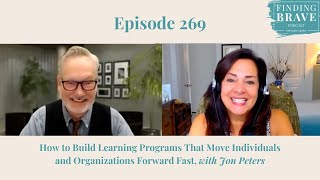
This is a Finding Brave podcast episode (host Kathy Caprino) interviewing John Peters (founder/Chief Innovation Officer of Athena Online) about designing learning programs that move individuals and organizations forward. Peters recounts his multi-decade experience launching learning products (CD-ROMs in the 1990s, early microlearning and streaming video products), explains why microlearning and spaced reinforcement work (cites Ebbinghaus-style forgetting), describes lessons about when to pivot versus wait for market readiness, emphasizes diverse teams and psychological safety for innovation, and outlines current AI integrations (an Athena advice bot drawing on thousands of lessons and ~250 expert contributors). Practical takeaways include defining impact/goals, measuring/distributing content, designing short digestible learning bites with spaced reinforcement, and using AI to surface sources and prompt learner reflection/application.
Questions this video answers
269
About one year after the Internet became open to the public; Peters cites launching in 1994.
Approximately 87% (percent who started but did not finish).
My Quick Coach launched around September 10, 2001; lessons were five minutes long.
He cites that within two days people forget about 75% of what they learned (used to motivate spaced/microlearning).
Chapters
Innovation doesn't happen in a vacuum. It is a collaborative effort and you have to take those ideas and you have to look for diverse ideas. You know, it's not good for me to be with a lot of people exactly like me. I need people who are diverse thinkers and have different approaches to it, and that's the way you really solve problems and come up with different innovations.
Hello everyone, this is Kathy Caprino and welcome to my podcast, Finding Brave. I've created this show for everyone who longs to create something bold and brave in their life, to rise up, speak up, and stand up for who they are and to reach their highest and biggest visions. Each week I'll be speaking with inspiring guests from all walks of business, leadership, entertainment, the creative arts, and the entrepreneurial world. And they'll be sharing their intimate stories of finding Grave and offer their best strategies for building your most rewarding, joyful and meaningful life, business and career. Hey folks, Kathy here. Are you ready for a big positive shift in how you're working and what you're capable of achieving in your career? Let's make that happen for you. While you might know me best as a podcast host and writer, a key focus in my work is helping women achieve greater success in their work. In my career and leadership Breakthrough one on one coaching program, I help women get what they want most, which includes more confidence, impact, advancement, financial reward and fulfillment. And I also help them achieve their most exciting visions for the future. In the past 16 years, I've worked with over 20,000 women across six continents. And before that I served as a therapist and before that I was a corporate VP managing multimillion dollar budgets and global initiatives. I leverage all of that experience to help women build a new chapter where they can reach their highest and happiest potential doing work they love. Check out Kathy Caprino.com CareerBreakthrough and I hope you'll register now. I'd love to support you. Hello everybody. Welcome to another episode of Finding Brave. Kathy here. Wow, am I excited for today's show and I know if you listen regularly. What are we on? This will be number 269, Oligra. I say this every show, but I have to say it, which is this. I love doing the show because I get to learn everything. I'm fascinated to understand that I don't have a deep enough understanding of and today is no exception with our amazing guest, John Peters. John, thank you for taking the time after you had a big meeting this morning. Thank you for joining. Appreciate it so much.
My pleasure. Kathy thank you for having me on.
Oh, so fun. All right people, we are going to be talking about, what is the title of our show here? How to. Well, we're talking about a lot more than this, but how to build learning programs that move individuals and organizations forward. But we're also going to be talking about how to lead your own organization, whether that's a one person situation or many thousands. How to be innovative, how to understand what has to change. And even though, John, what was the, the quote you just, you just gave me? So many pioneers have arrows on their back. Arrows in their back. Yeah, I needed to hear that today, I have to say. And I hope any of you listening who are launching something that you hope will be of impact will get something huge out of this. So I hope you will love it. But let me tell you about John first. Got your amazing bio here. John's bio went on like this, but he's so humble, you know, it could have gone on for 10 pages but here is a brief excerpt. John Peters is founder and chief innovation officer of Athena Online. And you're going to see links to all of these wonderful initiatives and businesses in the show notes. He's also board member for the Institute of Management Studies. That's got to be a fascinating job. As well as director and producer. And you wrote always a nervous dad. How old are is your child or your children?
I've got three. Yeah, so they range from 18 to 26 and.
Still nervous, huh? More nervous than ever.
My youngest, I just put him on a plane last night. He's going off to Ireland to Ballymaloo cookery school to learn how to be a chef.
Come on, what better place?
My daughter's in Australia and yeah, so it's exciting.
You're launching them. Launching them. I love it. But still nervous. We are, aren't we? All right. John has combined his passions for art and technology over his career running an award winning technology focused ad agency and has been involved in computer marketing, corporate development, design, visual effects and film. He's also been an animation director. I mean it's just amazing. And producer. And he founded Athena Online, an award winning elearning company we just mentioned that developed and released the first enterprise microlearning platform. Athena was also one first cloud based SaaS companies on the market. Your bio goes on a little more about what you've done in animation and video and award winning projects for Frito Lay and Adobe and Bosch and Dignity Help and independent films. So read those, read the show notes below. John, you've had about 20 careers in one, it seems. Is that.
Yeah, it's funny. I always love the opening of the movie Forrest Gump with the feather floating through the air. Right. And it seems like that's the way life is. You just float through, through and pick up these different things along the way. And yeah, it's been.
Some do. Some, some. I think, you know, many of the people I work with in corporate situations kind of resist that kind of change and that kind of flow. I mean, that's one thing those of us who have our own enterprises and businesses had the opportunity to do. I'm not sure we all do that enough. So let's, let's start there. Can we. You were talking a little before we pressed record about innovating, pivoting, changing. But you also said something that was fascinating. You tell me how you put that. We have to know what the impact is that. That we want to make. Is that how you put it? Let's start there.
Yeah. I mean, Kathy, we were talking a little bit about the folks who are creating their own content or own learning content. Right. And. And I think it's really critical to define the purpose of what you're doing because a lot of people get stuck in sort of the how to make it. Right. We're going to build this because we can. But. But what's the reason behind it? You know, it's framing. It's in problem solving. It's the idea of framing. Right. Okay. So let's. And, and I think that's really critical for organizations and for individuals who are creating their own content. To do is you have to know what is the end goal that you're trying to reach, and that helps you sort of lay out the path to it. Does that make sense?
Yes, but let me dig into that. And you know, again, I have people on, like, I'm picking your brain as if you're a consultant. I hope you don't mind. I hope that's helpful, people. So, you know, I have several courses, and one is the Amazing Career Project, and that started eight years ago, and that was 16 essential steps to Building a Better, Happier Career. And why did I do it? Because I saw that people didn't know how to. What to do, to change or pivot or grow their career. And I didn't either. It's always about my. It's always about me. What I didn't know that I wish and that the goal was impacting and helping individual women. So B2C, then there was the most powerful you, which is, to me, the Precursor, really. Confidence, power, impact, communication, strength. If we don't have all of that, if we have power and confidence gaps, we can't actually thrive in careers we build. And so when you say you, you want to know why you're doing it or what the impact is, can you tell me, would it be more than that, that I should have been aware of when I launched?
Yeah, sure. Let me unpack it a little bit more so you're understanding the purpose of what you're trying to create, the change that you're trying to create, that helps define the map. But then you also need to decide, okay, now, how do I distribute that? How do I get that to the individuals? How do I create that connection with the individuals? So having the end state in mind is, is critical and being able to measure it. But if you're going to measure it, that also gives you part of that path. Right? Because now you've got to say, okay, now If I want 3,000 people to view this, I want to change 3,000 or 50,000, however many it is, how am I going to distribute it? How are they going to learn about it? How am I going to continue to communicate and connect with this group of people? So I think those are all pieces of it.
And I think you, you gave me some amazing advice as well. Let's unpack it. You know, for people like me working B2C business to consumer, when you have an opportunity, that's a different way of delivering B2B, sometimes things will have to change. So I asked you, and I'd love you to tell us, you know, have you ever had, and I know the answer is yes, a tenfold. A situation where you were pretty clear exactly what the map should be. You vetted it, you did research, and, you know, you first mentioned CD ROMs. But I think this has happened in a number of different ways, when the market then either changed or what you delivered wasn't going to work. Tell us about when you've had those situations and what we do and when do we scrap it? When do we edit, change, revise, or say, oh boy, I missed the mark. I completely miss the mark. What do we do here?
Yeah, and it's different in every situation. So for instance, I, you know, we were talking earlier that we started back in the CD ROM days, right before the Internet. I mean, we literally launched our first learning programs one year after the Internet became open to the public.
When was that?
Early 70s, 89, I think it was not. Or 94. 90. 94. Yeah, I think so. That's when we first came out was in 94. So the Internet became. Had become available just right about a year before we launched. So we did the CD ROMs, we spent. I told you, we had quite a big investment in that. We were written up in Fortune and Wired for the work that we had done on them, Books on human factors, all those kinds of things. But what we found was there was a tremendous dropout rate, 87% dropout rate, not just for what we were doing, but for what all of the other companies in the market were doing.
What's that mean? Dropout rate? They buy the thing but not actually end.
Who would start but not finish. So 80, 87% of the people who started didn't finish. And we assumed it was technical issues, but in fact it wasn't. It was that people were starting to learn in different ways. We had to make a very difficult decision at that point. And we decided to let a number of people go and reinvent the entire delivery of the company. Because what we found is people were going in and learning in these very small little bits and pieces. They'd jump in, watch six minutes, they'd go watch another piece, that's three minutes, and then they'd leave. Then they'd come back a week later and watch some things. And so we decided, if this is the way people are learning, the shorter attention spans, let's design a system that works that way. Which is how we came up with My quick coach in 2000 and we had to scrap everything. Now, Kathy, I got to tell you, when we launched My Quick Coach, it was video over the Internet, five minutes long. It was five years before YouTube came out.
Look at you go. So innovative.
Yeah. And remember the, the quote about the pioneers with the arrows in their backs? We got kicked out of a lot of offices, let me tell you.
You mean as you were pitching it?
Oh, yeah. We were told by lots of people that video on the Internet was never going to take off. Nobody was ever going to use it. It was. It was too slow, too difficult to use, that we needed to change everything. We were told by many people, including investors, that we needed to change everything we did and just make a text.
Oh, my Lord.
Yeah.
The absolute, absolute antithesis of the reality. Text based only. I mean, right? People don't read now.
I mean, and people said that nobody can learn anything in five minutes. Everything had to be four to six hours long. So we talk about knowing when to change at that point. We were resolute in that we were right and we didn't change so we kept going and we had to wait for the market to catch up. Now, you and I discussed earlier that there were some other things we did. We had a. We created one of the first peer to peer sort of streaming coaching applications back in 2005, 2006 I think it was, which we ended up scrapping. So we had to make the decision. Even with the investment of time and money in it, the market was really, really far behind. And so we ended up having to scrap that. And we've had to do that a number of times. We've come out with things that were very innovative, but we've had to let them go because either the market wasn't ready for them or the technology wasn't ready for them.
Look at me, I'm actually tearing up. And I think it's because it hits so home for me. Like when I did my it's all about me here on this podcast. No When I wrote my first book, 2008, 12 Hidden Crises Professional women faced, women's issues were not in the national conversation. Can you imagine? Nothing was written, nothing was available. It was anti popular. So here I do this book and it comes out in 2008 in the fall economic crisis news was Obama, Palin and the economic crisis. And I thought really? And then I come out with the most powerful you in the middle of COVID And I thought what's going on here? But it's so hard. And I want to add, there's a question in here for you. When? And I guess I wasn't going to bring this up, but it is upsetting me a little bit. I really believe that the coaching work I do is based on a lot of research about what changes people. And that comes from my corporate life being a therapist and coaching for 16 years. And so many people at organizations are afraid don't go deep when we're doing training. I think that's backwards and I think it's wrong. And I think you can see the results of these ineffective, non impactful programs because we're not moving the needle.
Well, people don't change unless there's a pain point. Right. They have to want to change. There has to be a reason for them to change.
I need to. They have to be at a breakdown moment or a moment where this isn't working. And if you're only up here, that doesn't happen. But why I bring it up is I think we can sometimes bloody ourselves against the brick wall that the world isn't quite there yet. What do you. Is that right? Does that make sense? That.
Yeah.
I mean, I'm wondering within that question is this, how have you been? And you're humble, so you're not going to like it and you're going to blush at this question, but you are so clearly ahead of time, ahead of what is. Have you always been like that? Have you always, as a kid, thought way out of the box?
Yeah, I always wanted to be an astronaut. That's what I. That was sort of.
You could do it now if you had, you know, what is it, half a million? No, I don't know what they're paying.
Yeah, I like pushing the boundaries and I like thinking out of the box and I like approaching ideas and not just saying, you know, when people say, well, that won't work, to ask the question why or why not? Why can't we make this work? And maybe we're approaching it. So looking at innovative ways to solve problems and some of those might be, you know, not approaching it head on. I think that's one of the issues that people run into is they often approach a problem head on.
What's that mean? Don't do that.
So, for instance, when we were looking at reinventing, creating My Quick Coach and reinventing, what we were doing with learning is we looked at all the competitive landscape out there and we looked at companies and I think I mentioned this, that when we launched Myquik Coach, it was on September 10, 2001, we had VC meetings set up. We had all of these things that were then canceled. So, you know, we. Yeah, we had a lot of backing and all of that got canceled when the towers came down. So as we reinvented that model, this new model is we had to look at what was the competitive landscape and we had to look that companies were much better funded than we were. They had a lot more trajectory, a lot more Runway than we would have.
Meaning the ramping time, the development. Yeah.
Because they were so well funded, they. They didn't need to make money. And while we did.
That's a nice place to be.
Yeah, isn't it? So, so we had to look at. And they could pay faculty to come in and do things and they could just write big checks and all that. We had none of that available to us. And so we took a very innovative approach and we broke down everything. And how do we overcome these different problems? By first of all, doing something very, very different than any other company was doing. So creating a product that nobody else was doing, compensating people in a way that nobody else was doing. This is where the whole SaaS model came from for us. It's where we ended up moving to cloud based computing. We couldn't scale to the point we needed to without putting videos. Again, this is the video problem, the streaming video problem. We couldn't do it without putting the videos out into distributed networks.
So versus what, versus what, what, what would it be?
The versus having our own servers or building it all.
I see. We had to distribute it in this way. That's an economic reality for you.
It's an economic reality and a technology reality in that, you know, we had clients in England for instance, who were trying to get videos and if we had them out here, it was just, it was just too slow. And, and remember Kathy, at that point we still had some people who were operating on, we had a few companies that were operating on pile up modems.
So it was seen a lot of change in your lifetime. My goodness.
Yeah, it's been exciting.
So I'm going to tease out two other things that I think are really important. You said, and it's making me realize I don't have this data. You know, people are coming in, they're digesting six minutes, then they're leaving, then they're coming back in two weeks. I don't have that data on my, my courses. But what I do sense from you is you're very research based. You're not winging this, you're not making it up. Here's what you need, you know, what people need. And so would you agree with that statement that in depth research on what the market needs, what's out there, what they're not getting, what they are getting, is essential to success to these types. Tell us more about that.
Yes and no. I mean, yes, absolutely, yes. Right. There's a way to evade an answer. So it is important to do that sort of research, but it's also important to ask what if? Right. So you know, if, if you only go by what everybody else is doing and by what the research shows, you.
Won'T innovate, you can.
Right. You can miss some innovation. So it's also important to say, well, what if we did something different? So you know, one of the things that we found works really, really well for learning. And, and this does go all the way back to the 1800s actually to the Ebbinghaus Forgetting Curve by Herman Emmett. Herman Ebbinghaus is this idea of, of putting learning over a period of time because people forget, as I recall, the figure is that within two days people forget 75% of what they learned. Through a course or program, that kind of a thing. So you have to reinforce that along the way, which is where the micro learning really becomes important. Because if you can do some sort of a drip learning, and we talked about this a little bit before, this idea of creating connection with people, but creating connection to reinforce the learning that they took and asking them to apply it in different ways over a period of time, 30, 60 days, those are the things that we find work best.
You know what, it strikes me now, I've never studied. You know, I don't have a master's in curriculum development or it's really what I've felt I've needed, what I see is needed, what is proving out to be needed. But one thing I say in all my talks and courses, insight is great, but insight doesn't change your life. It's action that changes your life. And what you're talking about is here's the idea, but here's the step. The action, the change. 100 if we don't do change, ideas are nice, but.
Right. I always analogy that, you know, if, if I realize that if I eat 10 donuts, it's not going to be really good for me, but if I eat them anyway. So, right. You've got to change those habits. You've got to, you've got to put that. You got to apply what you know.
Exactly. I love it.
Difference.
Now, there's another thing. You say a lot. There's a word you use a lot in every sentence. Do you know what it is?
No.
You say we.
Yeah.
And I think you're humble. So even when you've done something, you'll say we. But I do think we is an important aspect here because it seems to me. Tell me if I'm wrong. You must have some amazing people on your team from the beginning or who have helped you do what you've done. Can you talk, Am I right?
Can you talk about standing on the shoulders of giants? Right. I mean, honestly, that's what it is. It's. Innovation doesn't happen in a vacuum. It is a collaborative effort and you have to take those ideas and you have to look for diverse ideas. You know, it's not good for me to be with a lot of people exactly like me. I need people who are diverse thinkers and, and have different approaches to it. And that's the way you really solve problems and come up with different innovations. So, yeah, when I say we, I really do mean we. It's, it's certainly not just me.
I really want to hit that home you know, I'm someone who teaches this, but it's hard for me. I mean, we're more comfortable when. With people who are like us, we have to fight against that. When we're. When we have our own board of directors, whether that's one person or a mentor or a team, it's really those people who don't see it the way you do that you will learn so much from.
Yeah. And you have to create the psychological safety and stand back and let them speak. Because that's the other problem that I've found in being a founder of the organization is people wait for me to say something and then they just agree, and that's not good, you know, so you have to sort of stand back. You know, one tip I heard for. For leaders is arrive at the meeting late.
Right. So let people.
Yeah.
Do you do that literally? Do you? Or is it more metaphoric?
It's more metaphoric.
That would make people go, where the heck is Kathy? She's always late. She's disrespectful.
Right.
But I understand the idea. And, you know, can I just say, as a former therapist, but in coaching, how you respond to challenges, it's one thing to say you want challenge, but if you get defensive and ruffled and angry, you just shut it right down. So if you need help with that, you know, get some outside help, you know, you want people to Respectfully, always respectfully. Like, you know, I have a big following on LinkedIn and I say stuff people don't agree with. Like, I talked about the Barbie movie and how I wanted to love it, and it disappointed me in some key way. I knew people were going to want to take me down for that a little bit, but I said, share, but share respectfully. And by goodness, they did it. They really did it. So we need to show people that we want challenge, but we also have to guide them in how best to do it so that we aren't screaming at each other and shutting ourselves down because we're defensive, you know, totally.
Well. And I love the idea, you know, Pixar has the idea of plusing. Right. Is to build off what somebody else says, which I. Which I really love. Right. So you build off of it. It's like, great idea and. Right.
And so I love that, you know, we. You could say, john, I really. Let's say you said five things and I don't like four of them, but I liked one. Wow, John. I really liked that. I'd love to build on that and blah, blah, blah, rather than smack you down and humiliate you and shame you for what I think are bad ideas, you know?
Right, right. And that's. I do think that's a part of a problem with a lot of leaders is they want to feel like they're the smartest person in the room still. Right. And it's. And that can cause some trouble, and it will shut people down and they won't share ideas and you won't get the best innovation.
One of my most favorite mentors was the president of the book club company I worked at for 11 years. And he's passed away now. And I never got a chance to thank him years later for being a mentor before I even knew what a mentor and a sponsor was. But he would say this. You'd present something and he would say. He'd look up and he'd say, well, that's not the worst idea I've ever heard. And that would. That would be a 10. Like, if he said that that was an idea, I wouldn't recommend saying it like that. But when he was a kind guy and once you knew his style, you knew, okay, it wasn't the worst.
We're moving forward.
Too funny. All right, now, what else? What about your creativity and how can. How you're so prodigiously creative and. And you've done it in a lot of media medium, mediums. What's the word? You know, in film and animation. And how can. How do you teach creativity? Do you know Berkeley or Stanford or. Boy, I would love to take class.
An avid learner in terms of creativity and innovation. And it is probably the thing that's most exciting for me is, is the idea of innovation, personal creativity. And I believe everybody is creative. I know we've got a lot of folks. My wife is one. She said, oh, I'm not creative. I said, you absolutely are creative. Everybody is creative. But there are different. You know, I. I had an old friend, Tony Buzan, who used to talk about, you know, the different sort of ways that people think. And creativity is one of those kinds of things where creativity shows up in different ways for everybody. You may not be able to draw, you may not be able to play music. Perhaps you're a great cook. Perhaps you have different ideas on maybe you're innovative with your kids and how you get them to not jump into the cookie jar right after school or some of those things. I think everybody has innovation and they just sort of have to find it and they have to work on it. They have to set aside time for it.
So you and I are on such the same page. And I didn't realize all these things that we were. For instance, you know, a lot of people, especially in corporate organizations and, you know, they're just spending every waking minute doing work. And if they have family or their caregiving for elders, which my sister did of my beloved mom, who passed at 98 in March. Why I'm bringing this up is so many of us have had a passion and a creative gift when we were little, right.
And we were taught not to express it. Right.
Or that's a nice little hobby. Move on and focus.
Are you drawn outside the lines?
Oh, that's another thing, Right. But so often in adult life, we let those go. And what I always ask people to do is, you know, I always say, writers write, teachers teach, dancers dance. You don't have to wait till a lot of people will say, I want to write a book like you, Kathy, but I have to work. You don't have to give up your job to write a book, start writing, write a blog, write a word, write a haiku.
We had, when we did our first stop motion animation here at the studio, we had a great mentor, John Berg, who worked on Star Wars. He did the Walkers and Empire Strikes Back and the Tauntaun and a number of things. Amazing stop motion animation. Person, animator.
Can you explain to people who don't know what that term means, what stop motion is?
So stop motion is where you have. Well, there's a number of ways you can do stop motion. People a lot of times think of claymation, the old Will Vinton dancing raisins, that stop motion, Right. But you can do it with live people, with objects. Typically in movies you've seen, like Coraline, Nightmare Before Christmas, they use very small puppets and they move the puppet, okay, just a little tiny bit, take picture, then they move it again. And if you're lucky and you're doing a good job, you can get three to seven seconds of film a day from doing it. So it is a very long process.
Is that what Pixar is? All the Pixar.
Pixar is computer generated. Although they are apparently. I'm not sure if I should be saying this. Apparently they are working on a short stop motion piece, but they're computer generated, which is also very time consuming, but on the stop motion side. And the reason for this story is that John Berg. And this goes back to your book writing, actually. So we'll tie it back into that. So we had agonized over how we were going to do this stop motion piece. And we kept changing how the puppets were going to be made and how the faces were going to be made and all the parts. And John came in one day, and he said the most important thing is to just start.
Just keep going here now.
Yeah. He said, you'll figure all this, will. You'll figure it all out. He said, but you've got to start. And. And that's the same for writing the book. Right. You just have to start.
And that is the hardest thing, sitting your butt down in the chair. Even when I had a book deal, you know, I'd be like, maybe I'm gonna go wash the floor or, you know, clean the toilets. Anything but write the chapter.
Yeah.
Even though it was all there. Yes. We know it's hard, and there's something about getting that first thing out. It's. It's incredibly challenging, probably because of all the fear and resistance that. Is it good enough? I don't know. It can be hard. Right.
It tends to flow out. Right. And then you can always go back and iterate.
Eddie, editing is a lot easier than creating, right?
Yeah, absolutely.
All right, we just have a few more minutes. John, what else can you tell us about? Let's go back to all you've done in the learning sphere.
Sure.
Do you see. Is there anything that jumps out when you're looking at the competition that you think, boy, they're getting it wrong?
I don't know. I don't think people are getting it wrong. I mean, everybody's trying. Everybody's trying new ideas. Right. And. And. And I love. You know, I look at the competition, I'm like, wow, that is great. Good thinking. And I wish I had thought of it. Right. That's. That's the biggest phrase. I wish I had thought of that. Great idea. It's. Yeah. I don't know that anybody's really getting it wrong. Everybody's just sort of trying different things. I mean, the latest thing is artificial intelligence. Right. And people are using that, and we've incorporated into what we're doing.
Can you tell us how you've incorporated that?
Yeah. So, you know, right now we've incorporated. We. We launched very quickly in terms of what we wanted to do.
So quick coach, you mean? Or.
Yeah. Online General have a advice bot called Athena who will advise based on the thousands of microlearning lessons and the 250 experts that we have in the system. So it'll take all of that information to answer very specific questions, and then it will show the sources to those. So let's say Kathy, he said, I have to have a difficult conversation with an employee who is underperforming. They're not showing up at meetings on time. What are five things that I can do to try to turn this around? It will outline the five different things it'll give you from.
From your Quick coach.
Yes. It'll draw from the Experts, from the 250 experts we have in the system and the thousands of articles and microlearning videos that we have. It'll pull the information from that, give you the five steps you need to do. And what's more is it'll say, and here are the sources, here's where I pulled that information from. So it'll give you links to the different microlearning lessons so that you can then go in and do a deeper dive.
You created that or you're using existing AI.
We use some existing AI platforms. We pulled from that and then started putting in our own pieces. Our own AI is going to launch in a couple of weeks, I think. So we're developing our own artificial intelligence bot.
I want to do that for. You know, I've put out so much stuff, I want to do that.
It's becoming incredible, I've got to say. It's becoming incredibly easy. These new tools are really amazing.
Can I just use OpenAI and say, answer this question and draw from Kathy Caprino's material that's online, the over thousand articles. Could I do that?
There are. Not with OpenAI but with Microsoft Azure. They have a closed system. We've worked with a company called Custom GPT which does that as well. They all pull from ChatGPT in order to create the large language or the way that it interacts with the user. But it's a closed system, so it's not going out to the Internet and pulling. You know, one of the problems with Chat GPT is it has this tendency, it's getting better, but it has this tendency to hallucinate. It will answer any question that you ask. If it doesn't have a good answer, it'll just make one up. So. So you gotta be a little.
Say, don't make one up, go find it. Can you, you know, prompt. Anyway, that's another topic. So you've developed this, what an. An add on amazing tool.
Yeah. And you're. Where it gets really exciting though is on the back end of that. Right. So that helps in terms of search, but on the back end of that. Now we can start asking questions to get the learner to reflect on what they've learned. How Are they going to apply what they've learned? Going back to what we talked about earlier, how are they going to apply it? We can set up reminders for them on that application so we can do that deeper dive and get that reflection going, which is where we deepen the learning and the impact.
What an amazing company you have and sets of, you know, companies, and you're providing such an enormous service. I'm so glad to know you and learn from you, John.
Been great getting to know you too, Kathy.
Oh, my goodness, it's so inspiring. So tell us where we can learn more about you. Athena Online. Quick coach. Where do we go? Where do we soak it up?
So several sites, Athenaonline.com is where the microlearning lives are. Other company that I'm on the board of is the Institute for Management Studies and that does live programs, live learning programs. The two work together really to, again, going back to this idea of deep learning supplemented by micro learning to overcome that Ebbinghaus forgetting curve. So look@IMS-online.com and those are probably the two best places.
Yeah, I think that. Tell me if I'm wrong. Anyone in the world who wants to put out something that is going to motivate, inspire, educate, can learn something from checking out your work. Do you agree with that?
Yeah. Yep.
Thank you for everything you're doing. And thank you for, you know, bloodying yourself and taking the arrows right and left, you know, and getting up and continuing. It's. It's incredibly inspiring.
Well, sometimes you have to embrace the failure, right? And it's sort of like, okay, you know, there was a classic. It was Jeffrey Katzenberg when he started DreamWorks, right? And Prince of Egypt came out and it failed. It didn't do well. And everybody was concerned. They thought, oh, this is it. We're losing our job and he's going to shut everything down and it's just going to be a disab. Bloodbath. Right, is what they were thinking. And he came in to the office and I remember this, and there was a great book on this. And he said to everybody, he goes, all right, what do we do next? And that's. That's really where you have to go. It's like.
And what did happen? What was wrong in. In the audience's mind or why did that movie fail?
I. You know, honestly, Kathy, I can't remember the exact reason that the movie. But it just. It didn't connect the way that people had hoped, but they moved on to the next one.
And what was the Next one. You know, the unbelievable.
Yeah. I can't remember what the next one was. Honestly. It was. But. But they continued to learn as they moved. And DreamWorks is one of those companies, honestly, I have so much respect for because they continue to learn. They really tried some different things that they were doing and challenged themselves to come up with things that were new.
So the final note that I'm glad you touched on is it's mindset here. It's. I failed. We failed. We failed miserably. What's next? Right?
Learn from it. Move on. Right.
Okay. We're gonna. We can lick our wounds for about, you know, a day, right? But failure doesn't mean you're a failure. It means the initiative, the project, you know, the way you thought this was gonna work did not meet your expectations. Pick yourself up and keep going.
Yeah. That's a great.
Thank you, John. Thank you so much. Thank you, Kathy. All right.
People love being here.
Oh, so great to have you. We want to hear from you wherever you see this, all over social media, where, please, again, I always say if you don't have a question about what we're talking about, I'm not doing my job on this podcast or in coaching or. There need to be questions that come up, and I hope you have some really juicy ones because we will do our best to answer those if you post them. And we would love to support you on your path to innovation and creativity and finding Brave all along the way. Thank you again, John, everybody. Have a wonderful two weeks and we will see you next time. Bye. Hi, folks. Kathy here. So are you thinking about launching a new podcast or have you been at it a while and recognize it's time for more or better production help to create the best podcast you can? I totally understand. I've been podcasting for over six years and I know how challenging it can be. That's why I'm really excited to share some key information about the great production team I'm using now called We Edit Podcasts. I've been working with them for well over a year, and I've been so happy with the results. They're a full service production agency, and their services give me access to a wonderful team of seasoned audio engineers and editors who help create a polished professional sound. And they work hard to ensure that my particular podcasting approach and style comes through in every episode. They also help me make sure that my guests are reflected in the best possible light through the creation of terrific show notes, which is an important part of the show for me. Their process is easy and streamlined, and their responsiveness and customer service is terrific too. If you're ready for better production help, definitely check them out and take advantage of their free trial episode, allowing you to sample their processing quality to see if it's a great fit for you. I'm confident you'll love them, just go to the link we edit podcasts.com finding brave. That's my special link for you and book your free call today. Happy podcasting. Thanks so much for joining us today. And please don't forget to check out findinggrave.org for more programs, resources and tips. And tune in next time for your weekly dose of Finding Brave.
More from Kathy


Elevate Yourself, Elevate Others, and Amplify Good | Chris Cooper | Finding Brave Ep. 334

Finding Brave Epis #333: How Leaders Can Harness AI Without Losing Their Humanity, w/Bennett Borden

Finding Brave Epis 332- How to Stay Brave, Valuable and Visible in the Age of AI, with Raman Rai

Finding Brave Epis 331 - The Power of Positive Disruption, with Dr. Patrick Leddin


Finding Brave Epis 330 - Being 40: Letting Go and Embracing Who You Are, with Stacey Lindsay

Disrupt Career Reinvention with Kathy Caprino - via The Disruption Lab Podcast w/Patrick Leddin

Creating Neurodiversity-Friendly Work Cultures: Simple Workplace Adjustments Matter

Finding Brave Epis 329 - How To Create a Neurodiversity-Friendly Workplace, with Kristen Pressner

Finding Brave Epis. 328: Reclaiming the Power to Trust Your Own Voice, with Dr. Cindy McGovern