270: Masculinity at a Key Crossroads: What Must Change For a Better World for All with Ludo Gabriele
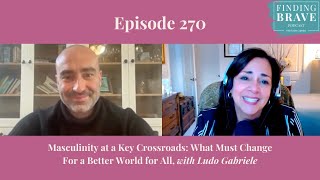
This is a transcript of episode 270 of Kathy Caprino’s Finding Brave podcast featuring Ludo Gabriele. The conversation (recorded around International Men’s Day) examines the crisis facing many boys and men: disconnection, poor mental health, high suicide rates (discussed as several-fold higher for men), and confusion as traditional masculine roles shift. Gabriele argues masculinity is at a crossroads, stresses that gender equity must be approached holistically (representation alone isn’t progress), and links workplace culture, restrictive norms, and online communities (e.g., influencers who offer simple, compelling but harmful narratives) to rising harm. The interview cites research/organizations (Catalyst; the 2023 'State of American Men' report), offers practical advice (lean against bias; listen to perspectives you disagree with; seek connection rather than conversion), and points listeners to Gabriele’s practice (ludogabriele.com / HUMEn / Human Leaders).
Chapters
When there's triggers, there's gold there. So it's, it's up to you. Do you want to go get it or you don't want to go look for it? So it's. I'm not saying it feels good all the time, but it helps understand people's perspective. And if the idea is to, you know, I always say, are you looking to convert or are you looking to connect? I am looking to connect. I know that.
Hello, everyone.
This is Kathy Caprino, and welcome to my podcast, Finding Brave. I've created this show for everyone who longs to create something bold and brave in their life. To rise up, speak up, and stand up for who they are and to reach their highest and biggest visions. Each week, I'll be speaking with inspiring guests from all walks of business, leadership, entertainment, the creative arts, and the entrepreneurial world. And they'll be sharing their intimate stories of Finding Brave and offer their best strategies for building your most rewarding, joyful, and meaningful life, business and career. Hey, folks, Kathy here.
Are you ready for a big, positive.
Shift in how you're working and what you're capable of achieving in your career? Let's make that happen for you. While you might know me best as a podcast host and writer, a key focus in my work is helping women achieve greater success in their work. In my career and leadership Breakthrough, one on one coaching program, I help women get what they want most, which includes more confidence and impact, advancement, financial reward and fulfillment. And I also help them achieve their most exciting visions for the future. In the past 16 years, I've worked with over 20,000 women across six continents. And before that I served as a therapist.
And before that I was a corporate.
VP managing multimillion dollar budgets and global initiatives. I leverage all of that experience to help women build a new chapter where they can reach their highest and happiest potential doing work they love. Check out Kathy Caprino.com career breakthrough and I hope you'll register now. I'd love to support you.
Hello, everybody. Kathy Caprino here. Welcome to another episode of Finding Brave. Oh, I can see my little sunshine coming in front of me. That's fine. I am so excited, so excited about this conversation with the amazing Ludo Gabriel. Ludo, thank you for taking the time here in New York. You are, and I know so much is going on with you today. Thank you for being here. I am so, so grateful to have this open conversation with you.
Likewise. It's always a pleasure chatting with you, Caddy.
Thank you, dear. And I say this, you're Going to hear it every single time. There is so much learning that happens in this podcast. One, because my brave guests come on here not to just spout what they believe, but to have a really open dialogue and a back and forth where there's learning on both sides. But I will tell you, speaking to Ludo, every time I do, I have.
Such a different appreciation and understanding of the key issues.
So let us dive in. We are talking about masculinity at a key crossroads. What must change for a better world. All right, Luda, we have so much to talk about in 35 minutes, but I wanted to read to everybody your three key takeaways. The bullets that bullet points that you submitted because in and of themselves, they're so eye opening. Number one, men are hurting.
Society is failing, boys and men in many ways.
Number two, and I had to question you about it because I wasn't quite sure we had it right. Masculinity is at a crossroads.
The lack of empathy and compassion for.
Boys and men is leading them to.
Disconnection, self harm, and discrimination.
And number three, gender equity must be approached holistically. And we are going to talk about this. We can address the unique challenges faced by men while being fierce advocates for women's rights. Both are not mutually exclusive. All right, let's dive right in. We are doing this, in fact, at this time, in honor of International Men's Day.
Wow. And I have to tell you, I.
You know, I'm transparent here. I didn't know there was an International.
Men's Day, to be honest. Can you believe.
And you explained to me, and of course, I went and researched what it means and why it's important. But can we start there? What, in your view is the importance of recognizing and celebrating International Men's Day?
Will you share?
Of course. Thank you very much. Kassim, Just a very quick note on point number two.
Yeah.
You said the word discrimination. And the word that I think I believe I shared is disconnection. So I think it's. It's an important. No, it's okay. No, it's, it's actually fine because I think that's also part of the issue. Like a lot of men feel discriminated against and it's a. Not necessarily a perception that. Okay, but this is the lived experiences of many. But it's. It's funny how.
It's funny that I maybe, yes. Consciously said that.
Yeah. But it's really disconnection. And I think. And we will touch on that a little later.
What a good point.
International men's Day before I dive into my thoughts about it and how they have evolved about this topic, I just want to share a quote with you. It's from Henry David Thoreau. And this is the, this is this one. The mass of men lead lives of quiet desperation. What is called resignation is confirmed desperation. So that was a quote that was from the 19th century, I believe, and it was not necessarily talking about men. Right. He was talking about. Because at that moment, the English language, the lives of men, men, humankind, essentially. And he was kind of pursuing people to go after daydream. However, today, what I just read to you is a real. It's a perfect way to sum up how many men feel in the world. And this is very dangerous. And that's why International Men's Day, you know, that I've, you know, I've worked at Catalyst. Yes. Time before, before going on my own. And this is a. An organization that, you know, advocates for workplaces that work for women and gender equity in that regard. Which is, which is the right thing to. To do, the right thing to say. And we were receiving, you know, from clients, from supporters questioned about International Men's Day. And I remember even myself thinking at that moment, what is this? Do we really need to celebrate men without understanding what it meant, also understanding that the context in 2019 and 2020 is. Isn't the same. But we had questions from supporters because men were asking about that celebration and the meaning of it at the organizational level and internally. I received also a lot of pushback from women, and rightfully so, because, you know, do men really need another day, you know, to, to. To get the spotlight, essentially? Right. And, and today, yes, I believe this is the case, not necessarily as a way to celebrate a specific achievement, because I think when we talk, think about International Men's Day, we think about International Women's Day, which is a celebratory, you know, event about the accomplishment of women's. In terms of advancement, in terms of, you know, things that are, like, inherently connected to the live experience of women. And we know that it has been, you know, millennia of discrimination up until, you know, and it's still the case. We still have a long way to go to go. But International Men's Day is celebrated by different groups. Some of them are pretty extremist, I have to say. But it really raises the issue of the lived experiences of men. You know, when we really look into the states of men in the world, and specifically in America, we see that every second a man take his own life, we see that men Kill themselves at four times the rate as women do. We see that there is a lot of struggle about mental health at all stages of, of men's lives. And we also see that there is a real issue with disconnection, loneliness and confusion, you know, with, you know, we come in a, in a moment where, you know, the masculine norms are questioned and rightfully so because they've been unquestioned, rigid for a very long time. However, nowadays, what used to be certain in terms of what men are supposed to do is really no longer the case. And we see that it leads to really historical level of, of self harm, of poor mental health, of violence, of.
Violence against women, against others communities, you know.
Yes, yes, absolutely.
Aren't the vast majority of mass shooters.
Male in, in our country, the overwhelming majority of men? And, and this is, this is also what is the core of the issue is do we think that there is something inherently wrong with men? I personally do not believe that. Is there something wrong in the way men perceive themselves in what they are supposed to do and not to do? I believe that this is the core of the issue. I believe that the disconnection that happens very early in childhood when men for boys are for example, at the same time pressure to, for example, not cry and express their emotions. So this is something that is very well documented, that this is very hurtful and it stays with you. So it creates kind of an empathy gaff internally, you know, like, oh, this emotion is not okay. So I'm not going to, I'm not going to go there. Right. Anger is acceptable socially, you know.
Right.
Socially we are almost bribed to show aggression and things like that. Right. All the type of emotion is different. And at the same time, historically, now it's less the case. But this empathy that we create within ourselves, we also create it with, with, with the experiences of women and girls. Because what is being taught to a lot of people, and now we see that those very traditional narrative are coming back, is that the worst thing that a boy can do or can be is any type of behavior that would be deemed as feminine. Right. And that double empty gap disconnect them for themselves and from and from and from girls very early in their lives.
All right, I have questions, but just to illustrate what you're talking about, I've interviewed quite a few people and you know them all or know of therapist Terry Real, Mark Green, Ed Frauenheim, lots of people who are reinventing masculinity and, and you know, Terry Real several years ago, it was his definition that I think Is might, might be helpful here that in a patriarchal world, and this is not to bash men, this is to talk about, you know, in my world, tends to be the work, working world. You know, in a world that has a dominant culture, and that's typically men, when you're talking business, et cetera, and a minority culture, we split ourselves in half. You know, there's the masculine, and I put it in quotes, and the feminine. And to illustrate your point, when we say feminine, the rigid stereotype is. And you listen to my voice, it's different, soft, pleasing, malleable, puts other people first, is not overly confident, is not overly assertive, is empathic, is connected. When you think masculine, this rigid stereotype, it's confident, gets it done, person of action. And, and Mark Green talked about the study that was done that, you know, asked little boys, little boys, what is it to be? Boy, not a pussy. They use that word, not vulnerable, never cry, don't have friends with girls. Don't show you're scared, don't show you're weak or vulnerable. And the net. Net of that is if you can't show that you can't be, that you won't be connected to yourself, you won't, right? Tell me if I'm wrong. You can't be connected to others. It's. It's a stunted emotion and a stunted response because it's not allowed. Am I getting it right?
This is absolutely correct. And when, when you do so, it's. It's usually dangerous, penalized in many ways. We know that masculinity is, Is really is strongly related to status and what boys do. So it's based on performance and power, everything that is outward, right? So if you show that you are not conforming, it's you putting yourself at risk. And at the same time, as we know now, boys are. We are also receiving a different narrative, which is be vulnerable, be open. You're in a privileged position. So be careful when you engage with girls and be so those conflicting narrative that boy receive give them in a state where they are almost frozen. I see. And what you would think saying a little bit before Katya is specifically about the workplace, right? I think it's. It's important. It's an important. You raise a crucial point in that conversation, which is, I think it's important that we talk about culture instead of talking about gender. So when you were saying before.
You.
Know, the masculine and the feminine attributes, what we call soft skills, they're all feminine, you know, dim, feminine, you know, empathy, listening Things of that. Even though we know that today it's a business, not only a business imperative, but it's a. It really. That really makes a difference. Right. However, when they are displayed by men, they are not received the same way than when they are the same. Are displayed by women same way on the other side. Right. An assertive woman is a right. That's the way she is perceived. And that's also the problem. So the problem is not the boys and the problem is not the girls. The problem is they, as you said, we are in a system that value masculine behaviors and masculine trade the most.
The way it's been defined for a hundred years.
Yeah.
And, you know, I need to punctuate a few things. Women hate it that these skills are called soft skills as if they're not important. Like, you know, it's been said, HR people, they have soft skills and often they're women in these HR roles. I hate that characterization because it makes it sound less critical, less essential, less important for business. Just had to make that point. But I have to ask you something. You. We were talking the other day and you mentioned that there's research and this is what. What's really important for people to understand that when men demonstrate these very traits that we as evolved people want people to understand. Women are both and men are both. We're empathic and we're strong. Men are strong and connected can be, you know, not just this caricature of a human being, but your research has shown a catalyst and beyond in your own work, that when men display those soft skills typically considered female, they are conceived perceived as less competent. Right.
Competent and less masculine and less.
And more of a threat.
I mean, the thing is less masculine. Meaning that especially when we consider the importance of engaging men in gender equity, the perceived cost is very often perceived too high because as exactly for the reason you described. Right. And I would argue that I told you that, you know, it's a quote from Rupee Core that I love. You know, I don't. I don't. I don't believe that putting women at the head of. Of system that are like oppressive is. Is progress. I don't think that this is. That this is the way to go.
But say it again. Say it again, Luda. So we understand. You don't believe what that putting woman.
At the head of oppressive systems, at the press, at the head of, you know, oppressive organization, this progress, a lot of people.
What is progress then?
Well, I would say that progress is a culture change where people are not judged by behaviors are attached to their gender. I believe this is progress.
I think we, I think we need to clarify because people will get upset about that comment. Yes, it may, they may very well. But we need to understand it. I think what you mean, Tell me is you don't believe in the automatic let's remove a man from the top and put a woman there. Well, you don't mean, you don't mean that you don't want to see women at the top of organizations.
No, that's not what I mean.
Tell us in another way.
Yes, so what I mean by that is to, to put it in a, in a different term that I think that gender alone in terms of representation is not enough to characterize progress for two reasons. Number one, if you, if you believe that, that means that you believe in biological determinism, which means, oh, you need more empathy, so let's get more, more women.
Right.
So that's discriminatory on the other side, I mean it's assuming that every woman has empathy and every man doesn't. And it's assuming every man is strong and every woman isn't.
It's, it's exactly what it is.
Right.
Pigeonhole people.
Right.
And, and you lo. And, and when you are, you know, I have a, I am a fairly masculine man, but I am extra creative, extra sensitive, extra empathic. When you limit people into rigid stereotype, you lose so much, so much from everyone. Right. That I, it doesn't serve, and it doesn't serve the overall culture. So what I meant by, you know, seeing women at the head of a pro. Oppressive system is not, is not progress. Meaning that I. Yes. I don't believe that just placing, just having 50 of women, you know, in, in having a 50, 50 split. I'm not necessarily sure that it will guarantee, I understand a better outcome.
I think the way I would say it is the simple act of removing a man from the top and placing a woman doesn't necessarily change anything in, in an oppressive system.
I mean, ask yourself, have you met leaders who were women that were toxic? That.
Of course.
All right, I have more questions and I didn't prep you on this. So if they, if they're hard to answer and you, you know, I get it.
Yes.
We, your, you're saying. And the data shows that suicide is on the rise for men and boys.
Yes.
And self harm. Also violence towards others? I think.
Yes.
And mental, mental health issues, depression, anxiety, drug addiction, substance abuse. Here's a question. The fact that I'm dying to know what you think about this from My view, our culture has moved a tiny bit towards not forcing men and women, girls and boys, to conform as rigidly as when I grew up. I mean, this wasn't in the national conversation. Nobody. So there was nobody talking about it. So by virtue of that, we stuffed ourselves into the models we were given. Are you following so far?
I am following, yes. Okay.
So it's so much more in the national conversation. It's so much more discussed transgender, you know, non conforming identities. I would think that that would help both men and women cope more with living in society. That restricts us. So what is leading to the increase in damaging effects? Is it that it's so confusing for men that they just go into themselves and, and we're not trying to paint every boy and every man with the same brush, please. Yes, but why is there more mental health issues and depression and anxiety and suicidality when in fact we're talking about how hurtful it is to both men and women to be stuffed in these boxes?
This is an excellent question, Kathy. I'm very happy that you, that you asked that question, because I think it's there. This is where a lot of people get confused. Right. Because on paper. Exactly. It's what you said. You're free to be anything that you want. So what is.
Well, I didn't go that far. I said, at least we're talking about it and there's some options. Where in my day. No, none.
Well, I think it's. First of all, I think it's very, is very theoretical, I think.
Theoretical, yes.
This is very theoretical.
You have a French accent.
Yes, I do.
We say it, but we don't live it.
Well, there is that, but also you. The, the amount of confusion that there is about what it means to being a man nowadays is that we have not, we have failed to provide a compelling narrative to boys as a, as an alternative of traditional masculinity. Right.
So we're talking about it, we're giving a narrative, but nobody's enacting it. It's not, I mean, I think it.
Doesn'T necessarily reflect also their lived experiences. Because if you tell men, yes, you need to be crying in public or you need to show vulnerability in the actuality, it does not necessarily help them. Right. So. And it doesn't.
You mean.
Because, I mean, if you're 13 year old boys nowadays and you show vulnerability.
On the soccer team, you get ridiculed and laughed out.
Well, that's, that's exactly, that's what I'm saying. And what, what. And this Is the issue because we are telling them what they should stop doing. We are not telling them what they should be doing. Instead we are not providing them with role model that are like inspiring. And therefore, and on top of that there is also the legitimate but difficult to process idea that boys are, are in a privileged position that they are like all. So I think the compounding effect of those two arguments and the fail the failure of providing an alternative that is compelling. Well, what do they do? They either retract or they go in places on the Internet that are welcoming, that are, that is about what they know and what is that they are still valued for. So you know, to, to be very direct. Nowadays you have characters like Andrew Tate, for example, that promise, that promise those young boys who has, who are confused, who have no attention, who are failing at school, who are struggling to, you know, have deep relationship. They promise them through discipline, through pushing, through to. They promise them money, girls and power and muscle. That's what they have to, that's what they are offering. So it's a simple, simplistic, but very compelling narrative and offer to boys what are liberal, liberal spaces offering them in opposition that would be more compelling to that. So I'm not saying that this is the way. What I am saying is that from a marketing and branding standpoint, those traditional messages, not only are they more compelling because they are simple, but also. And I know that this is not a, it's not a popular thing to say, but yes, I think we tend to see boys and men as, as a monolithic group. Well, we know, and that's why monolithic.
Meaning they're all the same.
Exactly. And, but there's, there are ranges, you know, there are many boys that are. Could be, you know, just because you have traditional, you know, aspiration, a hobby, doesn't mean that you're toxic, you know? You know what I mean? And, and now those spaces and those conversations also polarize that being silent is safer because as I told you before, being vulnerable puts you in danger. And being traditional is even safer because what you get with it is community. And we know that the art of every human being is the need to belong. So when boys feel not heard, ostracized, confused, and you know, they go where they are enforcing to their belief that yes, this is normal, that you're feeling like that and, and then those ideas are weaponized, you know, and they say, you know, you're feeling like that because this is the, this is woman's fault or this is immigrants fault. And this is when it Becomes political.
And, you know, Brene Brown said it years ago, we discharge our anxiety through blame. Yes, blame is where that our darn limited human brain goes. It makes us. I'm sure it releases endorphins and dopamine. You're the problem. You. You know, we talk about empathy all the time, and there's a million books written about it. But when you talk about this, immediately I go to the place of what here? I start crying on my show what it has been to be a woman. And it's the exact flip that we don't want to be what we're told we have to be. So we start to be different. And then we're attacked and criticized and called the biatch and penalized and fired and. And then we don't know where to go. And then we're angry at men. But women are drinking. You know, women are swimming in the water, too. Women. And. And so women against women and men against men.
So, I mean, you talk about patriarchy. Patriarchal patriarchy is a system.
It's a system.
It's a system. And.
But I had a place and hear what you had to say about this. What it leads me to do is this is why I do the work. I do that, number one, there's role models for other women about what it can look like. But number two, there's discussion that there will be pushback, there will be penalizing, and what are we going to do about it? And I don't mean this just for women. I'm trying to relate this to men as well. What, are we going to just fall back and do what we did 100 years ago? No, we got to push through the change. And thirdly, I think, and I want to talk to you about this, I believe having been a marriage and family therapist and been around a long time and doing this coaching for 16 years, you don't change society at the end point. You change society from the minute our children are born. I mean, it ain't going to change in my lifetime. I mean, it's changed this much since I was 12, you know, 1972, this much. So my daughter says, oh, sometimes, mom, it's a little doom and gloom what you talk about, but I do believe it has to start at the beginning, of course. What do you think? I mean, that doesn't mean your work and my work isn't important. But don't you believe it starts with how we raise our children?
I mean, 100%. But we also have. We all have children in our lives, whether they Are ours or not? For sure. We are the first role models, for sure. The relationship that they see at home reflects how they're going to appear in the world in terms of. In terms of dynamics, in terms of belief. So, of course, it's. It starts at home.
Well, when I say raise children, it's teachers, it's anyone who's involved in. In children's lives. That's what I mean.
But it's. But that's why. It's what is very concerning, Katy, nowadays. Is that so. There is a study that I would encourage the audience to go look at.
Let's link to it.
It's called the State of American Men. That has been done by equimundoi 2023. It's a heartbreaking. It's a heartbreaking report about what they do online, how depressed they are. I'm not going to get into every single step, but there is a lot of them. But I will tell you this. I think they did a segment of the study where they compared the version of masculinity across demographics of men. And the most traditional views are, not surprisingly, held by the older end of the spectrum. And are you sitting down? Right. And the youngest one. So what does that tell you? That tells you two things. That tells you that, one, we fail to deliver the message that you just said that restrictive gender norms is not good for them. And we have to under. And we have to ask this question, why are they, why are they going to.
Are we introducing and raising our kids with more restrictive norms in this decade or something?
No, I think it's really. It really reflects the confusion of men. I mean, look at the way, look at the workforce. Look at the workforce. The. What, what, what jobs are. Are disappearing. Traditional male jobs. Right. So the sense of certainty in terms of, you know, being the provider, being outward, all of those things that really made a lot of the identity or the way that men perceive themselves is no longer there. So again, because it's this transitional period where we have on one side men who are challenged on their privilege, which is the right thing to do at the. And at the same time, on the other side, we have a group, a court of people that us is saying feminists are against you.
Right?
And this is. You are a real man and this is what you should be doing, doing. And because there's one side that provides community and one side that cancels.
Right.
What do you think that. Where do you think they're going? And that. That white space, right, right there. This is critical that we engage them because What. What the study show online is that a lot of people are silent watchers. So, you know, the most extremist voices are the loudest. Right. But they won't stay silent very long if there's a critical mass of people that lead to the extreme called help us out. You know. You know, I have this. I love this image of, you know, when you tear out a paper, Right. You see how, like, each side go to the extreme where. I believe that this is a great image of. For the state of the gender conversation nowadays because we fail to see how you can simultaneously have empathy for the real struggles that boys and men go through and at the same time advocate for gender equity in terms of the pay gap in certain industry against violence against women. You know, and that's. That's the core of the issue.
All right, questions, questions, questions. You and I talked. I've heard from men, some of whom are my clients, some of whom are colleagues who have said, let's say they're 52 in white.
Yep.
They've actually been in the room where an HR person says to them, we. We have a commitment for DEI and more equal representation. You know, in five years, the number has to be blip. And they look at the white male, 50, and say, we can't have more of you. I want to slap whoever said that. Well, that's violent. Let's take that back. I want to sit them down and say, shaming of anyone doesn't work. Making you sound like you are unwanted. You're garbage. We don't need you by virtue of your gender and your skin color and your age. How is that helpful? And I believe. But you tell me, because you've been working with so many organizations, I think it's happening all the time that you're. We don't. They're not necessarily saying you're the problem. They're saying, we don't. We can't have more of you.
Well, it's what you just. The situation that you just described is this textbook definition of sexism and racism. However, and that's also one of the core of the issue is that. Right, we all have privilege. Yes, everybody has privilege.
Well, not everybody.
You're walking. We have all some form of. Some form of privilege. Right. But when you say you have privilege or where you say you are, you are privileged. It can be an extremely dehumanizing way of one characterizing someone. I think it's never okay to. How do you want to engage men into a fruitful exchange when those comments exist and when you Bring them up. They are brushed aside. Right. And I think rightfully so in some way because you're like, you know, there's been systemic racism for 200 years in the United States or there's been, or even more, or there's been all of these grievances. We need to give space to them. It's. It's important. But if we are not having an holistic approach of gender equity, which is all right, gender. And that's why I do not like gender equality. I think equality is actually a myth because nobody is born equal. If we are, if we are honest. We are all, you know, some, some of us have other abilities. Maybe we have the same potential. Potential. But that's not necessarily something that we can demonstrate. And that's why I really like the term equity. Because equity is not about giving everyone the same thing.
Right.
It's about giving what each and every one of us needs so that they can thrive. So just because you advocate for the gender the better, reducing the gender pay gap for women, it doesn't mean that you cannot at the same time advocate for better mental health for boys and men or, you know, you know, you know what I mean. And I think if we are still lost in that zero sum thinking because the, because the, the pain is too deep in each of our existence and because we are not necessarily feeling hurt in the way that we are. Well, we, we, you know, we just.
I have one more question and then I have to let you go. But I could talk for hours. Zero sum game is exactly what I wrote down here. I need to hear what you think. I mentioned to you earlier. I've worked with some organizations and heard from some organizations where the C suite is 80 to 90% white men. There's senior women underneath these men, but they're not going anywhere. And businesses don't have unlimited salaries to pay unlimited revenue. So if these women can't move up to where they feel they deserve and have earned because these men are not going anywhere and that's fine, why would you. I think that's a really strong illustration of men in these roles are going to fear.
Fear.
Feel like it is a zero sum game. How? I'm not going anywhere and why should I? So if she gets the C sweet spot, I'm not going to get it. How? In all the work you've done with organizations and you know, I'm going to. Everyone's going to have heard your bio before our conversation. How do you help men process, not see it as a zero sum game? I, I Can imagine one would that if 80% of my team is men, but in 10 years it's going to be 50% women. That means some of my colleagues are going to be either out of a job or not making that money that they were making because there's only so many spots at the top of the north. What do you say to that to your male colleagues who are saying, don't tell me it's not a zero sum situation.
Well, I think it's also showing. So there are two side of this conversation showing them that maybe the playing field has not historically been leveled. And that's why we are seeing, as you were describing the discrepancy in terms of. And I think a lot of reasonable men would agree with that idea and also agree with the idea that an appropriate gender representation is really necessary at the SE Suite because we see that. Because.
Well, they are going to see it, but are they going to want it to happen to them? Well, then I'm going to lose my job because they're not going to add five spots to the sea level.
Well, that's.
Do they do. What can they do? I'd love to give some advice here.
Well, some, some people have actually given up this, their seat. There is. Alexis Oanian was the husband, I believe, of Serena Williams. He gave up his board seat. And the reason why he did that is because he's raising also a black girl. And the role modeling aspect of his life dictated that he had to do this. But it's something that is very personal. I think at the end of the day, you need to create personal connection with those issues, whatever they are. And I, and I love, I love the pragmatic approach to it. If I have to talk about their daughter, just to open the door, I will do it. Yes, they, they, it's necessary that they don't stop there. But if you do not see them as both architects and beneficiary of the gender equity conversation, you're not going to go anywhere. I think if they are only doing it on behalf of others, it's insufficient if they have a skin in the game, a personal connection, something that they could say, yes, I am doing this because this is the right thing to do. I think that a lot of people would accept equity in a more productive way. Does that help a little bit?
It does. It's a hard pill to swallow for some people. I mean, some of these men are my clients and they're being told you're good. But time, times have changed and that's hard for them.
It's hard. Of course it's hard, but I think it's, it's also. How do we give them the message of it's time to go, you know, I think so.
Difficult.
Yeah, it's difficult. It's very difficult.
So people are going to be listening, driving their cars, going, wow, holy cow. This is, this is dark. What can we do to give some people. It's a very huge issue, let's face it, as is violence, as is, you know, you don't change it with seven conversations. You do, you know, make a dent. But what can we suggest for men listening and women? What would you, what would you wish their biggest takeaway would be? Men who are listening and women's. What would you, and I didn't prep you on this. I'm sorry. What would you, what would you want men to take away and women to.
Take away from this?
And maybe we give one practical strategy that is doable, of course.
Well, first of all, gender equity is a human issue. That's one of the number one takeaway. So I don't necessarily think that we need to compare each other experiences to give each other compassion. You have children. I know, Kathy, I have two. I have a boy and a girl. I'm not gonna pick one. Right. I love them both equally. Do they need the same thing? No, they don't. Does gender play a role in what it is that we need? They need in some degree, yes, they do. You know, I agree, equity, equality and sameness are not the same thing. And, and last but not least, I would say, and I think it's some, it's regardless of your gender, but I think it's something that is really critical at a time where we are not living in very forgiving spaces and mistakes cancel culture. I think it's a real, real issue, especially at the age of social media. I would say lean against your own bias, lean again and, and, and go to spaces where you would not necessarily go. So, for example, I'm not saying go on the darkest side of the Internet and absorb, you know, extremist propaganda at the same time. One of the ways that I've built bridges was realizing that listening always to liberal media, I stopped because I could.
Anticipate because we're not learning, we're hearing our voices being echoed back.
Exactly. And for. I kid you not, Kathy, six months non stop, I watched the other side exclusively. So that was not easy, but I am very glad I did. Was it was difficult because a lot of things were triggering and I think, and when it, when this triggers. There is something that there is gold there. So it's. It's up to you. Do you want to go get it, or you don't want to go or you don't want to go look for it? So it's. I'm not saying it feels good all the time, but it helps understand people's perspective. And if the idea is to. You know, I always say, are you looking to convert or are you looking to connect? I am looking to connect. I know that, and I know that I will always talk to anybody, regardless of the way they identify how in their political affiliation. I will. I will talk to anyone, literally.
That is a beautiful tip. You know, to me, the. The teaser quote of this. This episode is when it's triggering, there is gold. Are you gonna go get it, or are you gonna leave it buried?
Wow.
That is beautiful. Oh, Ludo, thank you. Honestly, I could learn so much, and my head hurts because I know there's so much gold here that I have not even seen before in my life. You know, because focusing on supporting professional women. And, you know, I want to say this. More men have been coming to me than ever before, more in the past year. And even though my website says I support professional women's advancement, thank goodness they're reading beyond that. That. I don't know what she's got over there, but I want to get coaching. Isn't that wonderful? Which is now making me realize maybe we change the language about, you know, who I love to serve. Because basically, don't we want to help? I know we have to have a focus, but we want to help people that are struggling in any way we can.
Well, I think it's because you have a very compassionate approach, honestly. And I think it's because you are. I'm sorry. My daughter is here. Is that okay? Yes.
Let's see. I'm Sophia. Oh, so.
And I think. I think it's because, as I was saying, you have a lot of compassion in your approach. And I think. And I think it's because men naturally open up to women more easily. My therapist. My therapist is a woman. You know, the people we feel heard.
Where we're not scared we're gonna be slammed down. I know you have to go with your beautiful daughter, Ludo. Where do we soak up everything? Where from you? Where do we go? Where are we sending people?
So I have created my personal website called ludogabriel.com I am building a practice called Human leaders, who is really has the hope to advance healthy masculinity in the workplace and beyond.
And that's H U M E n and we will link to that below.
And the idea is really so it's still under construction, but you know, it's really to, to show that men are human beings with full range of emotion, expression. And I think it's, it's important that, that we embrace all of it.
Thank you so much for being here and thank you for digging into my questions, which are not always easy to answer. You did such a beautiful job helping me understand more. All right, everyone. You know I say it every time. I'm going to say it again if you don't have questions. I don't feel we're doing our job here. Our job is not to just hear ourselves talk. It's to grab that gold, dust it off, take a bite out of it, turn it around, and try to really use it in our life. So I hope wherever you see this, I hope you will share a question or a thought. I hope you will do it respectfully. Screaming at people doesn't help them hear you, but do that as respectfully as possible, wherever you see it. And we will do our best to answer any question you have. We would love to hear from you and I hope you found found this enlivening. Thank you again, Ludo. I hope you'll come back soon because we didn't even. It's the tip of the iceberg. Thank you again.
Thank you for having me. I really appreciate it.
Such a pleasure. All right, everyone, have a wonderful two weeks and may they both be filled with finding brave moments. Thank you by.
Hi folks. Kathy here. So are you thinking about launching a new podcast or have you been at.
It a while and recognize it's time.
For more or better production help to create the best podcast you can?
I totally understand.
I've been podcasting for over six years and I know how challenging it can be. That's why I'm really excited to share some key information about the great production team I'm using now called We Edit Podcasts. I've been working with them for well over a year and I've been so happy with the results. They're a full service production agency and their services give me access to a wonderful team of seasoned audio engineers and editors who help create a polished professional sound. And they work hard to ensure that my particular podcasting approach and style comes through in every episode. They also help me make sure that my guests are reflected in the best possible light through the creation of terrific show notes, which is an important part of the show for me. Their process is easy and streamlined, and their responsiveness and customer service is terrific too. If you're ready for better production help, definitely check them out and take advantage of their free trial episode, allowing you to sample their processing quality to see if it's a great fit for you. I'm confident you'll love them, just go to the link weeditpodcasts.com finding brave that's my special link for you and book.
Your free call today.
Happy podcasting. Thanks so much for joining us today. And please don't forget to check out findingbrave.org for more programs, resources, and tips. And tune in next time for your weekly dose of Finding Brave.
More from Kathy


Elevate Yourself, Elevate Others, and Amplify Good | Chris Cooper | Finding Brave Ep. 334

Finding Brave Epis #333: How Leaders Can Harness AI Without Losing Their Humanity, w/Bennett Borden

Finding Brave Epis 332- How to Stay Brave, Valuable and Visible in the Age of AI, with Raman Rai

Finding Brave Epis 331 - The Power of Positive Disruption, with Dr. Patrick Leddin


Finding Brave Epis 330 - Being 40: Letting Go and Embracing Who You Are, with Stacey Lindsay

Disrupt Career Reinvention with Kathy Caprino - via The Disruption Lab Podcast w/Patrick Leddin

Creating Neurodiversity-Friendly Work Cultures: Simple Workplace Adjustments Matter

Finding Brave Epis 329 - How To Create a Neurodiversity-Friendly Workplace, with Kristen Pressner

Finding Brave Epis. 328: Reclaiming the Power to Trust Your Own Voice, with Dr. Cindy McGovern