274: How Playing Competitive Sports Supports Women's Leadership Success with Lara Abrash
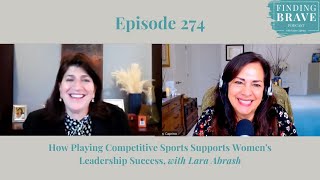
Podcast episode (Finding Brave) featuring Lara Abrash, chair of Deloitte US, discussing how playing competitive sports supports women's leadership and career success. Deloitte conducted a survey finding that 85% of respondents agreed sports play an important role in careers; 69% of women earning over $100,000 had played competitive sports; and 75% believe girls who play sports younger are likelier to succeed. Lara shares her own lifelong involvement in sports (softball, tennis), ties sports to self-mastery, teamwork, resilience, confidence, and discusses Deloitte's efforts to build inclusive cultures for 170,000 employees.
Chapters
We focus on everyone. It doesn't mean there's not special focuses on different cohorts on their unique needs. But at the end of the day, it's done under a context of we want 170,000 people to be the very best versions of themselves every single day.
Hello everyone, this is Kathy Caprino and welcome to my podcast, Finding Brave. I've created this show for everyone who longs to create something bold and brave in their life. To rise up, speak up and stand up for who they are and to reach their highest and biggest visions. Each week I'll be speaking with inspiring guests from all walks of business, leadership, entertainment, the creative arts and the entrepreneurial world. And they'll be sharing their intimate stories of Finding Brave and offer their best strategies for building your most rewarding, joyful and meaningful life, business and career. Hello everyone, Kathy here. Thank you so much for joining me today. I'm very excited to share that we've opened the enrollment window of the winter 2024 sess of my 16 week amazing career project course. This session, which starts February 1st, teaches professional women the 16 most essential steps to building a more rewarding, joyful and successful career with the respect and recognition you deserve in the fastest way possible. Through the four months of the course, you'll get 16 jam packed instructional videos, 16 weekly live group coaching calls with me, 16 tailored homework assignments to move you forward fast, an amazing online support network, my handpicked collection of Premier resources, plus great lifetime discounts to my private coaching programs and $1,000 off the full price plus seven great bonuses. Truly, it's a fantastic investment in you and your career and there is nothing to lose and so much to gain. Join me this winter. Visit amazingcareerproject.com for more information and I hope to see you February 1st.
Hello everybody. Welcome to another episode of Finding Brave. I am so excited to be with you. This is coming to you I believe in early January. So the holidays are behind. We're not there yet in our recording, but I hope you had a wonderful holiday season and your New Year's off to a great start and I am beyond this time. I'm truly levitating to be able to talk to the amazing Lara Abrash. If I get it wrong, you'll tell me who has such an illustrious background and experience and we are talking about how competitive sports has been proven to and we both know firsthand contribute to the success and leadership abilities that women have in later life. Thank you. Thank you so much for taking time, Lara.
I so appreciate it oh, so happy to be here and so excited as you are. I love it. Levitating a little bit in 2024 about the ability to talk about something I'm super passionate about. So thanks for letting us talk about that.
Oh, my pleasure. Thank you. Let me folks tell you about Lara, because it's pretty inspiring in every way. Lara is the chair of Deloitte us, the largest professional services organization in the United States with more than 100, 170,000 professionals. Yikes. Lara stepped into this role in June 2023 after an illustrious long career at Deloitte.
Right.
After serving four years as the Chair and Chief Executive Officer of Deloitte and Touche llp, where she was responsible for overseeing the US Audit and assurance business. Lara is a member of Deloitte's Global Board of Directors and Chair of the Deloitte Foundation.
Wow.
Thank you again for taking time. I know you're crashingly busy, so now let's just dive in about this topic of the study that you did this summer, why you did it and what it revealed. Can't wait to hear about this.
Well, maybe a little bit of background. I mean, our firm for a long time has been a strong proponent of women and women's leadership. When I joined many, many years ago, Kathy, maybe 30 years ago. Wow. Yeah, I know. Crazy. The reason I picked the firm, among many other opportunities I was lucky enough to have, was they talked about a women's initiative and how we were going to break the glass ceiling. And it has been a firm that has really tried to stay focused on this. And you know, we had the first of the big four women as our chair. We had the first of the big four, which is this is our competitive set for some parts of our business as our women se. And so this has been an area of focus, as has sports. So these two things have come together the last few years. We sponsor and support the wnba, the women's soccer league, women's tennis, as well as men's. I mean, this is a big area of focus and Some would say 2023 has been sort of a bit of the year of the. The woman. I mean, you know, Coco Graff, Taylor Swift, pick your thing, right? So we, we started really focusing on this intersection of sports and women and all the things we were seeing in our day to day efforts. And we did, we undertook a survey to understand what is the relationship between girls and women who have played competitive sports and sort of what happens to them and are there lessons learned? And some of the stuff was honestly, maybe not surprising to people who are in the suit. But for the benefit of all of your listeners and your viewers, I'll share, if it's okay with you, Kathy, A few, a few of the highlights. So 1, 85%. So a super majority of the people we surveyed when we did our study, so big majority, agreed that sports plays an important role in their careers. Right? So that, that's a good start. The more interesting piece is then when you actually say, well, women who earn over $100,000 annually. So as a tipping point, women that are into six figures, 69% of them have played competitive sports. So you start to look at not just the general benefits, you start to say, well, the people who may be moving a little bit farther along. And then we said, okay, what do you think about the likelihood of success? And 75% of the women who play competitive sports agree that girls who do it at a younger age are more likely to be successful in their careers due to playing sports. So the data, at least from our survey, which I think qualitatively, many of us thought to be true, actually was true. And we looked at what were the factors and we could talk more about these today, but we tried to figure out, like, what are the things that people pinpointed in those early years? And it was things like the opportunity to have teamwork, to find and have persistence and resolve to have an ability to create effective communication skills, problem solving skills. So this career success not only was the data, but was like trying to get into, like, okay, specifically, what is it about those experiences? What were the things they learned, the attributes they built, and then how did they start to help them in their careers later in life?
I find this so fascinating, and I do want to tell everybody, or let you tell you, this comes from the heart for you as well. Tell us about your competitive experience in sports and how you're, you're still doing it. I can't. I love it. Even though you're chair here and you have a million responsibilities. Tell us about it.
Well, I, I, I'm probably like so many people on the call, I will say I'm the youngest of four with three older brothers. So whether I liked it or not, you know, we were going to be in the backyard, you know, and I was just like one of the four of them. Like, this was not, I wasn't a girl with the three brothers. You know, I was roughhousing. I was definitely a tomboy. And I had a real interest in sports from a very young age. Matter of fact, I wanted to Play. And my mom tried to sign me up for a softball team, Kathy. And our town didn't have one. So I actually didn't have a girls softball team. They did not have a at that time. So I played on the boys baseball team because that was all that was available available to me. And that was the first experience I had. And I played other sports. I played competitive tennis, I played basketball, I played volleyball. But really the one I probably have stuck with most of my life was, is real and probably a passion for me was softball. I also am a huge baseball fan. I'm also a softball fan. I watch. One of my favorite things is watching competitive collegiate softball when the girls play. And then I'm a huge Mets fan. Everyone from Deloitte knows that I talk about it all the time. And so about 12 years ago, I got approached to actually join a women's league in the town I live. So here I am. I was joking with you earlier. It's an over 25 league. Way over 25. And even with the craziness of my job, it was really important for me to find something that gave me energy. And I talk about this a lot at Deloitte. There used to be this concept for women around work, life, balance, as if this was some mathematical formula that you're going to enter things in and every day you're going to spend a certain amount of time doing X or Y. I'm a big believer in integrating work and life and finding things that give you energy. And I don't play softball hundreds of hours a year, probably 100 to 200. But the energy level throughout the year is just immense. I smile every time I talk about it. I make great friends. And the lessons from when I was young still hold true on that team.
Oh, I love it so much. You know, there's something I want to ask you, and yes, we prepped a little bit, but I'm going to throw at you some questions as some of you who listen know. I, I, I did play competitive tennis and went to the New York State in doubles. That was amazing. And I still play today. And you know what? And maybe it was there in the survey, Lara, but I think that one of the key things it gave me. So I started playing at age 12 and, you know, went through 22. Age 22 and then took a big break, unfortunately, and now just play mostly for fun. But one of the things it did for me, or several, was it made me extremely comfortable with boys because with tennis, for instance, and this. I don't mean to Sound like a bragger. But my guy friends would call up and say, hey, you want to play a game? Because they wanted to beat the number one girl on the tennis team. They wanted that, and they didn't. And I would come home, you'll love it. And my mom, Greek mom heaven now, would say. She'd say, how'd it go? And I'd say, beat him. And she'd go, don't beat the boys. Don't beat the boys. Why not, Mom? They won't like you. Well, I was like, I don't care. Gotta beat the boys. But I, first of all, got very comfortable with boys and being on a level playing field with boys. Number two, there's competition, you know, involved. Of course, we're out. If we're playing competitive sports, we want to win. And so there's self mastery about winning. There's self mastery in terms of your emotional state, your physical state, your preparedness. And so I think those two things really helped me achieve what I've achieved. What do you think about what I'm saying here?
Oh, I definitely agree. Maybe I'll pinpoint self mastery, add a few others. On the self mastery side, you know, if you take tennis, you. I used to play. I would play for hours, lobbying, back and forth, back and forth, back and forth, approaching a net, not approaching a net. Mastery is hard. It requires a lot of effort. And what you learn in your professional life is you do things for 30 years, you may not actually leverage an experience, but then 10 years later, you do. And that, to me, is mastery of a sport is you practice certain things over and over and over again. You could play a hundred sets and never have that moment where you approach the net and you have to lob from the left side. You could play hundreds and hundreds of softball games and not have to worry about the squeeze play. But you practice for that moment. And I think, you know, this is something that, for women, gives confidence in ability, right? Because when that moment presents itself. So in a. And I'll say in a professional environment, having confidence is really important, which is very different than being cocky. And I do find for women, that's not a natural muscle. So I do. I see it come to life when a woman has confidence and she can bring the knowledge that she can do something, I see a different outcome. So I think your point on that excellence piece is someone becoming really good at their art, then creates confidence and then creates the ability to move. I agree with that one. Maybe I'd add two or three others. Teamwork. We talk about that a lot. But I really sit back and think about teamwork as an equation for being a great leader. So I mentioned I play softball still. My job on the team has been to be the manager of the team. And what you learn as the manager is you're not by definition, you're not the best player. Matter of fact, you shouldn't be.
Oh really?
The manager should be the person who gets the very best out of everybody on the team. And that is what leadership is. So leadership is about creating an environment where you are tapping into the very best around you, that you're creating an environment where the individuals know that it's more important to be a team than not. Right? They know that it's not about being the best and how to deal with victories and losses. And that is leadership. The emotional quotient aspect of leaning into people that comes from a very early age. And again, for women in particular, women generally have this innate ability to have the emotional quotient, the ability to lean in, but to have the confidence that they can. They don't have to be the best because sometimes you have this as a woman, this belief that you're going to get to the next level because you're the very best at X, Y and Z. The best at X, Y and Z is the person who actually gets X, Y and Z out of their people. And I really believe that's a superpower for women. And I think sports has played a big, a big impact and probably the last thing that I think again, just, just that sports did for me and I see it in the best women I see we use the word resilience, we use perseverance, we use bravery and courage. You have a professional career. If you're totally lucky, maybe it ends earlier because you win the lottery and decide you're done. But you could be doing this for 30 to 40 plus years and having the, the ability to be steadfast over that period of time to take the losses when they occur, to learn from losing. You know, what are we not going to do the next time? That's what you do as a, in sports. You're, you know, after a game, you don't just move to the next game. You're constantly evaluating it and you're, you're pumping yourself up and you're not letting it sink in and hamper your confidence. So this perseverance, resilience piece is I think really important. And it's again, back. It's important for women to not feel like they don't have a purpose Being here, they're, they're as entitled to be in the room where things matter as anybody and not letting it sit on their face. I'll be on calls with women, men, we could talk about that later. Where sometimes, you know, they wear their, their emotions. Don't let them see a sweat. Right. You learn from it. You internalize it. You let people know I'm internalizing it. That's another thing that I think has definitely come out of sports that I've seen in a positive way.
Do you mean, oh, I have so much to say. I have a question, but I did want to say this too. You may not know this. I've written two books, but the latest is called the most powerful you. And it's about what my research in, you know, working for 16 years with thousands of professional women. It's about what the research, my research has shown are the seven most damaging power and confidence gaps that when I did the survey, 98% Lara of professional women who took the survey said they have at least one of these gaps and 75% have three or more. And of course you're going to shake your head. You, you live and breathe this in leading women and men, and men have these gaps too. But what I've found is 90% said they had at least one gap, but they internalize it differently. Women, women allow. So let me just for anyone listening who's interested, you know, the gaps are. I don't recognize my special talents, abilities and gifts. I communicate from fear, not strength. I'm reluctant to ask for what I deserve. I. What is the fourth? I acquiesce instead of saying stop to mistreatment. I've lost sight of the thrilling dream I had for my life. I'm reluctant to ask for what I want and deserve. And the final is I'm allowing. This is so related to sports. I'm allowing the past and the pain and challenge I've had in the past continue to define me. I mean, if you think even overlaying it, sports and that experience and, and I'll even say, you know, I was in theater as well. I'm a singer. You know, any kind of activity where there is self mastery for you to be your best and for you to move other people in the process, I think helps us in later life. But if you overlay these gaps, like when you are a competitive player, you do know what your talents are. You wouldn't be on the team if you didn't.
Right.
I think it helps you not communicate from fear, but speak up strongly it helps you to ask for what you want and deserve. It helps with every one of these gaps. What do you think about that?
Oh, I totally agree. I, you know, my experience, and not as scientific as your survey, is that many of our women on one hand want to be recognized for what they do, but don't know how to go out and be recognized. They put their head down and it's like, why isn't somebody coming and saying, look at all you've done? And others in the organization just seem to have a better, I call it political savviness. You know, just the ability to be more savvy to, to go to the golf game, to go to the, the restaurant at night, to figure out how to be in those places. And it, they're not talking about work, they're talking about other things. And in that you get to be known. So we talk a lot about, you know, you need to be not only doing great work, but you need to be promoting yourself. And I find a lot of people feel so uncomfortable self promoting. But ultimately you're your, your biggest advocate. Right? So, and trust me, if you're somebody who has a lot of humility like so many of us do, if you don't, if you're starting to feel comfortable, you're likely not even close to doing anything that's arrogant. So, one, I agree, you know, I agree on the, just this need to feel like you deserve to be there. And two, you, you should recognize as women, that's the other thing is that the stuff that our women do, sometimes they'll say, well, you know, this isn't valued. And I mentioned earlier, this ability to have this innate, I call it a superpower for women. They have an innate ability. I don't know if it's a maternal instinct, how we've been brought up to be able to understand all the humans around them and try to help them navigate the weekends they're having, the days they're having, the suffering, the joy, and create as as much of a kumbaya as they can. And they'll say, well, that's not valued. I'm like, that's leadership. That's leadership. That's not, you know, you could train somebody to do X, you can't train somebody to get the very best out of people every day. So having our women and, you know, realize that to your point, these broader things, they matter. And you know, to bring it back to sports, you have the ability to get all those things at a very young age. For those of you who have played it. You probably now can relate to it. It's okay to be braggadocious when you win. It's okay because that's why you're there. You're not there to lose. Right. I don't think. And if you lose, you learn. It's really important to have vulnerability and lear. Learn from, from things that you were to do, but learn from it. Do it differently. But I. So I agree entirely with you that there that I find women will be most critical of themselves versus others. And I think confidence can go a long way. And a lot of the things we're talking about today, they inspire confidence.
Oh, I love every word you're saying.
I did want to ask you, but I can't. Yes, I can. I'm going to ask. You said, don't wear your heart on your sleeve. And, and I did want to dig into that for a minute. I remember, I think when I was in corporate life and I was a vice president, I think I might have only cried, you know, in front of someone else, overwork twice. And one time I was being asked by the president of the company to. To do something that was, it was against my integrity. And I said, I'm not doing that. And he got furious. And I said, I'm going to give you three other ways to accomplish what you want to do, but what you're asking me, I'm not going to do it. And I had power in that moment. But his anger and me feeling pushed into a corner made me cry. Not weep, but cry. I regret that. And I think part of that is it took a lot for me to say no to the president of the company.
Oh yeah.
Turns out, you know, if he was a strong supporter of me and it worked out until I was laid off after 911 with a hundred other people. And it was a crisis in a lot of ways for me. But can you tell us just a little bit about, you know, being a very successful woman and you help other women rise and you help men rise too. This is, this is not just a uni dimensional experience to build an inclusive culture. What do you say about letting your emotions out? Can I, can I hear.
Yeah. So I actually, despite that comment, and I'll explain it in a second, I actually talk about the power of vulnerability a lot. You know, we are in. Our organizations are not organizations of machines and robots everywhere. We are. We're human beings who come in and out of a workplace with so many facets of life impacting us and to truly have a connection, a human connection. I am a Big proponent of vulnerability. Empathy and compassion is three things I talk about. And there are ways to engage with each other and acknowledge some of the things that are going on because it makes us relatable, it makes us. Some people want to follow people that actually they feel like, okay, well, they're not so different than me because they're going to be thinking about my best interests when I need it. So I, I can't underestimate those. My, my point of the heart on the sleeve. And this is, I'm being, You know, I've seen men cry too, by the way.
Sure.
You know, I've cried. I've, I've wept. Not bawling, but I've had those moments. In the most emotional moments, it happens and it's okay. Right? You know, life moves on. But you don't want people to think that in another environment, you know, you maybe would be unable to do the task you did, the very necessary task, even though it resulted in a tear being shed. You don't want people to say, well, she, she couldn't do something because she's too passionate. And I will say this is by far one of the harder challenges for women. There's this expectation of feminism and, and, and soft voice and crying and, and, you know, those types of things versus a powerful woman who sometimes gets viewed as being, you know, too direct, too sharp elbows. The reality is you could do both. You could have the confidence to do what you need to do. You can bring femininity to it and how you engage with people, how you care about people. But sometimes you have to make business decisions, and it doesn't mean you're not a human being. You know, I, and I don't mean to be crass sometimes with you take an action on one person. Take your hundred people. You may have saved 50,000 other people a meal to serve their family, and you have to constantly be balancing this. But you, it doesn't mean you're not a woman when you're doing it, and you don't bring a femininity to it. So my heart on the sleeve would be. Be you be vulnerable, but be it, do it in a professional way so people don't feel like at some point this is some telling signal that you're not going to do the things that are required that are going to be ours. Interests of your organization first. You'll make all the right decisions.
Oh, beautifully put. I'm so glad I asked it. All right now I know I only have two more minutes with you. Can you. One thing that I didn't realize that Deloitte has always kind of been ahead of the curve in supporting women's growth. You know, I mentioned to you off camera, it has been my staunch commitment to support women into leadership and. And build careers that are rewarding and filling for them on their terms. Terms. And that said, I'm interviewing a lot of men on this podcast and in Forbes who are helping men reinvent masculinity because patriarchal systems hurt. Hurt us both, hurt us all. But what I wanted to ask you is it. It seems like now I don't work for Deloitte, that truly, people are walking the talk now, not Everybody. And it's 170,000 people, I'm sure. But what do you think is, because you're in such a leadership position to.
Shape it, what is at the heart.
Of being able to create inclusive environments of belonging, of trust? And we're going to say what we all know are the key facets of it, but I'd love you to go a little deeper. How has Deloitte done it? How have you done it? Where there is more a sense of, I feel safe here. There's engagement, there's trust, there's belonging. Can you touch on that? I didn't prep you for this.
This is. This is by far one of the. You know, this is. There's a saying, culture eats strategy, you know, for breakfast. Having an inclusive culture gets positive things out of almost anything that could be negative. It's not perfect. And it's. And it's. It needs. Constantly needs involvement. But this is really about our ability, from the very tone at the top, to talk about why we're doing this. Like, why are we trying to create it? You know, there's a business reason that we're doing this. And we start with getting the very best out of all of our 170,000 people. Isn't. Is that success? Right? And to do that, we need them all to feel that they can be their authentic selves, that they don't need to compartmentalize. They can bring the real them to work, and there's a business reason to do it. But for all of us to be successful, we have to be listening to each other. We have to be allies for each other. It's not being allies for people who look like us. It's being allies for each other. When there's a vulnerable group, there may be groups that are going through pain outside of work. We lean in to help those vulnerable groups. But ultimately it's about a commonality that we're looking for all of us to come together and to live our values. And we talk about how our values are, who we are, which may be different than how people have been brought up in their lives. So in our home, we live our values, we treat each other with respect, we listen to the dissenting views and we have this, I'll say, set of tone and expectation rather and accountability through the entire organization. And then we ask our people to go out and be champions in our society to talk about how they feel in our firm and why feeling the same set of events outside the firm is important. So we focus on everyone. It doesn't mean there's not special focuses on different cohorts, on their unique needs. But at the end of the day, it's done under a context of we want 170,000 people to be the very best versions of themselves every single day.
I could go on for hours about how you do this and it's so inspiring because, you know, my world is, is people reaching out to me and they're not experiencing what you're talking about. And it's crushing and we all know it. So it's just. Thank you for the work that you do. Thank you for this is not easy work to create environments that work for all. It takes everything we've talked about and then some. So thank you so much. Where do people learn more about you? Where do we send them? Lara?
Well, there's a lot of ways, but probably easiest thing would be on my LinkedIn account, which is Lara Abrash. It's really easy to find me there. I love posting about my family, the things I'm doing at Deloitte that give me energy and of course, some interesting topics I think would make all of us hopefully think for a second or two. So I'd love to see you on my LinkedIn. And Kathy, this was great. So thank you so much again for having me here.
Thank you for your time. I'm so inspired. All right, people. You know, I say it every time. First, I hope this moves you forward. Secondly, if you have a question, and I always say this if you don't have a question, we're not doing our jobs. So, you know, we've, we've done a Forbes interview that's going to be linked below. Read it. Read all of the implications, excuse me, of what sports can do for both men and women, but certainly for women and for parents. Listening. If your child wants to play sports or wants to have self mastery in anything, I hope you'll support them because we are seeing the benefits go on for many, many years throughout the rest of their lives. Hope you loved it. Everyone have a wonderful two weeks. Lara, thank you so much again.
Thank you again.
Have a Finding Brave month and we will see you next time. Bye.
Hi folks, Kathy here. So are you thinking about launching a new podcast or have you been at.
It a while and recognize it's time.
For more or better production help to create the best podcast you can? I totally understand. I've been podcasting for over six years and I know how challenging it can be. That's why I'm really excited to share some key information about the great production team I'm using now called We Edit Podcasts. I've been working with them for well over a year and I've been so happy with the results. They're a full service production agency and their services give me access to a wonderful team of seasoned audio engineers and editors who help create a polished professional sound, and they work hard to ensure that my particular podcasting approach and style comes through in every episode. They also help me make sure that my guests are reflected in the best possible light through the creation of terrific show notes, which is an important part of the show for me. Their process is easy and streamlined, and their responsiveness and customer service is terrific too. If you're ready for better production help, definitely check them out and take advantage of their free trial episode, allowing you to sample their processing quality to see if it's a great fit for you. I'm confident you'll love them. Just go to the link weeditpodcasts.com findingbrave that's my special link for you and book your free call today. Happy podcasting. Thanks so much for joining us today. And please don't forget to check out findingbrave.com for more programs, resources and tips. And tune in next time for your weekly dose of Finding Brave.
More from Kathy


Elevate Yourself, Elevate Others, and Amplify Good | Chris Cooper | Finding Brave Ep. 334

Finding Brave Epis #333: How Leaders Can Harness AI Without Losing Their Humanity, w/Bennett Borden

Finding Brave Epis 332- How to Stay Brave, Valuable and Visible in the Age of AI, with Raman Rai

Finding Brave Epis 331 - The Power of Positive Disruption, with Dr. Patrick Leddin


Finding Brave Epis 330 - Being 40: Letting Go and Embracing Who You Are, with Stacey Lindsay

Disrupt Career Reinvention with Kathy Caprino - via The Disruption Lab Podcast w/Patrick Leddin

Creating Neurodiversity-Friendly Work Cultures: Simple Workplace Adjustments Matter

Finding Brave Epis 329 - How To Create a Neurodiversity-Friendly Workplace, with Kristen Pressner

Finding Brave Epis. 328: Reclaiming the Power to Trust Your Own Voice, with Dr. Cindy McGovern