275: Race Rules What Your Black Friend Won't Tell You with Fatimah Gilliam
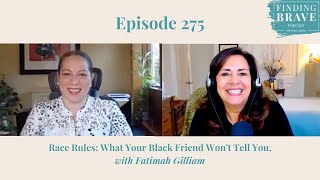
Fatimah Gilliam wrote Race Rules as a how-to manual for white people to reduce racist impact. The book has 31 rules built on one three-step framework: Learn, Reflect, Act. It includes translation charts showing what was said versus what was heard, plus guidance on centering people of color in conversations and avoiding white tears.
Questions this video answers
31 rules.
1) Learn (to unlearn) — seek external education; 2) Reflect (to repair) — internal evaluation via guided questions; 3) Act (to address) — take positive corrective action.
Available on Amazon.
Chapters
What happens when you're the crazy person at Thanksgiving that says something ridiculously racist? What do you do when you're thinking about releasing a product that leans into racism? Right. And so what I'm focusing on is giving people the how to.
Hello everyone, this is Kathy Caprino and welcome to my podcast, Finding Brave. I've created this show for everyone who longs to create something bold and brave in their life, to rise up, speak up, and stand up for who they are and to reach their highest and biggest visions. Each week I'll be speaking with inspiring guests from all walks of business, leadership, entertainment, the creative arts and the entrepreneurial world. And they'll be sharing their intimate stories of Finding Brave and offer their best strategies for building your most rewarding, joyful and meaningful life, business and career. Hello everyone. Kathy here. Thank you so much for joining me today. I'm very excited to share that we've opened the enrollment window of the winter 2024 session of my 16 week amazing career Project course. This session, which starts February, teaches professional women the 16 most essential steps to building a more rewarding, joyful and successful career with the respect and recognition you deserve in the fastest way possible. Through the four months of the course, you'll get 16 jam packed instructional videos, 16 weekly live group coaching calls with me, 16 tailored homework assignments to move you forward fast, an amazing online support network, my handpicked collection of Premier resources, plus great lifetime discounts to my private coaching programs and $1,000 off the full price plus seven great bonuses. Truly, it's a fantastic investment in you and your career and there is nothing to lose and so much to gain. Join me this winter. Visit amazingcareerproject.com for more information and I hope to see you February 1st.
Hello everyone.
Welcome to another episode of Finding Brave. Kathy here. I know that I say this every time, but I can't stop myself. Every episode of this show, to me and I hope you feel the same, is like a Master's class in life, in leadership, in careers, in personal growth. And today is such an important topic and episode along the lines of A Master's Class in Life. And I'm so honored to have our guest, Fatima Gilliam with us who has just written the amazing book. Give us the title here. Where is it? Race Rules. Tell us, Fatima. You say it.
Race rules. What your black friend won't tell you.
What your black friend won't tell you. The minute we connected, which was a few months ago, and you told me about this book, I truly, absolutely couldn't wait to Read it because I know that I have so much to learn and, and so many well meaning people do have a lot to learn. But we often, I think, don't know where to go to learn it. Don't know, don't have the friend that will tell us what we need to know. And we're not taking a class where we're studying it. So I'm grateful to you for writing this book and for letting us have this chat today. Thank you so much.
Well, thank you for having me.
Such a pleasure. All right, everyone, I want to tell you about Fatima because it's in an illustrious bio. Fatima Gilliam is an author, lawyer, consultant, public speaker and entrepreneur. Her career combines expertise in law, diversity, human capital, leadership, stakeholder engagement and negotiations. What a blend. I can't wait to hear more about that. She began her career as a corporate attorney on Wall street, worked for Citigroup overseeing campus diversity recruiting for all of its U.S. businesses. Wow. And oversaw corporate partnerships as the head of finance and fundraising for North America for the Nobel Peace Prize winning United Nations World Food Program. Wow. Since founding the Azara, I hope I'm pronouncing that correctly group which provides diversity and inclusion leadership development, negotiation and strategy consulting services. She's advised Fortune 500 corporations, senior execs leading billion dollar businesses and industry thought leaders. There is more to read about this, so go to the show Notes. But again, we are talking about race rules. What your black friend won't tell you. All right, let, let us dig right in here. Fatima, tell me why. Tell us why you wrote this book. Now I bet it's been brewing, but you decided. No, now is the time. Can you tell us about that?
Sure. I mean, it was. I've actually been writing this book for, for five years. And I'll tell you what was the catalyst for it and then my intention with it. And so the catalyst for writing this book was I was watching the news one day and it was another one of those news stories of a Karen going viral for calling the police for no reason. Right. It's sort of like we see this happening all the time. It's a rinse and repeat. And when I was watching that newscast, I started thinking about a multitude of things. I started thinking some of my experiences, you know, in my private life, in the work world, I started thinking about some of my diversity consulting work. And I also started thinking about the things that white people say when they don't realize I'm black. And as all of that was happening and I'm watching this newscast, I Had a light bulb moment. And I was like, white people need a manual. They need a manual, and somebody has to write that manual. I'll write that manual. And so that was the. The beginning of writing race rules. And so I started writing it because I was thinking about that, you know, somebody has to say it. Somebody has to say the hard truths. I'm serving as that, quote, unquote black friend that is going to say the quiet part out loud, the unvarnished truth. Being uncomfortably candid in sharing what I think a lot of white people need to know. You know, I find it. It' very interesting experience that happens. You know, you can have a white person has an encounter with a person of color, and they, you know, will walk away with two completely different perspectives as to how that interaction went down. You could have the white person thinking, oh, we're cool, we're friends, you know, or maybe there was some misunderstanding, but we're still okay. And then the person of color could walk around saying, I can't stand that person. I can't believe I have to encounter them in the next business meeting, at my cousin's barbecue, you know, at the community organizing event, whatever it is. And they have completely divergent views as to whether or not they even have a good relationship. And so I wrote this book to say the quiet part out loud so white people can learn and grow and. And evolve to be, you know, better friends, better leaders in the 21st century.
Gosh, I wish I could have you on for five hours. And again, everyone, you know, I ask the questions that I need to understand. You know, yes, we have some prep questions, but I have already one question I never prepped you on, but this is what I need to know. Sure, you and I talked before. We connected and shared a lot. And I want to give this little story. I was married to a Jewish fellow. We're amicably divorced. But it. It's been crazy to me how a lot of people with my name will assume I'm Catholic. And they'll say, well, you know about the nuns, you know about, I'm not Catholic. I was raised Greek Orthodox. So very early on, I saw how people make assumptions and the way they look at you are steeped in their assumptions. She's Catholic. And then, then, you know, similar to your situation, that people don't recognize that you're black, a person of color. People would say to me things about Jews because they. They thought I had no connection with Jewish people. And here I was married to. And what I saw was the anti semitism like you wouldn't believe. I'm interested in what is the biggest thing you hear from people who don't think you're black. What are they saying to you?
I mean, you know, honestly, Kathy, it runs the gamut. I mean, sometimes it's been people literally dropping the N word. Other times it's just making these tropified, stereotypical statements about, you know, different group, people of color as a whole, or about black people, you know, and it's just a lot of it is coming from people getting too comfortable, you know, thinking that they're by themselves and then revealing their true selves. And, you know, but it's interesting, Kathy. It happens from a couple of different perspectives. Sometimes people say things and reveal themselves to me when they don't realize I'm black. And then other times people do know I'm black because I, you know, I'm open about it, but then they still think that, like, I'm one of the good ones, right? No, you know, with air quotes on the good ones. And so, you know, and. And I don't fall into some tropified version of what they think black achievement is, right? Because I went to Wellesley College, got my master's at Harvard University, went to Columbia Law School, you know, worked on Wall street, all of these sort of things. The package is supposed to be that, I guess I'm supposed to be some downtrodden person. And so as a result of that, people get comfortable even when they recognize or know that. That I'm black.
You know, two words stop me in my tracks in everything you just said, which is they're being their true selves. So where do I want to go with that? You know, it's the same thing you and I have talked about, you know, and I've talked to millions of people about if you're doing leadership coaching and career coaching or any kind of coaching, what you're seeing are people's true selves. And that's what you have to change, right? It's not the language we want. I mean, we want to change the true self. The bigoted, racist, anti Semite, you know, hater of whatever. That's what we need to change. So let me just ask this, because I didn't prepare you for this either. Your book, Race Rules. What is your deepest hope for? Are you hoping to change people's true selves?
I'm hoping to do a couple of things. One is I want people to behave better and make better choices. So one of the things I say in my book is I want you to follow my rules, even if you don't always agree with the. And you don't fully understand it. Because part of what I'm trying to achieve is the impact of people's choices and behaviors and not the intent of their choices and behaviors. So I want people to just make better choices that positively impact communities and people of color.
And do you think I want you to repeat that? Would you repeat that statement? You want to focus on impact?
I'm all about the impact, not the intent. And let me also tell you why that's important, Kathy. It's important. I also want people to exchange, expand their understanding of what racism even is.
Can you tell us what it is?
People lean too much into this hearts and minds, you know, framework they're focused on. Well, in my heart, I believe racism is bad. In my mind, I believe that discrimination and bigotry is evil. And this is not about good and evil. It is about whether or not the impact of your choices harm people of color, individually and collectively. So that could be the choices that you make when you have a conversation with somebody. That could be the choices that you make in your behaviors when you're engaging in the workplace or coming out with products and services and leading teams. And that could be the choices that you make when you go and vote for things that uphold segregation in this country. Right. Like, the biggest battle in communities is where people live and send their children to school. And some of the most segregated parts of this country, surprisingly, for many people, is not in the South. It's in the Northeast, it's in the Midwest. Right. It's in places where people think, like, you know, that racism thing is over there. And what I'm trying to get people to see. No, that racism thing is in the mirror. And that people need to look at themselves and see, like, what choices are they making? And stop leaning into, am I a good person? Am I a bad person? What's in my heart? And instead, they need to say, what is the impact of what I'm choosing to do every day and how I'm choosing to behave when I engage with people of color?
So would you say the key difference between intent and impact is knowledge?
It is knowledge. It is knowledge and thinking about whether or not what you're going to do is going to lean into upholding white supremacy in American society? And it's really like, it's the little things, right? So people. People want to think that that racist person is like the person who shows up in Buffalo at the supermarket and shoots people. Right. And, yes, that is an extreme form of white supremacy and white nationalism. But people are on a spectrum, right? Right. So even the person who's a white liberal Democrat who voted for Obama, that person too can engage in racist decision making and racist actions and have racist thinking. And so I want people to expand and see their own role that they're playing.
And it isn't easy, is it? I mean, I'm trying to do that around gender. And I was even playing tennis with a guy and I don't know, someone tossed a ball and tried to get it into the basket of balls. And he said something seemingly very innocent. You know, I have a boy. That's what boys do. And I'm like, girls do that too, you know, and of course, that's not hurtful per se, but it's so embedded. It's so embedded what we think at a very deep level, you know, that it's. All right. Now tell, tell us, how do you think this book is different from other books on racism? How do you think it's different?
It's different from a couple of different ways. One is just the fact that, you know, I'm just ripping off the band aid. You know, my talent is truth telling. Right. That's. That's what I'm really good at. And so it's an unvarnished truth book. The other thing is, a lot of other books on racism are autobiographical in many respects, or they focus a lot on history. I don't personally show up in the book except in the introduction, and instead it's a bunch of rules. It's a how to prescriptive guide. And so a lot of books, they may describe what is sort of created, the construct of, of white supremacy in America. And I do touch on that in some history. But they also talk about their personal story. And then I think that's great, people can understand how that person's experiences impacted their view of society. Okay, and then what? And then what? What happens when, you know, you're the crazy person at Thanksgiving that says something ridiculously racist? What do you do when you're thinking about releasing a product that leans into racism? Right. And so what I'm focusing on is giving people the how too. Write that prescriptive. And I'll also say other thing. I've written my book in a way, for what I call, like the lazy reader. Because I'm a lazy reader. I like to skim, I like to hop around. And so I've written it so that each chapter, while it builds on itself, it doesn't depend on a previous chapter. If you want to understand cultural appropriation, hop there. In work, go there. Best practices for discussing race, hop to that chapter. Colorblindness. Go there. You know, you want to understand police violence, go to that chapter. And so it's just lots of different approaches, lots of different rules explained, you know, that are not that long. Giving people some context, some history, some data, some reflective questions. I have translation charts. You said this. This is what was heard. Please say this instead. I give people talking points. And the other thing that's different about the book is it has illustrations, you know, because people remember more what they see than what they read. And so each chapter, there are 31 RA rules, so 31 different topics. And each chapter starts with an illustration that encapsulates some of the core points in the book. Sometimes they lean into humor, sometimes they're a bit biting or there's some irony in there. But the point is, is I'm trying to meet people where they are, the different kinds of ways they may consume, you know, information so that they walk away learning something.
What an incredible achievement. I want to dig in to the top. Race rules that, you know, are not being, you know, the friend isn't saying it, and they're the most damaging. We're going to get there. But I have a crazy question.
Go ahead.
You know, how when we come from our own perspective, even though it's deeply informed, not everyone who is like us agrees? It's the same as when I write about women in leadership. Do you think that everyone of color who reads your book would agree or would some people say, I see where you're going, but I can't agree with this?
Well, I don't think every, you know, one thing I say in the book is like, I. I can't write for everybody, right? I can't write for every perspective. You know, black people aren't monolithic. People of color aren't monolithic. And so this is what I think will be the hump of the bell curve, right? And there will be some outliers. And so, yeah, not everyone's going to agree with what I have to say, or even all of my rules, or they might not agree with some of my premises, which are. Which are, you know, the controversial aspect, I think, for a lot of people to swallow with my book is that I believe that every white person is racist in some way. And that doesn't mean that's an analysis of them being a bad person. It's more so an analysis of society and so an analogy that I have is, does the fish notice the water that it swims through every day that is vital to its current existence, that it needs to breathe in to survive? Right. And we can think of society as being that water, and the people are the fish moving through it, and they're breathing in this construct of society, it is impossible not to take in and internalize subconsciously some of what has made America what it is. And so there are a lot of people that work really hard to combat racism, but that doesn't mean that they still may not make some decisions, whether it be about their local school, whether that be about whether there should be zoning or affordable housing, or whether somebody is a, quote, culture fit for their organization while they're still trying to do good things? And so with this book, with Race Wolves, I'm trying to give people access to information so that they can live their values and not just talk about their values.
I love it. And, you know, if anyone who's listened to the show knows, I talk a lot about. We are the fish in the water. And you don't. Fish don't see water. You know, we're swimming in the water and we don't understand it. There's one. One challenge I want to make here and see what you think. And. And I don't believe this is coming from. I don't believe a word you're saying. You know, I'm defensive, but I will say this. I believe every human being is racist.
And so that's. I would disagree with that. So I believe that every person is prejudiced, but there's a difference between prejudice and racism. And I have a whole chapter that.
Tries to tell us what that is.
The difference in. The key ingredient is power. Right. So. And. And whether or not you have power as a group. So. Yes. Are there, you know, prejudice, Black people? Yeah.
Every.
Every person is prejudice. I'm going to prejudge someone whether I see that they're female, tall, short, whatever. But if I don't have historical, societal, political, institutional power, then my prejudices aren't going to have the same kind of impact.
So racism to you. I. I was viewing the term as. I have prejudices based on race, and I believe every human being has prejudice based on race. I do, but I haven't met any that don't.
Which is prejudice. But see, if we don't include or understand the role that power is playing.
So racism to you embeds or is embedded by and with. And with power.
With power. And that's important because if we don't Consider the power and the historical context, then we can't come up with solutions because instead we're going to review. We're going to view everything that considers race, which basically, like affirmative action, we're going to consider everything as being racist as opposed to being a solution to a systemic, institutional, historic problem.
Love that distinction. I can get behind that. All right, now there's 31. Did you choose the number 31 or is it like my seven power gaps? It started with 15 power gaps in my book. And I went, wait a minute, that's too much for people. And this is a subset of that. And this is an offshoot of that. Did you do that where you wrote them all down? It was 131.
No, I mean, I actually, when I was writing this book, I initially had like almost 50 race rules, but my publisher was like, okay, Fatima, this is not going to be the treatise on racism, right? This, you got to scale it back. And so I scaled it back to what I thought were the most important rules that I wanted to convey. And I also created what I call the bedrock race rule. Right? So all of the rules, except for the bedrock race rule are very topic and situation specific. Right. Like I alluded to before, colorblindness, asking about somebody's name or race, Black Lives Matter versus January 6th, voting restrictions, you know, all of these things, they're very topic specific. But I also created the bedrock race rule, which is the universal three step rule to how to make you know when you're, when you're faced with a what do I do quandary, Do I say this thing? Do I come up with this product? How do I respond in this situation? I created a universal rule to guide people to making better choices and decisions in real time. Let's hear the rule. All right. It's got three steps. Step one is learn to unlearn, right? So you have to engage in some external education. You don't know something, go out and find some information about it to help guide your decision making. Step two is reflect to repair an internal evaluation. Because people have to then take a personal inventory of their thought process, how they've made decisions before, have they been impactful, harmful. And then step three is act to address positive action. One of the things I'm really trying to drive in this book is not this, like I said before, hearts and minds. Am I thinking about things right? But are you acting about things right? So to me, if you're not making the right kind of external expression of, of, you know, anti racist decisions, which means Acting, behaving in a certain kind of way, then. Then you're not doing anything but, you know, swimming in the status quo.
And, and the one reflect to repair. Is that the. The phrase. Do you even think people know what they have to repair?
I think sometimes they do, sometimes they don't. I do. One thing that I do is in the book, right? So I have the three steps, and then I give people for each step five reflective questions to help guide them to think through this sort of process so that they can arrive at the better decision. And then I also provide them with an example of, like, here's a situation, and this is how you can apply the rule so that someone can apply it to their own life, their own thought process, to help them make a decision that leans less into supporting racism and more into supporting people of color.
What an important book. All right, can you give us. We don't have all the time in the world. Can you give us the top five rules and a step to take to assess. Are we breaching the rule? Anything we need to know. This is it. This is our chance here.
Well, I think one of the top rules is voting restrictions are racist. I mean, if we're going to really impact society, then you have to start with people having access to the polls and democracy. So I think that's one. The other one is my.
Can I stop you there? Can I ask a question on that?
Sure, sure. Let's go for it.
Everyone knows I'm a liberal. We're not going to get terribly political here. But here's my question. You've been in high levels of leadership. When we see groups voting for voter restrictions, whether are we talking gerrymandering or we're talking about mail in ballots.
Do.
Do the leaders consciously know? Do they consciously say out loud, this is how we want it to be? Because we want to limit people of color to vote?
I think a lot of the political leaders know exactly what they're doing. But are they saying it sometimes, unfortunately, or maybe fortunately, Sometimes they do. You know, you have to look at what to say.
I mean, this just makes me want to move somewhere, you know, I mean.
At the end of the day, if we're supposed to have a representational democracy, then we need to allow people to have one person, one vote, and we need to have unfettered access to the polls and.
And obvious.
Right. But the thing is, people want to spend a lot more time focusing on restricting who can vote instead of focusing their time on coming up with better policy platforms.
I couldn't agree More instead they just.
Want to rejigger the rules and that thing. But in terms of what is the top thing someone can do, have really good impact is combat voting restrictions in their community. You know, voter rights, you know, research shows voter IDs, you know, it just more so impacts negatively people of color, young people, the elderly, people with disabilities. And there isn't voter fraud. You know, the Brennan center for justice at NYU Law School, I mean, they've done ext research about how voter fraud isn't a thing. So why are we trying to make it hard for people to vote? So that's one thing that people can do, focusing on voting restrictions. The other thing that people can do is focusing on what are the policies impacting their, their local community, so housing and schools. Right. And start making decisions that, that desegregate. But so those are two that I've given you that are more like on the policy level.
Yes.
So a lot of people could be like, okay, well I don't want to be that politically active or I just want to tune out or whatever. So then they might think, well, what can I be doing on a more individual one? On one level.
Okay, love it.
And I think what people really need to be focusing on there is, you know, what kind of language. Yeah, tell us, are they using, you know, are they saying things that are really offensive to people?
Tell me what's offensive. Where your situation where the white person walks away and says, that went great. I'm so glad we're. I'm so close to my friend.
I'll give you an example. Just like I can make it personal about me, right. So I put it out there. I'm a black woman, right. I'm light skinned. Some people are confused by that, you know, but I'll say to someone, I'm black. And then, you know, or they may then start asking me about my name. My name is Fatima. Like what's the origin of it? You know, but they're not listening to me. So for example, I could say I'm a black American whose family has been here for 400 years and fought in nearly, you know, and fought in every American war going back to the American Revolution, Civil war, War of 1812, etc. I could say that to someone, but then that doesn't fit into whatever little box that they want to put me in. And so they start asking me like, well, where is your family from? I just told you where my family is from.
Meanwhile, they're saying, how can you be black and how is that possible?
Or they Say where you, you know, someone can ask me like, oh, where are you from? California. Well, where's your family from? California. I'm a third generation Californian. Well, where are you really from? That line of questioning is extremely offensive because I've already said first of all I shouldn't ask people more, you know, directly where are they from? Because what that means you is they are othering someone. Because the undercurrent of that inquiry really is you're not from here, so where the hell are you from? Because I need to put you in some box that doesn't, you know, because you're not computing with me thinking American only means a white American.
Now I have a question and this is going to be something you're going to say, she's doing it. People ask me that question once a week because I could be from Israel, I could be from Spain, I could be from Brazil. I speak, you know, five words of Greek, I speak some Italian, I speak some French. I get it all the time. I just got it in the train station. We were in the bathroom and a woman said in Spanish something I said, I'm sorry, I don't speak Spanish. And then she said in English, where are you from? I do not take offense to that at all. And I get it all the time because here's my thinking, I look a certain way and that could be 50 different countries and you are curious what country it is. But I speak perfect English, pretty perfect. So I don't take it in any way they're interested in what country my family has emerged from. Do you think, and I'm really asking a challenging question, that sure, I should be offended by that and, or do you think when people ask people of color they're going for something different from what these people are asking me about?
I think it's, I think it's different. So first I'll say instead of people asking, where are you from? You know, better phrasing could be like, oh, where did you grow up? You know, which is, you like that better? I do like that better. Or, or if you ask like what state did you grow up in? Right. Already assuming something more about here. Or instead of asking if someone's trying to get to know you, they just say, oh, you know, I'm curious knowing more about you, what do you want me to know about you? Leave it as an open ended question and you don't even have to talk about whether or not, you know, you're Greek, whatever. And they, and you can come back and say, oh, I love Basketball, I love poetry, I crochet, whatever it is. And then if somebody doesn't give them what they want, meaning not saying, I, you know, my family's from XYZ ethnic community, that means they don't want to answer it potentially and leave it alone. But getting back to the other part of what you're asking is there's a big difference of asking you where you're from and asking me where I'm from. Really there is. Because the while it could still potentially be offensive for you or to be offensive to a white person, it's not the same kind of othering that's going to happen. This. It's not going to have the same kind of hit feeling as marginalized. When you're asking, if you walk up to somebody that is, you know, you're at a dinner party and you meet somebody who looks like they're, you know, south, you know, or East Asian, right. They look like they could be from Japan or Korea and you ask that person, oh, where are you from? They could feel othered and for all you know, they could be like a seventh generation Chinese American that came here in the 1800s. So where they're from is the United States or if they, you know, immigrated here, they're still from the United States.
I'm from the U.S. i'm from California. So can you explain othering when you're speaking? I realized when it bothers me when people think I'm Catholic and I'm not. It doesn't bother me if someone thinks I'm Brazilian. I think what bothers me is when you think of someone as a religion. You are bringing all of your assessments about that to that. Is that what othering is? Do you understand what I'm saying? I'm seeing a difference in how I interpret that question. Where are you from? Or oh, are you. You're Catholic and I'm not one makes me feel judged in a way I don't want to be judged. The other feels like an inquiry. A a, you know, not a loaded question. Am I, am I getting to something here?
I think with othering it's really about do you feel like you're, you know, is someone making an inquiry that makes you feel marginalized? Is something making an inquiry that makes you feel like you're not a part of the mainstream? Is someone making an inquiry that makes you like a foreigner in your own homeland?
Is that the definition of othering?
I mean, there are lots of definitions, but what I'm talking about is yes, it's about you Know, the marginalization of people, making them feel like they don't belong and they're not a part of the society. And that's the main thing that people need to avoid. Right? So in terms of how do people engage on a daily basis, how do they interact is, you know, are the words that people are choosing the decisions that they're making, the, the behaviors that they're engaging in, the words, right. Their, their body language, all of these things in however they're communicating. Is that making somebody feel like they're belonging, that they're included, that they're a part of society? Or is it making them feel like they're on the periphery and therefore don't have as much value, don't have as much power, don't have much of a voice.
It just brings tears to my eyes because it's so many layers, isn't it? I mean, people can be well meaning, thinking, what's wrong with asking that question? But it takes a lot of introspection to te. I'm not letting anyone off the hook, but to tease out the layers of how you just othered a person. Right.
Which is why, because these things are so complicated. That is why in my book Race Rules, that is why I'm trying to give people the tools. Right? Like that's why I have these translation charts. You said this.
Give us a few of those, Fatima. Give us.
I can't even remember some of them off the top of my head. But I mean, just like for the example of what we were talking about, you know, should you ask somebody where are they from? And instead ask them an open ended.
Question like, tell me about you.
Yeah, you know, asking those kinds of questions instead. Or some things like you just don't have, you don't have a right to this sort of information. Even though someone is curious about something doesn't mean that you have a right to have it. Like, have you earned the right to have and understand personal information about other people? People are going to want to reveal what they want to reveal. And so people have to pivot and accept that someone doesn't want to share something. And if they don't want to share it, that's their choice.
Buzz off.
Move on.
All right, give us three more. And you know what would be helpful? I think, Tell me if I'm wrong, please. I think to you and people living this experience, they're also very obvious to many of us. We're not aware we're doing it. That doesn't let us off the hook. But can you give us Some rules where you can clearly see the white person isn't aware they're doing it.
Well, I mean, the, the.
Is that a. Is that a not a great question? Not. Not clear enough or not?
I'm trying to answer. But I mean, in terms of, like, the context of some of the things in, in the, in my book, that they are very, you know, topic specific. Right. So. And that is why I created that broader bedrock race rule, so that people can, you know, think about any kind of topic and how they could, you know, respond in that moment. But I mean, I also have rules that talk about, you know, discussing race.
And give us the.
For example, when you're talking about discussing race, when you're having a conversation with a person of color, and mind you, a person of color who's consented to having this conversation with you, because that doesn't mean you've always consented when you're having that conversation. Who is being centered in that conversation? Because the person who should always be centered in that conversation is the person of color because they're already marginalized and having to live through racism and microaggressions. And microaggressions, frankly, are just little small versions of experiencing racism all the time. And so when people are having these conversations, it's like, is the, you know, is the setup of the conversation, if it's a structured conversation within an organization, is it even being done in a way where the person of color feels that they're being protected in some way? You know, is the conversation happening where all of a sudden. I could tell you one thing that really irritates people of color is having to endure white tears. Okay, so if you're having a conversation, I'm doing it. No, but I'm just saying, like, we don't. We don't want to deal with the tears. I'm just being. We don't want to be in the tears of.
Of empathy or like, I'm having. Or the tear. Any tears, like, shut up.
I mean, sometimes it depends on the situation, but, you know, the people. I do want people to have empathy, right? I want people to humanize people of color. And it's okay. You know, sometimes you might not be able to control it, but the question is, when a white person starts to cry in that moment, are they going to allow themselves to become this focus, centering themselves, centering themselves, and then instead they hijack the whole conversation? Because now everybody has to turn to the white person and has to turn to, like, are they okay in that moment? How do they Feel, which means now it's all about white feelings. It's all about white tears. And then that white person is becoming the victim in the equation, and it's moving away and distracting from addressing, you know, intrinsic problems with race. Or let's say you're having a conversation talking about race, and someone then says, okay, well, if we're going to talk about it, I want to talk about how you did XYZ thing to me that I found racist or offensive. Right. And then the. And then the person is going to, you know, feel attacked and cry or do whatever or get defensive. And then it's another situation of it becoming about the white person in the conversation. So when somebody wants to have a conversation, they need to come ready and prepared to navigate their own feelings.
I got another question on that.
Sure.
Tell me what you think when you are giving examples of othering or marginalizing. Where I'm going is trying to understand what. What occurs to me is when I have felt exactly that. Now, it is not the same as racism. I get it. But when you were talking, what. And I'm grasping at how does that feel? Let me try to identify how that feels. And one thing that came to mind, and I know it's not comparable, but I want to explain something and see what you think. I'm divorced. I never had any idea how much society rejects people who are divorced and criticizes and judges it. And I feel othered a lot. You know, like, oh, some just yesterday someone went, you're divorced. Like that. Like, you're one of those.
Even though, like, more than half the population, I'm like, yeah, and I'm amicably.
Divorced, which makes me really want in 20 million. I bring it up not to hijack, but I am desperately. It's not even conscious when you're speaking. I am empathizing by saying I've had that situation not at all as damaging as racism. If I were to bring that up like I am on my podcast, am I doing the very thing you're saying not to do? Wait, I need to correct that. I'm not asking for your empathy of my situation. I'm saying I have felt that for one half a second in my life. I'm bringing it up because if I felt it like this, I can't even imagine what I think, you know, like.
The answer to your question depends on the context. Right. And how it's brought up. Because I think, you know, someone is discussing race. And for somebody to understand another person and to humanize them, they do need to go through an internal process to identify. Right. And so the benchmark for identification with that person could be thinking about, well, here are examples of how I may have felt others. Right. And so with some of the reflective questions that I have in the book, I do want people to do some of that internal thinking so that they can then see how something can feel. In terms of when you're in a conversation and whether or not you bring it up, I think it depends. You know, sometimes people need to read the room and see whether or not that. When you bring that up, is that then going to shift the whole conversation and talk now about divorce in America and what that means, or is it still going to stay focused on race? And when people have conversations on race, one of the things that I say is you need to stick on that topic and then stick on that topic, not start focusing on other marginalized groups, whether that's trans people, whether that's, you know, women, whether that's religion, all of these other. You know, there are a lot of isms out there. But what does happen a lot of times when we're talking about race is we move to all the other isms and don't focus on what is the hardest thing for American society to truly focus on, which is having a. A conversation, an evaluation, an analysis of race in people's personal lives, in their professional lives, and in their communities.
There's so much. All right, let me ask two more questions. Five more questions. It seems when I'm having conversations about this topic and I'm a white woman, so it isn't an, you know, a thimble full of the vast universe of information you have. I sense that automatically, unconsciously, people don't want to look at their racism or our country's racism because they reject that they are flawed or our country is flawed. It's too much for our puny little minds. I mean, when we're recording this, there's war in the Middle East, I feel I. I read a book once that the person said, the Earth School is the. It was a reincarnated individual who said, the Earth School is the hardest because your population is so large and your. And there's so much diversity, and your human brains cannot cope with it, cannot grasp it. I don't think any truer words have ever been spoken. I don't think our human brains. I think we're reptilian. I think we're. We're not there.
And not everybody wants to take themselves on as a project.
Oh, that's a great way to Put it. I feel like there's so much defensiveness. What do you see? Is it defensiveness from pain that I don't want to see that our country is flawed, that I'm flawed. What is it?
I think, you know, I think part of it is people engage in too much exceptionalism. Right. So that they are, they are the exception to the rule. So if there's racism that's happening, it's over there.
It's not me.
Right. Or it's this, some other country, some other community. It's the south, it's not the North. As if the north, you know, didn't have slaves. Massachusetts was the first state to, you know, colonial colony to have slavery in the 1600s. Right. So they wanted to think that it. And by the way, New Jersey, you know, when New Jersey got rid of Slavery, 1865, pursuant to the amendment, the constitutional amendment that outlawed slavery, okay. That's when Jersey got rid of its slaves. And I think the same goes for Delaware. But, you know, my, my, my point is, is that people, yes, they get defensive. They don't want to take themselves on as a project. They don't want to engage in that internal analysis. You know, you have companies that talk about, oh, we need to get comfortable with uncomfortable conversations. Sure. Until you start wanting to talk about racism and diversity. Right. They want to have an uncomfortable conversation about a product failure. But they don't want to have a comfortable conversation because that product was somehow marketed in a way that was racially offensive. Right. That's not the conversation that they want to have. So what it is is that people want to think that they can't be the person who is engaging in decisions. Which is why, you know, to be frank, I come for everybody in my book, including having an entire chapter that talks about white liberals, Democrats and good white people. That's me.
You know, I gotta read that first.
I mean, even when I've told people that I've been writing this book on racism, right. In this book that's coming, I have a lot of friends and, and colleagues and the like. They'd be like, you know, and I'm saying I'm having a conversation with a white person. And they say, oh, I know a lot of people who could use that book. And I'm like, yeah, you, right. Because my part of my point is, is that that whites in America, all of them, even the person who is the most, you know, woke, liberal, progressive, all of them are engaging in decisions in small ways, big ways that are harmful, having harmful, racialized, negative impact on people of color. That could be what voting choices they're making. That could be about whether or not they, you know, think that everyone that goes to a Black Lives Matter rally wants to engage in violence when 93% of rallies have no violence whatsoever. You know, or it could be the person who says these, you know, their, their phrasing is problematic, you know, or somebody who's like, oh, I want to have a dinner party, but I want to, you know, have some diverse people, you know, any black people that, you know, we could invite. Why are you asking me this crap? You know, like those kinds of things that, that, that, that may come out. And so I'm trying to give people guidance so that they do take that internal look. And the fact that it's sort of written in this choose your own race knowledge adventure way where people can hop around and take the pieces that they need that are relevant to their lives in real time. It means that maybe it's not going to be for everyone the deep dive that they should go through, but it'll be like the initial dive to start making better decisions. Which is why I said in the beginning, like, I want people to make, to follow my race rules even before their brain has caught up, right? Because that means that the impact of what they're doing is less harmful even if their brain isn't fully there.
I adore it. And to me, tell me what you think. There's some great kind white people there, but we are racist, many of us, in an unconscious way, correct? Great. So here's what I suggest. Pick this damn book up and read it and get the unconscious conscious start. And what I also love is change your behavior now. Do it. And that if you can't get at the many layers of how these, how these biases formed and why and what you. Okay, start acting differently. And I believe, I see that even in teaching, you know, professional women, you know, I don't have confidence. I don't have executive presence.
Yes, you do.
But let's help you act a little differently, right?
And somebody has to help. Which is why, like I said, I wrote this, this book to tell people what someone isn't going to say to their face, right? That may think about them secretly or privately or as soon as the white person leaves the room, you know, the two black people in the room would be like, did you see what they just did? You know, and then, so the goal is to help people evolve so they make better choices. But one thing that I do want to do, because we were talking about discussing Race generally. I would love to read you like, my favorite passage from the book. Please do. Okay. Because this is totally my. My favorite pass. Please do. But. So this is from. This is from my chapter where the rule is it's not personal when people of color don't want to discuss race. And then before that, I talk about, you know, why that's the case, whether people have the right to this kind of information. And so then I want to. And then at the end of the chapter, I leave people with this analogy. And so now read it to you. What it's what it's like talking to you about race. Let's put this in perspective. Recall life living in the COVID pandemic. Do you remember that haunting feeling you felt that never went away? That the virus was lurking at every corner? You couldn't escape it because there were reminders everywhere. On the news, online, in social media. And when you saw your neighbors or people on the street, you felt a sense of omnipresence. As you walked around, always on high alert, looking at others, seeing if they wore masks, looked ill or coughed, you noticed them and observed how they reacted to you. You are in constant fear of your death. Loved ones may die or did die. And you felt perpetual anxiety. Your mental health was impacted along with your physical health from the stress. You had trouble sleeping. You weren't even safe in your own home because the virus could come to your door. You didn't know if you could trust the government or if officials had your best interests at heart, unsure if they would do something to kill you. You felt powerless, as if there were nothing you could do to change things, to make your life better. Since you weren't in control, you had to resign yourself to your circumstance. But you didn't want to accept your reality. You wanted to resist and somehow make things better. When you tried, you didn't succeed. That's what it's like living under racism every day 24 7, 365. Racism is a pervasive, invisible force, just like Covid. There's no escape. It's constant. Never a break or reprieve. It's isolating and marginalizing. It attacks your life, bank account, livelihood, housing, health care, schools and dinner table, and separates your family. You want the government to do something about it, but politicians want you to laissez faire your way to non solutions, absolving themselves of responsibility, willfully blind to its impact. You suck it up. You deal with big picture systemic issues. Pull yourself up by your bootstraps, heal yourself, pave your destiny. Avoid your own death or murder. Welcome to living like a black or brown person in America. But with racism, there's no vaccine coming, no magic pill to inoculate society. This is what it's been like since the 1500s. It isn't getting better. There are new strains, new waves and invisible resurgences, mutating, reinventing itself, seemingly dormant, but always there, stalking, ready to strike and viciously kill. This is the reality. It's bleak when you want to discuss racism. Sometimes people of color only want to discuss it with those who understand what they've gone through. Not white folks who will trivialize things, which is akin to speaking to an anti masker who berates innocent and defenseless store clerks. That's you questioning racism and their experiences. And you're the anti masker, anti vaxxer in the conversation when you come with COVID microaggressions, overt aggression, a lack of knowledge and a rejection of facts. Now can you understand why no one wants to talk to you? They're already too busy trying to literally survive. That's my favorite passage.
Incredibly powerful. Thank you for joining us here. Thank you for. I know this is just touching the tiny top of the surface, it's so deep. But you know, let me ask this, we'll leave it on this note. I. I'm not a Pollyanna, but I believe in hope and I believe that we can make a difference and I believe that we can learn and I believe that we can take ourselves on as a project. I mean I sure as hell have. And I think anyone listening, I hope you're encouraged to take yourself on as a project. I mean there's nothing more enlivening to learn how to unlearn, to be better. So I hope that this conversation encourages people to read your book, every word of it, or the chapters that they can handle. Maybe not sit down at the beach for, you know, for a five hour read. Okay, maybe you can. But I encourage everyone who wants to live better as a human being, be better, love better, to read your book and to understand that it is all of us, white people and others who are othering and, and engaging in racism every day. And most of us perhaps don't understand how we are. Thank you for joining. Any last words? Where can we soak up everything that you have to give? Where do we send people?
Well raised rules. What your black friend won't tell you is available on Amazon. So I encourage people to get my book. I encourage people to share my book with other people that they think can learn from it. I Also, and, and when you get it, please write a review on Amazon. But, you know, also, if a. If a person of color gives this book to a white person, they should see it as a sign that they cared enough to try to help them do better and be better. And so my goal in writing this book is because I do think people can change. I do think that people can change collectively and individually, and it has to start somewhere. And so I see Race Rules as my patriotic contribution to American society so that we can evolve. And if people want society to evolve, they have to do something. And I believe that Race Rules is a starting point for many people on how they can do things in their personal life, how they can do things in their professional life, and how they can do things better in their own community and as a country. And that is my gift. I've decided to do this courageously. I know that not everybody wants to have the difficult conversation and say the quiet part out loud. And. And I want, I want us to evolve as a society. So this is what I'm putting out there, and I hope people snatch it up.
Thank you for your courage. I know it takes. It's finding brave for sure, times a million. And as you're speaking, I can imagine you launching book club discussions on this because we have questions. I mean, I don't think it works for us to just read and not have questions. If we're really digging in, we're going to have questions about how do I.
Do this better, right? And people should write. They. They could read it as a family. They could read it in their, you know, communities, their churches, churches, mosques. They could read it in the workplace. You know, I even have tips about how to do it as a, you know, as a group for structuring conversations, things that people should think about. And so I want people to, to do this either in book clubs. The goal is with Race Rules. I do want it to catch fire because they. Through the, through this catching fire. That means that we're going to be moving to a better place, a place where we're not banning books, a place where we're not restricting what people are going to be teaching in schools. I mean, there is some history in my book where it includes things that you didn't learn in your school history class. And if we're not going to look and evaluate these things, then how can we evolve? How could we expect to be in a better place 20, 30, 40, 50 years from now? And to put stop the flow of intergenerational racism if people don't say, you know what? This buck stops with me. What can I do today? What can I do as an American, as a community member, as a family member, as an employee to make a difference wherever I go throughout my life?
Amen to that, my dear. Thank you so much for joining and letting me ask my my questions that I'm sure you hear 2 billion times and being so kind and respectful. Thank you. I wish you all the best in such important work. Love it. All right people, wow. I hope that you are moved, interested, intrigued, ready to take on yourself as a project. And we, you know that I say this, but we would love to hear from you wherever you see this comment. Comment respectfully please. That's my ask and we would love to hear your questions and comments and we'll do our best to support you on on that journey. Thank you for being here. Thank you again, Fatima. My goodness, such important work. I hope you have a wonderful week. I hope you've enjoyed this and here's to another Finding Brave. Two weeks and we will see you next time. Thank you. Hi folks, Kathy here. So are you thinking about launching a new podcast or have you been at it a while and recognize it's time for more or better production help to create the best podcast you can? I totally understand. I've been podcasting for over six years and I know how challenging it can be. That's why I'm really excited to share some key information about the great production team I'm using now called We Edit Podcasts. I've been working with them for well over a year and I've been so happy with the results. They're a full service production agency and their services give me access to a wonderful team of seasoned audio engineers and editors who help create a polished professional sound, and they work hard to ensure that my particular podcasting approach and style comes through in every episode. They also help me make sure that my guests are reflected in the best possible light through the creation of terrific show notes, which is an important part of the show for me. Their process is easy and streamlined and their responsiveness and customer service is terrific too. If you're ready for better production help, definitely check them out and take advantage of their free trial episode, allowing you to sample their processing quality to see if it's a great fit for you. I'm confident you'll love them. Just go to the link we editpodcasts.com Finding Brave. That's my special link for you and book your free call today. Happy podcasting. Thanks so much for joining us today. And please don't forget to check out findingbrave.org for more programs, resources and tips. And tune in next time for your weekly dose of finding Brave.
More from Kathy


Elevate Yourself, Elevate Others, and Amplify Good | Chris Cooper | Finding Brave Ep. 334

Finding Brave Epis #333: How Leaders Can Harness AI Without Losing Their Humanity, w/Bennett Borden

Finding Brave Epis 332- How to Stay Brave, Valuable and Visible in the Age of AI, with Raman Rai

Finding Brave Epis 331 - The Power of Positive Disruption, with Dr. Patrick Leddin


Finding Brave Epis 330 - Being 40: Letting Go and Embracing Who You Are, with Stacey Lindsay

Disrupt Career Reinvention with Kathy Caprino - via The Disruption Lab Podcast w/Patrick Leddin

Creating Neurodiversity-Friendly Work Cultures: Simple Workplace Adjustments Matter

Finding Brave Epis 329 - How To Create a Neurodiversity-Friendly Workplace, with Kristen Pressner

Finding Brave Epis. 328: Reclaiming the Power to Trust Your Own Voice, with Dr. Cindy McGovern