276: Building Intergenerational Support To Move You Forward Fast with Hope Paterson
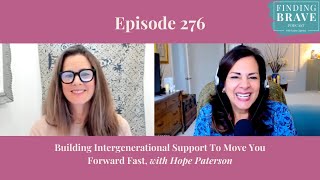
Hope Patterson talks about how her parents' encouragement shaped her into an education innovator and coach. She built the Hope Brain Trust during the pandemic, a cross-generational collaboration space, and shares how to create your own personal advisory board and set boundaries when groups go wrong.
Chapters
I'm a huge believer of how much our belief in ourselves or our belief about the world gets forged in the first seven years of our lives. And I would point to both my parents being they were really on a path of exploration and seeking self awareness, understanding.
Hello everyone, this is Kathy Caprino and welcome to my podcast, Finding Brave. I've created this show for everyone who longs to create something bold and brave in their life, to rise up, speak up, and stand up for who they are and to reach their highest and biggest visions. Each week I'll be speaking with inspiring guests from all walks of business, leadership, entertainment, the creative arts and the entrepreneurial world. And they'll be sharing their intimate stories of Finding Brave and offer their best strategies for building your most rewarding, joyful and meaningful life, business and career. Hey folks, Kathy here. Are you ready for a big positive shift in how you're working and what you're capable of achieving in your career? Let's make that happen for you. While you might know me best as a podcast host and writer, a key focus in my work is helping women achieve greater success in their work. In my career and leadership Breakthrough one on one coaching program, I help women get what they want most, which includes more confidence, impact, advancement, financial reward and fulfillment. And I also help them achieve their most exciting visions for the future. In the past 16 years, I've worked with over 20,000 women across six continents. And before that I served as a therapist and before that I was a corporate VP managing multimillion dollar budgets and global initiatives. I leverage all of that experience to help women build a new chapter where they can reach their highest and happiest potential doing work they love. Check out Kathy Caprino.com career breakthrough and I hope you'll register now. I'd love to support you. Hello everybody. Welcome to another episode of Finding Brave. How are you These days? I always just launch right in and start talking about me and our amazing guest. But you know what? I want to ask how you're doing. This comes to you in early February. We're not there yet here when we're recording, but I hope wherever you are, the weather's been good, you've been enjoying yourself, you've been finding Brave. I'd love to hear from you all about what's going on in your life, but in the meantime, we have a podcast to do and I'm so excited for our guest today, Hope Patterson. Hope, thank you for joining. I'm really thrilled to have our discussion today. Thank you so much.
It's a pleasure I'm so excited we're mutually mutual. What is it?
Admiration society? And I love to tell folks where I learn about my guests. Sometimes it's because they've written an amazing book and I hear from their PR team, but in this case, a wonderful new friend of mine, David Jurassic. Hope. I'm pronouncing that correctly. Who's been on the show? It came out a few months ago. He introduced me to you, Hope, and I just fell in love with everything you're doing. And, you know, I've realized that good people know good people in this world, which is a little bit about what we're going to talk about, but how wonderful to meet you.
Thank you.
All right. We are talking about this. Building an intergenerational support community to move you forward fast. I cannot wait to hear what Hope has to say. But let me tell you a little about Hope. Hope Patterson is a global nomad, mother of two, education innovation specialist, and transformation coach. For the past 20 years, she's been working in what she calls the Hope Triangle, electrifying pathways for humans of all ages working at the intersection of education, innovation, and entrepreneurship. She walks along. I love how you describe this. Walks alongside people as they move from old to new, supporting them to identify opportunities and support new ways of moving through their lives, careers, lifestyle changes, and family. Her innate skill of understanding and articulate the uni, articulating the uniqueness and brilliance of people allows them to explore and achieve what they envision. And there's more about hope. She's got 500 things going on, and you can read that in the show notes below, but there we go. Hope, you know, I love to sometimes read. My guests have a prep sheet, as you know, and sometimes the key bullets that they share, what they really want to take away, are fascinating, and I just want to read these and just dive in. Number one. And this is from Hope, Finding your intergenerational allies, an advisory board from many different dimensions. And it goes on. Number two, Moving through change is more about tiny shifts made on the daily than grand sweeping pivots. Boy, do I believe that with all my heart. And number through number three, as we're talking about finding Brave. How can you be brave to be more of yourself in this one precious life? All right, let's dig in. Hope where you want to dig in, but I'm really interested in this first. In the intergenerational piece. Can you talk about first how you discovered this and also how you found brave? How. How this is a wonderful fit for your work. The the brave piece. Can we start there? Let's.
Let's start with that thread. And I. I want to just pull out how much I love the name of your podcast, Finding Brave.
Thank you.
Sometimes when we're speaking in conversation, we have to kind of find a way in. There's no finding a way in. It just finding. Bravery has been such a huge part of my life, and I guess it started when I was really young. I started to recognize that I had a choice. And I think that is a really huge thing to realize as a young child, is that we as humans have all these choices all in front of us, and we can choose, you know, all these pathways. Yes. Some choices are made for us. You know, when we're little, we have less agency, we have less choice. But I was really fortunate to have a family and a culture around me that. That encouraged taking brave choices. And so I started to flex what I call my bravery muscles. I love metaphors, and I like visualizing what. What this meaning is in our lives. And I started to flex, I think, around 6, I started to flex the muscle of I don't have to live my life exactly like everybody else around me, and what would that look like? And that kind of opened up so much creativity. It opened up some fear. It opened up, you know, possibility and curiosity. And I would see, say, those are some of my huge values that I come back to as a compass as I work my bravery muscles. And I did this, Kathy, throughout my life at 6 years old, deciding I would take a journey and convince my parents to go to school abroad. It took a little while. They didn't let me go at six, but floored over here. Yeah. Throughout my formative years, I myself flexed bravery, and sometimes it led to some amazing failures, which in and itself, is a way to feel still brave. Even though it flopped your vision, as you kind of hoped it would pan out, I still felt brave.
So can I p. Can I stop you and ask a million questions on this? Ha. So, you know, whenever my. My guests speak, I'm splitting my mind in half. What. What I want to make sure to cover for the audience, but also, you know, pistons are firing about my own life and what you're spurring for me. So let me just ask this, say this. The first thing that's got spurred is at age 6, you. You realize you had choice. And when I think about what I did, which was a lot as a child and a teen, you know, I was on number one on the tennis team. I was a singer, I was a writer. On the paper I did a lot. Won the principal's award for, you know, contribution. But even the idea of choice, I'm not sure I consciously made these choices. I mean obviously I did I to sign up to, you know, write on the newspaper or I went to try out for the tennis team but boy, I did not see it in the way you describe it. It was more of a free flowing haha, kind of like this. Played tennis with dad. I'm pretty good. So I'm, I'm really stunned by at age 6, I realized there was choice. But secondly, I want to ask you this. I was a marriage and family therapist after my 18 year corporate career and so I know a lot about parenting. I know a lot about what goes wrong in parenting and what goes wrong in families that leads to children growing into unhappy, thwarted, depressed adults. I'm dying to know what your parents contribution was to you knowing you had choice because I sure didn't feel that.
That's a great question. And I would say I'm a huge believer of how much our belief in ourselves or our belief about the world gets forged in the first seven years of our lives.
And the data shows that. The research shows it.
Yeah. And I would point to both my parents being they were really on a path of exploration and seeking self awareness, understanding. I think they were recovering, I think they were recovering from not a great childhood themselves. So they were really rolling up their sleeves and putting in the work and building their emotional muscles in the open. Kathy. So they were sharing it with my brother and I, James. And they were so I would say they were so willing for us to be ourselves, which was kind of unusual. When I look around my contemporaries and friends, my brother and I are very different from each other and we're different from our parents. But they, they kept reiterating like be yourself, be yourself, be yourself. And sometimes that was a bit overwhelming because it's like, oh yeah, well who am I child? You're like, I'm like everyone else. But it really helped me to and it, it urged on my bravery to.
They would say the words, be yourself.
Yeah, be yourself.
Can I ask you, you said you grew up in the uk? Yeah. Are they British? Are they?
My father was educated in England, he grew up all over. But my mom, they're both Canadian.
Wow. And can I ask you the age they were when you were 6?
They were in their early 30s. They were very young when they had me.
Yeah. Why do I ask? You know, I'm always thinking, you know, trying to make patterns of Things, you know, my parents were second generation Greek and Italian, and they were older when they had me. I think these things shape us. I think when you're an immigrant or a child of an immigrant, be yourself. Now, correct me if I'm wrong, people, anyone listening, but it's not about being yourself. It's typically about fitting in. How do I fit into this culture that I'm not a part of? Really? Wow. I find this absolutely fascinating.
I think I was definitely standing out in not always the best ways by being myself at a young age. And I. I actually used to feel uncomfortable because it was so comfortable to be myself.
I can't relate.
Friends who were, you know, there were a lot of expectations and pathways they needed to go down and, and, you know, accolades and credentials and things that needed to be ticked off. And for my parents, they were like, well, if the world's your oyster, you.
Better be doing something with it. You better be opening that shell and cracking it open and doing something. Did they have one more question about childhood? Did. Because we are what our childhood taught us to be. Hope. I mean, unless we unlearned it or outgrew it or reshaped it, was anything about what they wanted about success on terms that they thought were important?
Well, I think this comes back to the intergenerational piece. I think for them, success meant living our lives in alignment with our values. Like my values are a little bit different from my brother's. Living in alignment with ourselves. So if we are compromising our values, compromising ourselves, kind of seeking the things just to have them, they didn't have a whole lot of respect for that.
So I did want to ask, when they say be yourself, if your values were not in alignment with theirs, were they still okay with being yourself? Totally.
And I would say that in some cases, yeah. I'm very different from my mother, for sure. And she was so amazing at. She was quite introverted, you know, quiet, not into community, not into really communicating a ton with people. And I was like this out and about love, people connecting, learning through doing. And she just let me be. There was never a, like, come back and be like me or don't do that. It's dangerous. They. They never put any fear in my path, which I see a lot of people working with my clients, working with adults. They have a lot of infusion of fear at an early age. And I feel so fortunate to have had that foundation that really has given me a lift for my entire life.
I don't think I've talked to anyone who can say what you just said in. In my over 1,000 interviews. I mean, I certainly can tell you it wasn't about be yourself. You know, it would be like you're shining a little too brightly. Tone it down. You sound like a braggart. That would come from Mom. Beloved Mom. They're both in heaven. Parents. Dad wouldn't say that, but, you know, I. The last thing I'll talk about with childhood is I was watching a Tony Robbins documentary. I am not your guru. And in it, he asked one question to the audience. Who did you crave love most from, and who did you have to be to get it? And out of my mouth. Out of. You know, I wasn't speaking in my mind. I knew in a minute I felt like I had to be obedient for mom and brilliant for dad. Now, if they were sitting here, would they say, that's true? They'd say, no, we love you with every, you know, fiber of our being, but the impression you get is truth to you. So if you have to be obedient and brilliant, that's what you're struggling for. You're going to have an unhappy life. I mean, obedient is not what we're going for for happiness. Anyway, thank you for letting me spend 10 minutes on that. I find it. Thank you to your. Are your parents still with us?
Yeah, they're very much.
Give them a hug for me, will you?
I will. Actually, my father and I have engaged in some great online chats because our relationship is so open, and there's so much connection and emotional intelligence between the two of us. It's. It's rare. And so we started to do these online chats about some deep topics.
Amazing.
Hope would message me saying, oh, my gosh, I can't believe that you can do that with your dad.
Yeah, it's. I know. You know, it's precious. You use that word. It's precious. You know, thank you for sharing it all. There's a lot to think about, and I hope anyone listening who's a parent or an authority figure in someone's life, you'll. You'll really think deeply about this and what it means to tell your child, be who you are. And of course, you're going to shape them in some way and you want to keep them safe, and there's some instruction that needs to happen. But how beautiful. Thank you, Hope, for explaining that. Wow. All right, now let's. Can we talk about the intergenerate generation? I can't even say the word. Intergenerational allies. And you're talking about like a support community, an advisory board. Tell us all about it.
Yeah, I, well, I think back to finding bravery muscles, I was not necessarily looking to become a transformational coach. Wasn't something that I was like. I woke up one day and I'm just thinking, I'm going to be a transformational coach. I spent many years, decades as an entrepreneur, really driven by my love of learning, by doing. And on that path, I got to work with so many inspiring mentors from all ages, all backgrounds. And I started to, with my love of people, I started to sense into how powerful it was when there was an intergenerational transfer. So something we would have had, you know, thousands of years ago, living more in, in community, living more tribally. We would have had different generations around us, sharing, passing on knowledge, passing on guidance. And some of the guidance isn't verbal. Some of it's modeling, some of it's living the example, some of it's showcasing your failures and your mistakes with honesty and transparency. And so when working in entrepreneurship with startups, businesses, my own and others, I started to clue in Kathy of wow, we've lost this in many situations. And how can I, as the hopeful glue, I often call myself the hopeful glue, providing examples of what's possible. A few years ago, on the heels of lots of global travel with my family and meeting more people in, in different areas of the world, different generations of people, I started to think, I'm sitting on a gold mine of amazing humans who don't know each other and are from different cultures and different age groups, different generations. How can I be the bridge? How can I be the translator, the hopeful glue?
Wow.
I started to build out environments, collaboration stations I called them, ways for people to come together. And one was called Hope Brain Trust. And really the idea was, what if we got a group of brains together? This is around the pandemic via Zoom. And we broke down all the silos that exist between, you know, you're from Europe and you're from North America and you're from Africa. I made sure that I had people from all different continents, countries. I made sure I had people from all different age groups. And I would say the theme, the Hope Triangle, was around innovation, education or learning and entrepreneurship, which for me, entrepreneurship is owning your work life in some way or form. So I started to run monthly events and I just kind of pulsed out this beacon. It wasn't paid, it was free. And people started inviting more people. People would land in my little Zoom box and we would spend 90 minutes, two hours. And Kathy, it was amazing. The topics we talked about, you know.
Would they be organic or you had a. Here's what we're going to be talking about today. Generally the theme no, I I am a facilitator.
I mean part of being a hopeful glue is there is this beautiful space between like facilitating and activating and letting things be emergent as you.
So I would hope a bit of.
A balance there I the best the people that could also help catalyze the conversation. We'd have conversations around the future of AI and learning or how do we support parents during the evolving landscape of education change. You know, what is the power of intergenerational learning? And I would have speakers of all different ages. And what was so cool was to see the elders really feel empowered to share their wisdom. And young kids, you know, some, in some cases they're 12, some cases they were 18, 19 or in their 20s, soaking up this information in this brave safe space online. And after these events was the cool part is they would connect with each other, they would go off and partner, they would collaborate. And in some cases people started businesses, initiatives, events, all from the spark of what happens when you break down the walls and barriers. You build a safe and brave space with lots of hope. And I would dare say love. I always start my events out saying this is a non corporate loving space for you to explore what's possible.
Non corporate? What do you mean by that? I mean, I can guess, but how do you define that?
I would say that for me, corporate has been, there's been a rigidity to obviously corporations grow to be big and in order to scale they have to build systems and rigidity and process. And this was sort of the antidote that's very useful, needed in our world to some degree. But this was more of a influx, emergent, creative, curious space.
All right, questions. Can I, you know, as you were talking, I. I was thinking about how I feel about LinkedIn which I call the great cocktail party in the sky. And people hate it, they're scared of it, they don't want anything to do with it. Some people, some people love it and they, they're getting pitched a lot and they can't stand that. And I've had, you know, I always say if you want to do anything in the business world, typically if you're hiding on LinkedIn, it's not helping. Now there are some people that Instagram is better, you know, whatever, but I really view LinkedIn as an intergenerational support community where the cocktail party is imagine you can walk into a room and there's 1,000 people or 500 or 50, whatever number you like, of the most inspiring people in the world. And that could be from age, you know, 14 to 13 to 8 to 90, 100. And you can ask them anything and you can learn from them and you can watch them. Why wouldn't you want to be present for that? But what does occur to me is your spaces tell me what you think. I think anyone who is drawn to participating has a certain energy, a certain, you know, I believe in spirituality. Not religiosity necessarily at all, but spirituality. And you're bringing your spirit, you're bringing your energy, you're bringing your openness, you're bringing your willingness to be helped and to help. Do you find that there's a certain kind of through line in the people that are attracted to these groups?
A hundred percent.
How would you articulate that, what they are like?
Well, this has been interesting because they're all different ages. So I would say that they are all open minded, which means for me they're willing to change their mind, to receive new perspectives, to test new models, which is amazing. I find they're all kind, kind and caring people who are willing to help and also receive help. I would say that they're brave. A lot of them speak out about vulnerabilities, about struggles, about what's not working. Really, really fascinating to, to see who gravitates to each other. And I just ran a brain trust last week with a group of amazing teams from Texas who are leading an event on audience building. So you're talking about LinkedIn being a hub cocktail party for making connections they broke down. How do you build an audience on Twitter and substack and TikTok for all these elders or people in their 40s, 50s, 60s, 70s who are like, what are these platforms help us understand and they idea the most simple, clear, dynamic way. There was discussions, there was so much care. And the end a the young girls who were delivering it said, this is amazing. I never thought it would be so much fun to hang out with so many old people.
Ouch.
All their people inspired to contact them after and say, listen, I'm trying to reach a teen audience for my education business or I'm trying to reach, you know, new people on Twitter. Can I contact you? And maybe even the young people delivering it would start doing a bit of consulting or start testing new pathways or what's possible because of this event that had different generations. So it kind of weaves in all the things that really matter to me.
I love it so much. You know what it reminds me of this open minded. I think you're, you're so articulate about the characteristics of people that can benefit from this group and can contribute the open mindedness, willing to change your mind. You know, for experts, often they're not willing to. So I just want to share this. This is happening now when we're recording. It's not even, you know, the new year yet. But I have a real problem with the word influencer and how it's used and what it means. I hate it. And some guy just reached out to me today. I'm an influencer with a million whatever and I was really interested in what the LinkedIn world thinks about the term. So I just want to tell you I like to put little questions, quote images that pithily share something. And so I did a quote image about don't call yourself an influencer. You know, I came out with the view but then I went wait a minute, let me do a poll. I happen to everybody listening. If you really want to learn what people are thinking, do a poll on LinkedIn. It gets thousands of views typically. But I pulled it back and said I'd like to know what you think about the term influencer when someone's using it about themselves or being referred to. And there's four options you can have as, as the voting. It's already so fascinating and I'm encouraging people to tell me what you really think. And there's so many new ideas but I think that so often in our world we get to this swim lane of expertise. Yeah. And we close our minds around it. I think, what do you think?
I, I totally agree. And I think again this is where intergenerational transfer is so inspiring because when you, when young people starting out, they've left university or they're even in high school thinking what, what next? What's on my path? They listen in or have a mentor who's older than them. So saying, you know what, I was in this swim lane, I was pretty on track for success and then I realized my values aren't in alignment. I don't feel good, I'm burnt out. I don't actually want this career. It's what my mom wanted or whatever. When they hear that that person had the bravery to step outside and try other things and had different experiences, it's so powerful for the person telling the story, the person who has experienced experience that reflecting and honoring that bravery. And then for the younger people Thinking, oh, right. There are way more paths than school is giving me an option for. There's endless, especially if I'm myself. So I think bringing people together so that they can share these, and it benefits both parties, is.
It's fantastic. All right, now give us two things here. I'm aware of our time. I know you have to scoot off soon. If we want to build this just for ourselves, like an advisory board for ourselves. We're not going to run a group like you, perhaps. But, you know, number one, what is. What is it that we have to do, and what is it we have to rethink? And. And secondly, I would love your honest thoughts about groups that you have run where it didn't work, it didn't go the way you planned. And I guess what I'm looking for here are what you really need to be aware of and look out for when you're creating this group. Can I just give a quick example? Now, this wasn't an intergenerational advisory group, but when I started learning a lot about narcissistic personality disorder, and there's been narcissism in my life, that's hurt me. I just had an idea. Let me put out a Facebook group for adult children of narcissists. Oh, my goodness. The thing grew so fast. It was 2,000 people in a very short time, and I was moderating it. And in some cases, adult children of narcissists have narcissistic wounds. And the. I had to kick people out because they were being bullying. I had to spend so much time doing this for free, and it isn't even my swim lane. And so I finally said. And. And two people actually said, we're gonna. I want to kill myself. And when you have a Facebook group, when that happens, you have to report it to Facebook and you have to call the police. And I had moved away from doing therapy. It was not what I wanted, and I didn't feel I could serve these people. So, long story short, I announced I was closing it. Well, I got a lot of narcissistic comments, like, we don't need you. Why do we need you? You don't have to close it. So I said, let me give you. Let me ask you this. If you saw someone saying they would kill themselves, what would you do? And one woman said, it's on them. Let them do what they want. Which, you know, wow. There we go.
I did not have an example like that, but I will think of an example, because.
Why this is important is we can start something from an idea that we think is going to be so helpful and so good and it can be a disaster of an idea. For me, that was a disaster. I learned so much, but I. It's not only learning about what you want, it's learning about what you never want to do again. I know. That's a really dramatic example.
The beautiful question around advisory, because I actually spent a lot of time on this with my coaching clients. My. My main work is. Is really offering coaching for people moving through change, professional, personal.
Wow.
And I think it is really key to build out an advisory or to connect with people outside of your sphere of influence. You are who you spend your time with. So often, even if I'm working with them, I'm one person, I'm one influence, I'm one space. So I call it. We call it speed dating your passions. And we spend time digging into the things they don't spend time on, but they wish they did. The passion, the interests, the curiosities. Then using my global network, I help them connect with a whole slew of diverse people. And they go about connecting with them and having conversations. And the cool part about it is when they're in conversation about sharing their passion, it's kind of clunky to begin with, right? Because it's not their job, it's not their lane of expertise. So they got to kind of. This is where coaching comes in. They have to get over that and be brave and have say, I'm contacting you, Kathy. And I'm like, I really want to get into coaching or therapy. Tell me. And I'm kind of awkward and a bit all over the place. But the more Kathy's. I speak with kind people who receive me, share about their work, the more I start to hone in what is it that I want or what I'm really passionate about. And that builds. So for people listening who I'm not working with and who aren't, you know, getting my support and building out an advisory is start from where you're curious, where you're interested and passionate. And then you can use LinkedIn, you can ask people you know for referrals, recommendations, but speak to people, kind, gentle people to begin with because it might be a bit awkward and clunky. And then you can move out to the bold connections that might be harder to reach.
I love it.
Valuable.
Can I throw in two questions that I learned from my mentor, Judy Robinette, who wrote a book a few years ago, how to Be a Power Connector? She said, when you have these discussions, ask Two questions. Make sure to ask two questions. You're going to tell people in a clunky way what you're thinking about, but then you, and hopefully you're going to ask about their trajectory to learn. Right. It's not just with your handout, but she said, ask these two questions. Do you have any ideas for me? It's not some boxed in question, it's you have an idea for me. And afterwards, do you know anyone who would be helpful to speak with? If you do that 10 times, you could have a hundred people to speak with. So I think what we're doing here is breaking it down to make it less scary. Of course it's going to be scary because you're coming out on the frontier of who you are. But these conversations with the right energy and the right kind of people, if they don't have to be scary, they can be so enlivening.
Yeah, yeah. And I would also add to your beautiful two points, is honor your word. So if you say you're going to do something, do it. If you say you're going to follow up, if you say you're going to be there or like for me, that's actually an act of bravery and it's something that builds trust within ourselves and other people. Is when we decide consciously what we're going to do, then we do it, then we follow through. That's golden. I just, I, I see, love that, hope that their life really shifts. And I, I know we want to end on that failure community that went.
Wrong or how, you know, lessons learned for people who want to build advisory groups that are intergenerational, diverse in every way. I would also say be with people that don't think like you. Yeah. Be with people who are different. That's where innovation happens. I just interviewed John Peters, amazing innovator. He said all my best thinking comes from being with people who don't think like me.
Yeah. And I, I completely agree. I would also say listen to your community, listen. And that is listening by asking and then really listening. That is listening to what's not being said. That is really listening. I think as long as you really have ways to understand what is valuable to them, what they want, what you're offering. And sometimes I think the mistakes I've made is the value I feel I'm giving isn't necessarily the value that they're getting, they're getting something else. So by asking them, by listening, I get to focus more on what they really want and less on what I think they want.
Love that. So that could be a key list, a key learning here. I mean, I think that's really true in, in coaching. I think I'm providing all sorts of strategies and guidance about steps to take for your career. But often what people are getting is they feel loved and, and appreciated, and they haven't felt that in 10 years. Oh. Any last words for anyone listening?
Build your bravery muscles. Have people in your corner that really inspire you to learn and grow and flex those muscles.
I love it. And I will say, look, human beings can be flawed. And so if you come across someone who's not helpful, who slams your ideal idea down, who's negative, who's disdainful, who's pejorative, part of this bravery is that you build your boundary that you don't take every ball that's thrown to you. It's so damn important. We come with our heart wide open and our eyes wide open, but often what comes at you is more about them than you. So please know that you're a person of deep value. The world needs you. The world world needs your ideas and talents and go out there and find your advisory group of diverse people and it's going to move you forward so fast.
Hope.
Thank you. Where can we learn all about you? Where do we send people?
Simplest place is my website hope1t wonderful.
Thank you so much for being here, people.
You know, energy, it's a beautiful thing through our little zoom window.
I know. I love it. Thank you, Hope. Thank you so much. It's so inspiring. Wow. At six you had choice. Blessings. Blessings to your family that allow that to happen. All right, people, every time I say it, I'm going to say it till I stop doing this podcast. We want your questions. We are hoping this spurs ideas. We're hoping that you move forward and do this, but you might have a question in the process. Please share the question and hope and I will do our best to, to. To answer it and support you on your journey. Thank you again everyone and have a hope and have a brilliant to finding Brave weeks and we'll see you next time. Bye.
Hi, folks.
Kathy here. So are you thinking about launching a new podcast or have you been at it a while and recognize it's time for more or better production help to create the best podcast you can. I totally understand. I've been podcasting for over six years and I know how challenging it can be. That's why I'm really excited to share some key information about the great production team I'm using now called we edit podcasts. I'VE been working with them for well over a year and I've been so happy with the results. They're a full service production agency and their services give me access to a wonderful team of seasoned audio engineers and editors who help create a polished professional sound, and they work hard to ensure that my particular podcasting approach and style comes through in every episode. They also help me make sure that my guests are reflected in the best possible light through the creation of terrific show notes, which is an important part of the show for me. Their process is easy and streamlined, and their responsiveness and customer service is terrific too. If you're ready for better production help, definitely check them out and take advantage of their free trial episode, allowing you to sample their processing quality to see if it's a great fit for you. I'm confident you'll love them just go to the link we edit podcasts.com finding brave. That's my special link for you and book your free call today. Happy podcasting. Thanks so much for joining us today. And please don't forget to check out finding brave.org for more programs, resources and tips. And tune in next time for your weekly dose of Finding Brave.
More from Kathy


Elevate Yourself, Elevate Others, and Amplify Good | Chris Cooper | Finding Brave Ep. 334

Finding Brave Epis #333: How Leaders Can Harness AI Without Losing Their Humanity, w/Bennett Borden

Finding Brave Epis 332- How to Stay Brave, Valuable and Visible in the Age of AI, with Raman Rai

Finding Brave Epis 331 - The Power of Positive Disruption, with Dr. Patrick Leddin


Finding Brave Epis 330 - Being 40: Letting Go and Embracing Who You Are, with Stacey Lindsay

Disrupt Career Reinvention with Kathy Caprino - via The Disruption Lab Podcast w/Patrick Leddin

Creating Neurodiversity-Friendly Work Cultures: Simple Workplace Adjustments Matter

Finding Brave Epis 329 - How To Create a Neurodiversity-Friendly Workplace, with Kristen Pressner

Finding Brave Epis. 328: Reclaiming the Power to Trust Your Own Voice, with Dr. Cindy McGovern