284: What HR Teams Are Not Doing Today That Hurts Their Organizations with Sable Lomax
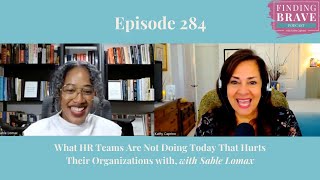
This is a podcast-style YouTube interview (Finding Brave episode) hosted by Kathy Caprino with guest Sable Lomax. They discuss what HR teams are failing to do around diversity, equity and inclusion (DEI): keeping DEI separate from core business strategy, under-resourcing DEI work, relying on performative/"check-the-box" activities, lacking rigorous data (surveys, retention, promotion and compensation cross-tabs), and failing to change systemic processes (talent management, performance reviews). Recommended remedies include: collect and analyze disaggregated HR data; properly resource DEI (people and budget); apply iterative design thinking to DEI programs; invest in training (focus on middle managers as well as entry and senior levels); and build psychological safety. The conversation also emphasizes DEI practitioner self-care and sustaining motivation via a personal "why."
Chapters
To those who are nervous, I always say that you have to figure out what is your why, even if you don't publicly share it with folks. What is your why? To keep you motivated when you're experiencing pushback. Maybe you have daughters and you don't want your daughters to experience what you experienced at work. Maybe you have a disabled son, like maybe your grandparent was disabled. Whatever your why is, I know it, identify it, breathe it, remember it. So when you are experiencing pushback where you are finding yourselves having to defend the right to have equitable policies for recruiting and retention, your why keeps your spirit thumping, thriving and going. Because you don't give up as easily. Because you're not doing it for you, you're doing it for others, whoever those others may be.
Hello everyone, this is Kathy Caprino and welcome to my podcast, Finding Brave. I've created this show for everyone who longs to create something bold and brave in their life, to rise up, speak up, and stand up for who they are and to reach their highest and biggest visions. Each week, I'll be speaking with inspiring guests from all walks of business, leadership, entertainment, the creative arts, and the entrepreneurial world, and they'll be sharing their intimate stories of Finding Brave and offer their best strategies for building your most rewarding, joyful, and meaningful life, business and career. Hey folks, Kathy here. Before we begin, I wanted to share a bit about my video training course, the Most Powerful youl, which is the companion to my latest book by the same name. In the 17 years I've been doing career and leadership coaching with thousands of people, I've observed and researched what I call the seven most damaging power and confidence gaps that negatively impact a staggering 98% of professional women today, blocking them from reaching their highest and most rewarding career potential.
My training helps women of all levels.
Recognize and close these gaps for good. The impact is remarkable, and I've seen that the training can shift everything about how you see yourself, how you operate in the world, and what you're capable of creating and achieving. If you're ready for a more successful and fulfilling professional Life, please visit mostpowerfulyou.com videotraining and register today. I'm honored that a division of the.
UN has sponsored it for members of.
Its workplace, and many other companies have had me in to train this content live. If your organization offers expert training and tools dedicated to supporting women's success, I hope you'll ask for it in your place of work. Thank you so much. And here's to all of us becoming the most positive, powerful and impactful we can be.
Hello, everybody.
Welcome to another episode of Finding Brave. I'm, I'm so excited. As you know, every time I, I open this podcast I say the same thing. But I'm thrilled to have our guest, Sable Lomax here and we met through a wonderful colleague in the UK actually. And don't you love this? I mean, this is why networking is just brilliant and we're so grateful for it. You meet through another person, good people, know good people, then you get on the zoom call and you're, you know, enraptured by what the other individual says, which is the case with Sable. So I cannot wait to introduce you all to Sable, but also tell you what we're talking about, which is what HR teams are not doing that hurts organizations. So I'm hoping that pretty much anyone in any organization is going to get a lot from this because it's not as we're going to talk about not only HR people that do this work work, it's everybody who contributes to a culture, which is everybody, you know, and we're not just leaders when we're in mid to high level professional spots. Right. We're leaders from the get go. So there we go. That's what we're going to talk about. Let me tell you a little about Sable.
Okay.
Oh, here we go.
Here we go. Your beautiful bio. I love this part. As a consultant, speaker and facilitator, Sable has held keynotes and led trainings at various companies and organizations within the US and globally. And her work has allowed her to work across various sectors to help turbocharge their DEI related learning and development objectives into world class clients such as WTW, Soho House, Expedia, MediaCom, BBH, TMS and MNC. Sachi, I didn't know they changed the name. Anyway, Sable has facilitated small and large group sessions related to diversity, equity and inclusion for non profit, philanthropic, public, multinational and private companies, partnering with stakeholders to develop strategic plans, implement new learning and development, programming and design initiatives, including equitable education, outcomes for students of color, recruitment and retention of diverse staffs, and equitable policy design in the US and abroad. The truth is, if you really want meaningful social impact, you need to know.
Sable and know her work.
So here we go. We're diving in.
Hi Kat, how are you?
Oh, wow, I'm good. Thank you Benner now for talking to you. So I, you know, I want to say this. I think I have a lens into the type of work Sable does, but from a different perspective, which is I am working with Mid to high level professional women who many of them are on the receiving end of strategies that aren't working. And they're not just working, not for women, they're working for almost everybody, except maybe a select few. So I'm seeing it from, how do I help a professional navigate this? And when is it time to leave an organization? Right, yeah.
Oh, wait a minute. I gotta change my screen for a sec.
There we go.
So I can see you up here.
But now I want to talk about what are. Let's dig right in here. What, what are HR people talking about now? What are they struggling with? And we're going to have as much compassion as possible. You know, this work is not easy work, it's not simple work, it's not uni dimensional. But what is not happening. That many of them would say, maybe, as you said, behind closed doors. Yeah, this is the problem. Can you just give us a primer about this, Sable?
I think one of the main things that comes out, even if you're talking with a professional in the HR space, whether they be mid level or, you know, within C suite or working, you know, arising C suiters, is there's an undergirding of the reality that diversity, equity and inclusion work. It might be called belonging. The names are adjusting and changing, particularly now within a political climate. But essentially we're still talking about dei. It wasn't even always called dei. So things do change is that it's seen as separate from overall organizational goals, business goals. So you have the organizational strategy, These are the goals. This is a five year strategic plan for X company. And in this five year strategic plan, we're going to do A, B, C, D, E. And then off to the side, we have this three year strategic plan. If we have a strategic plan at all for diversity, equity and inclusion. And oftentimes they don't come together at the throne for holy matrimony.
Oh, what a great. What a great analogy. All right, I am going to act like I don't know anything. So here's what I would say to that. If it's kept separate. What that says to me is I can't even give the number. 90% of professionals don't think it's important or don't see it.
Yeah.
As essential in contributing to business goals. Am I on the right track with this?
You are on the right track. I feel like in this space there are three tracks. There is the track that you just set out where you don't think it's important, but you recognize that you must do it. So you're going to do it the way I just described, where you have a team, you have a committee. If there's a committee, often they're unpaid and it's seen as extracurricular activities as if you were a high school student. And they have little budget, much less influence internally to carry out the strategic plan that they're being charged to know, develop and facilitate. So you have that track.
Would that be called. I checked the box. That track the box. Look, I did it, you know, okay.
We have a committee. You know, we, we had an event for Pride Month. Look, we had, we paid an amazing speaker to come in for Women's Month. Like we're diverse. You know, we, we sent out memos to say like Indigenous People's Day or you know, check the box, tick the box. Style activities, what many would refer to as performative. I see they're not really shifting the tie. They're not really causing change. There's no paradigms being shifted. But you can say certain things on a very surface level are being acknowledged.
Can I dig in? You know, you have three of these boxes. Can I just understand something from your.
Yeah.
I'm so excited to get pick your brain. When it's the check the box performative, is it typically that the entire organization doesn't buying but believe in it? Who cares about. In fact we just have to say this. You know, DEI in some arenas is a dirty word. Now we're, we're retracting from believing because now it's, it's considered something else. But when we're in this situation, you come in and you're being the consultant and you see it's the check the box. Are you seeing that? It's because most people really don't believe.
That we need diversity.
Oftentimes it's leadership. And those who are in positions of power and influence, even if they don't necessarily have a leadership title yet, who don't see the point, the value, the purpose.
I know. Are we saying these are white males.
Typically and not just any old white male. It's like cishet white male who grew up middle to upper middle class, not Jewish, not Muslim. Like you fall into very particular categories. Like you would check if we were doing a census bureau, like we were filling that out. You would check very particular boxes, non disabled, et cetera, et cetera, who might not see the value or importance. When you do have individuals, they're like, but we are diverse. Look at our stats. You know, we have this percentage that identify as Asian. This. But this percentage Is women this percentage, et cetera, et cetera. It's like, okay, well, it's diversity, equity and inclusion. So you might be doing well on the diversity front from a numbers perspective if that was solely the goal. But if you sat down and were able to have an open and honest conversation and your people felt they had psychological and job safety and security to be honest with you, on a survey in focus groups like whatever the methodology may be, do the women feel included? Do the black women feel included? Do disabled folks feel confident enough to say, actually I do have a disability and do need accommodations, but I've never said anything because I'm afraid of losing my job.
I see.
Or payment compensation.
Exactly.
You know, I need to insert this. Sable, can I. I have colleagues and friends who've created an incredible. And I've connected you hr. Yeah, not HR people. Data analytics organization. And what keeps coming to mind here? I think it's probably going to be a theme. You can't just guess. If you're running an organization, you. It has to be data grounded data. Data data, meaning it's all well and good that people are saying, you know, looks diverse, but are they being treated in a way that is equitable and fair? Right. Would you agree with that?
Yeah. And oftentimes when you have organizations that have data, years of data, they might have good data, but is it great data? So you'll hear like, oh, but the women feel xyz, all women. Or I'm like, you know, two minutes prior, is it white middle CIS had white middle class women who graduated from certain universities that are loving it. But anyone who doesn't check that box, it's like, wait, actually, no, I don't.
Feel included and I'm not responding to this survey either.
And I'm not responding to this because.
How is that going to help me here? Oh, wow.
Yeah. And if I'm the only one and I'm honest and I respond on a survey, it's going to be very obvious that Sable said she hates this place versus if there's 20 sables. You might not be able to guess who said what, especially when we're talking like open ended responses.
Oh, this is so important. Well, thank you. Now, you have two other categories of what's going on here. There's the check the box. Performative. Then what? What are the other two reasons that this is just not happening?
You have the folks where it's just not a priority because they see it as separate from business goals and overarching organizational goals. When you have a conversation with them, they're like, yes, you know, we want to be equitable, we want to be diverse. We want to, you know, we want everyone to feel like they belong. However, right now, because we're a startup, you know, we just got our, you know, our first round of funding, we have to focus on A, B, C, D. And then we get there.
Yes, innovation.
Now focus on that. We can't. We can't focus on that yet. So it's not a priority.
Wow.
One more. Jeepers.
And what's the third one?
So with that bucket, they're not even doing performative tasks later.
It's like, we have to launch, you know.
Yeah. Like, come back to us in six months, 18 months, what have you. Right now. The funding that we do have cannot go into that bucket. So you have, like, those. And that's a large group, I would say. And I feel like you have the ones in the middle where it's not a yes, it's not a no. They'll bring. You can come in, they'll work with you, but it's the responsibility of whoever has the title related to dei. So it's the HR team, it's the DI committee, you know, and they can do whatever they want to do, essentially, but it's up to them. So there's not necessarily stakeholders internally who are going to be pushing the envelope forward. So then when you think, when you consider a large organization, if you only have the DEI committee or DEI team saying this is important, and the CEO or the CFO or the COO and say chro, no one else is saying this is important, then you're communicating to the broader company. Oh, well, it's not important. It's just something that we have to do occasionally. Where the DEI committee says we need to, you know, participate in this workshop, that often is opt in.
Yeah. And while I'm incredibly grateful for all of the training and workshops I've been hired to do by organizations, all of whom who've hired me are, you know, really, really committed to this, as we all know. If I come in and do a workshop and it's a half a day, what is going to happen after the workshop? What is going to happen? Six months. What are, you know, and, and I love to offer, as. As we've talked about, actionable strategies that they can take on their own, all the participants that are going to help close power and confidence gaps. But you can't. You can't turn the Titanic around by yourself. I mean, no.
No one can.
It's a systemic situation. So if the system isn't participating, how much growth is there?
Not much.
So can you just tell me, because I was so intrigued before we pressed record, what are the HR people saying behind closed doors? Can we share that?
For those who have responsibility in the DEI arena or function, if you will, internally, many of them are frustrated and I will use the example of marketers. Marketers are being asked to do more with less. Folks who are responsible for DEI are being asked to do even more with even less.
There's nothing.
Yeah.
And so they, when you hear them speak, they are in favor of all sorts of initiatives. Yeah. But the frustration, I don't want to put words in your mouth is where's the funding? Where's the.
They understand that this is not a one person job. They understand that this is not even a 10 person job. They understand that this requires the commitment, the time of everyone in the organization at all levels, be it entry level, you, you just graduated from college, whether you went straight after high school or whether you took, you know, you explored the world for two, four years, whatever, entry level, mid level, senior level, they recognize it's the responsibility of everyone. And they also recognize the time that it takes to shift and change behaviors is not done overnight. It's not even done within a quarter, much less one fiscal year. And they're being asked to do things that require lots and lots of labor, but with very, very finite resources.
So what's the solution, Sable? What do we do?
Well, you know, if it's a Friday after work, some folks need to go for a really long walk. They go to hot yoga, they go to Pilates or they get drink, you know, they pour themselves a beverage just to like quickly woo saw, which is not always, you know, it's definitely not a long term solution. It's a short term solution. But I think it's having to have very hard, very direct conversations with those in positions and senior leadership to say, if you're actually going to do the work, you might as well do it right. This is the way to do it right. If not truly, why bother at all?
And what is the way to do it right?
One time to resource. Resource could be people, resource could be capital, resource could be many things, but properly resource it. And then three, I like, I was on a panel about two weeks ago and Erica used, I'm blanking on her last name right now, but want to say it's Erica Moore. I'll get the correct name for you. And she used the example of when product teams are charged with launching, they're allowed to fail. Iteration one, iteration two, iteration three. The right way to do DEI work is very much in line with how teams, especially those in tech space, in the tech space, go about product launching and product development. That first prototype, it might be okay at best, but you know, that's not the one that's supposed to go to market. And you don't shut down the entire effort and say, all right, we tried work, that's it. No, we take, we look at the data, we see, we see what worked, what didn't work, what might. We need to change, adjust, shift, tweak, and then we go back into design mode and now we have iteration two. That same process, that design process, design thinking, that framework that people use all the time, even not in the product space, should be applied to diversity, equity and inclusion initiatives, strategies, policies, programs, et cetera. The first workshop might not land. Okay, let's go back. You don't say, all right, we're going to pull their budget because someone didn't have a 180 behavioral change in a four hour workshop. That shouldn't even be the expectation to begin with.
Wow, there's so much to dig in.
So while you're speaking, what comes to mind too is, and let's talk about this. And this isn't just, this isn't about you and me getting business, although of course it would be great if we did. But what I do see, you know, we've talked about this. I have a eight module video training program, the most powerful. You and I've delivered this live over 50, 60 times. And it's transformative. And I hear from people, you know, raving. And what I find is when I'm talking to organizations about, would you like to take this video training in? There are so many interesting answers, but what I'm gleaning is they want to do it themselves.
Oh yeah.
And they want to save the money. And they also. And you're going to tell us why. If you're an HR person, I hope you'll really listen to this. If, if something's developed for dei, that's video training, that's internal, that's done by internal people. It's not going deep enough, it's not going to hit it hard enough. Yeah, you have to go to experts in these areas, I feel. But say, well, let me hear what you think. What about the inside? We're going to do it all inside. We're going to do the HR data. You know, tell me what you mean, what you think about inside versus outside.
You see the Light. One thing I'll say is there are definitely organizations that even if everyone who's responsible for diversity, equity, inclusion internally isn't what I would call like a far reaching, far stretching expert, they do have their specialties where like they understand, particularly in the US context, like the Hispanic, Spanish speaking population, how, how we've come to why are we saying Latinx versus Hispanic, et cetera, et cetera. You do have those who have like my specialty is a disabled community. So there are organizations that have that and there are organizations that don't. I think that if you're an organization that recognizes we can fill some gaps, but we can't fill all of them. If you have the experts internally play to their strengths and then bring in where those gaps need to be filled versus expecting someone who has no idea about the Muslim community and now you want them to put together a training on how to be anti racist to Muslims. That's not, that's just there shouldn't be an expectation. The same way you wouldn't hire someone who's never done anything in engineering, does not have an engineering degree, never did an internship or anything of that sort to now lead your engineering team. It just wouldn't happen. So it shouldn't happen in this space either.
What? You've just sparked a thought for me. I, I'm just teasing it out this second, but I think that is one of the downfalls of what goes on right now, that they think it's soft content. Not they. I'm not trying to demonize anybody, but I think groups of people think it's soft content and anyone can train it after they read a book about it.
Yeah, it's not seen often and respected as a discipline, much less as an area of focus or a major that people went and studied, different authors, different psychologists, sociologists, different thinkers and philosophers and they didn't all agree historically till now, it's not respected that way where you had to write papers, you had a thesis, people have PhDs in these topics where it's like you just wake up one day, you read a book, and now I get to call myself a DEI expert internally or externally. And it's like you might be sparking some interest, but I'm not sure expert is the title or even if you're not using expert internally. Recognizing that I have no business doing that because I genuinely just don't know much about it beyond surface level. Things that I might see scrolling on LinkedIn or you know, an article that might get linked on Twitter.
I love your point and I, I. Tell me what you think. I'd love to go farther and say you can do harm when you don't know enough.
Incredible harm. Incredible harm. And oftentimes, in that space, even pushing what you said further, incredible harm is often done. And when it's highlighted, the focus is rarely on the harm itself that was caused, whether it was to women internally, whether it was to the LGBTQIA population internally. Instead, the focus is on, well, we intended to do good. And you should take that under significant consideration.
You know, what comes to mind? There was, I don't know, maybe five, six years ago, a senior Microsoft person, I believe it was, who was presenting at a woman's conference, and there were, you know, I think these numbers are right. Thousands of women in. In. And he said something like, women have a superpower, which is their work speaks for themselves. They don't have to ask for more.
Something like that.
That. They. They don't. He was comparing a bit about they. They don't need to ask for more. That their work speaks for itself. Well, what, what backlash he got, including. I wrote about it in my Forbes blog and I watched his entire speech. And I don't believe that he's a racist. I don't believe, you know, his anti feminist. And I, I think that in that one case, he's ignorant.
Yeah.
That. That's not a superpower of women. That's how we've been trained and culturally formed, that we shouldn't ask for what we want and deserve. That is not a superpower. So if you're teaching that to women, look, you're great the way you are. You do not need to ask. It'll come to you. You're hurting women.
Right.
Because it's not rooted in the reality of how women. Workplace. Yeah. And not just individual women. Women as a whole, like sexism is a system.
Wow.
And if thousands and millions of women are having very, very similar, if not identical experiences, this is not a Kathy problem. This is not a Sable problem. This is a company workplace culture problem.
Wow. All right, now, in. In our remaining time, I know this is hard to do, and I don't want you to give away your top secrets, your brain trust, but let's say I had a company of, you know, a thousand people, and it was multinational, and I really had no idea what to do and where to begin to invest in and support diversity, equity and inclusion and trust and belonging to. Where would we begin? What would be the first three steps that HR people should be listening to now? And CEOs and middle managers, as you said. What's your perfect. What's your amazing comment that people leave. What, what did you say?
People, they leave managers. They do not leave CEOs.
There you go.
Isn't that so important?
So what, what are the, the top three things you would tell a CEO? Listening, saying, we. I know we have an issue. We've disregarded this. Or worse. What. What do they do?
I would say needs to be some type of surveying. If you don't already have data that you could hand over.
And the data you would ask would be pointing out what I'm looking at.
Employee engagement. I'm looking at. Can I see the different experiences between an entry level, a mid level and a senior level. I'm looking at retention. Where do people leave? Because there's. I'm for PR in marketing, often their agencies. So those marketing, those agencies, they're like, we have loads of women. You do in the beginning when they're doing the grunt work. And then you get to mid level and you still have a nice amount of. So we're like 50% maybe we're still hovering around 40%. And then we get to senior level and miraculously now we only have two women and one on the board. But marketing and PR is full of women. Well, what's happening that we miraculously, miraculously disappear once we get to a certain level. So I want to look. Let's just look at the data. And even though I would assume what's already happening, sometimes you need them to see the numbers to show them are correct.
And I'm guessing and thinking of my friends Merit Analytic Group, I think we'd also, if they had the ability to invest, you're looking at who's getting promoted, you're looking at compensation. You're looking at every person's trajectory and does it differ when you're looking at other different groups, which is what you're touching on. Right.
So that would be. I'm going to assume things just by the way in which the world is designed. But oftentimes someone's assumptions doesn't encourage you to spend money. So all right, let's take the time, let's get the data. So then we can prove we do have some issues occurring here. So then we can move on to the next step.
Can I stop you and ask you to give an example? What would be a glaring data statistic that would come out that you would say, look at this, this is proof you have a diversity problem. What would, what would a data point.
That you've seen is going to Point out who gets promoted, how long promotion takes, and connecting that to retention.
And you would say, you would sub categorize it, what's it called? Cross tab it. By women, by people of color. Disabled.
Yeah.
And you'd say, have you noticed that you only have one disabled individual and they have been in the same job for 17 years.
For 17 years. Because what you will hear folks share with you is that, you know, we, they'll be very honest with this. We recruit like we do, really good with recruiting, you know, diverse candidates, you know, but we don't retain them. Ding, ding, ding. Well, why aren't you retaining them?
Do they ever have an idea? Do they usually have an idea why.
Some do, some don't, or they're hesitant to share.
Wow, this is so interesting. All right, so, so first for. I keep interrupting on your wonderful.
No, it's done.
So the first thing is let's. We, we can't make this stuff up. And you cannot make assumptions because your assumptions are probably wrong. Data, data, data. Okay, after the data, what are the next two steps you recommend that organizations.
Embark on training and education? I don't know why I have five fingers up here, but essentially, let me take some down. It would be for entry level with a serious focus on middle management. They're often overlooked in this space. And then senior leadership, I don't know why, but oftentimes in training there's a focus on senior leadership. And we have this belief in the triple down theory, but it doesn't, it doesn't happen.
And wouldn't you agree that. And maybe that's your third point. I mean, we all know this. We all read books, we all do podcasts. How much are we retaining and how much are we acting on? So even if they have amazing training, what is the follow through? What is the follow?
And that's that third piece, which is actually taking a look at the systems. You mentioned this. These issues are systemic. So let's look at your internal systems. Let's look at the way you recruit, your policies, your processes. Let's look at all of these things and let's embed into those systems equity and inclusion across the different identity groups.
And that includes your performance evaluations, your.
Performance reviews are key. So even if sometimes, you know, not even sometimes, most times, the. The resource given is not. Is finite, it's not infinite. So if we have to prioritize which systems we're going to look at, let's look at our talent management, let's look at our learning and development.
Oh, my goodness. Tell in the remaining time.
Sable, what else do we need to.
Know when, like those, those thoughts that you have that why isn't this happening?
It makes no sense to me.
Any other points that people listening, whether they're an entry level or all the way up to CEO or hr, what are those things that you wish everyone understood in managing a healthy, thriving, vibrant culture?
It requires a mindset shift, especially if you're the manager. That is not always permissible at work because you are going to mess up.
Hmm.
And many of us are not and have not been in workplace environments where mess ups were encouraged. So if mess ups and mistakes aren't encouraged, the last thing that you want to do is mess up. When we're talking about someone's race, when we're talking about someone's ethnicity, someone's disability, you know, someone's religion, that. That is absolutely frightening. So what do we do? We do nothing. So it requires a really, really high level of courage, but also vulnerability to say, I am trying, I'm committed. I am going to get it wrong. But I also want to create space that you can call me in and say, stable. When you said X, Y, like the example that you gave at the conference a few years back to say, sable, I believe you didn't intend to do X, Y, Z, but that's, that's what this could imply. And for my ego to not come to protect me, to swallow it and go, oh, and now I have to apologize and take accountability for the ways in which I'll ensure that won't happen again. That's not easy to do in any type of relationship, much less in a, in, you know, in a workplace environment.
It. It's so important. I mean, I think, you know, it's a theme in this podcast. The things that we need to do as humans are often extremely difficult with our small, reptilian brain. That makes us very afraid, Afraid, anxious and anxious. And, you know, I'm going to assign the idea that most of us are doing our best and don't want to hurt people. And we. No, we.
We don't want to be seen as bad people either.
No. And we are up all night worried about the thing that we said that was hurtful and it was so unintentional and we're worried.
Instead of going, kathy, when I said, xyz, I've been up all night, did that bother you? Like, we'll. We'll wrestle and toss and turn for weeks instead of actually having a conversation with the person.
It's really true. On, on a podcast that's coming up with Jeff Wetzler. He's written a book on ask. How to ask questions that unlock opportunity and wisdom and connection and.
And that's how you start shifting the culture in your home, in your neighborhood, and at work and those really hard conversations.
You're right. And it ends with if you really want to make a difference and be an employer or a manager that embraces diversity. And that answer might be no. Well, I'd ask you to think about why is it no if you don't want to do that, if it's not.
Important.
Maybe we can offer some suggested reading about all the reasons, business case and otherwise, why diversity is so important. But to me, it's a fundamental human right and human need that we are all treated fairly, with respect, you know, equitably. But I think to be that person that says to your people, at any level, I would love you to give me candid feedback, and I promise you it'll be safe. You're not.
There's not going to be repercussions.
Right. I mean, I may not love it, we may disagree, but I want a culture where you can really tell me what you're feeling and thinking to. To the degree that you're comfortable doing that. I think that's the essence of what falls down. Sable, I think. Or systems. Organizational systems are like human systems.
The systems.
What's that?
I say add humans. As much tech advancement as we have had, humans are still developing the tech. Even in the AI space. Someone developed the AI that now develops AI. Humans are running the system. So what does that mean? There are going to be loads of mistakes.
Right.
And when I was a therapist, marriage and family therapy was the genre, and it was all about systemic.
Oh, yeah.
You know, systemic experiences and thinking. But what we learned is systems are homeostatic.
They.
It's like your thermostat. It wants to stay the same.
It does not want to.
No. Blow it all up.
Yeah.
Oh, I cut you off. Say it again.
I was gonna say it goes into shock. And I think for folks who are in the HR space who have tried to be bold and lean into courage and vulnerability, you were not off. Not all the time, but often you're met with resistance. And it's very much speaks to what Kathy just said, because the system doesn't want change. It doesn't want to reboot it. Yes. Adjust and tweak how it flows and operates. No, you're disrupting the status quo. So what does the status quo do? It leans in really, really heavy to protect itself.
There you go, people. I mean, there are the inherent challenges, but thank goodness we're innovative, we're brave humans, most of us, some of us. And. And when there is a need, it has to be done. I mean, you know, my first book was Breakdown Breakthrough, but. And what I'm trying to teach people is don't wait for the breakdown to have the breakthrough. Start realizing now there will be a breakdown soon if you don't address these things. This is a must have. This is not a nice to have.
Stable.
Any last words that you want? And where can people soak up what you have to offer? Where can we send them? But any last uplifting words for people who think, oh, I think they're hitting something here on the head and I'm nervous to do it. What do we. What do we say to them to.
To those who are nervous? I always say that you have to figure out what is your why, even if you don't publicly share it with folks. What is your why? To keep you motivated when you're experiencing pushback. Maybe you have daughters and you don't want your daughters to experience what you experienced at work. Maybe you have a disabled son, like, whatever. Maybe your grandparent was disabled, like, whatever. Your why is. I know it, identify it, breathe it, remember it. So when you are experiencing pushback, where you are finding yourselves having to defend the right to have equitable policies for recruiting and retention, your why keeps your spirit thumping, thriving and going. Because you don't give up as easily. Because you're not doing it for you, you're doing it for others, whoever those others may be. That's the why keeps you going. Because the work is tiring. You know, you will experience fatigue.
You know, I'm sorry. Go ahead.
I can't imagine what the work you do, Kathy, you know, hearing women who are still experiencing what you experienced and you know could be changed if only folks did X, Y, Z, you like, it can get tiring. So remember your why. For those you know who are dealing with that and outside of that is you have to take care of yourself. You still have to know how to have fun. You still have to know what you need to unwind, relax. Like, what are you prioritizing outside of this work? Because you cannot continue if this is how. If this is all you think about 24 7, you have to give yourself permission to go. In this moment, I am not a consultant. I am not even a chro. I am just stable and I'm watching Real Housewives of Beverly Hills catching up on the last two episodes, like, whatever it is, I love Real Housewives, for the record, so that's why I use that example. But give yourself permission to say, I don't have any of these titles right now. I'm just a human being that wants to exhale and really enjoy my mango juice. Like, whatever. Whatever that may be.
I love it. I love it. And, you know, I would summarize it, that this. You're right. This can be heavy work. You know, I. After going through what I went through in my corporate life, I said all I want to do is help at least one woman a day bypass what I went through. And. And if I can do that, that's a good day. But sometimes it's heavy, hard work. And, you know, those of us doing this, we do need to restore ourselves as well, you know, because it. It can be draining, and it can be hard and being open like that to, you know, wow, I don't think I handled that well. Tell me. And then getting the feedback and then sitting in it.
Yeah.
Okay. Then there was another experience blown. It takes a lot out of you. So stable. I love your. I love your thoughts about. Just hug yourself. You're doing the best you can, but you are contributing in a big way to something that makes the world better. Yeah. Yeah.
And it might not end up in the history books, but when have the history books always been accurate? That's fine.
Well, ending that and that important resonating note. Thank you, my dear. And where do people. Where do people go to soak up everything you have?
You can find me on LinkedIn. Sable Lomax. My picture might not show up, depending on degrees of connection, but it is me. You can just send me a request, let me know how you found me, and either way, I will accept. It's totally fine. And then you can find me at my website, which is www.sable S A B like boy. L like lollipop. E like elephant. In like Nancy Lomax. X like X ray@theend.com.
Beautiful. Thank you so much for digging in.
With us and thank you for having me, Kathy.
Eye opening.
So fun.
Come back again, Sable. All right, everybody, listen. You know, I say it every time and I can't stop myself, but this podcast is meant not to just entertain, but I hope it is entertaining, but meant to intrigue and. And. What's the word? Get you really thinking differently. And part of that is questioning. So if you hear this and you think I didn't quite understand that, or what do they mean? Or, wow, I'm angry at that comment. We would love your feedback. So wherever you see this, it goes on LinkedIn, Facebook, Insta, all over the place, wherever you see it. And do sign up for it as well@finding brave.org but we'd love your questions because that's how we help expand even what we're saying here and how it makes a difference in a longer term. So we'd love to hear from you. We would really appreciate that and wishing you a very Finding Brave two weeks and thank you for tuning in. And Sable, thank you again. So appreciate it again. Bye.
Hi folks, Kathy here. So are you thinking about launching a new podcast or have you been at.
It a while and recognize it's time.
For more or better production help to create the best podcast you can? I totally understand. I've been podcasting for over six years and I know how challenging it can be. That's why I'm really excited to share some key information about the great production team I'm using now called We Edit Podcasts. I've been working with them for well over a year and I've been so happy with the results. They're a full service production agency and their services give me access to a wonderful team of seasoned audio engineers and editors who help create a polished professional sound, and they work hard to ensure that my particular podcasting approach and style comes through in every episode. They also help me make sure that my guests are reflected in the best possible light through the creation of terrific show notes, which is an important part of the show for me. Their process is easy and streamlined, and their responsiveness and customer service is terrific too. If you're ready for better production help, definitely check them out and take advantage of their free trial episode, allowing you to sample their processing quality to see if it's a great fit for you. I'm confident you'll love them, just go to the link weeditpodcasts.com Finding Brave that's my special link for you and book your free call today. Happy podcasting. Thanks so much for joining us today. And please don't forget to check out findingbrave.org for more programs, resources and tips. And tune in next time for your weekly dose of Finding Brave.
More from Kathy


Elevate Yourself, Elevate Others, and Amplify Good | Chris Cooper | Finding Brave Ep. 334

Finding Brave Epis #333: How Leaders Can Harness AI Without Losing Their Humanity, w/Bennett Borden

Finding Brave Epis 332- How to Stay Brave, Valuable and Visible in the Age of AI, with Raman Rai

Finding Brave Epis 331 - The Power of Positive Disruption, with Dr. Patrick Leddin


Finding Brave Epis 330 - Being 40: Letting Go and Embracing Who You Are, with Stacey Lindsay

Disrupt Career Reinvention with Kathy Caprino - via The Disruption Lab Podcast w/Patrick Leddin

Creating Neurodiversity-Friendly Work Cultures: Simple Workplace Adjustments Matter

Finding Brave Epis 329 - How To Create a Neurodiversity-Friendly Workplace, with Kristen Pressner

Finding Brave Epis. 328: Reclaiming the Power to Trust Your Own Voice, with Dr. Cindy McGovern