285: Unlock The Power of Instinct To Accelerate Your and Your Organization's Success ft. Leslie Zane
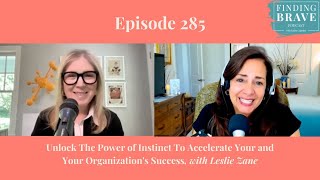
This content was created by Kathy Caprino. This content was uploaded by Kathy Caprino. This is a YouTube video titled "285: Unlock The Power of Instinct To Accelerate Your and Your Organization's Success ft. Leslie Zane" created on June 13, 2024. It features a conversation between Kathy Caprino and Leslie Zane on Kathy's podcast, "Finding Brave." They discuss the power of instinct in marketing, the limitations of traditional persuasion techniques, and strategies for leveraging unconscious associations to drive business success. Leslie Zane shares insights from her book, "The Power of Instinct," and offers advice on effective marketing strategies.
Chapters
We're only making 5% of our decisions with the conscious mind anyway. We have the two problems. One, that it's rigid, but more importantly, that's not where we're making decisions anyway. So we're essentially spending 100% of our time on only 5% of the decisions that people make. And that is not a good use of resources.
Hello everyone, this is Kathy Caprino and welcome to my podcast, Finding Brave. I've created this show for everyone who longs to create something bold and brave in their life, to rise up, speak up, and stand up for who they are and to reach their highest and biggest visions. Each week I'll be speaking with inspiring guests from all walks of business, leadership, entertainment, the creative arts, and the entrepreneurial world. And they'll be sharing their intimate stories of Finding Brave and offer their best strategies for building your most rewarding, joyful and meaningful life, business and career. Hey folks, is it finally time to make a big change in your career but you just can't figure out how to do it? It's time for help and time to invest in yourself and finally understand and shift what hasn't been working for you. Join me as I coach and guide you through powerful, proven steps that will unlock your fullest and happiest potential. I've worked with thousands of professionals across six continents and the results have been transformative for them. For a limited time, also take advantage of my 10% discount for you. My amazing finding brave listeners save 10% off my one on one succession career and leadership breakthrough program and my most powerful you video training course that helps you close the seven most damaging power and confidence gaps that are in the way of your ultimate success and happiness. You can work with me in both of these programs for the comfort of your own home, at your own pace. Now's the time. Don't wait. Build the career you're ready for. Check out the show notes below for details and I can't wait to support you. Hello everybody. Welcome to another episode of Finding Great. Kathy Caprino here once again. Here I am in my own podcast. Like a life course here. That's what I see. And a marketing course, and a business course, and a leadership course. And today is no exception. I'm so excited to have Leslie Zane here with us from upstate New York. Kind of.
I am so excited to be here with you, Kathy. This is a true pleasure. I'm speaking to a fellow marketer and a neighbor. That's it.
Oh, I'm so excited to dig in. So let me tell everybody what we're talking about. I cannot wait to, to learn more. How to unlock the power power of instinct to accelerate your success and your organization. Success instinct. So let me tell you about Leslie and then we, we've got to dive in. My challenge will be, you know, letting you go in 30 minutes. That's like you already gave me a consulting tip. That's worth a lot. Okay, here we go. Leslie Zane is an award winning marketer, TEDx speaker, founder and CEO of Triggers. What a great name. Brand consulting. The first firm of its kind rooted in behavioral science and the. And you are the author of the new book the Power of Instinct, the New Rules of Business and Persuasion. All right, so let's dig in here. I know we want, we need to go a little macro first before we dig in, but you, your team shared this with me and I stopped in my tracks. Human beings are unpersuadable. And you know, everyone listening, you know, I was a former corporate VP, then a therapist, now 17 years in coaching. I don't know that I would have said that, that sentence. So I, I know immediately you had me at hello here with persuade unpersuadable. And here's why. That's because the traditional approach to persuasion clashes with the conscious mind.
Would it be fair to start there.
Leslie, to explain what, why this book, why now? What have you seen, and I know you've seen shifts that make this even more important. Can we start with the bigger picture?
Absolutely. I love it. Thanks so much for having me. This is going to be a lot of fun.
Thank you.
So human beings are unpersuadable. They are rigid, they are set in their ways, they're skeptical, and they don't want to do what you tell them to do. It's really simple. And you know this from the last conversation you had at Thanksgiving with a relative about politics. It did not go so well, did it?
No.
And I say this to you as somebody who has spent her entire life trying to get people to change from one brand to another. I mean, that's what I do as a marketer. I'm a career market. I've spent my life on this. And what I've learned is that you really can't persuade people to do anything. What you can do is take another route. And I was forced to take another route because I had clients who are expecting me to help them drive growth and switch people from burger King to McDonald's or Coke to Pepsi. So I had to figure it out. And I spent the last 30 years identifying an approach that takes sort of the hidden Root to changing people's minds. That's not quite as confrontational. And I'll.
Great. And you, you know we talked earlier before we hit record. I have a million questions because I really want to learn, you know, and I'll apply it immediately. But can you define persuasion versus the route you're suggesting we all take? What? Because I think I don't quite understand what persuasion means in your mind.
So let's start by understanding that our brains have two mechanisms. We have the conscious mind, we really have one mind with two mechanisms. But I just to make it simple, I'm going to call it the conscious mind and the unconscious mind just to make it easy.
Sure.
The conscious mind is really only 5% of our decisions. And you kind of can think about this like an iceberg, like the tip of the iceberg that everybody sees is the conscious mind. And we think we're in control of that and we think that we make decisions with the conscious mind, but we really don't. 95% of our decisions are below the waterline in that unconscious mind that is truly what's driving our decisions. So we think we have control over our decisions, but it's really our unconscious mind that's calling the shots. And we really rationalize after the fact with our conscious mind. But all along it was that other hidden mind that was actually doing the work.
And may I just, may I cut you off and ask question and none of these are prepped people, you know, so I'm just, I'm just asking what I need to. Having been a therapist for five or so years, you know, I've, I've spoken about if you want to live a richer, happier, more joyful life, you have to bring the unconscious to the conscious. And you know, I've seen, and I'm dying to know what you think. There are different levels of self awareness in people that we meet in your research. Is the 5% truly set in stone or are there people that have expanded that ability to think more consciously? Does that make sense?
I, I, I hear what you're saying, but I think it's really more that the people who are very self aware are more aware of their subconscious mind.
I see. Not the unconscious. Unconscious means unconscious.
Well not accept they're more in touch with their deep inner voice, their deep associations, their deep memories. So I think it's more, it's one. We're not trying to expand the conscious, we're trying to get more in touch with the unconscious. But as people who are selling things and trying to promote our ideas or build a business or build our personal brand or just gain more power in the workplace. More, more power and influence in our lives. It's really just important to understand how everybody else works. Right.
Thank you. I was, I was a little going with has. Has. My 20 years of being on this journey away from corporate life taught me anything that would make me, you know, who cares?
Doesn't matter.
My podcast shouldn't be about me. It should be about your book. So tell, tell us more.
It's really, it's really a great question. You're bringing multiple worlds together, and I love that.
Wonderful.
So here's what persuasion does.
Great.
Persuasion tries to confront the conscious mind and tell it what to do. And as marketers, we have created a whole slew of techniques that we use to persuade. So that would be barraging people with messages, hitting them a thousand times until they're sick of hearing from us, using discounts, using coupons, using promotional incentives, using surveys that ask conscious questions. What do you like? What do you dislike? It turns out that all of that is hitting up against a brick wall because as I told you, that conscious mind is resistant to change. It's rigid, it's stubborn, it's skeptical, and it doesn't want to do what you.
Tell it to do.
And it thinks it knows best anyway. So if that is, if we're spending all of our time doing that on persuasion with all these arguments and we think we're going to win the day, we're kind of wasting our time. Because if we're only making 5% of our decisions with the conscious mind anyway, we have the two problems. One, that it's rigid, but more importantly, that's not where we're making decisions anyway. So we're essentially spending 100% of our time on only 5% of the decisions that people make. And that is not a good use of resources. Instead, what we want to do is use a whole different set of techniques that go after the unconscious mind, the non conscious mind, and there, it turns out, the unconscious mind is much more malleable and you can make change much faster. And by the way, that's where the decisions are made anyway. So that's where we should be concentrating our attention.
All right, tell, tell, tell me more. And if, if you want to, if it's easy, I know you have a. In your book, a million examples. But why don't we take, you know, I maximize what's going on in my podcast consulting. Here's my coaching business, you know, Catholic Reno, llc, and I'm Offering coaches. Yeah. Coaching programs and groups and classes and training. And I think I'm beginning to see really clearly exactly what you're talking about. Because while people will say to me, like, organizational, hr, dei people, I want this. The action sometimes is not there. Right. So will you tell us, what do we need? What?
What?
First of all, what are the biggest mistakes? Maybe you just said it. It sounds to me like data saying that, you know, 90% of people who eat McDonald's are going to blah, blah, blah, you should switch over to Wendy's. Those kinds of arguments are hitting up against. Is that what we're saying?
Yes. Because you can't tell people what to do. Nobody likes what to do. Not our kids.
And we will. Right. And even if there's a nugget of greatness in there, we're going to resist because that brings up fear. We don't like to change. We're homeostatic creatures. So what do we do instead? Where do we start?
So let's talk about the techniques that we use to take aim at that unconscious mind and start to influence it. The first, most important thing to understand is that we want to latch onto things that already exist in people's minds and use that to plant our messages.
Okay.
That's the first thing to understand. So we're kind of working with what people already believe, what already exists in their memories, and we're using that to sort of grease the wheels of our marketing and our messages. That's the first thing to understand. The second thing to understand is that if somebody is not your customer, that means they have implicit barriers up. Somehow negative associations have infiltrated their mind inadvertently. We don't know how. It could have nothing to do with what you've done. It could just be the story that they've created about your company in their own mind. And if you don't know what that story is and you don't know those implicit barriers, I don't know how you create a marketing strategy. That's the first thing that you need to uncover. And interestingly, it's not with your current customers. They will never be able to tell you that your current customers are happy with you.
They.
They like you. They are filled with positive associations. They have very few negative associations. They may have some, but they're not going to really tell you how you grow. So you want to spend much more time on the people you don't have understanding their mind than the people that you have already. And that is a complete flip of what we've been taught in marketing. Because everybody says, understand your customer, understand your customer. Create more loyalty. Well, you can only get so much blood out of a stone. I mean, people are only, how many bottles of shampoo can you sell to the same person? You can only wash your hair, you know, once a day. So.
And you're also, are you also not saying the customer that you have does not have the same profile as the non customer?
100%.
So why not? You already got that. How about the millions of people that won't buy the way you're. You're presenting yourself or.
That's right.
Is that what we're talking about?
Yes. And I love that you said millions because one of the other major mistakes that companies make, and particularly small companies, I would say, well, small and large, if I'm being fair, is that they only go after a very small market. They, they think too small. The world is your oyster. Think big. Think of everybody as your customer or almost everybody. The only thing that I pay attention to in terms of segmentation, which is something that I don't really believe in, because I've seen companies slice and dice audiences into 100 different pieces and they never really use all those segments anyway. And plus, who has the marketing resources to spend different efforts against different segments? So I say there's only two audiences that matter. The people you have and the people that you don't. And of course, you want to keep your current customers happy, treat them like gold, treat them, you know, with, with, you know, White glove service. But where you spend your energies is on recruiting the new customers to come in, and you can't do that unless you understand what's holding them back.
Oh, all right, we're getting to that in a minute. Can I go back to your first teaching that you, we need to latch them on to something that's already present within them in their unconscious mind rather than persuade. So can I ask you if this is an example of that? So if I'm reaching out, my typical niches, mid to high level professional women. But interestingly about segmentation, I have a ton of men reaching out. Even though I say on my website, women, you know, they disregard it because they see something in it that speaks to them that latches them. So I couldn't agree more. But I want to ask you if I'm on the right track. There could be two ways I could reach out in an email or a promotional post. One could be, do you want to be more powerful, confident and impactful? The other could be, do you remember the time you were powerful, impactful, and is that the difference between trying to persuade, look, you'll feel better when you're more impactful versus helping them remember when they were and latching onto that? Is that right? Is that the right direction?
I think that's directionally right. I think there's probably something even better you could say.
What is it? I'll send you a check in a minute.
I think you could say something that's a shared value. So rather than asking them to do the work, because both of those questions are asking the consumer to do the work, I'm saying present your values in a statement that, you know, they would also agree with. Like, I don't know, we're only as limited as we believe we are. You know, some, something like that is probably a better way to say that. You know what I'm saying?
Like, do you think most people believe that? Because I, I think, I'm not trying to question or doubt you. I think when I say that, people often go, what a bunch of hooey. I'm limited because of blip, blip, blip and blip.
So that may not be the right statement, but it could be. And by the way, you don't have to always nail it the first time, because I think marketing is an iterative science. Right. We should constantly. If I told you how many times I've redone my materials, it's over 30 years of work. I'm still redoing them to this day.
Right.
So we, we are all iterating and learning and finding, but I think this is going to accelerate your progress. Because what I'm suggesting you do is, Kathy, I want you to get in touch with your philosophy of this entire area of, of life, of business, of, of potential, of human potential, by the way, I would use that word, that, that phrase and I would put it out there. But as you're doing it, you know that there are, You've captured something there that everyone else agrees with as well. So it's going to be a sort of a universal truth and it's going to have some contrast in it. And the way I constructed that sentence, which again, I'm not sure that's the best one. Right. But you're only as limited as, you know, you, you, you believe.
It.
It has a tension in it. Right. That tension has, it's captivating or any tension. It's captivating. You need to find the right one for you.
And you're also, I think, piquing interest. I mean, some people are just going to tune out. Okay, great. Well, they're not my customers anyway.
But, but, but what's really important about this conversation is that you're not telling them any anything.
Right?
You are sharing your philosophy that drives you and they are going to connect with you emotionally because you said something that is aligned with what they feel. Do you and that creates a match, that creates customer engagement and creates interest and makes customers want to come over to you.
Do you feel like the why Simon Sinek, of course, you know, made that whole thing. Know your why. Very popular. But I notice if I write about why I do the work I do, you know, there's a story there. I was the I struggled with every one of these power gaps. I struggled. Sexual harassment, gender bias, toxic colleagues, narcissistic bosses, chronic illness. When I talk about why I do the work, I find that there's often a lot of resonance. So I'm not trying to persuade someone to work with me. It's a shared experience and they typically feel heard and understood. Is the why a part of what you're talking about?
The why is a part of it. But I want to say that I am not, not a fan of it. I, I, I, I, I, I, I, I. First of all, I love Simon Sinek. I think he's amazing and I love his work and I follow it very closely. He's awesome. My problem with it is that it's one dimensional.
Oh, tell us more.
It does not work on its own. I've tested why oriented positionings a million times and if you only talk about your purpose, if you only talk about your why, it does not drive business.
The reason it's too much about you and not about them.
Yeah, like good for you.
You found your why.
Exactly. Use you need to deliver a benefit. What am I getting out of this? So I think this comes down to another common myth in marketing which is that a brand can only stand for one thing. So I see you're trying to grapple and I see this with my clients too. You're trying to find that one thing that's going to be the magic bullet. And what I have to say to you is there is no one magic bullet. That most strong messages and most effective marketing has a couple of different drivers in it. The benefit to the consumer, your expertise, your values. And it's the combination of those drivers that hit all the levers of the mind and make it interested in coming over. And when we talk about the brand connectome, which we haven't touched on yet, but, but we will, you'll understand why one single minded message Actually doesn't drive choice.
Holy crap. All right, we're getting there. You might have touched on it, but I heard you talk about things have really dramatically changed in marketing. Or they need to. But is it, is it your belief that the way we used to sell, I mean, there can be two ways to look at it never really worked well, or we've changed so much. I mean, I even see attention span, you know, I have long form videos, forget it. Because people have a 90 second, you know, whatever. So that's how we deliver it. But it. Are you finding in your 30 years of research that we do have to behave from a marketing perspective differently now? The old way probably never worked great, but it sure is heck is not going to work now. Is that correct?
I think that's precisely right. I think that's precisely right. Humans are humans.
Right.
Our brains have always worked the same way. But we are, we've evolved in certain ways because of the environment around us. We have the echo chamber effect in social media, which is a major issue and very harmful. We have fake news, we have shortened attention spans. People are much more connecting with visual cues then verbal. So visual is really a big part of our work and has and has been from the beginning because we've always subscribed to that philosophy. So 100%. You said it exactly right. I really can't, I can't say it any better. It never worked well, but it, it certainly won't work. The overt approach is certainly not going to work. Today consumers have only gotten more skeptical and we need to even more latch onto what they already believe to create a connection. And that's what this is about. It's about connecting with your audience on the basis of shared memories, shared values, shared associations, and using those as an on ramp for what you want to get across.
Wow. So tell us. You know, I'm thinking I'd ask you to behave like a consultant where you come in and I'm guessing clients big and small say we got a problem, what we did isn't working and we're losing our shirts or whatever it is. We need a new perspective. Can I ask you to run through basically what your process is and the biggest thing, thing you're correcting, I mean, it's obviously instinct versus persuasion. But I'd love to hear your process a little. Ken, can we.
Yes, we, we can definitely do that. But do you mind if we back up just to give you a little bit more of a foundation.
Definitely.
To your, to your listeners. So I want to start with what A brand is. Let's, let's start with that.
Great. What is a brand?
A brand is the cumulative memories that have gotten glued to your brand over time in people's subconscious minds. And it, depending on how long they know you or have heard of you, some of those could go all the way back to childhood. So for McDonald's, for Coke, for Pepsi, these are brands that we are, we call legacy brands that have been, that are, that are known to people from the very beginning. And then there are newer brands that are maybe around 10 or 20 years. And so those are brands too. But you're a brand, I'm a brand. President Biden is a brand. The Republican Party, the Democratic Party, those are brands. America is a brand. Where you go on vacation is a brand. We're all brands. And so, and our ideas, you want to think of as a brand too, because I don't care what we're talking about, anybody listening is selling something. We are all marketers, every single one of us is trying to get something across and to grow it in other people's minds. And that is actually what it has to do with. It has to do with growth. So think of a brand like a seed. I plant the seed in people's minds and as I add its nutrients, which in this case are positive associations, the seed is going to grow hopefully into a seedling, into a plant. It's going to put down roots, it's going to branch out, and hopefully, if we're successful, we create a full grown tree, a healthy, thriving brand. So anything you're working on, whether it's starting up a business or getting your next job or launching a startup, like whatever it is you're doing, you want to grow this thing in people's minds. Because you cannot get share of market until you first have share of mind. Share of mind must precede share of market. They are directly, the two things are directly linked.
Can I ask this? Yeah, I'm trying to get specific. So we have. When I look at the work I've done in 17 years, I've put out a lot of content. A thousand articles on Forbes, 285 podcasts, et cetera. I feel like that's why I haven't had to place a lot of ads. Because if you Google search, how do you interview, how do I get fired? You know, usually something of mine comes up, not always. I would consider that an example of planting the positive seeds of association. Is that, Is that right?
100%. 100%. And the more ways you connect with your audience on More platforms and more ways of interacting and more connections. You know, one of my favorite examples to use is Taylor Swift, which everybody knows about. So the conventional wisdom would tell Taylor Swift to only do country music because she's a country music star and that's what she's known for. And if she deviates from country music, maybe her current fans won't like it. Maybe they'll say, you're changing on us. Well, she did not create the tremendous success that she has and a billion dollar tour in 2023 by sticking to just one thing.
Wow.
She branched out to dance music, to pop, to folk music. She keeps on expanding her brand and the branches of her brand, which I call the brand Connectome. The brand Connectome is that that model behind me is a representation of what a brand looks like in the mind. So think of every type of music that she's launched as another one of those spokes. And she just create, keeps thriving, keeps adding more and more spokes, more and more connections to people's lives. And beyond just the professional music connection, she has a personal connection to her audience and she tells her personal stories and you know who's caused her angst and you know, who she loves and she, you know, her boyfriend and you know, you know, all these different things about her. And so our connections to her are, are, are a multitude instead of just a single, you know, one dimensional kind of connection.
What a great.
That's what each of us needs to do if we want to have successful brands or launch a success, successful idea or even in the workplace. Let's say you have a recommendation and you want your recommended plan to be the one that they adopt and not the other guys. Then you need to create a connectome around your idea with lots of different connections to lots of different people, but many connections in the mind instead of just one.
Wow, you make it sound very simple.
I mean, obviously nothing in life is simple. Everything in life takes a lot of hard work. But I think if you use this as a mental model, it's going to help you understand what it is you're trying to do. Because those connections that you're creating, it means that, that you have a shared, you have some shared things going on, right? So you're going to connect to people's interests and to their personal lives and to their professional lives. The more connections, the better. You know, when I was a young woman, because I grew up in the, in the 80s and 90s, I thought you needed to hide your personal life. So when I was talking to a potential Client. I wouldn't talk about my children. I wouldn't speak as a mother. I would, you know, only speak professionally and only interact in a professional way. And then I kind of made this transition that I saw from other people that they were having more success by having a multidimensional relationship with those clients, doing things with them personally as well as professionally. And. And I was like, huh, this is. This is interesting. The more connections that I have with a person, the stronger our relationship becomes. And it's the same thing with building brands.
So tell us. I'm aware of our time. We have a few more minutes. Can you give us two other mistakes that businesses are making over and over? And you're like, oh, there it is. That you see in almost every new client.
Sure. So one mistake is not to be monitoring your negative associations.
What's that mean? And how do you do it?
So this is an example from McDonald's, who several years ago had. Was beset with these negative associations that came from these videos that had gone viral talking about pink slime in your chicken nuggets and meat that doesn't mold. And the perception that was taking hold in people's minds, sort of like a virus in the unconscious mind of. Of their growth target, the people that they didn't have was that the. The food was, you know, fake food, fake chemical food.
Right.
And they didn't. Weren't really aware of it because their existing research doesn't monitor the unconscious mind. It only monitors the conscious mind through surveys. Right, Right. So if you're not monitoring the unconscious mind, little by little, those negative associations, they kind of consume that tree, and you end up with a tree filled with dead leaves. So as soon as you have a negative association, you have to prune that negative association, nip it in the bud, and overwhelm it with a positive 1. What McDonald's did at first is that they said, no, we don't have pink slime in our chicken nuggets. And of course, what that did was tell more people more pink nugget.
I mean, more pink slime.
And you're to your point.
Don't try to persuade me.
Don't try to persuade me.
That's the wrong direction.
That was the direct approach. What they instead needed to do was to replace negative associations with positive ones.
Which they did shortly thereafter, introducing new, healthier. Here we go.
Well, not even. They didn't even need to introduce new healthy foods. They already had these amazing real ingredients in their existing food. They just weren't talking about it. So they they use all their ingredients come from family farms, sustainable ingredients. Like they were doing all the right things. USDAB, 100%, all of that. But they weren't, just weren't telling that story.
I never heard that story. I mean, talk about negative associations. Sorry, McDonald's.
Once they started telling that story, the business started turning around. But if you don't know what those negative associations are, then you don't have a line of sight. You can almost think of the negative associations accumulating in your growth targets. Minds are a precursor of what is going to happen to your, your business in the future. Because if, if the people you want to get have negative associations, then it doesn't matter how much marketing you do against that target, they're not coming over. So you kind of get this early predictive situation signal. And it's really important to be conducting research at the memory level.
How do we. I'm so, I'm so curious. Two things. One, yeah, how do we get at that? But secondly, I need to click. Have you clarify something? It seems like when you talk about negative associations you feel that they're unconscious or subconscious. But if you were to ask me about McDonald's for instance, they're very conscious. My negative associations. Are most of the negative associations you deal with as a marketing consultant subconscious or unconscious?
That's such a great question. By today. A lot of those negative associations that we uncovered like eight years ago were back then they were implicit, they were unconscious. They hadn't yet sort of regulated to that level, become more conscious. But the way we do our work is we find the conscious and the unconscious. But every single time it's the implicit or unconscious that is actually the big unlock to what's going on.
So how do you get at this?
It's called memory elicitation. It's a type of research where you're not asking people what do they like and dislike. Because what people like and dislike is not predictive of sales. You cannot trust what people say. All you can trust is what they do. You can also trust what's in their memories because that's what drives them. And you want to look at everything that is in their memories about a brand. You want to basically uncover their brand.
Connect home and can you. So I used to be a market researcher and one thing aligns many things with what you're saying. I have a lot of surveys that are self report. Here's a pat, here's the seven power gaps. Here's a description. Do you have it? Yes. No. Or maybe it's Amazing that people say yes. They often say maybe when. When I speak to them, they have it in in spades. But self reporting is inaccurate because it's typically because we're. We want to appear a certain way right in our own minds. But when you're talking about memory, can you. Can you share? I'm making you share, like insider secrets. How would you ask me in a way that would get at a memory in your research? May I ask that?
I can't tell you exactly how we.
Do it because that's your secret sauce.
Yes. But what I can tell you is that it's a lot of projective techniques. And any researcher you speak with will know what projective technique.
Basically, what would you think about this? When it's not really about that. You're projecting, is that right?
Projecting out. Actually what. What it is, is you're projecting your memories out for others to see.
See.
And there's a bunch of different research techniques, proprietary research techniques that we. We use to do that. But you can do it by really getting into people's first memory, second memory. Those are some of the questions that you can ask.
How amazing.
And after that, I'll have to shoot you.
Run me over in the parking lot. Oh, my gosh. All right, I know that we're out of time. What else? What, for final words would you give anyone listening? Because there's no question what you're talking about has huge impact for organizations that are selling businesses. But I think it's, as you've said, it's for anyone who wants to have pos. I want to say positive influence. I'm sure it's for people who wants negative influence too. But anyone who has an idea or they want to get something through to others. So I know that this impacts us in our personal life as well. Any final things we didn't talk about that are the most important things we need to take away here.
The only other thing that we did not touch on which is really important are growth triggers.
Oh, yeah.
Growth triggers are succinct codes or cues in any of the five senses. But as marketers, we mainly deal with visual and verbal triggers. Yeah, these are really important because what sticks is assets. Assets that are succinct and that have lots of positive associations. Interestingly, emotion doesn't stick. Emotion is fleeting. So if I make you laugh, if I make you cry, the. The again, the perception in marketing is that if I do humorous advertising, that's going to make people come to me, but it actually doesn't drive business. The only thing that Drives business are sticky codes and cues that seep into memory structure. An example of a, of a trigger, a growth trigger again for a major brand is. But again it can be used at any level for any business. You just need to find the ones that are right for you. Is a snow capped mountain. A snow capped mountain is a growth trigger for the bottled water category because it's packed with positive association and meaning. You just look at that little snow capped mountain and you know it means pure, pristine, untouched by human hands, water from the glaciers, cold, refreshing, clean, natural. I mean all of these positive associations and you want all that, you want all those associations to convince to be conferred on your brand.
Wow. So that's a growth trigger.
A growth trigger and it's very sticky. So it goes into memory and it helps you spread that brand connectome. Because remember what I told you is this is like a game of Monopoly.
Yeah.
Ever owns the most physical terrain in the brain wins. Brands have physicality. They actually have these pathways. And you want your brand to have as many pathways as possible. What sits on those pathways is these assets that you create. So I want you for your homework, Kathy, to create the verbal triggers and the visual triggers for your business and I want you to start using those in your content because that's what's going to remain and stay stick in people's minds. And if you find some really good ones, you're going to use them over and over and over again to build your brand connectome. And the moment that you build your brand connectome really, really large is the moment that people will switch from other podcasts over to yours, which they should be doing, by the way.
Bless you for that. So just so I understand my homework, when you say assets, it's either a picture, a pictorial representation, or a verbal one or a written one. Is that what the asset means?
Yes.
And my homework is rather than trying to persuade over and over using all those tools that and language that we've been using for 20 years, find something that you call it a growth trigger. I'm guessing because it's going to grow associations to you from that, right?
Yes. And it's. I'm going to do it. It's a. These are succinct, which is why they work so well in today's world with the short attention spans. They're super efficient because the associations with that snow capped mountain already exist in people's minds. So I don't need to say pure, pristine, clean, eco friendly from the glaciers. It's all in that tiny little visual of the snow capped mountain. Just looking at that. What I'm saying is there's probably four or five image triggers for your business and there's probably four or five verbal triggers for your business and once you figure those out, your business is going to take off.
Here we go. And research helps us do this right. We're not going to sit here by ourselves going, oh, I think it's this, right? I, I need to ask you one final question. There is, and this could be my negative association I'm aware of. When I see people on TikTok Insta and they're doing what marketers have told them to do. They're showing their boat, their yacht, their mansion and they're walking you through their mansion. And they're not talking about their mansion or their view of the Pacific Ocean. They're talking about basically, follow me. If you want great marketing help or you want, you know, great coaching or you want to lose weight, but they're showing this aspirational rich thing. It bothers me. Would you say those are sometimes a growth trigger, showing people your mansion as you're walking through it, talking about your business.
I would need to see the specific examples that you're talking about. What you do.
You know what I'm talking about.
I know what you're talking about. I haven't seen the specific application you're talking about. What I think you're describing to me is that the business that is trying to use this as a, as a their approach, they are representing the fantasy.
Exactly.
And I believe that fantasy can work if it's coupled with expertise and how, the how to along with the fantasy. In other words, the fantasy alone won't do it. But if there's enough pragmatic additional support for how you will get that fantasy, then that's a pretty darn good approach because we're all aspirational creatures.
And I'm going to look, thanks to your incredible advice here, I'm even going to look at why I have a negative association about that immediately. I think you're trying to manipulate me. If it's that obvious. I feel manipulated. I can't hear what you're saying, but maybe that's my memory, you know something and that's fair.
And maybe it is turning people off. I mean we wouldn't really know until you saw the example, until we saw it and did some research with its target. But. But what I can say is my book has a chapter on fantasy in it. So kind of you, the I'm heading.
Right over there, you're speaking of your book. First of all, what joyful work you do. I mean, you probably feel the way I do about my work every day you're learning something. Every day you're proving or maybe disproving something you thought. And you're helping businesses grow. Oh, what a joyful place. And where, where do people soak it all up? Where do we send them for your book, for hiring you? Where do we send them?
So you can link with me, Leslie Zane on LinkedIn. You can buy my book the Power of Instinct on Amazon.
We'll link to that below.
And then I also have a landing page about my book, the powerofinstinctbook.com which has a bunch of different levels of participation where you can buy more books and, you know, get me to come speak at your organization or do a webinar. There's many different ways to. To connect, but I really do. I love everything that I do. I love meeting you. This has been such a joy. You're an amazing interviewer. You're a phenomenal listener. You ask great questions. And you also just have just an incredible aura about you that's really magnetic. So I. That's beautiful.
Thank you.
Thank you.
I have learned so much. I so appreciate it. I hope you come back for round two. I loved it every minute. And your book, everyone. All right. I say this a lot, but I feel like we're not doing our jobs. If you don't have questions here like, what did she mean about this? And oh, I think I might be doing it the way I need help. I need to read the book. Wherever you see this, we would love your questions no matter how big or small, and we'll do our best to you help you on your journey. But I hope this inspires you. And I think if folks are like me, we get tired of doing the same thing over and over and it not working and us seeing that it isn't working in a bigger way than it didn't work five years ago. So I think start with this book and you're going to have a flood of new ideas to try.
Yeah. The book is really the how to application playbook for how to do this on your own. And each chapter takes another rule down of the old marketing and shows you how to do it the new way for the instinctive mind, which will just work so much faster for you.
I love it. I can't wait to do my homework. Thank you again.
Thank you so much for having me. This was a joy.
All right, everybody have a wonderful two binding Braid Weeks and we will see you next time. Bye. Hi folks, Kathy here. So are you thinking about launching a new podcast or have you been at it a while and recognize it's time for more More or better production help to create the best podcast you can? I totally understand. I've been podcasting for over six years and I know how challenging it can be. That's why I'm really excited to share some key information about the great production team I'm using now called We Edit Podcasts. I've been working with them for well over a year and I've been so happy with the results. They're a full service production agency and their services give me access to a wonderful team of seasoned audio engineers and editors who help create a polished professional sound, and they work hard to ensure that my particular podcasting approach and style comes through in every episode. They also help me make sure that my guests are reflected in the best possible light through the creation of terrific show notes, which is an important part of the show for me. Their process is easy and streamlined, and their responsiveness and customer service is terrific too. If you're ready for better production help, definitely check them out and take advantage of their free trial episode, allowing you to sample their processing quality to see if it's a great fit for you. I'm confident you'll love them just go to the link we edit podcasts.com finding brave. That's my special link for you and book your free call today.
Happy podcasting.
Thanks so much for joining us today. And please don't forget to check out findingbrave.org for more programs, resources and tips. And tune in next time for your weekly dose of Finding Brave.
More from Kathy


Elevate Yourself, Elevate Others, and Amplify Good | Chris Cooper | Finding Brave Ep. 334

Finding Brave Epis #333: How Leaders Can Harness AI Without Losing Their Humanity, w/Bennett Borden

Finding Brave Epis 332- How to Stay Brave, Valuable and Visible in the Age of AI, with Raman Rai

Finding Brave Epis 331 - The Power of Positive Disruption, with Dr. Patrick Leddin


Finding Brave Epis 330 - Being 40: Letting Go and Embracing Who You Are, with Stacey Lindsay

Disrupt Career Reinvention with Kathy Caprino - via The Disruption Lab Podcast w/Patrick Leddin

Creating Neurodiversity-Friendly Work Cultures: Simple Workplace Adjustments Matter

Finding Brave Epis 329 - How To Create a Neurodiversity-Friendly Workplace, with Kristen Pressner

Finding Brave Epis. 328: Reclaiming the Power to Trust Your Own Voice, with Dr. Cindy McGovern