297: How to Begin Doing Something That Matters with Michael Bungay Stanier
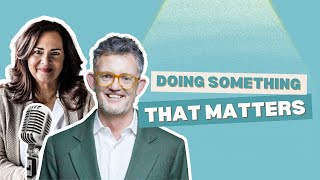
Michael Bungay Stanier discusses his book How to Begin, which helps people tackle meaningful projects. A worthy goal, he says, is thrilling, important, and daunting. He breaks down the process: find your goal, understand what commitment costs, cross the threshold with support, celebrate wins, and treat efforts as experiments.
Chapters
Sit with the idea of what would it mean for you to take on a worthy goal, Become the best version of yourself, Unlock your greatness by taking on the hard things. Because I'm asking. Not just for you. I'm asking for me and my world. Because it's a chance for all of us to live a better life.
Hello everyone, this is Kathy Caprino and welcome to my podcast, Finding Brave. I've created this show for everyone who longs to create something bold and brave in their life. To rise up, speak up and stand up for who they are and to reach their highest and biggest visions. Each week I'll be speaking with inspiring guests from all walks of business, leadership, entertainment, the creative arts and the entrepreneurial world. And they'll be sharing their intimate stories of Finding Brave and offer their best strategies for building your most rewarding, joyful and meaningful life, business and career. Hello everyone. Kathy here. I am beyond excited to announce the upcoming launch of Kathy AI, my new digital clone created with the amazing team at Delphi AI. Kathy AI brings my career growth teachings and guidance directly to you anytime you need it. Drawing on my 17 years of career in leadership coaching, writing and speaking, I've trained Kathy AI using over 2.5 million words that I've written and that have reached over 41 million readers worldwide. My goal? To make Kathy AI your trusted resource for career, leadership and personal growth, offering real time strategies, tips and answers, answers to your most pressing questions. All subscribers will get tailored support to help their career visions become a reality. Plus, we're offering some exciting bonuses and benefits when you subscribe in the introductory period and it makes a fantastic gift for friends, family and colleagues. I cannot wait to share Kathy AI with you. Stay tuned at Kathy Caprino.com in my newsletter for all the details. It's coming soon and I so hope it's helpful to you. Hello everybody. Welcome to another episode of Finding Brave. I am so excited today to have a wonderful guest who I actually have not met before, which is unusual on this show, but I know we're meant to actually connect. And that is Michael Bungay Stanier calling from Canada right now, right?
That's right, Michael. How you doing, Kathy?
Oh, so well. I'm so happy to be speaking with you and just. Just our five minute preamble. I know I'm going to learn so much and so are you because I know Michael really says it. Says it like it is, doesn't mince words. I'm counting on you for that, Michael. All right, I will.
I can be blunt. I'LL do what I can.
Yeah, I'm counting on it. All right, people, today we are talking about how to. Now, this is my title for the show, but Michael's the expert. How to begin doing something that matters. And I think, excuse me, that makes me choke up. I remember 18 years doing work that, you know, it helped me support my family, but I wouldn't say that it mattered to me at all.
At all.
And when we're living doing that. I'm sure you're an expert on this. The opposite of doing something. It matters. It really erodes so much of our health, of our joy, of our energy. So I can't wait to hear all about your new book coming out. But let me tell you people about Michael. Very inspiring. Michael Bungay Stanier is the author of six books. You know, I just finished my second. I don't know how anyone writes six books in a lifetime.
You forget. You forget how painful it was to write like childbirth. I've never had a child, so I can't speak to that entirely. But I suspect there's some sort of correlation, which is like you just forget how miserable the experience of writing a book. Book is.
It's hard because it looks like it just flies out of certain people. Do they have that? I don't. Anyway.
We don't like people who make it look too easy.
No, we don't talk to them.
Don't invite them on your show. For sure. Like Dory Clark. She makes writing books look easy. She's like, okay, I'm gonna write a book.
So darn. Dory, we love you. You're so prolific and you're such an inspiring person. That's how I know you. Okay. Author of six books which, between them, have sold more than a million copies. And you're best known for the Coaching Habit, the best selling coaching book of the century. That's something I don't say too often. And already a recognized classic you are. Michael is the founder of Box of Crayons, a learning and development company that helps organizations transform from advice driven to curiosity led. He is also the founder of MBS Works, Helping people be a force for good. His new book, this is what we're talking about. How to Begin. Helps people be more ambitious for themselves and for the world. Michael was a Rhodes scholar and plays the ukulele. You say you play it badly. I don't believe that. Maybe you'll whip it out for us right there. And you are on us. Michael's an Australian living in Toronto. Welcome, Michael.
Kathy, I'm Glad to be here. Thanks.
All right, now, can we dig in on something right before we talk about how to begin?
Yeah.
Since you wrote the darn, you know, coaching book of the century.
Right.
I ask your opinion about a few things about coaching.
I feel this is going to be a juicy conversation. Yes.
I'll try to keep it five minutes.
All right.
I am going to be really transparent, people. I don't know that I've ever even said this word, these words out loud, but I mean to an audience. But I see something happening with the coaching industry that makes me very angry, which is people will hang their shingle saying they're a coach with we were laughing maybe a day of training. And that infuriates me and makes me just so angry because I believe mastery is important in any field. I mean, would you call yourself a plumber if you'd never done any work or a lawyer or a financial consultant? Number two, I think that another thing that makes me angry is how coaching is trained, when you are trained. And one thing, one fellow I spoke to said the following, which I couldn't disagree more with. Number one, it is all in the questions you ask. And I don't think it is all in the what are you going to do when you get the answer? It is also important. Right. But also one person said, we are taught as coaches that if you're talking about the past, that's therapy and you never want to do that. And number two, number three, you never give advice, ever. You stay out of it. I'm so vehemently against these three things, but, Michael, you're really far more of an expert on the coaching industry. Can you tell me your overall thoughts on those things?
Well, let me start by saying that part of why I wrote the Coaching Habit was an attempt to unweird coaching and make it more accessible to more people. Because I think one of the things that coaching does right from the start is it makes it a kind of a bit of a black box woo woo thing, which is like, have you come in and have you done the requisite stuff and have you been anointed in a way to become a coach? And you know what that's about. And honestly, for me, there's an essence of coaching which is can you stay curious a little bit longer? Can you rush to action and advice, giving a little bit more slowly? And I think that already lays the platform to answer some of these questions. So it is true that coaching is basically an unregulated industry, so you don't even need a day's training. Like, there's lots of people who, for instance, finish an executive career and they're like, okay, I've been an executive for 20 years, I'll just call myself a coach now. And they don't do any training. They just kind of change the title.
And they believe they're a great coach and just think they are.
That's the danger, is that they believe they're a great coach. And I think there is a lot of kind of mediocrity in the industry because there is no barrier to entry. So it's easy to be a pretty average coach and tick along. Okay, so that is not that great for coaching in general and specific clients in particular. I suspect there's a shakeup coming though, Kathy, because, well, I don't think we're too far away from me being able to say, hey, Siri, can you coach me? And Siri will go, sure, Michael, what's on your mind? And I'll go, blah, blah, blah. And Siri will go, okay, we talked about this last week. What's the challenge here for you, Michael? And there's a way that artificial intelligence can structure and run some kind of basic kind of logic tree coaching conversations that do a lot of the, let's call it medium sized lifting that a coaching conversation can have. And I think that's going to just make it much harder for a less good coach to really flourish. And at the same time, there are also some brilliant coaches in the coaching profession. And for me, the brilliant coaches are not ones who just rely on questions. I think that is a. And I think it's just naive and wrong. I think great coaches understand the power of questions. I think great coaches often lead with questions because they stay curious longer. But part of why people would hire you if you're a coach is you've seen stuff and you've done stuff and you know stuff. And it's kind of rude to not share what you think could best be of service to that client. The nuance, though, Cathy, is, I think, or at least my opinion around this is you've also got to have a degree of skepticism about your own wisdom and your own experience. You're like, let me offer some opinions up, let me give you some ideas. Maybe this tool will be helpful, but it's less to think that you're the voice of authority and you're the voice of guidance.
Oh, I couldn't agree more with anything. You're every word.
Yeah. The third thing is around just therapy because I know, you know, you've got Experience in that. This is, this is tricky. This is a tricky road to walk as a coach or somebody interested in this, because there is, there's a reason why therapy is a regulated industry and people have gone through a lot of training and they do have an understanding of trauma and, and that world that most coaches don't have. And the danger, I think, is most coaches don't know what they don't know around that, and they don't really know when they might be flirting with areas that, where they're out of their depth. And I don't do a lot of coaching myself. I'm more about kind of trying to teach the skills of coaching, but I've always felt that I'm not quite sure how to manage that myself, because I'm like, if I, if I, if I find myself on the shore of that lake, what do I do from here? How do I. How do I go from there? But a big part of it is, is to remain aware of your. To be humble, really, to be a whip. You be kind of conscious of your own limitations and to be conscious that you are, in the end, in service to the person that you're working with and what would be most useful for them.
And it's just so beautiful. Can we end the podcast? But I do. In case you're listening and in case you're a coach, can I just add one more point? Then I want to talk about how to begin. Even though I am a trained therapist, I do not flirt in the arena of trauma. But what I'm skilled at is knowing where. When it's. When it's clear. And that is the. That is the delicate balance. So if, you know, you don't want to take people's money when you're not going to be able to help them, and it becomes very clear if therapeutic support is needed, because they might not be able to do what they say they're going to do in the session. And so if the next week they can't reach out, they can't change their LinkedIn profile, they can't have that networking conversation, they can't ask their boss, then it might be their functioning is impaired in some way. And then I refer them out. And sometimes we put coaching on. On hold, sometimes we do it together in tandem. But you're absolutely right, you don't want to be stirring a pot where you're actually not equipped to support them through the emotions that arise and the challenges. And so you do. The hubris has to go away. You know, you have to understand you're not everything to everyone and can't be and shouldn't be. Right. Yeah.
And the hubris is often, I suspect, anxiety around trying to add value, anxiety around going, look, I'm not sure if I've had all the training, so maybe I'll bluster and maybe I'll push hard through it, and maybe we'll skate over this thin ice without people noticing.
That's a very kind way to look at it. Empathic way that people are generally good and they're not trying to harm people and they're trying to help, but they're embarrassed what they don't know. Thank you. I feel. I feel validated, which is a great coach you are. All right, my dear. Thank you for letting me ask that. That means the world.
My pleasure.
Now, let us start with why your sixth book was about how to begin.
Well, I didn't mean it to be. I finished writing another book called the Advice Trap, which is like a sister book to the coaching habit, a kind of deeper dive into. Why is it so hard to stay curious a little bit longer? That sounds such an easy. It's an easy statement to say, like, it shouldn't be that hard.
Why is it. What is it in a sentence? Why is it so darn hard that we shut our mouths and listen instead of.
Because we get a lot of status and authority and control from being the person with the answer. And part of that is training in society. We've got lots of, you know, we've been rewarded all our lives to have the answers. And it's just partly a wiring. It's a very human construct, which is like, being the person with the answers creates more certainty. And our primitive brain, like certainty, asking questions as powerful as it is, is actually less certain. More ambiguous is a transfer of power. Like, we all love the word, you know, let me empower people. But when you realize that empowerment means giving up some of your power and giving it to that other person, when you ask a good question, there's an act of empowerment, which is you giving up authority, control, and some power. And naturally, there's a way, like, I don't know if I really want to do that. I quite like authority, control and power. Why would I give that up? So I think that's part of the deeper resistance. I was like, okay, I want to dig even deeper into change and how we change our behavior. So I wrote a first draft of this book. Cathy send it out to some friends. And my friend Misha, my blunt friend Misha wrote back and went, Look, I've read 40 pages of this. It's nonsense. I don't even know what your book is about. It's hopeless.
I was like, oh, my God, crap.
Because speaking of people who write books easily, I was like, I've written books, so I'm not overly intimidated by it, but turns out your first draft is always a bit crappy. So I was wandering through the rubble of this first draft of a book, and one sentence kind of still held true. And it was, we unlock our greatness by taking on the hard things. I'm like, okay, so that feels like it's the heart. It feels like it's essential. It feels like it's important. And so the second and future drafts of this book kind of got built up around this idea of I want people to be ambitious for themselves and for the world. I want them to be the best version of themselves, but I also want them to contribute to a better world. And if I'm thinking to myself, how do I do my best to have the impact I hope for in the world is to try and give people tools that will bring forth their best and encourage them to be brave and courageous, to take on worthy goals, projects that are worth pursuing.
How fascinating. And, you know, I've. I've got to go back to something you said that I don't think I've ever realized, which is back to the idea that when you're. When you are asking a question, you are handing over your power. But what you struck me with is I think that's the essence of relationships and coaching in that and why my own clients leave the first session feeling like a different person, I think, because it's so rare that people actually do it.
Yeah.
You'Re the expert.
Oh, go ahead to the answer. Because that's also the part of the. That's the other part of the magic, which is like, I've asked a really powerful question and then I've shut up and I've let you talk, and I've really listened to what you're saying. People are like, wow, I can't really remember when that was last done for me. So it's. It's a transformative effect. Yeah. Because you're. You're seeing. It's that, you know, if you. Martin Buber's philosophy or an I it or I thou, relationships, I it. When you're kind of. You see the other person more objectively. I thou. It's just when you see them in their wholeness, in a. In a great moment, when you ask a question and you listen to them completely. You have an I thou relationship, and that's precious and rare.
Oh, how beautiful. Now back to. I'm dying to know one thing here. You obviously have a prodigious mind and a curious mind, and you were a Rhodes Scholar. I don't know many Rhodes Scholars. Can I just ask. This is the therapist in me. What. What was your childhood like? And what did the Rhodes Scholarship experience make you more curious? Do you mind me knowing that? Oh, dear. Good grief. Oh, sorry.
That's all right.
Oh, no, there we go. My phone's off and I just hung up on that person. That's how much you matter to me.
I appreciate that. Do you want to re.
Ask you back later?
Do you want to ask the question again or should I just carry on?
I will ask the question again, but my wonderful editor will do what he wants with it. I am so interested in, you know, in looking at what's obviously a curious mind and that you see things slightly differently. I think I would love to know a little bit of your childhood and a little bit of the Rhodes Scholar experience. Did that inform how you see the world?
So I had a pretty fantastic childhood.
Like, I was really in Australia, right?
In Australia, yes. So I'm the oldest of three boys. My mom and dad were married for 53 years. My dad just died a couple of months ago. But they had a really strong loving relationship of equals. You know, my dad was always a contributor to the household and the like. Honestly, they spent their whole life being kind of surprised about who I was. Like, who the hell are you? Because they were. They were not. They were hardworking, they were people of service, they were modest. And I was always a kind of show off. Like, I. At three, I'd go up to strangers and go, hi, my name's Michael. I can hop on. And honestly, I'm basically still doing that. It's just slightly more sophisticated, but it's not that much more sophisticated. So my dad is English, and my dad is in many ways the most significant role model in my life as a man of integrity and a man of service and gentleness as well. And he's British. He emigrated out to Australia. He grew up in Oxford. His dad was the headmaster of Magdalen College School, a high school there in Oxford. So at the age of 14, one of my teachers asked me what did I want to do when I left high school. And I went, well, I think I want to go to Oxford University, because that's where my dad went. He was a local Oxford boy. He went to Oxford and so Mr. Lennox said, well, you'll need to be a Rhodes Scholar. I'm like, noted, I don't know what that means, but I'll just try and be a Rhodes Scholar then. And so a seed was planted then and it helped me in some ways claim an authority around going, what given choices, what choice would take me closer to being considered to be a Rhodes Scholar? So I ended up. Doesn't matter what I ended up doing. I did, I did stuff that helped that.
What is the definition of being a Rhodes Scholar then?
Well, you need to kind of be a high performing person across a range of different things. You need to be academically strong, you need to have a service element to what you do. You need to show leadership, you need to be good at sports. I mean, this was set up by Cecil Rhodes, who Rhodesia was named after before it became Zimbabwe. He's a classic imperialist in many ways. It kind of exploited the countries, but set up this legacy of leadership. So it's hard to know where the wiring comes from because I'm wired in a way that I've always been self confident. I've always had a willingness to kind of zag when other people zig. I mean, as an example, this may be more information than you want. Applying for the Rhodes Scholarship, I was in the short list of, I don't know, 10 people, men and women, and everybody showed up for the day of interviews and stuff, all wearing blue suits and white shirts and red ties or pearls or whatever it might be. And I showed up with long blond hair, multiple piercings, a tie, dyed pink tie, you know, And I was like, I'm kind of taking a gamble that I need to be a bit different to be selected for this.
So that just. That wasn't your normal way of dressing you?
That was kind of my normal way of dressing. Like I used to make my own clothes and stuff. So I always had a degree of, of, I don't know, it's this tension, which is always the interesting thing, which is like wanting to succeed within the system, but also never wanting to be part of the system, to kind of be backing against it. Which is why the MBS work is my new business, which is helping people be a force for change. It has at its heart helping people go, how do you change the system and the world around you? How do you disrupt the status quo? Because it's a, essentially a very deep value for me.
Oh, how fascinating. See, people, it's always what I say. We are what our childhood taught us to be. Unless we unlearned it. That's what I see. Or healed it or whatever. All right, thank you for explaining that. Now tell us about what is at the heart of how to begin. How do we do the thing that matters? What is in the way? I mean, this is ours we could take, but it is.
Well, it kind of builds up. I mean, it builds up from this idea we've already talked about, which is we unlock our greatness by taking on the hard things. Like, okay, so that's interesting. How do we do that? But then I'm like, okay, so the next step up is, how do I help people be ambitious for themselves and for the world? Because there's any number of reasons, whether it's just age or privilege or where you are in this world where you may have stepped away from your ambition, kind of resigned yourself to the life you've got and the way things are unfolding. So how do I help people with that? And so the practical version of that is to go, how do you set a worthy goal? A goal that is thrilling and important and daunting? And those three elements are all kind of equally important in my mind. Thrilling is kind of what lights you up and it gets you excited, makes you rub your hands and go, yeah, that sounds amazing. And it's also an antidote against obligation because you know how society and ourselves as well, we create obligations. I should be doing this by now. I ought to be doing this. And thrilling allows you just to own what gets you super excited. Important is about serving the world. How do you make a contribution? So it's not just the worst of self development. Sometimes the worst of coaching is it's all just me, me, me, and me expressing my inner self. And I'm like, okay, I don't have time for that if that's all it is. Because I were like, you're part of a bigger scheme here. You've got to be serving the world. You've got to be giving more to the world than you take. So that's important.
I need you to repeat that. I was sitting here thinking, do you think a worthy goal has to be that you're ambitious for yourself plus the world? You answered it. Can you repeat that? I don't have time. If it's just.
If it's just self indulgent and it's just the kind of me, me, me thing, I'm like, you know what? There's plenty of people teaching that, which is like, follow the secret and manifest your mansion in your car. And I'm like, that's not the world I want. I want a better world, and I want people going, how do I give more to the world than I take? That's a phrase from a woman called Jacqueline Novogratz who wrote a book called A Manifesto for a Moral Revolution. I love it. Give more to the world than you take. And then daunting is important because that's where growth is. That's when you step out to the edge of your confidence and your competence and your sense of who you are now to give yourself a chance to become the next best version of yourself. Because the literature around adult development is we kind of move up steps within a stage, and then we leap to the next stage of development. And I want people to be moving up those steps, and I want them to be leaping to the next stage, because the more evolved we are, the better versions of we are, the better our world is. So that's the triumvirate that make up the worthy goal. Thrilling and important and daunting.
I have to ask you this, if I could. Again, it's like you're over for dinner. You probably don't know this, but the book that I just wrote is on the seven damaging power gaps that keep us from thriving.
Oh, that's interesting.
And that. What's. I want to ask you this. There's a lot of coaches and a lot of helpers and empowerers who look at strengths and look at where you already are and believe that you can build on that and get where you want. I don't see it like that. If we could build on those strengths and not do other things, we would be. Yeah, What I see, what I'm looking at are what are the gaps? And that is what's on my radar. And I see power gaps in everyone. I mean, I've interviewed Pulitzer Prize winners, millionaires. We all have them. 98% of women working today and 90% of the men I've studied. But what I'm looking at is where are you gapped in how. How you look at yourself, how you speak, your ability to connect with others? You know, do you stand up for mistreatment? Can I ask you. I know it's a tough question, but in the work that you do in how to begin and helping people to have a worthy goal, do you also look at where they're gapped in doing that and help them close that?
Not directly, but if I touch on it at all, I'd say I touch on it in the last bit of the book. So the first part of the book is setting the Worthy goal. And you go through a process to kind of find and refine and redraft your worthy goal. Because first draft is always a bit crappy, so you need to kind of work it and interrogate your worthy goal so you really figure out whether it's up for it. The second section of the book is around understanding what it means to commit. So how do you understand the prizes and punishments of doing this? Also the prizes and punishments of not doing it. So you have a more nuanced, complete understanding it. What might you gain and what will you lose should you take this on? And then the third section is crossing the threshold, because I'm just trying to get people started. I can't take them to the end of the journey because the journey will evolve and change, but can I get them across the threshold and taking the first steps? And one of the exercises in that third section is, do you understand who you're traveling with? Because you can't really do this alone. And what I draw on here is kind of Native American tradition and kind of calling in the directions. And the calling in the directions. You're like, you've got the. What is it? The warrior, the lover, the magician and the ruler, and then a fifth archetype, which is the trickster. And I suspect. I'm just guessing, Kathy, but I suspect there's a way to understand where you're gapped against those archetypes to sort of understand where. Where do you need to rebuild those strengths within yourself and where may you lean on others to help you be more complete in terms of where those strengths may be? Because I imagine it's with different contexts, different places. But, you know, there are times where you're like, you know what? I could do with a little more fierceness, a little more boundariness. So I need to call on a warrior. So is that something within me or is that somebody in my corner to help me out? Other times you're like, look, I just don't know what the hell is going on. I need a little more knowledge. You may want to call them the magician strength here to like, okay, is that more me? Is that people in my corner? So maybe there's something there.
I love it. Oh, let's map the two and see what. Let's combine.
There's a really interesting overlap there.
I love that. Two more things, then I've got to let you go. You talk about being at the threshold of the goal. Can you explain that?
Well, I'll speak for myself. I've had plenty of brilliant ideas that I've never acted upon because I come up to the threshold of what it means to actually take the first steps forward and I lose my nerve or I get distracted or other things pull me away from it. And I want people to understand and they'll feel it, which is like if you've found a worthy goal, it's no small thing to get moving on it. You're asking and answering one of the most fundamental questions, which is if I'm going to say yes to this, what must I say no to? And that's what crossing the threshold means, which is not just the yes, but you're also getting clear on the no's. And so I'm just trying to do my best to help people be brave enough to step across that with as much knowledge as they can around the consequences of that.
So good. Two things. It's going to be two more things for another hour. Oh, where did it go? I had such a question for you. Some. Ah, here's what it is. You know, there's a Buddhist belief that you'll suffer when you overly attach to a particular outcome. I know, I bet you live and breathe this, but I struggle with this and I want to ask you how this fits in. So I run a business and my business is the worthy goal or you know, what I'm creating with that. And the idea is to uplift a million women. And I know how to do that specifically. And who knows if I've done it. But where I struggle on the threshold of the goal and then the completion of the goal is if you're running a business, you are attaching to an outcome. This thing needs to make some money. You know, this is not a, this is not a non profit here, although I have a, you know, philanthropic vision. But what I struggle with is I will, I will get to that goal. I'll give up a lot. I'll leave it all laying on the ground. And then it doesn't quite. It's not coming, it's not doing what I was thinking it would do. Now often if I hang on to that, don't attach it does something bigger in a way. For instance, the largest intergovernmental agency in the world just acquired some memberships to my new course for their works. Yeah, who would have guessed?
Yeah.
Now I want a hundred times that, you know, but it'll sometimes come in bigger or it'll sometimes not. Can you talk about your. We want to say how. We want to talk about how to stay brave pursuing it. But how do you suggest staying brave after you've completed it and it doesn't look like what you hoped.
Well, I feel you've answered the question in the way you were talking about it then, which is you try. I think of two things. First of all, how you hold what success looks like really matters. And this isn't my metaphor, it's somebody else's. But it's like you're. It's like holding. It's like holding a little bird. Like, you need to have a degree of firmness around it, but you need to have a degree of lightness around it as well. Too loose, too tight, kind of ends and tears. So how do you hold it? Lightly. I think the second thing is to understand what a minimum of success might be. What's necessary success. Like, if you're running a business, there is a degree of revenue and profit that you need to create, or else you just have to fire people or not eat or not do the things that you need to do. So what's minimum success look like? But you're allowed to also dream about what big success looks like as well. And again, I don't mean this to be universal because I'm just trying to make. I'm just trying to project from my own experiences. So two other things. I've got your trick now, saying two more things. The first is to try and do a better job at actually celebrating when I do achieve something. Because there's a way that you can be ambitious. I'm going to project that. This might be you too, Kathy, where you're like, yep, did that. But I'm on to the next thing. It's not enough for me to get five people from the largest world, largest intergovernment agency. I need 105. So you're like, you haven't even stopped and gone. This is amazing. Like, what have I done? What have I created that's allowed these people to find me and show up and buy this? You know, what have I given? What have I built? Who have I enabled? Who have I empowered? And just to have that moment around that. But then and now I've also done what you've done, which is like, I can't quite remember what my stunning final denouement point was going to be. It's like celebrating it. And.
Oh, we were talking about not attaching. How do we. So first of all, stop and celebrate what you have done, which I'm pretty terrible at, even though I see that in other people. You know, Michael, you haven't stopped for a minute. And here I am racing off 100%. Any other things we need to know to not attach, but yet to achieve. I mean, we're not doing this for.
The pure fun of it. The final point. So you've helped me remember. Thank you. The final point was to understand that often what has happened is an experiment, and what you're doing is collecting data, and the data is useful regardless of what happened. So in the Coaching Habit book, the last question in the Book of the seven, that is the learning question. And it's a suggestion that at the end of an experience, end of a conversation, you go, what was most useful or most valuable here for you? So when you have this moment, you're like, okay, so that worked really well, or that failed utterly. You go, so what was most useful here? What was most valuable here? And you stay open to what you're learning. And what this is actually a connection to is going, look, it's just a journey. This whole idea of getting somewhere, it's a helpful fantasy to have, but really we're just walking the path, doing our best, learning stuff along the way, and trying to walk more bravely and more courageously towards roughly the right direction.
I so love talking to you. I got a final question that has nothing to do with it. Do you feel we have more than one life?
I don't. Like, I'm a. I'm a hardcore atheist. So for me, I'm like, this is it. Tiny blip of light, and there's like long stretches of darkness on either side of that. What that is really helpful for me is I do my very best to just remember how ridiculous it is to be alive right now. There are literally trillions of years where I would not have flourished. I would not have flourished at all. So the fact that I am alive, that I am competent, that I live in Canada, that you know that. So I feel like I'm pretty alive to the luck and the specialness of this moment, but I think this is it. So I'm like, I'm going to do what I can to contribute and to enjoy this brief life that is so beautiful.
And what I think that illustrates, people, you know, I believe we have many, many, many lives. And I, in fact, seen a few, I think. But what it goes to show you is you can have very different views about what we're doing here and what comes next and still live a life where you are more than this.
Right.
Because I feel that what you're talking about is almost. Not almost. Don't, don't kowtow. It's a spiritual journey. Right. It's of the spirit.
Right.
It's not of this necessity, all of it, you know, only that. Is that right?
Well, for me, you know, as a. So this is interesting. I mean, atheist, bit wary of the woo woo spirituality, but a spirituality that understands that spirituality is connection and service to a bigger thing. I'm completely on board with that. And whether you have one life or you have many lives, I still go, but. But this is the life now. So what are you doing now? Yeah.
And even if you have 10,000 more, if you blow this one, you're not moving as fast forward as you could be, you know, in the biggest way we could. Any last words on how to begin?
Yeah. I would say the best thing to do is take one or two brave steps towards something. You know, sometimes listening to somebody like me going on about worthy goals and the like, you can actually feel a bit intimidating and a bit kind of. I'm not sure that's for me. It sounds like it's for people who are better resourced or younger or older or more activist or whatever, those sorts of reasons that you can exclude yourself from this conversation. And I hope you don't. I hope you go, look, just. Just take a step towards this and sit with the idea of what would it mean for you to take on a worthy goal, become the best version of yourself, unlock your greatness by taking on the hard things. Because I'm asking not just for you, I'm asking for me and my world. Because it's a chance for all of us to live a better life.
And we need it. We need each of us. Where do we. I could talk to you for hours, Michael. Maybe we will. I'll come to Toronto. Where do we get your book? Where do we learn about you? Where do we just soak up all your delicious training? Where do we get it?
Thank you. Yeah. So the book is at how to begin.com and if you want. Yep. So that's an ICZ URL to remember. And if you want more about me, my website is MBS Works. MBS Works.
That's it. I can't thank you enough. You know, this is why I love doing Finding Brave. It's the most rewarding thing. It's a masterclass in life, you know, and you, you just set me forward 10, 10 courses. Thank you for taking the time, Michael. People, we want to hear from you. Do you have a goal? Read the book. First of all, don't miss it. How do we even vet out a worthy goal? Michael talks all about that. Read the book which has just come out this week. When you hear this and then please let us know, please reach out. It's we're everywhere here. I'm on LinkedIn, Facebook, Instagram, Twitter. Wherever you see this, write a question. I have a feeling, Michael, you, I don't know how busy you are right now in your launch, but someone of us will do our best to respond. Would that happen? That would be for sure.
We'll keep an eye out for that. Yeah.
Thank you. And I would love to hear from you. What did you get from this? What hit literally. I have to go take a nap a little bit, which means my energy's been shifted. Where is your energy been shifted? What have you learned? We'd love to hear. Thank you everyone. And thank you again, Michael. And have a pleasure. Wonderful Brave Week Hey, Finding Brave listeners. Kathy here. Are you ready to take a bold step in your career but feel stuck on how to move forward? Whether you're craving a promotion, thinking about a career pivot, or just want more fulfillment in your work, I am here to help. For a limited time only, I'm offering my one hour career breakthrough consultation at 50% off. This is your chance to work with me one on one to uncover what's holding you back and map out the exact steps to achieve the success you want and deserve. But you've got to act fast. This offer won't last forever. Just head over to Kathy Caprino.com CareerConsult and use the discount code HELP50 at registration checkout to save 50% off the full price. Let's make your career breakthrough happen together this month. Don't wait. The future you've been dreaming of is a lot closer than you think. See you soon. Thanks so much for joining us today. And please don't forget to check out findingbrave.org for more programs, resources and tips. And tune in next time for your weekly dose of Finding Brave.
More from Kathy


Elevate Yourself, Elevate Others, and Amplify Good | Chris Cooper | Finding Brave Ep. 334

Finding Brave Epis #333: How Leaders Can Harness AI Without Losing Their Humanity, w/Bennett Borden

Finding Brave Epis 332- How to Stay Brave, Valuable and Visible in the Age of AI, with Raman Rai

Finding Brave Epis 331 - The Power of Positive Disruption, with Dr. Patrick Leddin


Finding Brave Epis 330 - Being 40: Letting Go and Embracing Who You Are, with Stacey Lindsay

Disrupt Career Reinvention with Kathy Caprino - via The Disruption Lab Podcast w/Patrick Leddin

Creating Neurodiversity-Friendly Work Cultures: Simple Workplace Adjustments Matter

Finding Brave Epis 329 - How To Create a Neurodiversity-Friendly Workplace, with Kristen Pressner

Finding Brave Epis. 328: Reclaiming the Power to Trust Your Own Voice, with Dr. Cindy McGovern