Episode 198: What's Really Holding Us Back From Earning and Having Exponentially More Money
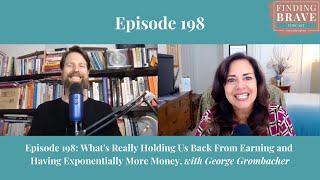
This is a podcast interview (Finding Brave, Episode 198) in which host Kathy Caprino speaks with financial advisor George Grumbacher about the psychological and practical barriers that prevent people from earning and keeping more money. Major themes: childhood money conditioning and scarcity, feelings of unworthiness, the complexity of financial knowledge (taxes, entities, investing), the role of advisors and how to vet them (fiduciary status, compensation), and the need to act (apply knowledge) rather than just learn. Guest contact points: moneyalignmentacademy.com and the Lifeblood podcast.
Chapters
Hi, Kathy here. And I wanted to share some information about my new digital newsletter, your Path to Career Bliss. This monthly newsletter explores one key career, leadership or personal growth topic that is essential for building a happier, more successful career or business. Every issue offers a selection of the most read articles that I've ever written, along with riveting podcast interviews with some of the nation's top experts, as well as career assessments, resource recommendations, a subscriber highlight section and an Ask Kathy column, and more. We've made it as affordable as possible with two tiers to choose from and the first month is completely free and you can cancel at any time. I hope you'll join me in this program. Now check it out@kathy caprino.com newsletter and get your free issue today. Thank you. And here's to your path to Career Bliss.
You have to know how, but I think with personal finance, it's not enough just to know how. We also then need to be able to take and apply these things and make them real in our lives.
Hello everyone, this is Kathy Caprino and welcome to my podcast, Finding Brave. I've created this show for everyone who longs to create something bold and brave in their life, to rise up, speak up, and stand up for who they are and to reach their highest and biggest visions. Each week I'll be speaking with inspiring guests from all walks of business, leadership, entertainment, the creative arts, and the entrepreneurial world. And they'll be sharing their intimate stories of Finding Brave and offer their best strategies for building your most rewarding, joyful, and meaningful life, business and career. Hello everybody. Welcome to another episode of Finding Grape. I'm so excited about. Well, I always am, George, but I'm really excited about this one, this episode. Because, you know, one thing I love about this podcast is it's like my master's class in life, my PhD in life. It's what I want to understand. And so those are the questions I ask. And hopefully other people are saying, yeah, I need to know that too. So today is no exception. We have the Amazing George Grumbacher here who and we're talking all about what's really holding us back from earning and having Key Point exponentially more money. And George is the guy to talk to you about this. So let us dig in here. Here we go. Let me tell you about George. George has worked in personal finance for 20 years and has been named a top 100 financial advisor. That's a big thing in the US by Investopedia for the past three years. I'm really fascinated on how one gets chosen. That's another podcast for that. He's working hard to encourage, empower, and entertain others. I love that combination because entertainment teaches too, you know. Right. So they can create more financial success and live as they wish to. George is the president of Financial Consulting Professionals and founder and chief community officer of Money Alignment Academy and the host of Lifeblood podcast, which I was just on. That should come out soon. And it had another name before George. Right. So people may know it by another name. Is that true?
Yes.
All right. Well, welcome, welcome, welcome. Let's dig in. So the top question I want to understand. And you know, we were chatting one second before we pressed record. George works with a wide range of people over these years, 20 years, from professionals probably making any range of money we can imagine to, you know, from CEOs to others, I'm sure, to small business owners to entrepreneurs, to startup people, to people who want to leave their corporate world. I'm sure you've really worked with the gamut here. But what I'd love to know before we dig in, we're talking about blocks, right? The internal ones, the external ones, the blocks in our behaviors and our mindsets. Do you see that these blocks are very similar across about every demographic and psychographic, or are they a little different among those little niche. Not little, those niches.
Well, let's just get started by giving you a perfect financial person answer, which is totally depends. Right. But, you know, part, I think the part of the human experience is that we are consciously competent some areas and we're unconsciously incompetent in other areas. So just depending on how you were raised, if you were raised with a positive money environment where your folks talked about money all the time and there was plenty of it, well, then your experience is going to be different than if you were raised in a house where the family was broke and money was just a source of tension. So there's unique problems that are there. And whatever your educational experience has been. So what I try to do, and I think it's something that we all try to do, is meet people where they are. And that's a little bit of a throwaway term, but I think that you talked about entertaining people. And whenever I do talks or visit with people, I always tell people that I've made a lot of really great financial decisions, but I've also made a lot of really terrible financial decisions. So wherever the person I'm speaking with is at, I'm interested in helping you to get better. So if you're doing great and you want to break through that next level and really start to just pull ahead or whatever. Great, I can help you with that. Or if you're in a spot where you're thinking, oh my gosh, I'm broke, I'm paycheck to paycheck, I'm up to my eyeballs and credit card debt, I think that I'm in a position to help people there too. But yeah, we all go through the same stuff. Whether you are super affluent and from the outside looking in like, wow, Kathy's got it together. But on the inside you could be a mess. Or you could look at somebody and they could look like, oh my gosh, that person doesn't have two nickels to rub together, but they could be a millionaire. So it all kind of depends.
Oh, what a field. All right, you know, I was a former therapist, George, so I got to ask a few questions here just because I want to know. First of all, you are so, so soothing to listen to. And we talked about your voice. I know you're a singer there either in the shower or somewhere else, but I feel very. When I speak to you, you would be the kind of person I would want as an advisor because I feel safe with you. Like, he gets me, he's not judging. And folks, I want to tell you the flip side of that. I had a financial consultant at a very big company everyone's heard of. And I went from making a lot of money as a VP to I said, I'm going to become a therapist. And you know what? He looked at me and said, george, you're not going to make any money with that. I was so hurt and so upset. And then I fired him finally after I got my together. But I just want to hug you up that you are the kind of person that I think people need someone who understands, someone who's compassionate, someone who doesn't judge and someone. It's kind of like therapy. I'm sure you feel like a therapist a lot of times, but you have to meet people where they are, otherwise you've lost them. Day one. That was my little preamble. But here's my question. How did you get drawn to this field? And that's a tie into. When you say a positive money experience in childhood. I'm immediately thinking what I had, which later I think tripped me up. But my parents did the best they could. Let me just share what that means. They were depression era people. World War II, incredibly risk averse. My dad was a genius. Seven patents at GE, but he stayed there for years, probably a little longer than he could have, and was really risk averse to do anything else. And they never spoke about how much anyone earned. Dad tried to work, work through. When I went to college, Boston U, I was spending a lot and he'd asked me to bring home kind of the, you know, not the receipts, but an itemization of what I was spending. And I was so angry. I thought to myself, I think you're so cheap. You know, it was a mess. So question one, how did you get drawn to this? And I'm guessing it might be from what you grew up with, with financial stuff. And secondly, what is the most positive way children can grow up in an environment around finance? I mean, that's like two podcasts in one. But will you answer that for me?
That's a really good question. Yeah. And it's fascinating how I got into the field and that it was just pure chance. It was my first job out of college. I graduated school and had no idea what I wanted to do. I didn't know what a financial person did at all.
What did you study? What'd you study?
I was a political science major, Kathy. I was going to go to law school. So liberal arts education. Literally had no idea what financial services was. I swear to God. A girlfriend in college said, I don't think I want to go into financial services. And I remember thinking, I have no idea what that, what she's even talking about. So, so I went to work, just, it was. Sounded like something I could do. It was more professional sales than it was really financial advisory.
And so, I mean, you were selling the services?
Yeah.
Your first job?
I was just selling product for sure, it was commission driven sales, but it was, you know, doing financial stuff. And for the first 10, 10 years of my career, I just followed the instructions that they handed me, said, okay. You know, it's like when you do Legos, it's like, okay, I can do this on my own or I can go step by step. And I just went step by step. And I did that for 10 years.
About how to sell these financial products and services, you mean or no?
Yeah. Or yes, Just follow, follow. The roadmap that they gave said, okay, here's the way that we get new clients, here's the way that we talk with them, here's the way we service them. It was very formulaic, which for me was, was very good because I didn't have any kind of a passion for it. When I did, sort of, I made the change and I went to a more Independent kind of a model. That's where I threw the instructions away. And I'll get away from that metaphor in just a second. But that's when things clicked for me. Said what? How do I fit in? What's, what's the work I'm really interested in doing? Then I sort of tapped into my creativity and got more in tuned with the work that I'm interested in doing and the impact that I'm interested in having. And now, now 10, 12 years later, I can say I'm very much connected to more of that purpose driven work. So. But I grew up in an environment. My mom was a single mom, school teacher, northern Minnesota, did an awesome job, but there was never enough money to go around. And so money was tight. Once a month my mom would pay bills and that meant she spread all of our bills out on the dining room table. And my brother and I knew to avoid being around her. And so that translated to me avoiding money. Even though I worked with money. I waited till the last minute to pay bills and was late a lot of the time. I certainly never budgeted because that was preposterous. I waited to pay my taxes, I used credit cards. And so I did pretty much all the really the wrong things.
And look at me getting choked up. I just have to interrupt you just when you said that about your mom, I could almost feel the fear and the pain and I could feel it. How, how, how difficult?
Yeah, I mean, everybody makes it through. So.
So you grew up with a relationship of fear or resentment or anger or denial, Some one word.
Yeah. From a financial standpoint, my folks split up when I was five and I think that that really, that also really embedded a scarcity mentality in me. And this is where the whole if you don't know what you're supposed to be looking for or you don't know to look into psychology of why I'm interacting with money the way that I am. Well then it's just a matter of, well, why am I bad at budgeting? It's pretty easy, right? Why am I bad at investing? I think I understand investing. So it's a function of. It's not enough to know. You have to know how. But I think with personal finance also, it's not enough just to also know, to know how. We also then need to be able to take and apply these things and make them real in our lives. For example, you know, I was a tennis player. You were very accomplished.
So me. So was I. Singer, Tennis. Go ahead.
So in high school and college, high School and college. And so that's, that's what I was, I was a tennis player. So now today I know how to play tennis. I, I, I, I, I, But I'm not a tennis player right now. So I can know personal finance, I can be a whiz in it, but if I'm not doing the things, then I'm not going to break through and, and have the kind of success that I want to have. And what makes this harder is that it's so incredibly complex. Every area of personal finance requires an immense amount of learning, of knowledge, of know how. And so when we talk about what, what these blocks are, there's, there's psychological thoughts, feelings that lead to behavior, but then there's head knowledge, right? There's, there's, there's, there's, there's book learning that needs to take place. And again, there's all these different kinds. I need to know investing, I need to know insurance, I need taxes, I need estate planning, I need business, I need philanthropy. Potentially later in life or early whatever, how does all this stuff interact together? And then do I have time, do I have attention, do I have the money to put towards this? And then do I want to. So all those things.
It's complicated. All right, let's start with, since there's so much, and I couldn't agree more, like running my own business, the tax issues, is it an S corp? I want an llc. I mean, and, and not to bash the irs, but holy cow, it's so complicated. And when do I speak to a human being? And when you do it, it's clear. But my goodness, the forms, the language. I got something from the Small Business Association. I literally didn't understand the resolution certificate. I mean, I don't understand these words and I'm pretty smart, so I know if I can't. Anyway, let's talk about. Well, let me just ask, because this is what I go through. There's a wonderful book. Do you know Gay Hendricks book the Big Leap?
I don't.
Your clients might, you might dig it. It's about the upper limit barrier that almost everybody has. And he works with top CEOs and he would see that at a certain point, whether that's money or love or success, people would begin to sabotage it. This upper limit. And let's take money and underneath that limit, and we have to actively do what you're saying, push that limit up because it's there. There are four barriers. For instance, the crime of outshining. We don't want to outshine Our family. I mean, I' spoken to clients who are making a lot of money and a lot of their family is on welfare or in prison, and they really reject her. You know, crime of outshining, not feeling you're worthy of it. And also that success will be a burden. I mean, all of these are so true. But when I look at my own blocks, I remember, as I said, I never heard a word about what my dad made, but we were middle class. And then one day I overheard Somehow the number 75,000. Do you know, George, that I stayed stuck as an adult at $75,000 for a salary for quite a few years I couldn't get. And there it was. I'm oh, upper limit. Don't make more than dad craziness. So this is how it works, people. But I feel like I've healed all of that. But even transparent, even in my own business, there seems to be a plateauing now, the pandemic didn't help and I was making a lot of money as a writer in certain platforms and that kind of went away. But can you tell us when there seems to be that limit and you're working with the individual and they seem to be having everything you're saying they have the book knowledge, the mind knowledge, the mindset, but they're still stuck. What do you think's going on? Let's even take a small business situation. Obviously, I'm getting financial consulting help here, but what keeps us stuck? When you've gone through, you've ticked all the boxes and you're doing everything right, what do you. What is underneath that, do you think?
Yeah, well, I think that that's. I think that might be the million dollar question. Right? I think there's got to be. The reason I talked about all the complexity and all the different stuff, it's not because I want people to be dissuaded from pursuing this. It's just sort of a reality that there's got to be somebody whose job it is to bring everything together. So that can be me as the CEO and CFO of my life, of my family, of my business, of all those things, or I'm going to need to look to bring somebody on who can take on that role. That's why I said, are you interested in doing this? Do you have a desire to do it It. Because most people don't. And so that's sort of the reality, is that there's got to be somebody who's driving that process because you could have done everything right. Like you could have set up your business correctly and all your taxes could be great and you're investing. But nine times out of 10, there's going to be inefficiencies that are within each of those. A lot of the times there's going to be gaps or even holes in the whole planning process. And that's just because the financial world, the financial industry, it's difficult to scale sophistication and expertise.
Boy, is that true. That's a tweetable.
What we scale is just the compartmentalized silo, different things. So you go to XYZ Financial firm and you get this, and you go to the accounting firm and you get this, and there's not a lot of crossover. And so the person to bring it all together is either going to be you or it's going to be somebody who actually does that kind of work. And this is not a commercial for me, because this is not work that I personally do. I just have immense experience and work in the field. But that's really what's. What's required to, I think, breakthrough, to close those small inefficiencies or sometimes massive inefficiencies, and to again, bring all those things together. Because you might be sitting here thinking, I've got it all together, but how.
Do you know you're right? And there's this other piece I just want to say that's probably out of your sweetest spot. But when you're running a business, it's also the products and services and pricing and packaging and niche marketing that you're doing. So you may be great at running your business, but. But when you're a business, it's the services and products you have, and how are you reaching clients? And how effective is, you know, customers? And is it priced right? And is it, you know, it's incredibly complicated. That's why when people say, I want to, oh, I want to start my own business, I take a big, deep breath with them because I don't think the average person understands the degree of complexity. All right, you answered that question helpfully to me. So before we move on to external blocks, are there. Is there one internal block you would like to say is, you know, 80% of the people listening have this.
Well, I could speak for me first. And it was 100% unworthiness. And it sounds like that was potentially you as well. If you're bumping up against 75,000 or whatever that number is, it could be $30,000. And for me, it was just. I'm feeling like I wasn't worthy of the kind of success that I wanted or to be somebody who was listened to and paid attention to. And so I think that that worthiness. And thank God for Brene Brown and thank God for a lot of the professional athletes who are talking about, you know, mental health issues right now, because that's something that we 100% all experience. You know, the people who are, who are psychopaths don't experience that at all because they know and have that feeling of self worth. And so there's probably cues that we can take for, from them without actually.
Being psychopaths or narcissists, you know. Yeah, or.
Yeah, or narcissists. So that, that, that, that's such a big one that I think most people struggle with at some point.
And I want to dimensionalize that one just a little bit because I talk a lot about that, but maybe people are asking, well, how does that even show up, this lack of worthiness? You know, I remember having a big bump from one corporate job to another. It was a lot more money. And I remember the feeling. I didn't say, am I worthy? We don't say those words. But I did think, yikes, I better deliver. Right away. They're looking at me to deliver, to pay me this and to get this kind of bonus. And I remember thinking, can I do it? Do I have the chops? Especially if you've been in a job a long time. The previous job where, you know, I grew up there and everyone knew me and pretty much loved me for a long while. When you're going to a new situation, you're really thinking, do I have what it takes? I think that's how the worthiness thing happens. And you're scared, and you're scared. That's why you're scared to stretch higher and ask for more money. It's quite embedded. All right, fantastic. Thank you, George.
I'd love to just say something else about that, that you're 1,000% right. And treating myself like I'm somebody worth taking care of. So treating myself like I am worth investing time, attention and money into. And that's for my mental health, my physical well being, my financial health, whatever that might be, that I am worthy of investment. I am worthy of love and of attention. And so I think that that's also part of it.
And, you know, I don't think this has ever come up in almost 200 episodes. When you come from a background where there's scarcity, there was no question you're not going to go get a massage. You're not going to play for it, pay for a tennis membership. How I remember my dad for first and only time he ever said. I said, can I go to school? The France trip, I take French. And he actually said, this is not to blame, Dad, I love him, he's in heaven. And he was such a supporter. But he said, no, it's very expensive and I'm disappointed that you would ask. What do you think we learn? Don't even ask. So now when I pay for that tennis or the, you know, the, the tennis club membership or my indoor tennis, it's a lot of money. But I look long and hard. What does this bring me? What does this give me? How does it expand? How does it make me feel? Well, and what is that worth? That is such a good point, George. Thank you. All right, external blocks. Is there one that you just feel like, oh, if I have to talk about this one more time today with clients, customers, is there one external thing that so many people are doing? Like you really wanted to add the word having, not just making more, but having it. Is there a block there that we might make it but then we throw it away or fritter it away or. Tell us, tell us.
Yeah, well, there's certainly. I very much am of the mind that cost is what you pay and value is what you get because I know it to be true. And I think that great professionals should be compensated greatly obviously and that's all going to worthiness again. But we need to be super mindful of the fees and the expenses that we are paying and as long as they are reasonable and we're receiving value for that, well then that's totally fine. So that's just being an active participant in our finances and that seems potentially very, very basic. But then you look at the other unforced errors that we're making and a lot of them are going to be lifestyle related, which I keep getting away from money, but you know how it goes. The cost of divorce is. That's probably the biggest creditor that we have on our financ. So being in bad relationships and toxic relationships, negative relationships, getting divorced, that has a horrible impact on our personal finances, which is obviously above and beyond just personal finance. But potentially personal finance leads to bad relationships or vice versa. It's kind of a chicken and egg kind of a thing. And then also recognizing that our brains, while they've kept us alive for a very long time, so we're grateful for that. They're terrible at helping us to invest.
Same parts of our brain scared because it's all risk. And what right is that? It?
Well, the same part of our brain that responds to moral danger is. Is the part of our brain that responds to financial loss.
The amygdala, you know, the fear. Right. Looking at when the tiger's coming out of the cave. The cave.
And so when I see the stock market go down, my brain says, oh, my gosh, sell, sell, sell, sell, sell, sell. But intellectually, I know that I'm supposed to buy low and sell when things are high. So stuff like that blows us up. And a lot of the time, that's a hard thing for people to recover from. Putting too much trust in outside advisors, even though I'm telling you that potentially an outside advisor is going to be a key component to your overall success in every area of life. But see exhibit A, Bernie Madoff. Obviously, we need to make sure that we are checking in and trusting, but verifying kind of a thing that these people are not charging us too much or they're not stealing from us, and that everything that we're expecting to happen is actually happening.
Can you talk about that for a minute? How do we. I myself have chosen the wrong people.
Sure.
And didn't know it from the behavior. I certainly wouldn't have seen it. And it was a really bad mistake that I'm still suffering from the repercussions. How do we vet a financial consultant? How do we make sure they're doing what they say they're doing?
Yeah, no, I appreciate that. So a couple things come to mind. There's a lot of different financial people out there, for better or for worse. One way is through something called broker check. And if they're a certain kind of financial advisor, they have a permanent record. And so if anybody ever got mad at them and made a complaint, it will go on their permanent record, which you can access through broker check. So you should look up your financial person and see what's on there. Other kinds of financial advisors fall under a different jurisdiction, so they don't fall under that. And for those who are independent, what's called a registered Investment advisor, or ria. And part of financial stuff that we talked a little about earlier is jargon and how dangerous that is. And here's hopefully the last jargony term I'm going to throw at you is fiduciary. And all that means is that your financial person is legally obligated to act in your best interest. Okay. So you should be working. In this day and age, I think that there's very little reason not to Work with a fiduciary financial advisor.
It's a designation. Like, it's in their title. How do we find out if they're a fiduciary?
You can ask them, and they'll have to tell you.
It's. And how do they get that? Is that a specific kind of training or specific. Specific certification or how do they get that? I don't even know that.
It's. It's. It's part of their licensing.
I see.
And how they're. And how their business is set up and how they're compensated as well.
I see. Right, right. It's not commission on, you know, as much.
That's right.
Wow.
And then simply. And so. So then ask them that. Say, hey, are you a fiduciary? How do you make money? How much money do you make? I want to know how much everybody's getting paid, and your advisor needs to be comfortable answering that question. I want to know how much George is making. If I'm giving you advice to take care of your overall financial situation, I want to know how much my investments cost, because that costs differently. I want to know how much my accountant makes. I want to know how much.
And so from my. From the work with me, not his salary, but what is he getting? Is it a 20% for every, you know, transaction. I see.
Exactly.
Oh, my. I never thought to ask that.
And you're probably. And a lot of people aren't comfortable asking that.
No.
But as. As we move along, just to sort of talk a little bit about a parallel, I think it's really important to be asking questions of our physicians these days as well. Say, you know, why are you suggesting that I do that? And if you were the doctor who says, you know, who gives a bad look on your face.
Yeah.
Like what?
Are you questioning me? A lot of narcissists who are doctors, I'm sorry to say.
Well, I think that we need to find somebody who is open to at least making. Giving me an explanation of why they're suggesting care. And so we, as consumers of professional services, you need to ask your financial advisor that question. Are you fiduciary? And how much money? How are you compensated and how much? And then I know, wow, I'm paying George $500. Wow, that's almost free. Or I'm paying George $50,000. That seems like a lot. And what's a lot to you is that's the whole cost is what you pay. Value is what you get. But that's what I would encourage you to do is to have the confidence to ask that question. And if they're not able to answer you or they give you a hard time about it, well, then it might be time to look for a different advisor.
You know, when I joined your life blog podcast, we talked about the seven damaging power gaps you're touching on every one of them. Communicating from fear, not strength. If you can't stand up, I move doctors. You know, if I don't like how I feel in your office, why am I coming to you and paying you all these? We have to not communicate from fear. We have to recognize our own value. Right. We have to get outside help. Don't isolate. If something doesn't feel right but you're not sure, ask your wonderful board of advisors. I don't mean they have to be literal, but, you know, the four people in your life you trust. Love it. You're hitting on closing all those gaps. I'm going to leave you with one tough question. If everyone listening could heal this one challenge that you have seen over and over and over, what would that challenge be? And what one tiny little tip. You've given a hundred tips here, but I'm going to force you what you know, here's the biggest thing I see with everyone, and this is the tiniest tip that I think you can take today and do.
Can you give us so the story that you keep replaying in your head. For me, it's. It's when I'm in the shower in the morning, I always. I was thinking about the same stuff over and over again. That is what you need to sort through. That's what you need to get into that closet and clean it out, because you're going back to that. And all of us, unfortunately, spend way too much time living in the past. And you have a choice. So I want you to exercise your choice to start thinking about that situation differently.
Is it a situation that runs through your head? The same one, like how you messed up something, I mean, or is it a theme? Oh, gosh, I'm embarrassed how I talked in that conversation. And you seem to be always embarrassed. That kind of thing, something that repeats.
I think it's more thematic. I think it's different experiences that you've been through and that is shaping how you are. That's obviously part of your operating system. Just like our phones have operating systems, so do you and I. And we're constantly going through the same loop that's keeping you at $75,000 a year, or it's keeping you broke, or it's keeping you in a bad relationship, or it's keeping you overweight, it's keeping you depressed, it's keeping you these different things, keeping you broke. So you need to get in there and get a permanent update, not none of this temporary update stuff. That's what. That's why I said it's not enough to know. It's not enough to know how. We also then need to take and do and apply it. And you have a choice. You have a choice. So choose to choose it. Choose to make it.
I want to leave with one other thought and see if you agree. You can have millions in the bank and still be miserable and still feel afraid that it's going away and still feel scarcity, but not even misery around money. You can just be miserable. I would say if that's playing through every morning, how unhappy you are. No, I mean, how does that relate to money? Money doesn't make us happy. Right. It allows for some things, allows for some freedom, some. But if up here, there's so many demons, get help with that, too. What do you think?
Yeah, I couldn't agree more. What an awful thing, right? That's what, you know, I think happiness is great. Ice cream makes me happy, but I'm striving for contentment. Right. I want to feel good with the things that I have. And when I'm doing that, then I can start to proactively look for ways to improve. But I'm always going to have that resting level of the way that I am, of my being as. As. As contentment. So that's what I strive for.
That's beautiful. I can't add one more thing to that. Oh, my goodness, people. George, where do we learn about you? Give us. You know, there'll be links in the show notes, but if someone says, I gotta have more of George, where do they go?
Yeah, you can go to moneyalignmentacademy.com and then check out the podcast that Kathy was on. It's called Lifeblood. So those are the best places.
Fantastic. Wow. Thank you so much. I feel I can't wait to make some changes right away. Got to clean this out a little bit, people. We want to hear from you. I mean, there are very few people I've ever met that don't have some struggle with money on one spectrum or another. So could we hear from you? What's your biggest problem? Maybe you don't want to share that on LinkedIn, but we'd love to hear what. What did you get from this? And if you took an action step and what happened? We'd love to hear that. Wherever you see shared. I'm sure George would love that, too. And that's it, people. You know, money is an essential part of our lives. So now is the time to build just a loving, a loving relationship with it. I think I never had that till now. And some days I struggle a little more. The closet is more full with those little gremlins, but there we go. People love it, but do the work to have the contentment towards it and towards your in your life. Thank you, George. Thank you. Come back again. Part two soon. We need it after the pandemic is a thing of the past. Maybe we'll have you back. I don't know why that relates, but the pandemic has thrown a lot of people into financial distress. All right, people, we hope you love the show and let us know and have a wonderful week ahead. Thank you. Hi, everyone. Kathy here, and I'd love to share that we have a really big milestone coming up. November 4th. It's our 200th episode of Finding Brave. It's because of you that we've reached this milestone, and I'm personally so very grateful to each and every one of you who are such loyal fans of the show and for helping us rank in the top 1.5% of over 2.6 million podcasts.
We.
Wow. In honor of our 200th episode, we're thrilled to introduce a new feature of the show. Starting now, we're accepting audio submissions of your most burning questions around careers, leadership, personal development, or business growth that you'd like me to answer right here on the show. Please submit your Questions@finding brave.org Ask Kathy. We'll be selecting as many as we can to play on the show, and I'll be giving you my personal take on those questions. And going forward, we'll dedicate one show a month to answering the great questions you submit. I hope you find this a helpful feature. Thank you again for tuning in and have a wonderful week. Thanks so much for joining us today. And please don't forget to check out findingbrave.org for more programs, resources and tips. And tune in next time for your weekly dose of Finding Brave.
More from Kathy


Elevate Yourself, Elevate Others, and Amplify Good | Chris Cooper | Finding Brave Ep. 334

Finding Brave Epis #333: How Leaders Can Harness AI Without Losing Their Humanity, w/Bennett Borden

Finding Brave Epis 332- How to Stay Brave, Valuable and Visible in the Age of AI, with Raman Rai

Finding Brave Epis 331 - The Power of Positive Disruption, with Dr. Patrick Leddin


Finding Brave Epis 330 - Being 40: Letting Go and Embracing Who You Are, with Stacey Lindsay

Disrupt Career Reinvention with Kathy Caprino - via The Disruption Lab Podcast w/Patrick Leddin

Creating Neurodiversity-Friendly Work Cultures: Simple Workplace Adjustments Matter

Finding Brave Epis 329 - How To Create a Neurodiversity-Friendly Workplace, with Kristen Pressner

Finding Brave Epis. 328: Reclaiming the Power to Trust Your Own Voice, with Dr. Cindy McGovern