Episode 201: Are The Stories You’ve Been Told Supporting or Suppressing You? with Heather Hubbard
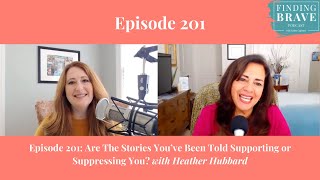
This is a transcript of Episode 201 of Kathy Caprino's Finding Brave podcast (guest: Heather Hubbard). The episode examines whether the stories people inherit or tell themselves support or suppress them — covering how childhood narratives, social messages, and personal choices shape identity and career decisions. Heather shares her path from entertainment attorney to founder of Simple Courage, discloses childhood and adult trauma (including a serious car accident at age three and an ACEs assessment), and emphasizes practical practices: small experiments to build courage, body-based nervous-system work, mindfulness/witnessing, and community-based training and challenges. The episode includes host promos for Kathy's newsletter and courses and ends with calls-to-action to join Heather’s Simple Courage newsletter and upcoming challenge.
Chapters
Hi, Kathy here. And I wanted to share some information about my new digital newsletter, your Path to Career Bliss. This monthly newsletter explores one key career, leadership or personal growth topic that is essential for building a happier, more successful career or business. Every issue offers a selection of the.
Most read articles that I've ever written.
Along with riveting podcast interviews with some of the nation's top experts, as well as career assessments, resource recommendations, a subscriber.
Highlight section and an Ask Kathy column, and more.
We've made it as affordable as possible with two tiers to choose from and the first month is completely free and you can cancel at any time. I hope you'll join me in this program now. Check it out@kathy caprino.com newsletter and get your free issue today. Thank you. And here's to your path to Career Bliss.
And that's when I realized I'm playing a role. In fact, many different roles depending on the room that I'm in. And these are stories. And I can change the stories. I can choose a different story. I can choose another adventure at any moment or any time.
Hello everyone, this is Kathy Caprino and welcome to my podcast, Finding Brave. I've created this show for everyone who longs to create something bold and brave in their life, to rise up, speak up, and stand up for who they are and to reach their highest end biggest visions. Each week I'll be speaking with inspiring guests from all walks of business, leadership, entertainment, the creative arts, and the entrepreneurial world. And they'll be sharing their intimate stories of Finding Brave and offer their best strategies for building your most rewarding, joyful and meaningful life, business and career.
Hello everybody. Kathy Cabrino here, and welcome to another episode of Finding Brave. So, so, so excited today. You know, I was just sharing with my incredible guest, Heather Hubbard, which I'm going to tell you all about in a minute. But the fun thing about this show, I feel, is, well, there's a million fun things. But I get to talk to not only people that are gurus in areas that are not necessarily connected to what I do right for a living. So I'm learning. It's kind of like a master's course. But sometimes, like I think today, I get to also talk to people who are in a similar space. And in this case, we're talking courage, bravery and courage, but are intervening at it in a different way. They're using their gifts and talents and abilities and insights in a slightly different way so that they can elevate and inspire people, but not necessarily in the way I would do it or how I approach it. And I, I learned so much from that as well. So, Heather, thank you for taking the time. I know you're so busy and you're launching new things, so thank you for being here.
Thank you so much for having me. I'm so excited.
So excited. And Heather's from Nashville. How jealous am I? And immersed in that incredible town of music. And we are going to be talking about are the stories you've been told supporting or suppressing you. And we even started having a conversation about is that the title we really want. So let us dig in. But before we do, about stories that you've been told or that you're telling yourself that are hurting or inspiring and uplifting you, here's Heather. Heather Hubbard is the founder of Simple Courage, a media company, movement and community focused on cultivating the courage needed for individual and collective change. Prior to starting her own company, Heather was prominent and award winning entertainment and intellectual property attorney and manager at one.
Of the largest law firms in the.
US I got to hear about that. As well as a go to business advisor and strategist. She's been featured in Forbes, NBC, Business Insider, Grammy magazine, and more. So holy crow, you've been busy and you've had kind of a mosaic of a career, haven't you, Heather?
Absolutely. It has been a journey.
Journey. And that's what we love. You know, marrying it all up and ending. And it's not ending. I mean, it's a, it's a journey. Right? We're not done yet. But where you are now is a marriage of all that which I so love. So I want to jump in with some questions about stories, stories we tell ourselves or stories others tell us. But I do want to tell folks, you know, I have a session prep form and my guests kindly fill this out. And they often offer bullet points about what they really want to make sure we talk about. And two out of the three, Heather, that you wrote, I, I want to start with. Okay, here's the first one. Sometimes we get so lost playing the role that others expect of us that we stop to remember who we are and what we want. We become bit parts in someone else's play. The second point we're going to dig into is the more you're. This is so important. The more you're willing to train your body and your mind to take action when you're afraid, the more you'll see scary stories as just that. Stories that frighten you but no longer control you. I think I must start there because you Know, just even this week, I have several coaching clients that, you know, when I look at their career path assessment and they're talking about what they want to change in their career. These are not career problems. They're almost never career problems. Yes, they manifest as career problems. I can't make enough money. I have a toxic boss. I'm wasting my talents. I'm so angry at work every day. I don't know what I want. Sure. Manifest that way. But it is so much what we think. So can we start there? But here I do. Why don't I just have a model podcast? All I'm doing is talking. But, Heather, can you. We were about to go into that discussion about. Is the title of this. Should it be the stories you tell this yourself or the stories others tell you? Can you talk about that? Yes.
I kept. I kept going back and forth. I was like, I don't. I don't know which is the better way to say it, because we're in charge in the sense that we are choosing the story that we accept. Right. So we are choosing the story that we are telling. But very rarely do we come up with that story on our own. From the beginning, right? So from the moment we're born, we're hearing stories. We're being told stories, either directly or indirectly. I mean, the person telling us the story may not even intend for us to take it that way, but that's what we hear, right? Like, we hear this story. And so. And so it's a combination of all these stories that we're using almost as, like, different characters and plot lines or whatever to then tell our story. And so I don't think it's either or. I think it's a blend of both. And I think it's important for people to realize that most of our beliefs, it's not just like we were born with that belief. We often think that it's so ingrained in us. Right. So I think it's actually important to look at where things are coming from.
Love it.
But I also think it's important to take ownership of the fact that you still get to choose the story you tell.
Oh. About yourself.
About yourself.
I love it.
And others. So. So that's where, for me, I'm like, I struggle. It's.
I get it.
Which comes first, the chicken or the egg?
Okay, perfect. So I think each side is so equally important. I'd love to say that I always talk about, you know, there was there. Tony Robbins has a documentary. I am not your guru. And I watched the Whole thing. But there was one question that I.
Literally kind of gasped when he asked.
The audience, and it was, who did you crave love most from in childhood.
And who did you have to be to get it?
And he asked that of a guest, an attendee. But because I'm a former therapist and have seen this, what I see is you didn't just. You're not. It didn't just happen then if you haven't. You are what your childhood taught you to be. Unless you unlearned it and healed it. So you're still. So for me, for instance, it was when he asked that question, I realized it was brilliant for my dad and obedient for my mother. Now, why I think that relates to what you're saying is if I stabs in heaven, but if I sat him down and said, did I need to be brilliant? He'd say, no, I love every aspect of you. So it doesn't matter if he meant it, and it doesn't matter if he only subconsciously meant it. None of it matters. It matters because that was the story that I got. Is that what you mean? So, yeah, it was kind of told, but he didn't mean to tell it, I don't think.
Right, absolutely.
So tell us more. All about stories that you see. And you have run big mastermind programs with mid to high level or high level professional women. It's women you focus on mostly.
Yeah.
Or men, too.
You know, it used to be women, but I'm playing with a concept I believe in experimenting, exploring. We are playing with the concept of being open to allowing men in our space.
Love it.
So, so to be.
And I'm sure they've asked. I mean, just today I got a guy saying, yeah, I love what you're writing, but it looks. Or, you know, talking about. But it looks like you work mostly with women. And for me, there are certain men that if they resonate with the content, then they'd be perfect for the community. All right, so can you talk about. Well, first of all, how. How did you get. I can tell you talk about story. You're talking about being a bit player in your own. How did you get interested in the concept of storytelling? And you were in entertainment as a lawyer, Right. I would love to hear.
Yeah. I mean, I think that I have always been a natural storyteller. I mean, I think that's part of my personality. I've always enjoyed entertaining. I've always enjoyed a microphone. When I was a little girl, my grandmother cleaned the church, and so I used to beg to go with her. Not because I liked church or I liked cleaning, but she had access to the microphone and there was a stage and for hours she cleaned. I, I literally stood up there with the microphone and I mean, was giving motivational workshops or preaching or who knows what I was doing, But I had a microphone, I wanted to sing, I wanted to talk, I wanted, you know, that's, it's just what I've always loved.
Wow.
So I think if you are a speaker and an entertainer, you naturally love a good story. And so I think that probably always resonated with me. And if you're into numerology at all, I'm very, I'm both. I'm logical and I'm woo. Right. I'm left brain and I'm right brain. So in the numerology world, my destiny number is three, which is also about expression. And so I think that just comes out like the storytelling. But in terms of when did I get interested or realize the concept of I was telling my own stories? I don't think I, like, I had zero awareness that that's what was happening until I had one crisis after another the year that I turned 30. And it was in that, it was in that exploration of basically my life just completely blowing up and going to shit where I was like, what's going on? That I had to start unpacking so much. And that I realized, that's when I realized, okay, one, so much of what I'm doing is because I think it's what's expected of me. And that's when I realized I'm playing a role. In fact many different roles depending on the room that I'm in. And these are stories and I can change the stories. I can choose a different story, I can choose another adventure at any moment or any time. And at that point when I realized that everything changed for me. And so that's, I think that's where the concept, at least for me comes from my own experience.
All right, questions, questions galore. So, you know, I went through a similar breakdown moment at 41, but I want to ask you this. What I see, and I saw this in therapy as well, human beings, you know, are incredibly reluctant to risk, to change, right. So they almost always wait till the breakdown moment. And I, you know, sometimes when my guests are talking, I can tell what my listeners are thinking. So here's what do I mean when we say you can choose a different story for the vast majority of people and they might be incredibly high achieving, who come to me for help and Who I hear from do not believe they can choose a new story. That's the problem. And that was my problem. You know, big house, you know, big house, little kids. My husband at the time was a jazz percussionist. I didn't. I was the money bags for 18 years. I didn't think I had a choice. So can we go right there? I love to make sure that people don't do what I did and have the break. Why do we wait till the breakdown moment? Because the breakdown moment means I'm so effing fed up. I hate this so much that I don't even care what I'm going to lose. I can't continue. So the breakdown moment gives you the freedom. How do you help people choose another story without the breakdown having to happen?
I mean, isn't that what we always wish? It's like, I wish someone could have helped me before the breakdown happened. And I think sometimes we're just not in a position to hear. I probably wasn't. I'm pretty stupid.
People like, why don't you just change your career? Oh, yeah, sure.
Easy for you to say, right? So. But, you know, so much of it is, I believe it's in constantly giving yourself little bitty things, little bitty areas to push yourself outside of your comfort zone and to treat it like an experiment to say, well, what's going to happen? Right? Like not trying to figure out, well, here's what's going to happen. Because that's what most of us say, I can't do that. Because that would work for you. Because that's nice for you. Because as opposed to saying, this is what I like, this is my hypothesis. I think this is what's going to happen for X, Y and Z. But I'm going to do this test and I'm going to experiment, and we'll see. We'll see. And the experiment doesn't have to start by being quitting my job, right? Like, you can do lots of other experiments, but it's when you get in that mode of experimentation, that's when you start to realize, oh, it's not a big deal to experiment. And the more you get in that practice and the more you do it, it's what gives you the freedom and the courage to then make those bigger experiments. Because you realize that even then you can always come back from anything. Nothing is ever permanent. But when you're in the mindset of you're afraid to experiment at all and to see what's going to happen, and you just need to prove your Point, then of course you're not going to be able to do the big things. You're scared of the little things, right?
You were so right. And you know, just even looking over a client who I'm about to speak to today, that if you look at the fears you have, I mean they're very specific based on your one's own life, but they're very universal. I'm afraid of losing everything. I'm afraid of looking ridiculous. I'm afraid of shame and humiliation. I'm afraid of disappointing my tribe. I mean, I've never heard one fear. That isn't something I've heard a thousand times. I mean, we're humans.
So.
The point that you make, that.
Let us train our minds and bodies, it's not just a mental thing.
I mean, I know when I get scared, the first time I've ever done a big thing, it's all physical. I'm hyperventilating. The first time I had to do therapy in front of a team, watching and critiquing, I literally thought I'm either going to have a heart attack or pass out one or the other. I'm not going to have to get through this. Can you talk about. And I 100% agree, it's in the little steps. Yes, sometimes we do a big thing. I checked my career and I'm now. But. But the best laid approach to that is the little steps that don't turn your entire system upside down every minute of the day. But can you talk about. Because you talked about your community because being like the gym. Talk about that analogy. But clearly you're talking body to talk about that. Willie.
Yeah, so for the longest, I mean I'm, I'm a high achiever, right. I was a lawyer. I like, I can get really in my head and I think that's also part of our western culture. And John Cabot Zinn, who talks about mindfulness, he says, you know, we're so used to being from the head up, right? Like anything from the neck down, we just like, unless we're having sex, like, we just try to shut it down. Like we don't even want to think about the fact that like we go to the restroom, right? Like we try to keep every, like we just don't even want to connect. And I so resonate. I so resonate with that. And you know, I'll also share like I've, I've done a lot of trauma therapy. I've done like EMDR and other things. And I know that I have a strong ability to dissociate with, which means I'm really good at checking out of my body. And so one of the things that I learned was if I was going to want, like, if I. If I'm going to start facing my fears, it's not just a matter of pushing through, because pushing through just leaves you exhausted. And then you're like, was that worth it? Right. Like, you're just exhausted all. All the time, and you're just like, you know what? I. I'm actually just. I just want to be, you know, I want to be Zen. I just want to sit on my porch, look at the birds and the trees, and not do anything in life because I'm. It's just too much. And that's where I feel like most of us were not taught. And I'm still learning.
Right, right.
How do we actually connect with our bodies? And learning about the nervous system, learning about how you ground yourself, learning lots of different tools, because I believe different things work for different people and depending on the situation. So you've got to just expose yourself to lots of different things and again, explore, experiment, but learning to be able to. In the same way that, you know, a mother or a father might nurture and care for their child, we have to do the same for our bodies. And I'm not talking about just mentally talking ourselves through it. I'm talking about we have to learn to ground our body and our nervous system so that it's not in that constant fight or flight or freeze. Right. Like, I mean, we're. We're triggering our amygdala. And that means that we've got to. We've got to learn how to regulate our body and train our body that there's a difference between being uncomfortable and truly being in the life or death situation.
Oh, I love it so much. And, you know, I do believe this. Our bodies share what our lips cannot. So for so many people who are unhappy, thwarted, angry, their body is showing.
Them in every possible way.
And, you know, a lot of people I work with who. Who happened to bring this up, they don't come to me for help with this, but a lot of them are eating to. To squelch feeling they're eating. And I've, you know, had some people on the show, you know, what are you actually truly hungry for? Like, I. When I get really mad, it's chocolate. I go for now, thank goodness I've controlled it. And I'll have a little, you know, dark chocolate every day. Not as a way. That's my way to Stuff down.
Yeah.
When I really want to scream at someone and don't think I can. Yeah. So your body is such a vessel of important cherished information that if you cut it off and you don't listen, it's gonna show you, Right? Yeah.
Do you mind?
All the time. It still does.
Right.
Like, I don't think we ever arrive. We're constantly going to be learning. I feel like that's one of the biggest things for us is how do we just embrace the body that we're in and listen to it and form a relationship with it, especially women. Most of us hate our bodies. Right.
You're so right. We re them, we reject them, but.
It'S what we've got for this life. So let's, you know, let's form a relationship with it and work with it as opposed to try to ignore it.
I love it. And you know, this is another ad adjunct to that. I do see that a lot of people who are expressing in this career path assessment, I have what they feel. It's depression. It's depression and anxiety. Now for some people, you know, I'm not a therapist any longer, but I can tell depression. For some people, that label doesn't feel good to them. But for other people, they're like, oh my God, that is what I have. So I think, you know, all of this, we use it or not in ways that are going to be helpful to the individual. But if you are struggling with chronic exhaustion depletion, I don't have the energy, I don't have, you know, there's so much inertia, I feel hopeless. That's probably a form of depression. And therapeutic help can be really helpful for that too. Hi, Kathy here.
Are you stressed or anxious? Having trouble sleeping? Is all the stress you're dealing with making it hard to get things done or to feel happy and healthy to be your best? Wouldn't it be amazing if you could dissolve anxiety, boost energy and sleep easier on demand? What if you had reliable ways to get focused, prevent headaches and improve your mood anytime? Well, I have a fantastic resource for you and it's called Quick Calm. It's the new self paced video series led by my colleague and friend Jordan Friedman, who's also been a guest here on Finding Brave. In this powerful series, Jordan teaches you 10 tested and fast acting stress and anxiety reduction techniques that he's brought to audiences for 25 years, including in his role as director of Columbia University's health education program. Test it out for yourself. Jordan's giving our Finding Brave listeners 20% off Quick Comm. Just go to QuickCom.net and use coupon code Finding Brave to get your 20% savings today.
So can I ask you, you mentioned, and I'm bringing it up because I think it would be helpful for people to hear you're very successful, you've had all sorts of high level success, award winning. Sounds like you had a little trauma in childhood, is that right?
Yeah, I mean, I think most of us do, but yes. Now the funny thing is I would have told you the answer to that.
Is no before you did all this work.
Yeah.
And then this is why it's important for people to hear this.
And so, and you may know this. Is it called ace or it's the aces, right? Yes, Aces. That basically it tests, it scores you on, on trauma. And so my husband, one of the things that. So now we're really going. So one of the things that I kept hidden for a long time because I didn't want people to know because I was scared. I didn't know what people would think, what it meant about me. My husband was dealing with addiction. And when I finally faced it, and when he finally faced it, um, I. We were at family week while he was in rehab and I was going through some of my own work and that's when they had me. They were like, did you have your own trial? And I'm like, no, right. Of course not. I'm like, I'm fine, I'm fine. He. He's got issues. I'm good. Thank you very much. And they had me do that test and they were just like, your ACEs score is really, really high. Like you're like really, really high. Not that you're trying to compete to win here, but. And so then it was basically being able to uncover because I was like, well, this happened and this happened. But, you know, that wasn't a big deal. And of course that wasn't a big deal. And that didn't impact me. And what I came to realize is one. So I was in a wreck when I was three years old.
A car wreck.
A car wreck. And I, it was, I almost died. I was in the hospital. But in my mind that wasn't trauma. I always assumed, you know what I mean? I had, in my mind there were stories as to what constitutes trauma and being in a car wreck was not one of them.
Well, that is a good point. Can I just say, people say that's when you're in a war or when you, you know, and therapists use the word much differently, but yeah, that's trauma, man. Right, well.
And it was also the first time I learned. They were like, did you ever have a head injury? And I was like, well, I mean, my head hit the windshield. But. Right. Things like that. And they're like, well, there's. There's evidence behind. Right. Like that. That it creates certain issues. But so I had that. And then there definitely were instances where. So, for example, I wouldn't necessarily say in my mind, and I still say this, which is actually bizarre to me because I can witness and watch what I'm saying when I'm like, that doesn't add up. But in high school, one of my best friends, her, by the way, I've never told this, but I'm going to tell it. It does. Her brother would sneak into bed and would try to touch me. And I. As opposed to saying, when you were.
Sleeping over at her house?
And as opposed to saying anything, I would actually just try to push him away. And then he would ejaculate beside me. Right. And he thinks I'm asleep. And in my mind I was like, but that's not abuse. Right? Right. But the. But the person witnessing what I'm saying right now can say, like, yeah, that's actually not okay. Right. Like, that is abuse. And so it's lots of little things like that that I started to recognize. It's almost like slime. Right? It's like just. It's slime. And those little things really do make a big difference, even if in the moment you didn't think it did. But. But the fact that I would not tell anyone, that's it. Right. Like you, that's a huge red flag. The fact that you don't tell anyone that that happened and that even as an adult, you try to minimize it. That's actually a really big red flag that it wasn't okay. And you're still processing that. Right.
Oh, thank you for sharing, and I'm so glad, because so many people have had something not specifically like that, but something they've kept hidden. And what I think is so interesting is everyone listening. Why do you think you don't tell someone because you're ashamed or you're afraid of what will happen to your friendship to the boy. There's fear. But most of all, I mean, I've. I've had coaching clients who've been abused. One was abused by a priest and couldn't tell her family because they would have sided with the priest. So people, when you're listening, you know, these are what I call dirty little secrets. They're not dirty, but we think they are. And we have. We all have them. Maybe not exactly not at all like this, but that is a place to start. Yeah. You know, make a list this week, what are my dirty little secrets? And they can be as benign as, I'm much older than I say I am, or I lie on my resume because I don't think I'm ever going to be accepted or, you know, even, you know, what came to mind?
I'm divorced.
It's incredible in our contemporary society how people behave towards divorced people or what people think about divorced people. So some people I know, you know, don't even want to get out there dating because they don't want to admit they're divorced. It's really something.
Thank you for sharing.
And can I. Can I point out something amazing that you did that you're telling us that you did? And this is what I think we all need. You can hear what you're saying, but you can be separate. You are not your thoughts, you are different from your thoughts. You are able to go, wow, listen to what I'm just saying. Is that part of telling a different story, in your opinion?
Absolutely. So one of the things that we focus on at Simple Courage is what we call presence, which in many ways is mindfulness. But it's really about the mind, body, spiritual connection. And that includes being able to witness. And it is a practice. It is a practice being able to. So with mindfulness, they often refer to, you are paying attention, so attention is the first. And then you move to what's called meta attention, witness, which is really the witnessing. And then you move to the response. Right. So, and you're then choosing how you want to deal with things. And the witnessing, the meta attention. To me, that is the most powerful tool we have because it allows us to. It almost allows us to be in the audience or to be the director. Right. Like, so we can hear what the main character is saying and doing. And we can be like, well, isn't that interesting? And I don't think that's quite right.
And I think we can also, you know, I've gotten to a point where, you know, when I call it the higher self and the lower self, and it's not a religious concept, but, you know, when you're not being your higher self, when a toad comes out and you say something that you're like, what? I can't believe I just said that. And I've had a few of those recently, or you're thinking something and you. There's the meta experience where you're like, wow, what's going on with you that you would be so hateful in your mind? And I think we have to get to that. If we don't get to the witnessing part, we are not separate from our thoughts and so our thoughts are going to control us. Would you agree with that statement?
Absolutely, absolutely. And that third part on the response is a nonjudgmental response. I should point that out because many of us, at least when we're starting out or I mean, I still do this. I mean, when you realize that you can witness the thought. I mean that in and of itself, right. Is like just huge. It gives you so much power and control. But then to not be judgmental about it.
Right?
Because the tendency can be like.
What a horrible person.
The hell, like what is wrong with you? You know what I mean?
Right. And then you're going to shut everything down. You're not going to work on that. Right. Because it's too scary for you.
Right. As opposed to the nonjudgmental piece of like. Well, that's interesting. Okay, that, that's an interesting take that you would say that. All right. I don't think that's how it works, but okay, no, that's. It's easier to deal with yourself when you realize you're just telling stories. Right? Like that's just human nature. And it's not right or wrong, it's not good or bad, it's just, well, okay, what do I want to choose in this moment? And so I love it.
I love it, Heather, so what else do we do? We have to know. You've said, you know, you can't choose what happens to you. Well, I do believe that once you get good at this, even this process, what you begin to co create. And I do not mean I'm not blaming the victim. Shit happens. But I've noticed, as I've done a lot, 20 years of work, what I am attracted to and what I am co creating and the people I let in my circle who then treat me a certain way, much better. You do shape what happens. You shape what comes. But before that part, yeah, we can't change. You couldn't change being a three year old being a car accident. Right. But you can change what, what, what do you, you know, espouse about what we can shift and change and take the reins on?
Yeah, I mean, for, so, for example, for that three year old little girl. So for those of us, like when we are in a situation where we have no control Just learning to see where it's showing up in our life and how, giving ourselves grace for it and then deciding, well, what tools do I need? What can I do to try to heal this? Or how can I. Like, where do I want to let things go because it's no longer serving me. I don't like that story. How can I rewrite it in a way that might empower me to do something instead? In other instances, what I was going to say is, like, from an adult perspective, one form of trauma was actually being in a relationship with an addiction. I chose that. And I didn't willingly choose it.
Right.
Like, I didn't go into it saying.
I want to sign. You know, I'm looking for blah, blah, blah.
That sounds like a fun challenge. But the truth is, at that point, I didn't have, you know, there were so, like, people saw me as big, bold and courageous. But at the time, I didn't actually have a strong sense of self worth and very, very much cared about what other people thought and people pleasing and validation. And so I ignored red, you know, red flags. I ignored warning signs. And it's part of why I hit it. Right. Like, and I just tried to fix it myself. And I didn't tell anyone. I didn't want anyone to know. I thought, this is just a problem for me to fix. And, you know, I think that. Sorry about that, Kathy.
Where, Where.
This might be one of those timeouts where, Matt, you'll have to edit it. What were we talking about? There was a point to that story.
Y. My question, how you can choose. So, yeah, you weren't in control. Okay.
Okay. So I just shared the.
You hit it and. Right. Yeah.
So now I know that that is a choice. Right. So I can't change what happened. But I can look at. Okay, what do I want to learn from that? I can beat myself up or I can say, what did I learn? And how do I not want that to happen again? And that's what then allows me and empowers me to. To choose each relationship in a new way. I know my tendencies, they still show up, but I know what they are and I can be fully, you know, myself in them. And I don't, you're right, I don't attract those same kinds of relationships anymore. And I. Right when I started processing all of that, I realized how dysfunctional the vast majority of my relationships were with my boss, with my colleagues, with my friends, with my husband, with my parents. Like, they were all dysfunctional because I was trying to get their validation and approval. And even though I was a loudmouth and bold and brash, the truth is, again, I didn't have a lot of self, you know, sense of self worth. And now that I am building that, I don't need those kinds of relationships. They're far healthier. Right. So that's part of what you're co creating is like as you learn, as you're more courageous, it starts to impact every area of your life, not just a single issue. Like you were saying, right. Like it's not always about changing that job because you can move. But you're taking your bags with you.
Here I am, they're yours. I mean, I did it. And people, I think what I hope you see is that Heather has what I call turned her mess into a message. I didn't coin that term. I wish I did. I love it. And I've turned my mess into a message. And I do think that people who have done that, when you've lived it, when you've hit rock bottom, when you've said, I don't want this anymore, but I don't know what the heck to do, but I'm going to figure something out. Those are people that I think have real empathy and compassion for what it feels like to be living that kind of life that's taking you on a road. Right. But I do, since I talk about this all, all the time, I want you to talk about it so people can have different language and different understanding you mentioned. So I love this idea that we can't choose the circumstances, but we can look at our tendencies, we can look at how we commonly respond. What a lot of people struggle with. I think, Heather, is if I look, they can come to you and me, they can come to your community, they can come for coaching and training. But what we're really good at is seeing that looks like a tendency that didn't just spontaneously occur. That's, that's from something. The average person can't do that. So here's my question. I think I heard you right when you said when you were three and had the accident, you know, that was not in your control, but it sounds like you had tendencies somehow based on something that was experienced there. Is that true? Yes, I'm really fascinated.
I. So in my keynote, I, I share that I was the strong and brave one. Right. So we get, we pick up these roles, that role and my whole life, what I thought I was and the way people, people perceive me is the strong and brave one. And so in that car wreck, when I'm three years old, it's my very first memory. I have an older sister, a younger brother. They're both in the car. My dad and my grandfather. My grandfather is hurt. I am hurt. I know I am hurt. But I hide my injury. And because I thought someone needs to take control, and that person must be me. Apparently, I'm the one that needs control. And so my father was taking care of my grandfather. I was like, well, I thought I was getting into a car with a stranger. My dad knew who he was, but I didn't know that. Right. Like, it's our own reality that really impacts us.
You mean after the wreck? You mean a police car or an ambulance?
No, it was a friend because my dad's with my grandfather who's, like, bleeding, like, right. He's getting into an ambulance. So it's just trying to get the kids back home to mom. So there's a guy who's, you know, at the accident scene who pulls up on it. And I was like, I'll get in the car with him and give him directions home. Which, looking back, it's like, could I even do that? Probably not. And I now know as an adult that my father knew that man. I didn't know that he knew that man. Right. Like, I just saw. So I think, you know, we get him home, come to. So then my mom finally sees it. Like, I'm holding my stomach, and then I get rushed to the hospital. But the whole point is, like. And then I'm at the hospital, and everyone's like, you're so strong. You're so brave. And so in that very first memory of caretaking, of, you know, of putting other people's needs above my own and getting the priority praise and the validation for what I thought was receiving praise and validation for doing that, for being so stoic. Right. That informed so much of how I then went about the world, because that's who I thought I had to be. So I didn't cry. I think I did dissociate. You know, I don't think I even had, like, a lot of. Like, I just was really strong, really brave in all situations. Would say I had thick skin, would do anything, and never allowed myself to have emotions, never allowed myself to appear weak. And, you know, there's also just the trauma of your. So there's a great book, the Body Keeps the Score. You know, I think there was a lot there. So sometimes, like, right, it's not even what's happening in your head, but your body has never really processed what happened that's traumatic.
Still have issues with your stomach, Is that what you mean? You know, it'll.
Well, for example, like I have a big scar. And so there, there's been some mindset issues a lot around that. Just image and things like that and just the fear of knowing you can die. But in terms of. So let me just say this. I am not a therapist. I am not a neuroscientist. Right. Like, so I. I can't. I'm not an exper. Expert on this subject. But I do know that the more I read and the more I learn related to the body and the nervous system and how you're nervous. So for example, my nervous system, I think has been wired to be on edge my whole life because it never processed what happened to my body when I was three years old. That is not something in my mind. You know what I mean?
Like that it's in your cells. Trauma is in our cells. Believe it or not, people. It is. It's not something you necessarily can think your way out of.
It's not.
Oh my God. Thank you for sharing.
We could go deep. We could go deep.
I want to throw something out and hear what you think. Now, you said you're quite linear, but you can also be woo. Woo. Right. I don't even love the term. But we say it because people know. I need to ask you this question if I could. I am just the same. You know, I write on Forbes, senior Forbes contributor. But I believe in some things that people would say.
She lost it.
I believe in energy healing. I've studied energy healing. I've been a recipient of it.
Yep.
But I've touched on this in a few episodes. But I just finished the book Journey of Souls and I'm going to throw this out to you people. It's written by who's. He's deceased. Michael. Dr. Michael Newton. And he was a psychiatrist who would regress people to their childhood, who would come in for chronic pain that doctors couldn't help. And one day. So these books are written 20 years ago, one day someone went farther back than their childhood and they went into the. The life between incarnations. Suffice it to say it is the most fascinating book. And now I just got the Second Destiny of Souls. But one of the key points is we live many, many, many lives. And I mean many hundreds and hundreds and hundreds over thousands of years and we have a choice in what body and life we come into. I happen to believe that because I've seen a few past lives. I know people now. They're you're swooning in your, you know, car listening to this.
She's lost it. We can't listen to her anymore.
Well, I bring it up because when you're saying at age 3, you had this role, to me, that doesn't sound like that was of your psyche to me that came in with you. What do you. What do you feel?
Yeah, so I definitely have done some past life regressions. And it's interesting. I actually have what I believe are vivid memories of certain past lives. And I have a very vivid memory of being burned at the stake. And so I think I absolutely believe that is real. Do we change? Choose the life that I don't know. I was actually speaking with a friend, literally, on Friday. What? Today is Monday, as we're recording this, and we were talking about that. We were like, do you believe that you choose it? And we were both joking about how, like, I was like, I was like, well, whoever chose this was drunk. Like, what was that bitch thinking?
She read this book, people, Journey of Souls. But that's the point. I need to say, people, if you. If we only look at what's happening from the human perspective, it's crap. It's not a human perspective. It's. Imagine if you were a soul and it was an experiment. You're not going to put yourself into a, you know, a garden of daisies. What the heck fun is that? What are we going to learn from that? You're going to put yourself where you need to learn. Yeah, that's my belief. If we only look at it from the human perspective, like, well, why would anyone have to get their leg amputated or be in a tsunami and die? Because we're not talking about the human urge. We're talking about something different.
Yeah.
Does that seem to make sense?
It does. It does. And, yeah, and we were joking, and I don't feel strongly about it. But. But what. What resonates with me on that is, like, when I think of my God and my higher power, and I grew up in a Southern Baptist church, which for me was traumatizing. And part of that was because, you know, God chose everything.
And, you know, hard to reconcile that.
Right. I was taught God is there to help you, but. But basically God's choosing for you. Right. And so. And it was always difficult for me to be like, well, that, like, why, if God can do anything, why the hell is that God so mean? Right? Like, that is a mean God. And as the older I get, I've really started to explore and experiment with, well, what's my understanding? What's my concept of spirituality? And you know, I don't think we ever really know what it is. Right. We're just exploring what it is. But I, I now see it more as there's, there's not one being trying to control everything. It's, you know, lots, lots of beings that are exploring human form and this concept of right and wrong and mean, you know, like that things are mean spirited. It's like maybe it's something totally different and who knows, right? So just exploring what the possible stories could be, knowing that maybe there's not any one right answer. Although we'll probably, I mean, who knows, like spiritually, we'll be having cocktails and having a conversation about our podcast. I hope so. Point.
Wow. I have so much to, so much to thank you for because we, you know, we went to a deep place and you shared so, so deeply and honestly. Thank you. And authentically and everything you're doing is, is the epitome of courage. I mean, even the idea of how I was raised and religiously, what I was taught to believe, you know, I'll leave people with this thought.
You can choose that.
You know, I was raised Greek Orthodox and I mean, I was little and thought, what is this nonsense? I chucked it. But then I didn't think I could reinvent it because that felt sacrilegious. So I reinvented it for what works for me and a spiritual life that works for me. So. But I think the message I'd love to leave folks with is all of this takes courage, all of it. To look at what role, whether you got it from another life or not or your soul. Choose what you want to believe, but choose it. Choose it consciously and use your body as a partner in it. Not something you suppress and shut down and don't listen to. Right. Oh, you. There's so many messages, Heather, where I have so many questions, but, you know, I have to let you go. Where do people learn of you? Where do they soak up all your delicious content? And, and I know you have a challenge coming up, a free challenge. Can you tell us where we should go?
Yeah, come hang out. Come Visit us@simple courage.com. if you sign up for the newsletter list, you will be the first to know when the challenge opens up. I think we're going to open it up around December 15th. We're going to do it the first week of January, so come sign up. You can also find me on Instagram. My personal, personal one is Heather Joy Hubbard. You're going to get probably more just, just authentic me. But you can also follow Simple Courage, which is really more of. Of the business side of things.
Love it. And you have your own podcast.
Well, I did and we have another one coming. The current podcast we have is actually exclusive for members of another to join people. Yes. The only one we have at the moment.
It's exclusive for members and that's the one edited by our incredible editor, Share.
Yes. Matt. Yep.
Of Pot Assist, who is just a miracle in my life. I know. Yes, he is.
He recorded. He edited my last, my last podcast as well. That ran for several years. Yeah. We love Matt.
We do. Thank you so much for joining and sharing. I mean, I think this hour, 45 minutes. So Rich with not just ideas but action steps. And that's what we need, right? The gym for life which your community offers all. You know where Heather is. You know where I am. We would love to hear from you. What did you get from this? I mean, maybe you don't agree with some of what we shared. Maybe some of it resonated like nothing else. Can you let us know? Can you drop us a line or wherever you see this on Instagram and everywhere else. Just post a comment for us. We'd love to hear. And we. I'm sure if Heather has time, she'd love to answer a question. I'd love to as well.
Absolutely.
Thank you.
Thank you, Kathy, so much.
Thank you. I can't wait to keep talking. And everyone, have a wonderful week. A wonderful week of self awareness. Greater awareness equals greater choice. That's what we're looking for. Everyone have a wonderful week and see you next time. Hello, Kathy here and thank you so.
Much for tuning into today's episode. I hope you loved it. One quick thing I'd love to share before you go is about my new digital training course, the Most Powerful you, which is the companion to my book the Most Powerful seven Bravery Boosting Paths to Career Bliss. I'm so thrilled that recently a division of the largest intergovernmental agency in the world sponsored several memberships to the Most Powerful U course for members of their staff. And what a powerful move that is in terms of bringing real world effective training to both men and women to help them thrive in the workforce. Coaching so many people, as I do each year, I see that leadership and career growth training programs today are so.
Often not effective because they simply don't go deep enough to address what really holds us back from thriving.
Believing in ourselves, understanding our talents and.
Abilities, communicating effectively, asking for what we.
Need and deserve networking to build a great support community and making the impact we long to. So I'd love to make an ask of you, and that is to briefly take a look at what I'm teaching in the Most Powerful U course and.
You can find that@mostpowerful you.com.
And if you feel that the content about the seven damaging power gaps and how to close those for good would be helpful for you and people at your organization, I hope you'll ask your supervisors, HR leaders, and diversity and inclusion managers to sponsor memberships of this course for you and other staff so that.
You can all thrive at the highest.
Level in your roles and organizations. Thank you so much. And here's to you becoming the most powerful you. Thanks so much for joining us today. And please don't forget to check out findingbrave.org for more programs, resources, and tips.
More from Kathy


Elevate Yourself, Elevate Others, and Amplify Good | Chris Cooper | Finding Brave Ep. 334

Finding Brave Epis #333: How Leaders Can Harness AI Without Losing Their Humanity, w/Bennett Borden

Finding Brave Epis 332- How to Stay Brave, Valuable and Visible in the Age of AI, with Raman Rai

Finding Brave Epis 331 - The Power of Positive Disruption, with Dr. Patrick Leddin


Finding Brave Epis 330 - Being 40: Letting Go and Embracing Who You Are, with Stacey Lindsay

Disrupt Career Reinvention with Kathy Caprino - via The Disruption Lab Podcast w/Patrick Leddin

Creating Neurodiversity-Friendly Work Cultures: Simple Workplace Adjustments Matter

Finding Brave Epis 329 - How To Create a Neurodiversity-Friendly Workplace, with Kristen Pressner

Finding Brave Epis. 328: Reclaiming the Power to Trust Your Own Voice, with Dr. Cindy McGovern