Finding Brave 175: Claiming Space: How to Stand Tall, Raise Your Voice and Be Heard
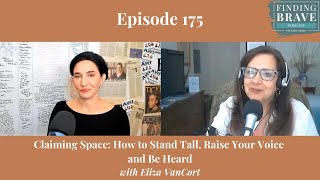
Eliza Van Cort talks about claiming space in five ways: physical, vocal, relational, financial, and intersectional. She shares acting techniques like silence and pacing that help you speak up and be heard, drawing from her own recovery from trauma.
Chapters
Hello, everyone, this is Kathy Caprino and welcome to my podcast, Finding Brave. I've created this show for everyone who longs to create something bold and brave in their life. To rise up, speak up, and stand up for who they are and to reach their highest and biggest visions. Each week, I'll be speaking with inspiring guests from all walks of business, leadership, entertainment, the creative arts and the entrepreneurial world. And they'll be sharing their intimate stories of Finding Brave and offer their best strategies for building your most rewarding, joyful, and meaningful life, business and career. I so appreciate you being here. And speaking of appreciation, I am so thrilled to share that Amazon Music is now a sponsor for Finding Brave. So if you feel as I do that music is an important, enriching part of your life and you would like unlimited access to safety. 70 million songs today. I hope you'll hop on our special link, which is getamazonmusic.com finding brave and get our 30 day free trial offer. Again, unlimited access to 70 million songs. That's a whole lot of music and a lot of listening, Joy. Thank you again so much and enjoy the show. Hello, everybody. Welcome to another episode of Finding Brave. Kathy Caprino here. I want to tell you, I say this every time and you think, here she goes. But speaking of pinching ourselves, which my amazing guest and I were just talking about, I pinch myself every week to be able to do this podcast and speak with people who are so inspiring, who have such amazing, riveting stories, but additionally have turned their mess into a message or have shaped that story to be something of incredible use for other people. And that is so true of my amazing guest, Eliza Van Cort. Thank you for being here, Eliza.
Thank you so much for having me. I'm just, I could not be more excited.
Oh, I'm thrilled to talk about. And here's what we're going to be talking about. And just a word of to the. To the wise. We're both a little verklempt today and you'll hear why Eliza is. You won't hear why I am, but it's about my sweet little beagle who maybe not doing so hot, you know, things get us upset, but we're a little more emotional today than usual. So if there's crying, you know, you know, you're used to it on this podcast. I know it'll be all right with you, my friends. But let me tell you what we're talking about. We are talking about Eliza's new book and life's work, really. About claiming space stand how to stand tall, raise your voice and be heard. And, you know, we've connected in a number of ways. Your publisher is the publisher of my first book. And bravery is something that, you know, we have so much in common, but you have your special slice of it, which is so powerful. So we're going to dive in. How do we do it? How do we claim space? But let me tell you about Eliza. Eliza Vancourt is an in demand consultant, speaker, speaker and writer on communications, career and workplace issues, and women's empowerment. The founder of the Actors Workshop of Ithaca. It's amazing. She's also a cookhouse fellow at Cornell University, an advisory board member of the Performing Arts for Social Change, a diversity crew partner. I need to know more about what that is. And a member of Govern for America's League of Innovators. Wow. Eliza has led a life that, and I can attest to this, any Hollywood studio would immediately dismiss. Can't make this film because it's too hard to believe. And you'll hear why in a minute. This incredible journey inspired Eliza to dedicate her life to helping people of all races, genders, and backgrounds empower themselves to claim space. And Eliza's new book is out May 11, just a few days before this is coming to you. So let's just dig in here. There's so much. It's going to be a challenge for me to keep this to 30 minutes, but can you talk about what is claiming space? What is it in your mind?
Sure. To claim space is to live the life of your choosing unapologetically and bravely. And it sounds pretty straightforward and pretty simple, but in a world that tells women to shrink, and it's pretty challenging.
To do so, would space be then every kind of space we can imagine, Psychic space. Energetically, spiritually, behaviorally, financially, relationally, all of it, we are physically taking up our full weight and space of who we want to be, not what society said we need to be. Is that it?
You hit it on the nose. That's exactly right.
Well, I'm guessing, because I know a little bit, you didn't claim space for a lot of years. Is that true? We'd love to hear your personal journey, which is so unbelievable. I'm guessing a lot of it is that you couldn't claim space for yourself. Can you tell us about it? Sure.
Yeah. So I had a really wonderful mother until I was about 4, and she was still wonderful after that, but her behavior wasn't. She became paranoid schizophrenic, and she had a very hard time with the fact that my father had temporary custody of me. And so she took me illegally three times from New York to once to Texas and twice to California. There was an APB out on me. I. One of the times we actually hitchhiked across the country from truck stop to truck stop to truck stop.
How old were you then?
I. It all started when I was about four. And so I. It was a rapid succession of kidnappings. And eventually I was in a courthouse with a guard when I would see her. And I still remember being in California, actually. And this was back in the day when I was in Oakland at the time, and they didn't have such a. We were a little bit more loose with the way we let our kids behave. So even though I was, I think at that point, five, I was doing all the grocery shopping. And so I ate only marshmallows and ice cream for a year. I was malnourished. I had cavities in my teeth. When my father finally got me back and the police pulled my mother and I over and I remember she said, I think this is it, kids. And she had me kind of hide in the passenger seat. I was so little and tiny. And the police, I remember them coming over, looking in the car, looking up at them, having them see my face. And I remember thinking, that man is shocked. And then he took me out of the car. I heard my mom screaming. I went into. And he took me to get ice cream. And I remember even as a five year old, developing a sense of humor about life and thinking how ironic. He probably thinks this is different, but this is all I've been eating for years.
Oh, my gosh. I, you know, marriage and family therapist here for years, few years. I can't help but ask, how do I put this? Did it feel like a traumatic experience or did it feel like, hey, look, this is life, this is fun? What did it feel like?
Oh, no, it was highly traumatic. And I remember, I don't always remember what the memory, what memories are from what kidnapping, but I do remember one. I think it was the second or third time my mother was driving us. We were supposed to go meet the visitation, the guardian at this pond. And she just kept driving. And I fell asleep in the car and I woke up and I said, mom, this is a long way to Heisey Pond. And she said, we're going to California. And I burst into tears and just couldn't stop crying. And she said, if you don't like it, I'll take you right back. Oh, yeah. And you know and now my adult self says, yeah, okay, but. But, you know, we. It was highly traumatizing. I mean, if you can imagine what happens to a little girl, what my mother had to do to always get those rides, and me hearing it sometimes because the trucks have the front seat and then the cab in the back. So it was a really. It was the moment where I started to conflate invisibility with safety.
Oh, my goodness. So claiming space is. If I'm taking up any space, I'm not safe.
That's right. That's right. I must be invisible.
And, you know, the. When you did claim space, what. What. What was the worst would that would happen? Would she hurt you?
Oh, no. She was never, ever violent toward me. I should be very clear about that. And she loved me. She was ferociously protective of me. In fact, I can't believe I'm telling this story, but I remember once waiting out in the rain for somebody to please get us into their truck, waiting. And we were holding a sign. I don't remember what the sign said. I probably couldn't read at the time. Then I saw my mom run over to this truck driver at the station, talk to him. I got back in the car with her. We moved into this truck. She wanted to get me out of the rain. And she turned to me and she said, whatever happens, do not come back here.
And what do you mean? You. You. You were going to get into the truck?
We got into the truck, but there's a little cab, like a sleeping area behind. And she said, whatever you hear, no matter what happens. And she was sacrificing herself to keep me dry. So even in her worst moments. Yeah, I mean, you know, you're still a parent even when you're very ill, at least in her case. So she was never, ever violent. She was always protective, but she was so ill that she just did not have reality. I mean, we were Indian and we lived in an ashram. I mean, there were just all of these crazy things that happened, and she was trying to do her best and she loved me, but it just didn't. It was dangerous and damaging and traumatizing. And my father had me in therapy from the time I got back continuously. And I had these women in my life who stepped in and just, you know, just took me in their arms, metaphorically and physically. And I think that saved my life.
What a story. I have so much to ask, but, you know, that's not the end of the story, is it? You had another crisis that defies belief. Can you talk about that for a minute. Yeah.
So I went to. I've led a very circuitous life to get to where I am. So I was a political science major, and then I went to law school for a year. And then I decided, you know, I really don't want to do the adversarial system. So I started going back to my love, which was theater. Ended up teaching Boston, teaching acting in Boston. And then I really found my passion and my love teaching. And it's such a relational technique that I teach, and I loved it. And I went back to Ithaca. I was with my ex husband. Everything was going really well. And I was riding my bike one day. We're avid cyclists in our family. And somebody was texting and driving and hit me with our car. And I got thrown up on the hood of the car, hit one side of my head, got knocked unconscious, thrown into the middle of a highway, hit the other side of my head. Woke up with a bilateral brain injury and a subdural hematoma. And I remember every day I would go to sleep and I would remember everything that happened, and I'd wake up and half my day would be gone.
You mean you'd wake up halfway into the day or.
No, I'd wake up the next day, and the half of the day prior would have left my brain. My memory was so shot. In fact, the first time I went downstairs, I thought it was the day of the accident. It was a week later. That's how bad it was in the beginning. So. But I. Again, it was. And my memory was compromised. Not just my memory, but my communication. So one of my dear friends was over. And I said, kim, why is everybody acting so strangely? And she said, eliza, they're not. You're compromised with your communication. And that's why everyone's acting weird. They don't know what to do. So I had to build my communication back from the ground up. And it was again, the support of the women in my life that made it possible for me, I think, to recover.
I don't understand. I mean, here's what I don't understand. The resilience that you have, that you're. You are such a survivor. But more than that, you know, I remember in therapy, I'm just speaking kind of like you are, like, we can't believe we're telling this story. But I remember as a beginning therapist, the only way I could conceive of it was for some people, the bandwidth of change was going to be this. You know, one guy watched his father, Stepfather. Shoot his mother to death in front of him. I mean, and this guy was addicted to weed. That's it. I mean, to me, that's amazing. But there wasn't going to be probably a lot of growth, you know, or people who'd been serially raped by their fathers or just unbearable things. But other people and, you know, man's search for meaning. Viktor Frankl writes about why in a Holocaust situation in a concentration camp, why do some people die, you know, so quickly and others almost seem to rise above it and not thrive in the way that they enjoy this? But there's this deep sense of meaning that they bring that keeps them alive. So if you had to say, you're standing in front of 10,000 people who've been through trauma, what do you think it is that has helped you? Even when you go on kind of flip ly to say, and then, you know, I studied law and then I taught, then I went to Cornell. I mean, how did you do it?
Well, I think it's three things. First of all, I've always been very oppositional, so. So that seems to keep me going when things aren't going well.
Thank you. Darn it, this thing isn't going to get me down.
No, forget this. I've seen worse. I used to joke that, I mean, this is gallows humor. You develop gallows humor. I used to say, I wish that, you know, they would have put me on a milk carton because back then they wouldn't put you on a milk carton unless you had a non family member kidnapping you. Because I was like. Because then I could just put that on my wall, frame it. And anytime things were going bad, I could say, you know, it's not that. It's not that. But I think that's the one thing. The second thing is to have. I don't believe in bootstraps. I actually, you know, my. I'm very lucky to have the most extraordinary angels in my life. And I will cry if I talk about that too much. But you know, my big sister, Alice Green from the Big Sister Big Brother program. I mean, just so many amazing people.
And what do you mean you don't believe in bootstraps? What's that mean?
I don't think that there's somebody out there who's just like, I did it on my own. Like, whenever you start hearing those stories, it's never true. Yeah, exactly. And so I won't, I don't want to say because some people aren't as lucky and didn't get the support I got and I don't want them to feel like, oh, well, I didn't. You know, whatever. I didn't. I couldn't do this. But then I think the last thing, and I actually think this is the most important, and I talk about it actually, in my book quite a bit, is that I had to reframe two things. One is my idea about bravery. I had to really rethink that. We have this image in our culture of a man running onto a battlefield with a sword, looking brave and unafraid. And my thinking is, that guy was afraid or else he's insane. He's about to play with swords. So being brave is not the absence of fear. Being brave, in my mind is actually terror combined with action. And so, for me, yeah, terror makes action, because there's nothing brave about doing something. If it doesn't scare you, who cares? You're just weird if something really, you know. And so bravery to me is this thing matters to me, and so it's a little scary. So that is, I think, the main thing. And then the other thing is reframing my concept of time helps a lot. So I was dating a guy who's 20 years younger than me for a while, and I went to my dear Yoda friend Kim and I said, kim, I feel like I'm wasting my time. And Kim said, well, that's if you believe in the concept of time.
Eliza, is this the same Kim who said yes?
So she lets me say her name. So I said, kim, even for you, that's a lot. Like, that's a lot even for you, my Morpheus friend. And she said, no, no. Either you stay with him and then it's not a waste of your time, or you don't stay with him and you learn what you need to learn to move on to the next thing. So either way, it's not a waste of your time. It's only a waste of your time if you don't learn.
Darn it. Is she a therapist?
She is.
Thank goodness she's helping. Wow. All right, now I got to go back to something, because we've got to talk about bravery, but then we want to talk more about, you know, really dimensionalize, how to be outspoken, how to claim space. But you did say something I wanted to ask about. You know, I watch a million movies around history and war, and I think when people have said, men or women, I am not afraid to die. I believe that they. I believe them when they say that. So, like, you know, are we afraid when we've got spears? I think we might be afraid that we're going to be tortured. We might get afraid we're going to have a long, hideous death. But, but back to your issue about terror plus action. I think that for me, being brave, terror plus action was the only thing that stopped me from the pain that I felt was unbearable. So a lot of other people might say, I'm too afraid to leave my corporate job, I'm too afraid to leave my spouse. I'm too afraid to speak up against this. I think when you get to a point where what is unbearable simply cannot be tolerated one more second, then the terror plus action doesn't seem so terrorizing. Does that make sense? Am I making any sense?
Yeah. I also think that fear is a wonderful tool for us because fear to me is telling you something's worth doing and that's really important. So I always say to my students, the day I'm not afraid that I walk into my class classroom on the first day, I'm quitting because it means I don't have a stake in it anymore. So when I'm afraid, if I'm going to go give a talk, I think, oh, this is interesting. I'm nervous. This definitely won't kill me. I guess I'm really invested in this. It must be important to me. Awesome. I'm doing something that's a goal.
When I talked, you know, the other day, so many people on my courses, whatever, say, you know, I didn't do that connecting and networking that we Talked about on LinkedIn. I'm afraid I'm like, uh huh. It's so cliche. I don't mean to be snarky. Of course you're afraid. Get good with it.
Right?
Why did we be, how did we become so afraid of fear? I mean, the way we should just be looking at every day.
Yes.
What can I be afraid of today?
Yes. But I think we're like that with a lot of things. I think our society has created this very false ideal that we need to be happy and comfortable all the time. You know, and if you're looking for peace and happiness and you know, I see safety and security, right then, okay, but you know, to me there, you're gonna have sad days, you're gonna have happy days, you're gonna have stress days. That's part of the human experience. And if you beat yourself up because all your days aren't sunny and bright, you're gonna be a very unhappy person.
And what do we. All right, this is a spiritual idea, but I don't think we came Here to live a life in physical reality if it's supposed to be every minute a walk in the park. First of all, boring.
Right?
Boring. And secondly, we didn't come here for that.
No, I don't think.
All right, that, that was a digression.
About learning what you need to learn. The usually the way you learn what you need to learn is not through a happy feeling. Often it's like, oh, my relationship with my 20 year old boy, 20 year younger boyfriend didn't work out. This is sad. But now what am I learning from it?
You know, I'm, I'm in the dating process. I'm single. And you know, I had something happen that I didn't just, I didn't like. I didn't enjoy cut it off. And no, you know, I was thinking to myself, why do I have to have this? You have to have it because you actually, I think had. Kathy had to learn really quickly on what is a red flag that you will say no to. I'm new to dating because I was married a lot of years. Isn't this, isn't this true? I mean, the angels or God isn't going to plop a perfect person in front of me. I've got to do the work to understand what is the right person for me.
Yes. And if the perfect person plops in front of you and says they're exactly like you in every possible way ever.
Ding, ding, ding, ding. I don't want that because you know what?
I don't even believe it. You know, if anyone to me that's somebody who doesn't have enough of a center to hold their own core.
Yeah. You know, and I certainly don't want a mirror image of me. Good grief. That's a lot. That's a lot of Kathy. All right, all right. Now let's talk about. You know, we, we have shared a lot about. There are external institutional, organizational and societal challenges. We know that a lot of people are working on those. You, I think, are maybe similar to me in that we're look, we are looking a little more at what's going on internally with women or those who are dominated, you know, by other factions of society in ways that they sabotage their own claiming of space. Am I saying that correctly, your focus?
Yes. I mean, the book actually has five different aspects of claiming space. I was looking when I was recovering for that golden, you know, the magic bullet, and I realized, yes, this is life. Of course there's not going to be one thing, but there I found that there are five things that really Help you claim space. And if you are able to really embrace those five things and not worry that you haven't conquered them, but just be mindful about them throughout your life, you will be a much more empowered, happy, fulfilled person.
What are those five things?
The five things are claiming space with your physicality and voice. So physically claiming space collaboratively. So that means creating a network. And my idea of network is pretty expansive. Like, who don't you let in your network? Anti mentors, for example. You know, don't let certain people in. Let certain people in claiming space, not seating your space. I'm a huge sci fi and superhero nerd. So I say, you know, watch out for your kryptonite, whatever that may be, you know, imposter syndrome, whatever. Don't let someone impinge upon your space. So mansplaining, bullying, sexual harassment, how to protect yourself. And then finally claiming space intersectionally. So making sure that you are so in the history of white feminism is quite embarrassing and not so great. We have not been wonderful to our brown and black sisters in the feminist movement, which is why many women of color do not identify as feminists, and understandably so. But this idea of the Kimberly Crenshaw came up with this idea of. And the intersection of womanhood and what Womanhood and race, womanhood and age, womanhood and being a queer woman, Womanhood. And so all of those things. If we neglect those intersections, we're not really talking about helping all women. We're really talking about helping women who don't intersect with other things. And what I found was women who united across differences, were more aware, more fulfilled, and had richer, more broad friendships. And that's such an important part of claiming space.
I love it so much. You know, I'm not proud to admit this, but when Black Lives Matter really emerged in a big way, I'm so 100%, 1,000% supportive of it, of the movement, of what we need to change. And what I noticed was people started asking me, okay, Kathy, you're talking about these power gaps. You're talking about, you know, white women, women making 70 cents on the dollar, men. What about overlaying race? And I realized I had not. I'm a market researcher. I've done a lot of research for my, all my books. I had not, I had criterion that I, you know, cross sectionally looked at. And race was not one of them. Them. There, there is a blind spot. There is an assumption you don't even know you're making. Somebody wrote a brilliant book. The. It's the assumption you don't even know you're making. That's going to kill you or hurt you. And from that minute on, I. I said, wow, look, now what I. What I have said, and I believe in some part it's true, I am talking to all women about these gaps because I believe that. I mean, the research shows 98% of women have these gaps. But if you don't want to look at or you refuse to admit there are intersectional areas that are going to make the experience of being a woman different, it's damaging.
Yeah. I mean, the best example that I say, when I try to explain this to women who are struggling with it, it sounds like they're not. But there may be some women who are listening who are. Is that one of my black girlfriends said to me, how did you feel when you knew you were pregnant with your son? And I said, oh, my God, I was so excited. And she said, I cried. This is going to make me cry. I said, why? And she said, because our young men are in danger. And I cried for his safety. And I knew every time he left the house, I'd be worried. Not that my daughter wouldn't be in danger, but not as much. And, you know, the mass incarceration of black men, police violence. I cried. And it wasn't that I didn't want this child. And I thought, you know, that is why Black Lives matter. And police violence is a woman issue, because it's a mother issue.
Wow.
And that's where that intersection comes in.
You know what that reminds me of? I met a person, a guy. I was talking to him, and I said, you know, I believe there is systemic racism. And I said, what do you think? He goes, well, where is it? I said, where is it? It's everywhere. And have you had a conversation with a black person? How can you ask that question? And, yeah, we'll get. If you call this political people. Okay, here we go. But I think what we all need to do is have more conversations with people who are not like us.
That's exactly right. Yeah.
I mean, start there. Start listening. Start listening. I mean, I think the more we do that, the more we do claim space. And it's not empty BS space. It's aware space. Oh, my gosh.
And it's about perspective. Like, just believe other people's perspective. Just as with women, when we say to a man, this happens, and they say, no, it doesn't. And we say, huh, how would you know? You are a man. You know, it's the same with women of color. If they say, this happened, you know, or this made me feel uncomfortable, what you just said, you know, the answer shouldn't be, well, I meant it. They are saying a truth. It made them uncomfortable. So your job is to say, okay, whatever I said had a poor impact. Find out how I can do it differently and change.
And frankly, you know, anyone who studies communication knows if your message doesn't get across, you're the one that needs to change, not them. Now, you know, on the other hand, in therapy, we learned, let's say you come at me, Eliza, and you attack me. You know, that's going to be more about you than me if I didn't provoke it. So there's a lot of nuance here, but wow. So let's. You know what I'm really interested in, because you teach acting, you started an acting actors workshop. This is one thing we haven't talked about on the podcast. Can you give us some tips about how we physically claim space, how we use our voice to claim space? Can you give us some tips?
Sure. My favorite one, because it is so underutilized, is silence. I love silence. Silence can be used to save you when you're completely screwed and you don't know what to say or to make a powerful point. Women tend to be interrupted more than men, so they don't like to use silence because we do something that I call defensive speech patterns, which is. But, you know, fill that space because.
We'Re going to be interrupted.
We're going to be interrupted. But the problem is speaking without any single break in all of your sentence and then putting all you know in everything is just very disempowered. So learning how to pause and knowing there is no wrong place to pause, people fear. What if I do in the wrong place? Absolutely not. As long as you maintain eye contact and you own your silence, anytime you pause will be a powerful moment, and that's important. And then slowing down. Slowing down is also something women don't do as much as men because we tend to have to offer more evidence to be heard. We try to fit more information in the same socially acceptable amount of time. We speak very quickly, but speaking very quickly is a very disempowered speech pattern. What you want to do is slow down your speech and take those pauses. Know that sometimes it's okay if people wait for you to breathe.
I love it. You know, there's another, I think, aspect of slowing down. When there's rapid fire speech, there's often anxiety there. And I have one client who's very Anxious and brilliant, but comes across harsh because she'll ask a question. And really the internal dialogue is, I should know this. I'm a senior person. So what's coming out is anxiety. So. And I can feel it even in our conversation. So I said, I want you to slow down, even though that's the last thing you want to do. Just take three deep breaths and slow it down. And I think that it's that beautiful interaction between the cart and the horse and the horse and the cart. I think slowing down does reduce the anxiety, but even if it doesn't, it gives the impression that you're more under control. Would you in control? Would you agree with that?
Absolutely. And actually, you just did something that is a huge technique that you didn't even mean to do because you're natural. Wow. But one of the other things you can do is get quiet. And you did that just now. And I try to teach people to do it as well as you did, and you just did it because it's a natural thing for people who are comfortable in their communication to do. But if you're struggling, you don't always do it. And the reason why is if every time we get our quiet, we get quiet like this, people lean in and listen. And the reason why is that as human beings, we build intimacy by telling secrets. So when someone gets quiet, everybody leans in. If you watch Obama, he's incredible at this. He'll be like, blah, blah, blah, blah, blah, blah, blah, blah. And they pan to the audience, and everybody's looking like he's talking to me. And I'm like, no, he's not. He's. He's just very quiet.
Wow. And where did you learn all this in your communication studies?
This was actually interesting. It was stuff that I came across as a director and acting teacher because you have to figure out how to make the audience experience a feeling. So you have to get very, very good at the human condition. And figuring out, if I have a person do this, what will the audience feel if I have a person do this? So you become a master at the human condition. Combined with the fact that I taught something called the. I teach something called the Stanford Meisner technique, which is all about observations of micro human behavior.
Wow. Do you give workshops at organizations to help executives build that presence? Is that part of the work?
That's a huge part of my work. And I love it because everybody.
I think everybody's gotta call Eliza.
I do love it, and I do it remotely.
I've gotta ask you this question. Can you stay on for five more minutes.
Oh, of course.
I learned so much when I was in corporate life in publishing, and we were doing market research for new products, and we did focus groups, and we hired this amazing woman. And she was just so mesmerizing. Six feet tall, so commanding. And we'd have a group of 10 people. You know, they're heavily screened. They were teachers. You know, they taught kids eight, blah, blah, blah. Because they were looking at book club products. But here's what I want to ask you. I noticed this. Tell me what you know about this. She could be kind of forceful. And even though she did make it very clear, everyone's ideas count. All ideas have value. Every once in a while, if she was anxious, she might come down a little hard on somebody. And what I noticed then is the group entirely flipped, and they were then against her. Is that another. And I think this is so important for every executive, every manager. I've seen it a million times in meetings that here's a manager leader speaking. If he or she does something that's ridiculing or putting someone down, in about a half a second, the whole group changes to support the underdog. Is that correct? Is that what I'm seeing?
That is correct. Although there are some, what I call these group clumping moments, where, for example, if there's an entire group of men, maybe one woman, sometimes that does not happen. So I'll give you a quick example. A woman had a client of mine had made a ton of money for this company, and he. And there were very. There were no. I think she was the only woman in the room. All these men, executives. And he literally made this joke that was like, oh, we're so happy for Jane. We'll call her Jane. You made so much money. I hope you didn't go out and spend it all on a new purse.
Oh, boy.
And everybody started laughing because she didn't have anyone in the room to help her, you know, shut it down. Now she did because I taught her some stuff, and that has actually happened to me with two different clients. That. That exact phrase, almost. It's crazy.
What did you teach her? What did you tell her to say?
The best way to deal with a microaggression like that is to ask a question and then. Then let the silence drop. So you simply say, I'm confused as to what you mean by that.
I so love it. I so love it. Shut that damn nonsense down.
And what would happen?
What would he say?
Right? What can he say?
Because you're stupid and you're buying purses.
Right?
That's what women do. I mean, there's nothing you can say.
There's nothing. And if he did, well, it's a joke. It's a joke that I would take company money and spend it on a purse. I'm just confused.
That makes me very happy. I'm very happy. And again, we're not painting all men with the same brush, people.
No, no, no. I'm very proud to have raised. I have four children, two sons and a nephew. And my daughter. And I cannot. My sons would have been right there with her saying, that's not cool, dude. They are very opinionated young men. And they are also feminists, which means they believe that women and men should have equal rights and opportunities.
I have to say this. And then I got to ask you one more question about your book. One of these people I was dating for half a second, I said that my son is a feminist. And he burst out laughing and said, boys can't be feminists. And, you know, at that point, I knew, okay, wow. But I want everyone to understand. Of course they can. You don't need to be in the female body to be a feminist. It's believing in equal rights. Unfortunately, I do wish there were another word, because it's been come to be known as bra burning, you know, from the beginning of the movement. It's about equal. Tell me. Tell me what you think.
I think every word we would ever pick would do that. They would demonize it because it's a technique as a old as time to find a word that is empowering and then stigmatize that word so the person can't do the action of the word.
Right. But the root feminism is feminine. Right. So I think that's the challenge. People say, no, I don't believe in that. I believe in equal rights for men and women.
I mean, I still feel like anywhere. Because what people will. I mean, look at what they've done to Black Lives Matter. They're simply saying, black lives matter.
And people say, no. What about white lives?
Exactly.
Respond to that.
Exactly. So in my mind, you know, I actually have a chapter in my book about words historically used to silence women and the categories of words used to silence women and how we can not allow that to happen. And I actually. The chapter, and I won't swear on. But it's called crazy Feminist. Baby is the name of the chapter. And I actually made crazy Feminist be action heroes at the end of the chapter with my nieces and me. And we're all standing there with like B, F and C on our shirts. So I really think to me, I'm like that, that word, whatever word I pick, it's going to get demonized because some people are afraid of people having equal rights and opportunities. So I'm going to own that word. Like a little scarlet ass on my.
Can help me. Because when I did the one post I did on what is feminism and why do so many men and women hate it. And it was a YouTube video too. Two different men wrote, shut up, you dumb C word.
Sure.
Now, I mean, my daughter comes in. You people have heard the story. She goes, of course, mom, it's YouTube. What do you think? Get the comments off. And she's right. When I posted In Forbes and LinkedIn, nobody said they might have wanted to, but you also have to. I think this is part of claiming your space. Get hip. You get hip to what's going to come at you. Don't put yourself in an arena of ignoramuses. Not that you do, you know, strictly an arena of ignoramuses, but understand what you're walking into. What do you have to say about.
Well, it's a tactic. Just like saying shut up. You would, to you is a silencing tactic. So if somebody's going to try to use a word to silence you, then just don't let it. I mean, if. I know I've never been called the B word, but if someone called me, I've never. Well, I mean, not to my face, but if somebody called me, I mean, my girlfriends are like, hey, B, you know, but, but, but if I were ever called that to my face, my answer would be, yes, I am a woman with opinions, but that is not your word to call me. But thank you.
Wants to have you in their pocket. Eliza, my gosh, you know, let me pull you out. Please say something to that person. Tell us one more thing from your book that we're going to get that could potentially be life changing for us. I know there's a hundred things, a thousand things. What's the one thing you want to make sure people understand?
I think if there's one thing that I would stress more than anything is that we need to redefine bravery. Beyond the idea that bravery is fear meets action, it's also that we need to honor ourselves for the everyday acts of bravery that we are doing. So getting up when you're tired and taking your son to work, getting off the ground when you're so sad, you don't think you can keep going. All of these moments Women are so brave and people are brave, but women have had to tolerate more in society and we are brave and making sure that you honor that. It's okay to be afraid. You're pushing through and you can claim space. You absolutely can claim space. Because you don't have to feel fearless. You just have to do the thing that will make you feel like a more empowered human being.
I love it so much. Can I share one thing? I should shut up and let the show end here. But you know what that reminded me of? When I was pregnant with My daughter, who's 26, I went and led a big research all day meeting at a company we were acquiring. So to me, it was really important. I got there, I go to the bathroom, and I won't give you details, but from what happened, I thought I had miscarried. What did I do? I left the bathroom, did what I had to do, and got through that day. Yes. And it was, you know, it was a fantastic success. At five o' clock, when it was done, I called my doctor. She said, you didn't miscarry. We. There was a polyp we removed, remember? And it was blah, blah, blah. I'm proud of that. Not because I'm not a deeply emotional person, but I do think there are times when we can feel very sad, but it's okay to compartmentalize and it's okay to keep persevering even though we want to fall down on our knees. Would you agree with that?
Absolutely. I mean, I think what you just did is my personification of bravery. That's brave for that.
So I think we all. To your point, it's not just once in a lifetime, once every three years. I think we are being brave. Yes. In so many ways and recognize it and let that help you claim your space.
And every time you feel afraid and you do the thing anyway, you are being heroically brave.
That's the note we want to leave on everyone. Where do we learn about you? Where do we hire you to come and teach people, men and women? How do we do this? How do we speak in a way that we can really connect and really communicate, but not be squashed in the process? Where do we learn? Where do we go?
You can go to my website, elizavancourt.com and the proper spelling, I think, is in the notes because people misspell it. You can find me on LinkedIn and I don't have a Facebook business page, but I do have a personal page. And when people tell me they specifically heard me on a podcast and Have a question. I love it. I connect with people all over.
On your Facebook page?
On my Facebook page and my LinkedIn page. I might not get to your question right away, but I will get to your question. I love hearing people often will call me weeks later and say, I tried what I learned on your podcast and it worked so well, and there's nothing that makes sense. Me more excited. And if you buy my book and you have a question, please reach out. I just love connecting with people. Oh, wow.
Everyone will. And let me ask you this. You had something important today that you posted on your Facebook page. Do you mind just sharing that and then I promise I'll let you go?
Oh, of course. Yeah. So my father was. You know, back in the day, it was almost impossible for a man to get custody. There was this weird idea that only women could be good parents. And my father was an excellent father. And he had a lawyer who helped him get custody of me at a time when it was near impossible with a woman who kept going in and out of psychosis. So he couldn't do any lawsuit because you can't have a lawsuit against someone who's incompetent. So it took forever. And this man, and he also was very loving about my mother and didn't want to destroy her in the process. His name was Rich Stumbar, and he died. And my father posted the most beautiful letter on his wife's Facebook page. And I contacted his wife and said, may I honor Rich by putting this on my Facebook page? And he said, yes. And I did. And, you know, Rich Stumbar was a hero in my story, and I. I think it's important to honor the. Honor the heroes in your story. So he was one of my heroes. So thank you, Rich Dunbar.
Oh, Rich, thank you for doing what you're doing. And we can read that on your Facebook page.
Yes, because he just passed away, but his memory is alive and well.
What a hero. Thank you so much for joining. Come back again, will you? Liza, What a joy. I kept you way over. I kept. Thank you for being so brave and writing this important book. It's going to change so many lives. All right, people, you know what to do. Read this book. Reach out to Eliza. She means it. And I'm sure you'll have questions. I'm sure this will resonate all of it, all the stories. Maybe not in the specificity of what you've been through, but so many of us are struggling and we don't know how to speak up. Stand up, lame space. So please reach out to anywhere you see this. We'd love to hear from you. Have a wonderful week. Thank you again, Eliza, and we'll see you next time. Bye. Thanks so much for joining us today. And please don't forget to check out findingbrave.org for more programs, resources and tips. And tune in next time for your weekly dose of finding Brave.
More from Kathy


Elevate Yourself, Elevate Others, and Amplify Good | Chris Cooper | Finding Brave Ep. 334

Finding Brave Epis #333: How Leaders Can Harness AI Without Losing Their Humanity, w/Bennett Borden

Finding Brave Epis 332- How to Stay Brave, Valuable and Visible in the Age of AI, with Raman Rai

Finding Brave Epis 331 - The Power of Positive Disruption, with Dr. Patrick Leddin


Finding Brave Epis 330 - Being 40: Letting Go and Embracing Who You Are, with Stacey Lindsay

Disrupt Career Reinvention with Kathy Caprino - via The Disruption Lab Podcast w/Patrick Leddin

Creating Neurodiversity-Friendly Work Cultures: Simple Workplace Adjustments Matter

Finding Brave Epis 329 - How To Create a Neurodiversity-Friendly Workplace, with Kristen Pressner

Finding Brave Epis. 328: Reclaiming the Power to Trust Your Own Voice, with Dr. Cindy McGovern