Finding Brave 177: How 30% More Courage Can Double Your Revenue & Your Happiness, with David Wood
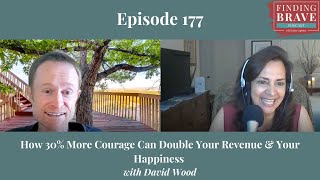
This Finding Brave podcast episode (host Kathy Caprino with guest David Wood) explores how increasing courage and focus can boost both revenue and life satisfaction. David shares personal trauma and recovery stories that shaped his coaching, then outlines practical steps for goal clarity, weekly CEO planning, focused work sprints, and boundary-setting to achieve twice as much in half the time.
Chapters
Hello, everyone, this is Kathy Caprino and welcome to my podcast, Finding Brave. I've created this show for everyone who longs to create something bold and brave in their life. To rise up, speak up and stand up for who they are and to reach their highest and biggest visions. Each week I'll be speaking with inspiring guests from all walks of business, leadership, entertainment, the creative arts and the entrepreneurial world. And they'll be sharing their intimate stories of Finding Brave and offer their best strategies for building your most rewarding, joyful and meaningful life, business and career. I so appreciate you being here. And speaking of appreciation, I am so thrilled to share that Amazon Music is now a sponsor for Finding Brave. So if you feel as I do that music is an important, enriching part of your life and you would like unlimited access to safety. 70 million songs today. I hope you'll hop on our special link, which is getamazonmusic.com finding brave and get our 30 day free trial offer. Again, unlimited access to 70 million songs. That's a whole lot of music and a lot of listening. Joy. Thank you again so much and enjoy the show. Hello, everybody. Kathy Caprino here. Welcome to another episode of Finding Brave. Once again, I'm pinching myself at the excitement of having my guest today and what I'm going to learn that, you know, I was speaking to the wonderful David Wood, who is our guest today, about how I love this to go and it's really, I love to ask the questions I need to understand personally because I think that's what, that's what's going to be really helpful. So today we're talking about how things 30% more courage can double your revenue and happiness. How about that? You know, obviously I want to know all about this, so David and I want to tell you about David Wood. David, thank you for being here. I'm so grateful for your time.
My pleasure. Kathy and I, you know, I've done 160 interviews now, but I don't think I've ever had a podcast host pinching themselves because I'm on here. So I'm quite excited.
There you go. I think they're pinching themselves, but not so. So the camera can see. I think it's gotta be the case. And you are calling from Boulder with this. This is not a fake view. This is. You're not sitting on your deck right now, but this is your new house, right?
Yeah, exactly. I got some pictures of the house and I sometimes I flash them up in the background to remind me where I am and because normally when you see a view like this, you think it's a fake picture.
Gotta be fake. Who lives in with that? Well, I'm so.
But this is. I'm pinching myself a little bit now because I just moved into this house and it's all very new for me and exciting.
How wonderful. Blessings to you in your new place. And I do want to tell everyone before I read your illustrious bio, Our dear friend Martin Root introduced us. And, you know, I experience this now. It took me a long time to get in a sphere of people that I feel are just so uplifting and inspiring, but when they recommend someone, I listen to and we connect. And Martin is that person. And he came on the podcast and spoke about Heaven on Earth, which was his new book that come out. So we'll share that link. You don't want to miss Martin either, but here we have David. So here we go. I want to tell you about David. David is a former consulting actuary to Fortune 100 companies. He built the world's largest coaching business, which is no small feat, becoming number one on Google for life coaching and coaching thousands of hours in 12 countries around the globe, as well as helping others. David is no stranger to overcoming challenges himself, having survived a full collapse of his paraglider and a fractured spine witnessing the death of his sister at age 7. I'm sorry to hear it. Experiencing anxiety and depression and a national Gong show, of course. We've got to hear all about this. And your book is get paid for for what you are, which is such an interesting title. Who, oh, who. It still is an interesting title.
Who you are.
Oh, good, good. I think either one would have been okay, but I like who a little better. And we are going to talk about. I know you have simple but not easy, sometimes, I think, steps to reap exponentially more reward. And we just don't mean financially. We mean every possible way. Spiritually, emotionally, I'm thinking, and how that's not possible from your comfort zone. So, David, before you launch in, do you mind sharing a little bit about what you've gone through and how it's informed not just what you are, but who you are?
Yeah, happy to hear about that.
Oh, thank you so much.
Yeah. And some things don't become clear until much later in life. Right. So it's not like as these things were happening, I was like, oh, this is growing and shaping David Wood. But when I was seven, my little sister was killed in a traffic accident, and I was there and witnessed it. And at that time, you didn't Send your kids to therapy. Particularly in Australia, you just kind of got on with the show. So I didn't go to the funeral.
And I didn't realize you were seven.
I was seven.
And it was just the two of you?
Pardon?
They were just the two of you in terms of.
Well, it was a bunch of kids getting off a school bus.
I mean, in terms of siblings.
Yes.
Wow. Oh, gosh.
Yeah. So it's later in life that I got to realize what happened. A lot of me shut down. And I found this out later when I went to therapy to go, why am I having trouble connecting intimately with a partner? And what happened is because of the trauma, I just learned not to feel very much.
Right. That's a coping mechanism.
Yeah. But in compensation, I got really good at a lot of stuff. I came top of my school, I got paid to go to university, I got my dream job and got transferred to New York and I got really good at numbers and systems and puzzle pieces and putting that all together. What I was missing, and I didn't know until about the age of 25 or 6 when I went and did a personal growth course, is that I was missing vulnerability. I was missing intimacy, transparency and authenticity, self expression. I didn't know about those things. So the first half of my life was largely about getting good with business and numbers and systems, and the second half has been quite the journey of exploration into the inner territory. So now when clients come to me, they usually come because one driver is they want to make more money in their business, but they know there are lots of people that could help them with that. I look at the whole person and sure, let's make more money, let's get you more time off. But how are you showing up in the world? How are your relationships? How's your relationship with yourself? Because it all fits together.
I love it. And I do want to say every time a guest comes on, we have so much more in common than anything else. But I had an 18 year corporate career, then became a therapist and now as a coach for 16 years. It's all about the inner work. It's an inner job.
Right.
But I do.
Life is an inner job.
Come on. It's an inner job. But I do want to highlight just something and ask your thoughts. I've really delved into what the world, what society, the boxes we're put in. And my first lens was women because I experienced a lot of stuff, you know, sexual harassment, gender discrimination, all of it. But I just had on Mark Green the other day on the show my gosh, man box culture and what is healthy masculinity. And I mean, I cried, he cried, and I will never, ever look at men the same way. So everyone, we're going to link to that. But what you just shared. And I want to ask you, David, the challenge with vulnerability, authenticity, transparency, true connection, is exactly what Mark talks about as the man box culture, that we put men in a box. So do you think that in. When you're working with men, are you seeing a lot of the same. Not for the same reasons you had, but are you seeing that they have problems with this too?
Yes, and my hesitation is just limiting it to men. So it's. It's absolutely true. I. I mean, I come from an Australian culture as well. So you've got the Australian culture.
Tell people what that means, what that means in five words.
Well, Australia is about 20 years behind the US in some things, and sexual equality, gender equality might be one of those things. I think we're catching up, but still a bit behind. So. Okay, that's more than five words. It's not okay to feel. You should, you know, man, gotta be a man. Man up.
What do you mean? This crying nonsense in this.
Yeah, but the reason I don't want to put too much of the emphasis on men is because I think humans in general, if you haven't done a lot of personal growth work, if you didn't have parents who were, like, really open and taught you how to feel and how to express your feelings, and we're getting more of those kids every day who can express those feelings, then as a human, you're likely coming up against issues of, oh, I couldn't say that, or I couldn't reveal that, or if I show my underbelly to this person, they're just going to take advantage of me. So I think it's a societal thing that I like to try and help combat. And for sure, men would have it worse. I think when they. When they come to sharing their feelings, I love it.
And I think a corollary to that is. And I say it every podcast, you know, I learned so much in therapy training. But greater awareness equals greater choice for so many people. Isn't that. Isn't that a winner? Winner of a saying. Oh, but for so many people, they're not aware of what they're not aware of. So it's an excavation job. It's a questioning job for us. Right. Like, wow, I'm interested in what you just said, so let's dig in. So thank you for that. I know that focus is your big thing, is it not?
It is when it comes to. When it comes to people who want results in time and space. So particularly, a lot of people, particularly business owners, are like, how do I get more money and more time off? And they've got, you know, things they want to make happen. When you want to be cause in the matter, then focus becomes critical.
When you want to do what?
When you want to become cause in the matter.
Cause in the matter.
If you want to be the author of your own actions, if you want to be the author of your own life, then focus becomes critical. Now, I preface everything with that caveat, because not everyone wants that. And that's fine. You might want to just surrender and flow to what comes up and, oh, I'll check email today and I'll do what feels right. That's totally valid. But when you're not getting the results you want and you're just busy versus being productive, then it starts to become important. All right? I need to decide what I will focus on, and I need an agreement with myself to what I will not focus on. And that's where a lot of people run into trouble.
And I've watched your videos, and one of my particular bugaboos is I'm uber responsive, or have been. And I run a business, you know, and I have four team members. And if your boundaries are such that you have to be responding within 10 seconds of an email and you want to be incredibly productive, you're either going to be working 24 hours a day or you're not going to get to the things that matter. Right. I think you might agree with that.
Yeah. And I would say if your boundaries are absent to the extent that you need to do that. I just had an example before this, before you, and I got on the call, it was like one minute to go, and my phone rang. And I'm so tempted. I'm so tempted to pick up the phone. I'm like, maybe that's a builder and I need you calling me. And I need to check this out. And I could feel it in my body. And I'm like, david, you don't need to pick up that call. It'll go to voicemail. It'll be there later. Let's not be rushed getting to this interview. So that was a really nice micro example of life wanting my attention. In this case, I chose to step away from the dark side of the force and to let that go.
But what that does tell me is you are a teacher of this. You have had incredible results. You help people have amazing results. And you still. I'm going to say struggle. It's still something you have to marshal your resources to address. And this is something so constant dance for me, too. If I have a fluid day, like, someone canceled our podcast earlier. I had another hour. Well, then I can be like you talked about. Let me go in the flow. What's coming my way, what emails, what texts, My son, my daughter. Great. But for me, it is still a dance. And I appreciate that because people don't often think that people who are. Had amazing success struggle like they do. They do struggle. They do. They just have processes that work for them. Right.
Yeah, I. You know, they say you teach that which you most need to learn. So I'm constantly a student of this stuff. I mean, I've been teaching tough conversations for a long time. I have some real doozies, and some of them I'm. I'm scared of. I'm constantly in this game of life. And I think that's actually. Those people make the best teachers.
Right.
You don't want to go to someone who did this 20 years ago, and they've lost touch with what it's like to feel that I'm constantly like, oh, me too. All right, let me tell you something that helped for me around this yesterday. Yesterday, a lot of this is hot off the presses.
I love it. Now, I would love to hear you have six simple steps. I would love to hear those about, how do we do this? How do we have more courage? You know, the podcast is called Finding Brave. It's about being brave so that you can be the most powerful, impactful you. So if that works for you, I would love to hear these six steps. And what I'd love to do is push back on. Wait a minute. Let me understand, because I think this is hard. Or could we do that? Can I hear your six steps?
Well, I do have six steps. I don't know that they're related to Finding Brave. I have six steps for how to achieve twice as much in half the time.
I think they are related to Finding Brave.
Could be.
Oh, I'm sure they are overlap.
And I'm constantly fascinated by the question because sometimes people actually slow it down enough to ask me, how do you find the courage to do something you're scared of? And. And I love that.
I love that we've got to talk about that. Because even what you said, the scary conversations, I can't believe that I'm 60 years old and have had all this experience behind My eyeballs. And I'm still scared to have a conversation, to fire someone, to not even that dramatic, to take a bold step that people are going to say, that's not like, Kathy, what happened there. There's so much courage in all of these. So let's hear them.
You have this room. Well, you know, maybe I just thought of something that happened in this last month that was terrifying for me. And perhaps we can break it down how I responded. We might get six steps out of that.
Let's do it.
So what happened for me was I knew the owner of my house. This is the one I've just moved out of. The owner of my house was moving back in downstairs to take the lower unit. And I was nervous about having the owner of the house downstairs and could I set boundaries? Because sometimes he can be a little bit like, it's my way or the highway. And so I was nervous about this for a couple of months. And then the first day he moved in, he opened the adjoining door separating his apartment from mine and just walked in and said, I'm going to be using the storage room.
What?
And I had a. I had the beginnings of a panic attack.
I was like, now he still owned it?
No, he owns a whole house. And I was renting the upstairs. I had the whole house for a year and a half. And then he moved in downstairs. And so now it's a shared situation, but he opened the door and just came in. And I said, firstly, welcome, and secondly, would you be willing to give me a heads up when you want to come into this space so I know to expect you. I didn't say as. As per the lease. And he said, no, I'm not willing to do that. I'm just going to be using this room. And I'm not asking you, I'm telling you, this is how it's going to be.
Oh, my God, David.
So. And I, you know, I'm pretty jumpy. My nervous system's a little hyper and hyper vigilant. And I was like, I just, I just. And my dog didn't like it. She starts barking when he starts coming in. Of course, I'm like, like, how do I handle this? Now, the first round of it. And bear in mind, I'm in a real stressed state right now. I'm really panicky. First round of it, I looked at a lot of boundary setting and I tried a whole bunch of things like calling his wife who was in another state. And I said, can you mediate here? Because this is not working. So I Tried to get some mediation from a couple of different sources. I looked for, can I get a hotel, go and stay somewhere else so I can feel safe and self care. Did all of that.
It was just temporary. You were going to be in that house situation. You were thinking it was going to go on a long while.
I was looking for a new house and I had about eight weeks to find a new house. So it could have been quite some time. But so I'm like, all right. So I'm doing all the boundary setting and I'm looking at my options, like could call a lawyer, can call the police. I can do. It's all sorts of things I can do given he doesn't seem willing to talk about it. But then I realized over the, over the next day or so, I needed to have a conversation with him. I needed to connect with him human to human. And I was scared that it wouldn't go well. I was scared that he. It'd be very uncomfortable. But I, I reached out. I woke up one morning and I couldn't sleep and I sent him a long text with the aim of enrolling him in the idea of having a cup of tea in the garden. It was very scary for me to send that text because if he said no, I'm like, I'm back to lawyers and police and whatever. And anyway, he said yes. He said, I can meet you in 20 minutes. And so we got together and I'm nervous and I got my cup of tea and I set out some chairs in the garden and I'm running around and there's a high stakes here for me because it's my own peace and sanity. And I didn't start the conversation with, hey, this is what the lease says and I really need you to do this. I started the conversation with, I want to manifest at home like this. And you've done it. How did you do it? Did you get lucky? Did you work hard? And he spoke for half an hour about this house and what it meant to him and how he built it from the ground up after, after the first one burned down. And he cried looking out over the valley. So we connected around that. And then I tried pure authenticity and vulnerability. I just said, I'm trying to change my mind so that I can be okay with you coming and going. And I'm miserable. I am just miserable. I'm having trouble sleeping. My nervous system is going haywire. It's beyond all logic. Is there any way that you might be willing to give me 24 hours notice so that my Nervous system can relax. And he said, yeah, I can do that. I cried. I just sat there. I. As we both looked out over the valley where he'd sat and cried when the house burned down, I cried and I said, I can't tell you the relief in my system. So now he's been offering to get me things when he's in town. I'm carrying his groceries. Transform that entire thing from calling the police. I did actually call the police. And they came out to mediate that first day from that to a real sweetheart and feeling connected and like, here's an ally in the house. That was a very scary example for me. And I managed to find the courage to reach out and do that instead of going the legal route and getting a letter from a lawyer or whatever, which would have felt pretty lousy when you got to share a house with someone like that.
I have much to say. Can I dimensionalize what I hear?
Let's do it. Let's break it down.
I was going to say to you before you finish the story that there's no question that he had trauma that was informing his behavior. So I remember I interviewed Alan Aldo, who's famous actor.
You did not. Kathy, Kathy. This has blown my mind. Three days ago, I achieved a lifelong goal of mine, which was to actually, literally chat for the first time in my life with Alan Alda.
What?
Three days ago.
What? I have not mentioned Alan Alda on this podcast in 170. Blip.
Wow.
Oh, gosh. Sync. What?
Yeah, you just mentioned Alan Alda.
Okay, What?
We got to talk more about him another time. I love the man and I love him so much.
And I love what he teaches. And in his book, which we'll link to below, he. And I have to tell you, I didn't speak with him. It wasn't, you know, email, written exchange, which is how I do my Forbes posts now. But what he did say is if someone comes at me, he says he teaches communications or had, you know, in a way that is abrupt, rude. I always stop and of course, I'm butchering it. I always stop and think what has happened to him or her today. That this is what they are bringing.
Yeah.
Oh, my God. So, David, here's what I hear as the former therapist, which, you know, marriage and family therapy is all about communication theory, right? Power dynamics. But what I hear, first of all, is you went to the intense fear place, of course, that you couldn't live the way you needed to live. He. When you ask that question in my mind, I'm guessing This house was so much more to him than a structure. He'd lost a house in a fire. This was who he was. This house. This was his piece. I'm guessing this meant so much to him. So now you're telling him he has to curtail who he can be? It's not just a house, right?
That's right. And he'd never rented the house out before. I was the first person he's. And he built the whole thing.
So he's like. Like. What do you mean? I've got to ask your permission? Okay. But what I love about what you did and what I'm trying to do, people, is break it down even more, is that you could have come at him as it was a negotiation over tea. You didn't. You did a brilliant thing. I'm not even sure you're aware how brilliant. You let him speak about the very thing that meant so much to him, and you also took a one down. I mean, I don't mean it in a manipulative way, but you're like, you have a house that I would aspire to have. Can I hear you speak? So you created safety for him.
And it was our point of common connection. It was the house. And I wanted what he had. So it was. Seemed the perfect thing to us.
Yeah. And then when you said, which is really, I think, unusual and rare, I need to share with you, you basically said, I'm the problem. My nervous system can't take what we've just said was going to happen. You made it that you're. You're the issue.
And I asked for help. I asked for his help and I was willing to beg. I'm not beyond begging at all. Valid strategy. Didn't need to, but I was just. I. Can you help me with. This is a wonderful thing to ask someone to do.
And isn't it wonderful? I mean, I. This is another thing I struggle with. I'm sure you do, too, David. Per that instance, I sometimes go to that. Well, it's flight or what is it? Fight or flight. I go to that place where if I can't get the thing I think I must have. It's not a calm reaction internally.
It's.
It's. It's. It's everything you don't want. It's anger, it's overreactivity, it's fear. So part of what you're saying is process that and get. I'm thinking. And get very clear before you act on that. Is that right? Is that. Am I getting?
Well, I like that. Yes. So now we can get to the steps. And, you know, there are four Fs now, so there's fight or flight. And I love when I, you know, keep accumulating Fs.
I didn't know there were.
There's fight, flight. The third one is freeze, which I tend to do. I won't fight. I won't flight. I will freeze. And so that's, that's another reaction that some people have. And then the fourth one is fawning. Fawning, pleasing behavior. Yeah, I'm not going to fight. I'm not going to fly away. I'm not going to freeze. I'm just going to try and please you. And so isn't that handy, the four Fs?
I didn't know that. Thanks for sharing that. Yeah. So to walk us through, for the person who's, you know, has the business and, yeah, they want more. You know, if you're listening to the podcast, it's not just money you want. You wouldn't be listening to this show. It's everything. But money helps us. Let's face it. Money can be an incredibly powerful tool. So if we want that third, you know, double your revenue, double your happiness. What are these steps we have to take?
Dave? Okay, so firstly, we've got to get clear about where we're going over 12 months. Let's just get clear. If we don't know where we're going over 12 months, how do we know where we want to go over this week or tomorrow or the next two hours?
So can I use me as a quickly to dimensionalize? So, yeah, last year I said, okay, it's time to impact and scale, but not in the way I used to scale. Not one on one. I can't do it anymore. It's. It's too much. I want to scale. Would you say that's clear or no, that's not clear enough. We've got to know how. What is that?
That's a beginning. You know, you want to scale, but how much? You know, so what I usually do with people. Let's start with some money targets. You've got this much coming in a month now. How much do you want to have coming in 12 months from now? Let's start with that. That could be one goal. Second goal, how much time off do you have now and how much time off do you want in 12 months? And so for scaling, you could put some numbers on it. You could say I'm impacting 300 people. I mean, impacting three times the people using half the hours. That would be an example. And now that's really clear. Now we know what we're heading for, because otherwise it's kind of vague. I just want to scale. We want to know when you hit it, when to celebrate. So we want to know, okay, we really nailed it. And then you might have some other goals. Like you want to be 50% closer to your kids, or they trust you 50% more, come to you for advice, or you and your partner have 50% more quality time or something like that. But you come up with some metrics for it.
I love it.
And then what's the three month version? So this would be step two. We're going to start layering those goals. And by the way, people say, well, I've got 20 goals. Is that too many? Yes.
Yes, it is, people.
Yeah, I'm good with, say, three big, clear business goals and then three big, clear personal goals. That's plenty for the mind to handle. You can have the other 14 in a drawer. Call it the bonus drawer. You pull them out of the drawer once you've already handled something on the list. All right, so step two, what's the three month version of that? How will you know in three months that you're fully on track?
Oh, can people come up with these by themselves or. That's why we need coaches or whatever you want. Advisors.
Most people have at least a sense of what they want. They have a better sense of what they don't want and what they want to avoid. And then sometimes they need me to say, well, okay, scaling's a good beginning. What does that look like? Let's get some numbers down to it.
What Isn't it like you? If I were working with you, you would help me recognize. Yes. I'm already reaching, you know, half a million people. But it's this way I want to do it, not this way. You would help me with those questions.
Yeah, exactly. Because I get curious and I'm like, you know, let's make it so clear that me and everyone else around you knows what that is. And then step three, we need to layer it again because three months out, meaningless. Meaningless to today. I don't know how today connects with that. So I recommend that you book in your calendar, once a week, a date with yourself for 20 minutes. That's all I'm asking for. A CEO date where you're in a CEO can come out and pat yourself on the back for what you did in the week and then choose what you will care about for the next seven days. This is My priority. I got my three month goals. What will I knock off in the next seven days and then what will I agree to keep in the drawer until those things are done?
You do that. You recommend that every week. CEO date, you're the CEO. You gotta, you gotta free yourself from the doing and the managing and all of it. You have to think, you have to strategize, right?
Yeah. If I said just pause the recording now and create your goals for the next seven days, that's great. But then in seven days you're going to be lost again. So that regular date is so valuable if you do two things. One, book the time and then two, show up for that date. I can't make you do that. I can encourage you to book it, but you're the only one who can say, boy, all these things are calling my attention right now. But it says in my calendar I have a date with myself right now. I'm going to honor that.
And can I just say, not that we're pitching each other as coaches, but I want to tell you, when I'm working with someone and then the next session is coming up, they have to fill out a session prep form. I can tell some of them, do it three minutes before the call and I will speak to them and say, look, you're paying me a lot. Um, you know, if this is an afterthought, you know, the results are going to be so limited. In other words, it's a tool where I'm wanting them to think about these things all along the way. I love it. I so love it.
So if you do step three and you actually show up for that date, the difference is you're now in the driver's seat, right? That, that's the difference. You're driving and your own life. Now step four would be, what are you going to do tomorrow? And I think a wonderful thing to do. I used to set my alarm 4:00 clock every day and it would say, choose the two things you're going to do tomorrow. If you are only allowed to do two things, if that's all you could do, what two things would make the biggest difference to my life and business? And put them on post it notes, put them up, and then when you show up to work the next morning, you start with those and don't touch anything else until they're done. Simple, simple structure. It'll get you the results you want, most likely. But the bonus is you get to feel really good about yourself. It's like I put that time aside to do These things that I think will make the biggest difference, and I did them. That's integrity and. And that feels very good.
I love it. And you talk about distractions, external and internal distractions. Can you talk about that?
Yeah. Well, let's suppose you've gotten this far and you've got the four steps. We might be up to five right now. The thing is, when you get up in the morning, how you actually do those things instead of getting lost, that's the question. I have clients, they're like two weeks in and they're like, yeah, I did all those steps and then the kid knocked on my door, or there was someone at the front door I had to handle, or I got an email that seemed kind of important, and so I'm gone. So what I recommend is a few things you can do. And by the way, there's a cheat sheet with all of this on it. We can give this away at the end of the. At the end of things.
I'll link to that. Thank you.
So you don't have to write it all down. I recommend not touching email or voicemail or even text messages if you can avoid that until you've done those two things. It just feels great. Otherwise, you're going to load up your mind with all these other things that are calling you. And it's stressful because now the mind is like, I need to do these 20 things. But your CEO is saying, look, you already know what to do, so you're just creating stress for yourself. So first thing is best not to check messages. Just wake up, do those things. Might take an hour, two hours, and then you can respond to life. The other thing I recommend is booking sprints in your calendar. It's too much to ask the mind to be focused 24, 7. That's ridiculous. You got to tell the mind when it's time. So it's nice to have some sprints. Might be 9 to 11, Monday, Tuesday, Wednesday, 4 till 7 on a Saturday. These are the times where you're going to get some good, solid work done. Phone turned off, email can't ping you, no notifications on the computer, and there's a sign on the door. Your family knows not to interrupt you short of a fire. And then now you've got a good chance. During that sprint, you set your goal. I got two hours. These are my targets. 1, 2, 3, 4. Your chances are much better now that you'll actually get those things done. The only other thing to handle is your own mind.
That's a big one.
It's A big one.
What do you suggest?
Well, one thing that's worked well for me is to have a sheet of paper next to me and I write at the top. Later. This is your later list. And so something comes into the mind. Oh, you didn't order that on Amazon. Just go and put it down. So the mind. It's like a meditation. So the mind can let it go. We'll come back to that later. We're focused right now. We've got a plan. We know what to do.
Later list. All right, I know you have to go soon. Do you have two more minutes, David?
Yeah.
I have some intense questions.
Go ahead.
In your work, you say, and we're going to get to this in a minute. I hope you can't do any of this from your comfort zone. It's not possible. So I want to talk about. I really believe that the comfort zone that I see is not comfortable. We call it that, but it's miserable. Do you agree? He loves it.
I'm wanting to see if I can find. All right, so this is what I wrote down this morning.
What does it say? I can't say it. A comfort zone.
The comfort zone can get pretty uncomfortable.
God, you and I are the same person.
Yeah, that's what I wrote down today. And I asked my assistant to create an image quote, because I loved that. I'm like, the comfort zone can get pretty darn uncomfortable. It's over time.
So we're not happy in the comfort zone. We're happy when we're pursuing our potential. I think, well, it's not comfortable.
It's both. And, you know, I'm a big fan of comfort. I got my cup of tea here on my coffee warmer so it never gets cold. I got comforts all over the place. And that's fine. Let's go for that. But if you stay there, there's a quote from the book Dune D U N E by, I think, Frank Herbert and. And I don't normally remember quotes from books, but this stuck with me. He said, and I'll misquote it, but be ever wary of staying comfortable because that way leads ever down into stagnation.
That's it.
And something like that. And I think that's true. So you want plenty of comfort in your life. That's fine. Enjoy that. But are you finding your edge and regularly riding your edge? Because a little bit like the Truman show, if you ever seen that movie. If you want to skip ahead 30 seconds and not if you haven't seen it, but he literally has walls to his world that he doesn't realize are walls to his world. We all have that. If you're willing to ride your edge and get uncomfortable, you push back those boundaries of your own world. So when I. When I go and see. When I go and step off a mountain in Nepal strapped to a paraglider, that's one way I push back my boundaries. When I go and have a conversation with my landlord, who I'm scared to talk to, that's another way that I push back those boundaries. Now, I've still got plenty of boundaries and edges, but they're way further back than they were in most areas when I was 20. Because I'm constantly looking for, you know what I feel scared of that. Let me try that out and see if I can go through that fear. We don't want to re traumatize ourselves and do something that's way past our edge, but find your edge and ride it.
I love it. All right, now, here's the final question. David, if I'm listening and I'm struggling in my career and I've tried in my business and I've tried everything, and I'm not making the money I need. I'm not making the money I feel I deserve, here's my question to you, what you shared. How do I really want to get it right? These are simple steps, but not easy. I've lived all of them over and over and over and over, and I continue to live them. I think they're rich and fantastic. But here's the question. What happens when you're doing this with the person and their goals are not quality goals? In other words, can everyone do this all by themselves? Can I just give a little context so people understand? People come to me and they want to change careers or pivot or do something more meaningful. All of it. If I, if, if we left it that what they thought the best goals were? For instance, I'm going to apply to 100 jobs a week online. That is not the best goal. It's not the best goal.
Well, I think you're talking about a plan or a strategy. Because the goal, I imagine the goal is something like, I'll get a job. I want a job that I love and that pays me well. Something like that. But let's suppose they came with that. I want to get a job in, I don't know, Internet marketing or something like that. Sometimes I'll probe a little bit and I might be like, you know, what would light you up about that? What would feel good about. Would that really have you do the happy dance and calling all your friends to say, this is so awesome. So sometimes they just need a little bit of encouragement to dream bigger. I had one client said, every single week, you ask me what would it look like if I dreamed bigger? Just ask the question. And he said, that was so useful. Yeah, so sometimes. And sometimes they want something, but I think they want something deeper underneath it, but they think that this thing will get them what they want. And so I might again ask the question, if you could get that another way, would that be good as well? Is it really that you want connection or you want peace or you want to feel really good about yourself, like you're a rock star? Like, what is it that's underneath it? I think it's always useful to know what's really driving us.
And.
And maybe we'll end up with different goals, or maybe we'll end up with the same goals, but at least they understand more about why they want that.
I love what you're saying. And what I would leave folks with is, to me, there's something called essence versus form. Rather than jump to, I want this job at this company and this, or I want to make another million dollars, let's look at the essence of why you think you want that. And it very well be that when you dig and dig and dip, the essence of what you want is not that goal, it's something else. That's what I see. But I think the point I was getting at is sometimes you have great goals, but you just don't have the strategies. You're. You just don't, and that's okay. And this is where, you know, I'm a coach, but I'm also a consultant, mentor, guide. I throw it all in there, and I'm guessing you do, too. But sometimes people just don't have the strategies they don't know. So that's where I'm guessing someone might come to you and say, yeah, I want double my revenue. And we were really clear, but what the heck do I do? Do you help with that?
Will come to me with that. I think the smartest people come to me with, yeah, I've got strategies, I've got goals, but I don't know what I don't know. And so you might spot some things that I didn't see that's going to help me get there quicker or fly higher. That's what's fun for me about coaching. I don't think anybody needs coaching. The people who really do, like, are really struggling. That's not my target market. It's just not as fun for me. I rather work with people who are already doing well and they're like, just help me see what I'm not seeing. And so I might spot something. And they're like, I had one client came to me because he wanted to increase revenue by 20 to 50% over a year.
Well, that's doable. Yeah, I'm guessing.
But after two weeks, he had this flash and he's like, oh, my God. Because of the questions you've asked me, I now see how to 10x this business. He's like, is it going to be hard? Yeah. Is it doable? Yeah. All right, let's work backwards. And he was like, on fire. And I didn't come up with a 10x plan. He just needed to be have a little nudge to. To say. I said, like, what's the end game here? What are you really going for? We discovered he doesn't really care about the money. He wants a brand that people love and trust. He wants a company where a thousand people are working for that company and feel grateful to be there. That's what motivates him. So he was on fire after that.
What a blessing. And again it is. Greater awareness equals greater choice. And you're working with and attracting people that have the means, not means financially, the emotional means to do it. They just need to get clear what that is, I think. Oh, thank you, David. I loved it. You're already. My mind's going, I'm going to do these exercises because I'm ready for scaling in that way, I believe. So. Where do we learn about you? Where do we reach out to you? Where do we get this wonderful free gift that we all, everyone should hop on? Where do we go?
I'm glad you seem excited because I did a radio interview yesterday and the host said, oh, that's amazing. I'm ready to confront my fear Now I'm going to go and throw up. And you seem in a much more empowered state.
Well, you unlocked what he was going through. We're all at a different. I'll go throw up in an hour, probably. I'm done throwing up. You know, I've been through the fire.
I think I hear you, so thank you. You know, if something resonated for you on this call, if you thought, yeah, I. I'm doing well and I'd like to do better and I want to see what I'm missing. And you're interested in who you are and how you show up, not just what you accomplish, then you can go to my site and I have a link which we'll put in the show notes which will take you to a hidden page on my site where you can request a 15 minute call with me and we'll see if we're a fit and see, see what you might need. And I also have that cheat sheet I mentioned. It's a two page PDF with a checkbox checklist and you can just go through and like just handle each one of those things to achieve twice as much in half the time and you can get both of those things plus some other goodies I put together@myfocusgift.com Beautiful.
David. What a joy. And on top of being so excited, I'm so chill. Like you have that way about you. What a blessing. What a gift. I'm sure it's cultivated.
What a great combination to be excited and chill at the same time.
I mean, it's a rare combination, isn't it? So fun people. All right, David, thank you so much for taking the time and sharing your, you know, your deep personal revelations and what you've been through and what it means for us. I'm so grateful, so happy to know you.
My pleasure. I'm glad to know you. And all credit to Martin Root who put us together.
We love you. We're sending you hugs, people. We hope this inspires right, double that revenue. But it's more than that. It's. It's living the life you dream of living. The life I feel like you were meant to be, meant to, meant to have. So reach out to wherever you see this, ask your questions. We're going to link to all of those wonderful gifts. I hope this moves you forward in a big way and of course, if it does, we'd love to hear. Thank you again, David. Enjoy that incredible place and have a wonderful week, people. Finding Brave Week and we will see you next time. Thank you. Thanks so much for joining us today. And please don't forget to check out findingbrave. Org for more programs, resources and tips. And tune in next time for your weekly dose of Finding Brave.
More from Kathy


Elevate Yourself, Elevate Others, and Amplify Good | Chris Cooper | Finding Brave Ep. 334

Finding Brave Epis #333: How Leaders Can Harness AI Without Losing Their Humanity, w/Bennett Borden

Finding Brave Epis 332- How to Stay Brave, Valuable and Visible in the Age of AI, with Raman Rai

Finding Brave Epis 331 - The Power of Positive Disruption, with Dr. Patrick Leddin


Finding Brave Epis 330 - Being 40: Letting Go and Embracing Who You Are, with Stacey Lindsay

Disrupt Career Reinvention with Kathy Caprino - via The Disruption Lab Podcast w/Patrick Leddin

Creating Neurodiversity-Friendly Work Cultures: Simple Workplace Adjustments Matter

Finding Brave Epis 329 - How To Create a Neurodiversity-Friendly Workplace, with Kristen Pressner

Finding Brave Epis. 328: Reclaiming the Power to Trust Your Own Voice, with Dr. Cindy McGovern