Finding Brave 181: Understanding the Unspoken Rules That Lead to Top Career Success, with Gorick Ng
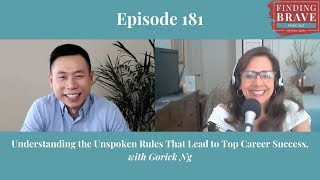
Podcast episode (Finding Brave #181) in which Kathy Caprino interviews Gorick Ng about the unspoken rules that help early-career professionals become top performers. Ng—drawing on ~500 interviews and his experience as a career advisor and practitioner—offers concrete frameworks (the "three Cs": competence, commitment, compatibility; performance vs. potential; learner vs. leader; do your homework/show your homework) and practical tactics (mirroring, vetting employers via LinkedIn, volunteering help, offering a point of view) to shorten onboarding and accelerate career progress. The episode also covers mindset, humility, relationship-building, and trade-offs of code-switching.
Chapters
Hello everyone, this is Kathy Caprino and welcome to my podcast, Finding Brave. I've created this show for everyone who longs to create something bold and brave in their life. To rise up, speak up and stand up for who they are and to reach their highest and biggest visions. Each week I'll be speaking with inspiring guests from all walks of business, leadership, entertainment, the creative arts and the entrepreneurial world. And they'll be sharing their intimate stories of Finding Brave and offer their best strategies for building your most rewarding, joyful and meaningful life, business and career. I so appreciate you being here. And speaking of appreciation, I am so thrilled to share that Amazon Music is now a sponsor for Finding Brave. So if you feel as I do that music is an important, enriching part of your life and you would like unlimited access to safety. 70 million songs today. I hope you'll hop on our special link, which is getamazonmusic.com finding brave and get our 30 day free trial offer. Again, unlimited access to 70 million songs. That's a whole lot of music and a lot of listening. Joy. Thank you again so much and enjoy the show.
All right.
Hello everybody. Welcome to another episode of Finding Brave. I am beyond thrilled you hear this every time. I know, but I am telling the truth. To have our guest today. In so many ways, Goric Ng is here in so many ways. You have been so inspirational to me in that you've written an amazing book. I'm going to tell you all about it, people. And we are, we, we are talking about understanding the unspoken rules that will lead to top career success. That's how I'm titling this. But Gorech just wrote and published now a Wall Street Journal bestselling book which is the envy of all. And it is so great and so important and clearly when something hits like this, you know, it's because it's desperately needed and it's, it's packaged and created in a way that's digestible. I think a lot of books that rise to the could rise to the top, but don't. There's something in how the material is presented that doesn't take off, doesn't allow us to really get it and take action and move. So that's my preamble. But you are here, people to learn about unspoken rules that we need to navigate, that we need to understand. So that's Goric. Let me tell you about them and then we're going to dive in. Gorek Ng is Wall Street Journal bestselling author just said that of unspoken secrets to starting Your career off. Right. And I do need to say this is really for not just grads, recent grads. I need to say that it's a practical guide to help early career professionals become top performers at work and ascend to positions of leadership. Based on over 500 interviews with professionals across geographies, industries and job types, Gorek's book is quickly becoming required reading for students, interns, employees, managers across a huge array of organizations all over the world. And this year, I mean, this warms your heart. Harvard Business School gave Gork's book to every MBA student to give them an edge in their internships and full time jobs. I mean, what, what an honor. Gork, your back, your backstory is amazing too. Career advisor at Harvard College, specializing in coaching first, first generation low income students. How important and how rewarding. He has managed new employees at Boston Consulting. How have you done all this? Boston Consulting Group worked in investment banking at Credit Suisse and also a researcher with the Managing the Future of Work project at Harvard Business School. Featured in a lot of media now, today's show, New York Times, Financial Times, Wall Street Journal, Forbes, cnbc. It goes on. And Gork is a first generation college student, graduate of Harvard College and Harvard Business School. What have I been doing with my life? I have to ask myself, you know, I can't ask your age because that's ageist. Age, ish. Age. What am I saying? Ageist. But you've done a lot. Bravo. Bravo to you. So let's dig right in. Why did you feel writing a book is no small thing? So why did you feel compelled to do it? What was the most burning reason? I'd love to hear that.
Yeah, I would say it wasn't a particular point in time. It was more of an accumulation of experiences where I was reflecting a lot over the course of university. My first job, my second job, about just how much privilege I'd collected as a first generation low income college student to is the son of a working class single mother who had mentors along the way, who guided me into college, who guided me through college. And I just started wondering, well, what responsibility do I have to hopefully pave a smoother path for those coming after me? What's my bit of contribution to the next generation? And that question really had permeated all of my shower thoughts for a long time.
Wow.
And it was real when I, it became real when I entered my first job when I realized that there are so many resources on how to get a job. There's really nothing on how do you succeed in a job. And this is even the case at large corporations that have onboarding programs, HR departments, learning and development teams. So much of what we learn is through trial and error or from a mentor pulling us aside or a parent pulling us aside and saying, hey, you should do it this way and not that way. And I just thought to myself, well, there's so much trial and error that goes into building a successful career that there's almost this assumption that when you enter into a new work environment that it'll take you 6 to 12 months to however much long of a time to get up to speed. Well, what if we could shorten the learning curve for folks entering a new job, a new position, onboarding onto a new team? How much more effective could we all be if we just take what is otherwise an oral tradition and write it down and democratize it to the world? So that's where this project really came from. And that's how I decided to write this book.
I have to unpack that for a minute and ask a question. It's pretty stunning to me that you say you were raised by a single mom. Did you say low income?
Yeah.
First generation? Yeah. Tell us this. And before you say it, it's really beautiful to me that what comes out of your mouth is you had so much privilege even given that. Can you explain that for folks? Because I think it's a mindset that you carry. I'm guessing you tell me, tell me a little bit about that.
Yeah, it's one of those thoughts that's still percolating in my mind. It's something I think about pretty much on a daily basis. Where. Yes, son of a working class single mother, my mom left school when she was 12 years old to support her brothers through school.
Where was that?
So she was born and raised in Hong Kong, and then I was born and raised in Toronto, Canada. And it was really when I was around 14 years old that she was laid off from her sewing machine factory job. And I became the person in the house who was responsible for getting us both back on our feet because I was the one who knew how to get onto the Internet, who was proficient and hopefully still is proficient at English. I became the person to go online and figure out how to write a resume, how to put together a cover letter, how to show up in an interview. All of this Google searching fell on me and I, over time found myself having a number of people who saw potential in me. My 8th grade teacher saw potential in me and encouraged me to attend a certain high school in High school, I met a certain student from another school who took me under her wing and guided me through the college admissions process. I was lucky enough to have gotten into Harvard, a place that I didn't even know existed, let alone was an institution that I could get into. And so all of this over time, I started wondering. Well, the universe has been awfully kind to me and I've. Over time, I'll use the privilege word that I've accumulated a great deal of privilege by having a great undergraduate education, by having a job and a series of internships that so many of these insiders had gotten that I started looking at some of these statistics around educational attainment and upward mobility between different socioeconomic strata. And I found myself being this outlier. And as an outlier raised the question of, well, what am I going to do with this outlier status? Am I going to take this privilege and collect more of it, or am I going to try and spread some of this knowledge, some of this life experience, to hopefully enable others to go down the path that I've gone down?
That is so inspiring to me. You know, we have so much to talk about, about unspoken rules. But I have one more question. It's the therapist in me. I can't let it go.
Please.
I think that what permeates everything you say and do, even, you know, as, as we communicated through our Forbes blog or our Forbes post. Right? There's humility, there's gratitude, there's seeing a silver lining. There's so much that I think in coaching a lot of people over a lot of years, if that mindset isn't there or if it's about what we're entitled to or look how far I've come, and darn it, I'm going to get what I deserve. All of that kind of repels the success that you're talking about, I think. So. Would you agree with that in what you write and what you teach?
I would. I think mindset has been. It's been helpful for what I've been doing and I think it's really given me purpose in my day to day work, where it doesn't even feel like work. It feels like a calling, it feels like a mission. It feels like something that I can look back upon decades from now and say I'm proud to have done that. I feel like I'm on that path. I can't be my own judge and I won't know what the. I don't know what the future holds. But I think about my lack of caffeine consumption recently, really, as. As I think about it, tells me.
That you don't need.
Tells me that the level of energy I have on a daily basis isn't necessarily correlated with how much rest I've gotten the prior night. It's correlated with how much I'm looking forward to the next day and what I'm about to do. And I feel like my lack of caffeine consumption is really a sign that I' something that I find deeply fulfilling.
Interesting. I drink a lot of decaf and regular, but I still feel the way you feel. Oh, I love it. All right. Now, you know, I'm thinking whenever I talk to someone, I'm trying to learn as well as help listeners learn. So I want you to, if you can walk through, maybe, and we didn't prep this, so if this is hard to do, you let me know. Maybe the top, most potent unspoken rules, top five, top 10, that you'd think that we'd know it or you'd think that the manager would say it, but it's not said. Can you tell us those?
Sure thing. Off the top of my head, I would say the first one has to be the three Cs of competence, commitment and compatibility. Where the idea is the minute you show up as a professional in the job search, and especially on your first day, week, month, year in a new role, the people around you are sizing you up and they're asking themselves three questions. Question one is, can you do this job well? Which is competence. Question two is, are you excited to be here? Which is commitment. And question three is, do we get along? Which is compatibility. So competence, commitment, compatibility, the three Cs, your job as a professional. All of our jobs, it's to convince the people around us to answer yes to all three questions all the time. Because you need to demonstrate competence for people to trust you with more important responsibilities. You need to demonstrate commitment for people to want to invest in your career because they're confident that you're invested in the team. And you need to flex your compatibility in order for others to see you as having passed that proverbial airport test of do we want to hang around each other? So I would say that the three Cs are what permeate our daily lives as professionals in the workplace. And it's something to be thinking about when you're entering that job interview and in that new job of how am I coming across and what does it say about my competence, my commitment, and my compatibility? So that's one piece I'll sort of park off to the side it is. The second is around showing both performance and potential, where performance is how reliable you are, how well you can perform in your current job. Potential is really about your promotability of how confident are we that we can give you more important work, that we can trust you to be a leader in this organization. And the key to not just getting a job, but rising up in the organization and attracting sponsorship and mentorship and more important responsibilities. It's all about flexing your potential of going from can you do this job? To can you lead this team? From can you crunch these numbers? To can you turn this into insights? From collecting information to synthesizing information, it's really elevating that to a higher level. I would say that's the second piece. The third piece is around knowing what matters to those who matter. And this is all about understanding what matters to your manager, what matters to your coworkers, what matters to your team, what matters to your department, what matters to your company. And how I like to think about it is the better you understand what matters to those who matter, the more you can align yourself with work that matters, and the more you can align yourself with work that matters, the more you will matter. So thinking about that also as a North Star can be helpful. And then I know you offered quite a few options of 5, 10, 20. I'll leave you with just one more before. Before pausing and handing back to you. The last one is when it comes to showing up as a new employee, when you're showing up in a new project, you caveat at this nicely of this sounds like common sense, but it's not often something we're necessarily consciously thinking about, which is show you want to learn and help show you want to learn that you're here as a sponge to soak everything up and learn about how things work behind the scenes, that you're taking notes, that you're asking questions, and then show you that you want to help in terms of asking, how can I be helpful? Is there anything I can do to be helpful? Or as you learn more and you understand what matters to those who matter, being able to say I noticed this, would it be helpful if I did this? And really just volunteering. So much of this comes across as common sense, but it really isn't. When we think about folks who might show up in an environment, not understand these unspoken rules and maybe not have as many opportunities come their way, partly because they're not navigating these spaces as effectively as they could be, there is.
So much to talk about and what you shared. All right, what do I want to start with first? You know, you can tell that you've worked with a lot of young people. So let me, let. Here's what I'm processing. There's young people in my own family who I, you know, oh, mom or aunt, you know, can you give me some career coaching advice? But I do see and you know, it's a long time ago that I was first starting out, so it's hard for me to remember. But I think that some of what you share is actually common sense for those of us who've been working a long time, but not for the 21 year old, 22 year old. So for instance, you know, just in watching my son, my, my other family members, it seems like they're coming in and they so want to do a great job and there's a lot to juggle to do that. Are they thinking of the leadership view that you're talking about? Like, I want to help and how can I be of help specifically? But I think for many people it can be overwhelming to just master what's on their plate. So the idea of saying, and what else can I do for, you know, how else can I be of service? It isn't something that's going to come to them. Would you agree with that? Do you see that when you're coaching younger folk?
Absolutely. And I would maybe blame school a little bit for this, where after having spent 16 plus years of your life sitting in the classroom waiting for the professor to tell you what to do next, looking at the top of this assignment and seeing all the instructions clearly laid out, having only five options to choose between, if it's a multiple choice questionnaire, all of this, I think conditions usually to think that life is a conveyor belt. It's equivalent to sitting at a conveyor belt sushi restaurant where the next thing just comes your way and all you have to do is reach out your hand and pluck it off the conveyor belt.
True. That's so right.
And that may have been what is necessary for school, where when you're living in this conveyor belt of an environment, success comes in the form of keeping up, not procrastinating. Whereas once you're in the real world, there's so much more ambiguity, there's so much less structure. And as a result, it's not necessarily about keeping up, it's about stepping up, it's about navigating this wilderness expedition that is our careers. So I would say it's definitely something that takes some getting used to, especially having just spent the last 16 plus years of your life living in passive mode versus proactive mode.
I love this. Questions, more questions. There's something that. So I have a team of four and they're contractors and in my corporate life I've managed a lot more than that. I think that somehow I figured out as a manager that there are specific things that will make or break you working with me. And why don't I tell you what those are. So now when we onboard someone, I will make it very clear I like to over. I would like you to over communicate. I don't want you to have to sit and guess as you're onboarding. If you have a question, ask. Nothing is too small, big, stupid. Secondly, you are. It's going to be a lot to grasp. So rather than worry am I catching up fast enough? Let us know where it's confusing, where our standard operating procedures don't make sense. And by the way, anyone in any business should have a lot of SOPs. Makes life so much easier. But I need communication and I need reliable. And what reliable means is if you can't be reliable, oh, I got sick or I'm taking care of my grandmother, I need to know that I do not like surprises and I don't like when you've disappeared when we're all working remotely. So I'm talking to them on slack. So I make it really clear. And if it's not a long list, it's maybe three things. So can you tell us? You know, this is the second thing that occurs when you said in school, it's like a conveyor belt, pick, pick, pick, do, do, do. Somebody once said one of the most narcissistic bosses I ever had ever said one of the smartest things ever, which is you're not going to succeed by what you do. It's not your performance, it's your relationships. And I thought what I want to be in a meritocracy that you know, he was right. I think it. Yeah, you can't be a deadbeat and not get your work done. Don't get me wrong, but it is the quality of the relationships you have with your peers, your colleagues, your subordinates, your. Would you agree with that?
I would. And it's, I would say perhaps a function of our modern day economy where if we were talking in a different era, I guess we wouldn't be podcasting in that prior era but if we were hunter gatherers, I'm thinking about, well, what really matters. What matters is That I come back to the cave with the berries collected and the wild boar hunted, where you can easily measure my outputs of how productive I've been, how good I kept.
My, my tribe alive. You know, we collaborated. Right. I didn't go off and let them die. Right.
Exactly.
Simple, simple rules.
Exactly, exactly. And whereas nowadays you're working, we're talking here, especially about white collar work, where you're going to be working in teams, long duration projects dealing with a great deal of ambiguity and where an ounce of input doesn't necessarily lead to an ounce of output. In the same case of hunter gatherers hunting for this wild boar and collecting these berries. And so as a result, so much of it is beyond just competence. It's all about, not all about, but certainly partially about compatibility. So I would definitely say that compatibility, your ability to build relationships, to build trust, to build a positive reputation, very much does matter. And as I think about reputation, I'm probably discounting what the hunter gatherers did. Presumably your reputation back then matters just as much. But I think about it as very much something to be thinking about nowadays.
I love it. Here's another question I have for you. I hear a lot among, you know, my grown children and their friends and there are people that come in and work in their job, in their work cultures and, and they don't last. And they often don't last either because they think they're above what they're given to do or there's some chip on their shoulder or resentment. Do you talk about that in the book? In other words, I'm not a big fan of humility because I think women are trained to be too humble. We don't even, we're not comfortable even speaking powerfully about and confidently. But there's a place for humility where if you're just starting out and it's your second month, I think to be acting like you, it's beneath you. What you're doing is a big mistake. Tell us what you think.
Yeah, I would absolutely agree with that. And I think about this framework that I think of as learner mode versus leader mode, where regardless of who you are and what level of seniority you're in, all of us are in one of those two modes in every situation. We find ourselves at work where when you're new to a team, new to a project, new to an organization, there's going to be an unspoken expectation that you don't know very much or you shouldn't be speaking up very much.
Oh, it's such a mistake to Come in like a bull in a china shop and act like you do. I've made that mistake.
Yeah, I think we all have to some degrees we're eager to learn and help. But sometimes that can come across as if you're saying, well, when I was in my last job, this is how we did things.
Don't say that. Don't use those words.
And then the question becomes, well, if your last job was so great, why are you here?
It's bad, it's bad. And part of this is empathy. Try to put yourself in their shoes if you are all excited. And gosh, there's one VP job I had that the boss wanted me to run a meeting or participate in a big way before I'd even started. And it's what he wanted me to do. You know, say we're going to change pricing before I'd even walked in. I mean, I made enemies, bad enemies. But what would you say to someone who is starting out? I mean, I will say this. Do you know that it's so long ago, my first job in publishing, I made $9,000 annually on Friday, Friday evening, it was either I, you know, I'm going to smoke a pack of cigarettes or I'm going to eat dinner for dinner. I mean, it was terrible. And the first two months I literally was on my bed in Brooklyn Park Slope with my. And I was in a fetal position on the bed. Like, how can this be what I have worked so hard for? So I'm not saying we should all be. And it's not a walk in the park, all roses. So can you advise if you come in and it is more grueling or less anything that you thought it would be, good God, this is not rewarding, or this feels like 10 levels below where I should be. What would you suggest that they do?
Yeah, it's an important question and it provides nuance to what we're talking about because on the one hand you don't want to be entitled, but at the other, on the other hand, you also want to make sure that this is going to be a place where you'll thrive, where you can build a career. And there are going to be a lot of places where they're not going to treat you very well. And there may not be, despite all the competence, all the commitment, all the compatibility you're showing, really just a dead end job. And for this I would advise two things. One, before you get the job and the other after the job, where before the job I found it helpful to go on LinkedIn and to see who's worked at this organization before and to see for how long they've worked there. I've actually advised a number of people who spoke to the CEO of a company and had had a great interview experience, went online, read all about them, and was more impressed than ever about this organization. But then when they go on LinkedIn and they search for prior employees of this organization, they find that they've all worked for less than a year.
Yeeks.
And from your reaction, it sounds like we're on the same wavelength. That that's, that's likely a red flag.
Either the conditions are difficult or they don't have a promotability kind of how do we help people ascend here and learn and grow? It's not good, right? Something's not. Something's off.
Oh, and so for. In the cases that, that I'm thinking about, they ended up actually reaching out to these individuals and saying, would you happen to have a few moments to share your perspective with me? Would love to hear about your work experience. Not all of them responded, but the one or two that did ended up.
Saying, don't go there.
Right.
Wow. So smart. What a smart, easy way to do this. Because, you know, on glassdoor or salary.com or whatever, a lot of times people who post are only the disgruntled ones.
Right.
So you saw a trend, you know, you. Let me, let me vet this.
Wow.
Okay. I'm aware of our time. I know you have to scoot soon, but questions? You said we're either in leader mode or learner mode. Can I challenge that? And I have a feeling you're going to say, yeah, that's what I. Oh.
Please, I would love to.
Yes, I think we should every day be in both. If you're a leader and you don't think you have anything to learn, especially from new people coming in, I don't think you're going to be that great to work with or build a culture that is. And if you're a learner, I mean, part of what you said earlier is. I think I heard it. Don't just think of yourself in learning mode. You are a leader. You can be a leader. Maybe you don't see yourself that way. Maybe you're an introvert and you feel like there's no way I can run this meeting. But I think if we can always think, where am I? You know, my book is called the Most Powerful you. Where are there ways that I can lead? I don't mean teams of 500. When you've just walked in. But where can I be a leader in a way that doesn't off put or jump ahead? What do you think?
I love that. I love the nuance you're adding to this, Kathy. Oh, God. Fantastic.
Oh, thank you.
Yes. It's an enthusiastic yes. Where it's. To oversimplify, we're in one of those two modes and it's sort of a binary state. But you're absolutely right that we all have those, even the tiniest moments to be a leader. Maybe you read an article about what a competitor is doing and this may not have been an article that your team members had read. Maybe you could forward it along and say, hey, I read this, I'm thinking about these implications. What about if we discussed A, B and C?
See, that's thought leadership. And I always say you're a big fan of. You've got followers on LinkedIn galore. When I say to people who, I don't know how to stand out, I don't know how to connect. Follow people that you admire and, and share what they share. Gorek's book, but don't just share it. Say why it spoke to you. That's your thought leadership. You know, the biggest takeaway I had was blip. And that is being a leader. I love it.
Love it.
Yeah.
If I could add to that, that's also one of those things that I feel like new grads may not necessarily be in the mindset of.
Yes.
Is one of the things that I heard a lot from managers is the tendency on the part of early career professionals to just pass on the decision making of, hey, I received this email forwarded over to my manager, or I have this problem, pass it along. In which case you become almost just a go between of, oh, yeah, you're.
Just pushing, you know, pushing out stuff.
Exactly. Whereas these high performers, they're not just passing something along, they're injecting their point of view. They're, they're, they're providing their own perspective. And, and that's really where you go from simply being that cog in a big machine to being someone who's a team member, who's a collaborator.
And that's where we are all immediately.
Exactly.
Value. I, I'm sure you've covered it, maybe not in this language, but I have had to say in the 40. No, how many years, 38 years of managing, I've had to say this a lot, but you're gonna have questions. I love them, but can you do this for me? Take a stab at what you think the answer is, take a stab at what you would do if you were me. And that's gonna move the conversation forward, give it that nuance that we're looking for, that. That richness. Do you talk about that when you. How to ask a question and how to bring it forward? I'm sure you talk about that in depth. Yeah.
Yeah. It's all about what I think of as, do your homework and show your homework.
Oh, I love it.
And I would say this is actually something that we can draw from the classroom environment on, where if we think back to those math assignments we got in school, it's not just about punching the calculation into a calculator and then spitting out the answer and then writing the answer. You have to show your proof. You have to show your work. And I think of workplace interactions as very similar, where you want to do your homework and say, kathy, I was doing my research on this and this, and I noticed this. And then you want to show your homework and say, and these are the implications. Wow. These are the next steps. This is my point of view, and this is what I'm thinking about.
You know what you have a gift at, can I tell you? And that's why your book's immediately. Number one, you have a way of creating a framework for a principle. You have language that's sticky. You know, everything you have said, someone's going to go, learner leader. Do your homework, show your homework. It's fantastic because we need help. We need it to be digestible. All right, here's one that I didn't prep you for, but I would love your thoughts. Of all these unspoken rules, what's the smallest one that nobody would think is important, but it has the most impact? That's a hard question.
That's a tough one. You know, I would say it's. It's both an effective one and a problematic one. So it's mirror others.
Mirror others. That's a therapeutic technique. Did you know that?
Oh, is that right? I didn't know that.
To build trust, if you swear like a truck driver, not that every truck driver swears. You know, if you come in, I'll just share. You're my client. If you're swearing all over the place, I'm going to swear a little, because unconsciously you feel like, yeah, she's kind of like me. Is that kind of what you mean?
It is, it is. It's helpful for compatibility, and it's also helpful for just learning a new environment in terms of looking left, looking right, seeing how others do things. Letting others go first and emulating and following along. So when in doubt, let others go first and then follow along afterwards. I say that it's problematic because it raises the question of, well, is this really the right way of doing things? Is there really an absolute way of doing something? And I think as we start talking about diversity, inclusion, equity, belonging, how much of this is a function of code switching, of really conforming to the majority? What are you maybe sacrificing as an individual when you venture into the territory of mirroring others? So very much up for debate about the effectiveness, but also some of the trade offs.
I love that you're saying that. I know a lot of people from other cultures, other approaches to living that and, you know, even the gender question, you know, still, I think women experience when they're at very senior levels. Like, I had a client who said to me, she ran a big meeting and the. The boss pulled her aside and said she wasn't a good communicator when the whole team thought she was. What he meant was, you're not communicating like me. Hmm. And when you're vulnerable, which many women in senior roles can feel, it's hard for you to go, wait a minute here, now, hang on, what are you talking about? So I appreciate that you're sharing that. There's an underbelly to that that can be damaging. So what we would ask is, yeah, suss it out, understand your ecosystem, look at what is done and how top performers, what they do to become top performers. And if it's not what you want and it's not who you are, then it's probably not the right place. But it's a good first step. So many good tips. I know you have to go, contractors are coming in. But where do we learn all about you? Where do we get the book? What else are you offering for, folks? Tell us where to go.
Yeah, the best place to find me is on my website, which is goric.com. that's G O R I C K dot com. And I'm on social media as well, so find me on LinkedIn. Follow me. Connect with Me. Would love your feedback, reactions, ideas on what I've written and I'd just love for this to spark a conversation. One of the things I talk a lot about in my book is just the value of finding an excuse to connect with someone. I put out my excuse to connect with the world. I hope the world connects with me.
Are you an introvert? I'm going to leave you with that.
I am. I've got A few more minutes. So I would love to get your diagnosis on what's going on.
I would say that you have extroverted tendencies in how you process information on the fly, which sometimes introverts don't, can't, or struggle with. I feel like you have extroverted tendencies, but my sense of you is the baseline is introversion. And so all of this hoopla over your book, you probably had to go to Bali and rest for a month. Did I get it right? Am I wrong?
I am one of those introverted extroverts. Extroverted introverts. One of those in betweens. I'd say the publishing process has really been helpful in getting me outside my comfort zone.
Well, you seem very comfortable, which is so great. And you have to be because you are now a recognized thought leader. So we. It's important. It's not that you should become an extrovert, but it's important to share a lot of yourself because we need it. We need it. Thank you for being here. Thank you so much. People. Gorg is on LinkedIn in a big way. I'm there on LinkedIn wherever you see this, and it's on every platform, almost every platform. But please let us hear from you. What are the. Read the book. What are the unspoken rules you struggle with? Which ones don't you agree with? Which ones moved the needle? We would so love to hear. We love that. To know that this is being, you know, of help to you. I hope it inspires you to rock your career at the highest level in a way that's authentic to you. That would be our goal, wouldn't it be? Thank you for being here, Gorek. All right, everybody. Oh, I hope we can talk again. Have a wonderful week, people. We. And we'll see you next time. Thanks so much for joining us today. And please don't forget to check out findingbrave.org for more programs, resources, and tips. And tune in next time for your weekly dose of finding Brave.
More from Kathy


Elevate Yourself, Elevate Others, and Amplify Good | Chris Cooper | Finding Brave Ep. 334

Finding Brave Epis #333: How Leaders Can Harness AI Without Losing Their Humanity, w/Bennett Borden

Finding Brave Epis 332- How to Stay Brave, Valuable and Visible in the Age of AI, with Raman Rai

Finding Brave Epis 331 - The Power of Positive Disruption, with Dr. Patrick Leddin


Finding Brave Epis 330 - Being 40: Letting Go and Embracing Who You Are, with Stacey Lindsay

Disrupt Career Reinvention with Kathy Caprino - via The Disruption Lab Podcast w/Patrick Leddin

Creating Neurodiversity-Friendly Work Cultures: Simple Workplace Adjustments Matter

Finding Brave Epis 329 - How To Create a Neurodiversity-Friendly Workplace, with Kristen Pressner

Finding Brave Epis. 328: Reclaiming the Power to Trust Your Own Voice, with Dr. Cindy McGovern