Finding Brave #315: Fawning: Why the Need to Please Makes Us Lose Ourselves, with Dr. Ingrid Clayton
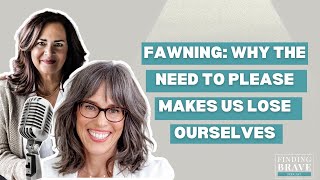
This is a Finding Brave podcast episode (host Kathy Caprino) interviewing Dr. Ingrid Clayton about her book "Fawning: Why the Need to Please Makes Us Lose Ourselves and How to Find Our Way Back." Clayton defines "fawning" as a trauma-based relational survival response (caretaking/appeasing) that develops often from childhood complex trauma and causes self-abandonment. The episode covers signs (conflict avoidance, compulsive caretaking, chronic people-pleasing, resentment, waiting for others to change), the mixed physiological profile of fawning (hyperarousal plus dissociation/submit), and practical somatic tools to reclaim agency (sensory grounding/orientation, hand-over-heart self-contact to release oxytocin, post-event curiosity and do-overs, and seeking trauma-informed therapy). It also includes Clayton's personal story and clinical examples to help listeners recognize fawning in themselves.
Chapters
It causes us to self abandon at the same time because by the nature of the thing, we're having to privilege and prioritize our external environment over who we are, what we feel, what we think, what we want, our values. Right? So there's a cost.
Hello everyone, this is Kathy Caprino and welcome to my podcast, Finding Brave. I've created this show for everyone who longs to create something bold and brave in their life, to rise up, speak up and stand up for who they are and to reach their highest and biggest visions. Each week I'll be speaking with inspiring guests from all walks of business, leadership, entertainment, the creative arts and the entrepreneurial world. And they'll be sharing their intimate stories of Finding Brave and offer their best strategies for building your most rewarding, joyful and meaningful life, business and career.
Hello there Kathy here. I'm so excited to share with you.
About a new program I'm launching on October 15th called the most Powerful you Group Coaching Program. So over the years, many graduates of my courses and readers of my books and articles and other folks have told me I wish there were a way to help keep my momentum going throughout the year with guidance, community and accountability all year long. So many people have a growth spurt at one time or another, but then their progress or momentum fades. This program is the answer to that wish. For 12 months, this program offers monthly 60 minute live group coaching calls with me and a small global group to help you identify and move through the best steps to take to achieve your most compelling and exciting personal and career growth goals. And this type of support can truly change everything for you. There are other great features and bonuses including with upfront payment, free access to my Kathy Caprino AI tool and two private one on one coaching calls with me and a lot more. Check it out@kathycaprino.com mpygroup coaching and that link is down below in the show notes. And if you feel ready for ongoing motivating support and an accountability structure that will move you forward, I would love to work with you starting October 15th. Hope to see you then.
Hello everybody. Welcome to another episode of Finding Brave. I am almost speechless and that's difficult for a podcast host to have. Our amazing guest, Dr. Ingrid Clayton here today and we are talking about her new book which I have to say I read a lot and this one gripped me from minute one, literally and boy did I have a lot of emotion and a lot of resonance with everything you shared. And it was so. You know, this is called Finding Brave. The whole theme is Brave, but finding it not, you know, come on, brave up. It's every day. We have to find it, every minute and sometimes every conversation. And I think that's just so the heart of your book. But, people, let me tell you all about Ingrid, and thank you for being here today. I. I have a feeling you're really going to feel changed from our conversation, I hope. Okay, let me tell you about Ingrid. Ingrid Clayton, PhD, is a licensed clinical psychologist with a master's in transpersonal psychology and a PhD in clinical psychology. She's had a thriving private practice for over 15 years and is a reg contributor to Psychology Today, where her blog, Emotional Sobriety, has received more than 1 million views. You live in California. Lucky you. And Ingrid's latest book, Fawning why the need to Please Makes Us Lose Ourselves and How to Find Our Way Back. Oh, talks of all about so many things beyond career. It's really about every aspect of living. But certainly you're going to learn why we stay in toxic environments, why we say yes when we should say no, how to. Why we prioritize our boss's approval or everyone else's approval over what's right for us and how to break free. Wow. All right, Ingrid, let's. Let's dive in. And, you know, I didn't prep you for anything here, but I. In reading, you know, the first pages of your book, your story is so compelling that if you could share with folks why this book for you, you've written, I believe, two others. Is that right?
That's right, yes. My third book.
Right.
And we'll link to your others as well. Would you mind sharing a little bit of that story?
Yes. Thank you. Thank you so much for having me, Kathy, and, yeah. For reading the book and your candid reflections on it. I, as you mentioned, I'm a clinical psychologist and a trauma therapist. But really, what I now know to be true for myself is that I'm a childhood trauma survivor. And that was not language that I could have used for a very long time. Like a lot of folks, I had this idea that, like, well, my experience wasn't that bad. And, you know, we all carry this sort of trauma measuring stick and we all know someone else who had it worse. And, and what we now know to be true about trauma is that it extends far beyond the sort of acute single incidents that we can all, you know, name and identify as. Oh, yes, that is traumatic. We now have the language of complex trauma, which means relational, ongoing, prolonged experiences over time that create the same experience physiologically as these acute single events. And so essentially this book is, is I say I wrote this book very quickly, but I also wrote it over the course of 38 years because it starts in the hot tub with my stepfather, who I knew as a child. I was growing up in an alcoholic family system. And that was, you know, the uncertainty and instability around that was enough. But I now know that my stepfather was also grooming me to be his girlfriend. And there's a moment in this hot tub scene that sort of came back to me as an adult where I recognize that there's something off here and I don't feel safe. And yet he's not acting like he's angry, he's not being overtly aggressive. But I know internally that I'm not safe. And yet, looking back, I did not fight, I did not flee, and I did not freeze. And these are the common trauma responses, you know, that, that we've all heard of time and again. But there's something else that happened to me in that moment which we now know is the fawning trauma response, which is a relational trauma response where you care take or flatter or flirt, you appease. Sometimes it's called please and appease response in order to mitigate relational harm. And because complex trauma is ongoing, our trauma responses then tend to be ongoing. And especially if you look at childhood trauma, you're. You're living in this trauma response as your brain is developing, as your personality is developing. And so, so many of us don't know that we're living in what is essentially survival mode. We think it's just our personality. We think I'm just being a good girl, I'm just being kind, I'm just a caretaker, that's my nature, that's who I am. And it's not that those things might not be true, because I think a lot of what I call fawners, the people that have this long term experience of a chronic fawning response, I think that is true. But the difference is that we don't really know where fawning ends and where we begin. We don't know. We don't really have conscious agency around our caretaking or appeasing. It just happens so reflexively all the time that there's a theme that sort of goes with all the symptoms of the fawn response. Even though it's a genius adaptation, even though it keeps us safe, even though I'm grateful for, causes us to self abandon at the same time. Because by the nature of the thing we're having to privilege and prioritize our External environment over who we are, what we feel, what we think, what we want, our values. Right? So there's a cost. There's a cost long term. And so that's why I'm writing it, because I've. I lived in this. What just felt like this confusion where I've sat on a million therapists couches in September, God willing, I'll be sober for 30 years. I've done all the programs, I've shown up, I have the degrees, I've written books. And yet there was a part of me that just still felt like, what is wrong with me? Why do I keep ending up in these relationships? Whether it's mentors, bosses, boyfriends, where there was always this feeling of sort of exploitation or dysfunction or people maybe had one foot in, one foot out. I was repeating these dynamics over and over, not knowing that one part of that is the fact that I was living in survival mode, in a chronic fawn response. And that leads to trauma reenactment.
Oh, my gosh. I don't even want to speak. I just want you to give us a master class.
All right.
Do you mind? Again, I didn't prep you. The are not questions that maybe other people would ask. You were 13 when this happened in the. In the tub. Is that right?
Were you?
Yes.
Yes. So what I'm hearing here, correct me if I'm wrong, is there's. There's elements of this experience that make it a chronic situation of fawning. Number one, we grow up with it, so it becomes our adaptive response from a very early age before we even know what a boundary is. Is that right?
That's right, yeah.
Now, here's my question to you in reading your book. Now, how do I want to say this? You know, having been a marriage and family therapist for a short amount of time, I know that disorders are often spectrum disorders. You know, take narcissism, say, on a 1 to 10 spectrum. And so, you know, it's hard for me to say this. My parents are in heaven and they were loving, but mom, I feel, had a bit of narcissism. She was low on the spectrum. But what happened for me is I was always on eggshells because she couldn't be challenged. And I. So much of what you write in the book, I was so confused all the time.
Why is she so mad?
I don't even know what I said or what dad said. And I developed. I don't want this to be, you know, a therapy session for you, but I developed a few things, but I. This is what I really want to get to here.
Yeah.
I developed an intensely keen radar of what people are thinking and feeling. But I later interviewed Andre Solo, who's the co founder of Sensitive Refuge. And it's all about HSPs, highly sensitive people. So I always assumed it was my childhood with mom.
Yeah.
But it turns out there's a lot of people who are highly sensitive to and they take in clues and information from the environment in deeper ways than others do. So I think my son is my daughter's, but in very different ways. So can here, here's what I'm asking. Can fawning be on a spectrum? And I ask because I think I'm a people pleaser, a recovering people pleaser. I believe you talk about. I have a knee jerk reaction to help people. Even when I want to shut my mouth and not offer help, it just comes out.
Yeah.
And part of that is I'm comfortable doing it, but part of it is, I think, fawning. So can it be on a spectrum where not everything you're doing can be attributed, not everything that makes you lose yourself can be attributed to this complex trauma situation?
Does that make sense, Ingrid?
I think it does. I mean, what you're basically pointing to is that we are complex systems. Right. There's all kinds of factors that go into making us who we are. But generally speaking, yes, fawning. All of our trauma responses can be seen on a spectrum and they are not just context dependent. Right. So you're saying I lived in this environment that wasn't really safe and I became hyper vigilant. Very common for fawners. And. But we also. Different contexts create different environments. Basically, fawning happens when we are in a system of power, in a hierarchy where the body sort of intuitively knows where it belongs on that, on that hierarchical structure. Right. And that you can't often challenge the people that are above you, but you gotta find a way to sort of exist. And so it depends on the context and it depends also on your own physiology that for some people they are fighters. Right. For some people they are freezers. And it's not that we only have one mode, but just to sort of say that even within all of our trauma responses, there's, there's spectrums, there's hybrids of, of different experiences. And I believe that fawning for a lot of people is a learned behavior because we are conditioned to. To fawn. I talk about this in the book, particularly women. If you sort of swap out a lot of the wow. Definitions for fawning, you're like, wow, that also sort of sounds like what we're told it means to be feminine. Right? Like sweet and caretaking and all these things. And so, yeah, so if you look on a spectrum, I think you will see every shade available. And primarily what I want people to have is just this lens and language so that they start to become curious about their own personal experience. Right. It's, it's less diagnostic in that way and it's more like, can you. Because faunas tend to look externally for permission and validation and we're so hyper attuned to the environment and others that again, we sort of go missing. My greatest hope is that people shine a light on themselves and be curious about what am I actually experiencing. Where does this resonate? Where does it not? And that's gold, right? It's for you to know what you resonate with. It's for the next person to take what they love and to leave the rest. It's so deeply personal and it looks so different each person.
I love that because it's so honest. I mean, if this stuff were so easy to. Oh yeah, I read a book and I'm fixed. I mean, what the heck, what would we be doing here? I mean it's, it's a complex thing to be a human being. I love it. So can you tell us, and you know, I want you to make sure you're talking about what is most important for people to get out of your book in this content. But for people listening, what would you say, let's say you're in, you know, you're doing psychology, work with a client. What are the clues you're looking for that when they say this, this, this, this. In other words, how can readers and listeners identify right away? Yeah, this is, this is me. I have some aspects where I'm truly losing myself. What, what did, what are the signs that you say there it is right there?
Well, I think most of us really fear conflict and do everything to avoid it. So conflict essentially is an example of a healthy fight response. You can have a voice, you can set boundaries, you can assert yourself, you can have an opinion. And for a lot of faunas, the fight response got snuffed out. For a lot of us, quite frankly, myself included, when I tried to have a voice and I tried to advocate, it made things so much worse. And so, you know, the body keeps this core or as we know from Dr. Bessel van der Kolk's best selling book, and the body goes. I'm never going to let that happen again. Right. So we've learned through these experiences that a healthy fight response is not safe. And so any conflict then feels unsafe. So to have a difference of opinion, to have not even a difference of opinion, but an opinion at all. It seems like a silly example, but I give it often. It's like, if you're the person where someone goes, kathy, where do you want to go to lunch? And you're like, I don't know, wherever you want to go is fine with me. Like, overly agreeable and accommodating. You might want to take a look at this. Like, where does this originate from? What would happen if I did have an opinion? What am I afraid will happen if I have an opinion? These are questions to ask yourself. So it's the conflict avoidance. It's the sort of compulsive caretaking, soaking up all the shame. Everything is your fault. You don't really matter. We tend to have a lot of resentments for this reason. So it's like, if you're going, gosh, you know, I'm the only one who's picking up the slack here, and am I the only one who can do X, Y and Z?
And do you see that as martyrdom as well? I mean, there's a little martyrdom theme for me.
Yeah, Yeah. I think it can absolutely lead it into that. But I think the intention is slightly different. It's that they literally don't feel like they have access to doing it any differently. Because, again, the body's just saying, well, you cannot sacrifice your relational harm in order to stand up for yourself. So we're kind of waiting and hoping for other people to show up. Right. When you talk about finding brave, this, to me, is. I say it often, actually. This is some of the hardest, bravest work I've ever had to do and I've ever invited my clients to do. Because literally, if the body is saying, it's not safe to be a whole person in the world, and yet we're touting all these things, like, come on, just set a healthy boundary. Like, who cares what someone thinks of you? Like, you're so great. Why don't you just. Right. We sound like it's so simple, Right? I think rationally and cognitively, no one's thinking that those are bad ideas. But when the body doesn't feel safe, it doesn't care about your opinion of what you think I should do.
And there's shame when the people say, it's so easy.
If so, why don't you just. It sounds so simple. So we're filled with shame. And then what we're asking people to do is to genuinely step into the firing line, because that's what it feels like in their body for me to have a voice, to assert myself. My body's going all the alarm bells. It's happening again. You're going to be steamrolled. It's going to make things worse. And yet this is a crucial part of healing from a chronic fawn response.
Let me understand here, Ingrid. I've always said the body says what the lips cannot. And from that, I mean, often. Like, I had chronic tracheitis for four years, an infection of the trachea, who's. And I'm a sick singer and a speaker. I mean, what do you think that means? But I didn't know about, you know, I finally got energy healing and I understood what the body means. But. So I'm. I'm halfway understanding. But you really make a point that the body keeps the score. The body knows. Can you explain that a little more? Do you mean that your body is going to give you a fear response, a trauma response? You're going to shake. You're going to. Your body knows it. Like, don't go into the fire. Your body knows. I can't say this. Whereas your mind is not aware. Is that what you mean?
Yes. So just to break it down, everything we know about the trauma responses come from what we know about animals generally. So if you look at a prey animal in the wild, okay, and it senses a threat and it bolts in the other direction, we would never look at the animal and be like, why isn't he just standing up for himself? Why isn't he roaring louder. Hello. And the animal also didn't have time to think it through, like, rationally, like, is this guy really coming to harm me? He's probably. The body reacts and it does it in a nanosecond. It is not conscious choice. In fact, when you feel threatened, what we know is that the body shuts down all systems that are not necessary in that moment. This includes conscious, rational thought. Prefrontal cortex goes offline, as does digestion and other things. All energy goes to fight flight. Right? So that's why I love this lens and language of a trauma response. Because for someone who sat on a million therapists couches cognitively, rationally, I like to think that I have some level of intelligence. I could not shake what I was experiencing day in, day out, until I learned that, oh, my word, these things originate in my nervous system. They do not originate in my thinking mind. And when we talk about things like codependency or people pleasing or why don't you just set a boundary? I think not only have these things been shaming folks for having what is essentially an adaptive genius physiological response that kept them safe, but it's also been missing the tools that could help them move through to the other side.
Oh my.
All right, we're going to go to the tools. But let me ask one more thing because I've never had someone articulate it in such a non complex way, such an understandable way. So if, if all of our body in these situations and, and they may not look like a threat to someone else, but as you said, you know, where do you want to go for, you know, I can't. And so you said, you know, prefrontal cortex, it all goes away. It's all about survival.
Yeah.
What are the ways that people can understand what the body is going to do in that situation? Is it. They're not going to eat, Is it what. What's going to happen typically when the body is responding. Do you understand my question?
Well, I guess if you put it in the context of fawning, because that's the visible evidence of what's happening. Right.
Yes. Right.
Oh, if you reflexively say yes when you mean no.
Okay.
That's what the body is doing.
That's what the body is doing.
If you're smiling when you're feeling terror on the inside, that is the body fawning.
Are there any other clues for people.
To say that's what I do and.
They would never tie it to fawning.
Yeah. And in the moment I'm trying to.
Yeah.
Are there things like the heart is beating so fast when why am I so nervous?
So the answer is yes. Here's the other tricky thing about the fawn response which makes it difficult to unpack sometimes. So I talk about that fight flight energy, which is adrenaline. It is your heart is racing. You might be flush. Right. The all in these floors are happening physiologically with a fight flight response. But at the end of the spectrum of trauma responses, we also have something called submit. This is where the prey animal plays dead, goes limp. Right. It's in the jaws of the tiger's mouth and it's acting dead in the hope that that. Did I say tiger or lion? Whatever I said is going to drop it for a moment so it can get away. It's like a true last ditch effort at survival. That animal does not have a racing heartbeat or adrenaline running through no muscle tone in its body. Even, like, even with the freeze response, you have all that adrenaline running through. It's just frozen, it's trapped. But your muscle tone is like you're holding this freeze position. Okay. So fawning is a hybrid of this hyper arousal, this adrenalized state of being, and hypoarousal of the submit response. The hyper arousal is us managing the moods and states and we're showing up and it's no big deal. And I got it and the smile and all the rest of it. The hypoarousal is the disconnect from self. It's dissociation, it's depression. So I say all of this to say you can't always see or tell what is happening in the moment because an aspect of the trauma response is that you are genuinely disconnected from self.
Wow.
So we tend to see it. It's easier to see historically. It's easier to see after the fact. Maybe when you're sort of back in your body, you're like, why did I do that? Or why do I keep engaging in these same behaviors? Why can't I leave this toxic situation that everyone tells me is toxic because our bodies found a way to survive within these systems. Often it's the water that we're swimming in. We don't know any different.
Right.
We don't have the skills, the internal safety, to step into something different. So it's really complex. Which is also why I. I tend to teach through story rather than.
I love that in your book.
Yeah. So I tell my story. I tell seven clients stories that they're very different, come from different places, different experiences. They all tended towards the fawn response and show. So my hope is that people see themselves reflected not in the moment of their own life, but in someone else's story. That tends to be the way in.
Wow. And before we get to tools, you know, we talked about, we mentioned, you know, why are you saying yes when the answer is no? Why are you putting what the boss wants over your own advancement? Can you give maybe five more examples of what you. You know, you'd be a millionaire if you had a dollar for every time someone said blip. You know, when you're in the initial consultation and they're wondering what's wrong? What are the other ways that listeners finding brave folk are going to say? Oh, no, that's exactly me. Like, you know, the walking on eggshells, the not feeling safe and not quite even knowing why.
Yeah. I think a lot of times people are waiting for other people to change. We tend to have this. It's can actually be a little naive and childlike. But we're going. I see the best in this person. I know there's some goodness in there. And I know they're going to show up and do right by me any minute out. Right. And then we tend to try to help them to do better, be better. We're almost loaning our own capacity and projecting it onto them as though they're going to change and then I'll be safe. That's one of the reasons that we stay and we, we are loyal long past the time that we should be. Because we're waiting and we really believe. Like. But they're gonna, they're gonna change their mind. They're gonna show up, they're gonna be better any minute now.
Why do we believe that? Is it because in childhood it was our parents or authority figures and it was safer to believe that they're going to come around than my parent is unsafe?
Yes. Because if you think about childhood, we need our caregivers longer than any other species. And it truly is life or death. Right. You cannot essentially believe that your caregiver is a monster, let's just say. So you have to find a way to stay alive in this system. Which means ultimately the child goes, it must be me. Or either the deficit must be me. Or certainly the burden of solving the problem is on me. So this is very common for Fauna's. We're amazing problem solvers where we have deep, deep empathy. We can read a room like, these are other things right where we go. I've been so attuned to other people my whole life. I know what you're experiencing and I sense where you're coming from. And it happens in an instant. My clients log on or they come into session and I know immediately I go, wait a second, what's going on? Because they're. They're bringing a different energy. I just. I know it right out of the gates there.
Can I add. Can I just give an example of that? I sing a lot and I sing in a church and regularly I honestly, I can see every face and because I'm singing in front of them and I can feel, oh, no, she's depressed. Something's very wrong here. And I get distracted by it. Whereas I look at my friends singing with me.
They're like, in their body.
Are you talking about. I mean, thankfully I sing in my body, but the mitten. But the minute the singing stops. So this is part of it, isn't it?
It is a part of it. Yes. And in a way, I also think that some of the gifts. Listen, there's a reason I'm a therapist, and I'd like to think that I'm a decent therapist. Part of it comes from the fact that I've lived in this way of being my entire life. But what I had to do at some point as a therapist and generally was go. I cannot only find my value through being helpful or being of service and sort of getting myself out of the way and only helping you. That even as a therapist and in my life, I've had to kind of put more of myself back into focus. And it's been a profound shift. Right. Like, I couldn't be more responsible for my clients than I was asking them to be responsible in their own life.
And that you were going to be responsible for you.
That's right.
Right, right. You have to model it. Well, a lot of service providers don't. They talk, but whatever. Yes. That's another podcast. But if you're not doing it.
That's right.
How? You know.
Wow.
Amazing. Oh, Ingrid. I think we're all hearing something that speaks to us. Maybe we're all. Are we all fawners at some point in.
I think it's very common. Yeah, I think it's very common.
And you're right.
There's a gender piece to this.
There is a gender piece. And the other thing I say is that we're never going to get rid of our trauma responses. These are hardwired, instinctual responses that every human body has. Right. So that's why it's so common and relatable. It's sort of like, even if you heal and you're not, you know, you've healed from your trauma and you're feeling much more free and flexible, you're always going to have a body. You're always going to find yourself in a new situation that may, you know, feel threatening to a degree. So it's also just normalizing some of this. Right. I'm definitely not trying to pathologize us for having a trauma response or living there long past when we needed to. It's like, this is normal, this is healthy. This is what it means to have a body. And we don't want to live 247 in survival mode, and we'd like to have a little more consciousness and agency, but at the end of the day, we're all still animals. Right.
Like, it's really true.
As much as we fantasize, that's not the case. All right. Thank you for making these These distinctions and differentiations. So can you give us three or four tools that you know, one, I, I fell over the re parenting journal prompts.
Wow.
I just, I just loved it. But there's so many in, in the book. Can you give us a few that we can start doing today?
Yes. So one of my favorites when you're. When you're thinking about us basically being animals in this human body. The way animals find safety is their connection and contact with the earth and with their senses. So the senses are the language of the nervous system. Right. They're smelling that a new scent is coming in and they're scanning the horizon and their paws are touching the earth. And so I say go for a walk. When was the last time your feet actually touched the ground? But even if you're sitting here like I am right now at my kitchen table, let your vision just scan what's around you. We are on autopilot most of the time. Right. Which is a level of dissociation. So in order to find a sense of internal safety, find more of an internal compass. We have to come back into our bodies in ways that feel safe. So this is actually a tool from Peter Levine in Somatic experiencing is just orient to your environment using the senses. Do it visually. Maybe you land on something that's like pleasant or neutral. I tend to gravitate towards natural things. So there's a leaf right now. The sun is shining on it. I can notice the green. And what tends to happen for myself and my clients when I invite them in. And people can do it in this moment. Notice what happens in your body when you start noticing with your senses. And what tends to happen is a spontaneous deeper breath. I'll see the shoulders like drop down a centimeter. And then people find often that they have a sense that's preferred. So it might not be visual. It might be I want to just listen and even just tune to the ambient sound of the air conditioner, whatever it is. Feeling a literal touchstone in your pocket. So, so play around with these ideas and these senses and, and, and notice what you notice. It's about cultivating internal safety as opposed to like, do you give me permission? Am I okay? Do I make you happy? Do you like me? Right. It's what am I experiencing? That's a big one.
Wow.
Secondly, I love hand to your own heart, which is just a self compassionate stance. It usually automatically makes me take a deeper breath. And then if, especially I think if you can do skin to skin. So you put your hand like right on your chest. And this releases oxytocin, which is the feel good bonding hormone. It's why you put a baby right up here in the crook of your neck. It's why we hug the way that we do. It releases oxytocin. You can release it sort of by yourself, for yourself. Look at I did it right now. Spontaneous, deeper breath coming into my body. And then the third biggie, which is an extension of all of these, is curiosity. Even after the fact that. So maybe you're out in the world and someone goes, well, you know, what do you want to eat? And you're like, I don't know, whatever you want to eat. Maybe when you don't have that relational pressure after the fact, when you feel safe and you don't have to tell anyone how you feel, be curious for yourself, have an opinion there. What did I actually think of the movie? Did I agree with what they were saying? Why was I smiling and nodding? Was that reflective of like what I was experiencing internally? The more that we can go back, even moments before, days before we can mine our own experience and start to reclaim pieces of ourself after the fact. And sometimes when it feels really safe, we can even go back to that person and go, you know what? I realize I didn't know what I felt in that moment, but I thought a little more about it. And I wonder if I can tell you now or can I have a little bit of a do over? Like I know I said yes, but I said it in a moment. And now that I've thought about it, I realize I don't have the time or the bandwidth and I'm not going to be able to show up for that. Right. We can start to, in hindsight, carve out a little more space for ourselves. And then this creates an experience of safety of these things in the body so it becomes more possible going forward.
That's fantastic. And then you're finding brave by taking it beyond your awareness that you're developing a deeper relationship with what you think and feel. But then you are articulating it, sharing it.
Wow. In the moment, relationally, which is the whole point. Yeah.
Wow, what an amazing tip. Is there any tips, anything else that we didn't touch on that you would say? Oh, no, we, we didn't say one of the most important things about this.
Anything else?
Well, I'm a trauma therapist, so this is my bias. So I will say if you think you want to do deeper work with someone who can support you in it. I always suggest finding someone who is at the very least, trauma informed and ideally trauma trained. Because trauma therapies are different than traditional talk therapy. And given what we've already talked about, if I'm just trying to make sense of these things with my rational brain and being very articulate and I might feel like I'm going somewhere, but it's not moving the needle in your life. You might want to try a specific trauma therapy with a trauma therapist.
Where is there a. An association where people can go. And there's a therapist locator or a psychologist locator.
Well, Psychology Today probably has the most robust directory, particularly in the United States. And you can search by your zip code. You can search by specialty, like trauma.
Great.
Or if you have a sense of. If you want to try EMDR or Somatic Experiencing Internal Family Systems. These are some of the biggies. But there are many others. You can go to their website and they tend to have directories of people that have done their training.
Right. Okay. I cannot thank you enough. What I learned so much and I am going to immediately apply it. Like even just doing that, you know, I could. When we do these things, I don't think we're watching. So how is it, you know, we're just. Let's see if this makes us feel better. But just being aware of how do I feel differently. Doing this shows you how responsive the poor body is and how we're just so out of, out of touch with it. I mean, I feel for me, if I don't walk every day that I can in nature.
Yes.
And no matter what the terrible stress is, it seems to evaporate within the first five minutes.
It's the best trauma therapy to me is walking in nature.
Yeah, it's. So anyway, thank you so much. Now, where do people learn about you? Where do they get your book? Where do we send them? Where do we. Where do they soak up everything you have for us?
The website has all the things ingridclayton.com and you can buy fawning wherever books are, are sold. And I'm on all the social media platforms and we have great communities there. So come find me and join the fun because we actually do have some fun. You gotta have a great sense of humor to be a fauna too, I think.
Oh, my God, I have to come back. Have you come back and talk about that? The funny fauna?
Yes, yes, yes.
Well, we will definitely link to all of this. And I cannot thank you enough for your honesty, your candor for taking your experiences and, you know, in, in. I don't mean to be flip about it, but you are someone who's turned your mess into a message. Not that it was a mess, but you know what I mean.
I do. I appreciate that. Thank you.
That you've turned your life's work to be helping people heal and recover from what you've been through. You know, similarly, thank you for the work you do. All right, everybody. I say it every time. I'm going to say it again if you don't have a question. Question here. I feel like we're not doing our jobs or I'm not doing my job. So wherever you see this, which is on every platform, please ask us a question. And I know, Ingrid, you're beyond with a book launch. You're beyond busy. But we'll do our best to help you on your path. And I. I pray that this is speaking to you right where you are. And it's going to help you understand yourself in a way that maybe no one has helped you understand before for. And that's going to lead to growth and healing, I'm sure. Thank you again, my dear, for your time. All right, everybody, have a wonderful Finding Brave two weeks, and we will see you next time.
Thanks so much for joining us today. And please don't forget to check out finding brave.org for more programs, resources and tips. And tune in next time for your weekly tip dose of Finding Grave.
More from Kathy


Elevate Yourself, Elevate Others, and Amplify Good | Chris Cooper | Finding Brave Ep. 334

Finding Brave Epis #333: How Leaders Can Harness AI Without Losing Their Humanity, w/Bennett Borden

Finding Brave Epis 332- How to Stay Brave, Valuable and Visible in the Age of AI, with Raman Rai

Finding Brave Epis 331 - The Power of Positive Disruption, with Dr. Patrick Leddin


Finding Brave Epis 330 - Being 40: Letting Go and Embracing Who You Are, with Stacey Lindsay

Disrupt Career Reinvention with Kathy Caprino - via The Disruption Lab Podcast w/Patrick Leddin

Creating Neurodiversity-Friendly Work Cultures: Simple Workplace Adjustments Matter

Finding Brave Epis 329 - How To Create a Neurodiversity-Friendly Workplace, with Kristen Pressner

Finding Brave Epis. 328: Reclaiming the Power to Trust Your Own Voice, with Dr. Cindy McGovern