Finding Brave 319: A Talent For Giving: Creating a More Generous Society for All - John Studzinski
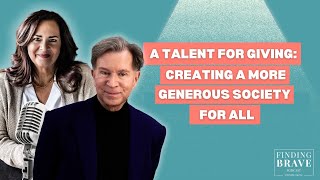
John Studzinski, vice-chairman of PIMCO, argues that giving isn't just for the wealthy. He says personal talents like time, networking, and empathy are currency for the common good. Start with what angers you, find a talent you have, and take modest action: volunteer, mentor, convene people.
Chapters
Young people are focusing on social media and they're hoping to learn something about themselves. This is a great way 'cause you get immediate human feedback. And actually human feedback is still much more powerful.
Hello everyone, this is Kathy Caprino and welcome to my podcast, Finding Brave. I've created this show for everyone who longs to create something bold and brave in their life, to rise up, speak up, and stand up for who they are and to reach their highest and biggest visions. Each week I'll be speaking with inspiring guests from all walks of business, leadership, entertainment, the creative arts, and the entrepreneurial world. And they'll be sharing their intimate stories of finding brave and offer their best strategies for building your most rewarding, joyful, and meaningful life, business, and career. Hello everybody. Welcome to another episode of Finding Brave. Kathy Caprino here. Once again, I have to say, I'm, I'm levitating pretty much to be able to speak with our guest today. And I think you're in for a very enlivening and deep conversation, not just about the topic we're going to introduce, but about life and about you and about your talents and about what makes you lit up and your passions and how we can use those for greater impact. And we have today from London, John Studinski. John, you're in the middle of your book launch, which is A Talent for Giving: Creating a More Generous Society That Benefits Everyone. Thank you for taking the time. I know this is probably number 100 on your book launch podcast tour. Is that right?
Ah, no, that's gracious and generous, but that's far too high. No, we've had a lot of conversations, but no two conversations are the same. And I'm sure this will be very, very unique.
I think it will. I hope it will. All right, people, what we are talking about again is John's new book. And I have a little description that I want to share as a way to highlight what we're talking about. The world has changed around philanthropy. But philanthropy has failed to change with the times, according to John and others. Once centered on communities and individuals driven to do good, philanthropy today has shifted towards large foundations and high-profile status plays like billionaires' mega pledges, etc. As millennials and Gen Z demand more from giving, philanthropy now needs to transform to inspire the next generation to make a more meaningful impact. And that is what this book is about. So I want to read John's bio because, you know, I think a lot of us think we're very busy and doing a lot of things. And I read your bio, John, and I just don't understand how one human being can do all this. And I, I want to touch on that later because I feel like that's embedded in how we live a meaningful life, which is how How we get done everything that matters to us. And you obviously have an enormous gift of that. So if it dovetails with the book, we'll talk about it. But everyone, I wanna tell you about John. John Studinski commits his time to business finance and philanthropy, managing director and vice chairman of PIMCO, sorry, the global investment management firm since 2018. He's also founder and chairman of the Genesis Foundation, a UK-based charity that supports emerging artists. How magnificent. He's also commissioner of the UN Commission on Modern Slavery and Human Trafficking and chancellor of Leeds Trinity University. In the US, he serves as a board member for the J. Paul Getty Trust, St. Patrick's Cathedral— I sang in St. Patrick's Cathedral for a year in the choir, oh, what an experience— uh, and the Foundation for Art and Preservation in Embassies. Right. Wow. And a member— I can't, I can't even believe it. And a member of the Council on Foreign Relations. In his philanthropic activities, he consistently emphasizes the importance of human dignity and the role of mentoring and active networks. You've been awarded so many awards. I'm going to stop there. But everyone, please read the full bio in the show notes. It's just so inspiring. And I really have to understand better how you're able to do all this. But let Let us dive in about your book. And I've watched quite a few discussions, and I now know you weren't planning to write this book, were you?
Kathy, it's serendipitous. Nigel Newton, who is the founder of Bloomsbury. Yeah. He's also the publisher of Harry Potter and J.K. Rowling. So he tends to have a strong intuition. I had written an editorial 3 years ago at Christmas for the New York Times about how the greatest gift you can give is to give yourself a sense of what your talents are and use those talents as currency, not just money, but currency along with time to develop and trust. To actually create your treasure, to give someone something. And whether it's volunteering, or if you get really emotional about something, create a project. Um, and you know, in the context of this, I had a lot of— the New York Times had an enormous reaction to this editorial, half a million, right? Yeah. And I got a lot of young people emailing me, and when I asked them what they were interested in, they said, well, what's— I'm not a philanthropist. A philanthropist is someone else. Philanthropist is someone who has money. Philanthropist is someone who has status. Philanthropist is someone who's reached the end of their career. Philanthropist is a 19th century idea. And I'd say, no, what are you passionate about? And interesting, Generation Zed, or Z as they say in America, their eyes glaze over. But when you say, well, what are you angry about? Or what do you think you can personally like to change? Then you get a long, robust list of things because people realize they are angry. They're concerned about climate change. They're concerned about democracy, concerned about the gap between the rich and the poor. They're concerned about jobs, AI, they've got so many concerns. So the next thing is, okay, let's use your talent. How can you use your talent to empower yourself for the common good? And then you get into a discussion about what is the common good. And the common good is, you know, the common good is a concept that's thousands of years old. You can find it in Aristotle. You can find it, you know, the beginning of the Lord's Prayer, Our Father. It's our, you know, the scriptures say our Father, not my Father, as God. And what does that tell you? It tells you that we're all in a community. So you have a role in a community. So what's interesting about this is I've had so many young people now saying, look, I've started to read your book, and one chapter at a time, and it's giving me some ideas that maybe I can do things. And what's also interesting, Kathy, is parents are reading the book to their children who are younger, and just to encourage them to do things like volunteer. Because one of the things I've been advocating, you know, I started a project when I was 6 years old. A soup kitchen with my mother, and I'm advocating that schools, as part of the curriculum, you know, with artificial intelligence, information is going to be available. And it's a bit like, you've heard me use the analogy, charity is about giving someone a fish, it's transactional. Philanthropy or entrepreneurial philanthropy is teaching them to fish. And it's like with artificial intelligence, We're going to have all the information in the world at our disposal. What we need to know is how to ask the right questions. And that's the same type of tools you need to think about how to create the right framework for the common good. So this is trying to— it's a call to order. It's a movement of trying to help people on a grassroots level, individual. And it doesn't necessarily mean You need to come from an upper middle class background. You don't necessarily need to have reached a point in your life. And as a matter of fact, I would encourage people to embrace their own talent and think, am I good at networking? Am I good at— you're obviously very good at communication. Am I good at finance? Am I good at organizing? Everyone has one or two talents, and quite often it's the talents that are buried that need a little nurturing that tend to be maybe your strongest talents. It's not often the things that you, you pick up in school or in sports. It might be things that over time emerge as a result of your own frustrations or your own emotion. So this is an interesting exercise for me. It's going further than I expected, Kathy, because I hadn't When I wrote the original article, I didn't realize where society would be 3 years later in terms of the serendipitous nature of this, that this is really, as, you know, as people are talking about large pools of capital, and look, this isn't a criticism of large pools of capital and philanthropy. They're doing great things. When I think of how many lives Bill and Melinda Gates have saved in Africa, through their projects fighting malaria. When I think about some of the other great projects that Mackenzie Scott are invest— is investing in, these are all great things, but this is trying to bring it back to the individual, right, to change. And also, the last thing I will say, and then I'll shut up—
no, I love it—
is, you know, the multiplier effect of giving is much more powerful than people realize. I don't know if you've ever volunteered or you've spent time with someone who, you know, I do work in prisons, I do work in a homeless shelter, but it's when you volunteer your time and you actually, you learn so much, not only about society and about humanity, but you actually learn a lot about yourself. And sometimes young people are focusing on social media and they're hoping to learn something about themselves. This is a great way because you get immediate human feedback. And actually, human feedback is still much more powerful.
I am tearing up, and so that means it's hitting 17 nerves that I just want to follow up on a few things if I could. When I read your book, of course, I think this happens when people read, they think about themselves.
Yeah, exactly.
And I felt a sense of, you know, you, if you know anything about my podcast, you know, we're just going real transparent, if that's okay with you. I'm laying it on the line. I felt shame. And I said, okay, why are you feeling shame? And, and I want to tie it back to that you're hearing from younger people, which really surprises me, frankly, because the world— well, I, I know you started writing this years before we're in what we're in here, but I digress. I felt shame because I realized my work is in the giving nature, one-on-one and groups. I'm a career and leadership coach, speaker, trainer. And what I realize is, and I'm getting really personal, sometimes when your work is all about giving, the impetus to give gets confused with making money. And that's where I felt shame. And it, it doesn't matter why I felt shame, but I did go back to my own childhood. And I adore my parents, they're in heaven, first-generation Americans, but it wasn't about who we could help. And I don't blame them. I mean, they were working hard. Dad was a GE guy for 30 years, 7 patents. But I was struck by your story that early on— and was it, was it your mother where you, you met someone, or your grandmother where you were in a park and you saw a homeless man and Um, what she said to you was so impactful. But why I bring it all up is I think a lot of us don't naturally have the impetus to be of help in a philanthropic way. Tell me what you think, because you're in touch with thousands of people. I'm dying to know.
I have, I have very strong faith, and that's of course a big part of it, right? But you have to remember, today everyone is conditioned to feel that if you see someone on the street, you better be wary because it's possible they could be dangerous, or it could create an awkward situation, or you might be criticized for confronting them. What my mother said was, we were walking and there was a very, clearly a very poor man who did need, who was very confused. And my mother stopped and engaged with him by just listening to him. And then she turned to me and said, um, now just remember one thing. You should always be prepared to give the shirt off your back because you never know, um, you may be confronting God or an angel. Uh, and you know, there's a— in Hebrews, in the Bible, there's Hebrews 13, it's called Angels Unawares, which whenever you meet a stranger, you never know whether it might be an angel in need of attention or help. And of course, we have the parable of the Good Samaritan as well. So I'm very conscious of, of putting myself— there's a wonderful expression called tactical empathy, of putting yourself in the position of the other person, thinking how terrified that person is on the street who's actually standing there begging. And put yourself in that person's position. Does he really want to ask you for money or no? He's not being aggressive. He's probably incredibly frail or embarrassed or fearful. And therefore you have to think about, well, what about— it's not about what about me, but put myself in that person's position. So I think so much of this notion of the common good is making us think that we're all the same. Some of us have more skills, more talent than others, and we have to find ways of marshaling our talent. Because I actually think as we go forward, it's not— it's about marshaling your talent and your time. And that relates to your question about time management.
Yes.
Your greatest gift from God that you have is actually not talent, but it's actually your time. You don't know how many days you have left on the planet, and you have to think about it. And that's that wonderful line, you know, if you were told tomorrow that you were going to leave the planet at noon, what would you do differently? And of course, the great line I always follow is, I wouldn't do anything differently. I wouldn't change anything because I'm quite comfortable with what I've done and who I am. And I certainly wouldn't go around the world and start telling everybody I'm leaving at noon. And I don't know, it's a good exercise because I do this sometimes in some of my classes with some of my students when we have spare time. You know, how do you think about, and you know, when you actually ask someone, if you're going to leave the world tomorrow at noon, um, it sometimes stimulates them to think, hmm, I better think about spending my time perhaps a little more wisely than using it like I'm wasting time. Because people waste time just to get from point A to B, and time is such a great gift. It really is.
So, gosh, I want to be a student in your class. So how do you And I really want to focus on the book as well, but I know you talk about this. How do you do all that you do? How is it humanly possible? And I'm asking it so that I can do more.
Well, you're kind to suggest that. I'm very disciplined. I get up at 4:00 in the morning.
There you go.
Okay. I get up at 4:00. I don't go— I go to bed at night at a reasonable hour, probably 9:00. Or 9:30 or 10 o'clock. And I'm conscious of what I'm doing throughout the day. I don't spend time, you know, I'm programmed in 30 or 60-minute blocks of time, but it includes time to pray and meditate. It includes time to walk the dogs. It includes time to exercise. Includes time to write letters. And then I do think penmanship is— and I do play bridge every day online with my partner. I love playing duplicate bridge online because it's very, it's very interesting. And it also keeps your brain, as you know, I'm 69 years old. And I think you've got to keep your brain as crisp as possible. And duplicate bridge is a good way of keeping your brain active.
So inspiring. All right. One more thing touching on what you said, and then I want to hear— I want you to think about for me, if people get only one strategy or message from this book, one, what would it be? But in a minute, and I didn't prep John for any of this, people, everything you just said right before strikes me as having a quality that I don't see as much as I wish I did, and it's empathy. And for me, I'm, you know, I had a corporate career, then I became a marriage and family therapist, then coach and writer. And in therapy, if you don't have empathy for the people that you're trying to help, if you are sitting in judgment of them— let's say they're beating their daughter, I had a client who was doing that— you can't help You cannot help sitting in judgment. So this empathy piece that you have, do you feel that empathy is critical in being a giver today? Do you think that's a critical part of it?
I think empathy is, you know, you have two eyes, you have two ears, you have one mouth, and you have to have that, that somewhere up on your forehead has to be the empathy sensor as, as part of just paying attention, putting yourself in other people's position, and not only doing it but trying to understand how they are reacting to you. Because you obviously, you're a very confident person, you're a very straightforward person, you communicate well. You know, and people have different reactions to me. Some people find me very formidable. Some people find me very sort of serious and formal as opposed to formidable. Some people find me hard to read. Other people find me very silly depending on what we're talking about. So it's very— and you have to sort of analyze the body chemistry. And I, I do, I am very perspicacious. I'm, I'm very good at reading, but I'm reading, I read people well because I'm empathetic. And I think if you're not empathetic, it's like having your eyes closed and your ears covered, and then it's worse than that. So it's like putting a bag over your head and not trying to engage. Empathy, it's the combination, it's the, you know, of all these things. But empathy really, and part of empathy is, as you know, the art of pausing in a conversation and including that great art of listening. Because listening and pausing, because sometimes people say, you probably are very good at this, And you're doing it well now. The more you pause, the more people talk.
Yeah, I love it. I don't want to hear myself talk. I want to hear you.
The more they trust you too. The more they trust you too.
That's right. Oh, I love it. All right, now back to that question. You know, as I said, I was taking notes. I have them all written down. You know, it went on and on. For instance, this is all straight from the book. Money is only generic versus talents and motivation. Or you need to be the real you in your giving. Oh, I wanna learn more. Or activating your talent, which is so, you know, I wrote a book recently, or was actually, it was 2020, on The Most Powerful You and how we close the 7 damaging power gaps that keep us from fulfilling our highest potential. And the first one is not recognizing your special talents. And the vast majority of people I work with, have no idea what their talents are, just as you said. So I have exercises too, but if you don't know what those God-given talents are that are special and unique, and you shun the idea that you have those, the impact you can have in this life is so much less. So it's, it's so aligned. And ambition versus humility and Mother Teresa's comment that you can only change the world one person at a time. It's really a primer for life, people. I really want you to read this book, but, and you are more talented than you know. Oh, I love it. But if, if people got only one strategy or message from this, because there's 10,000, what would you hope it would be?
I would like everybody to, to read this book one chapter at a time. Mm-hmm. Uh, and then pause. And after each chapter, you don't have to read them in order. You can read them in any order. Love that. Think about how it relates to you, but also think about how you as an individual can embrace giving as part of your ongoing lifestyle. The way, you know, the world has gone through a period of exercise. We now are very obsessed with diet. We're obsessed with climate and sustainability. But I think we now entering a period where fundamental giving on a grassroots level, and people don't realize giving— there's a chapter in the book called Power of Two, which is— and you're a mentor, Kathy, so you know this— the art of mentoring is very powerful because one mentor in my foundation, if we give someone a grant, they're obliged as part of receiving that grant to mentor at least 10 people. Wow. And then they are then encouraged to mentor those people and get them to mentor other people so that it has a domino effect. Because people still— there's a Generation Zed, or Z, is now starting to have a suddenly adverse reaction to social media, and they're, they're plateauing out on the use of social media. And they're going back to more one-to-one human interaction, um, which is good. But we want people to understand that human interaction is, is the most powerful thing we have. And in this age of AI, we're aware that, um, you have to understand human interaction is going to help you ask even better questions about how you can nurture the common good, how you can better understand yourself, how you can understand other people, you know. And I think the power of silence and listening will play a big role in understanding empathy and how empathy plays a role. People— the most important thing we lack in society today, and I was really thrilled to hear your word shame, because people don't use the word shame because they don't understand what it is. The other word people don't use enough because it's lost is trust. Trust is such an important thing, and you work really hard in the relationship. And if people could do one thing to change the world, it starts with your own personal relationships and building trust in a relationship. And trust is one-on-one. And as you know, trust is something that takes years to build, and of course it can dissipate in 5 seconds.
Oh, true.
Go ahead.
No, no, I don't want to cut off a word. All right, I'll ask. Why did the word shame resonate with you? How does that tie into the book and to what you're wanting people to do?
No, because it's very interesting. When Cardinal Hume and I started The Passage, which is a homeless center 40-plus years ago in London. He was walking around, we were walking around in the middle of February around the Cathedral Plaza, and he was a Benedictine by training, and he didn't want to be Cardinal Archbishop, but he became Cardinal Archbishop by the Pope's decision. But he said to me, people have no more Shame. No one knows what the word shame means because we were looking at all these homeless people that at that point they were all on the piazza in the middle of February freezing to death. And it's sort of like the word shame is like the other side of conscience. You know, you have no shame, you must have no conscience.
Yeah.
You must have no sense of human dignity and respect. And it's— that's— this is the whole point. And, you know, we have to— we forget we're all human.
Yeah.
And we all are vulnerable. And we get so much joy out of doing little small, small things. And that's why Mother Teresa's line, you can only change the world one person at a time. And even if people reading this book just get involved in starting weight, a simple use of their talent to volunteer their time. If someone asks you for money, Kathy Caprino, I always say, tell them you'll donate your time. And if they don't want your time, you don't want them because they don't appreciate you as a human being, as part of their community. And that's, you know, then you learn a lot about a project. You learn a lot about yourself. And you can decide whether you wanna be part of an existing project or over time, maybe you create your own or you get a group of people together and do something different.
I'm so inspired. I'm gonna get over myself and stop being so tired and, um, giving too much. There's, you know, you, you are so well-boundaried. I think maybe it's possible you haven't lived this situation where many of us who aren't as well-boundaried are giving too much and are beleaguered. We don't know when to not give. And I think this is not to be genderist, but I think women have this problem maybe perhaps more than men because of how we're trained culturally.
But women are biologically more naturally strong at nurturing.
Right. And so we sometimes overdo it.
Well, but the other side of all this is, and I wrote a chapter on this in the book because You can be a— and you're a very good giver. You can just tell by how enthusiastic you are. But giving is not very beneficial unless you understand how at the same time to receive, because you have to understand. And it's that wonderful line from the scriptures. It's give to somebody who cannot reciprocate. On the same level. And invite someone to dinner who can't invite you to dinner. Give someone something that cannot reciprocate. But you also have to figure out, how do I let them thank me? You know, is that in that story about the cherry? And in the book, I, you know, it's 2 in the morning and I'm on the piazza. I was taking a group of homeless men to McDonald's at 2 in the morning. Freezing cold in the wintertime. And I had bought them all hamburgers and food, and I bought one an apple tart. And then he came over and he called me Governor, and he said, Governor, do you think you could change this and get me cherry? And my first reaction was to say, what, you don't want apple? You know, why are you doing this? But my second reaction was to start laughing at myself, thinking, you know, he's a human being. Of course he wants, you know, he doesn't like apple, he wants cherry. But then it was his way of saying thank you because he was engaging with me of saying he really appreciated it. And I think we also have our own, have to be very careful because a lot of people in the world don't know how to say thank you. In our vocabulary. Wow. They know how to say thank you with their vocabulary, and we have to, we have to embrace that.
Oh, I love it so much. I would love to know from your perspective, what if nobody gave? What if we didn't care about the common, the common cause, the common— what, what would happen? What if it just all stopped? Well, I know this is a hard big question.
First of all, it's an excellent question because it's probably more prescient than you realize. If we're going in the direction of AI, we're going in the direction of robotics. If we're going in the direction of a nihilistic society, you know, George Orwell was worried about burning books, and Huxley was worried about people never reading again. But you get into a society where people are more and more nihilistic or narcissistic, and I think it evolves. It's potentially the end of humanity because we are a tribal civilization. We, we exist in whether it's the family unit, the community, the Greek plaka. People exist in and look at the Blue Zone work. We all know Blue Zones, people who live in communities and have a role live a long time, and it's unity and the nurturing value of the community. Plays a big role. So if people didn't give and they were not part of a network, I think it would be beginning of the ossification or the destruction of this species, this stage of the civilization, this version of the civilization. I would say there won't be another version, right? But it's, it's, we are very very dependent on each other, perhaps more so than we realize. And I think people don't want to say they depend on other people because it's seen often as a sign of weakness. It's not a sign as a weakness, it's a sign of reality that people are looking for people who are complementary, uh, not people who are the same, people who can bring something to them.
You do think people are looking for that?
Well, you know, it's that wonderful line in, um, I think it was Graham Greene's, um, Accidental Tourist. You remember that book? And it's a great book. And the couple, very high-profile, upper-middle-class professional couple, lose their child to a disease. And after 6 months after the funeral, they start to break apart. And he goes off and has an affair with a dog walker. Uh, they're both lawyers, and, uh, she confronts him, and he said, when we got married, you gave me things I couldn't give myself. I gave you things you couldn't give yourself. Then he referred to the dog walker. She— he said, right now we've become so independent and self-sufficient I can't give you anything you can't give yourself. You can't give me anything I can't give myself. Whereas the dog walker, she gives me things I can't possibly give myself, and vice versa. So it was an insight about how relationships, you know, and I think we're all that way. And that's part of this notion of giving.
I, I, it is spurring me in so many ways. I'm aware of our time. We have a few more minutes. That's such a thought. I believe I heard you say you dictated this book. Is that right?
I did. I would go into a zone and think about a subject, and I would dictate it into my phone, my mobile phone, and then I played it back and had it all typed up, um, because I, um, I really wanted to do it from my— the perspective of my heart and soul, uh, not my head. Because I think so much of the book is— it's all, as you've, you've read parts of the book, it's in the first person, um, so it's a bit of a meditation on different ways to understand how to experiment with enhancing your role in the art of giving. Um, and it, it talks about my mistakes, talks about lessons learned, it talks about insights in terms of myself. But the key thing is, um, it was— I dictated it because I felt it was going to be more genuine. It was going to be from the heart and the soul and not from the head. I think once you start something from the head, yeah, intuitively The intuition is lost.
Yeah, I agree with you. So I wanted to ask you this, you know, you may not use this terminology, but I feel like some of the best thinking I've had was a download, channeled, you know, from something else. So my question to you is, was there a chapter or a segment or a paragraph that was— that you were dictating that was coming out that you were surprised by? That you thought, huh, wow.
Well, it's interesting. I've gone back and looked, you know, when I went back and after I completed it, I put it in a drawer and looked at it 3 months later because I wanted to decide whether it was okay or whether it was a piece of rubbish. Because, you know, so much of things can be a piece of rubbish. And there are lots of chapters that I was completely in, you know, the chapter on Ben Franklin. I'm a great fan of Ben Franklin. I regard him as one of the great polyglots and polymaths and characters. But he, of course, has a wonderful quote about a life without giving is a life not well lived, or something like that. I'm not quoting him perfectly. And then the other channel that I, I learned many years ago, because I read Moby Dick by Herman Melville every summer, and I've read it at least 30 times. Um, and Herman Melville's one of my great heroes. And on his gravestone, Kathy, is a wonderful— I think it's Puritan inscription— you have what you gave, you had what you spent, you lost what you kept. Ah, so everything, Kathy, you've given, you'll have that forever. It's part of your personal balance sheet, it's part of your wealth. So if I can get your listeners to embrace the fact that their wealth will be enhanced not by how much money they earn, but by their— what they've given, because that's what they take with them when they move on. They'll always have that, and it's very, very powerful. Now, when I've told this story I was in Taiwan last week telling this story to a bunch of young people, young wealthy people who were all had read the book and they wanted to be young Chinese who were very inspired by it. A number of them were in tears because they said, that's so Confucian and we have to go back to being— it is Confucian. Wow. Have to go back to being focused on so much about our dignity is about what we've given, not what we've spent or what we've kept.
Say that again. So much of our indignity, or dignity. Oh, great. All right, I thought I lost it.
So much of what we've given is tantamount to our dignity, and not what we've spent or what we've kept. You know, I've met many wealthy people in the world, who don't give away much money. And I've said to them, shame on you, you have far too much money. Why don't you do more with it? And they say, well, my status in the league tables would collapse.
My gosh, that is one problem we have today, isn't it? Status is everything. I see it.
Status is associated with wealth. But actually, I think there are some brilliant philanthropists out there who give their time. Mother Teresa gave her time. There are some great philanthropists out there who've been transformational. When I look at what Michael Bloomberg has done with cities across America in terms of cultural and educational innovation, and there are lots of other great examples of people doing fabulous grassroots work. But more people can. And if people realized as a lifestyle matter, it would not only enhance their lifestyle, but it would be something they could carry with them.
Oh, all right. Just a few more minutes, John, do you have?
Sure.
I do want— because this is so chock-full, this book, we can go in 20 different directions and the reader can as well. Which is why it's precious. I would want to leave people with, if you're listening to this and you're moved in any way, if you get a tear coming or you think, what am I doing here? Why am I, why am I scrolling on Instagram for 2 hours when I actually— I'm not trying to shame anyone, but if you feel a stirring in your heart, where, what would be the one thing? I know you have so So many strategies. I wrote 52 of them down. Well, where would you have them begin? I mean, people will ask me that about the 7 damaging power gaps. I have all of the gaps. Where do I begin? I always say start with recognizing the amazingness of you. If you don't know that, if you don't feel that you have anything to give that's special, the rest of it's all gonna go to blip in a handbasket. But I'm interested in what you would say if someone says, yeah, I wanna do what he's saying. Where do I begin? What would you suggest as a doable strategy?
Well, we all respond to human stories and we all respond to the human condition. And I would say to people, first of all, what angers you right now? What upsets you right now? What troubles you right now? And then secondly, just think in a very simple way, of how you could begin to address that. People don't feel— there's a helplessness in the world today. People feel as though, um, government, yeah, do something, corporations can do something, the media can do something. No, no, no, no, this all has to go back to you as the entrepreneur to take more charge. I'm reluctant to use the word activism because the word activist has almost a destructive tone to it or connotation. I want to encourage people to be, you know, looking at human capital that being deployed through talent for the common good. And it's trying to identify your simplest talents and sometimes Your simplest talents are the things you take for granted.
Right, because they come so easily.
Your ability to communicate, your ability to convene. People have incredible convening powers today because they've learned a lot on social media. Wow. You can convene, and the power of convening is very, very powerful. You've seen it across the world in many countries. You saw it recently with Generation Z in Madagascar. Where they, the convening power very quickly. It wasn't about arms, it was a convening power and messaging that created a movement. So I think convening power is an easy one. But then you go into other things like communication and people wanting to share each other's ideas and listening to what they want to do. And I think there's a lot of ideas And, you know, sometimes the last thing I would say is, is people have to be tenacious about it and confident they can make a difference. And, you know, one of the things I say is knock on the door 19 times, and by the 20th time it'll open. Don't be put off. Don't be intimidated. Don't— that you have authority that God has given you that you don't use. And Everyone has authority. We know that from the scriptures, and authority is something we can use particularly to channel for the common good. And it starts on a— you have to start on a modest level. And sometimes it may just start with taking someone out to lunch and talking to them and getting their ideas. And if you don't know what you want to do, convene a small group of people and brainstorm.
I love it.
And create something in a group. And you know what? That will— that in itself, that process will be nurturing, and you'll be giving something to each other.
I love it. All right, 2 more minutes. This, this is an off— this is off topic of your book, but I wanted to ask you this. I work with a lot of people who are struggling with money. I have had struggles with money. It's disappeared. It's you know, things happen in the market or the world, or even, I'll be honest, you know, in our country where diversity, equity, and inclusion was— DEI was, you know, kind of stripped away, and that impacts a lot of people. Here's my question to you. Do you see a trend in terms of people who have an ability to amass wealth but use it for good. But the first part is be comfortable with generating wealth. I mean, I know you started after your MBA. It was at JPMorgan, was one of your first roles?
Morgan Stanley.
Morgan Stanley. Yeah, Morgan Stanley. Do you see a common theme with people who not only have been able to generate great wealth but are also able to utilize it in ways for the common good. Is there some kind of a theme that you see?
Well, it's, I think you're answering your own question, Kathy, to a certain extent. The book is about entrepreneurial philanthropy. And if someone has built their own business, sometimes they maybe should use the skills they've used in building their own business to build a project. I know a lot of very affluent people who've built their own business, but often they want to give people money as a transaction. And actually, real philanthropy, the art of teaching people to fish, is more of a partnership. It's a long-term relationship. It's a form of marriage. You have to see real giving as, you know, when you get married. Yeah, it's a partnership. It's an ongoing— you lock arms with the notion that I'm going to create a more generous society, and you do it in a way that is— it's just part of— it's like welcoming a new member of your family. Wow. And it's a sense of unconditional love. You have them, and that you're going to do that. And you might say, how am I going to— I can't, I don't have time. Make time. 2 hours a week. You know what, I know people who volunteer for 2 hours a week and it gives them 10 hours of blessings and joy. It really is. So don't— and it's the quality of the time when you volunteer, it's not the quantity.
And that giving aspect, again, shame here. Um, I think you'll be more success— one will be more successful in their own business endeavors when it comes from, I'm in partnership with you rather than you're a client and you're paying me and off you go. I mean, again, this is a primer for life. This book?
Well, there's a lot of— a lot has been said about that, and I believe young people, it helps them. Empathy is something— if you can be empathetic in your daily life, you'll be a very good business person, because putting yourself in the shoes of the customer or the client, very powerful. And it also teaches you a much more about yourself and where you can contribute and where you need a complementary set of skills to move forward.
I've got to let you go, but what— this was like a webinar training and a life class, and you're very kind, but, uh, I'm grateful for your interest. It is such an important book. So where do people go to soak up all your work. And, and to get the book, I know it's, it's coming out here, we said November 18th, is that right?
It'll be— it's already— you can pre-order it, I think, on Amazon Prime.
And I— where do we follow the rest of your work? Where do we go?
Where do we go?
I mean, what, what link do we send them to, to just soak up everything you're putting out is my point.
Well, you're nice to say that. I think you and I are both on LinkedIn, so there's some follow on there.
Wonderful. I can't thank you enough for the work you're doing.
Well, thank you. And thank you for your interest in Talent for Giving.
It's really a special, special experience. All right, my friends, thank you again, John, for your time and who you are in the world. I hope this this has inspired you, people. I hope it spurred feelings in you, because feelings do often make us act. And John's tip about, I don't know where to begin— well, convene and see where, where that goes. But I think if you're listening to this, it's a calling to you that there's more giving that you wish to do. And I hope this has been helpful. We would love to hear from you. I know you're too busy, John, to respond on LinkedIn, but wherever you see this, I hope you'll leave a comment and let us know what you got from it. Thank you again, John. Thank you so much. All right, everyone, have a wonderful two Finding Brave weeks, and we will see you next time.
Thank you.
Thanks so much for joining us today. And please don't forget to check out findingbrave.org for more programs, resources, and tips. And tune in next time for your weekly dose of Finding Brave.
More from Kathy


Elevate Yourself, Elevate Others, and Amplify Good | Chris Cooper | Finding Brave Ep. 334

Finding Brave Epis #333: How Leaders Can Harness AI Without Losing Their Humanity, w/Bennett Borden

Finding Brave Epis 332- How to Stay Brave, Valuable and Visible in the Age of AI, with Raman Rai

Finding Brave Epis 331 - The Power of Positive Disruption, with Dr. Patrick Leddin


Finding Brave Epis 330 - Being 40: Letting Go and Embracing Who You Are, with Stacey Lindsay

Disrupt Career Reinvention with Kathy Caprino - via The Disruption Lab Podcast w/Patrick Leddin

Creating Neurodiversity-Friendly Work Cultures: Simple Workplace Adjustments Matter

Finding Brave Epis 329 - How To Create a Neurodiversity-Friendly Workplace, with Kristen Pressner

Finding Brave Epis. 328: Reclaiming the Power to Trust Your Own Voice, with Dr. Cindy McGovern