Finding Brave 320: Be Yourself at Work: Show Up, Stand Out & Lead From the Heart, with Claude Silver
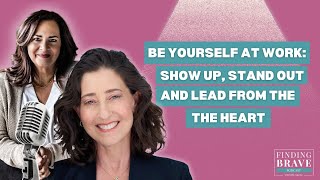
Claude Silver, VaynerX's Chief Heart Officer, discusses authenticity at work beyond the buzzword. She shares her three emotional pillars—emotional optimism, bravery, and efficiency—as tools for handling conflict and imposter syndrome, and argues that in an AI world, human connection and empathy remain irreplaceable.
Chapters
What I mean by that is I don't feel as though you're being you. I feel as though you're putting on a mask or a charade for me because you think I need to see you as la la la. I don't need to see you as anything other than you are because who you are is who I want to get to know.
Hello everyone, this is Kathy Caprino and welcome to my podcast Finding Brave. I've created this show for everyone who longs to create something bold and brave in their life, to rise up, speak up, and stand stand up for who they are and to reach their highest and biggest visions. Each week I'll be speaking with inspiring guests from all walks of business, leadership, entertainment, the creative arts, and the entrepreneurial world. And they'll be sharing their intimate stories of finding brave and offer their best strategies for building your most rewarding, joyful, and meaningful life, business, and career.
Hello everybody, welcome to another episode of Finding Brave. I feel like it's been a long time since I've connected with you, but it hasn't. But maybe just because time is so elastic right now, or so taffy-like. But anyway, here we are, and I am beyond excited to have our amazing guest Claude Silver here, who has a beautiful new book out. That, you know, I feel that everyone can benefit from reading, truly. Whether you're a professional, an individual contributor, if you run something, run a program, if you're a top leader, it really is so, so valuable. So I know we're gonna love this discussion, Claude. Thank you for coming here in the middle of your busy book launch. I'm thrilled.
Thank you, Kathy. I'm so happy to be here. And thank you for the wonderful compliments on the book.
Oh, it's so true. And I read a lot of books, so I can say that. Let me tell you all what we're talking about here. We are talking about how to be yourself at work, which is the heart of Claude's book. But let me tell you about her. Claude Silver is on a mission to revolutionize leadership, talent, and workplace culture. She is the world's first Chief Heart Officer at VaynerX and partners with CEO Gary Vaynerchuk to drive their success. Silver has earned Campaign US's Female Frontier Award an Adweek's Changing the Game Award. And she electrifies— and I can, I can, uh, I'm a testimony to that because I've been watching your talks wherever I can get them— electrifies audiences at national and international conferences. She is the author of— here it is— Be Yourself at Work: The Groundbreaking Power of Showing Up, Standing Out, and Leading from the Heart. Who doesn't want to know about that? But you know, of course, I get some notes um, beforehand, and a few things really stuck out for me. Um, but I want to dive in here first. This— and I didn't prep you on that, and we're okay with that. But Claude, there's so much been written about authenticity, and when I pore over your book, I feel it's— I feel it's different. But I'd love to hear how you think it's different.
What do you think?
What was missing in the discussion about authenticity? And I know I didn't prep you for that, but—
No, no, I actually think it's such a strong question because authenticity, like many other words, has now become very popular and overused in the zeitgeist, which is fine, right? Okay, so we're all talking about authenticity. There's nothing wrong with that. I think for me, it was very important to be raw, and real. That's what I think it is. And this is not a ding on anywhere else that it's written about or whoever talks about it. It just always felt a little theoretical to me rather than this is what it looks like day to day. This is what it could sound like if you're in a conversation with having conflict resolution. This is what it could sound like when you're with X, Y, and Z. That's what I, for me, that's what I wanted to really showcase was the, the how to do this. It's easy. It's easy if we really just spend some time thinking about, okay, well, where am I? Where do I feel most my, my most light self? Usually I'm feeling pretty much myself if I'm feeling pretty light. I'm not burdened by extra weight of hiding or armor or anything like that. And so for me, often I say to people, I actually say to people, who are you when you're brushing your teeth in the morning? There are no kids around, maybe no dog around. It's just you spacing out. Brushing your teeth.
Wow.
For me, that is very indicative of who we are when we are our real self. Maybe we have had our cup of coffee, maybe we haven't, but there's no noise. It is just kind of, it's just me in my natural habitat. Wow. And that to me is very real and, uh, doesn't have the pretense or the astrixes or Cliff Notes that sometimes you see when you talk about authenticity. It's just, hey, we're just real. And by the way, being real is a great thing. What we need more of is the acceptance, I think, that we are real. We do have lives outside of the workplace. We do go through emotions throughout our day, whether or not they happen with an incident at work or an incident— your dog got sick or your kid's sick or whatever. Like, We are human and this is the experience we're having. So why not be open about that?
You know, just what you said there, 52 things came to my mind and you address all of them in the book. But you said being authentic is easy. And, you know, it's almost like I can hear what our listeners are thinking and what half of them think is, no, it is not easy. Because I can't be myself. And I remember in my last corporate job, so I was in 18 years in corporate publishing, membership services, etc. I remember in this last job that I swear to you almost killed me. I said to myself, nobody knows who the real me is. Nobody. Like, I'm a singer on the side, you know, I had two little children. Nobody ever asked a question about me. And, and it wasn't that I didn't ask about them. Nobody really knew the real me, which is an interesting way to put it, because obviously I didn't feel like the real me in that job. But you said, and correct me if I'm wrong, if I'm misquoting, you recognize it's a privilege to be able to be authentic in our work. Did you not say that?
1000%.
Can you talk about that? So for all the people who say, yeah, you can say that, Yeah, but I can't be authentic.
Can you talk about that? Yeah, I can say that today because I've actually worked on it for 30-odd years. Right. So I want to break that down for a number of reasons. Number one, I am a privileged white woman and it is easier for me in many doors that I open to be fully me. And I recognize that I don't have to— I don't have to be concerned about an accent necessarily, skin color. You don't know what religion I am about. I have privilege. And so right there, it is a privilege that I'm recognizing. I have an open door and a lot of people don't. And that adds an extra layer of, let's just call it weight, burden, complexity, you know, just yuck to people not being able to feel like they can be them, their true selves at work or their true selves, period. The other thing is, This happens with self-work. This happens with awakening. Today I spoke to 20 16 to 18-year-olds that came in to learn about marketing and advertising.
Wow.
And what was so wonderful is I asked every single person to go around the room, tell me your name and tell me your passion. That's what I wanted to know. They all had a passion. The funny, the funniest thing for me to witness, it wasn't like funny, haha, but the 16-year-olds were very, very excited. The 18-year-olds were a little bit more ambivalent. They're getting ready to go through a big life change. They're gonna graduate. Maybe they're gonna go to school to get a job, all of that stuff. They were not half as excited to share their passions as the 16-year-olds were.
Were they more confused about it, do you think?
They, they were either more confused or felt like that maybe they shouldn't be so compassionate about it. So the 16-year-olds, cheerleading. Soccer. Someone said Jesus. And then as we went around the table to the older people, it just got softer and more subdued. Wow. And, you know, you recognize those types of things. And maybe, listen, maybe they were more shy in my presence. Maybe they were shy in their, in their, uh, their friend group. I don't know. But wow, I think that it is an enormous privilege to get to know yourself. That is what I mean. And that is something that is our birthright. Whether or not you do it or not is up to the person. For me, in my late adolescence and my early 20s, I was so confused and turned around that I didn't know what else to do other than to figure Claude out. I, I left college. I was like, I cannot do this. I need to go figure myself out because I'm going nowhere fast.
Wow. I was going to ask you, you know, I'm a former therapist too. When people do this kind of work and you can feel it, folks, even— I know I'm waxing poetic, but even when I haven't met you before, but even when you came on the call, you said, how are you? And I think I brushed it off and said something else. And you said, how are you? You know, not in a brusque way, but Who says that? Who really is asking a stranger, "How are you?" Everything you say, and there's a story in the book I want to talk about too, it truly is authentic. And you probably agree with me, I wish we had another word for it because it's gotten so misused, misunderstood, so hyped. But what you have is a realness that I can feel that you're connected from the heart. And I was going to ask you what happened in childhood that led to that, or early life. Was that the college piece, or—
well, it all— I think it was much earlier because I really, I struggled with dyslexia. And what I mean is, like, by 8 years old, I was already getting tutored. And so I didn't feel like I fit in anywhere. It was very apparent to me that I wasn't getting reading as fast as everyone else. It was apparent to me that I was going to a tutor 2 times a week, you know, and my brother wasn't. Like, I was just aware of that. And, um, and so I didn't have a home when it came to being smart, quote unquote. I didn't fit in any place there. I fit in great as an athlete and a great friend, and I knew that. Like, I knew that at a young age, highly intuitive and empathetic, but I was not empathetic towards myself. There was a, a just like Swiss cheese inside of me is what it felt like because I did not have a center. I did not have anything to hold on to because I thought you hold on to what it is you like, you get accolades for.
Oh wow.
Good grades, having the teacher write a good report card, or, you know, obviously getting into good schools. And those were things that I used as, uh, um, evidence that I was a black sheep, evidence that I was an underdog, evidence that I was dumb. That's what happened. And I carried that through, that lack of confidence in myself, through, you know, into college. And then when I left college is when I, I really was like, all right, listen, the rubber is going to hit the road here because you are not going down that road. Like, I'm not going down the self-sabotage road. It's too easy. It's too enticing. And it's also lazy. That's for me.
You thought that yourself.
Yeah, I was very aware. And that's not to say, as you read the book and, you know, I went on this, you know, amazing 93—
Outward Bound, right?
Outward Bound. That's not to say that life just got beautiful and utopic afterwards. I mean, getting rid of self-sabotaging behaviors takes a mini lifetime. You have to really decouple why. So yeah, I had many, I had many opportunities in my 20s, I would say, and early 30s to finally be like, huh, this is what that pit looks like. Hmm. I don't need this pit anymore. That goes into the river. I'm not going to carry that. And I'm going to look for evidence in ways in which I am you know, a bright human being in which I am a light, in which I am, uh, you know, radiate joy and radiate possibility rather than be a drain on myself and others. So I'm waxing poetically as well, but to answer the question, you know, we're influenced very heavily, uh, as children with our family. We're also today— oh my God, social media and media. So we didn't have that, but, um, Wow, wanting to fit in, wanting to be like one of the gang. And I was a tomboy also, and I, you know, I just didn't— yeah, I didn't know my way around.
Wow, what a story. And there's one other story from the book that I want to point out because, boy, that grabbed me. But then we're going to talk about your three pillars of, um, you know, emotion and what is authenticity, what is it, what it isn't. But You mentioned about your Outward Bound trip, and you'll talk about it, I hope, for a minute. But oh my God, it was so grueling. You're falling behind. You're— it's in a bad place. You're crying.
Oh my God.
And the coach comes down and says— no, he says to you, what's going on in your head? Tell the story. I love what she said.
Oh my God.
It was such a life-changing—
what a— what— and what a lightbulb moment. Yes. Day 1, Outward Bound, Colorado Rockies. I'm with 9 young men. I'm the only young woman. We're all 18 to 20 years old. We're all carrying 80 pounds on our back.
And you've done that before?
No. And remember, I had just left college. I had been doing drugs. I had not been taking care of myself. I was wildly out of shape. So no, I had not done that. Um, which is why I chose to do the hardest thing I could find to like shake my wake myself up, shake myself up. So here we are, we have to climb 1,000 feet, and in higher elevation, like 11,000, 12,000 feet, you have to step, take a breath, step. It's very— it's monotonous work. The guy is just like sped up the hill like nobody's business, right? They're in the prime of their life, and I am struggling just to traverse up this peak, right? Snowing, I'm freezing, I'm hating life, and I'm freezing, and I'm raining, and whatever. And the instructor comes all the way down, and I had a female instructor.
I'm loving that, I'm loving that.
She looks right at me, like, I— here's my face, and I mean, she's a foot and so away from my face, and she looks at me and she says, what's going on in your head?
That's the question.
What's going on in your head? I mean, what a question to ask.
That's a question we all should be asking 100 times a day of anybody we know.
And, you know, being, I don't know, very simplistic, I said, well, I'm, I'm singing the song by Nine Inch Nails, you know, Head Like a Hole, black is your soul, I'd rather die than give you control. And she looked right at me and she said, well, you better get another song in your head. And that was it. And that—
what did that mean to you?
What it meant in the moment was, I'm confused, I don't know what she just said to me, but like, probably F her. But what it meant probably 2 and 3 days later when I started to feel a little bit better was, oh shoot, all this time I thought someone else could change me. Ah, that's not— that's not what happens. I have to change the song. She can't give me a new song. I have— I'm the only person that can change this mind. And for a very long time through adolescence, I had thought that, oh God, if only I can get a microchip implanted into my brain and then I'd have a great memory and do well on SATs and all of those things. And here she is saying, you have the power to change your mindset. That's what she said in my words today. So do it.
Goodness. And you are the only one who can do it.
The only one. And so that is something that was the first time I actually had that breakthrough. I had, you know, 90 more days to continue to evolve with that spirit and really start to understand me, who I was, any noise around me. Right? It was quiet in the wilderness. There's no transistor radio, there's no cell phone, all of that. So it was an enormous breakthrough and something that obviously has stayed with me today. And, you know, I use a lot when I talk to people about their imposter syndrome or their limiting beliefs in terms of like, what are you saying to yourself? What are you saying? What, what is that song? Because like Nothing wrong with Nine Inch Nails, but it sure isn't like the Beach Boys or like Pharrell, Happy. It's like, turn it down. It's hardcore.
Wow. That is a fantastic story.
All right.
So let's start with, I mean, I, I hope you can feel it too, people. I feel like I could tell you anything. I could walk into your office and literally tell you anything. And what I would get from you would be heartwarming, heart-opening. That's the feeling I get. But let's talk about what is authentic presence. How do we know we're in that or doing that or giving that? How do you define it?
Well, again, I think authentic presence is going to look and feel different to everyone based on who they are, how well they know each other. I'm sorry, who they are, how well they know themselves, or are they on the journey of getting to know themselves?
Sure.
That's the deal. Because if you, if you said to someone, I said to this person right here, I don't really feel like your, your presence is authentic right now. What I mean by that is I don't feel as though you're being you. I feel as though you're putting on a mask or a charade for me because you think I need to see you as la la la. I don't need to see you as anything other than you are because who you are is who I want to get to know. Who you are is who I'm going to hold space for. I don't want you to act like a PhD or pretend that you have a following of a million people on social media. I don't care. I care about you, and I care about how you're treating yourself and how you're talking to yourself. I care. That's the presence I'm looking for. Who— it goes back to brushing your teeth or something very simple like that. Who are you at the end of the day when you get into your car to go commute home? Aside I'm exhausted. Who are you? Where are— where are you? Do you ask yourself, what do I need right now? What do I— what do I need? Do I need a hug? Do I need loud music? Do I need caffeine? These are the things that are so incredibly easy for us to gloss over and pretend that we need nothing or we don't deserve to need anything. You know, a lot of us have grown up in that way to not make a fuss, not rock the boat, put your head down, get through it. I don't think that's healthy.
Two questions with that, and I'm going in a lot of different directions. I know this will be different from your, you know, other interviews, but I hope that's okay.
This is perfect.
Oh, wonderful. I think you're an HSP, a highly sensitive person. I— have you heard that term?
Oh yeah.
I had André Solo, who's the founder of Sensitive Refuge, on the show, and I've always known I could sense things. I'd walk into a room, a meeting, oh, she's upset, he's angry, they're checked out. And I always wonder what's going on? Why do I know that? And I think there's a number of reasons, but you do feel to me like an HSP that you can sense. You're wearing a mask. Why are you wearing a mask? Has that always been the case for you?
At a very young age. In kindergarten. I can remember the first time I felt someone's energy. The funniest, crazy— is she and I ended up at the same college freshman year. I hadn't seen her since kindergarten. No.
Wow.
And we saw each other, and it— not that it all came flooding back. I mean, I was 5, but I can remember today to this minute what that was like. I can remember what she looked like, almost maybe what she was wearing, and remembering that she felt very, um, not only shy, fragile as a 5-year-old, or even later. Yeah, later too, but as a 5-year-old.
See, you're in a heavily HSP.
I was aware of that. And wow, I was aware of that. Now The part of me that I had to unlearn later in life is there's nothing I can do about that other than hold the space and walk beside someone. If that's the case, I can't change that person, which took me a mini lifetime to figure out.
So there's a little bit of fixing, wanting to fix.
Oh yeah. Oh yeah.
That's one problem when we feel so much. It's hard to just go, well, there it is. Wow. Fascinating. The other thing I just wanted to say. You know, you talked about— I don't care if you have a million followers. I'm saying this, this is not a braggerty comment in the least. You know, I have a big thing going on on LinkedIn. It adds to a million followers. And what I see, Claude, is what people think I am because of that.
You got that right.
Boy, do I not like that. Yeah, because I'm not that. And so they'll reach out in a way we won't go on forever, but they want something. Not everybody, please. I love my followers. I love my listeners. But you can tell when someone really cares about you as a person and when they just see a number.
Yeah, that's exactly right. And I would say I'm going to add a little bit of something to that. So it doesn't happen so much here at work because I am on the floor with people and they know I am as goofy as goofy can be. Right. And I sing out loud. But after a keynote or a fireside chat, anytime I get off of a stage, let's just say, quote unquote, people come up to me and I know they think I'm something I'm not. Whatever they see, they see me as something. What I always want to share with them is I am me. When they're like, oh, I want to be just like you. No, no, no, no, no, you don't. You want to be like you. I'm me. I got this. You want to be like you, you know, and pumping people up that way. And anyway, so I can relate to what you're saying.
What a fantastic role you're in. And Gary really saw that, didn't he?
Wow. Yeah.
All right, now tell me, tell, tell us about the pillars, the three pillars. Help us have a system to understand what do I do here. Helen.
So I'll tell you, uh, the, the three of them are emotional optimism, emotional bravery, and emotional efficiency. The reason why I put emotional in front of each and every one is because I'm emotional. We are emotional. There ain't no way out of that. We are emotional creatures. But what we know, if we are learning about ourselves and, and listening to you and listening to Dr. Susan David, is Emotions are guides. Emotions are data. It is not who we are. I am not a sad person. That situation made me sad, and I'm gonna unravel that to figure out why. That's self-awareness, right? But by no means am I a sad, depressed person, and I'm not gonna leave my house. No, situation made me sad, angry, happy, whatever. The optimism is belief. Optimism is hope. Optimism is entrepreneurship. Optimism is possibility. If I am having a sad experience now, I am not going to stay sad. Why? Because I believe that I will get through this through talking to my friends, talking to a coach, talking to a therapist, writing in my journal, talking to whatever. I am going to get through this. I have agency and accountability to myself to not stay stuck. And to know that the sun's going to shine tomorrow. And, and I, and at the end of the day, I believe enough in myself to get through this. The emotional bravery is then, yes, and I believe in myself enough to get through this. And I'm going to take an action, a brave action, which means the conversation that I had that left me feeling sad, the person that just interrupted me 3 times in a meeting, I am going to have bravery and courage, even though I might be shaking in my boots, to go up to that person and say, I know it wasn't your intention, but you interrupted me 3 times in that meeting and it really made me feel invalidated. Something like that. I'm going to take an action. Bravery, moving forward. And then the emotional efficiency is the speed at which you will eventually get through these things so that it doesn't drag you down. Once I see that, A, I can get myself out of a sticky situation, B, I have agency and I can use my voice to say, you know what, that really hurt my feelings, or that feedback that you gave me yesterday, as you could tell, I was really shocked by it. I'd really like to talk to you about points 3 and 4 when you have time. Then the more I do that, the faster I get, and I don't have to get dragged down into this crazy drama. Of me, Claude Emotion, or if I'm on a team, of team emotion, right? Because the idea here is the more you do the optimism, the bravery, and you build the efficiency muscle, then you build resistance, resilience. You build more authenticity. I think for sure you build more autonomy. You build just more confidence in yourself that you don't have to get stuck As we have gotten stuck so many times. So those are the pillars. It's literally—
Oh, good.
Without them, listen, without them, with emotional optimism, I believe without the, um, the fuel behind it can turn into toxic positivity.
Oh, such a, such an important point. I want to ask you about that, but I just do have to say, you know, my latest book that I mentioned came out 2020. It's called The Most Powerful You. It's about the 7 damaging power gaps and confidence gaps that negatively impact 98% of women and 90% of men. But the point is, the flip side, the bravery-boosting steps are brave sight, brave speak, brave ask, brave connection, brave challenge, brave service, brave healing.
Wow.
It's everything, I think. I can't wait to do another edition of the book. But the point is— When you have those bravery chops.
Yeah.
It really does change everything. It's the resilience. It's also boundaries because there are going to be people that don't want to hear your honest opinion. Sorry that you didn't like what I had to say in that meeting, but man up, they might say, you know. Yeah, get tough.
Yeah.
And so, wow, that my authenticity didn't go very well there. We can't fall apart. Not everything is what we can control.
Thank you. No. And especially in the workplace. And that's the thing. I can't control that that person is going to freak out in that next meeting. But what I can do as a fellow human being is check in with her afterwards and see how she's doing and see if she wants to talk. I can do that. Perfect. So human. Any— it's so human.
It's so human.
And that's the authenticity that is it is, it's, it's just speaking, speaking human. It's speaking human. It's understanding, you know, human literacy. It's, it's, it's emotional fluency. It's understanding that we all speak the language of emotions, like it or not. Some of us, I think, have an easier time with it because we've spent more time understanding our own emotions. Others don't. That's okay.
Do you hear in your talks— wow, I didn't prep you on this at all. Um, I mean, well, you, you of course do talk about an AI-driven world, but years ago when I was studying to be a therapist, there was a research study that you've probably even heard of it. A lot of people have. Um, it was actors behind a closed wall and they brought in participants to this lab and told them that these people were being shocked. So the participants had a little button and they were told to keep turning the knob until they heard something. So that was what they were supposed to do. And as I understand it, screams were happening. They were doing it. They were doing it. But what— wow. You know, nobody got up and left. I don't think maybe one out of a lot of people. I'm not doing this. But a lot of that research showed that when you're not physically in front of someone, you're not seeing them, you are much more likely to do harm. So when we're talking about human, I think even the definition of human has morphed. I think that some people would say, I don't really want to be human right now. Look what human looks like. Do you ever hear that in your talk?
Yeah. Oh, yeah. I mean, I hear that and I hear more just like, look at the world today, more of that kind of stuff. Right.
And how do you address that?
Well, I'm really glad you asked that question. I am never going to deny someone's experience because I can't. And I just see things a little bit differently because what I choose to concentrate on. That's not that I am, uh, ignorant and I don't understand what's going on with the new administration. I do. I don't spend a lot of time there. I don't. I understand the essence of what is happening to human beings. And so I am going to do myself and the world service in putting, putting a different message out there, rather than balance, rather than reinforce by Love it.
Now talk about, please, leading with heart in an AI-driven world. I mean, I'm sure you're getting 10 billion questions about this. I feel dehumanized is what people say. How do you handle that?
Well, I would say we're in the wild, wild west. The difference here between now and either Y2K or the advent of the internet in the '90s is Things were slower then. Now, every single day there is more urgency, more urgency, more fear, more anxiety to figure it out. Am I going to lose my job? Am I going to, am I going to, am I going to, right? We already have so much loneliness in the world. We already have, you know, young people that don't know how to read or write. They only know how to do shorthand, all of that stuff. So like, there's a lot. There's a lot to it. I feel as though the more humans can equip themselves in understanding this technology, the better we are going to be for it in a lot of different ways. One, the technology is fast and it creates a heck of a lot of efficiency. And by no means do I think it takes the place of a friend, a therapist, or a parent, but I think it can be a great you know, student teacher sometimes, right?
Or research assistant or whatever. Yeah.
It's not telling me anything new. It's aggregating what's out there. It's not telling me what, you know, I don't know what the next invention is in molecular science tomorrow, but it's going to tell me what it was yesterday. Those are good things for us to know. AI, as far as I'm concerned, in my lifetime, or at least in the next 20 years, I do not think is going to be doing what you and I do. Which is, even though we're on a screen, creating an intimate setting. You and I are looking at each other. I see your body movement. You see my body movement. I know that we are in this together. Right? I see your smile. You see my smile. AI is not gonna be able to put their arm on someone's shoulder and be like, I got you. I got you. And we gonna do this together. It's not gonna happen. It's not. And so I want people to know there is a real reason we are here, here, humans, we are here. And I think we are here to do something marvelous and miraculous with this world before we leave it. And maybe that is to invent AI and maybe that is to do X, Y, and Z, but it's not to get rid of the essence of who we are, our skin, our red blood. The fact that I cry at movies, what, AI is going to sit next to me and cry? You know? No.
I love it. It's such a positive view. I love it. All right. I know you have to go. Can I ask you to wrap up in this way? If people who are hearing you talk and reading your book get only one thing from it, one step or strategy, or I know this is not easy. What would you hope it would be?
Take up space. Be big in the room.
Tell us more. What does that look like?
I see so much shrinking in the workplace, shrinking in life when we're afraid and all of that. We are, we are, I don't listen. I think most, I think, I think of us as miraculous human beings, right? And I choose to think that way. And I think that we all have something to give. And I don't think we're all very that, that, that, that different from one another. Our lived experience is. Please take up space. If you have something to say, say it. All I ask on the workplace is don't spill it. Say it. Ask questions. Add your two cents. If you're in the room, Be big in the room. Share something. You, you have an idea that no one else has mentioned. I'm sure of it. That's what I mean. And I mean that for kids, adolescents, doesn't matter the gender, doesn't matter anything. Speak up and speak out about what it is you believe in, coming from positive intention, and, and be heard. And then see what happens around you.
Oh, I love it so much. And the final question is, anyone who's leading anything, and I don't mean, you know, has to be a Fortune 50 company, who's impacting people, what do they need to stop doing right now? What is it?
Pretend you know everything. Pretend you know. She knows. Listen in the room. Because you're not. The room is the smartest. It's the sum. You're not the smartest. I'm not the smartest. You don't have all the answers just because you have a C-suite title. Not at all. So let's get humble. Let's be learners.
That's beautiful. Any other final words you'd love to leave us with?
I, I just want everyone to, uh, to have a very healthy and happy New Year and take care of themselves and their loved ones and when you're thinking of that person, instead of just thinking about them and moving on, just send them a quick text and say, I'm thinking about you.
Oh, I love it so much. Thank you for this book. Thank you for what your energy, your spirit— everyone who comes in contact with you, I think, is quite fortunate. Thank you.
Likewise. Thank you so much.
And where do we soak up everything? Where do we send— what link can we send folks I'll put it in the notes, of course.
Please go to my website, claude-silver.com. Uh, I'm vocal on LinkedIn. I answer everyone that, that gets to me. It might take me a little bit of time, but, um, I love hearing from people and, and knowing what's up, what resonates, you know, what their questions are.
Fantastic. Thank you again for being here, and I wish you all the best and a wonderful continued book launch in the world. Now the world has it, as you said. Oh, That's a fantastic feeling. Everyone who reads it is lucky. People, we'd love to hear from you. I can almost sense what you're thinking. We wish we lived in the utopian world that all authentic behavior is loved and appreciated and welcomed. And we know it isn't always, but that doesn't mean we're not gonna keep trying. But we'd love to hear from you. What's working? What isn't? What did you get from the book? Please leave us a comment wherever you see this or reach out to Claude or me if I can be of help. We would truly love to be of help to you. And I am so grateful to be in community, the Finding Brave community with you all. I'm wishing you a wonderful 2 weeks and we will see you next time before the new year for sure, I hope. Thanks. Bye now.
Thanks so much for joining us today. And please don't forget to check out FindingBrave.org for more programs, resources, and tips. And tune in next time for your weekly dose of Finding Brave.
More from Kathy


Elevate Yourself, Elevate Others, and Amplify Good | Chris Cooper | Finding Brave Ep. 334

Finding Brave Epis #333: How Leaders Can Harness AI Without Losing Their Humanity, w/Bennett Borden

Finding Brave Epis 332- How to Stay Brave, Valuable and Visible in the Age of AI, with Raman Rai

Finding Brave Epis 331 - The Power of Positive Disruption, with Dr. Patrick Leddin


Finding Brave Epis 330 - Being 40: Letting Go and Embracing Who You Are, with Stacey Lindsay

Disrupt Career Reinvention with Kathy Caprino - via The Disruption Lab Podcast w/Patrick Leddin

Creating Neurodiversity-Friendly Work Cultures: Simple Workplace Adjustments Matter

Finding Brave Epis 329 - How To Create a Neurodiversity-Friendly Workplace, with Kristen Pressner

Finding Brave Epis. 328: Reclaiming the Power to Trust Your Own Voice, with Dr. Cindy McGovern