The Best Way To Rapidly Accelerate the Growth of Your Employees, with Sumana Rajagopal
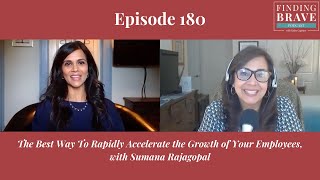
Sumana Rajagopal on what managers can do to accelerate employee growth: create dialogue, ask pointed questions, and give people space to reach their own conclusions. She shares how vulnerability and understanding each person's mix of professional and personal drivers builds trust, and why managers should identify what's actually the employee's problem to solve.
Chapters
Hello everyone, this is Kathy Caprino and welcome to my podcast, Finding Brave. I've created this show for everyone who longs to create something bold and brave in their life. To rise up, speak up and stand up for who they are and to reach their highest and biggest visions. Each week I'll be speaking with inspiring guests from all walks of business, leadership, entertainment, the creative arts and the entrepreneurial world. And they'll be sharing their intimate stories of Finding Brave and offer their best strategies for building your most rewarding, joyful and meaningful life, business and career. I so appreciate you being here. And speaking of appreciation, I am so thrilled to share that Amazon Music is now a sponsor for Finding Brave. So if you feel, as I do that music is an important, enriching part of your life and you would like unlimited access to safety. 70 million songs today. I hope you'll hop on our special link which is getamazonmusic.com finding brave and get our 30 day free trial offer. Again, unlimited access to 70 million songs. That's a whole lot of music and a lot of listening. Joy. Thank you again so much and enjoy the show.
Hello everybody.
Welcome to Finding Brave. Another episode. How are you this week? As I say every time I know you get bored of me saying it. I am so thrilled and honored to have our guest today and I can't tell you why. I can't wait to tell you why I have this amazing guest because there's a little bit of a personal story, but we have Sumana Rajagopal.
I hope I said it right.
Sumana, you're with us. And we are talking about investing in others, how to achieve rapid acceleration of employee growth. And I'm so thrilled to be speaking with someone who lives and breathes and embodies this. Because, you know, we were just chatting earlier when you speak to a lot of people and there's a lot of illustrious names and this is not to cast aspersion at all, but sometimes I find that even illustrious best selling authors sometimes are saying things that I think we've heard before but yet we don't quite understand how to demonstrate and embody these things. Like as we were talking about, you know, I had Howard Behar, the Amazing Howard on servant leadership and I asked him, what is it and how do you do it? Because, you know, we'd all be millionaires for every dollar, you know, we would get. For how many people have written about servant leadership in a way that I think that is hard to grasp. So that's why I'm so thrilled to have you here Sumana. And before I read your bios, I want to tell you once again because we've talked about this. I have a colleague who over the months and years we were working talking about career growth, leadership and she mentioned her boss and she said things about this boss who's Sumana, of course, that I literally am not jesting. I've never heard someone say about their manager in my entire life. And I certainly can say I never had a boss like you. And you know, just a few things that were said were that you recognized what her sweet spot, swim lane, natural talents, gifts were in a second. But you also recognize some behaviors that kind of put her in a. Put her. How would I say this kind of under a bushel. How the light was her potential. Well, there you go. But I think also didn't help her shine her light.
Light. Right.
And you know, she also mentioned that she believed that you believed she could do anything and go anywhere.
I still do.
People. How many bosses have you had that are like this? So I mean I get choked up because I think it's so very rare. And that's why you are the person to speak to us about how do we, how do we do that with people? I mean that's not just doing a lot of talking here, but that's not just cheerleading them. So you're going to tell us everything about how you do this and you're in a new role and you're doing it again. I know.
So let me tell you about Sumana.
Sumana recently returned to the place she credits with learning what it means to put people first. She is fortunate to have found her calling in media and advertising. They're fortunate to have you and is able to put that passion into purpose at Merck Pharmaceuticals. It was there that she found that fostering her own growth included managing employee development to create sustainable business and drive competitive advantage in a corporate environment. With over 26 years of marketing experience working for three Fortune 500 companies, Sumana's career, career focus has been in media and marketing. She has found success by fostering an innovation agenda and speed to market. You're going to tell us what this all means through rapid reapplication of best practices from local to global markets. And her true passion lies in working with business teams to develop media strategies using data and insights to create demand, maximize returns and build profitable business and uplift everybody you interact with at the same time. So can we please dive in to and where do we begin? How do we dimensionalize this? I think maybe let's start with. Because you're new in this role and you've worked with, you know, four, three Fortune 500 companies. You started to tell me that you see instantly. How would you put it?
I said universal truths. And this is definitely a marketing advertising term is we're all. When we build communications, we're always looking for that one thing that resonates with a lot of people. Like the most people that you can reach. Right.
And are you trying to find that as what the audience sees as a universal truth or.
Yes. A lot of it has to do with, and I believe it's this melding of professional and personal, and it's on overdrive because of COVID We're at home.
Yeah.
There's no break points. It's all one thing. So, you know, I have always loved a separation between work and home, and I've enjoyed that. I've enjoyed being professional and progressive in the workplace, but also keeping my work life, my. My work and my life separate. Unfortunately, that is not something that we can do anymore. And I think Covid. Talk about rapid acceleration. Covid has rapidly accelerated my need to get to understand what drives and motivates my employees. And the thing that you guys were talking about on your servant leadership podcast was embracing the whole human right. And I've never had to do that before. And the colleague you were talking about, I now that everyone was home and everyone was challenged in numerous ways, whether it be a parent, a child, a spouse, enough space to work and play in, cutting off work, cutting off home. Right. Now that we were faced with these challenges, it was all melding together. So that's where the rapid acceleration becomes really important because you could see these trends generationally. You started to see people come in and set up boundaries. I have my yoga class at 4:30. I will be leaving. And people always said, oh, the millennials. I'm like, no, no, time out. Let's not. Let's not do this generation. Let's not create divides. And I think that's where what I see in business, there's us and there's them. There's the ivory tower and there's you. And you know, we, in our first conversation that we had, you talked about, how do you. How are you so courageous? Yeah, like, I'm not courageous. I just do what I think is right. And I never saw doing what I thought as right, as being courageous. And I make a lot of mistakes, Kathy, a lot. But.
Okay, but let me ask. Let me get into this with you. Let me understand, because part of how you speak is very coach like. And what. What I find really interesting is you tell me how you do it. But if. Let's say I'm. Let's do it. Let's say I'm your employee and you sit down with me, and pretty clearly you see. Let's say you see that. I mean, these were the challenges I went through in corporate life. No work life balance. I didn't know how to do it. Number two, it was less value proposition. I knew what I was valuable at doing. It was that I didn't find any meaning in it, which I bet you heard.
Mm. So when.
What's that?
Why am I here? What am I doing?
Why am I here? I mean, okay, I want to sell stuff, and I'm learning, and there's some great things, but personally, I'm not finding meaning when. You don't have to coach me now. But I'm wondering, do you go to the place where you let them say all that stuff that they feel they can't say to anyone else? Tell us how you help this person that we know and all the others? What do you do differently?
Yeah, I am. I allow myself to be vulnerable with my employees. I say things that they've probably thought but never heard a boss say about.
The organization, the ecosystem, leadership. That's never gotten you into trouble.
It has, actually. It's gotten me into trouble. I have. I have an actual funny anecdote early on in my career because I find that all of these experiences have led me to rethink my approach. It's the way you say it and the way you make things land. Right. I used to have. I've been on the receiving end of having some wonderful bosses that basically weren't afraid to say, you know what? You've reached your full potential here. This is as far as you can and go with what you're doing. And unless you branch out and do something different, this is the end of the line for you. And that type of honesty allows you. And I had thought about this a lot because you said you need to simplify kind of the way that you think about how you elicit the responses you want from people. Right. And a lot of that is just opening up. And this is easy for me because if we sat down, let's say it's week one at my new job, the first thing I did was just say, tell me about yourself, not tell me about your work. Not. Not tell me about your family. But I asked them to start with what was most important to them and let Them just talk. You say that. What.
What's most important to you? To let me know, get to know you.
Let me get to know you. And they are work led. I'm work led. So I'll. I'll lead in with my. This is my resume, right? But some people are family led, and they. They start off with their family. It automatically triggers what their value proposition is. And sometimes they start to talk about family first, and then they get into the work and the challenges and the nitty gritty. Sometimes they talk about work first or they give you a resume. This is my background. They're very proud of their accomplishments. Those are all really good insights into human behavior, into what they might find is important. And I try to just build a lot of that trust early on. And I usually share, you know, something either embarrassing or a place where I made a mistake. I make mistakes in front of my employees too. That's another thing that builds trust is I screw things up. You know, I mean, and. And that's the way. And I allow them to learn from that mistake. Because when you do that, when you're a risk taker, you know, measured risk, like say the wrong thing and, you know, when you screw things up like I did. And I'll give you this anecdote of when saying something to management got me in trouble. And it does. Finding brave. I was 22, and I worked at an ad agency. And there was a guy who's really mean. He was mean. He yelled in front of an audience of people at one of. He was. He was kind of like an intern. And he's an interim intern.
He was an intern and he's yelling at everybody.
No, the manager was. Was yelling at the intern. I say, oh, there's an intern who, like, hands out water, does errands, does some. It works. And an executive director is screaming at the top of his lungs, you're so stupid. And I pulled. Pulled him aside and I said, why'd you let him do that? You pulled the intern aside? Yes. I said, why did you let him talk to you that way? And I. And I called him an effing asshole. Sorry, sorry.
The other guy.
Yeah, the other guy was this man.
The effing ass many levels above you or your left.
I'm like. I'm like a nobody. I'm just. I'm just 22, right out of college.
What did the guy say? The intern?
What? He goes. He just go. He just looked at me and he walked away. So my boss calls me in his office and he says, I understand that you said this.
They heard it. You. Everyone heard you.
I said it. I guess somebody told. Went back and told my boss and they said, you need to apologize. And I'm. I said, you know what I do?
To who?
To the guy I called the effing a hole. So I went into his office and this is my finding grave. But you know what I did as I listened to him and I sat down and I said, I'm in here to tell you I apologize, I'm sorry for calling you that. It was inappropriate and unfounded. I said, no excuses. And I stopped. I didn't say, well, you did. You called, you yelled. I didn't do that. I just said, I'm sorry. And he goes, how I treat so and so is none of your business. And I looked up and I said, you know what? You're right. I said, that's between him and you. And I said, and I truly apologize and thank you for allowing me to learn this lesson. Right. I'm 22 years old. What do I know? But by the time I was 22 years old, I had to do a lot of soul searching and work about who I was as a person and what I was going to put up with. But guess what? So he was right. It wasn't my business. But what was my business is how he treated me. And he never talked to me like that, so I was good. But I did feel the urge to stand up for someone. And so the reason I tell this story, Kathy, is because when you say you talk to people like a crazy coach, it's because sometimes you need to give somebody enough information and then stop talking. Right. And let them lead. It's called, like you've heard that term, leading from behind.
Yeah.
You throw out a topic and then you sit back and. And you do this. Right. Tell me more about that.
I have to tell you, my blood is boiling. And can I tell you if.
Inappropriate behavior, by the way, but.
So you were 22, I get it. But I have to tell you, if that were me now, I would say, I apologize for swearing.
Yeah.
But what you did is inappropriate and it is not just your business. It is not. You are senior. You. You pollute everybody you touch with that. And I'm resigning. I actually, I mean, all I want to tell you is I'm not proud of this. But I want to tell you quickly, I had a story where I regretted it for about half a second. But quickly, I had a boss who I adored. My very first boss ever. Yeah, he was so good to me and Then they pushed him out, they demoted him and brought in an F and A. And I hated this guy. And to me there was narcissism. I didn't know what it was. I was 24. But he started knowing that I was interviewing to leave. And one time he said, and I knew that I probably was going to get the job offer. It was a great company. And he said, where were you? And I said, I was at lunch. And he said, but where were you? I said I was at lunch. And he said, I want to know where. Sumana. I screamed in front of the office. F you. 24 years old. And I have that, I have had that kind of temper. I've managed it. F you. I mean, I said it. So of course I put him in no other position, but he would have to fire me. But about two hours later I got the offer. But what I do want to say is I think that being forced to go in and apologize to that person makes me want to vomit in my mouth.
Kathy, that would have, probably wouldn't fly today, right? Because you've got the generation of 20 something years ago and today are very different. And it's a good thing, right? And it goes back to that discussion around managing your, you know, managing your purpose in life and melding your personal and your professional. There are places where I hadn't spoken out and I have, I've just started to speak out. And one of the reasons that I wanted to go back to the place that I credit with my leadership style was because they allowed me to be my authentic self. And I didn't really believe it. And they were honest with me. They had a, you know, this, you know, Merck has this way of continuous feedback, open and honest dialogue. And I find that there's, but it's still, there's a lot of people, it's the individuals that are fear based. So creating that trust really just starts with what do you know about yourself? What do you think is important and why do you think it's important? Because I need to know from my employees why they show up to work every day. I have to know it. I know why I show up every day.
Why?
And it's because I generate this amazing energy from other people and leading other people. And I generate and I'm lucky enough to have found kind of a career that I love. And it's so, it's so ever changing and evolving. So I'm actually one of the lucky ones that actually loves what I do. I love media, I love advertising, I love communication. I Love the merger of mathematics and consumer behavior.
Right.
Those two things coming together, artificial intelligence, machine learning, all those buzzwords that you hear in the industry and applying that to the way the human mind works.
Right. I mean, you have to. I have so much to ask you. And look at our time. Oh no. Do you have 10 more minutes?
I do.
What does. First of all, to me, you have the career, you know, a dream career in that you've got it all functionally, you love what you're doing, but it's so much more than that. You also love the leadership in the ecosystem and, and you respect the people generally and you can use your gifts and talents in ways that are deeply meaningful to you. This is to me, people, an ideal role. But let's go back to leadership. So anyone who manages what I want you all to get out of this are concrete things to literally do and say. But I do have to ask you this. From what you say, my guess is my belief is first of all, find an organization that supports.
That's right.
People like you.
That's right.
What are people like you? People that are brave and bold enough to make mistakes visible. To say to someone, and I'd love to talk to you about how you do remedial work with someone as well as say you are so talented, gifted, but in how you are coming across, you're holding yourself back. You need an organization that allows this. But you do tell us more about how you rapidly accelerate people.
Sure. So first it starts by building trust. The other thing is going off of what you said. Merck's leading principles are ethics and integrity. Right. And those are mine. I grew up in a household where ethics and integrity, your name, who you were as a person was everything. And so when you find a purpose driven organization that also believes in the same things, science based, fact based, medicine, and then you have like a wild card personality like mine. You think that it's an explosive combination. But then you have these leaders that kind of say, what is it that is driving you here? Is where you're limiting yourself. But that only starts when you really. And they ask you hard questions. My managers ask me, what do you want to do? Why do you want to do that? Are you sure you want to do that? Have you ever considered X? And what those questions do with rapidly accelerating employees is it forces them to say, am I in the right spot? Am I with the right company? If all I do is come in and tell you all of my problems and all the obstacles, where's the solution? Where's the Solving, where's the power? And to me, it's all about grabbing the power back. Right. There's things I always know. Is that a you problem or is that a somebody else problem? I always say that there's a question. There's three things I always ask, oh, do you own that or does somebody else, like, are you bringing in a problem that's not yours to solve?
Do they let me ask, I think you know exactly whose problem it is. Do they tend to know, like they'll say, yeah, it's their problem. They're making me crazy how they're behaving. They don't see that it's a. They don't see that they're co creating it, that they're bringing things from the past that they do.
They what? Once you say it, they stop and they go, oh my gosh, I never thought of it that way. They never. What I give is just I create the space for dialogue. This isn't a monologue. And this is what happens with managers. They create a monologue. I'm going to sit here and tell you about yourself. And when you do that, you shut people down. You don't give them the space to get there on their own. Which I had the luxury of managers that coached, that allowed me. They might put something out there. Hey, Samantha, you know what? I've gotten some feedback that you're awfully direct. Sometimes you want to be invited into the conversation. It was the way they gave me the feedback, with kindness. Right. Sometimes you want to give something a soft landing. Do you have to be that harsh?
Wow.
And I've had, I've had manager, the same manager say to me, people call you aggressive. She goes, but because. And she goes, I'm going to tell you this, it's not aggression because if you're a man, they wouldn't say that to you. But she said, but where you can work on where the opportunity does lie is to give things a soft landing or bring them in with you. That's your job. Right. And so it's that creation of dialogue, Kathy, that is super important. And asking those questions like, is that a you problem or is that a me problem?
So you got that one. You said you have two others. What other questions do you ask?
Eyes on your. I actually, this is a statement. Eyes on your own paper. So I would have employees come in and say, well, why is so and so doing xyz? I said, do you? Do you want to do xyz? No, no, no. I'm just asking. But because I create this space conversation. And sometimes I hear things I don't want to hear, which happens a lot.
Like, why are you giving that to her? She's not capable. You know, that kind of thing.
You mean, why did she get to spend the night in New York and I have to take the train up and back?
Oh, dear.
You know. Do you want to stay up? No, no, no. I have a family. Oh, okay, cool. Because then it sounds like a different issue or a different question, right? Because getting to the root cause of what is driving the emotional. Emotionality, for lack of a better term, is super important. So the first question is, is that a you problem or is that a me problem? And what can you do to fix. Where can you fix. What can you do to make sure that doesn't happen again?
Love it.
The second is, are you keeping your eyes on what you need to accomplish or are you looking at what somebody else is accomplishing? And this is like, super important, right? Know what you own. Know who you are and what you want out of life, because if you don't, someone else will write it for you. Right? And so that's. That is something that has driven me for a long time where I would look at people, people. And people do this all the time. Comparisons. Look at her. Oh, my gosh. She's on the circuit. She's a cmo. I'm just a director. Oh, man. All of a sudden, I've put myself in a place where I've diminished myself. My capabilities, my talents, my accomplishments, and I've put my sorrow and my failures on the talents of someone else. And then what I started doing is I always try to think upside down or backwards, like flip it on its head. So that's the third thing. Flip it on its head. Think about it from a different perspective. Are you willing to do what it takes to be a cmo? Are you willing? Are you willing to. I've been. We talked about my marriage. I've been with my husband 29 years. I have a daughter who's 8. The stage of my life. I need a couple of. I have a couple of requirements. Right. Those requirements require me to be less selfish. So while I maybe have wish I was on a CMO track and I'm not, that's okay for me because I have other rewards. And I decided I'm not willing to do what it takes to be on that track.
Are you? Are you. You mean you really have. You're talking about yourself here?
I'm talking about myself. I don't know that we create the space for our employees to come to those conclusions on their own. And that's how. That's what I mean by rapid acceleration. You have to pinpoint, do you want to be in this job right now, the one you're in? Because I've said this to employees, too. Because if you don't, it's okay. We'll get there together. We'll get there together, and then I'll even help you. I'll be a reference. And for some reason, they want to work for me. Then they're like, no, no, I do want to be in this job, but it's about tapping into the untapped potential that they have. It sounds so simple, but no one gives the employees space to talk about what their hopes, their dreams or aspirations are.
I. Honest to God, eight, 10 years, never had a manager ask me that question. Or, I mean, where I really felt the most unhappy, miserable, lost, is that as a vice president in two years, I don't think. I don't think anyone asked me a personal question that I can remember. I felt like just. I don't understand. Does anyone care that, you know, I just sang at Carnegie hall or not to brag. You know what I mean? That what my life really is outside of this.
My gosh, I love that. Because you know what I. I did then I had to change my frame. I always wish someone knew my background before they start. Sat down to talk to me. So I always wish that someone would ask me for my resume because I have a lot of experience, and it's crazy experience. I was in procurement, media procurement. I was. I sold ads, I bought ads. I, you know, I measured ads. Right. Most recently as a vp, and I was a vp. And, you know, sometimes you get something and it's just not what it seems that or what you thought it would be. And so you have to readjust and you have to pivot. And nobody in all my time coming in asked me about, what is your experience? Where did you come from?
Here at this role?
It's the first thing I do. Where did you come from? Where are you bringing your experience from? I want to know. So my last job, I actually asked for everyone's resume, and I. And I had to caution them because, you know, people get scared. Oh, no. What's she doing with that? Yeah, so I said, I want you guys to know I'm interested in your backgrounds because I think each and every one of you has something unique to contribute. So I start by opening that door.
Awesome.
Nobody's asked me that either. Kathy and I Just didn't even realize that that was something that I did that was different. But I'm. I'm. I want to know. I want to know what you've done in your past. I want to know what you're. You want to do in your future.
What a manager, what a leader. All right, I want to leave. I want to end with one question. Can I. We all. I think everyone listening probably wants you as a boss. I mean, why not? Excuse me. We. We can be honest. You're asking us to step up. If you want this, let's do it together. If you don't, we're not keeping you here. That doesn't serve us or me or you or. I mean, who doesn't want this? So here's my question. What can people do to vet the culture of the organization they're about to go in to make sure it's close to what you're talking about, that I can be my whole self. I can be my honest self. If I'm gonna whine and winch, you're going to say, you know, what is it that you really want here? What is the root of the problem? And let's have a solution here. How do they do it? How do they get you as a kind of boss?
Well, this is the hard part, right? I mean, the people that you work for, the last two bosses that I had were the last boss that I had and the boss that I have now are spectacular. I vetted them. You have to vet the people that.
How do you do?
This is where your connections come in, right?
Okay.
Hey, so and so, do you know this person? Would you take a minute of your time to talk to me about their leadership style? I always, always, always vet the people that I'm going to work for. And if I can't vet them, I go on my gut. Because one thing that I know that I've developed and honed is extreme sense of my intuition and what I'm going to get from that person. And the last thing I'll say about that is you have to trust yourself. Nobody else will trust put their trust in yourself unless you do. And you have to use your relationships in business and industry or whatever industry you're in to say somebody in my network. That's the beauty of today and social media and LinkedIn and things of that nature, is that somebody in your network will know somebody who knows that person. And you've got to pull that thread all the way through before you step into a job. And that's what I did here Oh, I love it.
And you know, I'll add one more thing to that and then I'd love any last words. But I, when I had a series of just terrible bosses, I said to myself, the next one, the next job I'm going for, I'm going to vet the boss. And I found the most amazing boss on the planet. I get in and about three months later, she quits.
Yes.
And I ended up with a situation for a long time that was so not right for me.
So you can't hit your wagon to a person.
That's it.
The personal belief comes in.
So I, the other tip I'd have is don't just look at the person you're reporting to. Look at the entire ecosystem because that's going to happen. You know, people do should move on. People should move. Their boss isn't going to be your boss for 20 years probably. So also you want to look at what is the style, what are their values, not just the spoken ones, but the ones they demonstrate. Right.
Kathy, that is such a great point because I looked at the CEO because I wanted to work for the CEO that was in place the day I interviewed. They announced his departure and somebody else was coming in. Before I took the job, I waited to find out who the CEO was. I read about, I read about, I read about the leadership. Wouldn't you know, the person on top of the person on top of the person left, one of those people left. People will always play musical chairs and you have to be committed to yourself and what you bring to the table. And this is what, why. If you invest in your employees and they know what their strengths are and they can find passion and purpose in their, in their drive, they will be there and they will find a new way or a way to pivot regardless of their leadership and they'll carry it through. I love it all.
Any last words for either those of us who want to be the kind of leader that our employees trust us and we know they have their back and yet we're not going to soft pedal. We see something go on in a meeting that wow, that's really not what I want to see from you. I don't think this is really going to help you. We want all of that. Any last words for either those of us wanting a boss like that or those of us wanting to be that kind of manager?
Yeah, I definitely think that it's up. Remember, every day is up to you and the way you show up is up to you. You have to take that into your own hands. And say, who is it that I'm coming in to be and how am I going to represent a team of people and be there for people and make mistakes in front of them so that they know that they can make mistakes. And also have them understand that it's a privilege and an honor for me to be there in charge of their careers. Like, I'm there for them. I'm not there for Sumana. Yes, I'm there for a paycheck. Absolutely. And, yes, I'm there because I want to build generational wealth. I have all my 10 goals written down. Right. I have my goals. I have a daughter. I want to pass down wealth. I want her to be able to do advocacy work or something that doesn't have to require something so much hard work. Right? Absolutely. If I could give her that, I would give her the world. But in the meantime, I'm also there to help bring my replacement in. Right. I'm not there for. If I do my job right, I will engineer myself out of my job.
Oh, please. So good. It's just what Howard Behar talked about, but in a different way. It's servant leadership, but I see it differently. Let me see if I can articulate it. I think you get intense gratification and personal fulfillment from what you do, and so does Howard, of course. But I feel like you're investing in others as a way to uplift the entire world around you.
That's right. What is it that they say? You can be the first, just make sure you're not the last. Right.
Wow.
I mean, and I'm the first of many. Right? The first for many of these things. I'm usually the only woman of color at the table all the time, you know, So I have to represent and show up in a totally different way. The things that are table stakes for most people are not. Are not table stakes for me. Right. I have to earn my way in. A lot of the appearance or the way that I speak, my patience level. The way that I see you is very different than the way you see me. I have to actually come in with all of those filters and actually start to chip them away. I think that just adds to the experience and adds to my drive to want more for everyone else.
Oh, it's so beautiful, and it's so inspiring. It's just, you know, I wish I'd met you and saw a glimpse of someone like you. I. Who knows, I might still be in the corporate world. Not that I would want that, but I never did. Never did. And aren't we lucky to have someone like you as a role model to look up to and aspire to be like. Thank you for coming on. Where can people learn about you? Where do I send people to read more about you?
Well, I mean, I try to keep a really low profile, so this is my highest profile thing that I've ever done. I'm, I'm, I feel I'm embarrassed because I just, I try to. But typically, you know, if you want to read about me or reach out to me in any way, you can get me on LinkedIn, perfect. That's the best place to get.
The best place.
Yeah, perfect.
And we'll link to that, of course. And as I say every time, we so hope that this is meaningful for you any which way, whether you're the leader wanting to be better more, or you're someone who wants a juicier career and wants to even learn how to make that happen for yourself as you rise up the ladder. Please let us know what you get out of this. Let us know your specific questions. I mean, if we're not generating questions, we're not doing our job here. And where you see, see this on LinkedIn. Share a question. Share a question. And if you're not too busy, Sumana, maybe you can answer. And I'll do my best to answer. Again, thank you for being you and for giving us a real embodiment of what leadership is in a way that I think we'd all aspire to.
Thank you.
Thank you. Come back again. Come back again. All right, everyone, have a wonderful brave week, and we can't wait to hear from you about this. And we'll see you next time.
Time.
Bye. Thanks so much for joining us today. And please don't forget to check out findingbrave.org for more programs, resources, and tips. And tune in next time for your weekly dose of finding brave.
More from Kathy


Elevate Yourself, Elevate Others, and Amplify Good | Chris Cooper | Finding Brave Ep. 334

Finding Brave Epis #333: How Leaders Can Harness AI Without Losing Their Humanity, w/Bennett Borden

Finding Brave Epis 332- How to Stay Brave, Valuable and Visible in the Age of AI, with Raman Rai

Finding Brave Epis 331 - The Power of Positive Disruption, with Dr. Patrick Leddin


Finding Brave Epis 330 - Being 40: Letting Go and Embracing Who You Are, with Stacey Lindsay

Disrupt Career Reinvention with Kathy Caprino - via The Disruption Lab Podcast w/Patrick Leddin

Creating Neurodiversity-Friendly Work Cultures: Simple Workplace Adjustments Matter

Finding Brave Epis 329 - How To Create a Neurodiversity-Friendly Workplace, with Kristen Pressner

Finding Brave Epis. 328: Reclaiming the Power to Trust Your Own Voice, with Dr. Cindy McGovern