What College Grads Need To Do Now To Land Great Jobs Post-Pandemic, with Allison Cheston
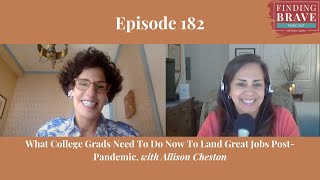
Allison Cheston advises recent grads to skip blind online applications, which get filtered by software, and instead request 20-minute informational calls to build a network. Internships matter more than you think, and early jobs are experiments to shape from within before moving on.
Questions this video answers
July 1, 2021.
Allison Cheston.
AllisonCheston.com
Chapters
Hello everyone, this is Kathy Caprino and welcome to my podcast, Finding Brave. I've created this show for everyone who longs to create something bold and brave in their life. To rise up, speak up and stand up for who they are and to reach their highest and biggest visions. Each week I'll be speaking with inspiring guests from all walks of business, leadership, entertainment, the creative arts and the entrepreneurial world. And they'll be sharing their intimate stories of Finding Brave and offer their best strategies for building your most rewarding, joyful and meaningful life, business and career. I so appreciate you being here. And speaking of appreciation, I am so thrilled to share that Amazon Music is now a sponsor for Finding Brave. So if you feel as I do that music is an important, enriching part of your life and you would like unlimited access to safety. 70 million songs today. I hope you'll hop on our special link which is getamazonmusic.com finding brave and get our 30 day free trial offer. Again, unlimited access to 70 million songs. That's a whole lot of music and a lot of listening. Joy. Thank you again so much and enjoy the show. Hello everyone. Kathy Caprino here. Welcome to another episode of Finding Brave. Man, am I excited today for so many reasons, but one of them is to have the illustrious Alison Justin on today. The second is to talk about what recent grads need to understand if they want to land great jobs. And boy, so much has changed and so much has shifted and there's so much that I think college grads don't learn about what it is to get a job and what you need to have and what you have needed to demonstrate. So we are going to dive into all of that with Allison. Thank you so much for being here, Allison.
It is such a pleasure. Kathy, it's so much fun to do this with you.
So much fun to see you. You in the middle of our beloved Manhattan. I love it. All right, let me tell you people all about Allison. I gotta read here. I need my glasses. Alison Cheston is a career advisor based in New York City and she helps executives and young adults launch, develop and change their careers with a background in. This is why you're so fantastic at this, I think. Background in marketing and executive search. Alison guides clients through a process of identifying their unique values, their unique value and their values and right career direction and works with them to develop their narrative and their skill stories which we're going to hear all about and then helps them find the right job. How amazing. And I know this works because I know people that have Worked with you. And I've sent people by the many to you who all say, holy cow, that was the best thing we've ever done. Parents of grads and grads themselves. So I know you work magic. All right, Allison, let's do the hard talk here. Okay, first of all, what I really want people to get at here is what do we not know when we graduate from college that that is hurting us? But maybe let's start with has the landscape changed here about how we get jobs and what are the jobs and how we have to go for them? Tell. Tell us everything.
Sure. Well, you know, first of all, I don't think that the landscape has changed recently. I think the landscape really changed with the advent of the Internet, which was a long time ago. I think that the issue, the core issue is that people graduate from college, they're very focused on getting into college. Like, everyone wants to go to a great school. Everyone puts a lot of time and energy, money behind getting into the right school. And I think that there is. There's this thing everyone kind of jumps. They dive off a cliff when they graduate. They don't know how to take what they've learned and apply it to the job market. And there are not a lot of great resources to teach them.
Why aren't we getting taught? Why aren't we getting taught? Why isn't there a mandatory high school class and college class from the career guidance people? Why don't we, do you think?
It's an excellent question. I've looked into it quite a bit, and I think that there is a real. There's an issue between the career office and the academic side of schools. They can't quite get together, you know, so I think it's a structural problem more than anything, because I've been advocating for years that school schools should have required coursework and how to get a job. I mean, it just seems so obvious. Parents want it. They're spending upwards of $200,000 a year for their kids to go to college. And a lot of kids get out and they don't get jobs. They don't know how to look for a job.
Oh, gosh, that's so true.
It's so true. And you know, I mean, we've seen this with you and I both have kids the same age. You know, we. We understand the problem. Both, both viscerally. But we also see it. I mean, I see it every day with people contacting me and they all say, I. I'm applying for so many jobs, I'm sending out Tons of applications. I'm not hearing back what's going wrong.
And I think we hear this by the thousands, no matter what age, no matter what, don't we?
No matter what age. And.
And you tell them. What do you tell them?
Well, of course, you know, we've been in a very weird time because on top of this structural issue, we're now in a pandemic. We're just coming out of the pandemic. And people who graduated in 2019 who didn't already get a job, or maybe they got a job and they weren't able to keep it during the pandemic, they then go into that bigger pool, and then they start competing with the graduates of 2020 and now 2021.
Right.
So, you know, I think there are a number of things here that are happening. One great thing about the pandemic for these kids is that you essentially get a pass for the pandemic year. So I have clients who are 2019 grads who either they didn't get a job coming out, one of them did have a job, and it fell through, and then they didn't work at all during this whole year, but they are now. One got a job because he went back and got additional training, which I always advocate. If you graduated in 2019 and you've been looking for the same kind of job and it's now 2021, you probably need to do something additional to get another skill set. So, you know, in this case, I've sent people to coding boot camp. I've sent them to data analytics boot camp. Data analytics is a great. Is a great skill set to have. You know, understanding how to look at trends, assess them, apply them to marketing or finance. That is a very, very good skill to have. But there are lots of other things you can do. It doesn't have to be, you know, data analytics, but the idea is to bolster your chances of getting a job because you have this additional thing that you didn't have when you graduated. And it also shows employers that you're investing in yourself during this very difficult time when a lot of people were scared to get jobs, they didn't know what to do. And a lot of people went back to school for master's degrees. You know, people have done all different kinds of things, but to do nothing and just to keep doing what you've done and start just continue to apply online blindly, not a good strategy.
I have so many questions. Let me fire them at you. Can I? Based on what was embedded in what you said and you Know, the reason I need Allison for this is I, I work with mid to high level professional women. And so they're 10 years, seven years, what out of, you know, beyond this stage. I want to ask you this. It was Fawn Germer I interviewed who Pulitzer Prize winner, I believe. But she interviewed people, you know, hundreds of high level executives around the opposite of this stage, our stage of life, where we're feeling obsolete and being pushed out and we don't understand it. And what she is saying is it's all great that you have the experience you have, but that isn't what's going to keep you in your job. What is it? It's skills that are going to move the organization forward today. And that is probably not the skills you have. So this is what I want to ask you, and I'm dying to ask you also about did you see the Netflix special on the college scandal? I really want to get your view on. But why I'm ti. Oh my gosh, let's talk about it later. But why I'm tying that in is so many parents are absolutely obsessed about the name of the school. And we all know Harvard's great, Yale's great, and who was it I was speaking to? Some live person who said going to Yale changed their entire life. Yes, I'm sure it does. And I don't mean to belittle it. What I am saying, however, is education is critical and training is critical. So what you should be looking at is what is my child interested in and passionate in? Who might I know that they don't know at age 16, 18? But my son, who we were talking about, knew he was gifted in math, he's always loved numbers, and he always thought finance would be a great direction. And he went to business school at UConn. I mean, he had an inkling. But here's what I want to ask. Is it different today than it was in my day? Your day, where, you know, for instance, I knew I wanted ideas and writing and I went to bu, School of Public Communications. Interestingly, I dropped out of that in two seconds because it was so journalistic. And I didn't want to be a journalist. I wanted to be a great editor. So I went to the College of Liberal Arts, English major. And even my dad back then as a scientist was like, what are you going to do with an English major? But I went into publishing. Now, here's my question. Back then, I think we felt there was great value in a liberal arts education. What do you think now? And I'm going to cut to the chase and ask you this. I think we have to look at the skills we have and see if they are relevant.
Yes.
What do you think? That was a lot in one question.
I fully agree with you that it's about the skills that we have and about upskilling continuously in terms of a liberal arts education. I am a big fan. I'm a big fan. I feel just to back up, when you and I were in college, you know, most people didn't go to college, right?
So, so true.
Something like 25% of the population graduated from college. People who started. Now it's like 75% of people go to college. Wow. So. So it's really grad school is where you get a lot of specialist education that for us we basically just needed a college degree for, you know, unless we were going to be a doctor or a lawyer.
Interesting.
You know, or some other. There's, there are obviously other professions where you need graduate school. But, but so now it's so much more competitive. But I believe that when you're in college, you know, it's so it's a wonderful opportunity to try a lot of different things and to skill up in areas like being an English major, I think is a wonderful major.
I mean, I use that every single minute of the day now.
Every single minute of the day. So you communicate, you write, you speak, you, you consider, you think about things, you analyze things. Those are really important skills. So I would never diminish the value of a liberal arts degree. I mean, you and I are reading the same things. The classics are at huge risk. A lot of schools are removing the classics. That is so terrible. I mean we as a country, we're already in such a deficit in terms of classical education, religion, like things, knowledge, knowledge in Europe that this is just like the basic stuff that everybody learns. So we're already running at a deficit. Then you take out some of those subjects and you have, you know, not everyone should be an undergraduate business major. It just.
That's so true.
Go to business school later on after you figure out exactly what you want to do. But a liberal arts education really can open your mind because you don't know what you're good at until you try it. Right. I mean, your son knew that he was really good at math, but that's a great clue. So you think, well, if you're good at math, what are some of the careers that you should consider? Engineering, physics. I mean, there's so many things you can do with math. Right. But you know, if you're a great writer, journalism is only one of many. And I think to specialize too early, I think is a shame also, you know, if you can afford to go to college and do something that's a little bit, you know, less vocational, I think that people should have a chance to do that.
I love it. Although, boy, a four year degree is changing, isn't it? In terms of. It's out of reach for most now. It's gotten so ridiculous. All right, now here's another question. If someone asked me, what is the one thing that if your child or you don't do in your college years you're going to struggle like mad to.
Get a job, I will tell you. It is it. There's only one thing.
There's one word.
One word. If you do not get an internship when you're in college, you are really behind. I cannot tell you how many people don't do that. They are lifeguards, they are camp counselors, they work in restaurants. That's fine. But at least like later in your, you know, when you're between junior and senior year, get an internship or something that really prepares you because they don't, kids, they don't understand anything about being in a work environment. Like, you just have, it's baby steps. You just need to learn some of these basic skills.
So let's dimensionalize that, Allison, because I have people in my family who, they're not doing it. And honestly, if I say to them it's an internship you need, they don't have any idea how to do it. Of course they don't know how to do it. And they are scared to do it. And they don't know. Let's take someone in game design or someone who's studying creative writing. They don't. And they don't have parents who are career coaches. So the parents don't have a network that you could say, talk to my friends Sally, Bill and Fred. Can we break this down for people?
Absolutely.
Okay, what do we do?
So first of all, I believe that anybody can create a network. So any student in college already has a network available. So if you're, if you're, say a game design major, which is a fantastic major to be in, okay, that's your, if you love to, to play games, it's a great thing to do. And if you're creative, so let's just take that as an example. You have your professors, you have your friends, you have your friends, parents, you should have a LinkedIn profile. You don't know who you don't know. So go online, connect with whoever you can reach out to people in the field and just try to get in touch with them. I know, you know, I work with a lot of people who are very introverted and they really struggle. They get, they are so nervous. I don't want to bother people. I don't really know what to say. It almost doesn't matter. Like taking the initiative and really trying to get, get to somebody and with your message is worth so much. And just practice on those professors. Professors are, you know, they're a great kind of. They're great training wheels for the real world and often they will be able to send you in the right direction. So, you know, I did want to make a comment about internships because there was, there's been a lot written about the inequality factor of internships because some people, a lot of people actually need to make money in the summers. They can't afford to take these free internships, these unpaid internships. So a number of years ago, the government mandated that companies of a certain size, if they were for profit, had to pay their interns. Wow. So yeah. So if, but if you're a nonprofit, that doesn't apply to you as an example. So a number of years ago as well, a lot of colleges started. They have these grants that are. People don't. They don't advertise them.
I don't even know about this.
It's unbelievable. It's such an incredible opportunity. So you go and you go to the career office or you go to the, you know, the, the, the development office and find out if your college. And they're online as well. Find out if your college has this program. If you go to work for a nonprofit in the summer as an intern, your college will pay you. What for that internship?
Are all colleges and universities participating in this?
No, but a ton are. And I actually did. I did actually I think I wrote a post on this last summer and I listed maybe 10 colleges, all different ones, universities, colleges of all kinds. And I listed their pages with those programs. But it's like a well kept secret and it's not.
Oh, they want to keep it secret. They don't want. Huh.
Does that.
I want to ask you, does. Can you just find, find one of these universities that's near you take one course in it and would that allow you to take part in that?
I'm sure not.
You have to be a matriculated. Okay. Four year degree. Got it.
All right, so that's for the unpaid internships, but for the paid. But. But so many companies will pay you, right? You know, you can negotiate your own internship with some friend of the family. People do it all day long and get paid. You know, kids don't need to make a ton of money. So I will say that is the number one thing that when I see that somebody doesn't have internship experience, I know that we're going to have to get a start. There's going to be a starter internship before the job because they're not ready. They're really. They're not ready to have a job.
And can I make a real clear point about this? In thinking of my son, he got a finance internship that wasn't at all the content of the job that he landed. That was great. And I want to make this clear. They wanted someone right out of school so that they could train him. This. This great job he has. But that doesn't mean they wanted someone with no work experience.
Precisely.
This is really an important differentiation. They, you know, had my son not had any finance experience or any work experience that wasn't at the movie theater, he would not have gotten this job.
I'm pretty sure you're absolutely right. You're absolutely right because they're able to pick from a big pool of kids who already have had these internships. So it's really, really important to get work experience. And, you know, you said something about your son. It wasn't exactly the area that he wanted to be in. Honestly, people should not be that picky.
No. And I didn't mean that he didn't want to be in it. It was very different from what the end job gave, but it was. He was so grateful for it. It was something in finance. He learned so much.
Totally. So, you know, one of the things I tell clients is, is don't reject the job until you get the job, because it's so awesome.
Get the offer, man. Get it.
I have these conversations and, you know, we'll be looking at job descriptions. Oh, but no, that's. That's not exactly, you know what I. And I'll say, it doesn't matter. Get the job. And then we can have a real discussion about it. So you should treat every interview like you really, really want that job.
And you know what I love about this? Oh, I'm going to wait, because you're pa. It. I love what you're saying about internships. Get it. Get the job. Let's not be too overly picky. But also what I'm seeing, and I think you see this too, once you get into any role, but particularly these roles, you can shape it. Projects come your way, you can raise your hand and say, I see that, blah, blah, blah. You know, I know both my kids did, did things that were not on the job description that were, that turned out to be projects that were so thrilling for them. Would you agree with that, Alison?
Absolutely. I mean, you know, the thing is it's, it's as much about what you do want to do as, as what you don't want to do. And so if you take an internship and you just say, oh my God, you know, it was great experience, but I know I never want to, you know, I don't want to be an investment banker. Great. Good info, you know, that's really helpful. And that can then guide you to your pivot. And I think, you know, people are, they have all kinds of reasons why they're, they're scared, they're, you know, they, they have some very specific idea of what they think an internship should be. Somebody, you know, indicated that they would be really good at one thing or their parents are putting pressure on them to try this one thing. There are so many reasons why these internships don't end up working out, but they work out and that it's just an experiment. Like, the more you experiment, the better off you are because, you know, careers are long and our, you know, our children and our clients, they're going to have many, many careers. They're not just going to stay with one thing. There's so many more opportunities to do things that we never could even dream of when we were coming, coming of age.
I love it. So let's do one more thing about internships. I think young people listening say, I don't even know what I'm asking for when I'm networking. What do you mean? So do you have language you teach them about if they're doing on LinkedIn, a reach out to you or to their, their friend's mother who's in the fashion field or whatever. What are they saying? What are you ask telling them to say?
Well, so I think, you know, everybody likes to talk about themselves. So flattery will get you everywhere. And the other piece, is that any, everybody. But I would say especially, especially baby boomers or maybe Gen Xers are. They really want to mentor people. They're looking for opportunities to be helpful to young people. So if you're a student, you have like, you have such carte blanche, you've got such entree into all kinds of people because everybody wants to help you, you know, you're this up and coming person, you're young, you're full of promise, they want to be helpful to you. So capitalize on that. You know, really take advantage. And basically I think that the key is to explain very clearly what you're studying, what your main interest, what you think your main interest is, and then say, would you be willing? Now it's to have a phone call. It used to be, would you willing to have a cup of coffee? Although getting a cup of coffee with somebody senior can often be tough task. But just say, I promise to respect your time and limit it to 20 minutes and more often than not they'll be happy to talk to you. I have my clients reaching out to all kinds of people with very vague. Either they're not connected to them on LinkedIn or they just look at their profile and they think they're somebody who they should speak to. And more often than not, they're willing. And during the pandemic, everybody's been working from home. They have the time. It's easy to take a quick call with a kid.
I love it. You know, my, my biggest sponsor and mentor is Judy Robinette and she's written two books, but one is how to be a Power Networker. You probably know Judy, but she also gives this verbatim two questions to ask. So you're going to do what Allison has shared. Could you tell me about your trajectory, how you got to, how you chose this, whatever you want to say and let the person talk as they love to do it. The second is you're going to share a little bit. It's okay if it's vague a little bit about, you know, I'm really interested in graphic design or whatever it is. And here's what I'm thinking. The second question is, do you have any ideas for me? And then the third question is, might you know of anyone who would be helpful to speak?
That's, that's the right.
By the end of that you're going.
To have five without another name. Never leave without another name and say would, would you be willing to make an introduction or would you like, can I use your name when I contact? That's actually better. Then you don't have to wait for them.
This is it. This is how we do it. It's truly that simple. I know you'll be scared. I know you'll think, why would they ever talk to me? You know, even mid to high level professional women say, why would that person talk to me? Because we're all human and we've all been in a boat where we need some help. So, okay, that's, that's how we land internships.
Can I add one thing to that? Because, and this really, this is true for both internships and jobs. The other thing to remember, you know, I often hear from my clients I don't have, you know, I feel bad. I feel badly asking for things. I don't have anything to give them. The truth is there is a lot of exchange that can happen between that generation and our generation. We need a lot of help from, from digital natives. You know, there's so many things that they can be. Be helpful to us.
Like how do I get on Instagram? I don't even know what button to push here. And wow, it's visual. It's not like LinkedIn. I'm at a loss.
Exactly.
You know, you all can zip that up in half a second.
Yeah.
Yeah, that's so true. Everyone has something to offer everyone.
I love it.
All right, now that's number one. Get an internship. And by that we mean a job that is going to give you some form of experience that's more than what you're lear learning in school. That's what we mean. What would you say, number two, most important thing, that recent grads or about to be grads don't know that they.
Have to do so I think there is such. It's a combination of ease and sort of fear. But when students get out of college, they don't understand that it's just not about blindly applying to things online. Because once, once you see that job listing, so do you know a thousand other people, Literally. And, and they don't. They also don't seem to know for the most part that what's happening is when they're sending in their resume and cover letter and often not even a cover letter, which is so ridiculous because it's so hard to distinguish yourself.
But you mean they're, they're skipping that step?
No, often, like there's this easy apply feature on LinkedIn which doesn't require a cover letter. And so they think, oh, that's okay, I'll just send my resume. But the problem is a couple things. First of all, there's an applicant tracking system. It's not a human being. And they feel rejected when they don't hear back. And they think, oh, they didn't like me. You know, they didn't think I was good enough. And that's what they take away. And they do that a hundred times. You know, they've sent out 100200 applications and never heard anything back. This goes for all ages, by the way. This is not exclusively young people. So the thing is, you have to get to a human being. And the way to do that, I think, is to find someone again using LinkedIn, because it's probably the best research tool there is. Find someone who you think this job might report to. So based on the title of the job and the titles of people who work at that company, figure out who you think it might be. With big companies, it's hard to do. But even if you're wrong and you send your cover letter that maybe you didn't Already send through LinkedIn, send your cover letter, send your resume, send it to that person, figure out what the email system is, send it to that person. Oftentimes you will hear back from that company. No, not everybody.
You mean don't do it through LinkedIn. But in fact, you can just Google kind of the domain and you can guess it's going to be Alison at da da da da da. Right. And so use that format in your email.
Yes.
I love it. Now, I know you have to, you have to apply.
The first thing they're going to ask you is, did you already apply online? I did have to go through that step. But the way I suggest doing it is if you go to a corporate website and you look up their press releases, you will often have someone who works at the company who wrote the press release, and then you can figure out what the email system is. You find the right person, you figure out the email system, you send them your cover letter and your resume, and then you will often hear something back when you didn't hear back from just sending it through the app.
I love it. I love it. You know, I. You tell me, you know the data more on this, but I believe it's something like 80% of jobs are not gotten through applying. They're gotten through what we are telling you. Number two, a very large number. I think it's something like, what is it? Over 75% are not even listed.
Oh, that's right, they're not. They're not.
So you're spending time on LinkedIn or wherever on Monster, and they're not even there. Number three.
God, Monster. I don't even, I know Monster is still, still exists. I don't even know if anybody goes to Monster.
Where do people go now?
I think mostly LinkedIn indeed is, you know, indeed. And Google also has a big, you know, has a big job search tool.
Interesting. I just dated myself. The third thing is oh, no, I keep forgetting, but it's important. What is it that I'm not going to remember? It's about, oh, here's what it is. Don't take it personally that you don't hear anything. It's truly, when you say it's not a person, what it, what's happening is it's scanning for words that match as closely as possible the description.
Exactly.
Right.
So you want to make sure all the, the right keywords are in both your resume and your cover letter.
Right. And the keywords are the, the words that they're saying that you know, must have. Right. So if it's digital marketing and you know, well, if you don't have, you know, how. What would your idea be? If you don't have 50% of what they're asking, would you still apply?
No, no, I think the ratio is if you have 70% of it, I would apply. Okay. And I would. But again, you know, there is nuance that you can get in a face to face or you know, through a letter that you send to a person that is not going to be able to come through the applicant tracking system. So. So, you know, don't get down on yourself. The best thing people can do in addition to applying more personally, as I'm suggesting, is to do a bit of a listening tour when you are looking for a job. Because as you were just pointing out, the majority of people get their jobs through a human being, not through sending their stuff through, you know, LinkedIn or Indeed or whatever. So the more people you can just talk to, as we were talking about earlier, contacting different people, asking them to spend a little bit of time getting another person through them who you can speak with, you'll get a lot more information and little by little you'll have built a network and people will start to come to you. It will take more time, but you would. But it's much more strategic and that's what your peers are not doing.
Oh, I love it all. And it is true, you know, especially in high demand fields, you know, we, I have a lot of resources on my site if you're interested about how to craft your summary and your headline on LinkedIn. And you know, in some cases what you're doing is in such demand, you're going to hear from recruiters because of what you have there. But that's a whole other podcast. Okay, Alison, can I ask you one more thing here, keeping you a little longer? Okay. They've landed their internship. They may have landed their very first job, but they're realizing, whoops, this is not it. What would you say for people, you know, one year out, you know, what's your advice when they come to you and they think, oh, my God, I don't like this. Like, I know someone who was in accounting and she suggested that her daughter become an accountant because it's got flexibility, and the daughter did it and even got a master's and who doesn't want it?
Oh, I know.
Oh, do you see this?
I have two anesthesiologists who are clients.
Two anesthesiologists, and they. Both.
Because of COVID No, they just, they. They realized. I mean, they're, you know, they're grown up. They're, you know, they're. They're closer to our age, but they realized over time that, that, that really, it was fine for a while, but they really don't want to spend the rest of their lives being an anesthesiologist. Right. So I think it's going, you know, for them, it's going back to what are, you know, what are the core values? What are the things that you've done that you loved? What are the other things in your life that you care about? There's so many things that they can do. But for someone who's in their first job, oh, my God, there's so. And this is actually, there's going to be an epidemic of people like this because there are so many college students who went right into grad school during COVID as a way to mitigate.
And it looks like I didn't do anything or that I couldn't.
But. No, but they've gone all in on a career track that they may or may not really be interested in, and they don't have any experience.
I so see this. I see this with people who spent 10 years. They don't get career coaches. They go, I think what I really want is this. They get the mba, they get the masters, they get out. They don't want the jobs that degree would give. And they didn't even love the content.
Right.
What you want to do, people you try on each step. You don't want to leap and invest all of that money in time when you don't have a surety of. And no, we never can know. Always. But so what do you do with the person right out one year and says, I don't want game design, I don't want finance, I don't want architecture. What do you do with them?
I think that. Well, first of all, I don't think you should quit right away because you got to give things a chance. So, you know, say you were hired, you're hired as an in house accountant at some corporation. You realize right away, you know, you're not enjoying the work. Maybe there are things about the company, first of all, maybe there's a lateral move, possibly within the company. If you decide you're fully invested in getting out of there, think about what you can do to kind of prime the pump while you still have this job. Maybe there is additional learning you can get on their dime. Maybe you can attend conferences, maybe you have an idea for some new area, something that you're in accounting. Maybe there's some kind of financial technology platform that you can help build. I mean, I don't know, there's so many different ideas. But don't just completely throw in the towel too early because, you know, it shows lack of imagination and a bit of laziness to just say, I'm done. Like, this is definitely not what I signed up for and just take it on the road. I think every job can be made into something that's positive. But it does take patience and creativity and forward commitment. And commitment, yeah. I mean, I have, I have definitely. I saw, I've seen this a few times with people who are kind of serial job changers. You know, they're looking, they think they want this one thing, then they get it, and then they're, oh, no, that's not quite the thing. And then six months later they're somewhere else doing something completely different. I mean, I've seen people go through three or four jobs, cycle through them in this, you know, just the span of two years. I mean, that's crazy. It's also really, really a bad practice because employers won't trust you.
Allison, you and I come from such, you know, the, the same ideas. You know, the way I talk about that is often it isn't the job that's the problem or the career, it's you in the job, wherever you go. Like, there it is. Like, you don't have boundaries. So they keep heaping more and more. And you're working non stop and you're thinking it's the job, it's not the job. Or why am I always passed over? You know, the person who just came in with me now is a manager and I'm not, I'm leaving. What I find is when we're serially leaving and jumping, it's what I call the pendulum effect. You know, we're a little bit broken down in what we're doing. So we want something very different. Thinking that'll heal the problem.
Right.
So I'm 100 with you. See what you can improve now. Sure. Interview. Sure. Look. But see if you can change that dynamic. That's. That's upsetting you, you know?
Right. It's the same as with relationships. Right. Get divorced, you marry the same person.
I love it. I think you've given us such great concrete information. Can. Can I do. I'm just dying to know what you think about the college scandal issue and, and what parents need to do differently. What do we need to do differently?
Oh, my. It. It. It's so. It. That was such a shocking thing. But I think in. In. In smaller ways, parents make those kinds of mistakes all the time. I have to tell you, I got a call. I got a call the other day from the sky. He calls me up out of the blue and he says, I wanted to talk to you because my son is a sophomore in college and we're trying to figure out what he should major in.
Oh, no.
And I said, well, who's we?
My wife and I. Who else?
I'm a little nervous that it's you calling me and not your son. Oh, no, no.
He.
He knows he's involved. He, you know, he knows.
And so he sounds just like the scandal issues.
Oh, my God. And he went back and forth. Do you. What do you think about an undergraduate business major? What? He wanted to know what I thought of different majors.
Which ones were the most marketable, Employable.
Employable. And it was the most ridiculous conversation. And it just made me think about so many parents, again, who are so fixated on the names of the schools, and they are not even thinking about the kid and how that kid will do if they do happen to get into a top school, Will they be able to handle the pressure? I mean, there are so many factors that are at play there. So I think I would say to parents in general, stop fixating on the college because your kid will have a good experience in a lot of different places. There's not one college that is the right college for your child. And what they do with it is. And whether or not they thrive. That's the most important thing. And then figure out, what are they going to do afterward. Don't. Just, Just don't think about the school because the school is. It's just a blip. It's.
Love it. I would go so far, you know, being a former marriage and family therapist. You know, when I would hear from parents for their child, I would Say, I'd be happy to work with your son or daughter, but they're the ones that need to talk to me.
Oh, yeah.
But out. No, I don't say that. But that's. So I would also say to you, part of what you're saying, Alison, is stop looking at yes, they need to go into finance, because that's the secure thing. First of all, there's nothing secure. Nothing. It's all going poof. Only what is secure is what you have inside yourself that you've honed, that you're passionate about. That's what is secure. Secondly, if you're trying to figure out a major for your child, you are.
Enmeshed and it's a grip.
You're a meshed.
Yeah.
Meaning let me be clear. It's what your child is interested in pursuing for potentially a lifetime that matters, not what you think the major is. And I'm saying it roughly because you need to back out of their lives. You're not going to be there holding their hand when they're 40, I hope.
Completely.
Would you agree with that, Allison?
I would. I mean, I, you know, because I work with so many young people and so often the parents are paying the bills. They, you know, they have a sense of entitlement about the relationship. And so a number of years ago, I told parents, I'll have one conversation with you, and then the relationship is between myself and your child. And I don't give progress reports. And amazingly, it's actually worked pretty well. You know, I was wondering how it would go because, you know, just the parent body that I work with in general, I mean, with their kids, but they've been respectful. Once I, once I made that clear, they've been pretty respectful.
Boundaries. I love it. And obviously it's because you are delivering co. Delivering incredible results.
Thank you, Kathy.
Oh, I'm so glad you said that. Because a happy coach is not someone who's micromanaged.
Oh, God.
By either the executive who's sponsoring the professional development or the parent, that's only going to lead to very bad work.
That is. Right.
Any last words for our young grads?
I just wanted to say that what's really wonderful and exciting for me and for everyone I work with right now is that the job market is exploding. Everyone I'm working with and people I know in general, everyone's getting jobs. It's just been in the last six weeks, things have just literally exploded in all fields it. Across the board. People are getting interviews, they're getting offers, multiple offers, you know, competitive offers. It's really coming back. So I am feeling so happy and grateful.
So happy to hear it. On that note, people, I hope you feel inspired. Alison is the one. If you're right out of school or getting out of school, school and call Allison directly. Find her on her own website. Where does everyone reach out to you? Where do they get your delicious information?
Allisoncheston.com and read my blog because I've got a lot of info in there.
Beautiful.
Usually I've been very bad about updating, but I'm gonna. I'm gonna write.
You're too busy helping grads. Oh, it's such a, you know, aside from the doom and gloom about am I going to figure it out? You will figure it out. I mean, Alison, you've taken a circuitous path to this. I had three different careers. You will find your way. You will be passionate. You will succeed. We know you will. So let us hear from you and let us know how this helps in any challenges you have. Wherever you see this, if you'll see it on LinkedIn and Allison and I are there, so ask your question there. Wherever you see this, we hope this is helpful and have a wonderful week. And Allison, thank you. Thank you so much for your amazing help.
It was so much fun. Thanks. Fun.
I'll see you in New York soon.
Can't wait.
We need our annual lunch that got postponed for all right, everyone, have a wonderful week and we will see you next time.
Bye.
Thanks so much for joining us today. And please don't forget to check out findingbrave.org for more programs, resources, and tips. And tune in next time for your weekly dose of finding Brave.
More from Kathy


Elevate Yourself, Elevate Others, and Amplify Good | Chris Cooper | Finding Brave Ep. 334

Finding Brave Epis #333: How Leaders Can Harness AI Without Losing Their Humanity, w/Bennett Borden

Finding Brave Epis 332- How to Stay Brave, Valuable and Visible in the Age of AI, with Raman Rai

Finding Brave Epis 331 - The Power of Positive Disruption, with Dr. Patrick Leddin


Finding Brave Epis 330 - Being 40: Letting Go and Embracing Who You Are, with Stacey Lindsay

Disrupt Career Reinvention with Kathy Caprino - via The Disruption Lab Podcast w/Patrick Leddin

Creating Neurodiversity-Friendly Work Cultures: Simple Workplace Adjustments Matter

Finding Brave Epis 329 - How To Create a Neurodiversity-Friendly Workplace, with Kristen Pressner

Finding Brave Epis. 328: Reclaiming the Power to Trust Your Own Voice, with Dr. Cindy McGovern