Why Happy People Are Annoying Part 1 with Josh Peck
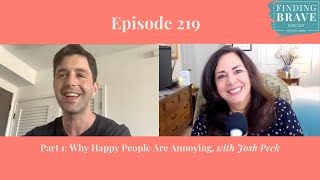
This YouTube podcast episode (Finding Brave with Kathy Caprino) features actor and author Josh Peck discussing his memoir "Happy People Are Annoying," his trajectory from child actor to adult performer, struggles with weight and substance issues, the role of comedy in masking pain, and perspectives on fame and social media. The episode includes host promotional segments for coaching and digital courses.
Chapters
Hi everyone.
Kathy here.
Do you run a coaching business that focuses on supporting women? If so, I've got some news. Right now we're opening the enrollment of my coach training program called the Amazing Career Coach Certification, which is a 17 week hands on training program that certifies female coaches in my proprietary 16 step career growth model, which is perfect for coaches who want a deeper dive into powerful, proven coaching frameworks and concepts and skills that will help you become far more effective in working with women. And through the program, you'll get access to a powerful small business acceleration program called the Rapid Growth Academy, delivered by my friend and colleague, award winning business growth expert, Matthew Pollard. Through Matthew's program, you'll be taught essential business and sales growth information that will help you grow your business success in the quickest way possible. In my view, there's nothing on the market like this for coaches because it targets the two critical aspects of success, how you support your clients to thrive, and just as importantly, how to grow your own business to the next level. For more information, visit certification.amazingcareerproject.com and check out the details. The program starts March 22nd and I'd love to work with you.
See you there.
The whole book is about me finding happiness in my own way and what it looked like for someone like me to walk through what I did, be it, you know, losing £100, facing, you know, drug and alcohol addiction, and then eventually pivoting in my career. All these things that allowed me to find what happiness was for me and redefine it.
Hello everyone, this is Kathy Caprino and welcome to my podcast, Finding Brave. I've created this show for everyone who longs to create something bold and brave in their life, to rise up, speak up, and stand up for who they are and to reach their highest and biggest visions. Each week, I'll be speaking with inspiring guests from all walks of business, leadership, entertainment, the creative arts, and the entrepreneurial world. And they'll be sharing their intimate stories of finding grave and offer their best strategies for building your most rewarding, joyful and meaningful, meaningful life, business and career.
Hello, everybody. Welcome to another episode of Finding Brave. You know, I say this every time.
Good grief.
How excited I am and how thrilled and just cannot wait to dig in. And today is no exception. We have the amazing actor and new author Josh Peck with us today. Josh, thank you so much. You're in the middle of a book launch, you're crashingly Busy with 17 things you're doing.
Thank you for being here.
So grateful, so great.
Oh my Pleasure. Thanks for having me.
My pleasure. All right, people, I'm going to dig right in. And if you don't know Josh, you've been hiding under a rock. But I will read you his amazing bio. But before I do that, we were just talking a minute. You know, I adore everybody I speak to on this show, but in this particular case, I have so much gratitude for Josh because of the family time that Josh, in his show, Drake and Josh, and of course with Drake as well, gave my kids, who are now 24 and 27, and the show was out 2004 to 2007.
The.
The Amazing family time. The amazing hilarity. Just. We still have memories. There's a memory I have of you in the kitchen of that show doing something ridiculous.
And.
And he. My son Elliot remembers it, too. You know, these are special, special times that kind of weave you into the fabric, you know, that's why actors become so important. They've shaped you in so many ways. So I'm so grateful to you in. In just a thousand ways, Josh.
Oh, I appreciate that. And. And it means so much that people have loved the show over the years. And also now having my own son, like Max. Right, Max. Yes. And he is a.
Is he four.
He's three, and he's a Sesame street aficionado. And like my wife and I talk about now, we'll never. I don't know if I'll ever be able to, like, watch or talk about Sesame street in the future without choking up because of how much it means to him and the impact it had.
Yeah.
It's so special.
It's so special. And that show is so remarkably wonderful. Yeah. So you're a parent, too. All right, people, let me tell you about Josh, and then I want to dig in to your new book, Happy People are annoying.
Love it.
I can't wait.
All right.
Josh Pack has established himself as one of Hollywood's rising talents, making the seamless transition from child actor to leading man. Your bio is so long. Your Wikipedia page is so long. This is just a little excerpt.
You can paraphrase now.
We'd be on for two hours. He starred in numerous feature films with great actors and performers such as Ben Kingsley, Al Pacino, Chris Hemsworth, Annette Bening, Andy Samberg, Fred Armisen, and Netflix the Musical, co starring Debra Messing, which is.
Out later this year. Yes.
13, the musical. Yeah. On Netflix.
There we go. Oh, there we go. Perfect. Currently. Is this true? I hope this is right. Josh is in Disney Turner and Hooch series. Yeah. Am I getting all this.
Right.
All right. A continuation of the 1989 Tom Hanks film of the same name. And we can see Josh in the highly anticipated Hulu series How I Met yout Father, and in the iCarly reboot oh, I can't wait on Paramount.
Plus.
And Josh is best known for the Nickelodeon phenomenon that we're talking about, Drake and Josh, which ran from 2004 to 2007, for which you received a Kid's Choice nomination.
Bravo to you.
Josh constantly strives to push the envelope in his work, and now he's doing just that by unleashing his unflinchingly honest memoir, Happy People Are Annoying, which is on sale right now. This week, with humor, warmth, and introspection, Josh chips away at the glitz and glamour to expose the highs and lows of the journey as an actor and an influencer. So there we go. I want so much to know about this book and why you wrote it. But before that, can I ask a question here? And maybe you've answered this 2 billion times, but when I look at your stuff now, even on YouTube and Instagram, I howl at every one of your posts like you were talking about the book on Instagram. And you go, all right, let's just call it out. I got a zit here. All right. You know, to me, your humor just tickles my funny bone like nobody else's. I'd love to know what. What do you think is your secret sauce for. And you're humble, so you're not. This is going to be an uncomfortable question, but you have 36 million plus fans, followers the world over loves you.
What do you think is your special.
Ingredient in humor that has caught so many people?
I think being overweight as a team. No, I'm kidding. But.
Oh, I don't know what to say about that.
I mean, it certainly was comedy. I come from funny people. My mom is sort of a unrealized performer in the sense of she could have easily been on Broadway and whatnot, but at the time that she was growing up, she just kind of had to go into the business world. And. And so I would watch her throughout my whole life, sort of take over a room and spit out some great joke that she had heard. And so to me, growing up, comedy had value. There was like a social currency to it. And I also obsessively watched television as a kid. So the rhythms of. I say in the book, like, my best friends growing up were the Fresh Prince of Bel Air and Ace Ventura and Happy Gilmore. Like their rhythms through Osmosis just made its way into my head. So even at a young age, I didn't. I didn't know necessarily why something was funny, but I knew what it sounded like.
Wow, what a gift. What a gift.
And I also think there's this exuberance that you have.
Like, you.
Nothing's off limits. You make fun of yourself without. Without hesitation. You make fun of the ridiculous things all around us.
There's an exuberance there, it seems to.
Me, not a snarkiness.
Is that right?
I try not to. Yeah. I mean, you're right. I can certainly find myself. And there have been moments in my sort of life where I've leaned on the snarky kind of cynicism, which. Comedy can lean in that direction, and I don't wear it well. It doesn't look good on me. But I find if I can add sort of a. Sort of a pleasant bent to whatever I'm looking at and pointing out the absurdity of things. You know, comedy has this special superpower in that a laugh is involuntary. And I think that's why, like, it's sort of rewarded as the highest. You know, if something is incredibly funny or something moves you to tears. But, like, laughing and crying are very. They're like. They're. They're brother and sister. Right. They can easily be mistaken. So I think it's. Yeah, I think I try to have this outlook on life that I. I share in my comedy that's. That's positive. I mean, and I saved the neurotic outburst for my. My shrink.
Oh, my goodness. I love it. I love how you knew what MFT stands for. People look it up.
It's funny.
All right, so let. Let's start with what does Happy people are annoying?
What does that phrase mean to you? What does that mean?
Hopefully, it means the New York Times bestseller. No, I'm kidding.
I think it will.
I think I spent my whole life sort of believing that happiness in quotes was reserved for the popular crowd, the quarterbacks, people who were born into money, attractive people. Like, I spent so much of my life assuming that a manual had been given out at birth on how to navigate the ups and downs of life. And I just was not privy to that. Somehow mine got lost in the man. And so it seemed like life was more challenging to me than to others because I was overly sensitive and hyper analytical. And also growing up without a dad or being overweight and navigating that weirdness when it came to being on screen, I just assumed that the life I was living was real, and it was full of self obsession and a bit of nihilism and that the world that those other people that seemed to put on a happy face and weren't obsessing about everything going on in their life, that was reserved for some other group. But of course, the whole book is about me finding happiness in my own way and what it looked like for someone like me to walk through what I did, be it, you know, losing £100, facing, you know, drug and alcohol addiction, and then eventually pivoting in my career. All these things that allowed me to find what happiness was for me and redefine it.
Wow.
I have a million questions.
So, you know, when.
When.
So how old were you when you were doing Drake and Josh?
I was. So I started on a show called the Amanda show, right, the sort of the. The precursor to that. And then I started Drake and Josh right around 15 years old.
15.
So to us watching you, what you just said. How would I put this? You were the epitome, it seemed, of everything. We think the manual, you know, that you got the manual and we didn't. So were you. So what we're saying here is, were you going through some depression and anxiety and issues, but you used comedy to mask it? Would you say that's what was happening?
Or.
I think, you know, there's this great saying that funny people are funny for very unfunny reason. And so I think what I was using to sort of mask my feelings was food. Because for many of us, I would dare to say most people like using food in excess. It's sort of our first foray into overindulging in something. And when you're a kid, it's just assumed that everybody eats sweets. I just ate them more than my fellows. But of course, as I got a little bit older and I got hip to this idea that, like, I was uncomfortable, I had a lot going on inside, and it seemed as though food had this diminishing return. It would work in the moment, but I was left feeling incredibly uncomfortable. And slowly but surely, I realized that, you know, a lot of kids will go through an awkward teenage phase, and then they'll burn their yearbooks and, you know, swear their family to secrecy. But my yearbooks are in reruns. And so I think there was certainly a part of that where, to your point, in so many ways, I was overpaid. I was doing the kind of comedy that I dreamt of doing. I grew up watching Nickelodeon, and it was sort of the highest comedy of the highest order. But I was also balancing that with knowing that I was publicly introducing myself to the world in a body that I didn't want them to know me in.
Tears to my eyes.
That'd be so hard. Right? So these are not questions we planned, they're just questions. If you were over for dinner, I'd want to know.
I love that. What are we having?
Oh, well, you tell me. You know, you're a huge social influencer now and you've pivoted and you talk about that. But in those days, was it as difficult to be a phenom as it is now? I mean, you know, I have 1, 1 millionth of the following that you have. And it can be hard, I mean, from people wanting to use you, from people. You know, for instance, I write on Forbes, so people, they reach out because they'd like to be covered in Forbes, but I don't realize that's why they're reaching out. You know what I'm saying? There's, and my gosh, what social media has done to make us all feel so vulnerable and self hating.
And was it that hard then or.
Is the world different from what you see now?
I say in the book, when you get some notoriety and you become a public person, it's sort of this duality of the world becomes one small town, so everybody knows you. So you walk around and you go anywhere at any time. And people are more inclined to help you. They're more inclined to give you a free cup of coffee. Like, they're like, hey, Josh, like as if you were walking around the town you grew up in. Except it could be anywhere at any time because, you know, people feel like they invited you into their home watching you on television.
Right?
And I think it's also ridiculous. I'm like, listen, I'm not the one who needs free coffee. I don't mean to brag, but I got enough scratch to pay for my coffee. Like give it to a guy who actually needs it.
Beautiful.
But I think. But the other side of it too is because people feel so comfortable with you, they're more inclined to sort of comment whether it's on social media or. Back then, when I was doing Drake and Josh, it was like common comment boards in the Internet. Of all the ways that they think you could be better or all the ways that as an actor, just in general, why doesn't he lose weight? Why doesn't he do this? Why doesn't he get it together that he was funnier then? Or this is, you know, people. So you're balancing Both of these things. And I think where I was lucky, I was listening to Mayim Bialik, who I'm such a fan of, do this great interview. And they asked her a similar question, but in the way of, like, how have you been able to sustain? Cause it is rare to start when she did at a similar age to me and still be working. And I love what she said, which. Which was. She said, I seem to have a particular talent or just ability in which to play dress up and pretend in a heightened way. She's like, and I love that everything else. I'm really not interested in the red carpets and the press and the premieres. She's like, it's not of great interest to me. So the fact that I've always stuck to the. The work is what saved me. So similarly, it's like, I. Luckily, I never got too impressed with myself because I knew that I just cared about what happened between action and cut.
Wow, Josh, you got a head on your shoulder, son. So tell me, because I know you talk about it in the book, too. There are so many things you went through that, yes, they were magnified because of the attention, but I think it's what so many people go through. But how. How do you even. I'd love to learn this. How do you deal with the detractors and the people on your Insta platform.
Or whatever that say mean things? How do you.
How do you handle that? What do you do?
I think there's. I mean, there's a great sort of quote that. That if you're. If you don't have haters, you're not doing anything.
Really?
You're not doing anything. Right, Exactly. So I think you have to remember that. And also, it was funny. Cause I'm doing this new show, how I met your father, and I'm ashamed to say it, that when I have something new that comes out, I'll check Twitter every now and then and see what they're saying about me. I'm not a perfect person. And it was fascinating because literally, I want to frame this. I screenshotted it, and I want to put it up in my room and with the title the Internet. And it was literally two tweets in a row. And one tweet was loving Josh Peck on how I met your father. What a great performance. And someone being like, I can't stand him. And it's the challenging thing about art, right? In that there's no stats. Right. You might not like LeBron James as a player, but you can't argue his stats. Right. He's incredible.
Right.
Art doesn't have that. Right. It's subjective. And so that person who likes me on the show is just as entitled to this their opinion as a person who can't stand me.
And except there are ratings. So if you're, you're highly rated. Well, that helps.
Yeah. So you know, it's taking both. I try not to attach my wagon to either one and just try to stay somewhat in the middle if possible.
That sounds like a spiritual, a Buddhist philosophy. Don't over overly attach to an outcome or people's good or bad opinion of you.
Right.
I mean it's best really not to get too excited about the great accolades either.
Oh my gosh. I. Because you know what? They're probably both wrong. Right. Like I'm probably not that great and I'm probably not that bad. I'm just okay. And that's enough for me today, which is, I mean to just be okay today is such a. Has taken 20 years of work. But I do, I love that phrase of like, we seek neither to despair nor rejoice.
That's it.
And I, I talk about it in the book. Like I say the good times are here or the bad times are here to teach us and the good times are here to remind us what we're fighting for. And a friend of mine has this great quote of like too much sunshine brings about a desert. Like the universe demands balance. And so the good times are coming as sure as the tough times are coming. And it's. And if I can be sort of unreactive to either and live in the middle of it is when I'm. I'm feeling okay.
How have you learned all this so at such a young age?
Who knows? I don't know. Just having a very odd life.
I wish I knew what you did back then when I was your age.
Hello, Kathy here and thank you so much for tuning into today's episode. I hope you loved it. One quick thing I'd love to share before you go is about my new digital training course, the Most Powerful you, which is the companion to my book, the Most Powerful seven Bravery Boosting Paths to Career Bliss. I'm so thrilled that recently a division of the largest intergovernmental agency in the world sponsored several memberships to the Most Powerful U course for members of their staff. And what a powerful move that is in terms of bringing real world effective training to both men and women to help them thrive in the workforce. Coaching so many people as I do each year, I see that leadership and career growth training programs today are so often not effective because they simply don't go deep enough to address what really holds us back from thriving. Believing in ourselves, understanding our talents and abilities, communicating effectively, asking for what we need and deserve, networking to build a great support community and making the impact we long to so I'd love to make an ask of you, and that is to briefly take a look at what I'm teaching in the most powerful you course and you can find that@mostpowerful you.com and if you feel that the content about the seven damaging power gaps and how to close those for good would be helpful for you and people at your organization, I hope you'll ask your supervisors, HR leaders, and diversity and inclusion managers to sponsor memberships of this course for you and other staff so that you can all thrive at the highest level in your roles and organizations. Thank you so much. And here's to you becoming the most powerful you. Thanks so much for joining us today. And please don't forget to check. Check out findinggrave.org for more programs, resources and tips and tune in next time for your weekly dose of finding Brave.
More from Kathy


Elevate Yourself, Elevate Others, and Amplify Good | Chris Cooper | Finding Brave Ep. 334

Finding Brave Epis #333: How Leaders Can Harness AI Without Losing Their Humanity, w/Bennett Borden

Finding Brave Epis 332- How to Stay Brave, Valuable and Visible in the Age of AI, with Raman Rai

Finding Brave Epis 331 - The Power of Positive Disruption, with Dr. Patrick Leddin


Finding Brave Epis 330 - Being 40: Letting Go and Embracing Who You Are, with Stacey Lindsay

Disrupt Career Reinvention with Kathy Caprino - via The Disruption Lab Podcast w/Patrick Leddin

Creating Neurodiversity-Friendly Work Cultures: Simple Workplace Adjustments Matter

Finding Brave Epis 329 - How To Create a Neurodiversity-Friendly Workplace, with Kristen Pressner

Finding Brave Epis. 328: Reclaiming the Power to Trust Your Own Voice, with Dr. Cindy McGovern