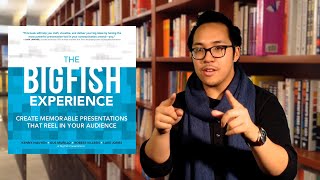
The Big Fish Experience | Kenny Nguyen & Gus Murillo | Talks at Google

In this Talks at Google session, co‑founders Gus Murillo and Kenny Nguyen share the story behind their startup Big Fish, which helps executives craft compelling presentations. They outline a three‑part process – Content, Design, Delivery – and provide concrete frameworks and tactics for each. For content they stress a clear "big idea", a three‑point structure, and a strong call‑to‑action, illustrated through a live doughnut‑pitch exercise. For design they champion simplicity (KISS), the rule of thirds, memorable and understandable visuals, and recommend tools such as Canva, Haiku Deck, and PowerPoint/Google Slides. For delivery they demonstrate body‑language cues, eye‑contact tricks, rehearsal methods (recording, rituals, peer feedback), and adapting style to audience size and virtual settings. Throughout they weave personal anecdotes (their Cajun‑Asian background, failed culinary scholarship, early student organization, Fortune‑executive slide disaster) and case studies (TEDx, Clinton Global Initiative, Dubai Hope Prize). The talk concludes with practical advice for time‑crunched decks, remote presentations, common pitfalls (200‑slide read‑outs, cluttered slides), role‑model inspirations, and a vision for future immersive (VR) presentation experiences.
Chapters
Thanks, Kenny Nguyen. Alright guys, we're gonna have a little bit of fun, but before we have a little bit of fun today, I'd like y'all to get to know a little bit about me. So, a little about me is, uh, can we pull up the slides please? Is, I love creating amazing presentations. And when it comes to amazing presentations, this is what I love right here, is that it's very detailed. This guy right here is like, "There's no way." I'm joking with you. So, really what I love doing is is simplicity. But before we get really into what I love doing in presentations, I feel like I just killed half of this audience thinking, "Oh my God, what did I sit down for?" Is that let me get you to know, let me introduce a little bit about me. And so, a little bit about me is that I am a proud Cajun Asian born from Louisiana. I am from Baton Rouge, and this is actually me in my thug life years about 10 years ago. And so I had a very interesting creative journey. And during this time, we had a lot of different things that I loved doing, such as I loved playing music, which is actually a funny story. It's like, this is my co-founder Gus right here. That's him all the way to the right with the afro. We played a lot of music together. And I always thought that being a musician would be my calling. I wasn't that good. So— and Gus would probably say like I was kind of good, but he's being nice. Don't believe him. And I figured at that point that maybe creativity and music wasn't for me. So I decided to go on a different path. And the next path I came on was I wanted to be a chef. And I trained for 4 years as a cook in Asian food, sushi, but also I trained in Italian food. I really thought that this was gonna be my calling in creativity. It wasn't. I lost a culinary scholarship because I missed a competition. And because of that, I actually left the country and went to Vietnam to go find myself. And in Vietnam, I had this crazy idea was, I always loved the subject creativity and communication and conversation. Music, food, really intimate ways to communicate that. But is there another way that I can communicate and help others with my passion of communication and conversation, whether it's through music or food? And decided, how about I just go to college? At this point, this is when I was in high school, I actually go in and create a student organization. And so I created an organization. How many people know where LSU is? Like, I'm a very proud LSU Tiger fan. And at LSU, we created an organization called IME, which is I Am Entrepreneur. And it was funny because I had the student organization and didn't own a business. And it was even crazier that I managed to get a lot of really great CEOs in the room locally talking about entrepreneurship, and it made me think, I thought, what if I could help these guys with their PowerPoint presentations because they were so boring? And it was just in the back of my head. But the story gets even funnier is that I remember it was in January 2012 where it was actually me and Gus. We were sitting in a room for a student organization. And I remember there was a Fortune executive coming to speak to us. And I remember I was so excited. I was young. I was naive. And I thought, Fortune executive, he must be an amazing person. Presenter. There's no way he could be bad. Well, soon lo and behold, I remember he walked up and had a USB drive and he plugged in his slide deck. I remember seeing in there 200 slides at the bottom right corner of his PowerPoint. I'm thinking, oh shit. And at this point, this guy scheduled for an hour went on for 3 hours reading off every single slide. And to make it even worse, this guy started telling his own jokes, answering his own questions. And as I was sitting there, it made me think, if the world and these companies are presenting like this, chances are the next big idea won't be heard. And that's when we had an idea of, why don't we create a firm that can help these executives, help these companies create amazing presentations? And that's when we had the idea of Big Fish presentations. And we never thought the idea would take off. It was a college startup. It was one of those ideas that we had was, why don't we just help a couple of companies here and there? But soon enough, people started noticing us. We got on Inc. magazine as one of Inc.'s coolest college startups. That was really neat. And that's when the Fortune companies actually came calling us and saying, can we get you guys to help with our presentations? And we thought, maybe we have a really cool and crazy idea and we should just run with it. And so as we evolved more, Entrepreneur covered us and we started getting more clientele. We worked with clientele like TED, Verizon, GE, and soon enough we actually worked with this guy. And it was really cool because we worked with this organization called the Hope Prize down in— actually here, it was during the Clinton Global Initiative, the huge summit they had down here. The Hope Prize is $1 million for the biggest college startup that's helping the world and a nonprofit as well. And what was so cool is that we helped the Dubai team and it was such an amazing experience because after the whole entire show we helped the Dubai team, Bill Clinton walked up to us, shook our hand and said, "That was an amazing presentation." And that's when we thought, "Okay, wow, we're actually doing something right." So this is some validation. So a little bit about me was that that's our journey so far. And from that we have a book which is actually located right over there, "The Big Fish Experience." But even further and even better than all this is now my girlfriend agreed to marry me, and so I'm now engaged. And so I joke with her all the time when I show this slide, was like, "So was it all that that led to this?" She's like, "No, don't show that." But, you know, a little bit about me, I'm a very happy engaged man. This actually happened at Disney World. But with all these things that happened with Big Fish, we learned there's a process in creating amazing presentations. And while I know you're so interested to hear my story, I know you're really interested and hearing how to make amazing presentations. And we have a process, and that process is actually called the Big Fish Experience. And it's content, design, and delivery equals an amazing presentation experience. And we're gonna go through those three things today. Just content, design, delivery. I know we have a whole entire range of people, from designers to app designers to even some business development people in here. So we're gonna talk about a lot of different ways where from the basics, how can you— everyone walk away here, create amazing presentation, but even more, how do you find a way to become the best version of yourself as a presenter? And the first thing that we're gonna do is actually content. And so our content, part of the design delivery process, is that engaging content always wins. But what does engaging content really mean? So, with content, there's 4 different things that I always recommend when it comes to making a great presentation. And this goes from whether it's a deck that you're gonna send out, to a pitch deck, to even if you're pitching an idea. And the first is that every single presentation that you have should have this thing called a big idea. And a big idea is an idea that formulates around the whole entire presentation. It's your central argument. And, uh, by the way, in the middle of this talk, we're actually gonna go create a presentation from scratch. So we're gonna have a lot of fun. So the big idea is the main central argument of your presentation. It's what people are compelled to believe in. And furthermore with that is that every good presentation should have a structure. So when I say structure, how many people here know about the rule of three in presentations? So the rule of three in communication and presentations is that if I tell you there are 6 things to remember, there are 5 things to remember, it's a little bit more difficult. Well, if you're able to condense your presentation down into 3 easy points, they're, I say, Twitter handles, you're more likely to walk away and have someone be able to retain the information. The next is a call to action. Every presentation, I tell you this, is that when I think of the word presentation, I don't think of just the formal presentation we're doing here on stage. I think of going home, talking to my fiancée, and saying, what do you want for dinner? Then I present my ideas. She presents her ideas, and we go back and forth. It can even be a conversation, or if you're pitching an idea, such as a design concept. Presentations can be anything, but here's the thing. Anytime when you go and present an idea, or just an argument, it's important to have a call to action. And when I say call to action, there are 3 different ones. One is an offer, such as, "If you buy this, you'll get X." Next is demand, "Do this." And the next and final one is actually more of a question, such as, "What if you did— what if you went home and ate a doughnut and became happy?" And the reason why I say doughnut is that that's actually the presentation we're gonna create. We're gonna create a live and full argument on why everyone in this room who might not think doughnuts are healthy will now believe that doughnuts are healthy. And so we're gonna do it with the same exact process. So, From going around this room, how many people here actually love donuts? Good, there's not that many. I love this. Alright, challenge accepted. So, how many people here that don't think that donuts are actually healthy for you? Kinda wrong, but it's all good. Donuts are delicious though, they're great for your mind. They make you happy. And so with that being said, is that that will be the central argument, the big idea, is that for all the donut lovers in here that now have my back, We're gonna create and work on a reason why everyone else in the room should love a doughnut. So just going around, why should people in this room love doughnuts? And this is where I'm gonna ask you questions, 'cause we're gonna come up with our own pitch together. There are so many different kinds of doughnuts. Exactly, there's so many different kinds of doughnuts. What else? They taste delicious. They taste delicious. Come on, guys, this is the time to rise up and talk about doughnuts. They're filling. They make you happy. Sugar rush. They're America. They're America. There we go. So let's create this central argument. For the doughnut lovers in here, what if we can say that doughnuts make you happy? That's a good enough reason why people should believe, because I don't think anyone in this room wants to be unhappy. Now let's think of a call to action. And I always say when you create a presentation, no matter what it is, think about the call to action at the end. Where do we want to lead people? Where do we want to take them on this journey? 'Cause if you have a big idea and you have an argument, there's always a chance and there's always a reason why you should create your call to action first. And that's because you should know where you want to take your audience. So for us then, doughnut lovers, call to action. Let's be a little bit gentle. Let's say we ask them, "If you want to be happy, Why don't you get a doughnut? Do y'all feel like that's enticing enough and not forcing enough conversation for the non-doughnut lovers in here? You think so? Cool. So our main idea— and imagine this as a circle— is that doughnuts make you happy. At the end of the presentation, our big ask is, why don't you get a doughnut to make you happy? Now comes the fun part when it comes to structure, is creating the 3 main points to convince people. So I heard 3 main points. I probably won't say, like, "It's America," for this case, but let's think of some main points. If I were to come in right now and pitch someone that doesn't like donuts why they should like donuts, and the main point is to make them happy, what would you say? Start pointing at different people now. Is, I heard earlier that someone said that they have a sugar rush, right? And you like sugar rushes. What's another one? And this is what we're gonna build up for our structure. They taste good. And tasting good— you like to eat food that tastes good, right? Exactly. So let's say the main point one is they taste good. What's main point two? They're what? Cheap? America. So, they're cheap. What else? Let's have our third point. Let's hit it home here. Come on, guys. We gotta help. Sugar helps your brain function in the afternoon. Damn, so that was a really deep answer, so we're gonna close off with that. So let's say this. If I came up and pitched— and I will give this whole presentation right now about donuts is that, one, like, they taste delicious. Two, they're cheap. But here's the thing: being cheap and delicious can actually make you more productive because a sugar rush will help you out in the afternoon. And overall, if you're more productive, you'll be more happy. There's a very compelling reason that everyone can walk out right here, right now, and think, "I should go and get a donut." Now, to close this whole entire presentation, pseudo-presentation that we have right here, it's always important to remember your introduction. And I say this with so much importance, and I waited to the end to tell you this, is that every presentation should have an introduction that's very memorable. And there are 5 different ways to have a great introduction. One is to build the emotional connection through a story. Two is to tell a statistic. Three is to share a quote. Four is to actually deliver media, whether I open up with a video to kind of bring y'all in, make y'all feel very welcome. 30 seconds to a minute is what we normally like recommend, or fifth, I open and tell a joke. Jokes are dangerous, as everyone knows, because if it falls flat, you're fighting an uphill slope the rest of the presentation. But for the sake of this one, how about I actually give this presentation by telling a story and using all the points that you delivered to me? So again, who are the people that love donuts in this room? Get my back. Cool. That's a lot of people. We're gonna convince everyone else right now through your support that they should love donuts, just from what you just said. So, when I was a kid, my father used to bring home donuts for me all the time. And the reason why is that he always told me, "You need to eat breakfast." And I was a very energetic kid. And for anyone that's actually seen my TEDx talk, I actually shared a story where I used to run around all the time outside, and it drove him crazy. And he thought, "You know what? How about I just stop feeding him donuts?" And he noticed that my energy levels really went down. And the thing is, he wanted a happy kid, and so why did he take that out of my diet? So it actually leads to another story. About 2 years later, I was actually at my brother's birthday party. And in Louisiana, if you'll ever go down to Baton Rouge, there's this wonderful place called Mary Lee Donuts. And I feel like I should get a sponsorship for name-dropping them. But a delicious place called Mary Lee Donuts. I remember that my dad took me here. And he said, "Son, let me tell you something. I love you very much." And he never says this. And he tells me furthermore, "Do you want a doughnut?" I was like, "Yes, I do." And he said, "Well, here's the thing. You know, we never get to spend time together. Why don't you take a doughnut and we can just go and hang out and relax?" My father's always very busy, so this meant a lot to me. And so that moment there, I realized that doughnuts made me happy and that if anyone ever asked me about a doughnut and we want to bake— break bread together. And this is a really cool story. And so I want everyone here to believe in doughnuts. So my presentation, my argument to you today, is that doughnuts can make you happy. And here are 3 reasons why. One is that they are delicious. Who doesn't like good food? Good. No one raised their hand. I'm very happy about that. Two, who here wants to spend a lot of money on something that tastes delicious? Sure, we can go to, like, a 3 Michelin star restaurant. Sure, we can go to a 2, 1 Michelin star restaurant. But for just the price of $2 or $5— I'm using New York prices— $2 to $5 right here, you can have a delicious doughnut and really make you happy. But the thirdest most compelling point— everyone here at Google here, I know, works very, very hard. And I know that everyone here, when they come in the morning, you're energetic. But as you go throughout the day, the brain kind of drains down. You get tired. There's so much bombardment in our lives. So what if there was a way, what if there was a device or something that we can ingest, cheap, that can totally make us more effective as leaders in the creative community? And if we remember that that device does exist and exists in this delicious small pastry called a doughnut, I believe then that everyone here will have a much more fulfilling career and be much more happy. And that's why you should go and eat a doughnut. See, that right there was a very compelling way to tell a story about the doughnut. And if you follow that format exactly how I did in any of your presentations, say you have a big main idea, if you have a project coming up, explain why the project is the best for everybody. Next is to have a call to action. What's your big ask at the end? Where do you want to lead them to? Next, have your main points. What are your main arguments? Just from those 5 minutes right there, we came up with an idea of how to make other people that don't love doughnuts love doughnuts. And finally, have an introduction that's memorable. If you're sending out a presentation, make it very simple in the beginning with the design. You don't wanna just jump in and bombard people with a lot of clutter. However, if you're going on stage, I always suggest share a story. That story's actually a true story, that my dad always brings home Mary Lee Donuts. I'm always very energetic as a person, so he actually cut it off for a while, but then he took me to the donut store for my brother's birthday. That's a true story. Now you actually know a little bit more about me. I'm sure that everyone here today has a story about a donut where they remember the company that they were with, and they want everyone else to have that same happiness. And so that's content right there, is that content can be engaging if it has a structure, a call to action, and a big main idea. But the next thing that's so important in the presentation process is that we actually have design. So how do you take content to the next level with design? And the way that we do that is that we have a very simple equation. It's just simple, simple, memorable, and understandable. And so, when it comes to simple, memorable, and understandable slides, I actually share some slides that we created with clients, including one we did for the Holt Prize, uh, for the Dubai team that I think y'all really would like. And so the first thing is simplicity. So, everyone— have y'all heard of the KISS principle? Keep it simple, stupid? It's one of those things that goes into slides completely well, because if you're giving a presentation, the focus should always be on you, the presenter, and not the presentation. Keep this in mind, people will always remember the presenter more than the presentation. And so when I say simplicity, this is what I mean. This is actually a slide that our team did for a client where it's very, very simple. And the thing is, everyone here is wondering, why don't I understand the slide? What is he trying to say? And that's what it should be, is that at the end of the day, I need to be here to present it to you for it to make sense. However, after I deliver my message, this should ring home with you, and that's my first message to you, is that if you're designing slides, keep in mind is that if you are needed there to deliver it, that's a good slide. However though, if they can just read this slide and you don't need to be on stage, you're wasting your time. So think about it like this: always keep it simple when it comes to slides because people need to see you. Next is being understandable. And so this slide right here is a slide that we actually send out, and it's not clutter, and you exactly know where your mind actually, or your eyes actually draw. So it's in the top corner, to the bottom, to the left. And it's very, very simple, but it's also understandable. You know exactly the way this means with this infographic. Now, what's simple and understandable, it should all come together. And I'll show you one of my favorite slides that we've ever created at our firm, Big Fish, and it's this slide right here. Is that you might notice it's kind of blurry, right? You might think, "Man, that's a really shitty design slide." And we did that on purpose, and the reason why is that for the whole prize, we had 4 amazing judges. They included Muhammad Yunus, one of the Nobel Peace Prize winners, and also Sanjay Gupta from CNN. And what was so cool was that we had an opportunity to tell with our client the story of Harambee. And Harambee, you see, was a very small little black box. This company developed a black box that can make glasses for $5 for kids in urban slums. And that's amazing, because if you think about it, we can just go walk outside this door and walk, like, less than 2 miles to go get a pair of Warby Parkers, like, right here. However, though, imagine a kid in an urban slum where they couldn't do that. Imagine not being able to see, not being able to learn. What can we do to make that happen? And the thing is, we actually thought to ourselves, what if the judges all had perfect 20/20 vision? How can they understand what does it feel like to be blind? And so we created this slide right here when we pitched the company was, imagine if you were a child growing up in Guatemala and you couldn't see anything, but you wanted to learn. You wanted to lead and you wanted to do great things, but your sight isn't there. And if you want to be better, you need to see the people that believe in you. And this is actually what they pitched. They said, for those here, who here has 20/20 vision? And the judges raised their hands, and we were right. And they never— and they asked, so y'all might not know what it's like to be blind. However, though, if you look at right here, this is what it's like. But for $5, and you invest in us today, you can do this, and a child can see. And make a huge difference. And they loved it. And that was one of the most memorable moments in that whole entire presentation. And it was one of those feelings where I thought, that's how design can be memorable. So for anyone here today can take away something when it comes to presentations, whether it's with content but for design, is that simplicity wins because they need you as the presenter. They need to be understandable, but most of all, it needs to be memorable. There's no reason why slides can't be fun. PowerPoint is fun. I know everyone, when they come to our firm, they think, "What can we do besides PowerPoint?" We have all these cool tips and tricks in our bag, but I always say, "What's wrong with PowerPoint? You can do amazing things with PowerPoint." This right here was done in PowerPoint, but it delivered a very effective message. So, with content design comes one of the most important things, and that's actually rules of thirds. Is that, with every grid slide here— how many people here are photographers on their off time? Here, so, what do you, when you think of the rule of thirds, you always think of your central figure should not be in the center when you're creating a slide. It's actually, you wanna be able to position your figure, wherever your main point of focus is, to the left or the right, so you have a little bit of slot, or a little bit of room to the left or right to actually put in there some words. That's what we recommend for a lot of our presentation slides. For anyone going home today, creating their own presentation, think about the rule of thirds. If you put it in the middle, you're forcing something. But you're putting it to the left or right, you're actually coexisting. And that's what you want with slides, is that you want to coexist when it comes to photography. You never want to impose on top. And here's some of our other slides that we created, is that for this, when it comes to slides like this, you think of photography. This is very, very, very boring energy usage. How can you make this more fun? And we see this in a lot of corporate presentations, is that you actually think Okay, this gets the point across, but how do you make it memorable? And this is what I recommend doing. Let's bold the important points and let's throw an image at the end. Next, what do you think about when you share a graph like this? We've all seen graphs like this where it's a chart or some kind of information presented, and you think to yourself, "Wow, what can we do here to make it more fun?" Very simple. Why don't we turn it into a graphic? And it's simple tools like this where you can do it and where you can turn very minute and boring information into something fun and more lively. Design should be fun. And the thing is, like, how many people in here are actually designers? I'm not a designer, and I'm proud not to be, because if you learn these simple design principles, anyone can become a great presentation designer. And I say that is that there are many tools out there. So this tool right here, you can create something using Canva, for example, a really popular Or Canva or Piktochart is another one. And those tools can create amazing infographics for you very quickly. If you're ever in a rush for presentations and you can't hire an agency or you don't, you can't just spawn it off to another designer, I recommend there's a tool called Haiku Deck. It actually puts in your presentation content for you and actually allocates it into a way where it does not feel like there's too much slide or too much text per slide. But there are many good tools out there to make you an effective presentation designer. It's just very important to look for them and to keep in mind that Being simple, memorable, and understandable for any type of designer is the most important thing. Now, this is the fun part, is delivery. So, when it comes to delivering slides, presentations, or even arguments, or even conversations, it's very important to have powerful body language. May I have a volunteer? Preferably a doughnut lover. May I have a volunteer in here to actually demonstrate some good body language? I'm gonna choose you, Gus, to come up here. This is my co-founder, Gus, over here. And so, whatever I say, you do, okay? Just trust me. Okay. That's the way I sold it to him. That's my presentation to him. So, ways to have better body language. The first thing is to always remember, when you give a presentation, no one wants to have a grumpy person in the room. It's very important to smile. So smile. Let's smile at him. Let's wake him up a little bit. Just smile at him. So, it's very important to smile. Smiling actually alerts the other human in front of you that you're ready and you're ready to engage. If you're grumpy and you're walking up and you're sad, it pulls off a very different opinion of you. Second is that you always want an open posture. Imagine if you're like this, talking in a presentation, and it's one of those things where it's very It's very hard to do because when you're nervous, you're going up, you're like, "Okay, let me think about something." It looks like you're not sure, but you're open. It shows a much more positive and more engaging type of body language. The third is to use hand gestures. So, you can do this. Yeah, it's hand gestures. And I say it in a controlled way. Is that, imagine if I presented like this. You don't know if I'm excited. And just by using one hand, it shows a completely different way of saying, You don't know if I'm excited. It seems very, very different. That's the power of hand gestures. It can actually show your emotion and it shows your point. The fourth is to actually have eye contact. So let's stare him down.
Again?
Yeah, again. Sorry, man, you're my direct line of sight. So, it's eye contact. So, I'll tell y'all a secret trick that one of my friends taught me. Is that for those people here that are very afraid of eye contact, there's a trick called looking in the forehead. I'm looking at your forehead right now, man, but it looks like I'm staring directly at you. It's very creepy, I know. Just bear with me. But the thing is, though, that's a very effective way, is that when you're able to look someone in the eye and tell them a message that they might not believe in, or an argument, a call to action, a big idea, but you're able to look them in the eyes and show that genuine authenticity, it's much more compelling for you as a presenter. But if I look away, I'm telling you something, you want that attention on you. And so that's why eye contact is so important. And the fifth and most important point is do it naturally. You should not look like a creep. Sorry, man, we just totally just bombarded you with some of that, but if I'm just doing this and talking, pull me out, NYPD, come get me. And you don't want that. You want something that looks very natural, and that's why it's so important to rehearse. Gus, thank you, man. So let's give him a round of applause. He had no clue, and that's how I sold it to him, but Next thing is, how do you rehearse? Because when you think to yourself, body language, "Oh, I can do this, I know what, I remember how to do this," it's very important to rehearse and create habits. Presentations, public speaking, they become great through habits. Sure, you can present once or twice, but if you don't, are able to critique yourself, there's a very different way for you to learn. And I recommend 3 different ways to actually rehearse. One, does anyone ever record themselves for a presentation? It's really hard to watch, right, sometimes in the first— yeah, it's actually really miserable. For my first TEDx talk, and actually the same talk I did at HubSpot recently, I actually gave a talk and I watched it and I thought, "Man, I don't like this." And I watched it about 9 times and I just said, "I'mma scrap it." And that's really frustrating, I understand, but here's the thing, is that if I'm able to do that, I'm able to watch it and say, If I'm not able to sit through my own presentation, why would someone else want to sit through it as well? And sure enough, we redid it, and I think the video now has almost 40,000 views on YouTube and 10,000 on SlideShare. And it was actually telling the story about Shark Tank. How do you make— we turned down Shark Tank in my TED Talk. We were explaining how we turned the process of Shark Tank, and the challenge was like, how do you make that sound fun? And so watching it over and over and over again to the point where we knew where it sounded fun, I would enjoy hearing the story, was that breaking point. And so finding a way to rehearse and watch yourself, pull out that webcam, pull out that iPhone, watch yourself rehearse and critique yourself. Did you say something that sounded weird? Did you say a lot of "ands," "ums," or "ahs"? Or did you have body language that just made you look boring, creepy, or did you not enunciate your words correctly? It's very important to record yourself. Because then you'll find your biggest critic. Next is always find your own unique ritual. So my ritual before I go and present is that I love listening to stand-up comedy, and it just makes me happy. And the thing is, before I go on a presentation, I should be happy. So there are different ways for you to actually prepare yourself mentally. So does anyone here want to share some of the things they do before they go on a presentation?
Oh, that was another TED Talk, but there was a woman that did a Superwoman pose.
Oh yeah, yeah. That's actually one of the most common ones I actually hear, is like the Superwoman pose actually just gets you really revved up. I think it's great. I think I would love to try it for myself. I should do that. Any other ones? Yeah, I like to listen to Rocky, "I Am the Tiger." Yeah, that's good, that's good. Music's actually another big one. Yoga, I've heard. Tony Robbins actually jumps on a trampoline. I've read that, like, before he went on Dreamforce, he just jumps on a trampoline to get that adrenaline up, those endorphins, and it gets him really amped for like his 6-hour workshop. It's incredible. And so it's good though, is that you have these rituals, and to prepare yourself is one of those overlooked things, is that, sure, I'm just gonna give another presentation, but you always wanna be in your element. If you're able to find what makes you happy beforehand, that makes you really energetic, Use that, keep that in mind. And the third is to actually find friends that can critique you. And that's one of the most overlooked things because you always think, oh, you know, I'm in this alone. If you have people in the room— and I'm not— I usually ask this question: who— how many people here in the room have actually wanted to fall asleep when they've seen someone else here present? And usually it's a really uncomfortable question. I always tell them, those are the people that you should go to because those are the people that tell you straight up that will tell you, you can do better on your presentation. And that's very important to find those friends, or those colleagues, those coworkers, those siblings that'll tell you straight up, "I didn't understand what you had to say." So, to close for this formal part, is that there are 3 things that everyone should remember when it comes to an amazing presentation experience. One is that content should always be engaging and should always have a structure and should always, always, always have a call to action. Next is that design should be simple, memorable, and most importantly, memorable and understandable. Now finally, delivery. Delivery, always find your element. Have that great body language, but most importantly, find what makes you comfortable. Because at the end of the day, if I'm up here and I'm teaching you and telling you, "Why don't you become like Steve Jobs when you go present?" You're gonna think, "I'm not Steve Jobs." You wanna find your own element. And that's why we have this process. The process here isn't to teach you to be like someone else. This process here is to teach you to be the best version of yourselves. And for people here that know the poet Maya Angelou, people always remember what you say, what you do, but people will never forget how you made them feel. That is the true essence of an amazing presenter. And you remember that quote in any presentation that you give. It's how you make others feel I promise you, you'll be the most amazing presenter in the room. Thank you.
Thank you for that presentation. You guys definitely know what you're doing. So I have a handful of questions about how you can take all the experience that you guys have and how we can apply it to our day-to-day work here. So one of the first questions I have is, all this information is pretty fantastic if you have a week to prepare for a presentation. But the reality is there's gonna be situations where I get an email in the morning and I have to give a presentation in 3 hours. Do you have any tips or tricks or advice on how to prepare presentations under a time crunch?
Yes, I do. And, like, feel free to chime in. For our stuff is that I actually get pretty frequent requests to do presentations. If let's say a speaker drops out, I'll go and give a presentation the day of. And the best thing I've always learned to do is like, I talked a little bit about earlier, creating that type of structure in your presentation. Intro, 3 main points, and then a call to action. I make sure before I go on anything else, design or even delivery, I have that kind of content right there. 'Cause at the end of the day, that's your message. And so before I even open up PowerPoint, and you're in a time crunch, if you have less than 6 hours or even less than 2 hours to put together a deck, that's what I recommend doing. Come up with your structure and your message before you take on anything else. I don't know, do you want to chime in on that?
And keep in mind that content is the most important thing. You shouldn't be spending too much— if you have 6 hours, you shouldn't be spending 5 hours on your deck. Focus on what you're going to say. Spend your last bit of time putting— making sure that your slides look good. But honestly, just the biggest tip is just keep it simple. There's tools out there like Haiku Deck, or if you just honestly want to make something really quick and simple on PowerPoint, that's good. Because if you try to spend too much time making the most detailed slides, it's not going to matter if you're not prepared for what you're gonna say and if you don't have a clear and memorable structure.
Okay.
A lot of these rules sound really excellent when you're giving a presentation to a large audience. Do you think it changes at all when you go from a stage and a platform to a small room or a conference table and you're presenting to a small set of coworkers?
I actually learned that by doing some workshops. We do a lot of workshops. I actually change a lot more based on the audience size. For example, if we had like a stadium crowd here, or like a crowd of like 1,000, for example, I normally wouldn't do and engage with them that much, compared to if it's a smaller room, and it's like, let's say like 5 to like 50 people, that's when activities would be more, I'll be more open to activities. It matters because The reason is, is like you can only engage so much people in the room at a time. But the smaller it is, let's make it more intimate, let's make it a conversation. And so I'll tell anyone that like when they give a presentation, if you have like a small room, make it a conversation. But if it's a bigger room, that's where a more formal presentation would be okay. I don't know, what do you think? Agreed.
Just make sure your activities are tailored specifically to your group. Like for groups of 5 to 10, which a lot of small meetings are, you can actually get every one of them to answer your question and to chime in, rather than here you have to get a crowd to come up with a few suggestions. For a group of 5 to 10, you can really get some, some, a lot of back and forth and actually turn it into a conversation. Because groups that small don't want to sit for 45 minutes or even 30 minutes and just be talked to for that period of time. They want to talk.
Yeah, everyone has a voice. That's why when I did the donut activity, it's always fascinating because Usually it's like, it's usually a hit or miss when it comes to people actually engaging back. 'Cause a smaller room, everyone will just start, just bombard me with like, "This is why I love doughnut, this is why I love doughnut." It's cool. But when it comes to larger crowds, you know, you have that feeling of, "Should I say something?" But once a person says something, like we have one person that just chimes in, then the others will chime in. It usually takes that one, but with a smaller room, and you have like 5 to 10 people, usually you're getting it left and right.
So Google has the unique problem where we might have a meeting in the morning where we're talking with our coworkers on the same floor. An hour later, we may have a meeting with our coworkers in India or California or Brazil. Do you have any advice on how to communicate when you're doing it digitally across GBC or something like that?
Yeah, so whenever I think of presentations or webinars or just doing something remotely, with colleagues, like, complete— like, this even comes in when we do client pitches, is that we've had to learn the hard way on how to engage them. When you do something on the computer, you're fighting with what's available on the other person's computer. It's like internet, it's YouTube, it's cat videos, it's— it can be anything. And the way that we always thought about it is this, is like, how do we get to be direct? So I'll answer it in two parts. One is if you have a small group for 5 to 10 people, that's when I say I would engage with people. I would ask them questions, I wouldn't just go sit down and present, and if I do, I keep that at a minimum where there's a break in between where I can ask them questions, what do they think, and give a time where they can actually submit in questions in the box. However though, if it's from like 25 to 50 people, that's a little bit different where it's a little bit harder because you have a whole entire team call and you don't know who's really paying attention. I mean, quite frankly. So what I recommend in that case is that if you use a slide deck, keep it very simple. It's even harder to present off a webinar because you're not there having that personal connection. So that simple, memorable, understandable design applies to that. If there's no slide deck though, I would recommend actually asking questions, engaging, but at the same time have an agenda call and clearly make sure who's involved in that call. Kenny Nguyen, you want to piggyback on this?
Yeah, especially for smaller meetings between— and you're pitching ideas, make sure that you go into it and they go into it knowing, like, I guess an agenda, but it's mainly just a structure so they know that they're gonna come away with these few things. And that might not be a deck, just make sure that you have that written down and sent to them.
Okay.
So in the next few minutes, we're gonna open this up to the audience for questions. So if you have something you wanna ask, please stand by one of the two microphones. Yes. So in your opinion, you know how to give good presentations, and so you probably have a sense of what a bad presentation is. What is the absolute worst thing a person can do?
Read off 200 slides.
200 slides.
No, I'm kidding. Well, like, no, the worst thing that I've seen, I hope everyone takes this to heart, is when the presenter's everywhere. There's no structure in the presentation. I kid you not, when you have a structure, a roadmap, you know where you're going, and it can be suspenseful, you don't have to reveal everything in the beginning, but if you have a roadmap that can tell, like, there are 3 things we're gonna learn today: content, design, delivery, you know where I'm taking you. That's fine. But if I'm telling you all these different stories and you don't know where we're going, that's a big problem. It's always to say, like, I like to have presentations that have a structure. Still surprise me, but at least, like, let me know where we're going, where we're at.
And the biggest thing for me, since I guess I mainly contributed to the design portion of the book, was just everyone putting too much on the slide. And that just happens so frequently. It's just, keep in mind that what you're gonna send to the people later is not what you should be showing to them right now on stage. And that's the worst thing for me. That guy with the 200 slides having 60 bullet points a slide and we can't even read it. That's the worst.
So the flip side of that question, are there any speakers that you particularly look up to or view as role models?
I really like Scott Harrison from Charity:water. He's a very good presenter because he's really, he's able to tell very emotional stories, then deliver the meaning to that story after. And while this presentation I just gave didn't have a lot of stories, but you're able to incorporate more stories in your presentation, make it more personal, you're able to connect more with the other person. That's personally my favorite presenter. And then you have the Steve Jobs of the world, or even, uh, you know, I actually really like Malala. Malala's a really good communicator as well. So I have several presentation heroes. I never try to emulate them, but I always try to learn from them.
I like Scott Harrison from a design perspective because he's a photographer. He documents his entire life, and so as a designer, you can and just visually see him walk you through his story. And just seeing him present, it just helps it so much. His slides aren't a crutch. It's just a way to walk you through his life and his story.
It should always be an aid and not a visual crutch. And those rule of thirds that we shared earlier, that's actually a big proponent of his slides, is that they always follow the rule of thirds. It's coexistence. It's not overpowerment. Okay.
Great. So let's open this up to questions from the audience.
Great presentation. Thank you guys for coming. When I think about doing a lot of presentations here, oftentimes I may present it to a small group, but the deck will live on forever. People are going to look at it and I won't have the opportunity to present it. How does that change the calculus of how you're putting together a deck?
The way we do it is we make two pieces. One for, especially if you're either on stage or in a meeting room, in front of people, you make that deck completely separate from what your actual information is. So you can work on your deck if you like to display everything in PowerPoint or Keynote or whatever you like to put all your bullet points in and what you want them to remember and take away. Make all of that first and then make what you're gonna present after that. Make what you're gonna present as a completely different document that doesn't live on 'cause that needs you. So that's the way we—
and that's a hard thing to remember, 'cause you're not doubling your work.
'Cause in the end, you just put all your work into your structure and your content and then just spend the last bit of time making a really simplistic deck so people aren't overloaded in trying to read that.
Got it. Hey, you mentioned PowerPoint and Keynote. Hopefully you also use Google Slides. Yeah, that was one joke that Ben threw at me. He was like, "Yeah, why don't you use Google Slides?" I'm like, If I have no time, I promise you I'll switch over. Unfortunately, we didn't, but— That actually leads into my question, is that you talked a lot about the content and your body language and whatnot, your person as you present the presentation. But in terms of the underlying technology, do you still feel like a slide, your traditional slide that's been around for decades now, is still the way to go? And sitting here at Google among some of the best and brightest, are there any changes or feature requests that you would like to put out in the world right now to help make your jobs better?
I don't think that the slide would be— I think it's an option. I think it's a way for people to display information. But I honestly am starting to like the way that we just cut out the deck completely, write it on a whiteboard or like Simon Sinek draws his on paper. I'm starting to find that as a way to, for people, for seasoned presenters or people who can get on stage and are comfortable with complicating what they're doing on stage, but it's just such a cool way and a different way 'cause it's not the deck that's been living on. It's even older than that.
It's before that.
It's just drawing it out for people to see live and it changes and it'll change from what the audience says. So, slides work, but I'm, I guess I'm starting to be partial and starting to like a lot of the engaging presentations are finding different ways to display the information outside of the computer.
Going back. Yeah, actually, so for my TEDx talk, what I did was like, I actually cut out all my slides. It's funny because people always expect me to have this amazing slideshow. I actually normally don't use slides in my presentations. I usually use an easel and a whiteboard. And this is why it's kind of new for me, is like when I use Decks, I'm like thinking, oh man, I like to be like kinda like run wild almost, but at the same time, like, have that like canvas creativity. So that easel and that whiteboard really helps me. But one thing that I really, really, really like doing in some of my pitches and like my presentations is having props. I like to do show and tell a lot. So my TED Talk was talking about why we turned down Shark Tank, but the underlying message was the power of saying no and why that's so important in people's careers and their personal lives. And I used the analog— or pretty much the metaphor is that a sword is like yes, but a shield is like no. And I gave that analogy to people and actually pulled out a sword and shield after my talk, and I remember people were like going crazy over it. At the end of my talk, I had this like really cool moment of my life where I remember just like putting the sword in the air, then the shield in the air. But it made a more memorable presentation. So if you're able to use props, that show-and-tell type of element, I know Cisco does that really well and Apple does that as well. I think that's another element to your presentation that goes beyond the slides. It's like show people why you're so excited.
And one feature request would be as you connect to the audience, which is why I like the hand-drawn way to present, is like no platform is very good at integrating social and then getting real life, like live feedback during a presentation. Especially like tying into— there's a few out there. There was one by the agency, an agency at a heat— like one of the big agencies and they created a lackluster app that kinda does it and pulls in some feeds and stuff but it's not that good. And there hasn't been a solid platform that allows people to pull in real-time social feedback. So as a feedback request, it's something that I haven't been able to find to suggest to people, that'd be one.
I would love for one way, by the way, if y'all can incorporate— when virtual reality becomes more commercialized, I would love to find a way where the slideshow can actually extend beyond just the slide and take you to a different, more immersive experience. And whether we develop that in-house ourselves or even Google develops it, that's one thing I'm really interested in the future of presentations is virtual reality. Even just seeing on screen, putting on a pair of glasses and just seeing it as being something completely different, that's that wow factor I hope I'll see one day. Thank you.
Okay guys, well we're almost out of time, so to wrap this up, you covered a lot of topics today. If there's one thing that everyone here remembers and takes away from this, what would that be?
Mine is that people will always remember the presenter more than the presentation, and you should never ever ever ever deliver a presentation you wouldn't want someone else to sit through?
I would say just in creating your content and working through your pitch, make sure you keep everything from content to design as simple as possible.
Okay, great. Well, this has been Kenny Nguyen and Gus Nguyen with their new book, The Big Fish Experience. Thanks for coming, guys.
Thanks for having me. Thank you. Appreciate it.
More from Kenny
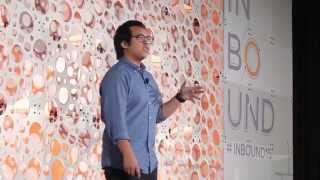
INBOUND Bold Talks: Kenny Nguyen "How to be the Coolest Person at Your Funeral"