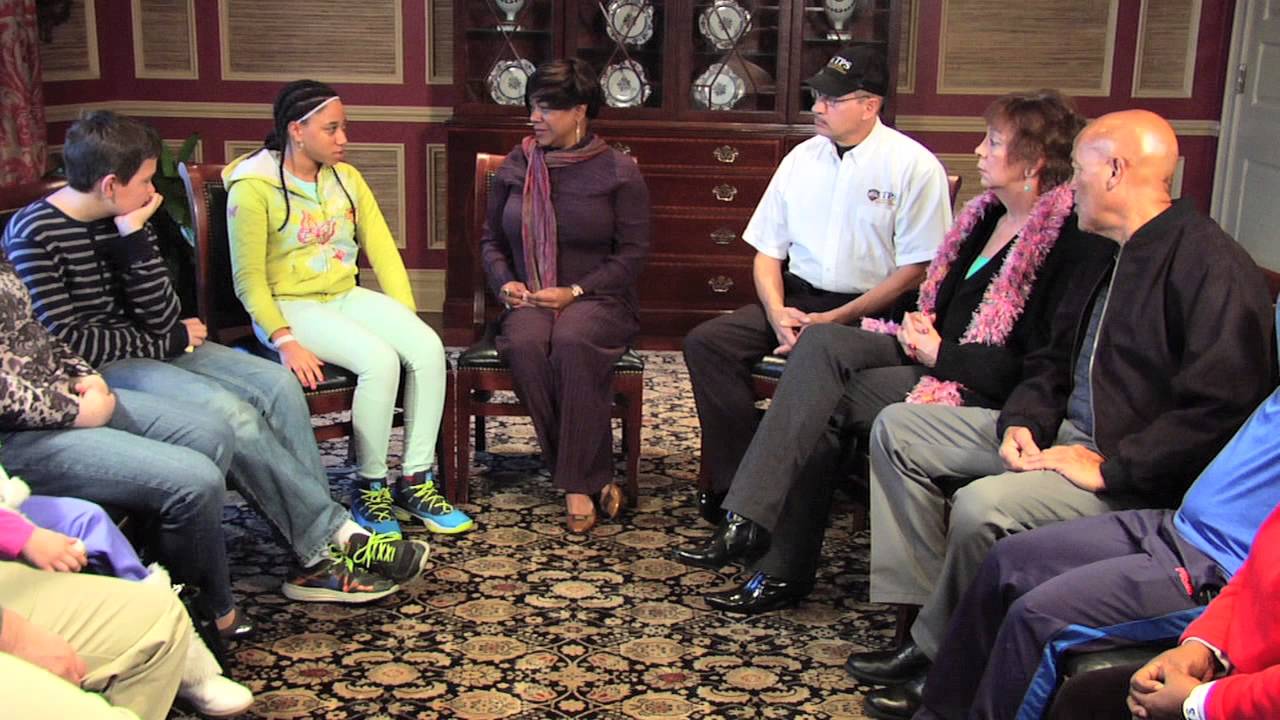
The video records a community forum hosted by Kim Brattain Media in which several participants (labeled Speakers A–E) discuss how to keep children safe at home, in public, and at school. The conversation moves through four main strands: (1) the importance of keeping children close to their parents and teaching them to stay together in public spaces; (2) personal experiences of bullying, the emotional impact on victims, and the observation that many school‑shooting perpetrators were previously bullied; (3) criticism of school disciplinary practices, with speakers arguing that punishments are too lenient and that a politically‑correct culture has weakened authority; (4) recommendations for prevention, including counseling for both bullies and victims, teaching children to trust their “sixth sense” and to report suspicious behavior to adults or authorities. The discussion ends with a call for continued dialogue in future meetings.
Chapters
So, welcome. Thank you guys for coming today. We are here to celebrate an opportunity to come together as family to talk about national security and safety, being personally safe at home and in school and in your surroundings. How do you keep kids from spreading out and getting away from their parents? Because they want to maneuver this way while the parents are going this way. Not actually— trying to keep them focused on sticking with the family.
Just to instill in the children the importance of staying with mom and dad and not letting them go off on their own. If they want to look at something over here at a toy store, Well, let's tell mom and dad about it, and then we'll all go look at it. You're gonna have to educate the kids at home and stuff of what the world is all about.
What are you experiencing? What are you? What are what are your concerns?
I think that they should stop bullying in my school. A group of girls and try to get the other girl like attack the other girls, and then. They just continue on bullying people.
How does that make you feel when that happens?
It makes me nervous a little bit, but at the same time, I'll go back and tell the teacher.
Have you been bullied? And how does that make you feel?
Um, mad.
Well, I think that the administration and the teachers' hands are pretty much tied right now. I don't, you know, they can reprimand the kids and stuff, you know, but that doesn't affect the children, you know, at any level from kindergarten through the 12th grade because the punishment is not severe enough.
These teachers are not doing nowhere near what they should be doing, you know, to the point where the whole system has become more like a politically correct system. It's not the way I grew up, you know. When I grew up, if you got in my face, 3 o'clock school bell. Over here, they'll suspend the whole lot of you.
This is a serious issue, and if you look back at the statistics of some of these school shootings, you will find that almost half of the perpetrators were bullied, and they had a bullying experience, and they were taking out instead of fighting back, instead of They held that in and they did not get counseling, which I think is necessary also for some of these children, the bullies and the people who are bullied and the children who are doing it. So they explode with a shotgun, for example.
And I got this thing with sixth sense protection. You know what I'm talking about when we say sixth sense. It's that thing you just feel and sense that something ain't right. You know, and kids need to be able to understand they have a sixth sense. And I think we have just, as parents and family members, have gotten away from teaching our kids. They're born with it. We all have it.
If you see something that looks out of place, it probably is. Call 911, tell a teacher, tell somebody what you've seen. If it's nothing, it's nothing. But it may be something bad getting ready to happen. So if more of us could do that, And we will have more on this discussion next month.