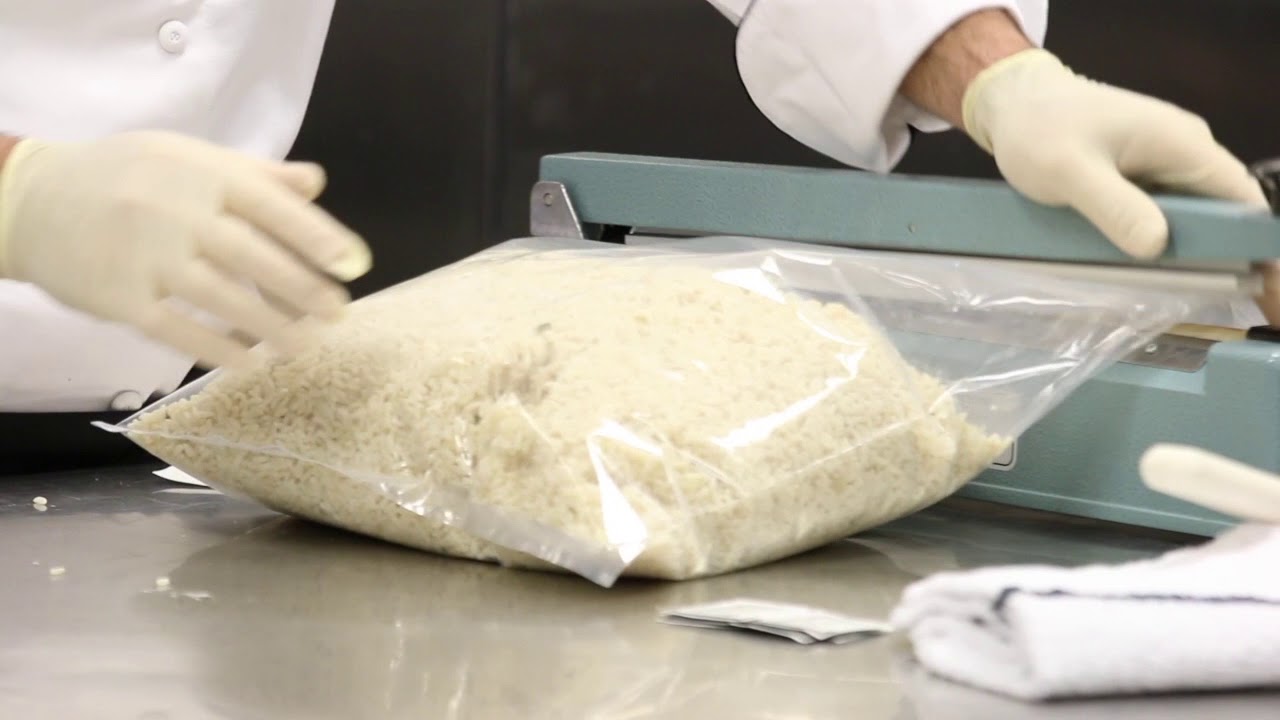
In this instructional video, Chef James Fox of Best Impressions Caterers walks through the Standard Operating Procedure (SOP) for preparing and packaging food donations for the Stew of Sustainability program. He begins by donning food‑handler gloves and shows a pre‑cooked, dated rice bag. The rice is placed on a ring holder, and its temperature is recorded, emphasizing that safe holding temperatures are 32–41 °F to inhibit bacterial growth; temperatures above 41 °F enter the danger zone. Using a scoop, the product is transferred into a bag, which is then sealed with an impulse sealer for five seconds. Fox fills out a food donation data sheet, noting product contents, allergens, production date, remaining usable days, and the bagging temperature. The bag receives a data‑plate sticker and a backing label that remains exposed for the receiving organization to write on after freezing. The bag is then stored in a freezer, giving the end user three days to use the product once frozen. Fox concludes with a call to adopt the program, highlighting its impact on reducing waste and feeding those in need. The SOP was originally developed by Dr. Ben Chapman and Katrina Levine of North Carolina State University and was taught to the catering team on‑site.
Chapters
Hi, I'm Chef James Fox with Best Impressions Caterers, and I'm here to demonstrate our food backing procedures for our Stew of Sustainability food donations. So the first thing I'm going to do is put on some food handler's gloves. So what I have here is some rice. It's labeled and dated. It was cooked on The 14th of January. So what I have here is one of our food donation bags, and this will be placed on this ring holder to stabilize the bag while it's being filled. So I'm going to record the temperature of the product that's going to be bagged. We want to make sure it's been held between 32 to 41 degrees. The point of temperature is we want to inhibit any growth of bacteria. So bacteria is inhibited between 32 and 41 degrees. When it's frozen, it's actually completely stopped. So once we get above 41 degrees, we'd be in what's considered the danger zone, and we want to make sure we don't serve any food that's been held in the danger zone. And I'm going to— to make this a quick task of this, I'm going to use this scoop, and it just simply goes inside the bag. This procedure, standing operating procedure, was developed by Dr. Ben Chapman and Katrina Levine of North Carolina State University, and we were trained by them here on our property. Once the food is placed in the bag, we take the bag off of the stand. The bag is then sealed using an impulse sealer, which is a very simple tool to use. The bag goes in there, we just close the lever for 5 seconds, and the bag is now sealed. So the next process, the next procedure, is to fill out the food donation data sheet where we're going to record what's in here, any allergens, the date, how many days are left to use the product, and the temperature when we bagged it. This, this product has been stored for 4 days, which is going to give the user 3 days to use this product. Essentially, we're stopping the clock once this goes into the freezer. So this will be very simple for them to see that they have 3 days to use it.
This, this product is going to be stored in a Data plate is now put on the bag.
It's just a sticker, and it's ready for the freezer. As simple as that. An important part of placing the label on the bag is to leave this bottom portion with the backing label still on it so the receiving organization can then write on the label properly. It's hard to write on something that's frozen. Bottom line is, working in this industry, we all have some food that's, that's usable for somebody else, and even if it's a small amount, Please take the time and adopt this program and save it and donate it because it's really for a great cause.
We get the privilege of seeing people's lives being transformed and they feel good about that. I know when I have a great meal, I feel good, and that happens at the Harvest Center every week. Because of the steward sustainability.