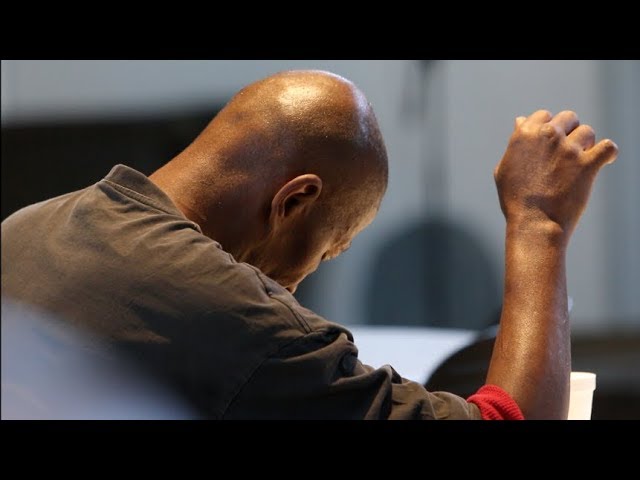
The video presents a series of first‑person testimonies from five speakers (A‑E) describing their journeys through homelessness, disability, chronic illness, addiction, and incarceration, and how the Harvest Center’s programs helped them regain stability. Speaker A shares living with cerebral palsy and a history of prenatal crack exposure, emphasizing the need to see people through a spiritual lens. Speaker B discusses ulcerative colitis, the financial strain of medical needs, and how the Center provided food, clothing, and a sense of dignity. Speaker C recounts repeated cycles of alcohol poisoning, jail, solitary confinement, and numerous detox attempts before finding lasting sobriety through Bible study, mentorship, and a supportive community. Speaker D highlights the gender‑specific challenges of finding housing for men, his experience of living in limbo, and his current work as an Amazon warehouse associate while in transitional housing. Speaker E introduces New Life Mentoring, describing mentors as trusted advisors who model possibilities rather than dictate lives. Across the testimonies, themes of faith, mentorship, vocational training, and the tangible impact of stable housing (e.g., having keys to an apartment) emerge, illustrating the Center’s role as a “hand up” rather than a handout.
Chapters
Here at the Harper Center, you get to work with people that are less fortunate. You get to, you get to touch lives. The reason why I'm in a wheelchair is that I have cerebral palsy. I was born a crack baby, addicted to crack. And when people look at me in the wheelchair, A lot of people don't want to give you opportunities because they look at your disability. But when you learn to look at people through the eyes of God and not through the eyes of humanity, you become more patient.
I have a medical condition. With ulcerative colitis, you could lose your employment having it because your bowel movements are pretty much uncontrolled. How would an employer understand that? Anyone can get an apartment, but to maintain it and all that's connected to it, there comes a time there's a little bump or hiccup in the road. When you face those hiccups, you start to incur debt. You're out on the streets. You don't sign up to be homeless.
So many times I got out there and I died from alcohol poisoning, wrecks, being with men that I shouldn't have been with. Who abused me. My whole life was based on fear. And so at jail, I didn't have any medication to take, so I was panicking really bad. So I kept calling them on the intercom, and they got tired of it, so they ended up putting me in solitary confinement with no clothes. I had nothing on, absolutely nothing. And I got down on my knees in the jail naked And just poured my heart out to God and got ready to die because I just knew I was going to die. I went to detox and I would mess up again. I went to detox about 20 times.
A family situation immediately put me in a homeless situation, and I was— so I was living in limbo for a while. Wintertime can be tough, especially for the men in Charlotte, Because it's a little bit tougher for the men to get housing than for women and children to get housing. Just moving around constantly. You know, dress as warm as I can and stuff like that.
Hey Belinda, I guess you think it's about time I wrote to you. I think of you every day about how much I love you. We've had some good times in the last years. I like to think about those days. It sounds like you're doing good with your job and being with the dogs. I know you love that. You couldn't get a better place, I don't think. And she's talking about here at the Harvest Center. I think she's right. I've been sober for 2 years, going on 2 years. Thank you, thank you. I never could do that before. It was always a couple months and that was it. So turning it to God, having Bible studies and structure, that's the only thing that made a difference for me.
I mean, who of us hasn't had to overcome some great challenge or difficulty? Fortunately for most of us, it doesn't cause us to be homeless. or left out in the cold. New Life Mentoring is a new part of the process for our Transformation participants.
Amen!
Our mentors will be trusted advisors and be able to walk alongside of our participants, answer questions, tell them how they made it, you know, not really tell them how to live, but help them see that it's possible to live your dreams and your best lives.
I felt like I had to— my back was up against the wall. I cried myself to sleep at night plenty of times. What the Harvest Center did for me, they fed me, they clothed me. It was a hand up and not a handout.
After being in ministry 20 years preaching to people, I actually could see my thumbprint on someone's life. The difference is you minister to people on Sundays, but here at the Harvest Center you actually I'm a certified nursing assistant.
I work with elderly and chronically ill people from all walks of life, from Alzheimer's, dementia, diabetic. I'm 15 people in one some days. I'm proud of my apartment. This is my home. I have keys. And having keys is stability to me.
Well, I'm a warehouse associate over at Amazon. Right now I'm living in transitional housing, and then eventually I will end up having my own place.
I work at the airport. I volunteer at the Humane Society. That's my passion. One of these days, that's what I hope to really do is work with animals. Now, I graduated from a homeless program at the Harvest Center, and they were amazing. They have really helped me on this I live over at Gabriel House, and it's one of their houses after you graduate, so I'm very thankful for that.
I ended up in the Harvest Center because someone cared for me, and, and they took time for me. They saw potential in me to, to be able to make something of my life and stuff like that.